INSTRUCTOR’S PROFILE
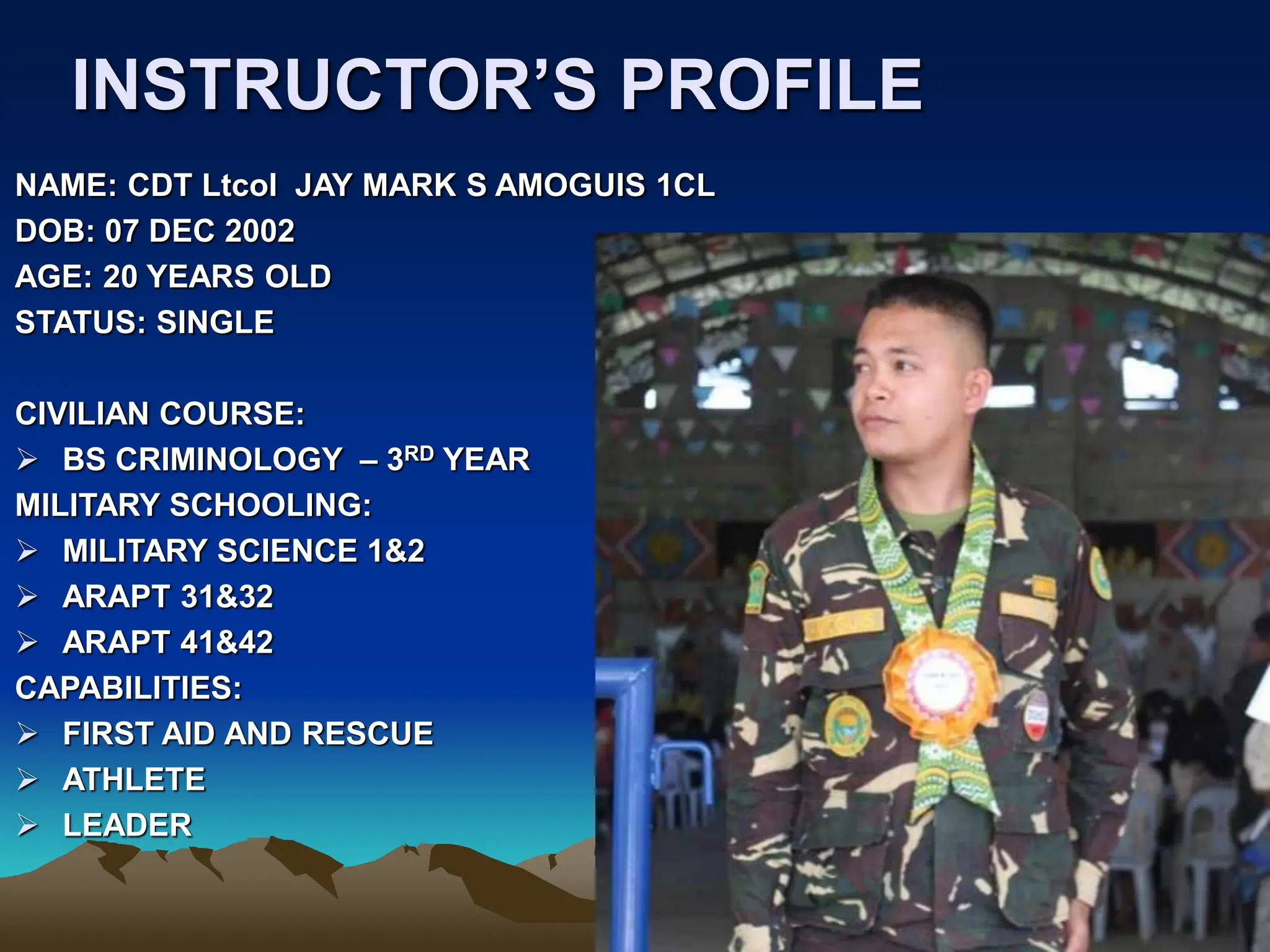
NAME: CDT Ltcol JAY MARK S AMOGUIS 1CL
DOB: 07 DEC 2002
AGE: 20 YEARS OLD
STATUS: SINGLE
CIVILIAN COURSE:
 BS CRIMINOLOGY – 3RD YEAR
MILITARY SCHOOLING:
 MILITARY SCIENCE 1&2
 ARAPT 31&32
 ARAPT 41&42
CAPABILITIES:
 FIRST AID AND RESCUE
 ATHLETE
 LEADER
OBJECTIVE
To develop in students the qualities
and skills expected in the military
leaders necessary in the discharge of
their leadership functions in order
to achieve the common goal for the
accomplishment of the unit mission.
SCOPE
• BACKGROUND
• DEFINITION OF TERMS
• FOUNDATION OF ARMY LEADERSHIP
• FACTORS OF LEADERSHIP
• PRINCIPLES OF LEADERSHIP
• PRE-REQUISITES OF LEADERSHIP
• LEADERSHIP TRAITS
• LEADERSHIP INDICATORS
• ROLES OF A LEADER
• BASIC RESPONSIBILITIES OF A LEADER
POLITICAL LEADERS
MILITARY LEADERS
is the authority of the person in the
Military service lawfully exercise over
subordinates by virtue of his Rank and
position.
Is the process of planning, organizing,
coordinating, directing and controlling
resources such as men, money, material and
machinery to accomplish the oganization
mission.
•Is the ability to influence others
directing them toward s the
accomplishment of a mission
personal qualities essential for a
Commander in gaining obedience, trust,
respect and cooperation of his men in
accomplishing a mission.
Fundamental guidelines for the selection of
appropriate action and orders in the
exercise of the Command.
14 LEADERSHIP TRAITS
Bearing – is the general appearance, carriage,
deportment and conduct of a leader.
Courage - Is a mental quality that recognizes
fear of danger or criticism, but enables him to
face it with calmness and firmness.
Decisiveness- A positive approach, little waste
of time, objectively, timely analysis and sound
evaluation of opinions made by others all
contribute to the development of decisiveness.
Dependability- The certainty proper performance of
duty, is a quality the leader must develop. A
dependable leader can be relied upon to carry out any
activity with willing effort.
Endurance- The mental and physical stamina
measured by the ability to withstand pain fatigue,
stress and hardship is a kin to courage.
Enthusiasm- Is the display of sincere interest and
zeal in the performance of duties. This requires the
leader to be optimistic and cheerful.
14 LEADERSHIP TRAITS cont’d.
Initiative - Initiative or taking action in the
absence of orders, is often required of leaders.
 Integrity - The uprightness and soundness of
moral principle, the quality of truthfulness and
honesty describe integrity.
Judgment – Is the ability to logically weigh
facts and possible solution on which to be sound
decisions.
Justice - Giving everyone his due, being
equitable, impartial and consistent in the
bestowing awards and punishment.
14 LEADERSHIP TRAITS cont’d.
Knowledge - Acquired the information including
knowledge of the job and the knowledge of the men.
Knowledge is power, nothing will attract confidence
and respect more quickly and more demonstrated.
Knowledge is the ability to create self confidence
within the leader himself.
Loyalty - Is the quality of faithfulness to country,
the Army seniors, subordinates and peers. The
confidence and respect that can be gained from
superior and subordinate is immeasurable.
14 LEADERSHIP TRAITS cont’d.
Tack - is the ability to deal with others in a
respectful manner. The leader who displays tact
in dealing with superior and subordinates
encourages courteous treatment in return.
Unselfishness - The unselfish leader is one who
avoids providing his own comfort and personal
advancement at the expense of others.
The principles of leadership guide
leaders. This guidance is not new. It is
based on a common sense approach to
accomplishing the mission. If the leader
understand the Principles and recognize
the necessity for a working knowledge
of human behavior in order to apply this
principle, he will have the basic tools to
be an effective leader.
•Know yourself and Seek Self-Improvement-
Honesty self evaluation to
determine his own strengths and
weaknesses is of paramount
importance to a leader. Through
this process he can determine his
capabilities and limitations.
•Be Technically and Tactically Proficient-
A leader must demonstrate to
his men that he is qualified to lead
his unit. He must be competent in
combat operations and training as
well as in the technical and
administrative aspect of his duties.
•Seek Responsibility and Take Responsibility for
your Action-
Armed with the knowledge gained
from honest self evaluation and with
the sound technical and tactical
foundation required to perform his job,
the leader must take initiative to
accomplish his units’ mission. By
seeking responsibility, he develop
himself, professionally and increases his
leadership ability.
•Make Sound and Timely Decisions-
The leader must be able to make
rapid estimate of the situation and
arrive at a sound decision. He must
be able to reason under the most
trying conditions and decide
quickly what action is necessary to
take advantage of opportunity as it
occur.
•Set the Example-
A leader must be a good example
for his men in integrity, courage,
administrative knowledge,
professional competence, personal
appearance and personal conduct.
Moreover, he must set the personal
and professional standard of his
performance.
•Know your Men and Look Out for their
Welfare-
Of equal importance to understanding
himself is the requirement for the leader to
know and understand his men. It is not
enough just to know your names, marital
status, hometown and other such data. The
leader must understand what makes his
men tick-their values, ideas, and attitude.
•Keep your Men Informed-
This will encourage initiative,
improve teamwork enhance morale. In
the past, soldiers did not expect to be
told why they were required to perform
task. They expected the fact that their
leader and they performed as required.
By keeping them informed, you will
reduce fears and rumors.
•Develop a Sense of Responsibility
in your Subordinates-
Another way to show your men that you
are interested in their welfare is to give
them the opportunity for professional
development. Delegation of authority
commensurate with responsibility develops
mutual confidence and respect between the
leader and his subordinates.
•Insure that the Task is Understood,
Supervised and Accomplished-
Your men must know what is expected
of them and must be informed or specific
task requirements through clear, concise
orders. Be sure that you are understood by
communicating with your subordinates.
Men respond quickly to orders which are
clear and concise. Do not overtake and
order by giving too many details.
•Employ Your Unit in Accordance With its
Capabilities-
Good training prepares a unit for its job.
The leader must know what his unit is
trained to do, as well as its capabilities. He
must employ the unit within its
capabilities. Men get satisfaction from
performing task which are reasonable but
challenging, but become dissatisfied if they
are given task which they consider too easy
or too difficult to accomplish.
•Train your men as a team–
Issuing clear, concise orders and checking on
their execution is only part of being a successful
leader. Your men must be well trained if they
are to accomplish any mission. It is the leader’s
duty to train the members of his unit so they
will be tactically and technically proficient and
so that they work as a team. Teamwork is a key
to mission accomplishment. It starts in the
smallest unit and carries through to the largest
organization.
There are three (3) elements that a young soldier
should possess at the start of his service.
•Character. To be a leader, a person must be of good moral
character. Some indication of good moral character are
honesty, good manners, industrious, self-control and
bravery.
•Intelligence. Intelligence is the ability to grasp knowledge
easily. Its includes native ability and good common sense
and judgment.
•Alertness. Alertness could be both mental and physical.
Mental alertness means watchfulness, vigilance, and being
observant of the things around him. Physical alertness on
the other hand refers to bodily movements which should be
fast, nimble and agile with stealth.
Morale
Esprit de Corps
Discipline
Proficiency
Morale
 Is the state of mind of an individual. It depends on his
attitude toward everything that effects him his fellow
soldier, his leaders and army life in general morale is
closely related to satisfying man’s needs.
Esprit de Corps
 Is the loyalty to pride in, and enthusiasm for the unit as
shown by its members. Esprit the Corps is the unit spirit. It
is the common spirit reflected by all members of a unit and
provides group solidarity.
Discipline
Is the attitude that insures prompt obedience to
order and the initiatives of appropriate action and
the absence of order.
Proficiency
Is the technical, tactical, and physical ability to do
the job well. Unit proficiency is the sum of the skills
of all men in the unit welded together by the leader
into smooth functioning team.
As a model soldier
As an Instructor
As a Personnel Manager
As a Commander and Supervisor
As the Custodian of his men’s Welfare
As a Counselor
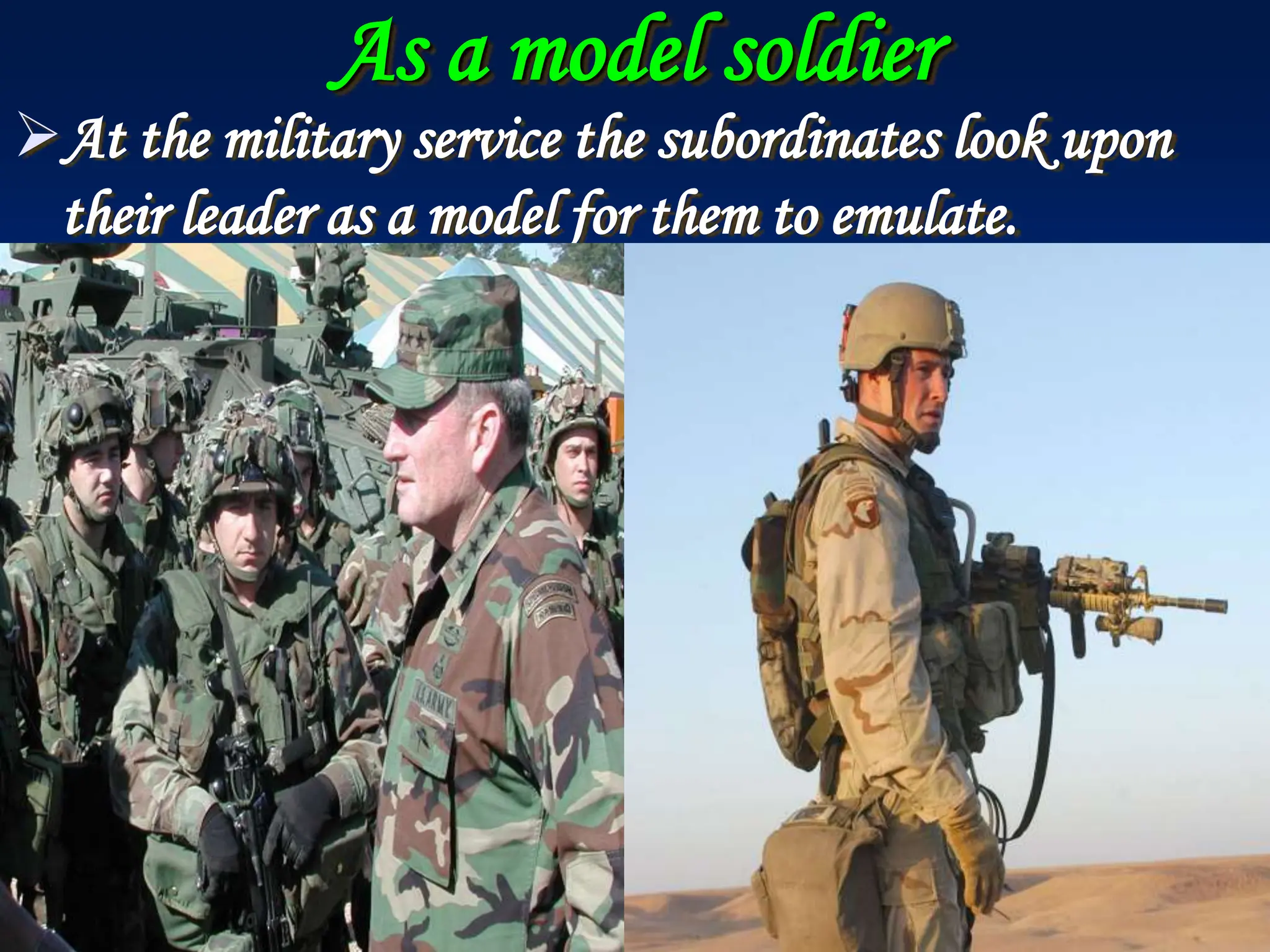
As a model soldier
At the military service the subordinates look upon
their leader as a model for them to emulate.
As an Instructor
Since in all military activities, particularly combat is
the main objective or goals of military training of his
men.
As a Personnel Manager
As a leader of his unit, the commander is in charged
of planning, organizing, directing and supervising
all personnel in his unit, in a manner as to ensure
the maximum efficient utilization of manpower.
As a Commander and Supervisor
In this role, the leader must be proficient
troop leader. As a commander his primary
functions is to receive orders and then make
an estimate of the situation, formulate
plans, issue orders and supervise the
compliance/ execution of his orders. 1%
direction and 99% supervision.
As the Custodian of his men’s Welfare
The leader must concerned with is men’s needs that
are essential to their comfort and well being such as
adequate supplies, good quarters, recreation facilities,
sanitation, etc.
As a Counselor
A leader must know how to deal with his men
and at times gives personal advice and
encouragement to his men.
Basic Responsibilities of a
Commander
•Accomplishment of the Mission.
•Welfare of the men.
SUMMARY
• BACKGROUND
• DEFINITION OF TERMS
• FOUNDATION OF ARMY LEADERSHIP
• FACTORS OF LEADERSHIP
• PRINCIPLES OF LEADERSHIP
• PRE-REQUISITES OF LEADERSHIP
• LEADERSHIP TRAITS
• LEADERSHIP INDICATORS
• ROLES OF A LEADER
• BASIC RESPONSIBILITIES OF A LEADER
Military-leadership.-ROTC,. PPT., College

Military-leadership.-ROTC,. PPT., College

  • 2.
    INSTRUCTOR’S PROFILE NAME: CDTLtcol JAY MARK S AMOGUIS 1CL DOB: 07 DEC 2002 AGE: 20 YEARS OLD STATUS: SINGLE CIVILIAN COURSE:  BS CRIMINOLOGY – 3RD YEAR MILITARY SCHOOLING:  MILITARY SCIENCE 1&2  ARAPT 31&32  ARAPT 41&42 CAPABILITIES:  FIRST AID AND RESCUE  ATHLETE  LEADER
  • 3.
    OBJECTIVE To develop instudents the qualities and skills expected in the military leaders necessary in the discharge of their leadership functions in order to achieve the common goal for the accomplishment of the unit mission.
  • 4.
    SCOPE • BACKGROUND • DEFINITIONOF TERMS • FOUNDATION OF ARMY LEADERSHIP • FACTORS OF LEADERSHIP • PRINCIPLES OF LEADERSHIP • PRE-REQUISITES OF LEADERSHIP • LEADERSHIP TRAITS • LEADERSHIP INDICATORS • ROLES OF A LEADER • BASIC RESPONSIBILITIES OF A LEADER
  • 6.
  • 7.
  • 9.
    is the authorityof the person in the Military service lawfully exercise over subordinates by virtue of his Rank and position.
  • 10.
    Is the processof planning, organizing, coordinating, directing and controlling resources such as men, money, material and machinery to accomplish the oganization mission.
  • 11.
    •Is the abilityto influence others directing them toward s the accomplishment of a mission
  • 12.
    personal qualities essentialfor a Commander in gaining obedience, trust, respect and cooperation of his men in accomplishing a mission.
  • 13.
    Fundamental guidelines forthe selection of appropriate action and orders in the exercise of the Command.
  • 15.
    14 LEADERSHIP TRAITS Bearing– is the general appearance, carriage, deportment and conduct of a leader. Courage - Is a mental quality that recognizes fear of danger or criticism, but enables him to face it with calmness and firmness. Decisiveness- A positive approach, little waste of time, objectively, timely analysis and sound evaluation of opinions made by others all contribute to the development of decisiveness.
  • 16.
    Dependability- The certaintyproper performance of duty, is a quality the leader must develop. A dependable leader can be relied upon to carry out any activity with willing effort. Endurance- The mental and physical stamina measured by the ability to withstand pain fatigue, stress and hardship is a kin to courage. Enthusiasm- Is the display of sincere interest and zeal in the performance of duties. This requires the leader to be optimistic and cheerful. 14 LEADERSHIP TRAITS cont’d.
  • 17.
    Initiative - Initiativeor taking action in the absence of orders, is often required of leaders.  Integrity - The uprightness and soundness of moral principle, the quality of truthfulness and honesty describe integrity. Judgment – Is the ability to logically weigh facts and possible solution on which to be sound decisions. Justice - Giving everyone his due, being equitable, impartial and consistent in the bestowing awards and punishment. 14 LEADERSHIP TRAITS cont’d.
  • 18.
    Knowledge - Acquiredthe information including knowledge of the job and the knowledge of the men. Knowledge is power, nothing will attract confidence and respect more quickly and more demonstrated. Knowledge is the ability to create self confidence within the leader himself. Loyalty - Is the quality of faithfulness to country, the Army seniors, subordinates and peers. The confidence and respect that can be gained from superior and subordinate is immeasurable. 14 LEADERSHIP TRAITS cont’d.
  • 19.
    14 LEADERSHIP TRAITScont’d. Tack - is the ability to deal with others in a respectful manner. The leader who displays tact in dealing with superior and subordinates encourages courteous treatment in return. Unselfishness - The unselfish leader is one who avoids providing his own comfort and personal advancement at the expense of others.
  • 21.
    The principles ofleadership guide leaders. This guidance is not new. It is based on a common sense approach to accomplishing the mission. If the leader understand the Principles and recognize the necessity for a working knowledge of human behavior in order to apply this principle, he will have the basic tools to be an effective leader.
  • 22.
    •Know yourself andSeek Self-Improvement- Honesty self evaluation to determine his own strengths and weaknesses is of paramount importance to a leader. Through this process he can determine his capabilities and limitations.
  • 23.
    •Be Technically andTactically Proficient- A leader must demonstrate to his men that he is qualified to lead his unit. He must be competent in combat operations and training as well as in the technical and administrative aspect of his duties.
  • 24.
    •Seek Responsibility andTake Responsibility for your Action- Armed with the knowledge gained from honest self evaluation and with the sound technical and tactical foundation required to perform his job, the leader must take initiative to accomplish his units’ mission. By seeking responsibility, he develop himself, professionally and increases his leadership ability.
  • 25.
    •Make Sound andTimely Decisions- The leader must be able to make rapid estimate of the situation and arrive at a sound decision. He must be able to reason under the most trying conditions and decide quickly what action is necessary to take advantage of opportunity as it occur.
  • 26.
    •Set the Example- Aleader must be a good example for his men in integrity, courage, administrative knowledge, professional competence, personal appearance and personal conduct. Moreover, he must set the personal and professional standard of his performance.
  • 27.
    •Know your Menand Look Out for their Welfare- Of equal importance to understanding himself is the requirement for the leader to know and understand his men. It is not enough just to know your names, marital status, hometown and other such data. The leader must understand what makes his men tick-their values, ideas, and attitude.
  • 28.
    •Keep your MenInformed- This will encourage initiative, improve teamwork enhance morale. In the past, soldiers did not expect to be told why they were required to perform task. They expected the fact that their leader and they performed as required. By keeping them informed, you will reduce fears and rumors.
  • 29.
    •Develop a Senseof Responsibility in your Subordinates- Another way to show your men that you are interested in their welfare is to give them the opportunity for professional development. Delegation of authority commensurate with responsibility develops mutual confidence and respect between the leader and his subordinates.
  • 30.
    •Insure that theTask is Understood, Supervised and Accomplished- Your men must know what is expected of them and must be informed or specific task requirements through clear, concise orders. Be sure that you are understood by communicating with your subordinates. Men respond quickly to orders which are clear and concise. Do not overtake and order by giving too many details.
  • 31.
    •Employ Your Unitin Accordance With its Capabilities- Good training prepares a unit for its job. The leader must know what his unit is trained to do, as well as its capabilities. He must employ the unit within its capabilities. Men get satisfaction from performing task which are reasonable but challenging, but become dissatisfied if they are given task which they consider too easy or too difficult to accomplish.
  • 32.
    •Train your menas a team– Issuing clear, concise orders and checking on their execution is only part of being a successful leader. Your men must be well trained if they are to accomplish any mission. It is the leader’s duty to train the members of his unit so they will be tactically and technically proficient and so that they work as a team. Teamwork is a key to mission accomplishment. It starts in the smallest unit and carries through to the largest organization.
  • 34.
    There are three(3) elements that a young soldier should possess at the start of his service. •Character. To be a leader, a person must be of good moral character. Some indication of good moral character are honesty, good manners, industrious, self-control and bravery. •Intelligence. Intelligence is the ability to grasp knowledge easily. Its includes native ability and good common sense and judgment. •Alertness. Alertness could be both mental and physical. Mental alertness means watchfulness, vigilance, and being observant of the things around him. Physical alertness on the other hand refers to bodily movements which should be fast, nimble and agile with stealth.
  • 36.
  • 37.
    Morale  Is thestate of mind of an individual. It depends on his attitude toward everything that effects him his fellow soldier, his leaders and army life in general morale is closely related to satisfying man’s needs.
  • 38.
    Esprit de Corps Is the loyalty to pride in, and enthusiasm for the unit as shown by its members. Esprit the Corps is the unit spirit. It is the common spirit reflected by all members of a unit and provides group solidarity.
  • 39.
    Discipline Is the attitudethat insures prompt obedience to order and the initiatives of appropriate action and the absence of order.
  • 40.
    Proficiency Is the technical,tactical, and physical ability to do the job well. Unit proficiency is the sum of the skills of all men in the unit welded together by the leader into smooth functioning team.
  • 42.
    As a modelsoldier As an Instructor As a Personnel Manager As a Commander and Supervisor As the Custodian of his men’s Welfare As a Counselor
  • 43.
    As a modelsoldier At the military service the subordinates look upon their leader as a model for them to emulate.
  • 44.
    As an Instructor Sincein all military activities, particularly combat is the main objective or goals of military training of his men.
  • 45.
    As a PersonnelManager As a leader of his unit, the commander is in charged of planning, organizing, directing and supervising all personnel in his unit, in a manner as to ensure the maximum efficient utilization of manpower.
  • 46.
    As a Commanderand Supervisor In this role, the leader must be proficient troop leader. As a commander his primary functions is to receive orders and then make an estimate of the situation, formulate plans, issue orders and supervise the compliance/ execution of his orders. 1% direction and 99% supervision.
  • 47.
    As the Custodianof his men’s Welfare The leader must concerned with is men’s needs that are essential to their comfort and well being such as adequate supplies, good quarters, recreation facilities, sanitation, etc.
  • 48.
    As a Counselor Aleader must know how to deal with his men and at times gives personal advice and encouragement to his men.
  • 49.
    Basic Responsibilities ofa Commander •Accomplishment of the Mission. •Welfare of the men.
  • 50.
    SUMMARY • BACKGROUND • DEFINITIONOF TERMS • FOUNDATION OF ARMY LEADERSHIP • FACTORS OF LEADERSHIP • PRINCIPLES OF LEADERSHIP • PRE-REQUISITES OF LEADERSHIP • LEADERSHIP TRAITS • LEADERSHIP INDICATORS • ROLES OF A LEADER • BASIC RESPONSIBILITIES OF A LEADER