Future of AI
#OpenTechAI
Jim Spohrer
Director, IBM Cognitive OpenTech
Find my presentations on line at:
http://slideshare.net/spohrer
Narrow AI
Emerging
Broad AI
Disruptive and
Pervasive
General AI
Revolutionary
▼ We are here 2050 and beyond 2IBM Research AI © 2018 IBM Corporation
The evolution of AI
Borrowed from David Cox, IBM-MIT Lead
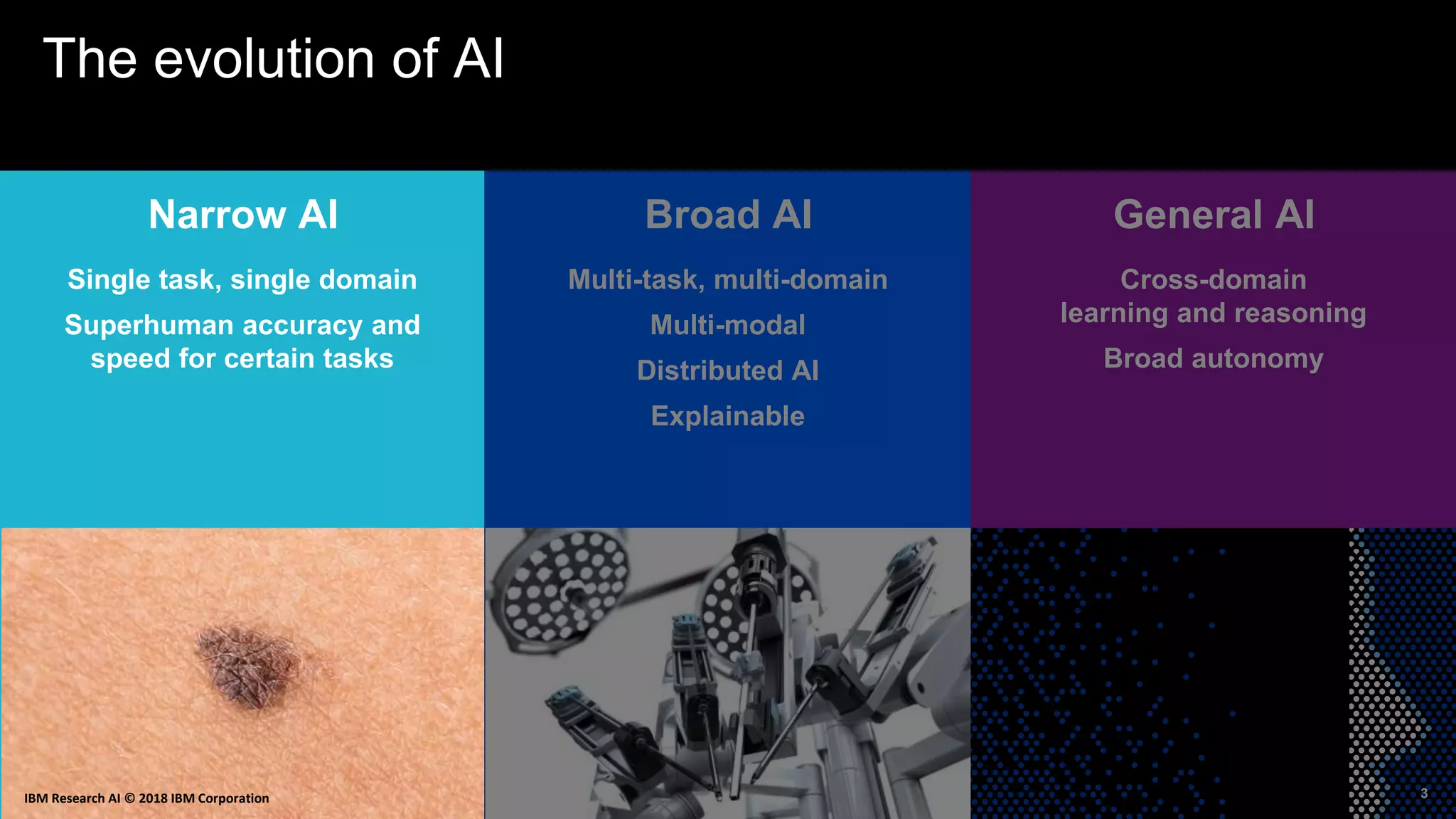
Narrow AI
Single task, single domain
Superhuman accuracy and
speed for certain tasks
Broad AI
Multi-task, multi-domain
Multi-modal
Distributed AI
Explainable
General AI
Cross-domain
learning and reasoning
Broad autonomy
3IBM Research AI © 2018 IBM Corporation
The evolution of AI
Karpathy and Li, 2015
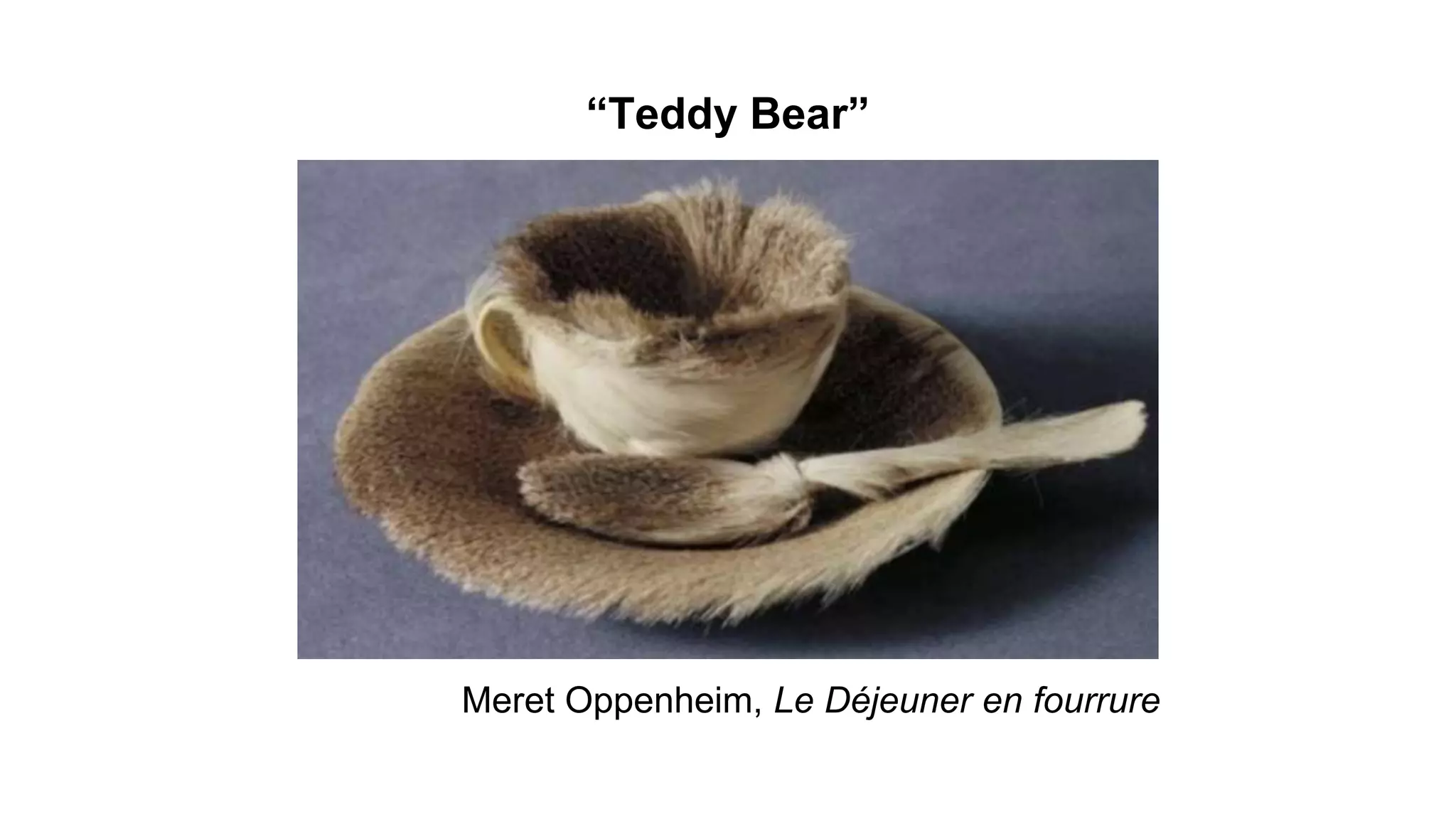
“Teddy Bear”
Meret Oppenheim, Le Déjeuner en fourrure
The path to Broad AI
Explainability Security
+
Ethics
restaurant
cook
Follow
recipe
person
sweet
cheesecake
dessert
satisfy
hunger
oven
bake
survive
swallow
eat
cake
Learn more from small data
ReasonsLearns to transfer
+
Infrastructure
Physics of AI
IBM-MIT $240M
over 10 year AI mission
5/29/2019 (c) IBM 2017, Cognitive Opentech Group 7
Cognitive OpenTech & CODAIT / Future of AI / March 23, 2018 / © 2019 IBM Corporation 8
Linus Torvalds & Todd Moore
5/29/2019 IBM Code #OpenTechAI 9
Timeline: Every 20 years,
compute costs are down by 1000x
• Cost of Digital Workers
• Moore’s Law can be thought of as
lowering costs by a factor of a…
• Thousand times lower
in 20 years
• Million times lower
in 40 years
• Billion times lower
in 60 years
• Smarter Tools (Terascale)
• Terascale (2017) = $3K
• Terascale (2020) = ~$1K
• Narrow Worker (Petascale)
• Recognition (Fast)
• Petascale (2040) = ~$1K
• Broad Worker (Exascale)
• Reasoning (Slow)
• Exascale (2060) = ~$1K
105/29/2019 (c) IBM 2017, Cognitive Opentech Group
2080204020001960
$1K
$1M
$1B
$1T
206020201980
+/- 10 years
$1
Person Average
Annual Salary
(Living Income)
Super Computer
Cost
Mainframe Cost
Smartphone Cost
T
P
E
T P E
AI Progress on Open Leaderboards
Benchmark Roadmap to solve AI/IA
Timeline: Leaderboards FrameworkAI Progress on Open Leaderboards - Benchmark Roadmap
Perceive World Develop Cognition Build Relationships Fill Roles
Pattern
recognition
Video
understanding
Memory Reasoning Social
interactions
Fluent
conversation
Assistant &
Collaborator
Coach &
Mediator
Speech Actions Declarative Deduction Scripts Speech Acts Tasks Institutions
Chime Thumos SQuAD SAT ROC Story ConvAI
Images Context Episodic Induction Plans Intentions Summarization Values
ImageNet VQA DSTC RALI General-AI
Translation Narration Dynamic Abductive Goals Cultures Debate Negotiation
WMT DeepVideo Alexa Prize ICCMA AT
Learning from Labeled Training Data and Searching (Optimization)
Learning by Watching and Reading (Education)
Learning by Doing and being Responsible (Exploration)
2018 2021 2024 2027 2030 2033 2036 2039
5/29/2019 (c) IBM 2017, Cognitive Opentech Group 11
Which experts would be really surprised if it takes less time… and which experts really surprised if it takes longer?
Approx.
Year
Human
Level ->
+3
Join: Registrations Open 2019-03-25 - https://callforcode.org/
12IBM Open Technologies / Future of AI / April 19, 2019 / © 2019 IBM Corporation
This multi-year global initiative rallies developers to create practical, effective, and high-quality applications based on cloud, data, and artificial
intelligence that can have an immediate and lasting impact on humanitarian issues. Call for Code brings startup, academic, and enterprise developers
together and inspires them to solve the most pressing societal issues of our time - for example, faster and more resilient recovery from natural disasters.
5/29/2019 (c) IBM MAP COG .| 13
5/29/2019 (c) IBM MAP COG .| 14
Timeline: Short History
5/29/2019
© IBM Cognitive Opentech Group (COG)
15
Dota 2
“Deep Learning” for
“AI Pattern Recognition”
depends on massive
amounts of “labeled data”
and computing power
available since ~2012;
Labeled data is simply
input and output pairs,
such as a sound and word,
or image and word, or
English sentence and French
sentence, or road scene
and car control settings –
labeled data means having
both input and output data
in massive quantities.
For example, 100K images
of skin, half with skin
cancer and half without to
learn to recognize presence
of skin cancer.
5/29/2019 IBM Code #OpenTechAI 16
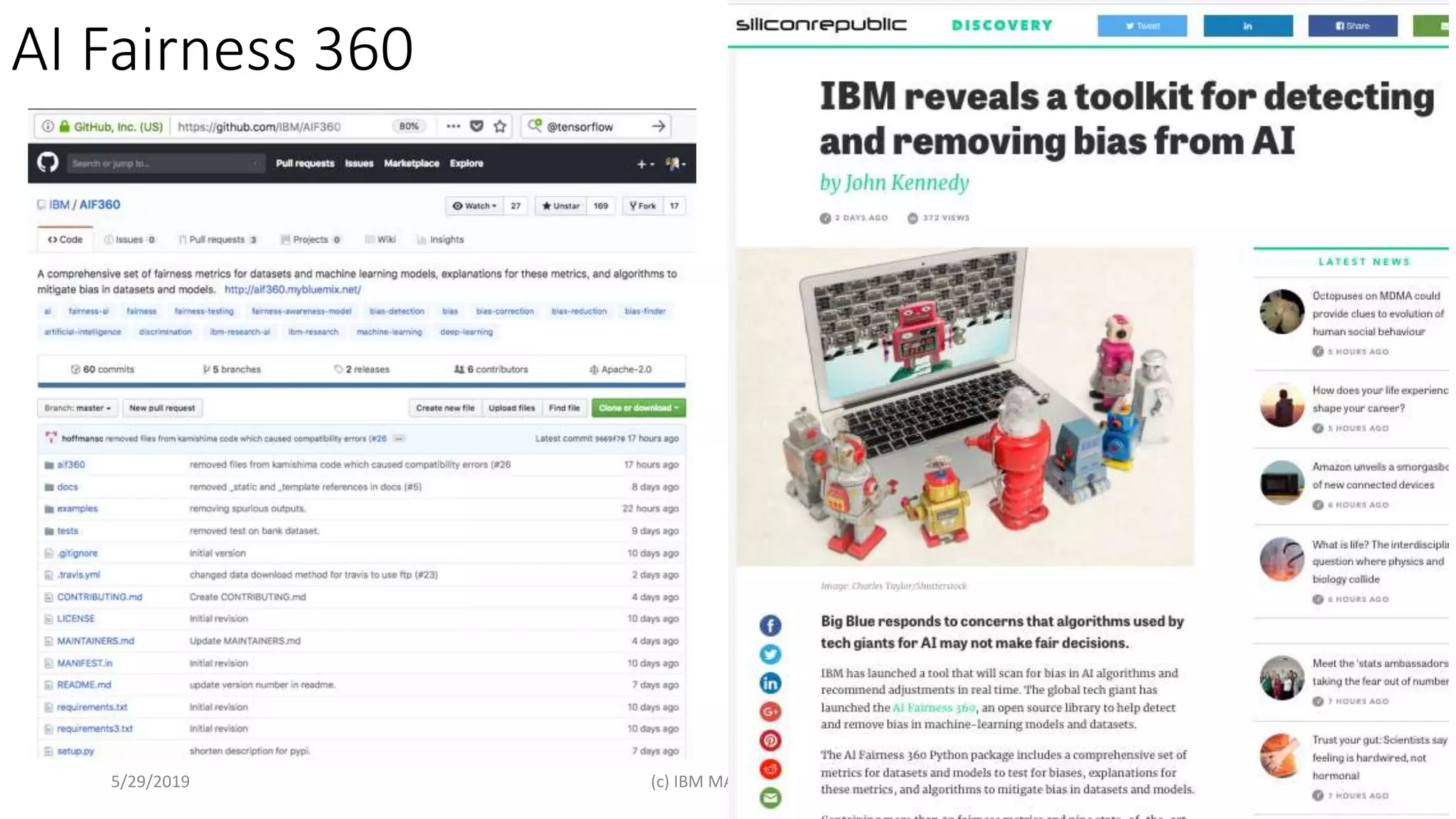
AI Fairness 360
5/29/2019 (c) IBM MAP COG .| 17
18September 2018 / © 2018 IBM Corporation
5/29/2019
© IBM 2015, IBM Upward University Programs Worldwide
accelerating regional development
19
5/29/2019 (c) IBM MAP COG .| 20
Microsoft acquiring GitHub $7.5B
2018 John Marks on Open Source
Models will run the world
Why SW is eating the world
5/29/2019
© IBM 2015, IBM Upward University Programs Worldwide
accelerating regional development
21
Cognitive Mediators
for all people in all roles
Occupations = Many Tasks
5/29/2019
© IBM 2015, IBM Upward University Programs Worldwide
accelerating regional development
22
Watson Discovery Advisor
5/29/2019
© IBM 2015, IBM Upward University Programs Worldwide
accelerating regional development
23
Simonite, T. 2014. Software Mines Science Papers to Make New Discoveries. MIT. November 25, 2014.
URL: http://m.technologyreview.com/news/520461/software-mines-science-papers-to-make-new-discoveries/
Types: Progression of models
Models = instruction set of future
5/29/2019 Understanding Cognitive Systems 24
Task & World Model/
Planning & Decisions
Self Model/
Capacity & Limits
User Model/
Episodic Memory
Institutions Model/
Trust & Social Acts
Tool + - - -
Assistant ++ + - -
Collaborator +++ ++ + -
Coach ++++ +++ ++ +
Mediator +++++ ++++ +++ ++
Cognitive
Tool
Cognitive
Assistant
Cognitive
Collaborator
Cognitive
Coach
Cognitive
Mediator
“The best way to predict the future is to inspire the
next generation of students to build it better”
Digital Natives Transportation Water Manufacturing
Energy Construction ICT Retail
Finance Healthcare Education Government
5/29/2019 26
1955 1975 1995 2015 2035 2055
Better Building Blocks
Trust: Two Communities
5/29/2019 IBM Code #OpenTechAI 27
Service
Science
OpenTech
AI
Trust:
Value Co-Creation,
Transdisciplinary
Trust:
Ethical, Safe, Explainable,
Open Communities
Special Issue
AI Magazine?
Handbook of
OpenTech AI?
Resilience:
Rapidly Rebuilding From Scratch
• Dartnell L (2012) The Knowledge: How to
Rebuild Civilization in the Aftermath of a
Cataclysm. Westminster London: Penguin
Books.
5/29/2019 IBM Code #OpenTechAI 28
Cognitive OpenTech & CODAIT / Future of AI / March 23, 2018 / © 2019 IBM Corporation 29
Call for papers: Advances in Cognitive Systems, Aug 2-5,
MIT, Cambridge, MA
http://www.cogsys.org/conference/2019/ … submission
deadline: May 10th. @neurobongo
https://twitter.com/JimSpohrer/status/1118180598583
947269
Cognitive OpenTech
Cognitive OpenTech & CODAIT / Future of AI / March 23, 2018 / © 2019 IBM Corporation 30
Director, Jim Spohrer CODAIT (Center for
Opensource Data and AI
Technologies)
- Vijay Bommireddipalli
AI OpenTech &
Systems Performance
- Tom Truong
Watson Developer
Advocates
- Josh Cheng
Susan Malaika
(STSM)
Augustina Ragwitz
Open AI Advocato,
Computational Anthropology IBM Silicon Alley, NYC, NYIBM Silicon Valley, San Jose, CAIBM Watson West,
San Francisco, CA
IBM Almaden,
San Jose, CA

Milano short 20190529 v1

  • 1.
    Future of AI #OpenTechAI JimSpohrer Director, IBM Cognitive OpenTech Find my presentations on line at: http://slideshare.net/spohrer
  • 2.
    Narrow AI Emerging Broad AI Disruptiveand Pervasive General AI Revolutionary ▼ We are here 2050 and beyond 2IBM Research AI © 2018 IBM Corporation The evolution of AI Borrowed from David Cox, IBM-MIT Lead
  • 3.
    Narrow AI Single task,single domain Superhuman accuracy and speed for certain tasks Broad AI Multi-task, multi-domain Multi-modal Distributed AI Explainable General AI Cross-domain learning and reasoning Broad autonomy 3IBM Research AI © 2018 IBM Corporation The evolution of AI
  • 4.
  • 5.
    “Teddy Bear” Meret Oppenheim,Le Déjeuner en fourrure
  • 6.
    The path toBroad AI Explainability Security + Ethics restaurant cook Follow recipe person sweet cheesecake dessert satisfy hunger oven bake survive swallow eat cake Learn more from small data ReasonsLearns to transfer + Infrastructure Physics of AI
  • 7.
    IBM-MIT $240M over 10year AI mission 5/29/2019 (c) IBM 2017, Cognitive Opentech Group 7
  • 8.
    Cognitive OpenTech &CODAIT / Future of AI / March 23, 2018 / © 2019 IBM Corporation 8 Linus Torvalds & Todd Moore
  • 9.
    5/29/2019 IBM Code#OpenTechAI 9
  • 10.
    Timeline: Every 20years, compute costs are down by 1000x • Cost of Digital Workers • Moore’s Law can be thought of as lowering costs by a factor of a… • Thousand times lower in 20 years • Million times lower in 40 years • Billion times lower in 60 years • Smarter Tools (Terascale) • Terascale (2017) = $3K • Terascale (2020) = ~$1K • Narrow Worker (Petascale) • Recognition (Fast) • Petascale (2040) = ~$1K • Broad Worker (Exascale) • Reasoning (Slow) • Exascale (2060) = ~$1K 105/29/2019 (c) IBM 2017, Cognitive Opentech Group 2080204020001960 $1K $1M $1B $1T 206020201980 +/- 10 years $1 Person Average Annual Salary (Living Income) Super Computer Cost Mainframe Cost Smartphone Cost T P E T P E AI Progress on Open Leaderboards Benchmark Roadmap to solve AI/IA
  • 11.
    Timeline: Leaderboards FrameworkAIProgress on Open Leaderboards - Benchmark Roadmap Perceive World Develop Cognition Build Relationships Fill Roles Pattern recognition Video understanding Memory Reasoning Social interactions Fluent conversation Assistant & Collaborator Coach & Mediator Speech Actions Declarative Deduction Scripts Speech Acts Tasks Institutions Chime Thumos SQuAD SAT ROC Story ConvAI Images Context Episodic Induction Plans Intentions Summarization Values ImageNet VQA DSTC RALI General-AI Translation Narration Dynamic Abductive Goals Cultures Debate Negotiation WMT DeepVideo Alexa Prize ICCMA AT Learning from Labeled Training Data and Searching (Optimization) Learning by Watching and Reading (Education) Learning by Doing and being Responsible (Exploration) 2018 2021 2024 2027 2030 2033 2036 2039 5/29/2019 (c) IBM 2017, Cognitive Opentech Group 11 Which experts would be really surprised if it takes less time… and which experts really surprised if it takes longer? Approx. Year Human Level -> +3
  • 12.
    Join: Registrations Open2019-03-25 - https://callforcode.org/ 12IBM Open Technologies / Future of AI / April 19, 2019 / © 2019 IBM Corporation This multi-year global initiative rallies developers to create practical, effective, and high-quality applications based on cloud, data, and artificial intelligence that can have an immediate and lasting impact on humanitarian issues. Call for Code brings startup, academic, and enterprise developers together and inspires them to solve the most pressing societal issues of our time - for example, faster and more resilient recovery from natural disasters.
  • 13.
    5/29/2019 (c) IBMMAP COG .| 13
  • 14.
    5/29/2019 (c) IBMMAP COG .| 14
  • 15.
    Timeline: Short History 5/29/2019 ©IBM Cognitive Opentech Group (COG) 15 Dota 2 “Deep Learning” for “AI Pattern Recognition” depends on massive amounts of “labeled data” and computing power available since ~2012; Labeled data is simply input and output pairs, such as a sound and word, or image and word, or English sentence and French sentence, or road scene and car control settings – labeled data means having both input and output data in massive quantities. For example, 100K images of skin, half with skin cancer and half without to learn to recognize presence of skin cancer.
  • 16.
    5/29/2019 IBM Code#OpenTechAI 16
  • 17.
    AI Fairness 360 5/29/2019(c) IBM MAP COG .| 17
  • 18.
    18September 2018 /© 2018 IBM Corporation
  • 19.
    5/29/2019 © IBM 2015,IBM Upward University Programs Worldwide accelerating regional development 19
  • 20.
    5/29/2019 (c) IBMMAP COG .| 20 Microsoft acquiring GitHub $7.5B 2018 John Marks on Open Source Models will run the world Why SW is eating the world
  • 21.
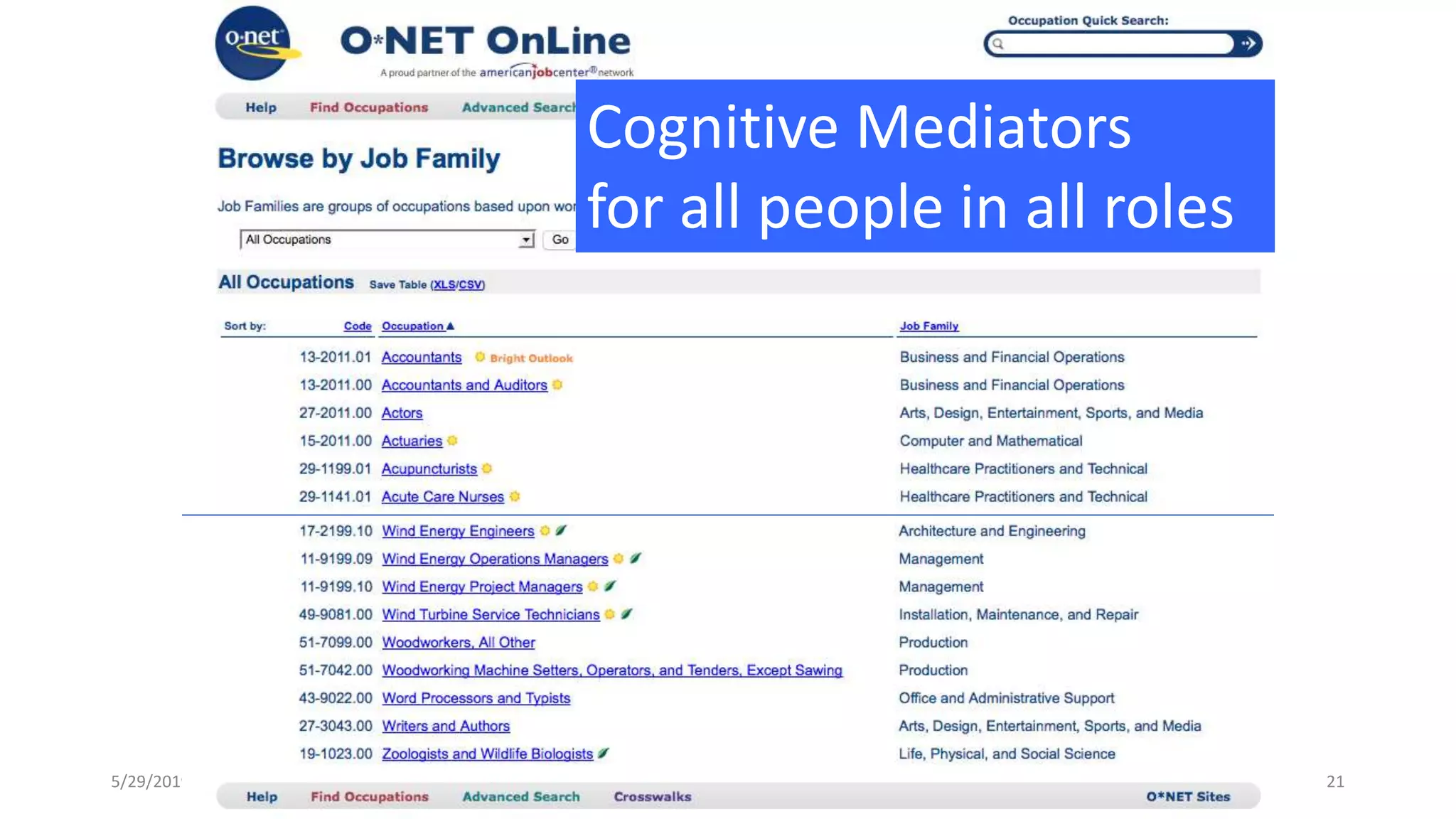
    5/29/2019 © IBM 2015,IBM Upward University Programs Worldwide accelerating regional development 21 Cognitive Mediators for all people in all roles
  • 22.
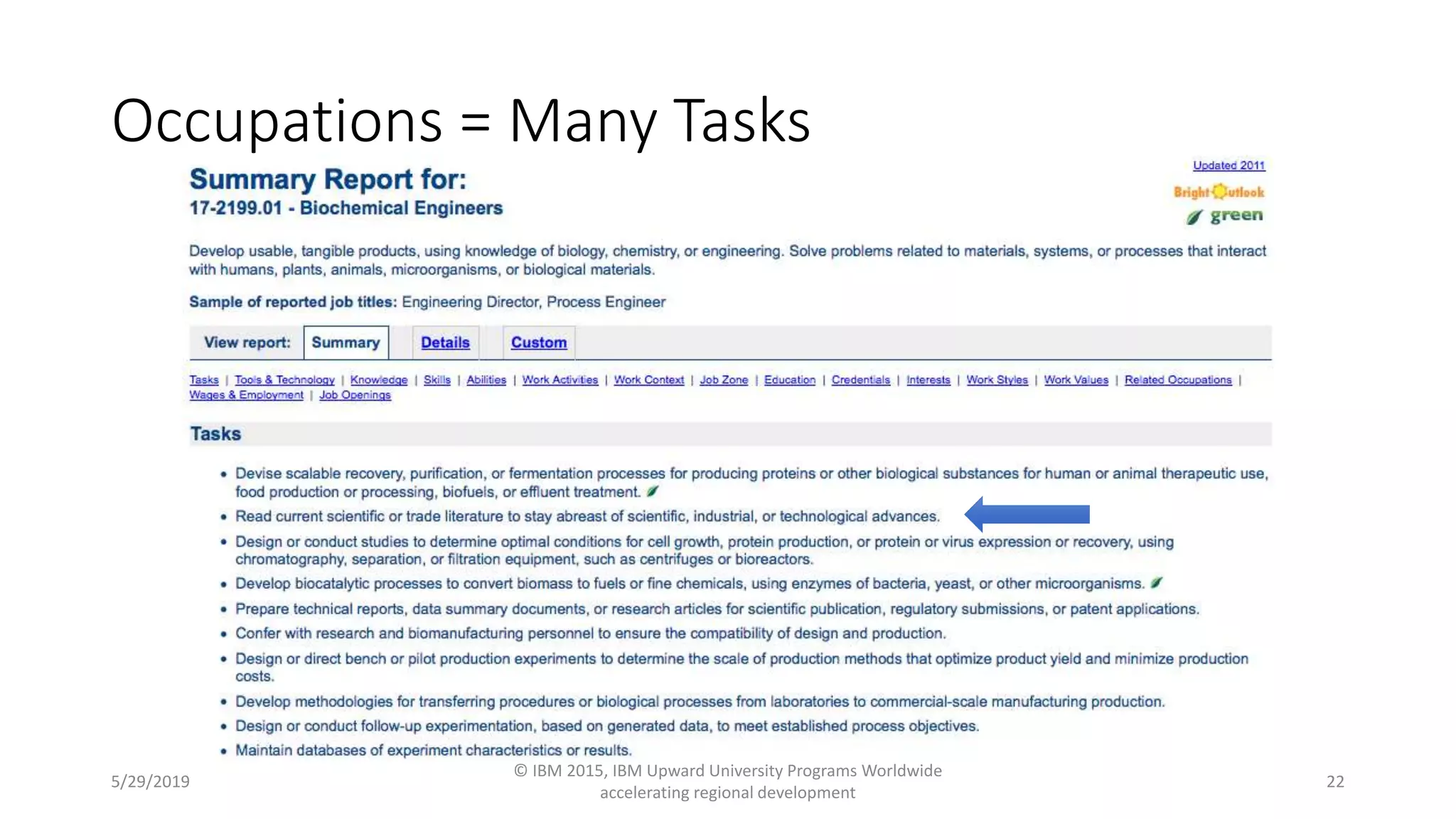
    Occupations = ManyTasks 5/29/2019 © IBM 2015, IBM Upward University Programs Worldwide accelerating regional development 22
  • 23.
    Watson Discovery Advisor 5/29/2019 ©IBM 2015, IBM Upward University Programs Worldwide accelerating regional development 23 Simonite, T. 2014. Software Mines Science Papers to Make New Discoveries. MIT. November 25, 2014. URL: http://m.technologyreview.com/news/520461/software-mines-science-papers-to-make-new-discoveries/
  • 24.
    Types: Progression ofmodels Models = instruction set of future 5/29/2019 Understanding Cognitive Systems 24 Task & World Model/ Planning & Decisions Self Model/ Capacity & Limits User Model/ Episodic Memory Institutions Model/ Trust & Social Acts Tool + - - - Assistant ++ + - - Collaborator +++ ++ + - Coach ++++ +++ ++ + Mediator +++++ ++++ +++ ++ Cognitive Tool Cognitive Assistant Cognitive Collaborator Cognitive Coach Cognitive Mediator
  • 25.
    “The best wayto predict the future is to inspire the next generation of students to build it better” Digital Natives Transportation Water Manufacturing Energy Construction ICT Retail Finance Healthcare Education Government
  • 26.
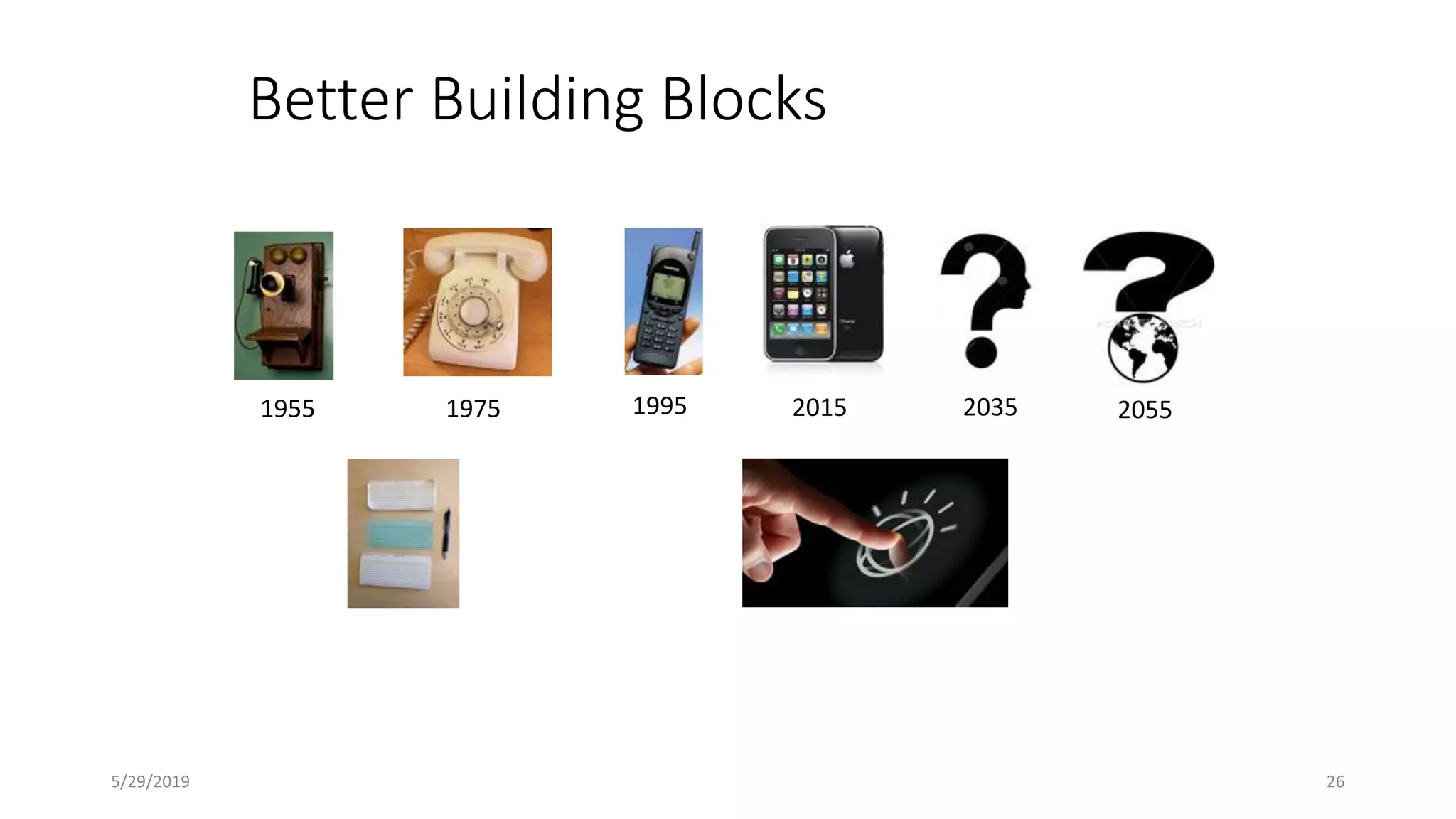
    5/29/2019 26 1955 19751995 2015 2035 2055 Better Building Blocks
  • 27.
    Trust: Two Communities 5/29/2019IBM Code #OpenTechAI 27 Service Science OpenTech AI Trust: Value Co-Creation, Transdisciplinary Trust: Ethical, Safe, Explainable, Open Communities Special Issue AI Magazine? Handbook of OpenTech AI?
  • 28.
    Resilience: Rapidly Rebuilding FromScratch • Dartnell L (2012) The Knowledge: How to Rebuild Civilization in the Aftermath of a Cataclysm. Westminster London: Penguin Books. 5/29/2019 IBM Code #OpenTechAI 28
  • 29.
    Cognitive OpenTech &CODAIT / Future of AI / March 23, 2018 / © 2019 IBM Corporation 29 Call for papers: Advances in Cognitive Systems, Aug 2-5, MIT, Cambridge, MA http://www.cogsys.org/conference/2019/ … submission deadline: May 10th. @neurobongo https://twitter.com/JimSpohrer/status/1118180598583 947269
  • 30.
    Cognitive OpenTech Cognitive OpenTech& CODAIT / Future of AI / March 23, 2018 / © 2019 IBM Corporation 30 Director, Jim Spohrer CODAIT (Center for Opensource Data and AI Technologies) - Vijay Bommireddipalli AI OpenTech & Systems Performance - Tom Truong Watson Developer Advocates - Josh Cheng Susan Malaika (STSM) Augustina Ragwitz Open AI Advocato, Computational Anthropology IBM Silicon Alley, NYC, NYIBM Silicon Valley, San Jose, CAIBM Watson West, San Francisco, CA IBM Almaden, San Jose, CA

Editor's Notes

  • #2 Susan’s references Internal https://w3.ibm.com/w3publisher/ibm-developer-marketing/code-and-response https://w3.ibm.com/w3publisher/cfc-finalists External https://developer.ibm.com/callforcode/ https://developer.ibm.com/code-and-response/
  • #5 it used to be that computers couldn’t understand images
  • #8 URL: http://news.mit.edu/2017/ibm-mit-joint-research-watson-artificial-intelligence-lab-0907 URL: https://www.amazon.com/Master-Algorithm-Ultimate-Learning-Machine/dp/0465094279
  • #10 Source: Vijay Bommireddipally (CODAIT Director) and Fred Reiss (CODAIT Chief Architect)
  • #11 What is beyond Exascale? Zetta (21), Yotta (24) Time dimension (x-axis) is plus or minus 10 years…. Daniel Pakkala (VTT) URL: https://aiimpacts.org/preliminary-prices-for-human-level-hardware/ Dan Gruhl: https://www.washingtonpost.com/archive/business/1983/11/06/in-pursuit-of-the-10-gigaflop-machine/012c995a-2b16-470b-96df-d823c245306e/?utm_term=.d4bde5652826   In 1983 10 GF was ~10 million.   That's 24.55 million in today's dollars.   or 2.4 billion for 1 TF in 1983   Today 1 TF is about $3k http://www.popsci.com/intel-teraflop-chip
  • #12 +3 from original estimates, getting video understanding (verbs and nouns and context) and episodic dynamic memory for learning events and expectation violations and importance is taking longer than expected… Expert predictions on HMLI: URL https://arxiv.org/pdf/1705.08807.pdf 2015 Pattern Recognition Speech: URL: http://spandh.dcs.shef.ac.uk/chime_challenge/chime2016/results.html 2015 Pattern Recognition Images: URL: http://www.image-net.org/ 2015 Patten Recognition Translation: URL: http://www.statmt.org/wmt17/ 2018 Video Understanding Actions: URL: http://www.thumos.info/home.html > Also UCF101 http://crcv.ucf.edu/data/UCF101.php 2018 Video Understanding Context: URL: http://visualqa.org/challenge.html 2018 Video Understanding DeepVideo: URL: http://cs.stanford.edu/people/karpathy/deepvideo/ 2021 Memory Declarative: URL: https://rajpurkar.github.io/SQuAD-explorer/ Also Allen AI Kaggle Science Challenge https://www.kaggle.com/c/the-allen-ai-science-challenge 2024 Reasoning Deduction: URL: http://www.satcompetition.org/ 2027: Social Interaction Scripts: URL: https://competitions.codalab.org/competitions/15333 2030: Fluent Conversation Speech Acts: URL: http://convai.io/ 2030: Fluent Conversation Intentions: URL: http://workshop.colips.org/dstc6/ 2030: Fluent Conversation Alexa Prize: URL: https://developer.amazon.com/alexaprize 2033: Assistant & Collaborator Summarization: URL: http://rali.iro.umontreal.ca/rali/?q=en/Automatic%20summarization 2033: Assistant & Collaborator Debate: URL: http://argumentationcompetition.org/2015/ 2036: Coach & Mediator General AI: URL: https://www.general-ai-challenge.org/ 2036: Coach & Mediator Negotiation: URL: https://easychair.org/cfp/AT2017
  • #14 Visit IBM Research – Almaden, San Jose, CA USA 05120 – instructions: http://service-science.info/archives/4679 Join ISSIP.org – it’s free for individuals to join and get monthly newsletter: http://service-science.info/archives/4901 Contribute a short book to our series – blog compilations welcomed - http://www.businessexpertpress.com/product-category/service-systems-and-innovations-in-business-and-society/ We are trying to make complex servce systems things simpler – but not too simple. Wise innovation increase resilience with abundant opportunities for all.
  • #15 Visit IBM Research – Almaden, San Jose, CA USA 05120 – instructions: http://service-science.info/archives/4679 Join ISSIP.org – it’s free for individuals to join and get monthly newsletter: http://service-science.info/archives/4901 Contribute a short book to our series – blog compilations welcomed - http://www.businessexpertpress.com/product-category/service-systems-and-innovations-in-business-and-society/ We are trying to make complex servce systems things simpler – but not too simple. Wise innovation increase resilience with abundant opportunities for all.
  • #16 1950 Nathaniel Rochester (IBM) 701 first commercial computer that did super-human levels of numeric calculations routinely. He worked at MIT on arithmetic unit of WhirlWind I programmable computer. Dota 2 is most recent August 11, 2017 as a super-human game player in Valve Dota 2 competition – Elon Musk’s OpenAI result. Miles Bundage tracks gaming progress: http://www.milesbrundage.com/blog-posts/my-ai-forecasts-past-present-and-future-main-post DOTA2: https://blog.openai.com/more-on-dota-2/
  • #18 URL: https://www.siliconrepublic.com/machines/ibm-fairness-360-ai-bias URL: https://github.com/IBM/AIF360 (Sept 21 2018) 169 stars, 17 forks, 60 commits, 6 contributors Kush Varshney’s Sept 20, 2018 presentation - http://cognitive-science.info/community/weekly-update/ Presentation: http://cognitive-science.info/wp-content/uploads/2018/09/CSIG_krv-aif360-2018-09-20-1.pdf Individual fairness, group fairness, etc.
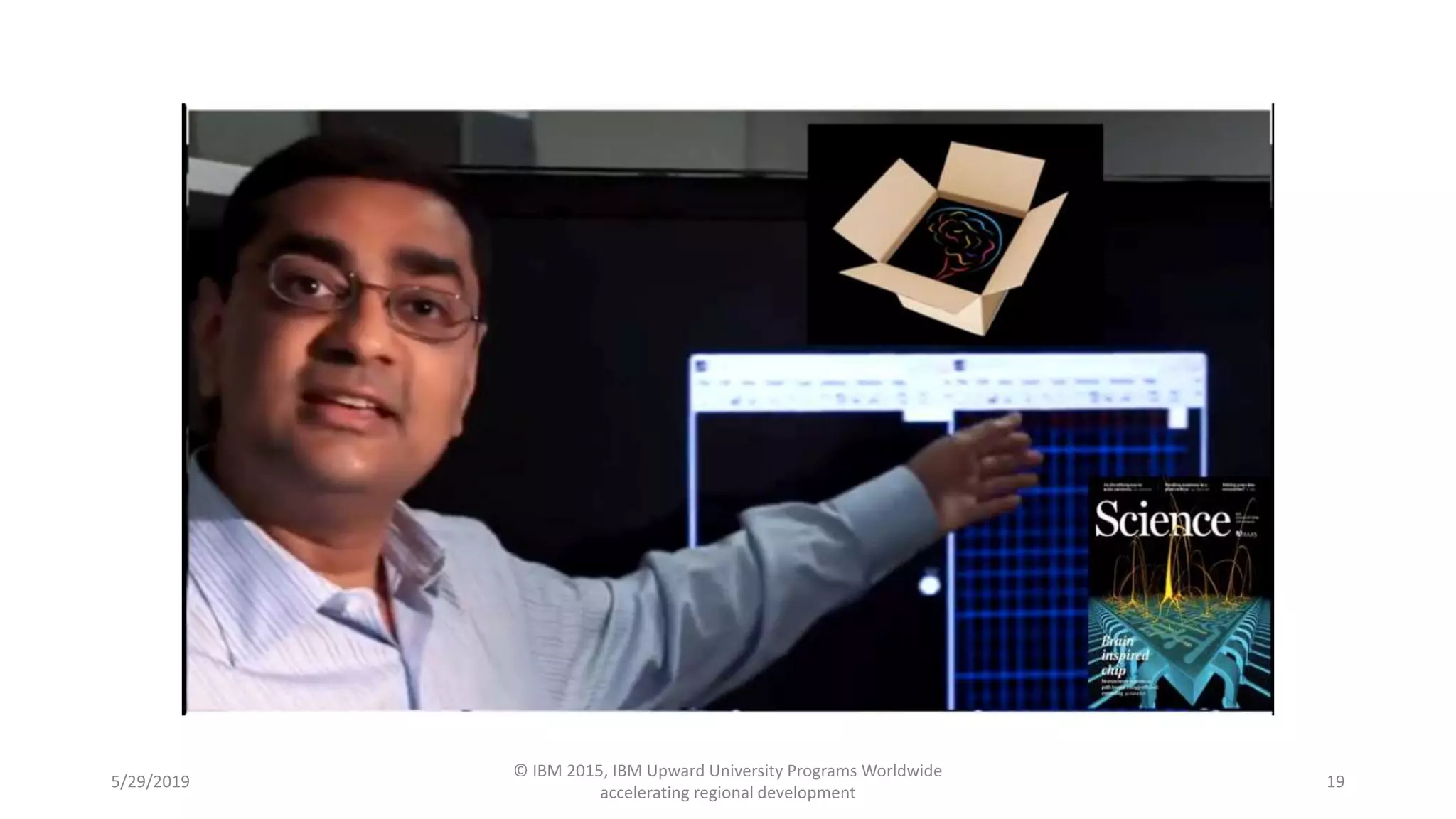
  • #20 Modha’s Brain - Goal 1KW and 2 Litres…. Dharmendra Modha and his design for a brain chip playing pong: https://www.youtube.com/watch?v=gQ3HEVelBFY https://www.youtube.com/watch?v=tqeINGOzIZo https://twitter.com/dharmendramodha/status/545693986149511168
  • #21 URL: Why software is eating the world – see https://www.wsj.com/articles/SB10001424053111903480904576512250915629460 URL: Microsoft acquiring GitHub – see https://blogs.microsoft.com/blog/2018/06/04/microsoft-github-empowering-developers/ URL: Models will run the world – see https://www.wsj.com/articles/models-will-run-the-world-1534716720 URL: John Marks, “Why Open Source Failed” https://medium.com/@johnmark/why-open-source-failed-6cae5d6a9f6 First, the good news, which is actually bad. In a 2016 survey from Blackduck, 96% of software products developed that year used open source software. That number is likely higher now. In the software world, particularly software that runs the computing infrastructure of the internet, open source is ubiquitous. One could claim, without any exaggeration, that our current world runs on open source software or that our modern world would not exist in its current form without open source software. I don’t know how to calculate the total value of open source software to the world, but I do know that if open source software suddenly went away, the results would be catastrophic, an existential crisis for humanity. So when I write that “open source has failed” I’m obviously not writing from a technology perspective, where it was been a clear-cut winner and the foundation of an endless supply of business models, products, and services. To say that open source contributed to the overall innovation of the world would be a shameful understatement. Better would be to say that the world’s computing innovations owe their existence to the triumph of open source development. If you think this all sounds pretty terrific, read on to find out what I left out. In the context of this essay, “failure” refers not to any technical achievements but rather to the lack of social ones. When we were but wee lads and lasses on the forefront of this thing we called free software and eventually open source, we knew that this was dangerous stuff. It was destined to set fire to an entire industry, undermining entrenched monopoly powers and establishing a more equitable approach to building wealth around the tools that would power humanity in the 21st century. It was about the democratization of software and would smash what we then called the “digital divide”. That premise was entirely false. The crux of this essay is thus: not only did open source not stem or stall the redistribution of wealth and power upwards, but rather it aided and abetted the redistribution of wealth and power upwards. To be an open source proponent at this time without acknowledging this very real and most unfortunate consequence is to be a cog in a much larger machine; a stooge; a very useful idiot. When considering the role of open source in redistributing wealth upwards, it’s instructive to consider the example of Microsoft. Not because I enjoy picking on them or think they’re evil — I don’t; Microsoft as a publicly traded company is no more or less evil than any other company. Rather, I like to single them out because their public stance towards open source has changed much over the years and is a useful measuring stick for the points I’m trying to make. Did you ever wonder *why* their public stance towards open source shifted so much over the years, from “Linux is a cancer” to “use our open source software”? Could it be because, unlike the company’s predecessors in 2000, current executives now understand that open source software forms the building blocks of modern capitalist behemoths?
  • #22 O*NET Online is the occupation network online, started by the US Dept of Labor in the 1990’s – it now represents one of the most comprehensive lists of occupations along with a great deal of information about each occupation, including skills, tasks, certifications, demand for these jobs, etc. O*NET lists about 1000 occupations from Accountants to Zoologists – and many job families in between. O*NET updates the descriptions of the occupations as well as adding new occupations over time. Source: http://www.onetonline.org/find/family?f=0
  • #26 By 2036, there will be an accumulation of knowledge as well as a distribution of knowledge in service systems globally. We need to ensure as there is knowledge accumulation that service systems at all scale become more resilient. Leading to the capability of rapid rebuilding of service systems across scales, by T-shaped people who understand how to rapidly rebuild – knowledge has been chunked, modularized, and put into networks that support rapid rebuilding.
  • #27 The weakest link is what needs to be improved – according to system scientists. Accessing help, service, experts is the weakest link in most systems. By 2035 the phone may have the power of one human brain – by 2055 the phone may have the power of all human brains. Before trying to answer the question about which types of sciences are more important – the ones that try to explain the external world or the ones that try to explain the internal world – consider this, slide that shows the different telephones that I have used in my life. I grew up in rural Maine, where we had a party line telephone because we were somewhat remote on our farm in Newburgh, Maine. However, over the years phones got much better…. So in 2035 or 2055, who are you going to call when you need help?
  • #29 URL Amazon: https://www.amazon.com/Knowledge-Rebuild-Civilization-Aftermath-Cataclysm-ebook/dp/B00DMCV5YS/ URL TED Talk: https://www.youtube.com/watch?v=CdTzsbqQyhY Citation: Dartnell L (2012) The Knowledge: How to Rebuild Civilization in the Aftermath of a Cataclysm. Westminster London: Penguin Books. Jim Spohrer Blogs: Grand Challenge: http://service-science.info/archives/2189 Re-readings: http://service-science.info/archives/4416 Bad actors can cause collapse, but collapse can also happen from natural or accidental causes. When rapidly rebuilding from scratch, it is sometimgs possible to get to higher than previous level of performance, much faster.