BEHAVIOR ANALYSIS in 2010 Behavior analysis processes and strategies, complementing medical and psychiatric services for people with Developmental Disabilities and Dual Diagnoses.
CURRENT STATUS OF BEHAVIOR ANALYSISBorn of PsychologyEvolved into a different paradigmSignificantly different philosophy, theoretical framework, research and strategiesPSYCHOLOGYMindThe seat of perceptions, self consciousness, thinking, behaving, remembering, hoping, desiring, judging, analyzing, evaluating, reasoning, conation* or volition/will.
Existence as a conscious, perceiving, independent entity. Mind/body (or brain) are separate entities.
Mind may apprehend some truths directly, without requiring the medium of the senses.
Overrides reflex response and frees behavior from sense dominance.
Focus on thoughts/feelings as causes of behavior*The aspect of mental processes directed toward action or change and including impulse, desire, volition, and striving.
PSYCHOLOGYPhilosophy:Freedom of choiceIndividuals are responsible
Blamed for bad choices
Credited for goodPSYCHOLOGYStrategies:Talk therapyPsychotherapy
CounselingEmphasisFeelings: Being in touch with, controlling them
Thoughts: Changing themThe ultimate intent is to change behavior “from the inside.”
EVOLUTION OF THE SCIENCE OF BEHAVIOR1913 to 1930 Classical S-R Behaviorism1938 Classical and Operant BehaviorismRadical Behaviorism 1953 to presentOperant and Respondent behavior
Growing behavioral processes
Verbal behavior: Operant, socially mediated behavior
Private events
An in depth, data based, effective natural scienceRADICAL BEHAVIORISMA Natural SciencePhilosophical assumptions:EmpiricismAll knowledge is derived from sense experience
The method of observation and experiment used in natural sciences (physics, chemistry, biology)
Behavior, and behavior processes (the repeated effects of environmental events) are identified and described by scientific observations
No hypothetical constructs
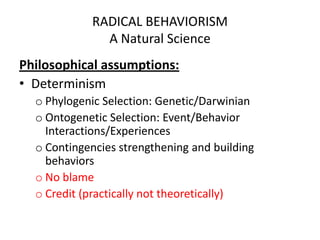
No Mind, ID, EGO, SUPER EGO and so onRADICAL BEHAVIORISMA Natural SciencePhilosophical assumptions:DeterminismPhylogenic Selection: Genetic/Darwinian
Ontogenetic Selection: Event/Behavior Interactions/Experiences
Contingencies strengthening and building behaviors
No blame
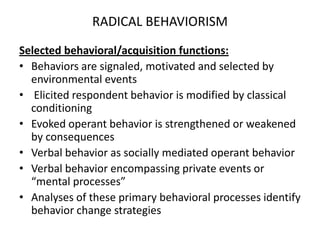
Credit (practically not theoretically)RADICAL BEHAVIORISMSelected behavioral/acquisition functions:Behaviors are signaled, motivated and selected by environmental eventsElicited respondent behavior is modified by classical conditioningEvoked operant behavior is strengthened or weakened by consequencesVerbal behavior as socially mediated operant behaviorVerbal behavior encompassing private events or “mental processes”Analyses of these primary behavioral processes identify behavior change strategies
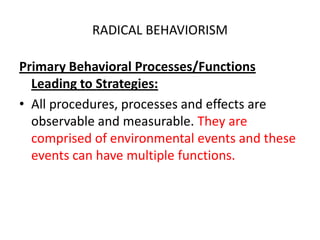
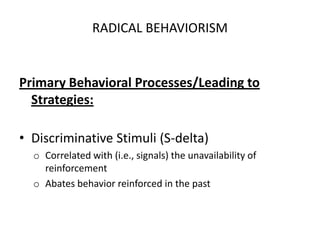
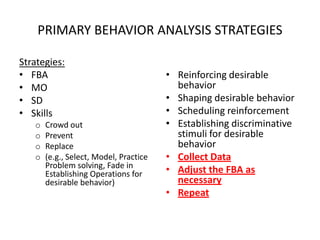
RADICAL BEHAVIORISMPrimary Behavioral Processes/Functions Leading to Strategies:All procedures, processes and effects are observable and measurable. They are comprised of environmental events and these events can have multiple functions.
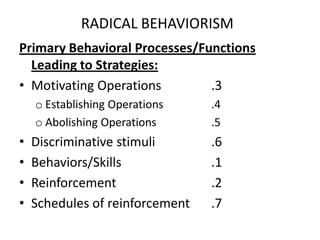
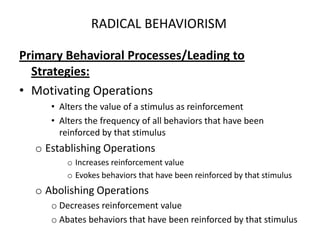
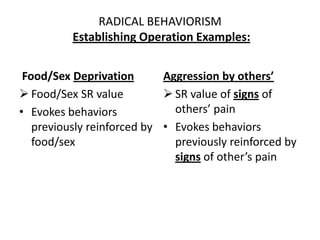
RADICAL BEHAVIORISMPrimary Behavioral Processes/Functions Leading to Strategies:Motivating Operations		.3Establishing Operations		.4
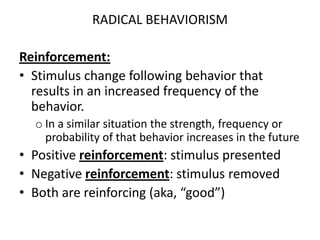
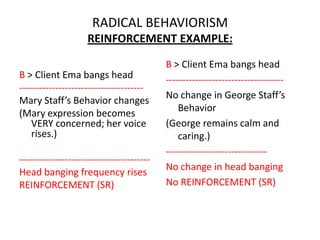
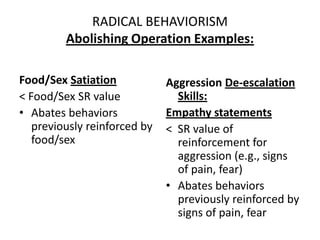
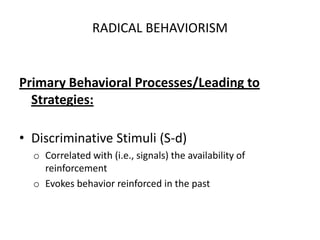
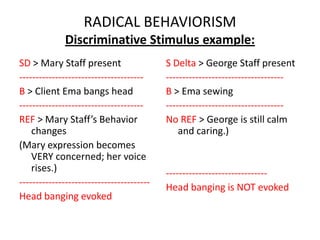
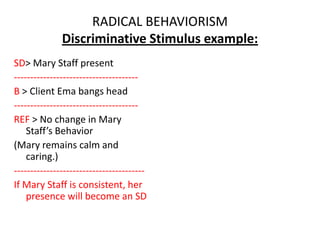
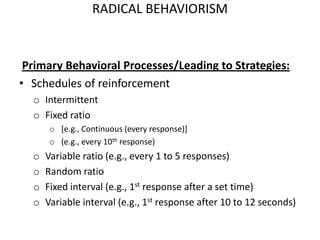
Abolishing Operations		.5Discriminative stimuli		.6Behaviors/Skills			.1Reinforcement			.2Schedules of reinforcement	.7
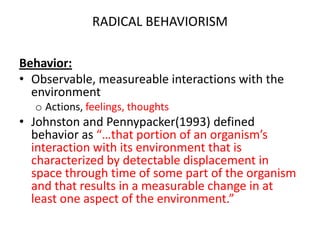
RADICAL BEHAVIORISMBehavior:Observable, measureable interactions with the environmentActions, feelings, thoughtsJohnston and Pennypacker(1993) defined behavior as “…that portion of an organism’s interaction with its environment that is characterized by detectable displacement in space through time of some part of the organism and that results in a measurable change in at least one aspect of the environment.”
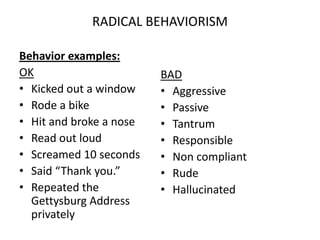
RADICAL BEHAVIORISMBehavior examples:OKKicked out a windowRode a bikeHit and broke a noseRead out loudScreamed 10 secondsSaid “Thank you.”Repeated the Gettysburg Address privatelyBADAggressivePassiveTantrumResponsibleNon compliantRudeHallucinated

Mike behavior analysis2 4 13

Editor's Notes

  • #2 Particularly in Developmental Disabilities, Behavior Analysis is best practice across the nation.However, behavior Analysis has gone through a significant evolution since 1913, and I want to provide a brief overview of what behavior analysis was and currently is to make sure we’re all on the same pageThis is a varied audience including psychiatrists, psychologists, behavior analysts, physicians, nurses and administrators. I expect that most or all of you some will view some of what I have to say as very simple (behavior analysis 101), and will view other parts as very complex.As you listen I’d like all of you to think about how behavior analysis interfaces with the services you provide.
  • #4 I loved this stuff!However, most of this is comprised of metaphor and hypothetical constructs and is no longer part of behavior analysis.
  • #5 The behavioral view is that choices are ultimately determined by environmental events.We’ll get back to that.
  • #6 Talking is a part of behavior analysis strategies, but the focus is on teaching and skill building.Also, behavior analysis works “from the outside,” focused on how environmental events interact with behavior. We’ll get back to this later also.
  • #7 UNCONDITIONED STIMULUS ELICITS AN UNCONDITIONED RESPONSEUCS > UCRPAIR UCS WITH NEUTRAL STIMULUSPAIR NS/UCRNEUTRAL STIMULUS BECOMES A CONDITIONED STIMULUSCS > CRMany people continue to think that behavior analysis is an S>R science.It isn’t. We’ll get back to that.
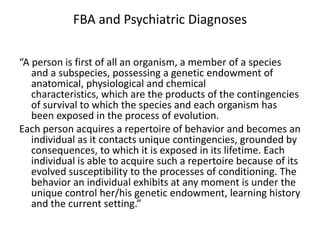
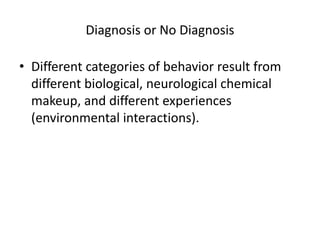
  • #9 Behaviors (thoughts, feelings and actions) *are determined by environmental events Bill Baum: “The more we attribute causation to environmental events, the more compassionate and effective we are.”Identify causal, environmental events (FBA)Identify and implement behavior change strategies comprised of environmental events (provide new experiences)Return to FBA as necessary* Will get back to this
  • #12 Behavior stream on leftOrder for presentation on right
  • #14 Operationally, precisely describedDurationMagnitudeTopographyLatencyAnd so on
  • #24 Intermittent: Greater resistance to extinctionFixed ratio[e.g., Continuous (every response)]: Acquisition(e.g., every 100th response): Post RFM pausesVariable ratio (e.g., every 1 to 5 responses): Fade strengtheningFixed interval (e.g., 1st response after a set time): ScallopsVariable interval (e.g., 1st response after 10 to 12 seconds)Effects of drugs on behavior are altered by schedules