A l’attention de :
Auteur(s) :
Réf :
Date :
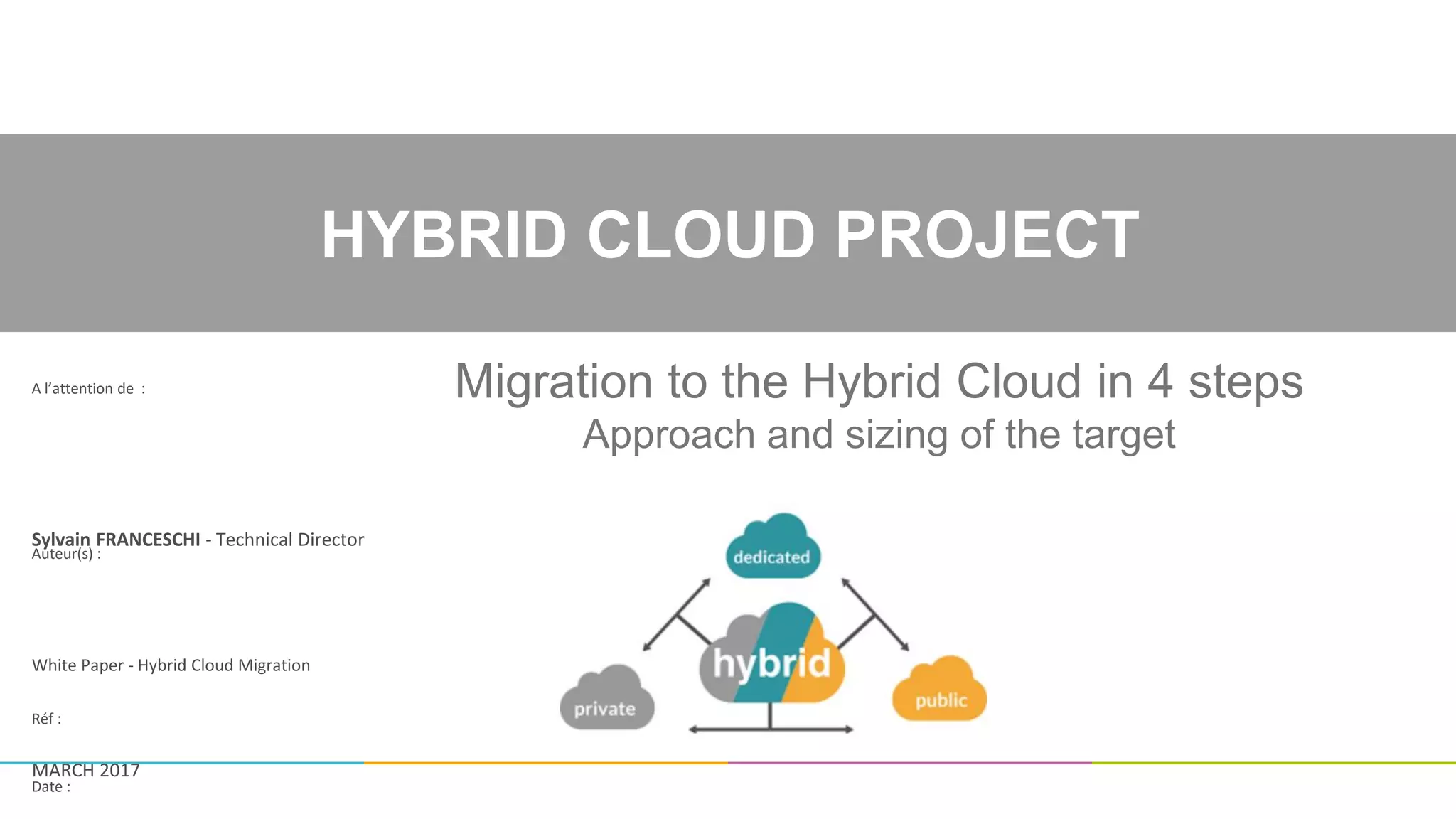
Migration to the Hybrid Cloud in 4 steps
Approach and sizing of the target
HYBRID CLOUD PROJECT
MARCH 2017
White Paper - Hybrid Cloud Migration
Sylvain FRANCESCHI - Technical Director
Projet CLOUD HYBRIDE
© Copyright 2017
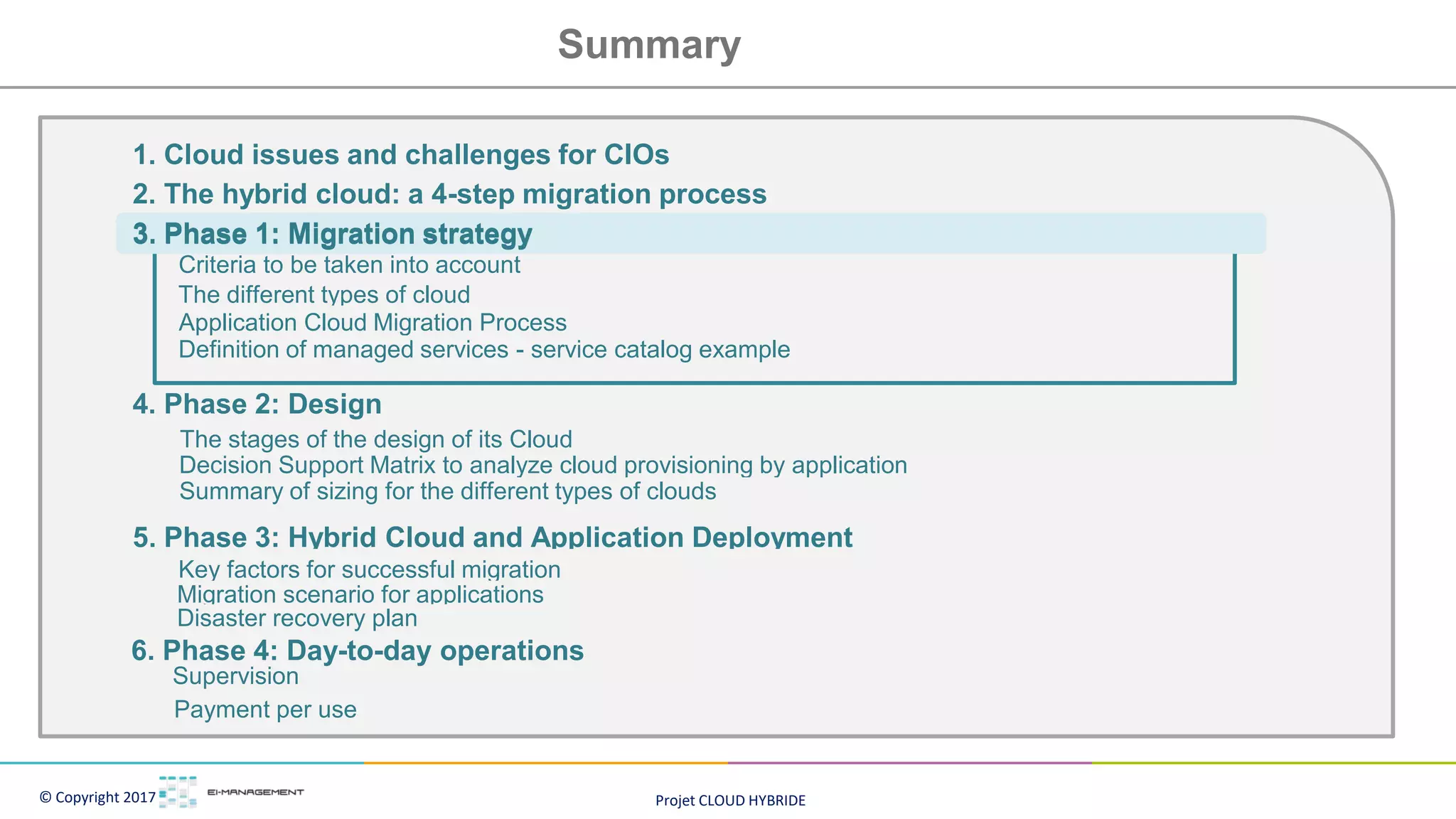
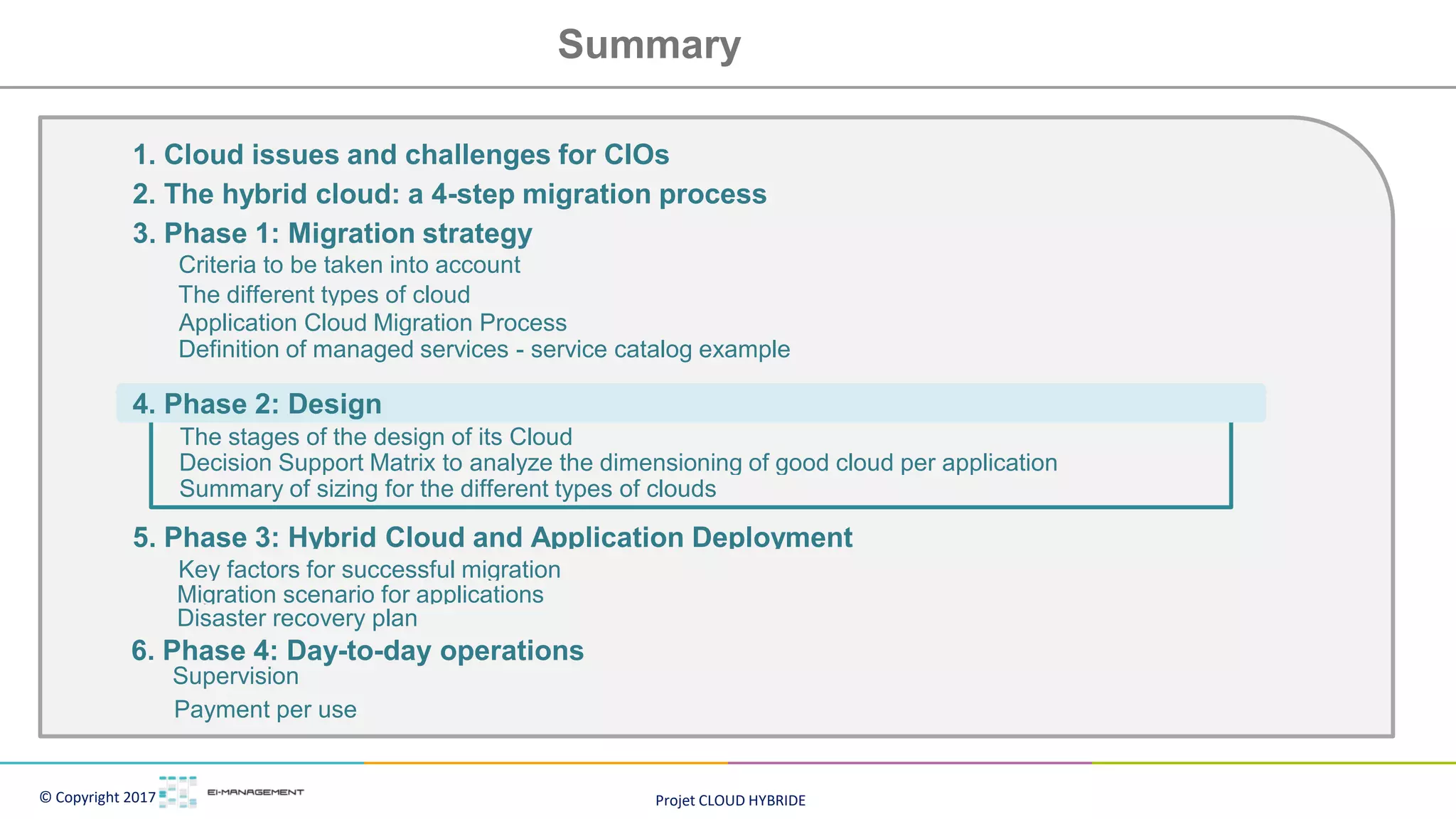
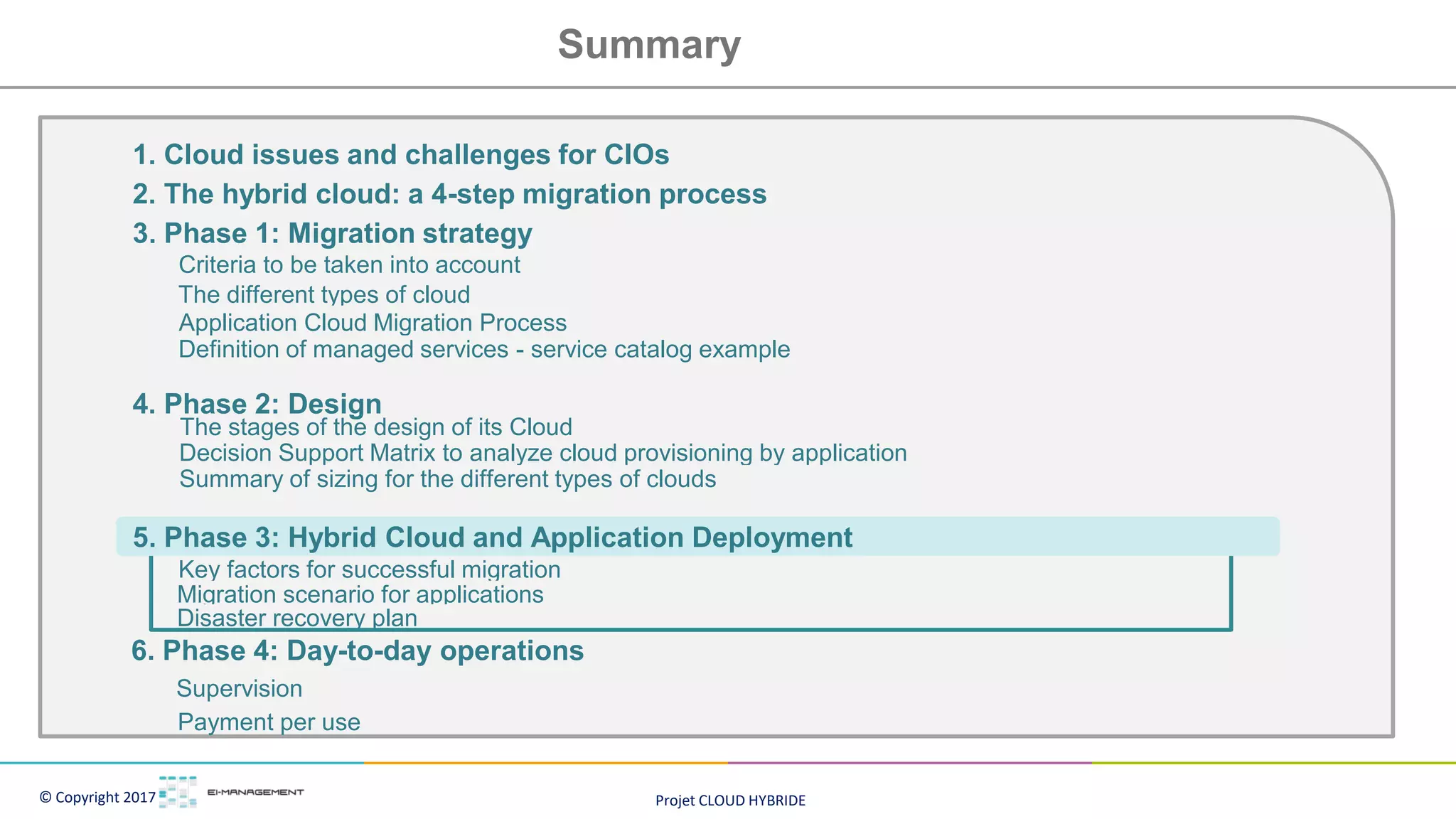
Summary
1. Cloud issues and challenges for CIOs
2. The hybrid cloud: a 4-step migration process
3. Phase 1: Migration strategy
4. Phase 2: Design
5. Phase 3: Hybrid Cloud and Application Deployment
6. Phase 4: Day-to-day operations
Supervision
Payment per use
Key factors for successful migration
Migration scenario for applications
Disaster recovery plan
Criteria to be taken into account
The different types of cloud
Application Cloud Migration Process
Definition of managed services - service catalog example
Decision Support Matrix to analyze cloud provisioning by application
Summary of sizing for the different types of clouds
The stages of the design of its Cloud
Projet CLOUD HYBRIDE
1. Cloud issues and challenges for CIOs
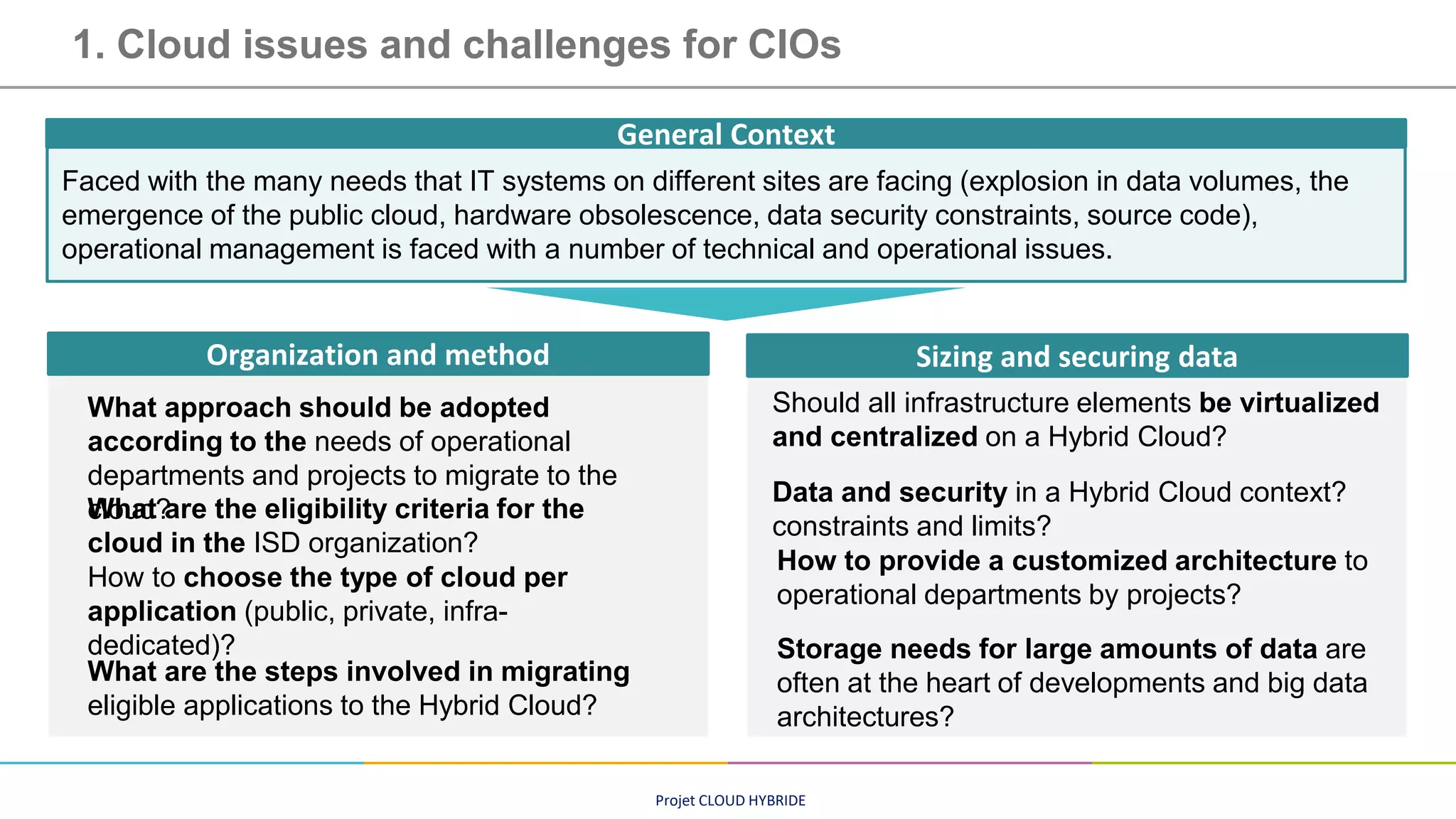
Faced with the many needs that IT systems on different sites are facing (explosion in data volumes, the
emergence of the public cloud, hardware obsolescence, data security constraints, source code),
operational management is faced with a number of technical and operational issues.
General Context
How to provide a customized architecture to
operational departments by projects?
Storage needs for large amounts of data are
often at the heart of developments and big data
architectures?
Data and security in a Hybrid Cloud context?
constraints and limits?
How to choose the type of cloud per
application (public, private, infra-
dedicated)?
Should all infrastructure elements be virtualized
and centralized on a Hybrid Cloud?
What are the eligibility criteria for the
cloud in the ISD organization?
What approach should be adopted
according to the needs of operational
departments and projects to migrate to the
cloud?
What are the steps involved in migrating
eligible applications to the Hybrid Cloud?
Organization and method Sizing and securing data
Projet CLOUD HYBRIDE
1. Cloud issues and challenges for CIOs
Constraints of the operational departments
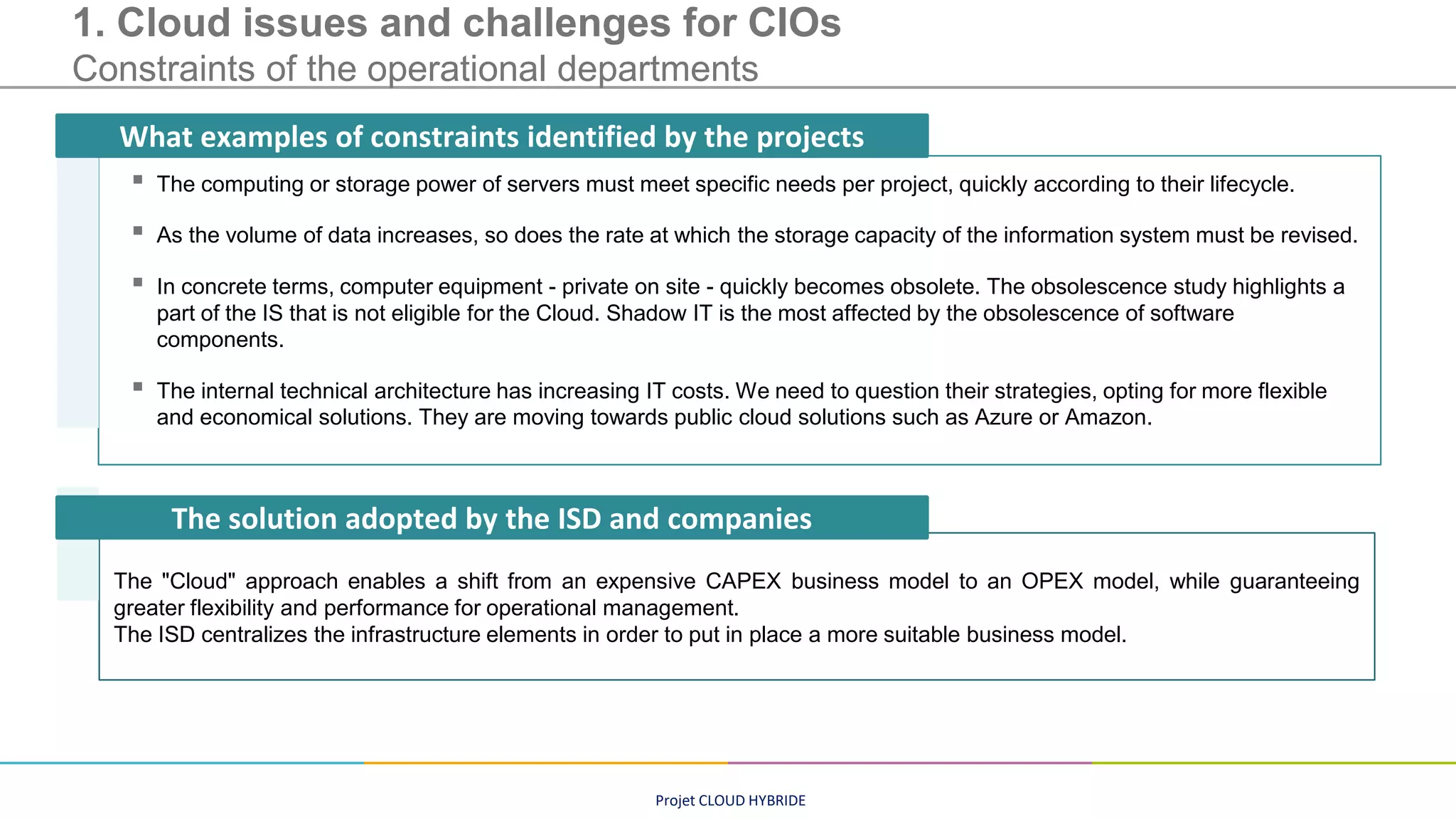
▪ The computing or storage power of servers must meet specific needs per project, quickly according to their lifecycle.
▪ As the volume of data increases, so does the rate at which the storage capacity of the information system must be revised.
▪ In concrete terms, computer equipment - private on site - quickly becomes obsolete. The obsolescence study highlights a
part of the IS that is not eligible for the Cloud. Shadow IT is the most affected by the obsolescence of software
components.
▪ The internal technical architecture has increasing IT costs. We need to question their strategies, opting for more flexible
and economical solutions. They are moving towards public cloud solutions such as Azure or Amazon.
What examples of constraints identified by the projects
The "Cloud" approach enables a shift from an expensive CAPEX business model to an OPEX model, while guaranteeing
greater flexibility and performance for operational management.
The ISD centralizes the infrastructure elements in order to put in place a more suitable business model.
The solution adopted by the ISD and companies
Projet CLOUD HYBRIDE
1. Cloud issues and challenges for CIOs
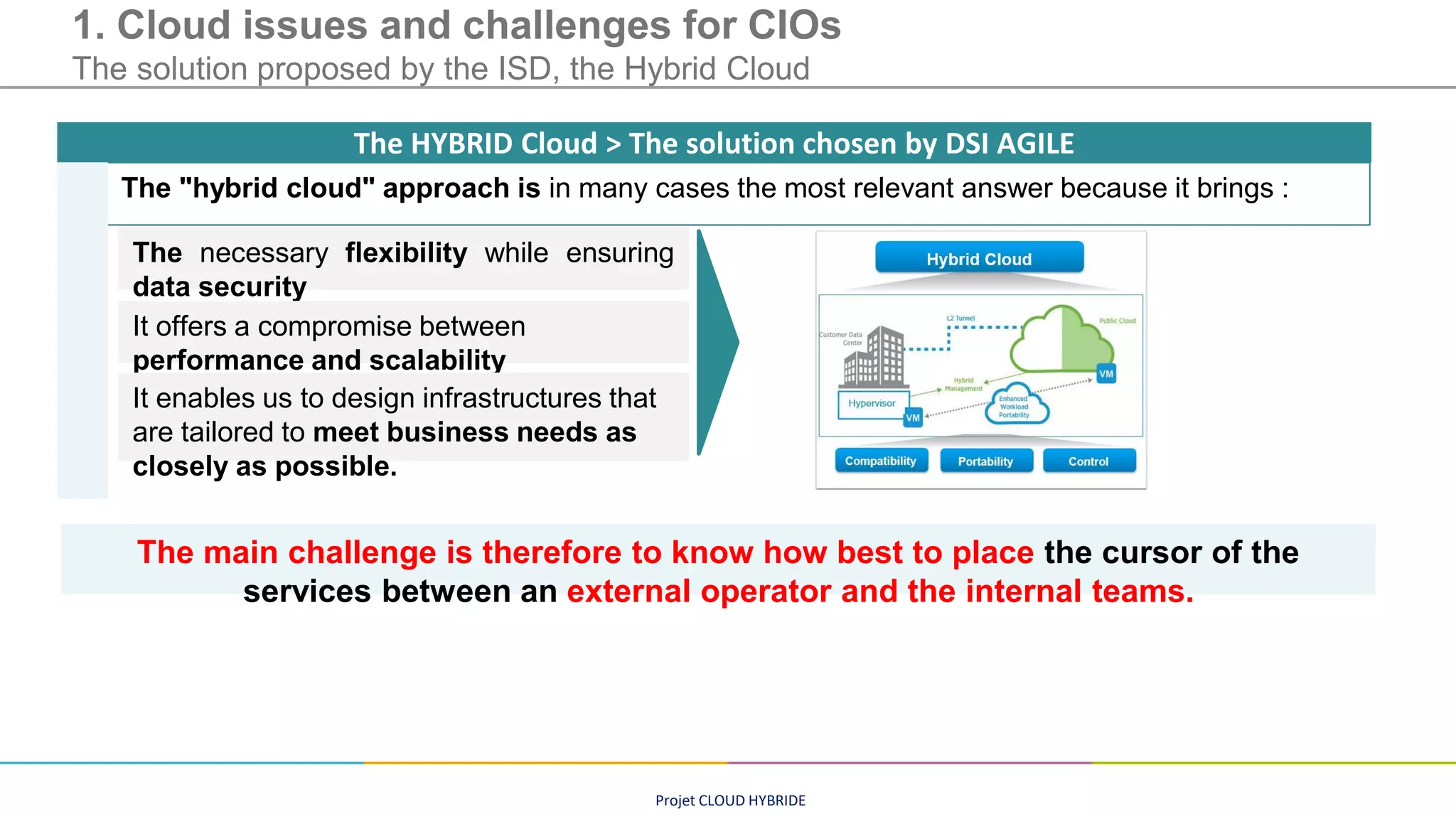
The solution proposed by the ISD, the Hybrid Cloud
The "hybrid cloud" approach is in many cases the most relevant answer because it brings :
The HYBRID Cloud > The solution chosen by DSI AGILE
The necessary flexibility while ensuring
data security
It offers a compromise between
performance and scalability
It enables us to design infrastructures that
are tailored to meet business needs as
closely as possible.
The main challenge is therefore to know how best to place the cursor of the
services between an external operator and the internal teams.
Projet CLOUD HYBRIDE
© Copyright 2017
Summary
1. Cloud issues and challenges for CIOs
2. The hybrid cloud: a 4-step migration process
3. Phase 1: Migration strategy
4. Phase 2: Design
5. Phase 3: Hybrid Cloud and Application Deployment
6. Phase 4: Day-to-day operations
Supervision
Payment per use
Key factors for successful migration
Migration scenario for applications
Disaster recovery plan
3. Phase 1: Migration strategy
Criteria to be taken into account
The different types of cloud
Application Cloud Migration Process
Definition of managed services - service catalog example
Decision Support Matrix to analyze cloud provisioning by application
Summary of sizing for the different types of clouds
The stages of the design of its Cloud
Projet CLOUD HYBRIDE
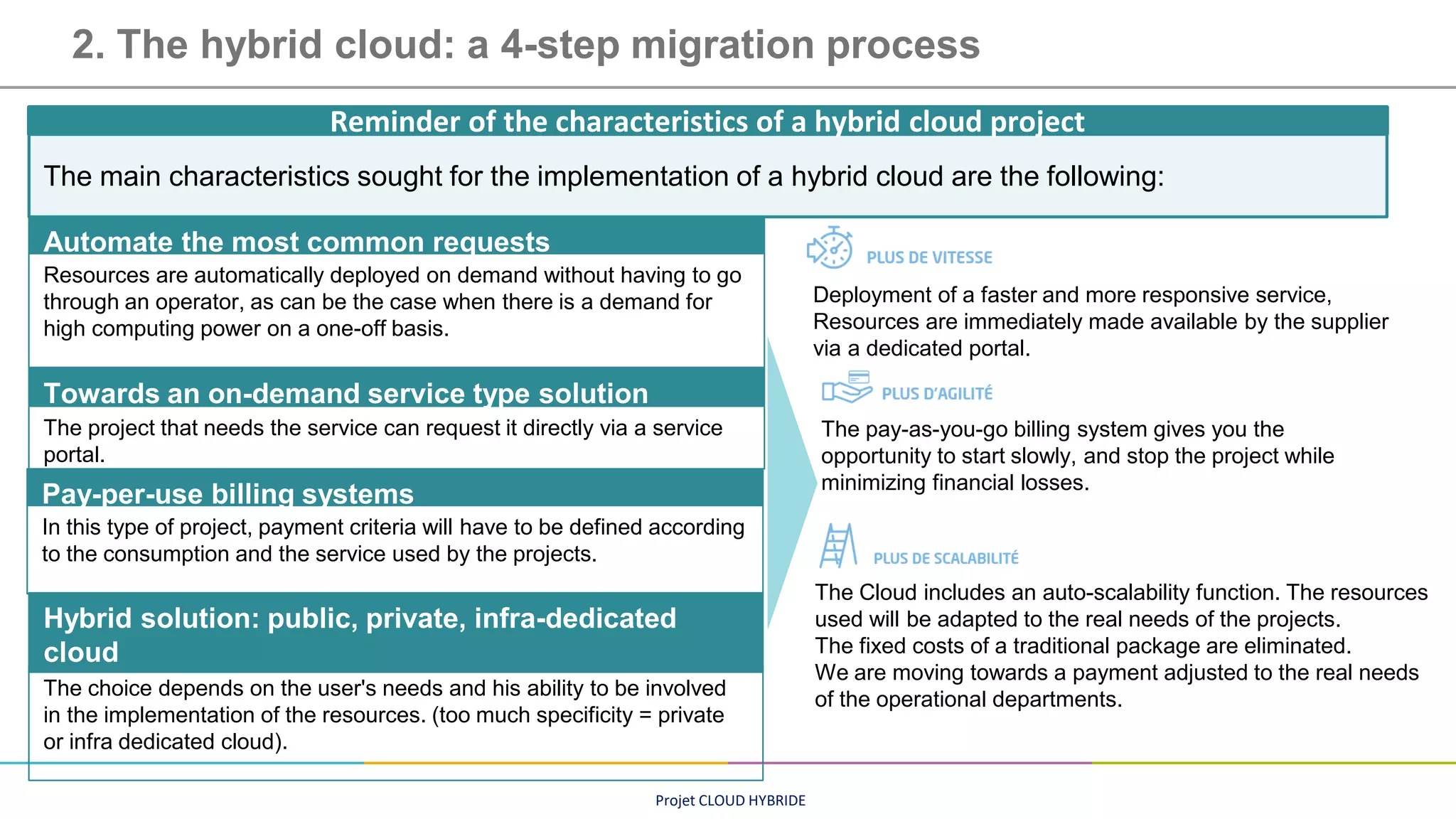
2. The hybrid cloud: a 4-step migration process
The main characteristics sought for the implementation of a hybrid cloud are the following:
Reminder of the characteristics of a hybrid cloud project
The choice depends on the user's needs and his ability to be involved
in the implementation of the resources. (too much specificity = private
or infra dedicated cloud).
Resources are automatically deployed on demand without having to go
through an operator, as can be the case when there is a demand for
high computing power on a one-off basis.
The project that needs the service can request it directly via a service
portal.
In this type of project, payment criteria will have to be defined according
to the consumption and the service used by the projects.
Automate the most common requests
Towards an on-demand service type solution
Pay-per-use billing systems
Hybrid solution: public, private, infra-dedicated
cloud
Deployment of a faster and more responsive service,
Resources are immediately made available by the supplier
via a dedicated portal.
The pay-as-you-go billing system gives you the
opportunity to start slowly, and stop the project while
minimizing financial losses.
The Cloud includes an auto-scalability function. The resources
used will be adapted to the real needs of the projects.
The fixed costs of a traditional package are eliminated.
We are moving towards a payment adjusted to the real needs
of the operational departments.
Projet CLOUD HYBRIDE
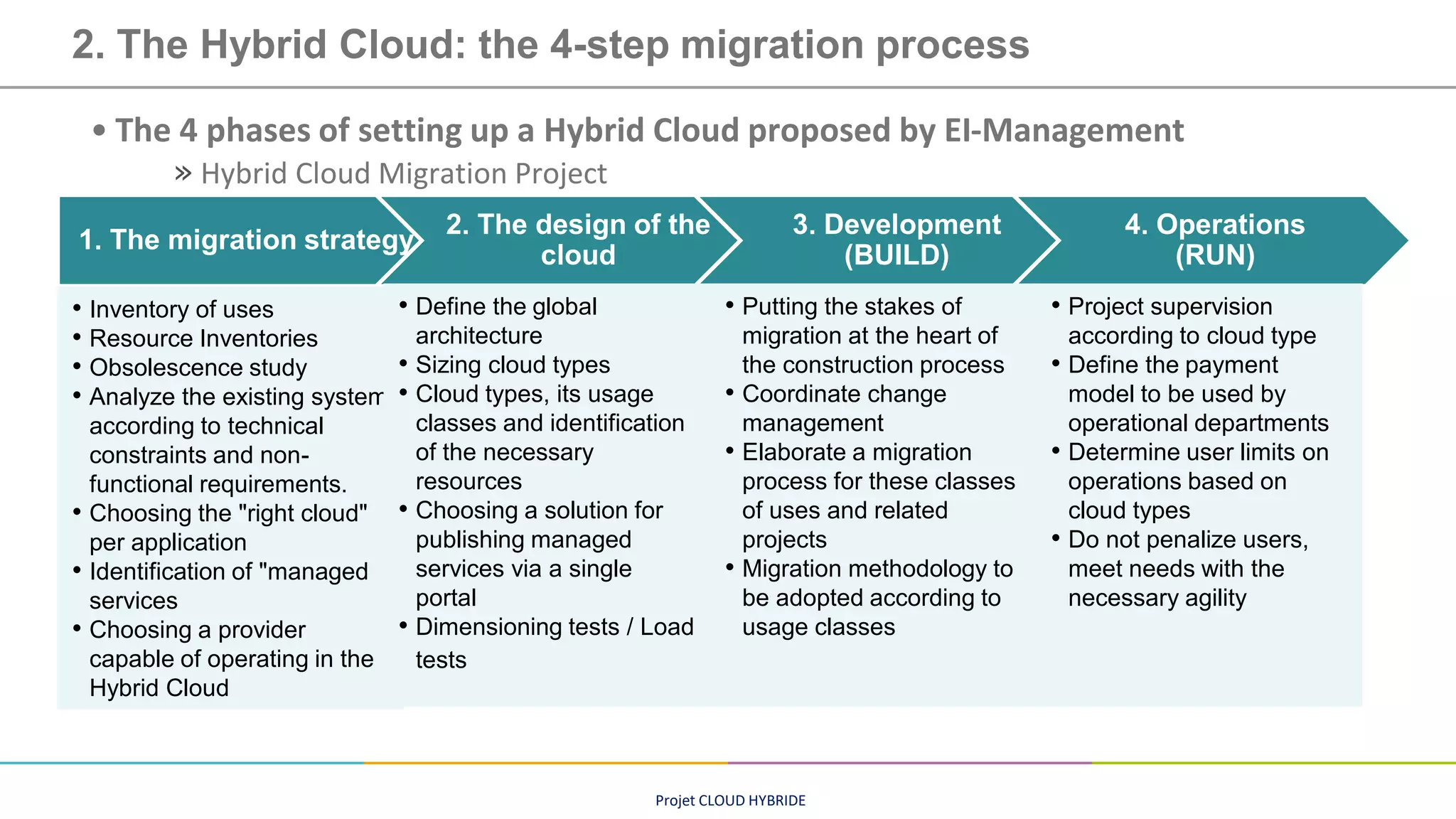
2. The Hybrid Cloud: the 4-step migration process
• The 4 phases of setting up a Hybrid Cloud proposed by EI-Management
» Hybrid Cloud Migration Project
1. The migration strategy
2. The design of the
cloud
3. Development
(BUILD)
4. Operations
(RUN)
• Inventory of uses
• Resource Inventories
• Obsolescence study
• Analyze the existing system
according to technical
constraints and non-
functional requirements.
• Choosing the "right cloud"
per application
• Identification of "managed
services
• Choosing a provider
capable of operating in the
Hybrid Cloud
• Define the global
architecture
• Sizing cloud types
• Cloud types, its usage
classes and identification
of the necessary
resources
• Choosing a solution for
publishing managed
services via a single
portal
• Dimensioning tests / Load
tests
• Putting the stakes of
migration at the heart of
the construction process
• Coordinate change
management
• Elaborate a migration
process for these classes
of uses and related
projects
• Migration methodology to
be adopted according to
usage classes
• Project supervision
according to cloud type
• Define the payment
model to be used by
operational departments
• Determine user limits on
operations based on
cloud types
• Do not penalize users,
meet needs with the
necessary agility
Projet CLOUD HYBRIDE
© Copyright 2017
Summary
1. Cloud issues and challenges for CIOs
2. The hybrid cloud: a 4-step migration process
4. Phase 2: Design
5. Phase 3: Hybrid Cloud and Application Deployment
6. Phase 4: Day-to-day operations
3. Phase 1: Migration strategy
Supervision
Payment per use
Key factors for successful migration
Migration scenario for applications
Disaster recovery plan
3. Phase 1: Migration strategy
Criteria to be taken into account
The different types of cloud
Application Cloud Migration Process
Definition of managed services - service catalog example
Decision Support Matrix to analyze cloud provisioning by application
Summary of sizing for the different types of clouds
The stages of the design of its Cloud
Projet CLOUD HYBRIDE
3. Phase 1: Migration strategy
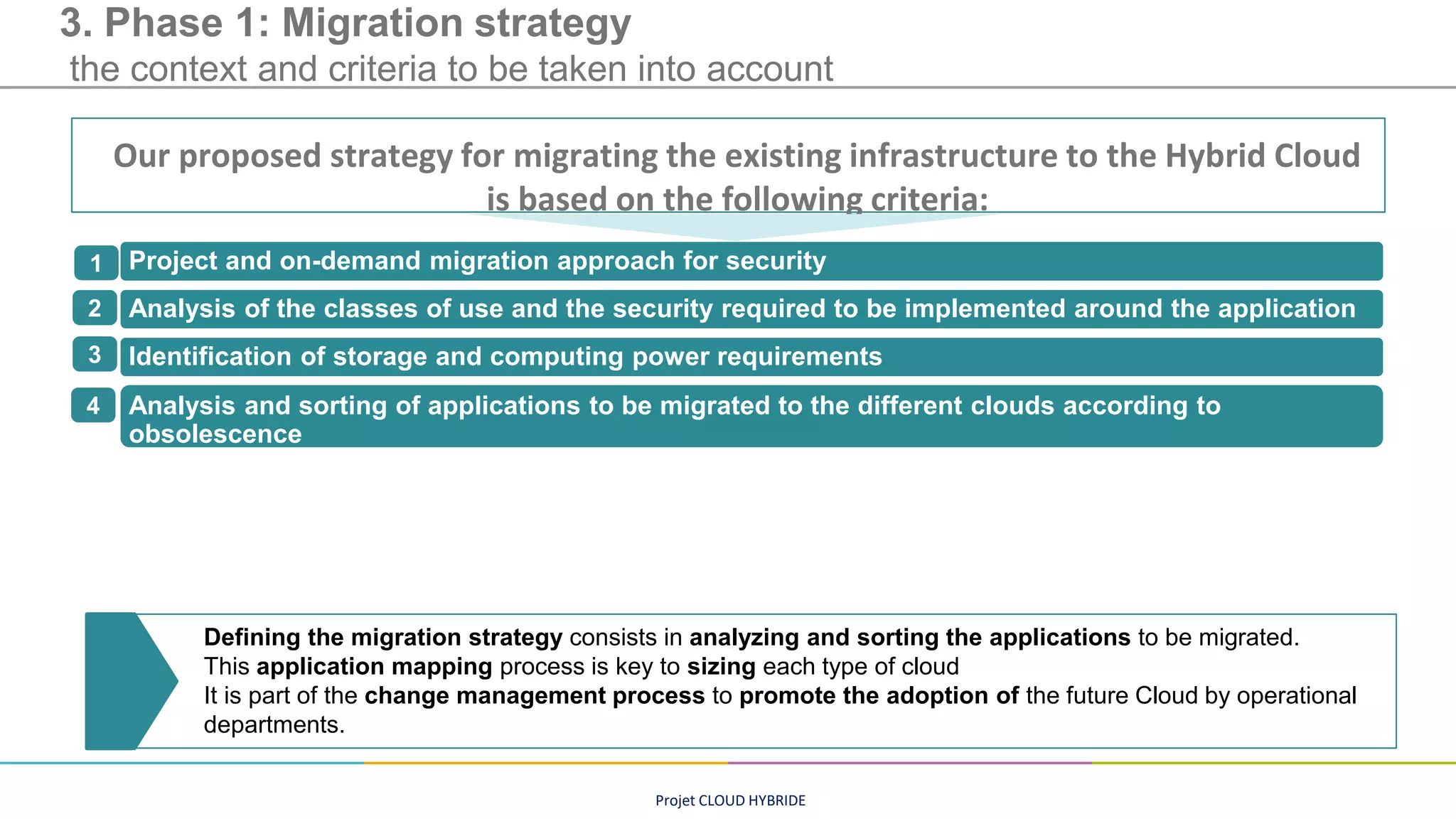
the context and criteria to be taken into account
Our proposed strategy for migrating the existing infrastructure to the Hybrid Cloud
is based on the following criteria:
Project and on-demand migration approach for security
Analysis of the classes of use and the security required to be implemented around the application
Identification of storage and computing power requirements
Analysis and sorting of applications to be migrated to the different clouds according to
obsolescence
Defining the migration strategy consists in analyzing and sorting the applications to be migrated.
This application mapping process is key to sizing each type of cloud
It is part of the change management process to promote the adoption of the future Cloud by operational
departments.
1
2
3
4
Projet CLOUD HYBRIDE
3. Phase 1: Migration strategy
Reminder of cloud types
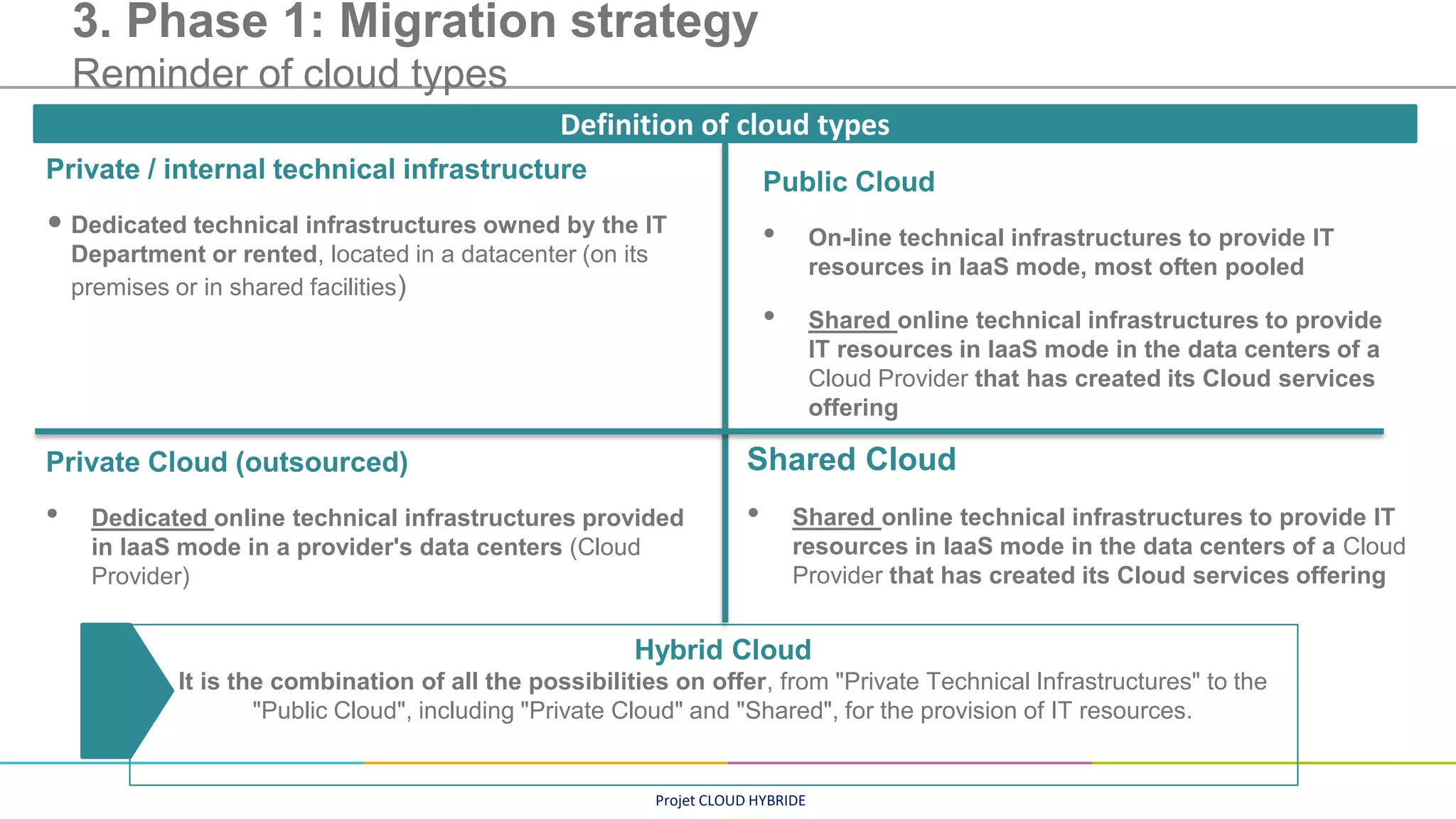
Definition of cloud types
Public Cloud
• On-line technical infrastructures to provide IT
resources in IaaS mode, most often pooled
• Shared online technical infrastructures to provide
IT resources in IaaS mode in the data centers of a
Cloud Provider that has created its Cloud services
offering
Private / internal technical infrastructure
• Dedicated technical infrastructures owned by the IT
Department or rented, located in a datacenter (on its
premises or in shared facilities)
Private Cloud (outsourced)
• Dedicated online technical infrastructures provided
in IaaS mode in a provider's data centers (Cloud
Provider)
Hybrid Cloud
It is the combination of all the possibilities on offer, from "Private Technical Infrastructures" to the
"Public Cloud", including "Private Cloud" and "Shared", for the provision of IT resources.
Shared Cloud
• Shared online technical infrastructures to provide IT
resources in IaaS mode in the data centers of a Cloud
Provider that has created its Cloud services offering
Projet CLOUD HYBRIDE
3. Phase 1: Migration strategy
Reminder of cloud types
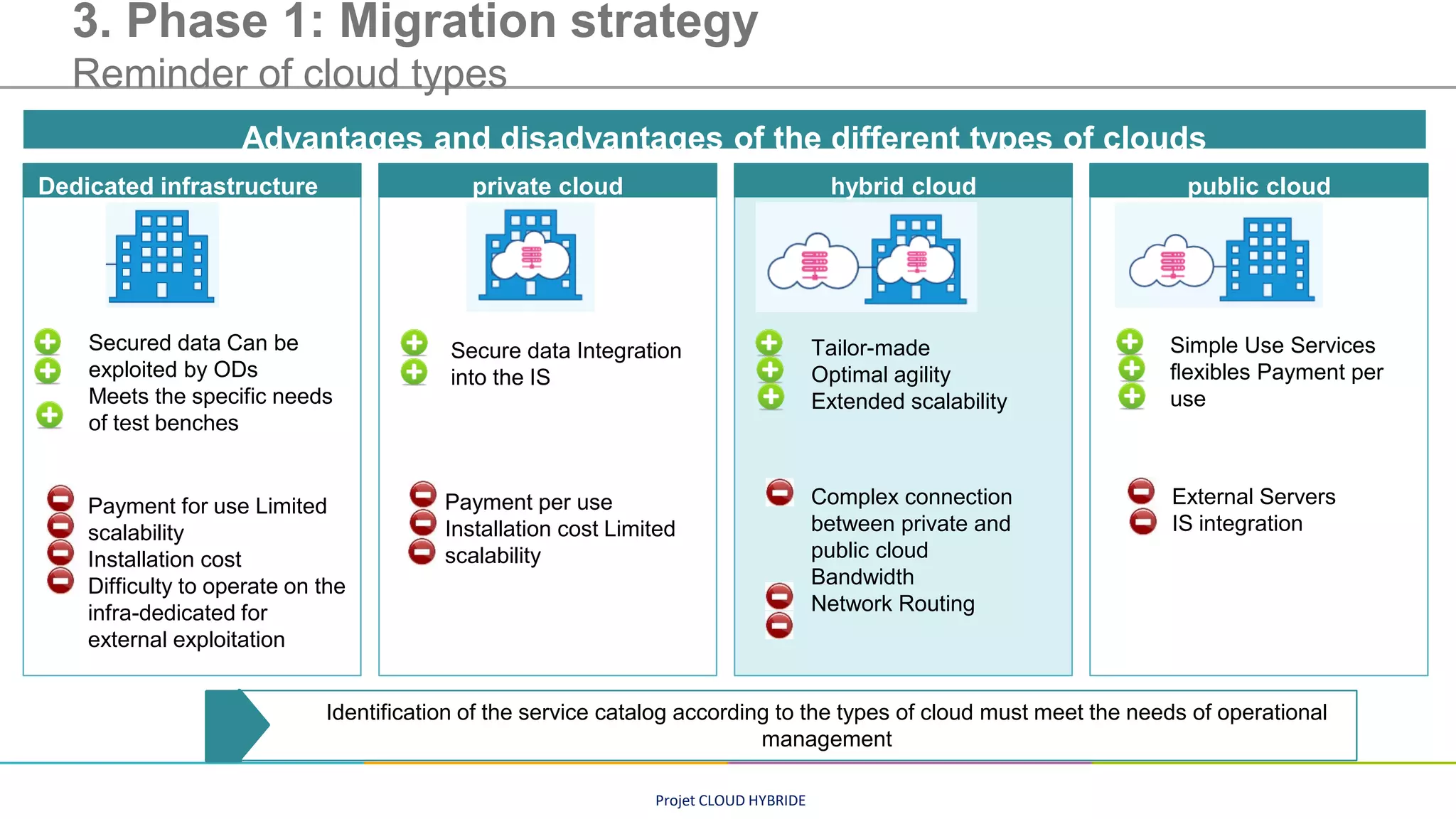
Advantages and disadvantages of the different types of clouds
Dedicated infrastructure private cloud hybrid cloud public cloud
Secure data Integration
into the IS
Tailor-made
Optimal agility
Extended scalability
Complex connection
between private and
public cloud
Bandwidth
Network Routing
Simple Use Services
flexibles Payment per
use
Payment per use
Installation cost Limited
scalability
Secured data Can be
exploited by ODs
Meets the specific needs
of test benches
Payment for use Limited
scalability
Installation cost
Difficulty to operate on the
infra-dedicated for
external exploitation
External Servers
IS integration
Identification of the service catalog according to the types of cloud must meet the needs of operational
management
Projet CLOUD HYBRIDE
3. Phase 1: Migration strategy
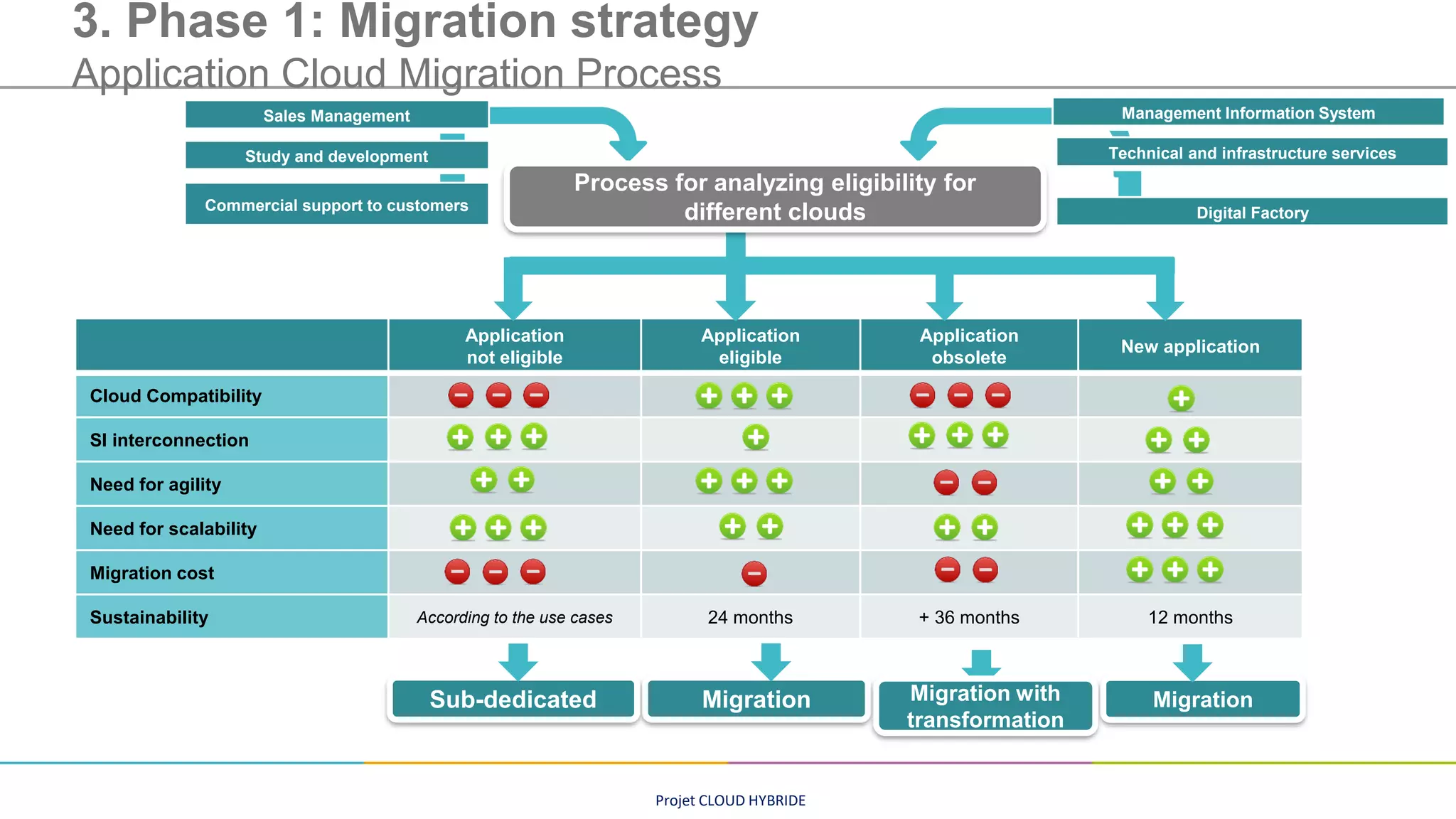
Application Cloud Migration Process
Application
not eligible
Application
eligible
Application
obsolete
New application
Cloud Compatibility
SI interconnection
Need for agility
Need for scalability
Migration cost
Sustainability According to the use cases 24 months + 36 months 12 months
Commercial support to customers
Study and development Technical and infrastructure services
Digital Factory
Sales Management Management Information System
Migration
Sub-dedicated Migration
Migration with
transformation
Process for analyzing eligibility for
different clouds
Projet CLOUD HYBRIDE
3. Phase 1: Migration strategy
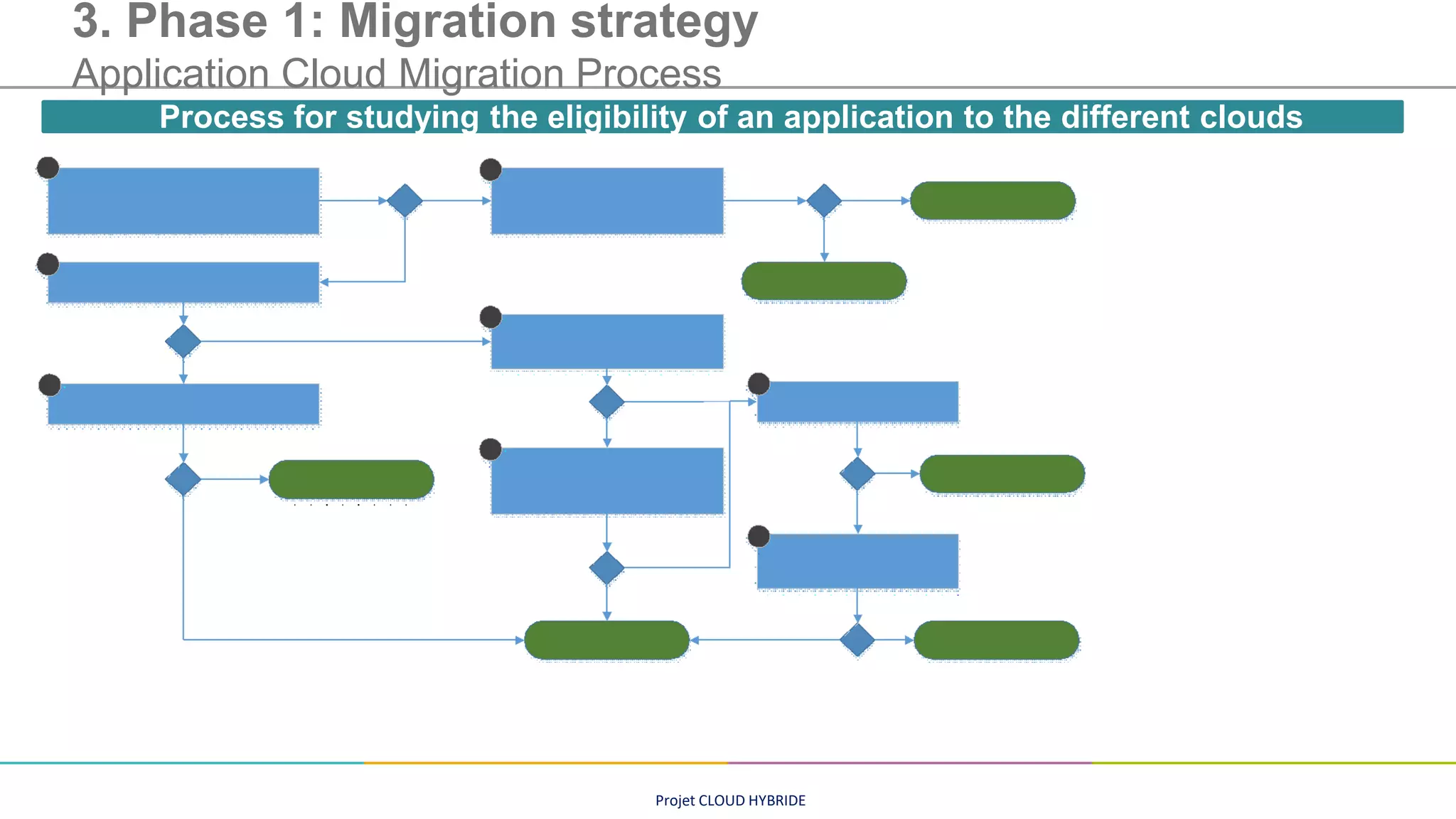
Application Cloud Migration Process
Process for studying the eligibility of an application to the different clouds
Projet CLOUD HYBRIDE
© Copyright 2017
Summary
Decision Support Matrix to analyze the dimensioning of good cloud per application
Summary of sizing for the different types of clouds
1. Cloud issues and challenges for CIOs
2. The hybrid cloud: a 4-step migration process
5. Phase 3: Hybrid Cloud and Application Deployment
6. Phase 4: Day-to-day operations
Key factors for successful migration
Migration scenario for applications
Disaster recovery plan
The stages of the design of its Cloud
4. Phase 2: Design
Supervision
Payment per use
3. Phase 1: Migration strategy
Criteria to be taken into account
The different types of cloud
Application Cloud Migration Process
Definition of managed services - service catalog example
Projet CLOUD HYBRIDE
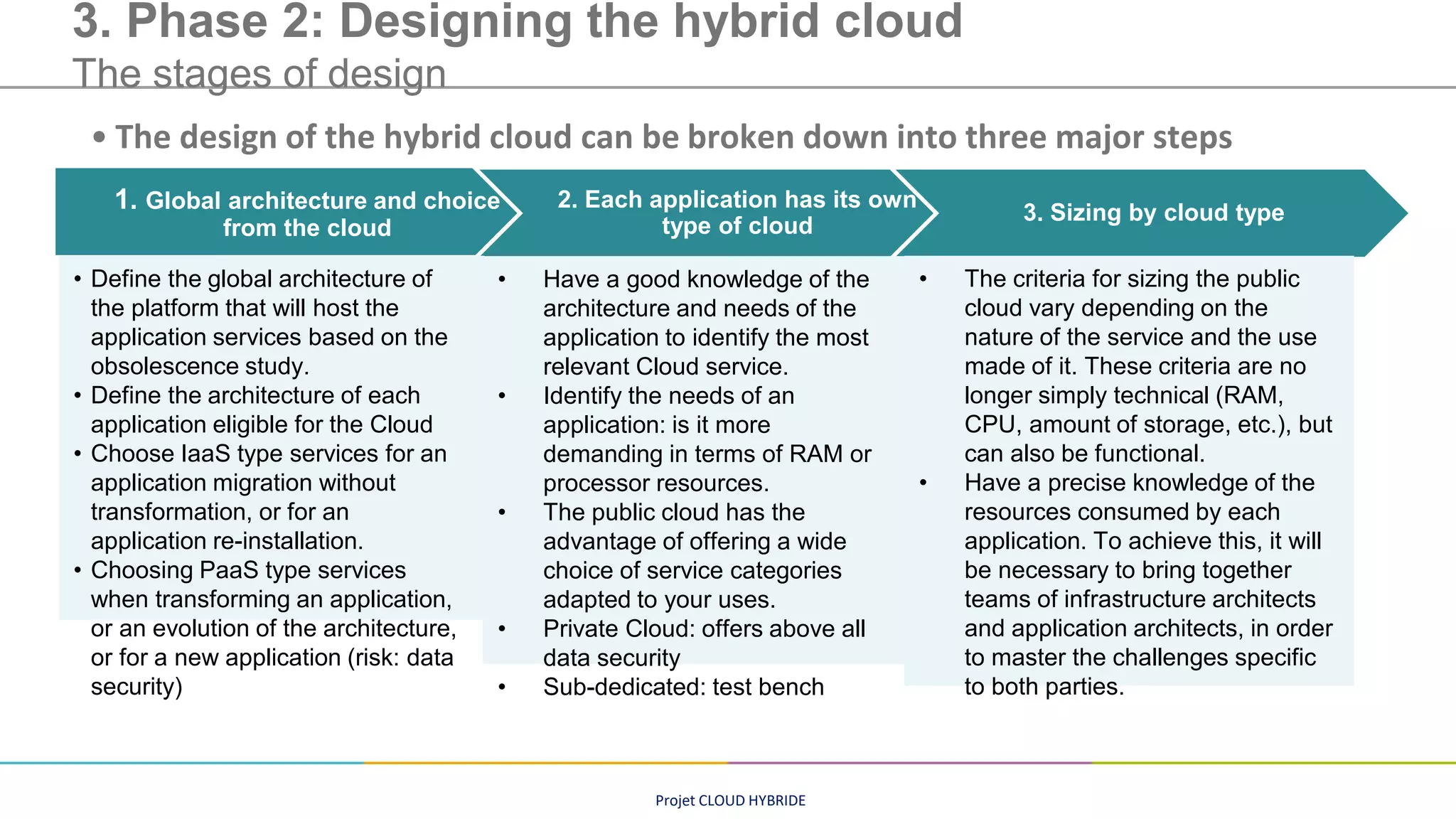
3. Phase 2: Designing the hybrid cloud
The stages of design
• The design of the hybrid cloud can be broken down into three major steps
1. Global architecture and choice
from the cloud
2. Each application has its own
type of cloud
3. Sizing by cloud type
• Define the global architecture of
the platform that will host the
application services based on the
obsolescence study.
• Define the architecture of each
application eligible for the Cloud
• Choose IaaS type services for an
application migration without
transformation, or for an
application re-installation.
• Choosing PaaS type services
when transforming an application,
or an evolution of the architecture,
or for a new application (risk: data
security)
• Have a good knowledge of the
architecture and needs of the
application to identify the most
relevant Cloud service.
• Identify the needs of an
application: is it more
demanding in terms of RAM or
processor resources.
• The public cloud has the
advantage of offering a wide
choice of service categories
adapted to your uses.
• Private Cloud: offers above all
data security
• Sub-dedicated: test bench
• The criteria for sizing the public
cloud vary depending on the
nature of the service and the use
made of it. These criteria are no
longer simply technical (RAM,
CPU, amount of storage, etc.), but
can also be functional.
• Have a precise knowledge of the
resources consumed by each
application. To achieve this, it will
be necessary to bring together
teams of infrastructure architects
and application architects, in order
to master the challenges specific
to both parties.
Projet CLOUD HYBRIDE
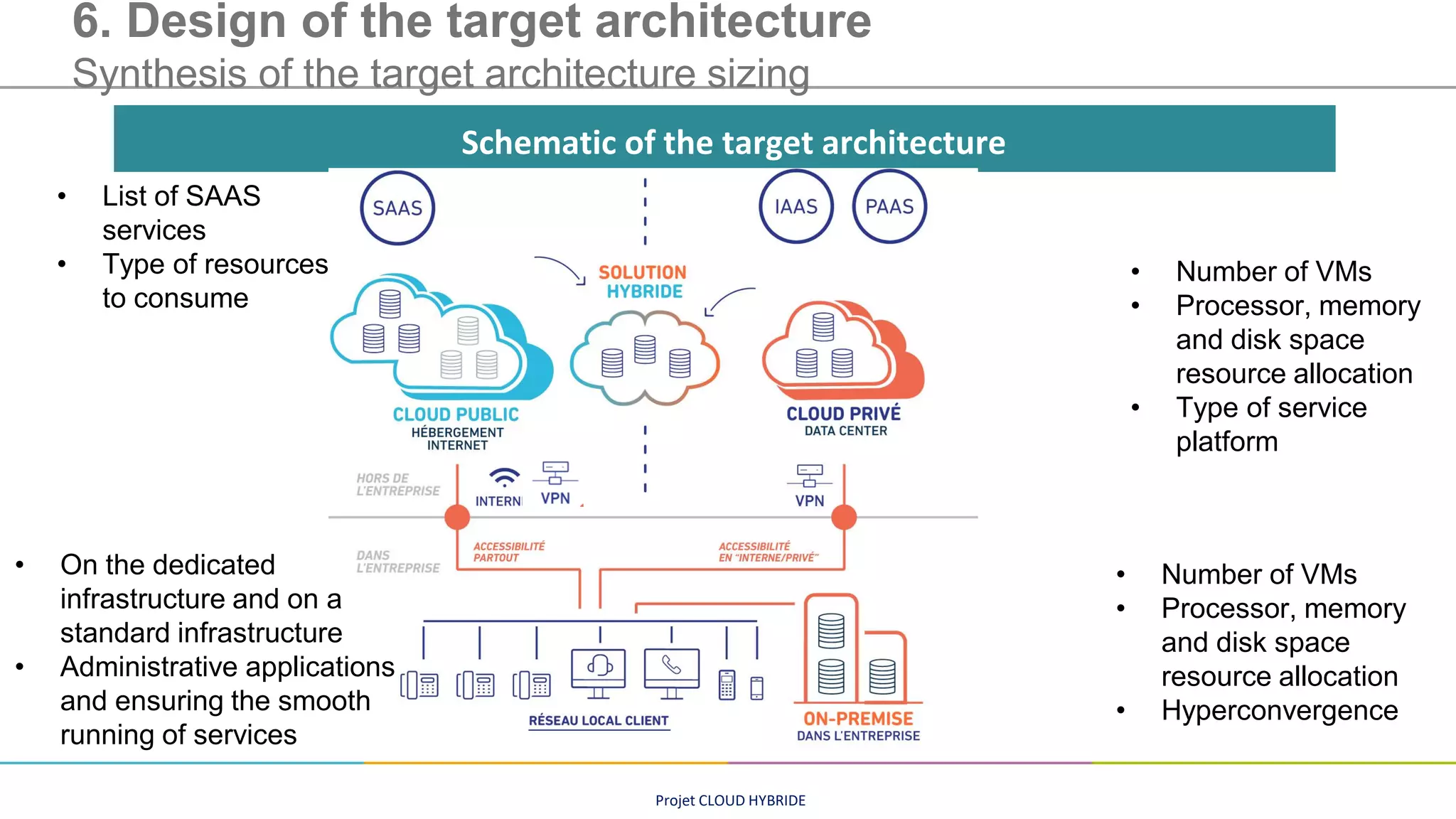
6. Design of the target architecture
Synthesis of the target architecture sizing
Schematic of the target architecture
• List of SAAS
services
• Type of resources
to consume
• Number of VMs
• Processor, memory
and disk space
resource allocation
• Type of service
platform
• Number of VMs
• Processor, memory
and disk space
resource allocation
• Hyperconvergence
• On the dedicated
infrastructure and on a
standard infrastructure
• Administrative applications
and ensuring the smooth
running of services
Projet CLOUD HYBRIDE
© Copyright 2017
Summary
1. Cloud issues and challenges for CIOs
2. The hybrid cloud: a 4-step migration process
6. Phase 4: Day-to-day operations
Key factors for successful migration
Migration scenario for applications
Disaster recovery plan
4. Phase 2: Design
5. Phase 3: Hybrid Cloud and Application Deployment
Supervision
Payment per use
3. Phase 1: Migration strategy
Criteria to be taken into account
The different types of cloud
Application Cloud Migration Process
Definition of managed services - service catalog example
Decision Support Matrix to analyze cloud provisioning by application
Summary of sizing for the different types of clouds
The stages of the design of its Cloud
Projet CLOUD HYBRIDE
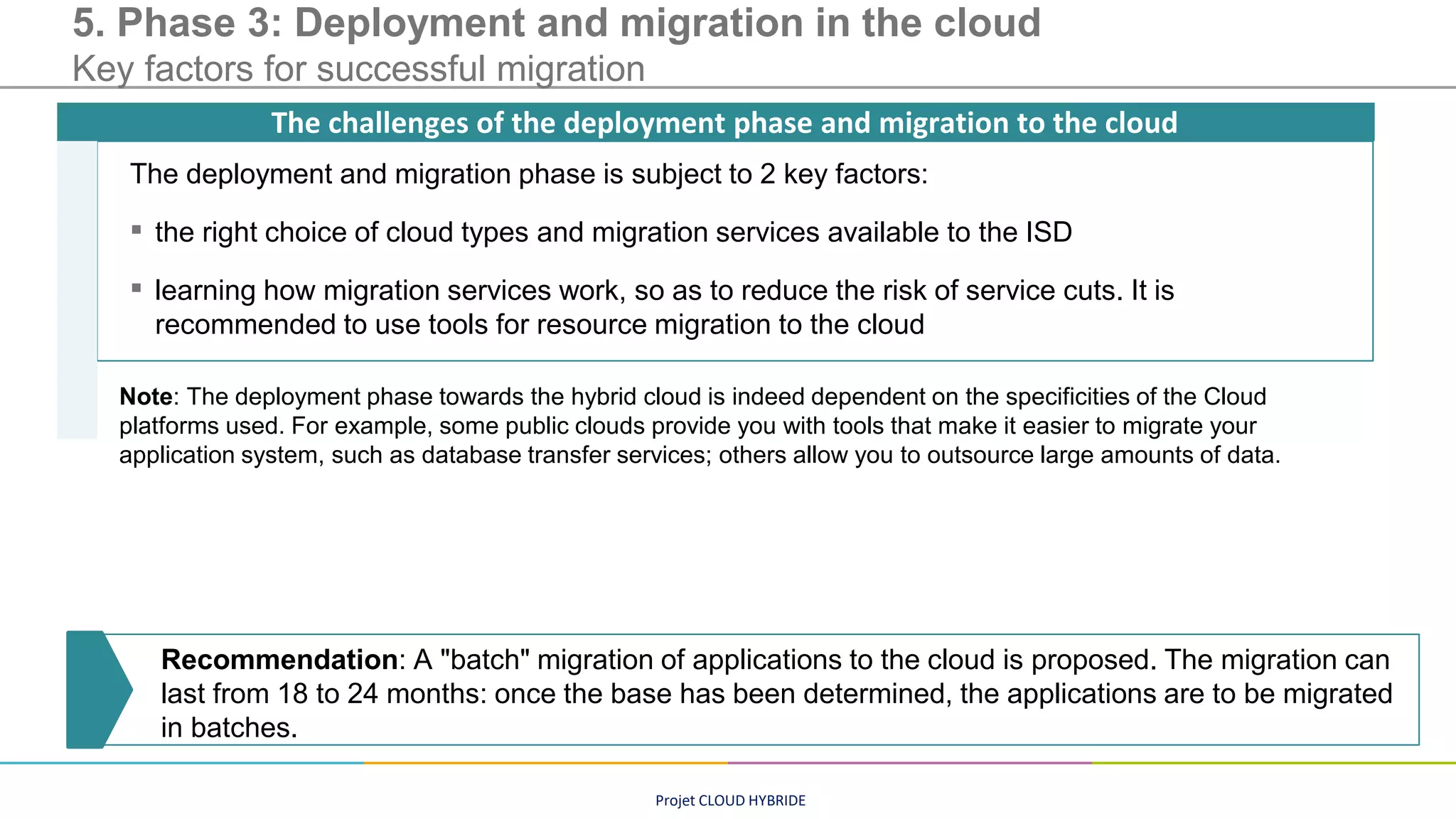
5. Phase 3: Deployment and migration in the cloud
Key factors for successful migration
The deployment and migration phase is subject to 2 key factors:
▪ the right choice of cloud types and migration services available to the ISD
▪ learning how migration services work, so as to reduce the risk of service cuts. It is
recommended to use tools for resource migration to the cloud
Note: The deployment phase towards the hybrid cloud is indeed dependent on the specificities of the Cloud
platforms used. For example, some public clouds provide you with tools that make it easier to migrate your
application system, such as database transfer services; others allow you to outsource large amounts of data.
The challenges of the deployment phase and migration to the cloud
Recommendation: A "batch" migration of applications to the cloud is proposed. The migration can
last from 18 to 24 months: once the base has been determined, the applications are to be migrated
in batches.
Projet CLOUD HYBRIDE
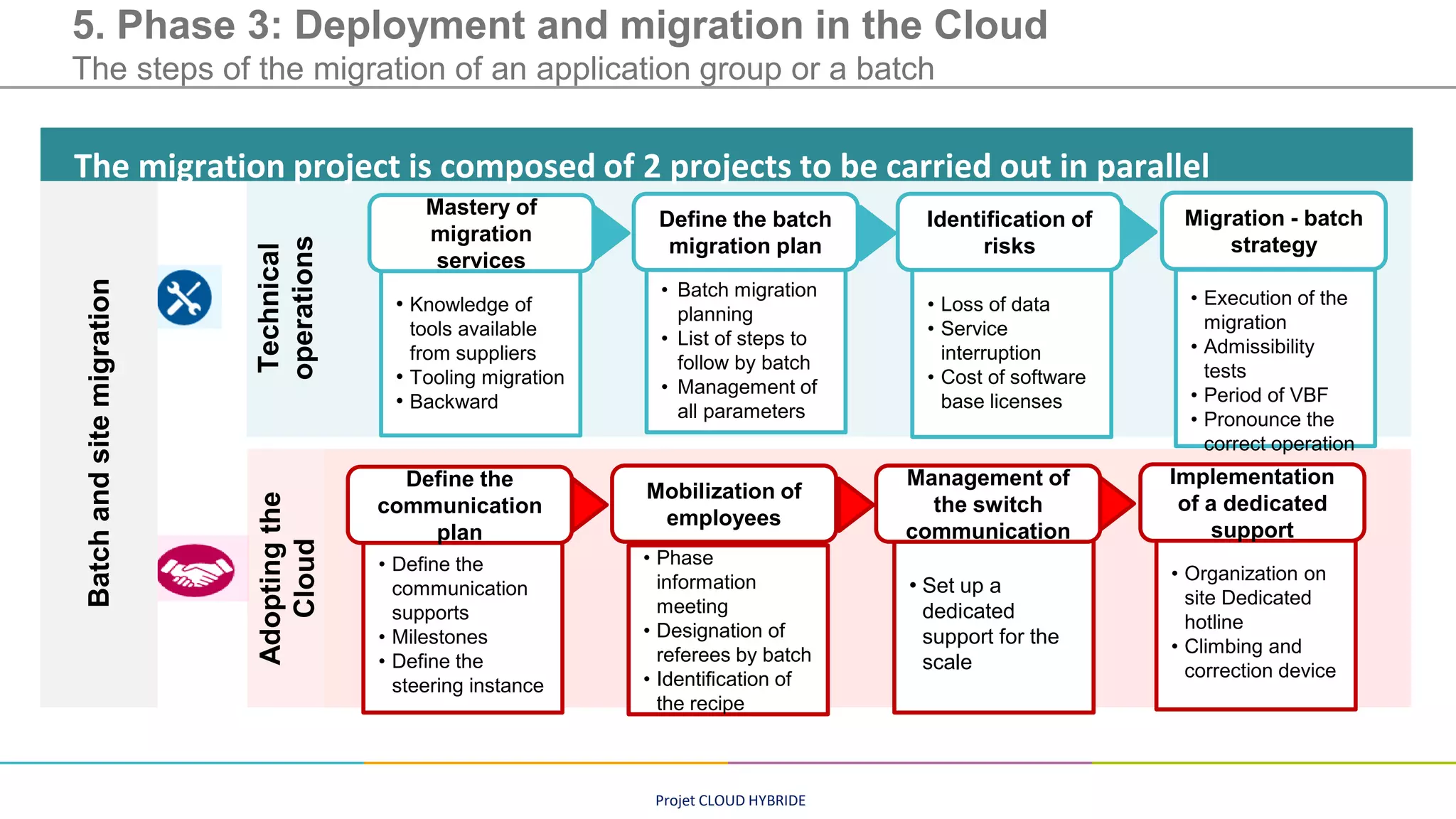
5. Phase 3: Deployment and migration in the Cloud
The steps of the migration of an application group or a batch
Technical
operations
Adopting
the
Cloud • Knowledge of
tools available
from suppliers
• Tooling migration
• Backward
Mastery of
migration
services
• Batch migration
planning
• List of steps to
follow by batch
• Management of
all parameters
Define the batch
migration plan
• Loss of data
• Service
interruption
• Cost of software
base licenses
Identification of
risks
• Execution of the
migration
• Admissibility
tests
• Period of VBF
• Pronounce the
correct operation
Migration - batch
strategy
• Define the
communication
supports
• Milestones
• Define the
steering instance
• Phase
information
meeting
• Designation of
referees by batch
• Identification of
the recipe
• Set up a
dedicated
support for the
scale
• Organization on
site Dedicated
hotline
• Climbing and
correction device
Define the
communication
plan
Mobilization of
employees
Management of
the switch
communication
Implementation
of a dedicated
support
Batch
and
site
migration
The migration project is composed of 2 projects to be carried out in parallel
Projet CLOUD HYBRIDE
5. Phase 3: Deployment and migration in the Cloud
Steps in the migration of a group of applications or a batch
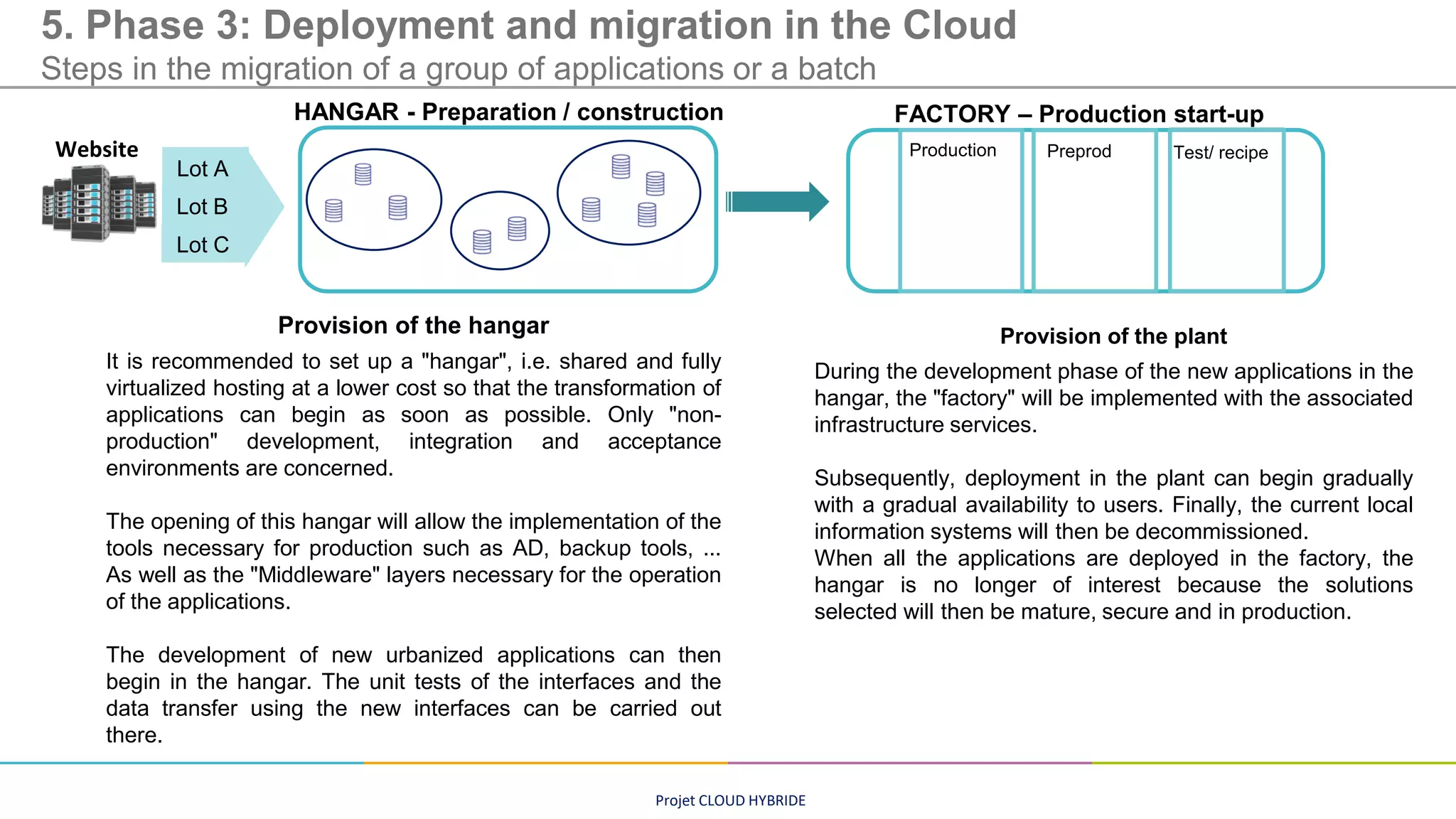
Provision of the plant
During the development phase of the new applications in the
hangar, the "factory" will be implemented with the associated
infrastructure services.
Subsequently, deployment in the plant can begin gradually
with a gradual availability to users. Finally, the current local
information systems will then be decommissioned.
When all the applications are deployed in the factory, the
hangar is no longer of interest because the solutions
selected will then be mature, secure and in production.
Provision of the hangar
It is recommended to set up a "hangar", i.e. shared and fully
virtualized hosting at a lower cost so that the transformation of
applications can begin as soon as possible. Only "non-
production" development, integration and acceptance
environments are concerned.
The opening of this hangar will allow the implementation of the
tools necessary for production such as AD, backup tools, ...
As well as the "Middleware" layers necessary for the operation
of the applications.
The development of new urbanized applications can then
begin in the hangar. The unit tests of the interfaces and the
data transfer using the new interfaces can be carried out
there.
Website
Lot A
Lot B
Lot C
HANGAR - Preparation / construction FACTORY – Production start-up
Production Preprod Test/ recipe
Projet CLOUD HYBRIDE
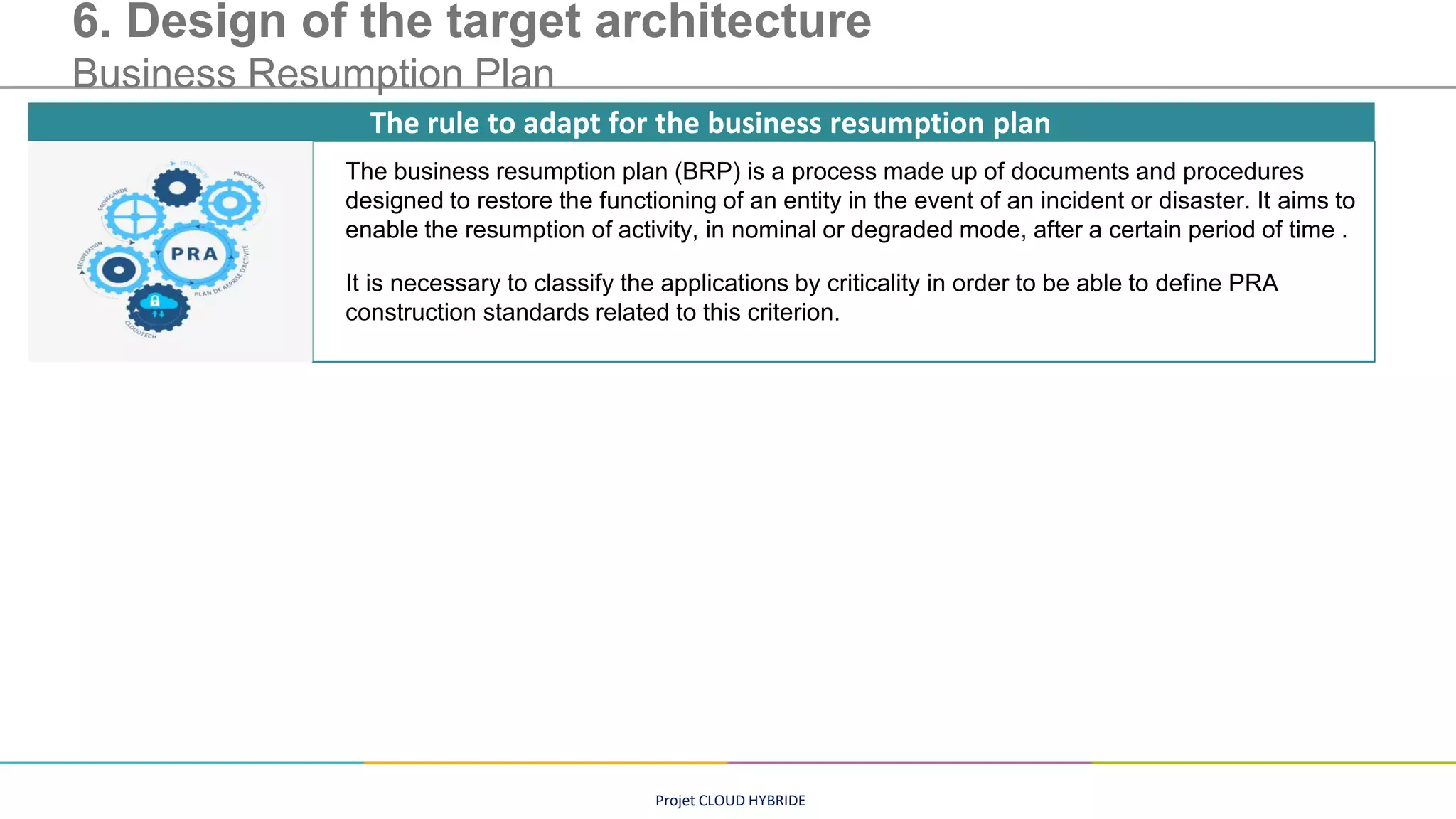
6. Design of the target architecture
Business Resumption Plan
The business resumption plan (BRP) is a process made up of documents and procedures
designed to restore the functioning of an entity in the event of an incident or disaster. It aims to
enable the resumption of activity, in nominal or degraded mode, after a certain period of time .
It is necessary to classify the applications by criticality in order to be able to define PRA
construction standards related to this criterion.
The rule to adapt for the business resumption plan
Projet CLOUD HYBRIDE
6. Design of the target architecture
Business resumption plan - technical architecture
As part of an ARP, it is necessary to have a backup site where critical data and applications are synchronized and to which
regular users are redirected in the event of a major outage or malfunction.
The PRA is based on a global storage replication
mechanism between the two datacenters.
Therefore the activation of the servers on the backup is
necessary, i.e. all servers containing the business data
for a given application must be started.
rescue
Asynchronous
data
replication
Critical
applications
Projet CLOUD HYBRIDE
© Copyright 2017
Summary
1. Cloud issues and challenges for CIOs
2. The hybrid cloud: a 4-step migration process
6. Phase 4: Day-to-day operations
Key factors for successful migration
Migration scenario for applications
Disaster recovery plan
4. Phase 2: Design
5. Phase 3: Hybrid Cloud and Application Deployment
Supervision
Payment per use
3. Phase 1: Migration strategy
Criteria to be taken into account
The different types of cloud
Application Cloud Migration Process
Definition of managed services - service catalog example
Decision Support Matrix to analyze cloud provisioning by application
Summary of sizing for the different types of clouds
The stages of the design of its Cloud
Projet CLOUD HYBRIDE
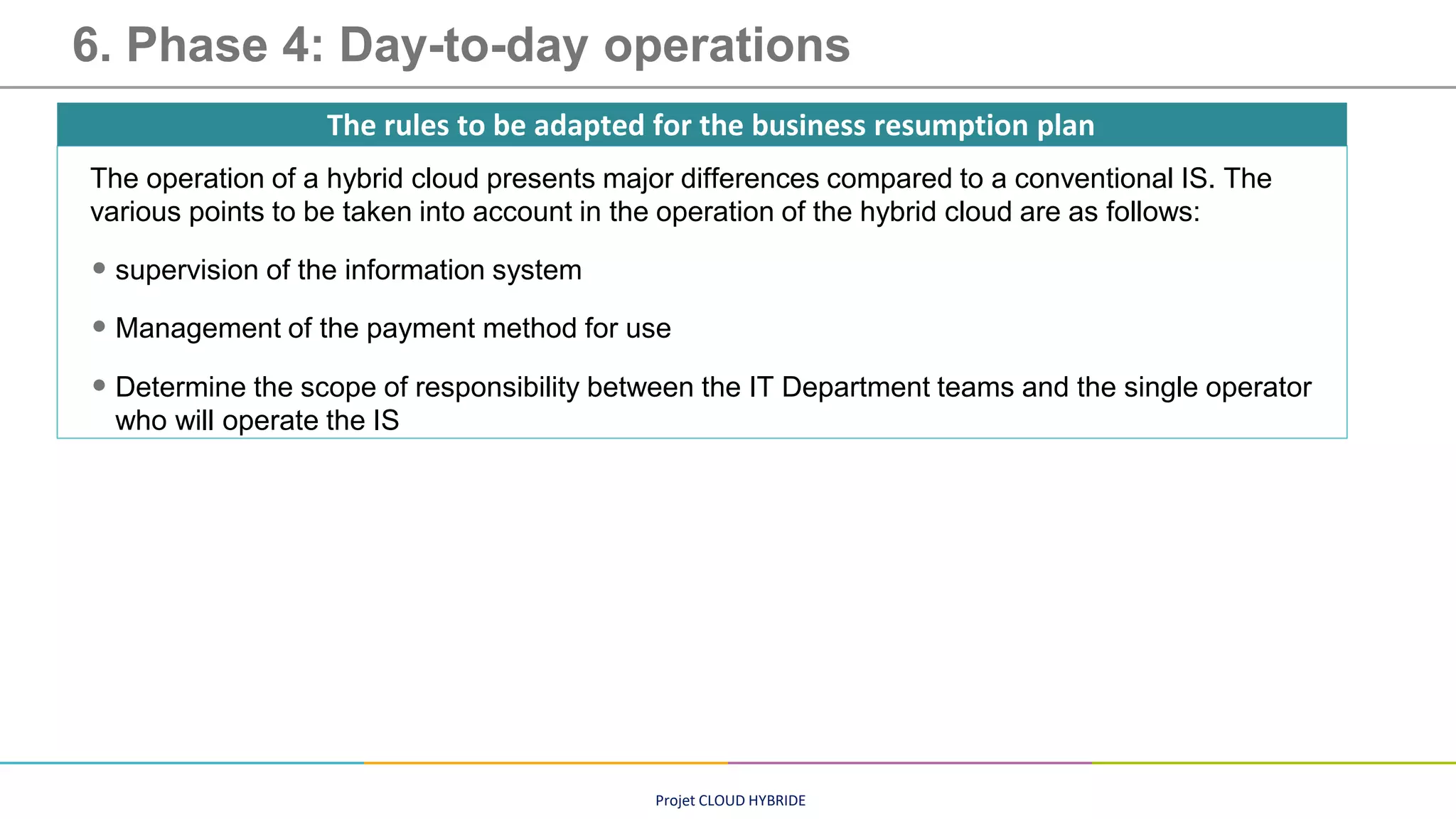
6. Phase 4: Day-to-day operations
The operation of a hybrid cloud presents major differences compared to a conventional IS. The
various points to be taken into account in the operation of the hybrid cloud are as follows:
• supervision of the information system
• Management of the payment method for use
• Determine the scope of responsibility between the IT Department teams and the single operator
who will operate the IS
The rules to be adapted for the business resumption plan
Projet CLOUD HYBRIDE
6. Phase 4: Day-to-day operations
Supervision
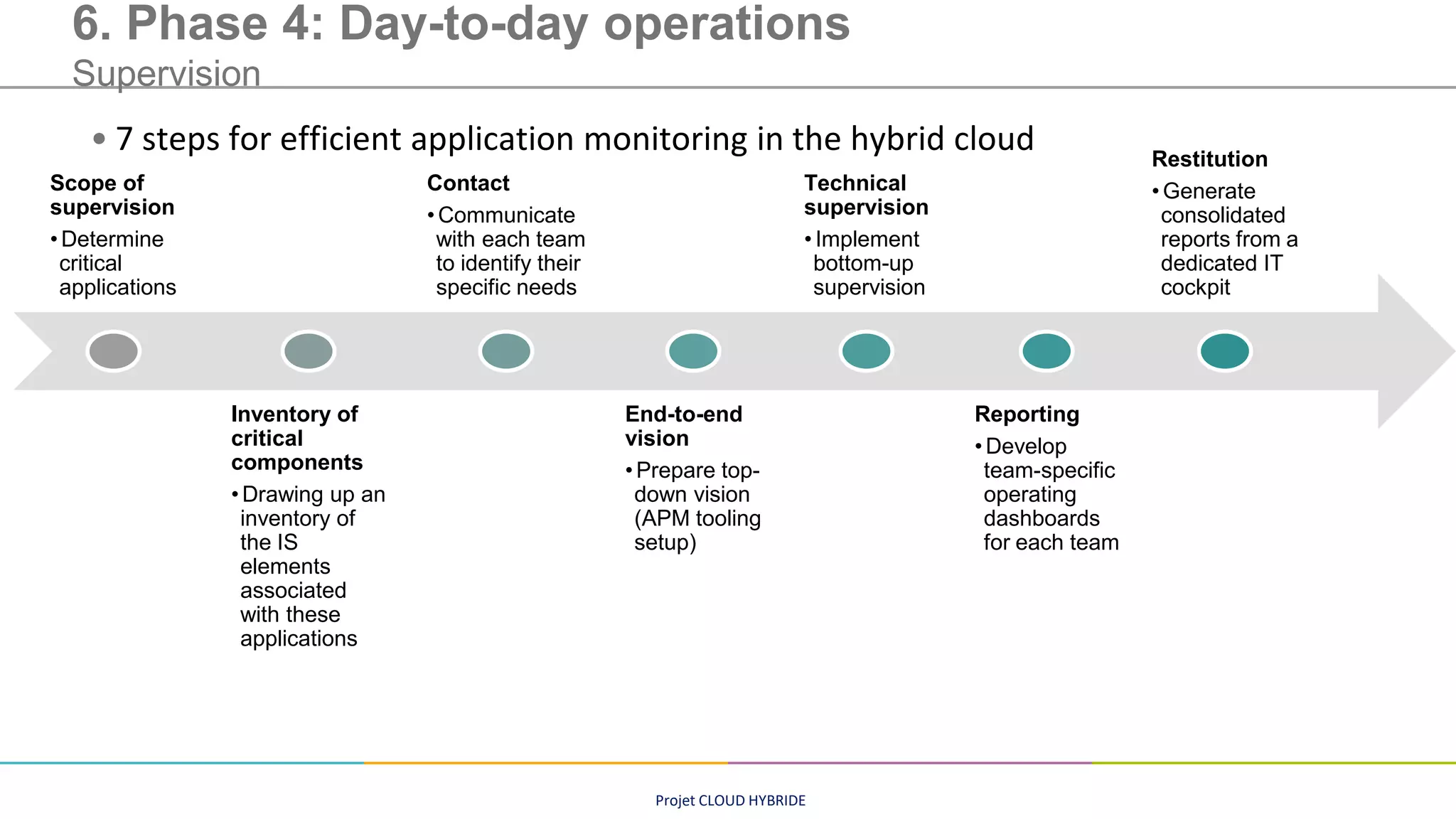
• 7 steps for efficient application monitoring in the hybrid cloud
Scope of
supervision
•Determine
critical
applications
Inventory of
critical
components
•Drawing up an
inventory of
the IS
elements
associated
with these
applications
Contact
•Communicate
with each team
to identify their
specific needs
End-to-end
vision
•Prepare top-
down vision
(APM tooling
setup)
Technical
supervision
• Implement
bottom-up
supervision
Reporting
• Develop
team-specific
operating
dashboards
for each team
Restitution
•Generate
consolidated
reports from a
dedicated IT
cockpit
Projet CLOUD HYBRIDE
6. Phase 4: Day-to-day operations
Hybrid cloud budget tracking
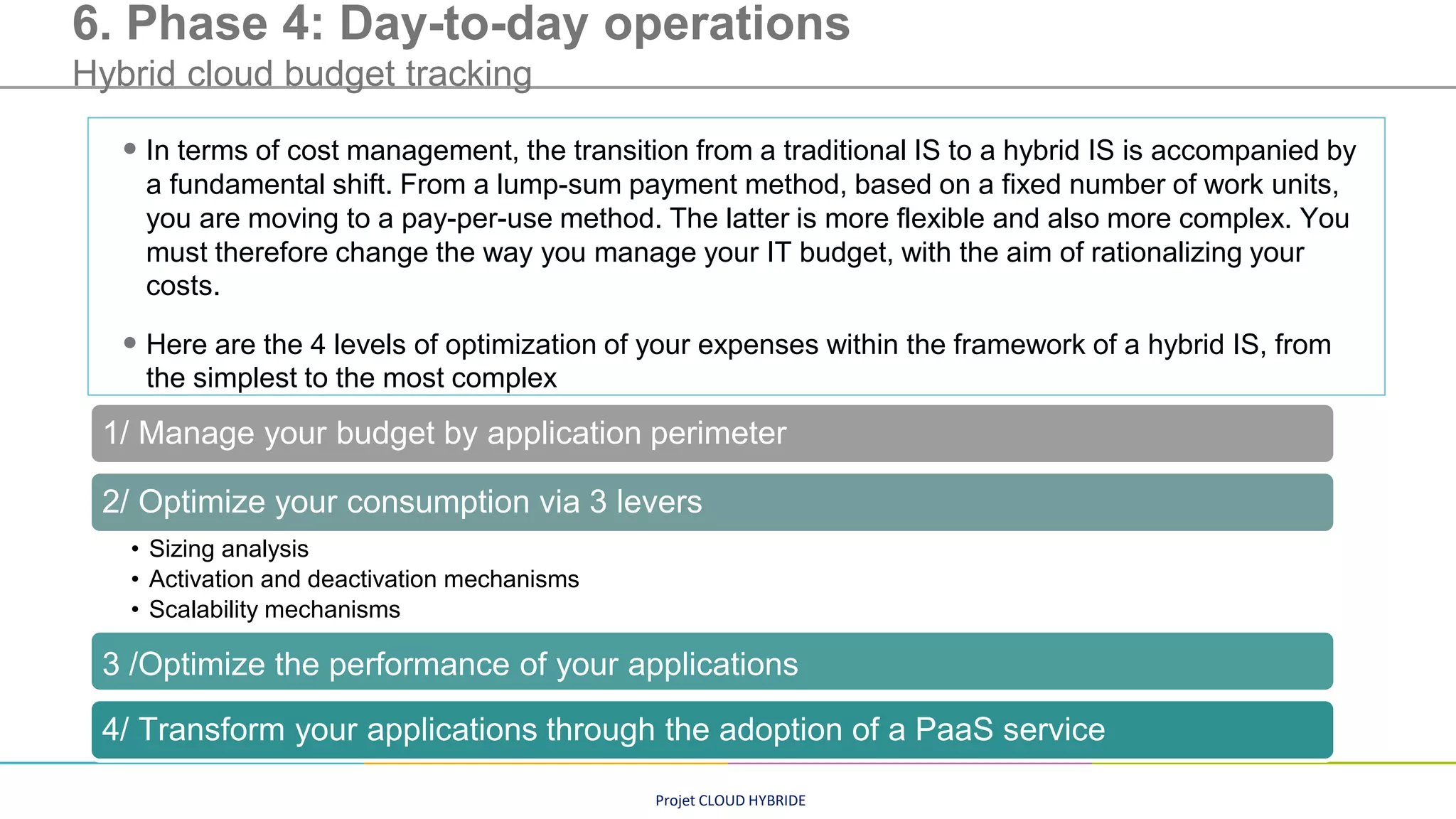
• In terms of cost management, the transition from a traditional IS to a hybrid IS is accompanied by
a fundamental shift. From a lump-sum payment method, based on a fixed number of work units,
you are moving to a pay-per-use method. The latter is more flexible and also more complex. You
must therefore change the way you manage your IT budget, with the aim of rationalizing your
costs.
• Here are the 4 levels of optimization of your expenses within the framework of a hybrid IS, from
the simplest to the most complex
1/ Manage your budget by application perimeter
2/ Optimize your consumption via 3 levers
• Sizing analysis
• Activation and deactivation mechanisms
• Scalability mechanisms
3 /Optimize the performance of your applications
4/ Transform your applications through the adoption of a PaaS service
Contact
Sylvain FRANCESCHI
Partner I Conseil DSI
Mob :+33 (0)6 85 13 62 34
Mail : sylvain.franceschi@
28

Migration to the hybrid cloud in 4 steps

  • 1.
    A l’attention de: Auteur(s) : Réf : Date : Migration to the Hybrid Cloud in 4 steps Approach and sizing of the target HYBRID CLOUD PROJECT MARCH 2017 White Paper - Hybrid Cloud Migration Sylvain FRANCESCHI - Technical Director
  • 2.
    Projet CLOUD HYBRIDE ©Copyright 2017 Summary 1. Cloud issues and challenges for CIOs 2. The hybrid cloud: a 4-step migration process 3. Phase 1: Migration strategy 4. Phase 2: Design 5. Phase 3: Hybrid Cloud and Application Deployment 6. Phase 4: Day-to-day operations Supervision Payment per use Key factors for successful migration Migration scenario for applications Disaster recovery plan Criteria to be taken into account The different types of cloud Application Cloud Migration Process Definition of managed services - service catalog example Decision Support Matrix to analyze cloud provisioning by application Summary of sizing for the different types of clouds The stages of the design of its Cloud
  • 3.
    Projet CLOUD HYBRIDE 1.Cloud issues and challenges for CIOs Faced with the many needs that IT systems on different sites are facing (explosion in data volumes, the emergence of the public cloud, hardware obsolescence, data security constraints, source code), operational management is faced with a number of technical and operational issues. General Context How to provide a customized architecture to operational departments by projects? Storage needs for large amounts of data are often at the heart of developments and big data architectures? Data and security in a Hybrid Cloud context? constraints and limits? How to choose the type of cloud per application (public, private, infra- dedicated)? Should all infrastructure elements be virtualized and centralized on a Hybrid Cloud? What are the eligibility criteria for the cloud in the ISD organization? What approach should be adopted according to the needs of operational departments and projects to migrate to the cloud? What are the steps involved in migrating eligible applications to the Hybrid Cloud? Organization and method Sizing and securing data
  • 4.
    Projet CLOUD HYBRIDE 1.Cloud issues and challenges for CIOs Constraints of the operational departments ▪ The computing or storage power of servers must meet specific needs per project, quickly according to their lifecycle. ▪ As the volume of data increases, so does the rate at which the storage capacity of the information system must be revised. ▪ In concrete terms, computer equipment - private on site - quickly becomes obsolete. The obsolescence study highlights a part of the IS that is not eligible for the Cloud. Shadow IT is the most affected by the obsolescence of software components. ▪ The internal technical architecture has increasing IT costs. We need to question their strategies, opting for more flexible and economical solutions. They are moving towards public cloud solutions such as Azure or Amazon. What examples of constraints identified by the projects The "Cloud" approach enables a shift from an expensive CAPEX business model to an OPEX model, while guaranteeing greater flexibility and performance for operational management. The ISD centralizes the infrastructure elements in order to put in place a more suitable business model. The solution adopted by the ISD and companies
  • 5.
    Projet CLOUD HYBRIDE 1.Cloud issues and challenges for CIOs The solution proposed by the ISD, the Hybrid Cloud The "hybrid cloud" approach is in many cases the most relevant answer because it brings : The HYBRID Cloud > The solution chosen by DSI AGILE The necessary flexibility while ensuring data security It offers a compromise between performance and scalability It enables us to design infrastructures that are tailored to meet business needs as closely as possible. The main challenge is therefore to know how best to place the cursor of the services between an external operator and the internal teams.
  • 6.
    Projet CLOUD HYBRIDE ©Copyright 2017 Summary 1. Cloud issues and challenges for CIOs 2. The hybrid cloud: a 4-step migration process 3. Phase 1: Migration strategy 4. Phase 2: Design 5. Phase 3: Hybrid Cloud and Application Deployment 6. Phase 4: Day-to-day operations Supervision Payment per use Key factors for successful migration Migration scenario for applications Disaster recovery plan 3. Phase 1: Migration strategy Criteria to be taken into account The different types of cloud Application Cloud Migration Process Definition of managed services - service catalog example Decision Support Matrix to analyze cloud provisioning by application Summary of sizing for the different types of clouds The stages of the design of its Cloud
  • 7.
    Projet CLOUD HYBRIDE 2.The hybrid cloud: a 4-step migration process The main characteristics sought for the implementation of a hybrid cloud are the following: Reminder of the characteristics of a hybrid cloud project The choice depends on the user's needs and his ability to be involved in the implementation of the resources. (too much specificity = private or infra dedicated cloud). Resources are automatically deployed on demand without having to go through an operator, as can be the case when there is a demand for high computing power on a one-off basis. The project that needs the service can request it directly via a service portal. In this type of project, payment criteria will have to be defined according to the consumption and the service used by the projects. Automate the most common requests Towards an on-demand service type solution Pay-per-use billing systems Hybrid solution: public, private, infra-dedicated cloud Deployment of a faster and more responsive service, Resources are immediately made available by the supplier via a dedicated portal. The pay-as-you-go billing system gives you the opportunity to start slowly, and stop the project while minimizing financial losses. The Cloud includes an auto-scalability function. The resources used will be adapted to the real needs of the projects. The fixed costs of a traditional package are eliminated. We are moving towards a payment adjusted to the real needs of the operational departments.
  • 8.
    Projet CLOUD HYBRIDE 2.The Hybrid Cloud: the 4-step migration process • The 4 phases of setting up a Hybrid Cloud proposed by EI-Management » Hybrid Cloud Migration Project 1. The migration strategy 2. The design of the cloud 3. Development (BUILD) 4. Operations (RUN) • Inventory of uses • Resource Inventories • Obsolescence study • Analyze the existing system according to technical constraints and non- functional requirements. • Choosing the "right cloud" per application • Identification of "managed services • Choosing a provider capable of operating in the Hybrid Cloud • Define the global architecture • Sizing cloud types • Cloud types, its usage classes and identification of the necessary resources • Choosing a solution for publishing managed services via a single portal • Dimensioning tests / Load tests • Putting the stakes of migration at the heart of the construction process • Coordinate change management • Elaborate a migration process for these classes of uses and related projects • Migration methodology to be adopted according to usage classes • Project supervision according to cloud type • Define the payment model to be used by operational departments • Determine user limits on operations based on cloud types • Do not penalize users, meet needs with the necessary agility
  • 9.
    Projet CLOUD HYBRIDE ©Copyright 2017 Summary 1. Cloud issues and challenges for CIOs 2. The hybrid cloud: a 4-step migration process 4. Phase 2: Design 5. Phase 3: Hybrid Cloud and Application Deployment 6. Phase 4: Day-to-day operations 3. Phase 1: Migration strategy Supervision Payment per use Key factors for successful migration Migration scenario for applications Disaster recovery plan 3. Phase 1: Migration strategy Criteria to be taken into account The different types of cloud Application Cloud Migration Process Definition of managed services - service catalog example Decision Support Matrix to analyze cloud provisioning by application Summary of sizing for the different types of clouds The stages of the design of its Cloud
  • 10.
    Projet CLOUD HYBRIDE 3.Phase 1: Migration strategy the context and criteria to be taken into account Our proposed strategy for migrating the existing infrastructure to the Hybrid Cloud is based on the following criteria: Project and on-demand migration approach for security Analysis of the classes of use and the security required to be implemented around the application Identification of storage and computing power requirements Analysis and sorting of applications to be migrated to the different clouds according to obsolescence Defining the migration strategy consists in analyzing and sorting the applications to be migrated. This application mapping process is key to sizing each type of cloud It is part of the change management process to promote the adoption of the future Cloud by operational departments. 1 2 3 4
  • 11.
    Projet CLOUD HYBRIDE 3.Phase 1: Migration strategy Reminder of cloud types Definition of cloud types Public Cloud • On-line technical infrastructures to provide IT resources in IaaS mode, most often pooled • Shared online technical infrastructures to provide IT resources in IaaS mode in the data centers of a Cloud Provider that has created its Cloud services offering Private / internal technical infrastructure • Dedicated technical infrastructures owned by the IT Department or rented, located in a datacenter (on its premises or in shared facilities) Private Cloud (outsourced) • Dedicated online technical infrastructures provided in IaaS mode in a provider's data centers (Cloud Provider) Hybrid Cloud It is the combination of all the possibilities on offer, from "Private Technical Infrastructures" to the "Public Cloud", including "Private Cloud" and "Shared", for the provision of IT resources. Shared Cloud • Shared online technical infrastructures to provide IT resources in IaaS mode in the data centers of a Cloud Provider that has created its Cloud services offering
  • 12.
    Projet CLOUD HYBRIDE 3.Phase 1: Migration strategy Reminder of cloud types Advantages and disadvantages of the different types of clouds Dedicated infrastructure private cloud hybrid cloud public cloud Secure data Integration into the IS Tailor-made Optimal agility Extended scalability Complex connection between private and public cloud Bandwidth Network Routing Simple Use Services flexibles Payment per use Payment per use Installation cost Limited scalability Secured data Can be exploited by ODs Meets the specific needs of test benches Payment for use Limited scalability Installation cost Difficulty to operate on the infra-dedicated for external exploitation External Servers IS integration Identification of the service catalog according to the types of cloud must meet the needs of operational management
  • 13.
    Projet CLOUD HYBRIDE 3.Phase 1: Migration strategy Application Cloud Migration Process Application not eligible Application eligible Application obsolete New application Cloud Compatibility SI interconnection Need for agility Need for scalability Migration cost Sustainability According to the use cases 24 months + 36 months 12 months Commercial support to customers Study and development Technical and infrastructure services Digital Factory Sales Management Management Information System Migration Sub-dedicated Migration Migration with transformation Process for analyzing eligibility for different clouds
  • 14.
    Projet CLOUD HYBRIDE 3.Phase 1: Migration strategy Application Cloud Migration Process Process for studying the eligibility of an application to the different clouds
  • 15.
    Projet CLOUD HYBRIDE ©Copyright 2017 Summary Decision Support Matrix to analyze the dimensioning of good cloud per application Summary of sizing for the different types of clouds 1. Cloud issues and challenges for CIOs 2. The hybrid cloud: a 4-step migration process 5. Phase 3: Hybrid Cloud and Application Deployment 6. Phase 4: Day-to-day operations Key factors for successful migration Migration scenario for applications Disaster recovery plan The stages of the design of its Cloud 4. Phase 2: Design Supervision Payment per use 3. Phase 1: Migration strategy Criteria to be taken into account The different types of cloud Application Cloud Migration Process Definition of managed services - service catalog example
  • 16.
    Projet CLOUD HYBRIDE 3.Phase 2: Designing the hybrid cloud The stages of design • The design of the hybrid cloud can be broken down into three major steps 1. Global architecture and choice from the cloud 2. Each application has its own type of cloud 3. Sizing by cloud type • Define the global architecture of the platform that will host the application services based on the obsolescence study. • Define the architecture of each application eligible for the Cloud • Choose IaaS type services for an application migration without transformation, or for an application re-installation. • Choosing PaaS type services when transforming an application, or an evolution of the architecture, or for a new application (risk: data security) • Have a good knowledge of the architecture and needs of the application to identify the most relevant Cloud service. • Identify the needs of an application: is it more demanding in terms of RAM or processor resources. • The public cloud has the advantage of offering a wide choice of service categories adapted to your uses. • Private Cloud: offers above all data security • Sub-dedicated: test bench • The criteria for sizing the public cloud vary depending on the nature of the service and the use made of it. These criteria are no longer simply technical (RAM, CPU, amount of storage, etc.), but can also be functional. • Have a precise knowledge of the resources consumed by each application. To achieve this, it will be necessary to bring together teams of infrastructure architects and application architects, in order to master the challenges specific to both parties.
  • 17.
    Projet CLOUD HYBRIDE 6.Design of the target architecture Synthesis of the target architecture sizing Schematic of the target architecture • List of SAAS services • Type of resources to consume • Number of VMs • Processor, memory and disk space resource allocation • Type of service platform • Number of VMs • Processor, memory and disk space resource allocation • Hyperconvergence • On the dedicated infrastructure and on a standard infrastructure • Administrative applications and ensuring the smooth running of services
  • 18.
    Projet CLOUD HYBRIDE ©Copyright 2017 Summary 1. Cloud issues and challenges for CIOs 2. The hybrid cloud: a 4-step migration process 6. Phase 4: Day-to-day operations Key factors for successful migration Migration scenario for applications Disaster recovery plan 4. Phase 2: Design 5. Phase 3: Hybrid Cloud and Application Deployment Supervision Payment per use 3. Phase 1: Migration strategy Criteria to be taken into account The different types of cloud Application Cloud Migration Process Definition of managed services - service catalog example Decision Support Matrix to analyze cloud provisioning by application Summary of sizing for the different types of clouds The stages of the design of its Cloud
  • 19.
    Projet CLOUD HYBRIDE 5.Phase 3: Deployment and migration in the cloud Key factors for successful migration The deployment and migration phase is subject to 2 key factors: ▪ the right choice of cloud types and migration services available to the ISD ▪ learning how migration services work, so as to reduce the risk of service cuts. It is recommended to use tools for resource migration to the cloud Note: The deployment phase towards the hybrid cloud is indeed dependent on the specificities of the Cloud platforms used. For example, some public clouds provide you with tools that make it easier to migrate your application system, such as database transfer services; others allow you to outsource large amounts of data. The challenges of the deployment phase and migration to the cloud Recommendation: A "batch" migration of applications to the cloud is proposed. The migration can last from 18 to 24 months: once the base has been determined, the applications are to be migrated in batches.
  • 20.
    Projet CLOUD HYBRIDE 5.Phase 3: Deployment and migration in the Cloud The steps of the migration of an application group or a batch Technical operations Adopting the Cloud • Knowledge of tools available from suppliers • Tooling migration • Backward Mastery of migration services • Batch migration planning • List of steps to follow by batch • Management of all parameters Define the batch migration plan • Loss of data • Service interruption • Cost of software base licenses Identification of risks • Execution of the migration • Admissibility tests • Period of VBF • Pronounce the correct operation Migration - batch strategy • Define the communication supports • Milestones • Define the steering instance • Phase information meeting • Designation of referees by batch • Identification of the recipe • Set up a dedicated support for the scale • Organization on site Dedicated hotline • Climbing and correction device Define the communication plan Mobilization of employees Management of the switch communication Implementation of a dedicated support Batch and site migration The migration project is composed of 2 projects to be carried out in parallel
  • 21.
    Projet CLOUD HYBRIDE 5.Phase 3: Deployment and migration in the Cloud Steps in the migration of a group of applications or a batch Provision of the plant During the development phase of the new applications in the hangar, the "factory" will be implemented with the associated infrastructure services. Subsequently, deployment in the plant can begin gradually with a gradual availability to users. Finally, the current local information systems will then be decommissioned. When all the applications are deployed in the factory, the hangar is no longer of interest because the solutions selected will then be mature, secure and in production. Provision of the hangar It is recommended to set up a "hangar", i.e. shared and fully virtualized hosting at a lower cost so that the transformation of applications can begin as soon as possible. Only "non- production" development, integration and acceptance environments are concerned. The opening of this hangar will allow the implementation of the tools necessary for production such as AD, backup tools, ... As well as the "Middleware" layers necessary for the operation of the applications. The development of new urbanized applications can then begin in the hangar. The unit tests of the interfaces and the data transfer using the new interfaces can be carried out there. Website Lot A Lot B Lot C HANGAR - Preparation / construction FACTORY – Production start-up Production Preprod Test/ recipe
  • 22.
    Projet CLOUD HYBRIDE 6.Design of the target architecture Business Resumption Plan The business resumption plan (BRP) is a process made up of documents and procedures designed to restore the functioning of an entity in the event of an incident or disaster. It aims to enable the resumption of activity, in nominal or degraded mode, after a certain period of time . It is necessary to classify the applications by criticality in order to be able to define PRA construction standards related to this criterion. The rule to adapt for the business resumption plan
  • 23.
    Projet CLOUD HYBRIDE 6.Design of the target architecture Business resumption plan - technical architecture As part of an ARP, it is necessary to have a backup site where critical data and applications are synchronized and to which regular users are redirected in the event of a major outage or malfunction. The PRA is based on a global storage replication mechanism between the two datacenters. Therefore the activation of the servers on the backup is necessary, i.e. all servers containing the business data for a given application must be started. rescue Asynchronous data replication Critical applications
  • 24.
    Projet CLOUD HYBRIDE ©Copyright 2017 Summary 1. Cloud issues and challenges for CIOs 2. The hybrid cloud: a 4-step migration process 6. Phase 4: Day-to-day operations Key factors for successful migration Migration scenario for applications Disaster recovery plan 4. Phase 2: Design 5. Phase 3: Hybrid Cloud and Application Deployment Supervision Payment per use 3. Phase 1: Migration strategy Criteria to be taken into account The different types of cloud Application Cloud Migration Process Definition of managed services - service catalog example Decision Support Matrix to analyze cloud provisioning by application Summary of sizing for the different types of clouds The stages of the design of its Cloud
  • 25.
    Projet CLOUD HYBRIDE 6.Phase 4: Day-to-day operations The operation of a hybrid cloud presents major differences compared to a conventional IS. The various points to be taken into account in the operation of the hybrid cloud are as follows: • supervision of the information system • Management of the payment method for use • Determine the scope of responsibility between the IT Department teams and the single operator who will operate the IS The rules to be adapted for the business resumption plan
  • 26.
    Projet CLOUD HYBRIDE 6.Phase 4: Day-to-day operations Supervision • 7 steps for efficient application monitoring in the hybrid cloud Scope of supervision •Determine critical applications Inventory of critical components •Drawing up an inventory of the IS elements associated with these applications Contact •Communicate with each team to identify their specific needs End-to-end vision •Prepare top- down vision (APM tooling setup) Technical supervision • Implement bottom-up supervision Reporting • Develop team-specific operating dashboards for each team Restitution •Generate consolidated reports from a dedicated IT cockpit
  • 27.
    Projet CLOUD HYBRIDE 6.Phase 4: Day-to-day operations Hybrid cloud budget tracking • In terms of cost management, the transition from a traditional IS to a hybrid IS is accompanied by a fundamental shift. From a lump-sum payment method, based on a fixed number of work units, you are moving to a pay-per-use method. The latter is more flexible and also more complex. You must therefore change the way you manage your IT budget, with the aim of rationalizing your costs. • Here are the 4 levels of optimization of your expenses within the framework of a hybrid IS, from the simplest to the most complex 1/ Manage your budget by application perimeter 2/ Optimize your consumption via 3 levers • Sizing analysis • Activation and deactivation mechanisms • Scalability mechanisms 3 /Optimize the performance of your applications 4/ Transform your applications through the adoption of a PaaS service
  • 28.
    Contact Sylvain FRANCESCHI Partner IConseil DSI Mob :+33 (0)6 85 13 62 34 Mail : sylvain.franceschi@ 28