INTRODUCTION
Our middle school curriculum is centered around teaching our students how to take control of their
own learning. We focus on teaching students to ask the right questions and be confident searching for
answers. By developing ‘Critical Skills’ in our students we prepare them for their journey as learners for
the rest of their lives. This document explains how we plan student learning opportunities (our pedagogy)
and the environment within which learning takes place.
Students are welcomed
into an environment that
is engaging, challenging,
inspiring, and nurturing.
Learning experiences
are created that foster
inspiration, promote the
development of a core
set of academic skills
and learning habits, and
that encourage students
to ask questions, explore
and identify their core
values and passions.
More than preparing students for high school, our middle school program focuses on a whole child
approach that supports the special needs of middle years students. Students are engaged in learning
and community life, challenged intellectually and academically, and supported by passionate, nurturing,
and inspired adults.
Our curriculum is strongly rooted in internationally recognized learning outcomes, and we use these
outcomes to drive our instruction. Traditional timetables have been replaced by a more fluid schedule
to meet the needs of the students and the themes being studied. Our thematic instruction is supported by
a strong arts program that includes visual and performing arts, and the collaboration helps to provide
students with rich experiential learning opportunities that are thematic across the curriculum,
inquiry-based, and designed to fully engage the multitude of intelligences and learning styles. Learning
outcomes include relevant projects and presentations that meet real needs in the local and/or global
community, and can be shared with authentic audiences in school, community-wide, and beyond.
MIDDLE SCHOOL CURRICULUM
| GREEN SCHOOL CURRICULUM OVERVIEW - MIDDLE SCHOOL1
Our curriculum is strongly
rooted in internationally
recognized learning
outcomes, and we use these
outcomes to drive our
instruction.
“
“
2 | GREEN SCHOOL CURRICULUM OVERVIEW - MIDDLE SCHOOL
The middle school runs on a six-week block system. Students choose or are assigned to appropriate classes
in the Experiential and Proficiency frames and are grouped according to interest and learning needs
across grade levels. Students focus on one topic and rotate through different lens of one week each
during the thematic units in their grade classes.
THREE-FRAMES OF LEARNING
Green School’s overall pedagogy utilizes three-frames of learning to give our students a well-rounded
and comprehensive learning environment:
1. Experiential Frame
2. Proficiency Frame
3. Thematic Frame
EXPERIENTAL FRAME
Our experiential frame includes physical and artistic endeavors and gets our students kinesthetically
engaged with their learning. With an emphasis on student choice, these courses are meant to give
students the time and space to dive deep into a concept.
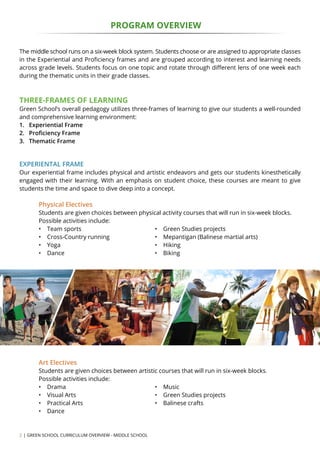
	 Physical Electives
	 Students are given choices between physical activity courses that will run in six-week blocks.
	 Possible activities include:
	 • Team sports				 • Green Studies projects
	 • Cross-Country running			 • Mepantigan (Balinese martial arts)
	 • Yoga					 • Hiking
	 • Dance					 • Biking
	 Art Electives
	 Students are given choices between artistic courses that will run in six-week blocks.
	 Possible activities include:
	 • Drama					 • Music
	 • Visual Arts					 • Green Studies projects
	 • Practical Arts				 • Balinese crafts
	 • Dance						
PROGRAM OVERVIEW
3 | GREEN SCHOOL CURRICULUM OVERVIEW - MIDDLE SCHOOL
PROFICIENCY FRAME
These lessons focus on building the core skills needed in literacy and maths. Students are mixed
between the grade levels and put into groups allowing them to focus on particular needs and interests.
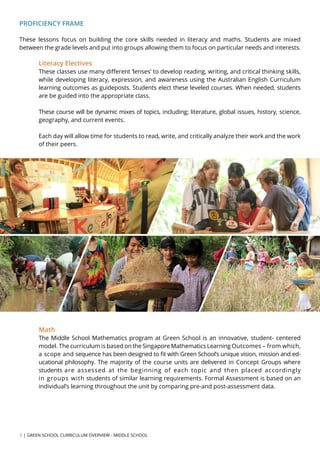
Literacy Electives
These classes use many different ‘lenses’ to develop reading, writing, and critical thinking skills,
while developing literacy, expression, and awareness using the Australian English Curriculum
learning outcomes as guideposts. Students elect these leveled courses. When needed, students
are be guided into the appropriate class.
These course will be dynamic mixes of topics, including; literature, global issues, history, science,
geography, and current events.
Each day will allow time for students to read, write, and critically analyze their work and the work
of their peers.
Math
The Middle School Mathematics program at Green School is an innovative, student- centered
model. The curriculum is based on the Singapore Mathematics Learning Outcomes – from which,
a scope and sequence has been designed to fit with Green School’s unique vision, mission and ed-
ucational philosophy. The majority of the course units are delivered in Concept Groups where
students are assessed at the beginning of each topic and then placed accordingly
in groups with students of similar learning requirements. Formal Assessment is based on an
individual’s learning throughout the unit by comparing pre-and post-assessment data.
4 | GREEN SCHOOL CURRICULUM OVERVIEW - MIDDLE SCHOOL
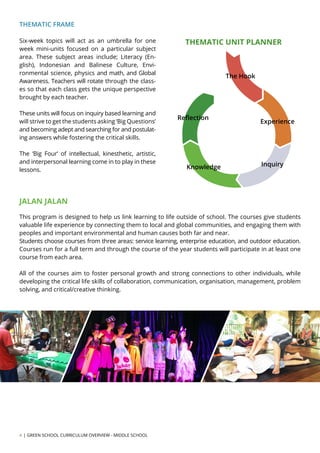
THEMATIC FRAME
Six-week topics will act as an umbrella for one
week mini-units focused on a particular subject
area. These subject areas include; Literacy (En-
glish), Indonesian and Balinese Culture, Envi-
ronmental science, physics and math, and Global
Awareness. Teachers will rotate through the class-
es so that each class gets the unique perspective
brought by each teacher.
These units will focus on inquiry based learning and
will strive to get the students asking ‘Big Questions’
and becoming adept and searching for and postulat-
ing answers while fostering the critical skills.
The ‘Big Four’ of intellectual, kinesthetic, artistic,
and interpersonal learning come in to play in these
lessons.
JALAN JALAN
This program is designed to help us link learning to life outside of school. The courses give students
valuable life experience by connecting them to local and global communities, and engaging them with
peoples and important environmental and human causes both far and near.
Students choose courses from three areas: service learning, enterprise education, and outdoor education.
Courses run for a full term and through the course of the year students will participate in at least one
course from each area.
All of the courses aim to foster personal growth and strong connections to other individuals, while
developing the critical life skills of collaboration, communication, organisation, management, problem
solving, and critical/creative thinking.
The Hook
Knowledge
Reflection
Experience
Inquiry
THEMATIC UNIT PLANNER
SERVICE LEARNING
These courses develop life skills while introducing students to the importance of community service for
personal, community, and world health. Special attention is paid to the need for considering environmental,
economical, social, and personal sustainability in order to promote healthy interactions between human
and natural systems. Some examples include;
	 Bye Bye Plastic Bags
	 This course supports a student-led initiative to ban the use of single use plastic bags on the
	 island of Bali.
	 Community Mapping
	 This course created a detailed map of the community around Green School to create a waste	
	 management program.
ENTERPRISE EDUCATION
This is a hands-on program intended to get students designing and creating. These courses also
encourage students to develop entrepreneurial skills by marketing and selling some of the products created.
The path is from ideas to planning to creating. Some examples include;
	 T-shirts for the World
	 Students designed t-shirts with social and environmental messages while sourcing material,
	 marketing and selling the shirts.
	 Ogoh-Ogoh Construction
	 Students create an Ogoh-Ogoh for celebration of the Balinese holiday, Nyepi.
OUTDOOR EDUCATION
The outdoor education courses expose students to new outdoor activities, while encouraging
a more active lifestyle. These courses not only keep students active, they also provide valuable skills
relevant to leading an outdoor lifestyle. Some examples include;
	 Green School Dive Club
	 Student receive open-water dive certification and explore coral reef ecology while working with reef
	 watch to monitor the health of Bali’s coral reefs.
	 Mountain Bike Club
	 Students design and create a Green School community mountain bike club while exploring and
	 mapping the trails around Green School.
	 Life Saving Skills
	 Students learn basic first aid and water rescue skills.
5 | GREEN SCHOOL CURRICULUM OVERVIEW - MIDDLE SCHOOL
7
| GREEN SCHOOL CURRICULUM OVERVIEW - MIDDLE SCHOOL 2015-2016
CRITICAL SKILLS
With our rapidly changing world our students, we recognize that in order for them to be prepared, it is
vital that they possess a set of core skills.
PROBLEM SOLVING			 Accurately identifying problems, finding related resources, looking
					 for and considering wide range of solutions, testing ideas and
					changing direction when needed.
COLLABORATION			 Contribute to and invest in group discussions, keep personal agenda
					 in perspective, resolves conflict by seeking common ground.
COMMUNICATION			 The organisation of coherent ideas through writing, speech and
					 digital production understanding tone and deeper meanings.
DECISION MAKING			 Being part of the process, listening to all options and advice,
					 drawing conculsions, seeking consensus, and defending opinions
					and taking responsibility for them.
LEADERSHIP				Positively challenging yourself and others, building connections
					 between tasks and people, setting good examples and articulating
					a vision or process.
MANAGEMENT
ORGANISATION			 Prioritising tasks, optimising time and resources, managing details,
					 responding to the unexpected, documenting what is important
					with clarity.
CRITICAL THINKING			 Analysing information objectively, identifying cause and effect,
					 distinguishing between fact and opinion, looking at the big picture
					 and different perspectives, sourcing appropriate judgements,
					 being open-minded and asking clarifying questions.
CREATIVE THINKING		Seeking information and solutions that have not been tried before,
					 integrating diverse ideas, taking risks, and building on ideas.
Each 6 week long course module is planned around five building blocks:
1. General subject area, for example: Mathematics or Science.
2. A topic, for example: Sociology, Maths in Literature, or Existential Philosophy.
3. A core number of critical skills, for example: collaboration and literacy.
4. A competency level of learning, from introductory to intermediate, etc.
5. By lesson type, including Thematic, Proficiency, and/or Experiential.
6 | GREEN SCHOOL CURRICULUM OVERVIEW - MIDDLE SCHOOL
CURRICULUM PLANNING

Middle school Curriculum

  • 2.
    INTRODUCTION Our middle schoolcurriculum is centered around teaching our students how to take control of their own learning. We focus on teaching students to ask the right questions and be confident searching for answers. By developing ‘Critical Skills’ in our students we prepare them for their journey as learners for the rest of their lives. This document explains how we plan student learning opportunities (our pedagogy) and the environment within which learning takes place. Students are welcomed into an environment that is engaging, challenging, inspiring, and nurturing. Learning experiences are created that foster inspiration, promote the development of a core set of academic skills and learning habits, and that encourage students to ask questions, explore and identify their core values and passions. More than preparing students for high school, our middle school program focuses on a whole child approach that supports the special needs of middle years students. Students are engaged in learning and community life, challenged intellectually and academically, and supported by passionate, nurturing, and inspired adults. Our curriculum is strongly rooted in internationally recognized learning outcomes, and we use these outcomes to drive our instruction. Traditional timetables have been replaced by a more fluid schedule to meet the needs of the students and the themes being studied. Our thematic instruction is supported by a strong arts program that includes visual and performing arts, and the collaboration helps to provide students with rich experiential learning opportunities that are thematic across the curriculum, inquiry-based, and designed to fully engage the multitude of intelligences and learning styles. Learning outcomes include relevant projects and presentations that meet real needs in the local and/or global community, and can be shared with authentic audiences in school, community-wide, and beyond. MIDDLE SCHOOL CURRICULUM | GREEN SCHOOL CURRICULUM OVERVIEW - MIDDLE SCHOOL1 Our curriculum is strongly rooted in internationally recognized learning outcomes, and we use these outcomes to drive our instruction. “ “
  • 3.
    2 | GREENSCHOOL CURRICULUM OVERVIEW - MIDDLE SCHOOL The middle school runs on a six-week block system. Students choose or are assigned to appropriate classes in the Experiential and Proficiency frames and are grouped according to interest and learning needs across grade levels. Students focus on one topic and rotate through different lens of one week each during the thematic units in their grade classes. THREE-FRAMES OF LEARNING Green School’s overall pedagogy utilizes three-frames of learning to give our students a well-rounded and comprehensive learning environment: 1. Experiential Frame 2. Proficiency Frame 3. Thematic Frame EXPERIENTAL FRAME Our experiential frame includes physical and artistic endeavors and gets our students kinesthetically engaged with their learning. With an emphasis on student choice, these courses are meant to give students the time and space to dive deep into a concept. Physical Electives Students are given choices between physical activity courses that will run in six-week blocks. Possible activities include: • Team sports • Green Studies projects • Cross-Country running • Mepantigan (Balinese martial arts) • Yoga • Hiking • Dance • Biking Art Electives Students are given choices between artistic courses that will run in six-week blocks. Possible activities include: • Drama • Music • Visual Arts • Green Studies projects • Practical Arts • Balinese crafts • Dance PROGRAM OVERVIEW
  • 4.
    3 | GREENSCHOOL CURRICULUM OVERVIEW - MIDDLE SCHOOL PROFICIENCY FRAME These lessons focus on building the core skills needed in literacy and maths. Students are mixed between the grade levels and put into groups allowing them to focus on particular needs and interests. Literacy Electives These classes use many different ‘lenses’ to develop reading, writing, and critical thinking skills, while developing literacy, expression, and awareness using the Australian English Curriculum learning outcomes as guideposts. Students elect these leveled courses. When needed, students are be guided into the appropriate class. These course will be dynamic mixes of topics, including; literature, global issues, history, science, geography, and current events. Each day will allow time for students to read, write, and critically analyze their work and the work of their peers. Math The Middle School Mathematics program at Green School is an innovative, student- centered model. The curriculum is based on the Singapore Mathematics Learning Outcomes – from which, a scope and sequence has been designed to fit with Green School’s unique vision, mission and ed- ucational philosophy. The majority of the course units are delivered in Concept Groups where students are assessed at the beginning of each topic and then placed accordingly in groups with students of similar learning requirements. Formal Assessment is based on an individual’s learning throughout the unit by comparing pre-and post-assessment data.
  • 5.
    4 | GREENSCHOOL CURRICULUM OVERVIEW - MIDDLE SCHOOL THEMATIC FRAME Six-week topics will act as an umbrella for one week mini-units focused on a particular subject area. These subject areas include; Literacy (En- glish), Indonesian and Balinese Culture, Envi- ronmental science, physics and math, and Global Awareness. Teachers will rotate through the class- es so that each class gets the unique perspective brought by each teacher. These units will focus on inquiry based learning and will strive to get the students asking ‘Big Questions’ and becoming adept and searching for and postulat- ing answers while fostering the critical skills. The ‘Big Four’ of intellectual, kinesthetic, artistic, and interpersonal learning come in to play in these lessons. JALAN JALAN This program is designed to help us link learning to life outside of school. The courses give students valuable life experience by connecting them to local and global communities, and engaging them with peoples and important environmental and human causes both far and near. Students choose courses from three areas: service learning, enterprise education, and outdoor education. Courses run for a full term and through the course of the year students will participate in at least one course from each area. All of the courses aim to foster personal growth and strong connections to other individuals, while developing the critical life skills of collaboration, communication, organisation, management, problem solving, and critical/creative thinking. The Hook Knowledge Reflection Experience Inquiry THEMATIC UNIT PLANNER
  • 6.
    SERVICE LEARNING These coursesdevelop life skills while introducing students to the importance of community service for personal, community, and world health. Special attention is paid to the need for considering environmental, economical, social, and personal sustainability in order to promote healthy interactions between human and natural systems. Some examples include; Bye Bye Plastic Bags This course supports a student-led initiative to ban the use of single use plastic bags on the island of Bali. Community Mapping This course created a detailed map of the community around Green School to create a waste management program. ENTERPRISE EDUCATION This is a hands-on program intended to get students designing and creating. These courses also encourage students to develop entrepreneurial skills by marketing and selling some of the products created. The path is from ideas to planning to creating. Some examples include; T-shirts for the World Students designed t-shirts with social and environmental messages while sourcing material, marketing and selling the shirts. Ogoh-Ogoh Construction Students create an Ogoh-Ogoh for celebration of the Balinese holiday, Nyepi. OUTDOOR EDUCATION The outdoor education courses expose students to new outdoor activities, while encouraging a more active lifestyle. These courses not only keep students active, they also provide valuable skills relevant to leading an outdoor lifestyle. Some examples include; Green School Dive Club Student receive open-water dive certification and explore coral reef ecology while working with reef watch to monitor the health of Bali’s coral reefs. Mountain Bike Club Students design and create a Green School community mountain bike club while exploring and mapping the trails around Green School. Life Saving Skills Students learn basic first aid and water rescue skills. 5 | GREEN SCHOOL CURRICULUM OVERVIEW - MIDDLE SCHOOL
  • 7.
    7 | GREEN SCHOOLCURRICULUM OVERVIEW - MIDDLE SCHOOL 2015-2016 CRITICAL SKILLS With our rapidly changing world our students, we recognize that in order for them to be prepared, it is vital that they possess a set of core skills. PROBLEM SOLVING Accurately identifying problems, finding related resources, looking for and considering wide range of solutions, testing ideas and changing direction when needed. COLLABORATION Contribute to and invest in group discussions, keep personal agenda in perspective, resolves conflict by seeking common ground. COMMUNICATION The organisation of coherent ideas through writing, speech and digital production understanding tone and deeper meanings. DECISION MAKING Being part of the process, listening to all options and advice, drawing conculsions, seeking consensus, and defending opinions and taking responsibility for them. LEADERSHIP Positively challenging yourself and others, building connections between tasks and people, setting good examples and articulating a vision or process. MANAGEMENT ORGANISATION Prioritising tasks, optimising time and resources, managing details, responding to the unexpected, documenting what is important with clarity. CRITICAL THINKING Analysing information objectively, identifying cause and effect, distinguishing between fact and opinion, looking at the big picture and different perspectives, sourcing appropriate judgements, being open-minded and asking clarifying questions. CREATIVE THINKING Seeking information and solutions that have not been tried before, integrating diverse ideas, taking risks, and building on ideas. Each 6 week long course module is planned around five building blocks: 1. General subject area, for example: Mathematics or Science. 2. A topic, for example: Sociology, Maths in Literature, or Existential Philosophy. 3. A core number of critical skills, for example: collaboration and literacy. 4. A competency level of learning, from introductory to intermediate, etc. 5. By lesson type, including Thematic, Proficiency, and/or Experiential. 6 | GREEN SCHOOL CURRICULUM OVERVIEW - MIDDLE SCHOOL CURRICULUM PLANNING