www.blueoceanacademy.com
Middle
Management
Development
Program
January, 2024
Middle Management Development Program
Course Agenda
1. Management and Leadership
2. Motivation
3. Goals And Goal Setting
4. Time Management and Planning
5. Strategic Problem Solving
6. Importance of Teamwork
7. Effective Delegation
8. Reviewing Performance
Middle
Management
Development
Program
Management and Leadership
Defining Management
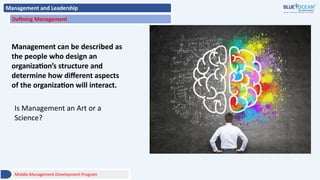
Management can be described as
the people who design an
organization’s structure and
determine how different aspects
of the organization will interact.
Is Management an Art or a
Science?
Middle Management Development Program
Management and Leadership
Defining Management
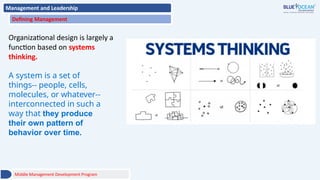
Organizational design is largely a
function based on systems
thinking.
A system is a set of
things-- people, cells,
molecules, or whatever--
interconnected in such a
way that they produce
their own pattern of
behavior over time.
Middle Management Development Program
Management and Leadership
Defining Management
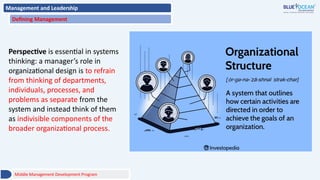
Perspective is essential in systems
thinking: a manager’s role in
organizational design is to refrain
from thinking of departments,
individuals, processes, and
problems as separate from the
system and instead think of them
as indivisible components of the
broader organizational process.
Middle Management Development Program
Management and Leadership
Defining Management
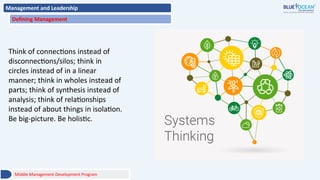
Think of connections instead of
disconnections/silos; think in
circles instead of in a linear
manner; think in wholes instead of
parts; think of synthesis instead of
analysis; think of relationships
instead of about things in isolation.
Be big-picture. Be holistic.
Middle Management Development Program
Management and Leadership
Defining Management
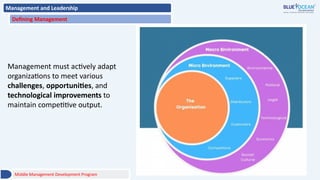
Management must actively adapt
organizations to meet various
challenges, opportunities, and
technological improvements to
maintain competitive output.
Middle Management Development Program
Management and Leadership
Scanning the Environments
Middle Management Development Program
Management and Leadership
Scanning the Environments
Middle Management Development Program
Management and Leadership
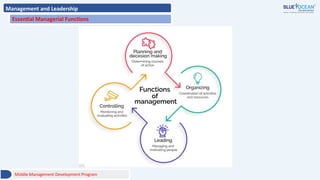
Essential Managerial Functions
Middle Management Development Program
Management and Leadership
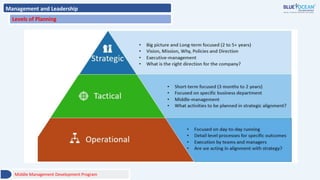
Levels of Planning
Middle Management Development Program
Management and Leadership
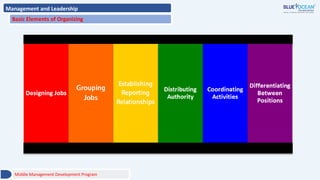
Basic Elements of Organizing
Middle Management Development Program
Management and Leadership
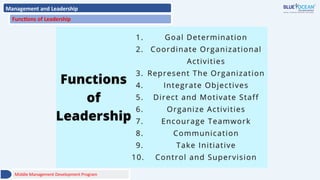
Functions of Leadership
Middle Management Development Program
Management and Leadership
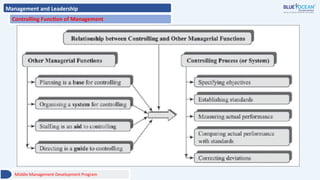
Controlling Function of Management
Middle Management Development Program
Management and Leadership
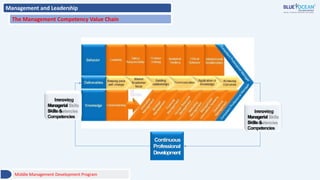
The Management Competency Value Chain
Continuous
Professional
Development
Imroving
Managerial
Skills &
Competencies
Imroving
Managerial
Skills &
Competencies
Middle Management Development Program
Management and Leadership
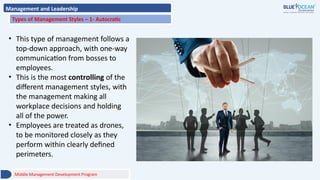
Types of Management Styles – 1- Autocratic
• This type of management follows a
top-down approach, with one-way
communication from bosses to
employees.
• This is the most controlling of the
different management styles, with
the management making all
workplace decisions and holding
all of the power.
• Employees are treated as drones,
to be monitored closely as they
perform within clearly defined
perimeters.
Middle Management Development Program
Management and Leadership
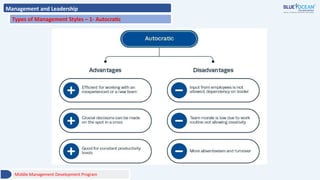
Types of Management Styles – 1- Autocratic
Middle Management Development Program
Management and Leadership
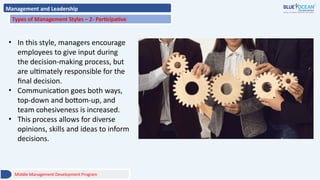
Types of Management Styles – 2- Participative
• In this style, managers encourage
employees to give input during
the decision-making process, but
are ultimately responsible for the
final decision.
• Communication goes both ways,
top-down and bottom-up, and
team cohesiveness is increased.
• This process allows for diverse
opinions, skills and ideas to inform
decisions.
Middle Management Development Program
Management and Leadership
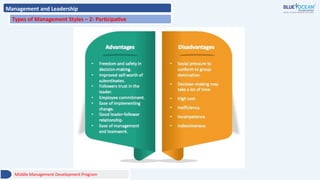
Types of Management Styles – 2- Participative
Middle Management Development Program
Management and Leadership
The Responsibilities of a Manager
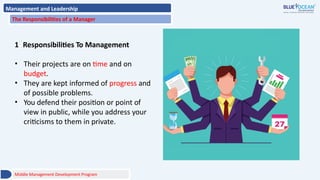
1 Responsibilities To Management
• Their projects are on time and on
budget.
• They are kept informed of progress and
of possible problems.
• You defend their position or point of
view in public, while you address your
criticisms to them in private.
Middle Management Development Program
Management and Leadership
The Responsibilities of a Manager
2- Responsibilities To Your Workgroup
• Give them your support and recognition
in public, while you address
criticisms to them in private.
• Provide a fair and consistent
interpretation of rules, regulations, and
policies.
• Give them opportunities to grow and
develop.
• Provide a safe work environment.
• Promote good communication.
Middle Management Development Program
Management and Leadership
The Responsibilities of a Manager
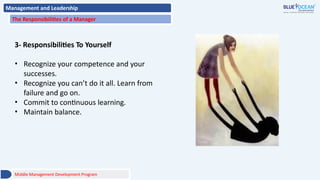
3- Responsibilities To Yourself
• Recognize your competence and your
successes.
• Recognize you can’t do it all. Learn from
failure and go on.
• Commit to continuous learning.
• Maintain balance.
Middle Management Development Program
Management and Leadership
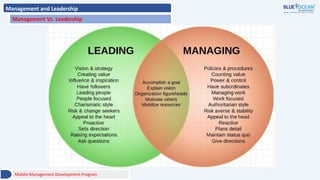
Management Vs. Leadership
Middle Management Development Program
Management and Leadership
Management Vs. Leadership
• Leadership is a process by which an executive can
direct, guide and influence the behavior and work of
others towards accomplishment of specific goals in a
given situation.
• Leadership is the ability of a manager to induce the
subordinates to work with confidence and passion.
• Leadership is the potential to influence behavior of
others. It is also defined as the capacity to influence a
group towards the realization of a goal. Leaders are
required to develop future visions, and to motivate
the organizational members to want to achieve the
visions.
• Leadership is the ability to persuade others to seek
defined objectives enthusiastically. It is the human
factor which binds a group together and motivates it
towards goals.
Middle Management Development Program
Management and Leadership
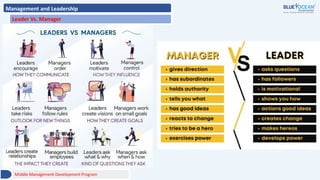
Leader Vs. Manager
Middle Management Development Program
Management and Leadership
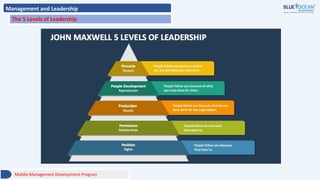
The 5 Levels of Leadership
Middle Management Development Program
Management and Leadership
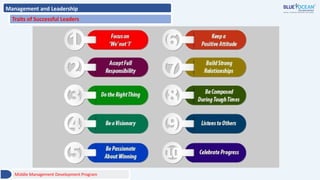
Traits of Successful Leaders
Middle Management Development Program
Management and Leadership
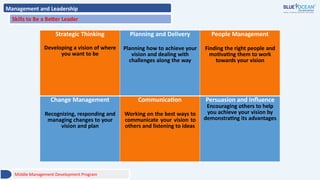
Skills to Be a Better Leader
Middle Management Development Program
Strategic Thinking
Developing a vision of where
you want to be
Planning and Delivery
Planning how to achieve your
vision and dealing with
challenges along the way
People Management
Finding the right people and
motivating them to work
towards your vision
Change Management
Recognizing, responding and
managing changes to your
vision and plan
Communication
Working on the best ways to
communicate your vision to
others and listening to ideas
Persuasion and Influence
Encouraging others to help
you achieve your vision by
demonstrating its advantages
Management and Leadership
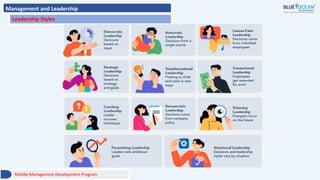
Leadership Styles
Middle Management Development Program
Management and Leadership
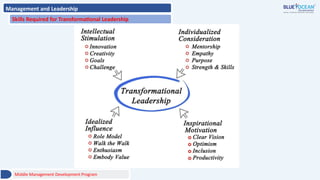
Skills Required for Transformational Leadership
Middle Management Development Program
Management and Leadership
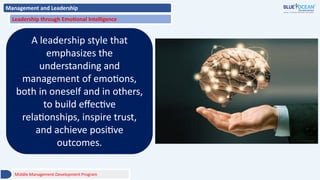
Leadership through Emotional Intelligence
A leadership style that
emphasizes the
understanding and
management of emotions,
both in oneself and in others,
to build effective
relationships, inspire trust,
and achieve positive
outcomes.
Middle Management Development Program
Management and Leadership
Leadership through Emotional Intelligence
Emotional intelligence (EI)
is the ability to recognize,
understand, and regulate
emotions in oneself and
others, and it plays a
crucial role in successful
leadership.
Middle Management Development Program
Management and Leadership
Leadership through Emotional Intelligence
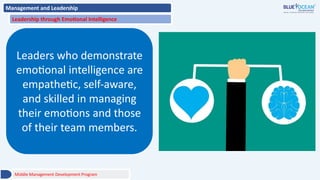
Leaders who demonstrate
emotional intelligence are
empathetic, self-aware,
and skilled in managing
their emotions and those
of their team members.
Middle Management Development Program
Management and Leadership
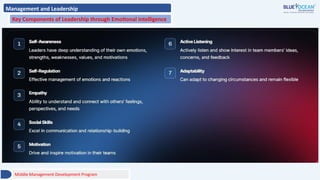
Key Components of Leadership through Emotional Intelligence
Middle Management Development Program
Management and Leadership
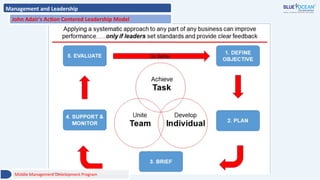
John Adair's Action Centered Leadership Model
Middle Management Development Program
Management and Leadership
John Adair's Action Centered Leadership Model
Middle Management Development Program
Management and Leadership
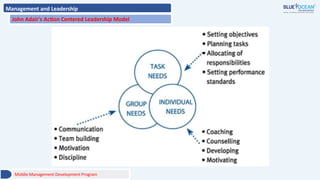
John Adair's Action Centered Leadership Model
• Adair also promotes a '50:50 rule' which he
applies to various situations involving two
possible influencers, e.g. the view that 50%
of motivation lies with the individual and
50% comes from external factors, among
them leadership from another.
• This contradicts most of the motivation
gurus who assert that most motivation is
from within the individual.
• He also suggests that 50% of team building
success comes from the team and 50% from
the leader.
Middle Management Development Program
Management and Leadership
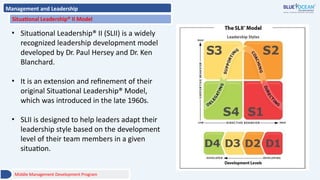
Situational Leadership® II Model
• Situational Leadership® II (SLII) is a widely
recognized leadership development model
developed by Dr. Paul Hersey and Dr. Ken
Blanchard.
• It is an extension and refinement of their
original Situational Leadership® Model,
which was introduced in the late 1960s.
• SLII is designed to help leaders adapt their
leadership style based on the development
level of their team members in a given
situation.
Middle Management Development Program
Management and Leadership
Situational Leadership® II Model
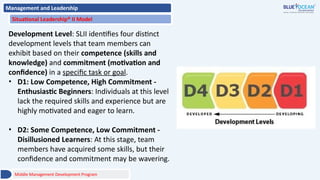
Development Level: SLII identifies four distinct
development levels that team members can
exhibit based on their competence (skills and
knowledge) and commitment (motivation and
confidence) in a specific task or goal.
• D1: Low Competence, High Commitment -
Enthusiastic Beginners: Individuals at this level
lack the required skills and experience but are
highly motivated and eager to learn.
• D2: Some Competence, Low Commitment -
Disillusioned Learners: At this stage, team
members have acquired some skills, but their
confidence and commitment may be wavering.
Middle Management Development Program
Management and Leadership
Situational Leadership® II Model
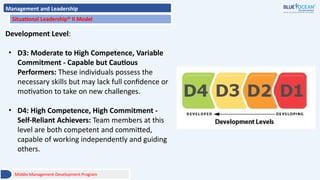
Development Level:
• D3: Moderate to High Competence, Variable
Commitment - Capable but Cautious
Performers: These individuals possess the
necessary skills but may lack full confidence or
motivation to take on new challenges.
• D4: High Competence, High Commitment -
Self-Reliant Achievers: Team members at this
level are both competent and committed,
capable of working independently and guiding
others.
Middle Management Development Program
Management and Leadership
Situational Leadership® II Model
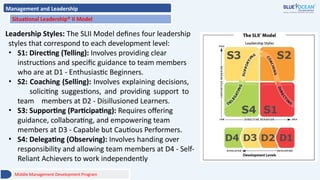
Leadership Styles: The SLII Model defines four leadership
styles that correspond to each development level:
• S1: Directing (Telling): Involves providing clear
instructions and specific guidance to team members
who are at D1 - Enthusiastic Beginners.
• S2: Coaching (Selling): Involves explaining decisions,
soliciting suggestions, and providing support to
team members at D2 - Disillusioned Learners.
• S3: Supporting (Participating): Requires offering
guidance, collaborating, and empowering team
members at D3 - Capable but Cautious Performers.
• S4: Delegating (Observing): Involves handing over
responsibility and allowing team members at D4 - Self-
Reliant Achievers to work independently
Middle Management Development Program
Management and Leadership
Situational Leadership® II Model
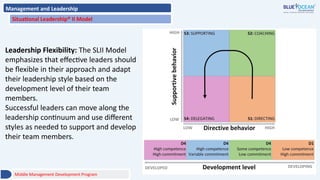
Leadership Flexibility: The SLII Model
emphasizes that effective leaders should
be flexible in their approach and adapt
their leadership style based on the
development level of their team
members.
Successful leaders can move along the
leadership continuum and use different
styles as needed to support and develop
their team members.
Middle Management Development Program
Management and Leadership
Situational Leadership® II Model
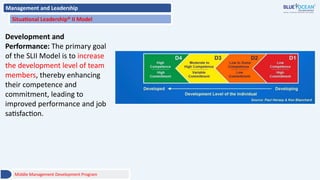
Development and
Performance: The primary goal
of the SLII Model is to increase
the development level of team
members, thereby enhancing
their competence and
commitment, leading to
improved performance and job
satisfaction.
Middle Management Development Program
Middle
Management
Development
Program
Management and Leadership
Key takeaways?
END
Motivation
Middle
Management
Development
Program
Motivation
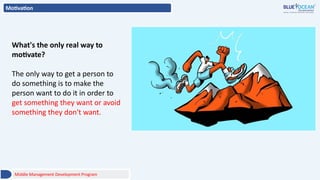
What's the only real way to
motivate?
The only way to get a person to
do something is to make the
person want to do it in order to
get something they want or avoid
something they don't want.
Middle Management Development Program
Motivation
Middle Management Development Program
 What is motivation?
 Why does a supervisor
need to understand
human motivation?
Motivation
• Motivation is a force that leads
people to attempt to satisfy their
important needs.
• Motivation is a drive from within
that prompts or incites an action.
• Supervisors need to create a climate
in which internal motivation will
activate performance.
What is motivation?
Middle Management Development Program
Motivation
Types of Motivators
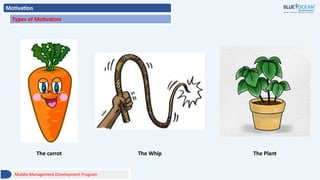
The carrot
Middle Management Development Program
The Whip The Plant
Motivation
Types of Motivators
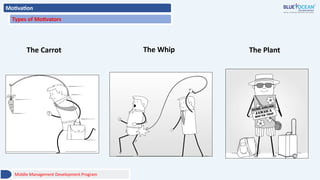
The Carrot The Whip The Plant
Middle Management Development Program
Motivation
Types of Motivators
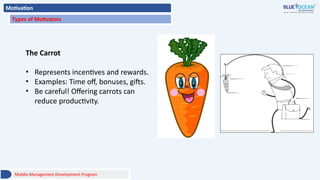
The Carrot
• Represents incentives and rewards.
• Examples: Time off, bonuses, gifts.
• Be careful! Offering carrots can
reduce productivity.
Middle Management Development Program
Motivation
Types of Motivators
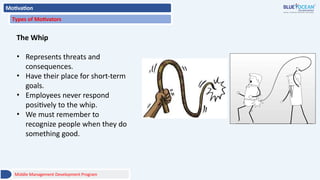
The Whip
• Represents threats and
consequences.
• Have their place for short-term
goals.
• Employees never respond
positively to the whip.
• We must remember to
recognize people when they do
something good.
Middle Management Development Program
Motivation
Types of Motivators
The Plant
• Represents a positive
environment.
• Suggests many things a
supervisor should strive for.
Middle Management Development Program
Motivation
Motivational Theories
Middle Management Development Program
What do you know about:
1. Maslow’s hierarchy of needs theory
2. Herzberg’s Two factor theory
Motivation
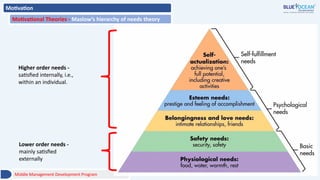
Motivational Theories - Maslow’s hierarchy of needs theory
Lower order needs -
mainly satisfied
externally
Middle Management Development Program
Higher order needs -
satisfied internally, i.e.,
within an individual.
Motivation
Motivational Theories - Maslow’s hierarchy of needs theory
Middle Management Development Program
• Human behavior is goal-directed.
• Motivation cause goal-directed behavior.
• It is through motivation that needs can be handled and tackled
purposely.
• This can be understood by understanding the hierarchy of needs by
manager.
• The needs of individual serves as a driving force in human
behavior.
• Therefore, a manager must understand the “hierarchy of needs”.
Maslow has proposed “The Need Hierarchy Model”.
Motivation
Motivational Theories - Maslow’s hierarchy of needs theory
Middle Management Development Program
• According to Maslow, individuals are motivated
by unsatisfied needs.
• As each of these needs is significantly satisfied, it
drives and forces the next need to emerge.
Motivation
Motivational Theories - Maslow’s hierarchy of needs theory
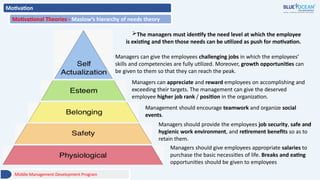
The managers must identify the need level at which the employee
is existing and then those needs can be utilized as push for motivation.
Managers can give the employees challenging jobs in which the employees’
skills and competencies are fully utilized. Moreover, growth opportunities can
be given to them so that they can reach the peak.
Managers can appreciate and reward employees on accomplishing and
exceeding their targets. The management can give the deserved
employee higher job rank / position in the organization.
Management should encourage teamwork and organize social
events.
Managers should provide the employees job security, safe and
hygienic work environment, and retirement benefits so as to
retain them.
Managers should give employees appropriate salaries to
purchase the basic necessities of life. Breaks and eating
opportunities should be given to employees
Middle Management Development Program
Motivation
Motivational Theories - Herzberg’s Two-Factor Theory
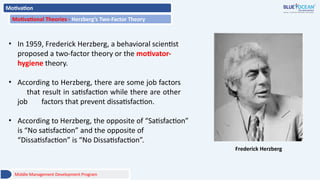
• In 1959, Frederick Herzberg, a behavioral scientist
proposed a two-factor theory or the motivator-
hygiene theory.
• According to Herzberg, there are some job factors
that result in satisfaction while there are other
job factors that prevent dissatisfaction.
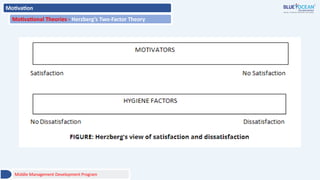
• According to Herzberg, the opposite of “Satisfaction”
is “No satisfaction” and the opposite of
“Dissatisfaction” is “No Dissatisfaction”.
Frederick Herzberg
Middle Management Development Program
Motivation
Motivational Theories - Herzberg’s Two-Factor Theory
Middle Management Development Program
Motivation
Motivational Theories - Herzberg’s Two-Factor Theory
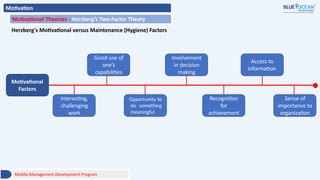
Herzberg's Motivational versus Maintenance (Hygiene) Factors
Motivational
Factors
Interesting,
challenging
work
Good use of
one’s
capabilities
Opportunity to
do something
meaningful
Involvement
in decision
making
Recognition
for
achievement
Access to
information
Sense of
importance to
organization
Middle Management Development Program
Motivation
Motivational Theories - Herzberg’s Two-Factor Theory
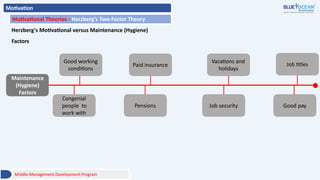
Herzberg's Motivational versus Maintenance (Hygiene)
Factors
Maintenance
(Hygiene)
Factors
Congenial
people to
work with
Good working
conditions
Pensions
Paid insurance
Job security
Vacations and
holidays
Good pay
Job titles
Middle Management Development Program
Motivation
Motivational Theories - Herzberg’s Two-Factor Theory
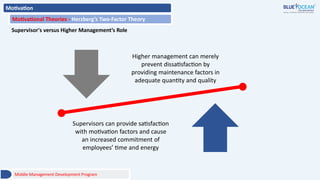
Supervisor's versus Higher Management’s Role
Higher management can merely
prevent dissatisfaction by
providing maintenance factors in
adequate quantity and quality
Middle Management Development Program
Supervisors can provide satisfaction
with motivation factors and cause
an increased commitment of
employees’ time and energy
Motivation
Motivational Theories
Why do you think there are so many
theories on motivation?
• Human behavior is very complex.
• No single theory seems to explain all
human behavior.
• Theories are essentially different sets
of glasses for looking at life.
Middle Management Development Program
Motivation
Guidelines on motivating people
1- Share your vision and set clear
goals
Regularly set clear and measurable
goals that are framed by a clear vision
so that you and your teams can track
progress and they are able to see their
success in a tangible way
2- Learn what people want
Every employee has a different
motivation for why they work.
Learning what employees want will help
you formulate the next step when
building motivation in the workplace.
3- Communicate with your staff
Communication is a two-way street
and you should make sure that there
is a constant flow of communication
between you and your employees.
This way you can not only keep them
up-to-date with what needs to be
done but you can also listen to their
ideas, opinions and feedback.
Make sure you are available to
contact and be open and
approachable in your attitude to
communication.
4- Promote Positive Employee Self Esteem
Middle Management Development Program
Self-esteem has two essential components:
a) Self-efficacy: Confidence in the ability to cope with life's challenges. Self-
efficacy leads to a sense of control over one's life.
b) Self-respect: Experience oneself as deserving of happiness, achievement,
and
love. Self-respect makes possible a sense of community with others.
Motivation
Guidelines on motivating people
Middle Management Development Program
5- Encourage teamwork
You can do this by regularly holding team-
building exercises and opportunities for your
team members to bond and get to know one
another.
6- A healthy office environment
Create a space that is enjoyable to work in
and an office where your employees want
to spend their time.
Be conscious of privacy, noise, air quality,
natural light, areas to relax and the
ambience.
And don't forget about your remote
employees. They need just as much
attention and support from your side to
create a healthy work environment for
them, too - even if their office is at home.
7- Give positive feedback
and reward your team
When employees achieve
results, put in extra effort or
do outstanding work make
sure to tell them that you’re
grateful and be specific in your
praise.
Reward your team for hard
work, whether this in the form
of monetary rewards, gifts,
bonuses or more
responsibility and
independence.
8- Provide opportunities for
development
These opportunities should be tailored
specifically to suit the individual employee
and can be in the form of further training,
setting challenging targets, inviting an
employee to shadow you or spending your
own time teaching and mentoring
somebody.
Middle
Management
Development
Program
Motivation
Key takeaways?
END
Middle
Management
Development
Program
Goals and Goal Setting
Planning and Goal Setting
Goals
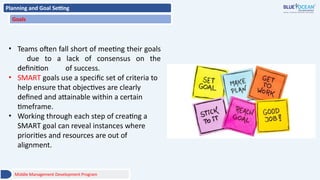
• Teams often fall short of meeting their goals
due to a lack of consensus on the
definition of success.
• SMART goals use a specific set of criteria to
help ensure that objectives are clearly
defined and attainable within a certain
timeframe.
• Working through each step of creating a
SMART goal can reveal instances where
priorities and resources are out of
alignment.
Middle Management Development Program
Planning and Goal Setting
What are SMART goals?
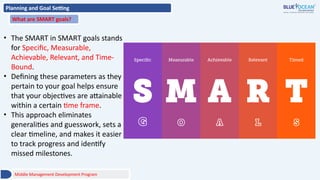
• The SMART in SMART goals stands
for Specific, Measurable,
Achievable, Relevant, and Time-
Bound.
• Defining these parameters as they
pertain to your goal helps ensure
that your objectives are attainable
within a certain time frame.
• This approach eliminates
generalities and guesswork, sets a
clear timeline, and makes it easier
to track progress and identify
missed milestones.
Middle Management Development Program
Planning and Goal Setting
What are SMART goals?
• An example of a SMART-goal statement might
look like this: Our goal is to
[quantifiable objective] by
[timeframe or deadline]. [Key
players or teams] will accomplish
this goal by [what steps you’ll take
to achieve the goal].
Accomplishing this goal will
[result or benefit].
Middle Management Development Program
Planning and Goal Setting
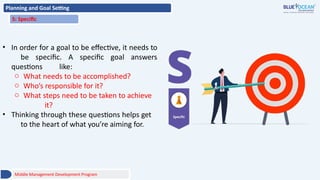
S: Specific
• In order for a goal to be effective, it needs to
be specific. A specific goal answers
questions like:
o What needs to be accomplished?
o Who’s responsible for it?
o What steps need to be taken to achieve
it?
• Thinking through these questions helps get
to the heart of what you’re aiming for.
Middle Management Development Program
Planning and Goal Setting
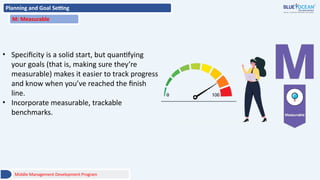
M: Measurable
• Specificity is a solid start, but quantifying
your goals (that is, making sure they’re
measurable) makes it easier to track progress
and know when you’ve reached the finish
line.
• Incorporate measurable, trackable
benchmarks.
Middle Management Development Program
Planning and Goal Setting
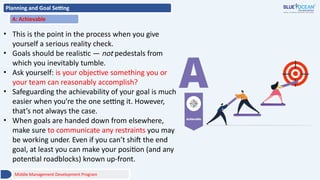
A: Achievable
• This is the point in the process when you give
yourself a serious reality check.
• Goals should be realistic — not pedestals from
which you inevitably tumble.
• Ask yourself: is your objective something you or
your team can reasonably accomplish?
• Safeguarding the achievability of your goal is much
easier when you’re the one setting it. However,
that’s not always the case.
• When goals are handed down from elsewhere,
make sure to communicate any restraints you may
be working under. Even if you can’t shift the end
goal, at least you can make your position (and any
potential roadblocks) known up-front.
Middle Management Development Program
Planning and Goal Setting
R: Relevant
• Here’s where you need to think
about the big picture. Why are
you setting the goal that you’re
setting?
Middle Management Development Program
Planning and Goal Setting
T: Time-based
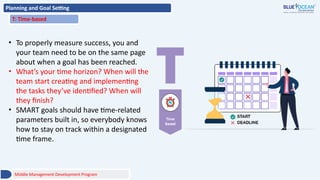
• To properly measure success, you and
your team need to be on the same page
about when a goal has been reached.
• What’s your time horizon? When will the
team start creating and implementing
the tasks they’ve identified? When will
they finish?
• SMART goals should have time-related
parameters built in, so everybody knows
how to stay on track within a designated
time frame.
Middle Management Development Program
Planning and Goal Setting
SMARTER Goals
• S.M.A.R.T.E.R. goal setting takes this two steps
further, forcing you to evaluate and readjust
or revise your approach.
• This added sense of measurement and
readjustment is critical to the achievement of
anything in life.
• All too often, we tend to set our goals, but not
put any type of measurement to them.
• When we don’t measure and track something,
it becomes far easier for the mind to trick us
into either putting things off or thinking that
we’ve come further along than we really have.
Middle Management Development Program
Planning and Goal Setting
E: Evaluated
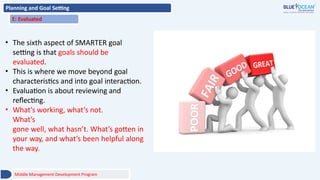
• The sixth aspect of SMARTER goal
setting is that goals should be
evaluated.
• This is where we move beyond goal
characteristics and into goal interaction.
• Evaluation is about reviewing and
reflecting.
• What’s working, what’s not.
What’s
gone well, what hasn’t. What’s gotten in
your way, and what’s been helpful along
the way.
Middle Management Development Program
Planning and Goal Setting
R: Revised
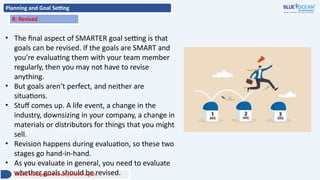
• The final aspect of SMARTER goal setting is that
goals can be revised. If the goals are SMART and
you’re evaluating them with your team member
regularly, then you may not have to revise
anything.
• But goals aren’t perfect, and neither are
situations.
• Stuff comes up. A life event, a change in the
industry, downsizing in your company, a change in
materials or distributors for things that you might
sell.
• Revision happens during evaluation, so these two
stages go hand-in-hand.
• As you evaluate in general, you need to evaluate
whether goals should be revised.
Middle Management Development Program
Planning and Goal Setting
R: Revised
• What should we change about
upcoming goals and what should we
keep the same?
• How can we ensure better results than
last time?
• Are there different metrics we can
track that better represent
performance?
• Do other or additional people need to
be included on these goals?
Middle Management Development Program
Planning and Goal Setting
Goal Attributes
Middle Management Development Program
Specificity
Difficulty
Acceptance
Commitment
Planning and Goal Setting
Goal Attributes
Middle Management Development Program
Specificity
Difficulty
Acceptance
Commitment
• Studies show that there is a direct relationship
between goal specificity and employee performance.
The more specific the goal, the less ambiguity involved
and the higher the performance.
• When employees are given do-your-best goals, they
do not have an external reference by which they
can measure their own performance.
• For example, telling a salesperson to "do the best you
can" is an extremely vague goal that may not increase
performance. However, "increase sales by 10 percent"
is much more specific and encourages high
performance because the employee has past sales as a
reference point.
Planning and Goal Setting
Goal Attributes
Middle Management Development Program
Specificity
Difficulty
Acceptance
Commitment
• Goal difficulty also has a direct relationship with
performance. Research shows that more difficult goals
lead to higher performance, as long as the goals do not
become so difficult that employees perceive them as
impossible. Unreasonable goals frustrate, rather than
motivate, employees.
• On the other hand, difficult but realistic goals lead to
increased performance and motivation. Research
suggests that employees are highly motivated when
the probability of achieving a specific goal is 50
percent.
Planning and Goal Setting
Goal Attributes
Specificity
Difficulty
Acceptance
Commitment
Middle Management Development Program
Planning and Goal Setting
Goal Attributes
Middle Management Development Program
Specificity
Difficulty
Acceptance
Commitment
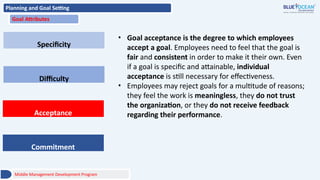
• Goal acceptance is the degree to which employees
accept a goal. Employees need to feel that the goal is
fair and consistent in order to make it their own. Even
if a goal is specific and attainable, individual
acceptance is still necessary for effectiveness.
• Employees may reject goals for a multitude of reasons;
they feel the work is meaningless, they do not trust
the organization, or they do not receive feedback
regarding their performance.
Planning and Goal Setting
Goal Attributes
Middle Management Development Program
Specificity
Difficulty
Acceptance
Commitment
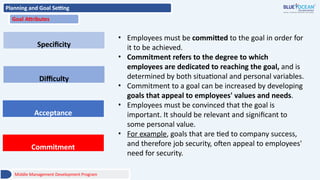
• Employees must be committed to the goal in order for
it to be achieved.
• Commitment refers to the degree to which
employees are dedicated to reaching the goal, and is
determined by both situational and personal variables.
• Commitment to a goal can be increased by developing
goals that appeal to employees' values and needs.
• Employees must be convinced that the goal is
important. It should be relevant and significant to
some personal value.
• For example, goals that are tied to company success,
and therefore job security, often appeal to employees'
need for security.
Middle
Management
Development
Program
Goals and Goal Setting
Key takeaways?
END
Middle
Management
Development
Program
Time Management and Planning
What is Time Management
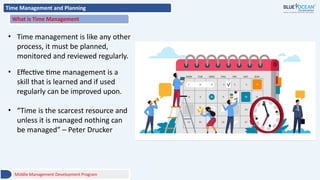
• Time management is like any other
process, it must be planned,
monitored and reviewed regularly.
• Effective time management is a
skill that is learned and if used
regularly can be improved upon.
• “Time is the scarcest resource and
unless it is managed nothing can
be managed” – Peter Drucker
Middle Management Development Program
Time Management and Planning
What is Time Management
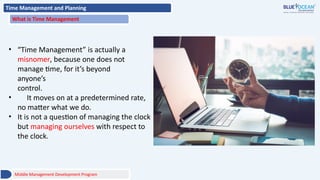
• “Time Management” is actually a
misnomer, because one does not
manage time, for it’s beyond
anyone’s
control.
• It moves on at a predetermined rate,
no matter what we do.
• It is not a question of managing the clock
but managing ourselves with respect to
the clock.
Middle Management Development Program
Time Management and Planning
Benefits of Time Management
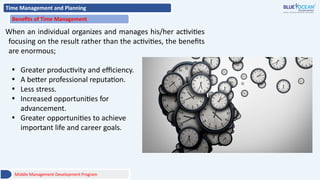
When an individual organizes and manages his/her activities
focusing on the result rather than the activities, the benefits
are enormous;
• Greater productivity and efficiency.
• A better professional reputation.
• Less stress.
• Increased opportunities for
advancement.
• Greater opportunities to achieve
important life and career goals.
Middle Management Development Program
Time Management and Planning
Risk of Missing Time
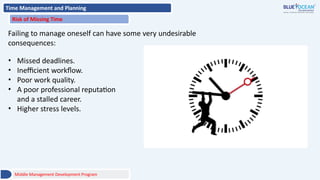
• Missed deadlines.
• Inefficient workflow.
• Poor work quality.
• A poor professional reputation
and a stalled career.
• Higher stress levels.
Failing to manage oneself can have some very undesirable
consequences:
Middle Management Development Program
Time Management and Planning
Risk of Missing Time
• Time management is not very difficult
as a concept, but it’s surprisingly
hard to do in practice.
• It requires the investment of a little
time upfront to prioritise and organise
oneself.
• But once done, you will find that with
minor tweaks, your day, and indeed
your week and month, fall into place in
an orderly fashion, with time for
everything you need to do.
Middle Management Development Program
Time Management and Planning
Common Time Wasters at Work
• 73% of people say they waste time at work --
at least one hour per day.
• Checking email wastes 50% of the workday
• When people aren't at their desks, there's a
good chance they're getting more coffee. The
average worker drinks 3 cups per day.
• They waste time by surfing the web (48%),
talking with coworkers (33%), taking care of
personal agendas and calls (49%), and taking
long lunches (15%)
• They're in the bathroom checking Facebook:
54% of women and 46% of men do this. 77%
of employees who have access to Facebook
from work check it daily.
Middle Management Development Program
Time Management and Planning
Common Time Wasters at Work
• But a lot of time is also
wasted on boring work
tasks, like fixing
coworkers' mistakes
(54%), dealing with office
politics (47%), waiting on
colleagues (42%), getting
dragged to meetings
(42%), and doing
administrative work
(33%)
Middle Management Development Program
Time Management and Planning
How to Manage Time
• “Time management” is the process of
organizing and planning how to
divide your time between specific
activities.
• Good time management enables you
to work smarter, “not harder” so
that you get more done in less
time, even when time is tight,
and pressures are high.
• It's important that you develop
effective strategies for managing your
time to balance the conflicting
demands of life.
• Failing to manage your time damages
your effectiveness and causes stress.
Middle Management Development Program
Time Management and Planning
Principles of Time Management
The key principles for effective Time
Management are:
1. Set clear goals & objectives
2. Plan your work
3. Get organized
4. Prioritize your activities
5. Destroy procrastination
Middle Management Development Program
Time Management and Planning
Principles of Time Management
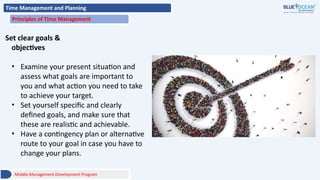
Set clear goals &
objectives
• Examine your present situation and
assess what goals are important to
you and what action you need to take
to achieve your target.
• Set yourself specific and clearly
defined goals, and make sure that
these are realistic and achievable.
• Have a contingency plan or alternative
route to your goal in case you have to
change your plans.
Middle Management Development Program
Time Management and Planning
Principles of Time Management
Get Organized
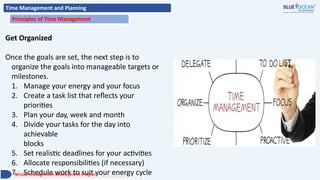
Once the goals are set, the next step is to
organize the goals into manageable targets or
milestones.
1. Manage your energy and your focus
2. Create a task list that reflects your
priorities
3. Plan your day, week and month
4. Divide your tasks for the day into
achievable
blocks
5. Set realistic deadlines for your activities
6. Allocate responsibilities (if necessary)
7. Schedule work to suit your energy cycle
Middle Management Development Program
Time Management and Planning
Principles of Time Management
Get Organized
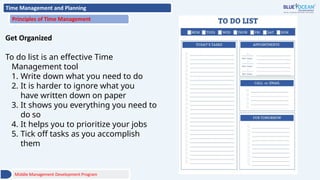
To do list is an effective Time
Management tool
1. Write down what you need to do
2. It is harder to ignore what you
have written down on paper
3. It shows you everything you need to
do so
4. It helps you to prioritize your jobs
5. Tick off tasks as you accomplish
them
Middle Management Development Program
Time Management and Planning
Principles of Time Management
Know your Energy Cycle
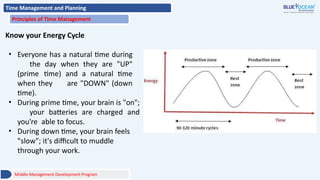
• Everyone has a natural time during
the day when they are "UP"
(prime time) and a natural time
when they are "DOWN" (down
time).
• During prime time, your brain is "on";
your batteries are charged and
you're able to focus.
• During down time, your brain feels
"slow"; it's difficult to muddle
through your work.
Middle Management Development Program
Time Management and Planning
Principles of Time Management
Know your Energy Cycle
• When considering a daily schedule, it
is a good idea to keep your energy
cycle in mind.
• Some people are at their best early in
the morning, others peak in the
afternoon.
• Whenever possible, try to plan your
daily schedule to match your
prime time.
Middle Management Development Program
Time Management and Planning
Principles of Time Management
Know your Energy Cycle
• Consider such ideas as doing work
that requires concentration, creativity,
and thought during your prime time.
• Leave less-demanding activities, such
as reading, responding to mail, or
returning phone calls, until after lunch
if your prime time is in the morning
• The challenge for most people during
their prime time is self discipline,
resist the urge to do ‘fun”, easy, trivial
things.
Middle Management Development Program
Time Management and Planning
Principles of Time Management
How to Prioritize
• Listing things is one of the most basic ways to
manage time.
• In a priority list, you get to rank the order of
importance of each task so that you can pay attention
to the most urgent ones.
• The idea is to concentrate more on tasks that need to
be completed earlier.
• For this to work, we can’t choose to do things based
on how easy it is to complete or based on our
personal preferences.
• Prioritization benefits your time management by
first
highlighting to you what needs your attention first.
Middle Management Development Program
Time Management and Planning
Principles of Time Management
How to Prioritize
What is the best way to Prioritize
workload?
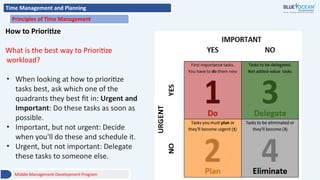
• When looking at how to prioritize
tasks best, ask which one of the
quadrants they best fit in: Urgent and
Important: Do these tasks as soon as
possible.
• Important, but not urgent: Decide
when you'll do these and schedule it.
• Urgent, but not important: Delegate
these tasks to someone else.
Middle Management Development Program
Time Management and Planning
Principles of Time Management
How to Prioritize
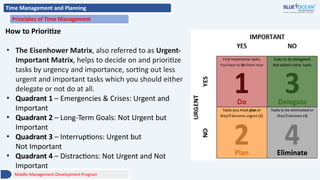
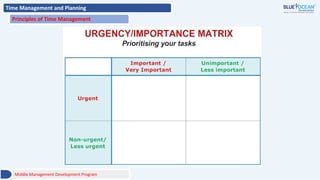
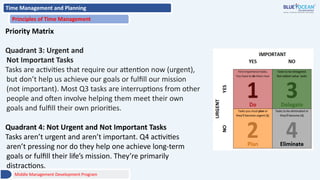
• The Eisenhower Matrix, also referred to as Urgent-
Important Matrix, helps to decide on and prioritize
tasks by urgency and importance, sorting out less
urgent and important tasks which you should either
delegate or not do at all.
• Quadrant 1 – Emergencies & Crises: Urgent and
Important
• Quadrant 2 – Long-Term Goals: Not Urgent but
Important
• Quadrant 3 – Interruptions: Urgent but
Not Important
• Quadrant 4 – Distractions: Not Urgent and Not
Important
Middle Management Development Program
Time Management and Planning
Principles of Time Management
Middle Management Development Program
Time Management and Planning
Principles of Time Management
Difference between
Urgent & Important
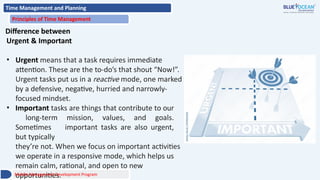
• Urgent means that a task requires immediate
attention. These are the to-do’s that shout “Now!”.
Urgent tasks put us in a reactive mode, one marked
by a defensive, negative, hurried and narrowly-
focused mindset.
• Important tasks are things that contribute to our
long-term mission, values, and goals.
Sometimes important tasks are also urgent,
but typically
they’re not. When we focus on important activities
we operate in a responsive mode, which helps us
remain calm, rational, and open to new
opportunities.
Middle Management Development Program
Time Management and Planning
Principles of Time Management
Priority Matrix
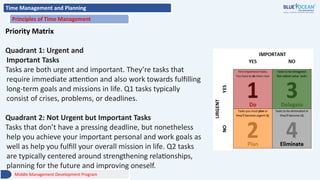
Quadrant 1: Urgent and
Important Tasks
Tasks are both urgent and important. They’re tasks that
require immediate attention and also work towards fulfilling
long-term goals and missions in life. Q1 tasks typically
consist of crises, problems, or deadlines.
Quadrant 2: Not Urgent but Important Tasks
Tasks that don’t have a pressing deadline, but nonetheless
help you achieve your important personal and work goals as
well as help you fulfill your overall mission in life. Q2 tasks
are typically centered around strengthening relationships,
planning for the future and improving oneself.
Middle Management Development Program
Time Management and Planning
Principles of Time Management
Priority Matrix
Quadrant 3: Urgent and
Not Important Tasks
Tasks are activities that require our attention now (urgent),
but don’t help us achieve our goals or fulfill our mission
(not important). Most Q3 tasks are interruptions from other
people and often involve helping them meet their own
goals and fulfill their own priorities.
Quadrant 4: Not Urgent and Not Important Tasks
Tasks aren’t urgent and aren’t important. Q4 activities
aren’t pressing nor do they help one achieve long-term
goals or fulfill their life’s mission. They’re primarily
distractions.
Middle Management Development Program
Time Management and Planning
Principles of Time Management
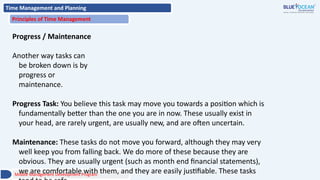
Progress / Maintenance
Another way tasks can
be broken down is by
progress or
maintenance.
Progress Task: You believe this task may move you towards a position which is
fundamentally better than the one you are in now. These usually exist in
your head, are rarely urgent, are usually new, and are often uncertain.
Maintenance: These tasks do not move you forward, although they may very
well keep you from falling back. We do more of these because they are
obvious. They are usually urgent (such as month end financial statements),
we are comfortable with them, and they are easily justifiable. These tasks
Middle Management Development Program
Time Management and Planning
Principles of Time Management
Power of Choice – 80:20
PP
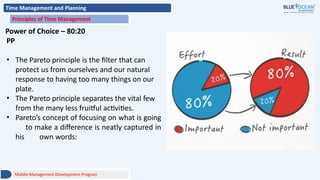
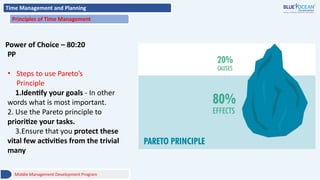
• The Pareto principle is the filter that can
protect us from ourselves and our natural
response to having too many things on our
plate.
• The Pareto principle separates the vital few
from the many less fruitful activities.
• Pareto’s concept of focusing on what is going
to make a difference is neatly captured in
his own words:
Middle Management Development Program
Time Management and Planning
Principles of Time Management
Power of Choice – 80:20
PP
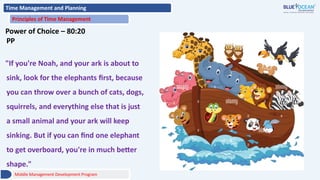
"If you're Noah, and your ark is about to
sink, look for the elephants first, because
you can throw over a bunch of cats, dogs,
squirrels, and everything else that is just
a small animal and your ark will keep
sinking. But if you can find one elephant
to get overboard, you're in much better
shape."
Middle Management Development Program
Time Management and Planning
Principles of Time Management
Power of Choice – 80:20
PP
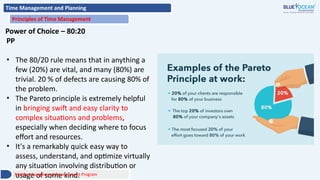
• The 80/20 rule means that in anything a
few (20%) are vital, and many (80%) are
trivial. 20 % of defects are causing 80% of
the problem.
• The Pareto principle is extremely helpful
in bringing swift and easy clarity to
complex situations and problems,
especially when deciding where to focus
effort and resources.
• It's a remarkably quick easy way to
assess, understand, and optimize virtually
any situation involving distribution or
usage of some kind.
Middle Management Development Program
Time Management and Planning
Principles of Time Management
Power of Choice – 80:20
PP
• Steps to use Pareto’s
Principle
1.Identify your goals - In other
words what is most important.
2. Use the Pareto principle to
prioritize your tasks.
3.Ensure that you protect these
vital few activities from the trivial
many
Middle Management Development Program
Time Management and Planning
Principles of Time Management
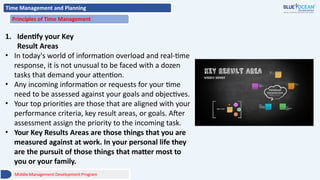
1. Identify your Key
Result Areas
• In today's world of information overload and real-time
response, it is not unusual to be faced with a dozen
tasks that demand your attention.
• Any incoming information or requests for your time
need to be assessed against your goals and objectives.
• Your top priorities are those that are aligned with your
performance criteria, key result areas, or goals. After
assessment assign the priority to the incoming task.
• Your Key Results Areas are those things that you are
measured against at work. In your personal life they
are the pursuit of those things that matter most to
you or your family.
Middle Management Development Program
Time Management and Planning
Principles of Time Management
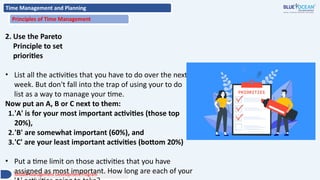
2. Use the Pareto
Principle to set
priorities
• List all the activities that you have to do over the next
week. But don't fall into the trap of using your to do
list as a way to manage your time.
Now put an A, B or C next to them:
1.'A' is for your most important activities (those top
20%),
2.'B' are somewhat important (60%), and
3.'C' are your least important activities (bottom 20%)
• Put a time limit on those activities that you have
assigned as most important. How long are each of your
Middle Management Development Program
Time Management and Planning
Principles of Time Management
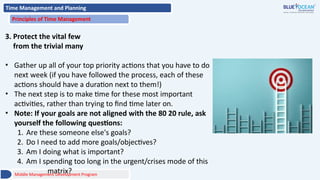
3. Protect the vital few
from the trivial many
• Gather up all of your top priority actions that you have to do
next week (if you have followed the process, each of these
actions should have a duration next to them!)
• The next step is to make time for these most important
activities, rather than trying to find time later on.
• Note: If your goals are not aligned with the 80 20 rule, ask
yourself the following questions:
1. Are these someone else's goals?
2. Do I need to add more goals/objectives?
3. Am I doing what is important?
4. Am I spending too long in the urgent/crises mode of this
matrix?
Middle Management Development Program
Time Management and Planning
Planning – Case Study
Middle Management Development Program
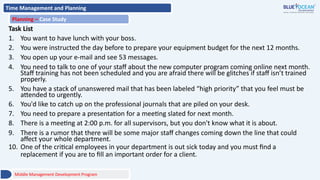
Task List
1. You want to have lunch with your boss.
2. You were instructed the day before to prepare your equipment budget for the next 12 months.
3. You open up your e-mail and see 53 messages.
4. You need to talk to one of your staff about the new computer program coming online next month.
Staff training has not been scheduled and you are afraid there will be glitches if staff isn’t trained
properly.
5. You have a stack of unanswered mail that has been labeled “high priority” that you feel must be
attended to urgently.
6. You'd like to catch up on the professional journals that are piled on your desk.
7. You need to prepare a presentation for a meeting slated for next month.
8. There is a meeting at 2:00 p.m. for all supervisors, but you don't know what it is about.
9. There is a rumor that there will be some major staff changes coming down the line that could
affect your whole department.
10. One of the critical employees in your department is out sick today and you must find a
replacement if you are to fill an important order for a client.
Time Management and Planning
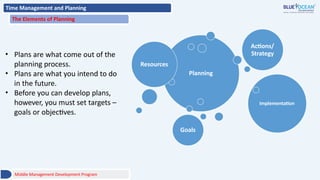
The Elements of Planning
Planning
Middle Management Development Program
Resources
Actions/
Strategy
Implementation
Goals
• Plans are what come out of the
planning process.
• Plans are what you intend to do
in the future.
• Before you can develop plans,
however, you must set targets –
goals or objectives.
Time Management and Planning
Planning
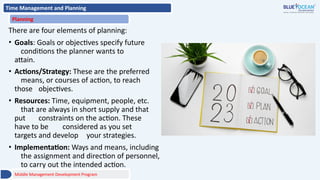
There are four elements of planning:
• Goals: Goals or objectives specify future
conditions the planner wants to
attain.
• Actions/Strategy: These are the preferred
means, or courses of action, to reach
those objectives.
• Resources: Time, equipment, people, etc.
that are always in short supply and that
put constraints on the action. These
have to be considered as you set
targets and develop your strategies.
• Implementation: Ways and means, including
the assignment and direction of personnel,
to carry out the intended action.
Middle Management Development Program
Time Management and Planning
Planning
• Typically, the goals you set for yourself (or that are set for you) will be a part of the
company's overall objectives. They will be targets to aim for in the near future.
They will pin down your department's output, quality of workmanship, and
allowable expenses.
• Recognizing that part of what supervisors do is get work done through the
efforts of others. To achieve this, they must schedule and prioritize. They must
organize resources to make sure plans hit their targets/goals: that people are at work
on time, that resources aren't wasted, that machines are in good repair and able to
give their expected daily output, and that services will be of the highest quality to
ensure customer satisfaction.
Middle Management Development Program
Time Management and Planning
Planning
• Your work targets/goals will be achieved through short-range planning.
• Check your habits. If you are too busy to worry about anything but today,
chances are you spend your time fighting fires that could be avoided by planning a
week or even a month ahead of time.
• Employees have confidence in someone who is willing and able to plan their
work well for them. Nothing breaks down morale like continual crises.
• Employees don't like change. They like going home at night fairly certain of
what they will do tomorrow and that the tasks will be ones they feel able to do. If
you show them you can schedule the work smoothly, employees will feel more
like pitching in when the occasional emergency comes up.
Middle Management Development Program
Time Management and Planning
Planning
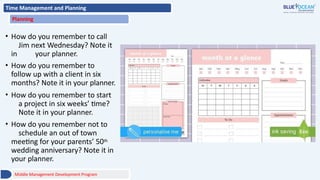
• How do you remember to call
Jim next Wednesday? Note it
in your planner.
• How do you remember to
follow up with a client in six
months? Note it in your planner.
• How do you remember to start
a project in six weeks’ time?
Note it in your planner.
• How do you remember not to
schedule an out of town
meeting for your parents’ 50th
wedding anniversary? Note it in
your planner.
Middle Management Development Program
Time Management and Planning
Planning
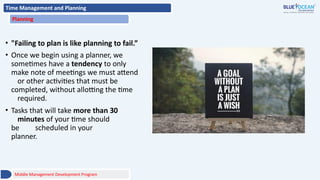
• "Failing to plan is like planning to fail.”
• Once we begin using a planner, we
sometimes have a tendency to only
make note of meetings we must attend
or other activities that must be
completed, without allotting the time
required.
• Tasks that will take more than 30
minutes of your time should
be scheduled in your
planner.
Middle Management Development Program
Time Management and Planning
Dealing with Procrastination
1 Salami Technique
• Break-up the tasks into small
manageable activities.
• Eat the elephant piece by
piece.
• Follow the divide and rule
policy.
• Start small but aim big.
• Don’t try to do too much too
quickly.
Middle Management Development Program
Time Management and Planning
Dealing with Procrastination
2- Worst First Method
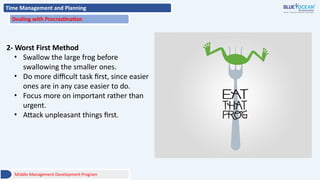
• Swallow the large frog before
swallowing the smaller ones.
• Do more difficult task first, since easier
ones are in any case easier to do.
• Focus more on important rather than
urgent.
• Attack unpleasant things first.
Middle Management Development Program
Time Management and Planning
Dealing with Procrastination
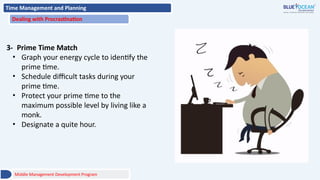
3- Prime Time Match
• Graph your energy cycle to identify the
prime time.
• Schedule difficult tasks during your
prime time.
• Protect your prime time to the
maximum possible level by living like a
monk.
• Designate a quite hour.
Middle Management Development Program
Time Management and Planning
Dealing with Procrastination
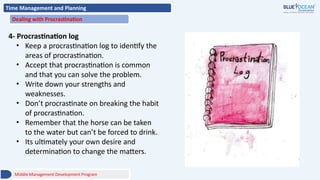
4- Procrastination log
• Keep a procrastination log to identify the
areas of procrastination.
• Accept that procrastination is common
and that you can solve the problem.
• Write down your strengths and
weaknesses.
• Don’t procrastinate on breaking the habit
of procrastination.
• Remember that the horse can be taken
to the water but can’t be forced to drink.
• Its ultimately your own desire and
determination to change the matters.
Middle Management Development Program
Time Management and Planning
Dealing with Procrastination
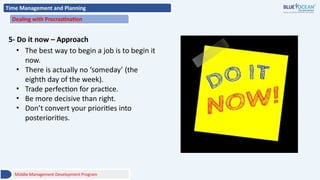
5- Do it now – Approach
• The best way to begin a job is to begin it
now.
• There is actually no ‘someday’ (the
eighth day of the week).
• Trade perfection for practice.
• Be more decisive than right.
• Don’t convert your priorities into
posteriorities.
Middle Management Development Program
Time Management and Planning
Dealing with Procrastination
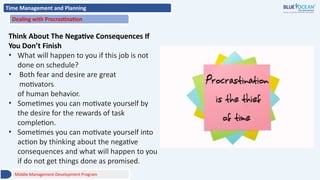
Think About The Negative Consequences If
You Don’t Finish
• What will happen to you if this job is not
done on schedule?
• Both fear and desire are great
motivators
of human behavior.
• Sometimes you can motivate yourself by
the desire for the rewards of task
completion.
• Sometimes you can motivate yourself into
action by thinking about the negative
consequences and what will happen to you
if do not get things done as promised.
Middle Management Development Program
Time Management and Planning
Managing your Workload
Managing Email
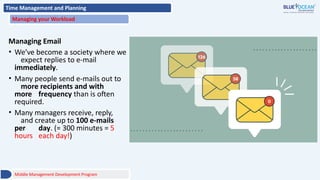
• We’ve become a society where we
expect replies to e-mail
immediately.
• Many people send e-mails out to
more recipients and with
more frequency than is often
required.
• Many managers receive, reply,
and create up to 100 e-mails
per day. (= 300 minutes = 5
hours each day!)
Middle Management Development Program
Time Management and Planning
Managing your Workload
Managing Email
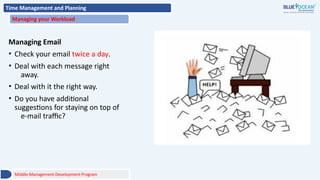
• Check your email twice a day.
• Deal with each message right
away.
• Deal with it the right way.
• Do you have additional
suggestions for staying on top of
e-mail traffic?
Middle Management Development Program
Time Management and Planning
Managing your Workload
Workload Analysis
• Was it hard to remember how you spent
your time?
• Did you take any time out just for you?
• How many things did you do that you
planned to?
• How many things did you put off?
• What is it you want to spend more
time
doing?
Middle Management Development Program
Time Management and Planning
Managing your Workload
Workload Analysis
• What do you want to do less?
• Are you happy with the way you spent your
time?
• How many of these hours did you spend on
the things that you said were a high
priority for me?
• When I look at my life so far, I’m glad I took
the time to…
• I regret I haven’t taken the time to…
Middle Management Development Program
Middle
Management
Development
Program
Time Management and Planning
Key takeaways?
END
Middle
Management
Development
Program
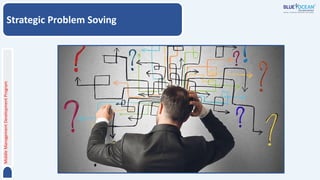
Strategic Problem Soving
Strategic Problem Solving
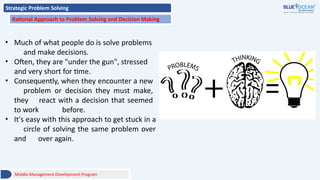
Rational Approach to Problem Solving and Decision Making
• Much of what people do is solve problems
and make decisions.
• Often, they are "under the gun", stressed
and very short for time.
• Consequently, when they encounter a new
problem or decision they must make,
they react with a decision that seemed
to work before.
• It's easy with this approach to get stuck in a
circle of solving the same problem over
and over again.
Middle Management Development Program
Strategic Problem Solving
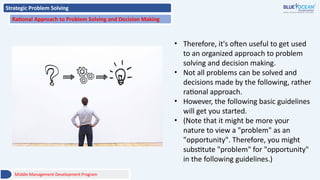
Rational Approach to Problem Solving and Decision Making
• Therefore, it's often useful to get used
to an organized approach to problem
solving and decision making.
• Not all problems can be solved and
decisions made by the following, rather
rational approach.
• However, the following basic guidelines
will get you started.
• (Note that it might be more your
nature to view a "problem" as an
"opportunity". Therefore, you might
substitute "problem" for "opportunity"
in the following guidelines.)
Middle Management Development Program
Strategic Problem Solving
1. Define the Problem
• This is often where people struggle. They react to what they think the problem is. Instead, seek to
understand more about why you think there's a problem.
Define the problem: (with input from yourself and others). Ask yourself and others, the following
questions:
1. What can you see that causes you to think there's a problem?
2. Where is it happening?
3. How is it happening?
4. When is it happening?
5. With whom is it happening? (HINT: Don't jump to "Who is causing the problem?" When we're
stressed, blaming is often one of our first reactions. To be an effective manager, you need to address
issues more than people.)
6. Why is it happening?
7. Write down a five-sentence description of the problem in terms of "The following should be
happening, but isn't ..." or "The following is happening and should be: ..." As much as possible, be
specific in your description, including what is happening, where, how, with whom and why. (It may be
helpful at this point to use a variety of research methods.
Middle Management Development Program
Strategic Problem Solving
1. Define the Problem
Defining complex problems:
• If the problem still seems overwhelming, break it down by repeating steps 1-7 until you have descriptions of several
related problems.
Verifying your understanding of the problems:
• It helps a great deal to verify your problem analysis for conferring with a peer or someone else.
Prioritize the problems:
• If you discover that you are looking at several related problems, then prioritize which ones you should address first.
• Note the difference between "important" and "urgent" problems. Often, what we consider to be important problems
to consider are really just urgent problems. Important problems deserve more attention. For example, if you're
continually answering "urgent" phone calls, then you've probably got a more "important" problem and that's to
design a system that screens and prioritizes your phone calls.
Understand your role in the problem:
• Your role in the problem can greatly influence how you perceive the role of others. For example, if you're very
stressed out, it'll probably look like others are, too, or, you may resort too quickly to blaming and reprimanding
others. Or, you are feel very guilty about your role in the problem, you may ignore the accountabilities of others.
Middle Management Development Program
Strategic Problem Solving
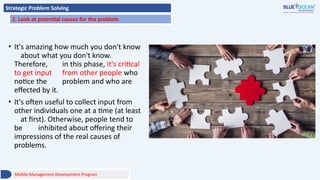
2. Look at potential causes for the problem
• It's amazing how much you don't know
about what you don't know.
Therefore, in this phase, it's critical
to get input from other people who
notice the problem and who are
effected by it.
• It's often useful to collect input from
other individuals one at a time (at least
at first). Otherwise, people tend to
be inhibited about offering their
impressions of the real causes of
problems.
Middle Management Development Program
Strategic Problem Solving
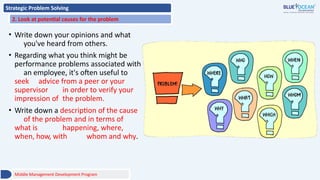
2. Look at potential causes for the problem
• Write down your opinions and what
you've heard from others.
• Regarding what you think might be
performance problems associated with
an employee, it's often useful to
seek advice from a peer or your
supervisor in order to verify your
impression of the problem.
• Write down a description of the cause
of the problem and in terms of
what is happening, where,
when, how, with whom and why.
Middle Management Development Program
Strategic Problem Solving
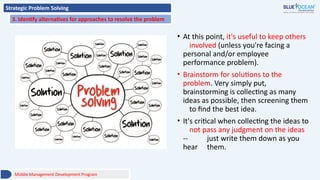
3. Identify alternatives for approaches to resolve the problem
• At this point, it's useful to keep others
involved (unless you're facing a
personal and/or employee
performance problem).
• Brainstorm for solutions to the
problem. Very simply put,
brainstorming is collecting as many
ideas as possible, then screening them
to find the best idea.
• It's critical when collecting the ideas to
not pass any judgment on the ideas
-- just write them down as you
hear them.
Middle Management Development Program
Strategic Problem Solving
4. Select an approach to resolve the problem
• When selecting the best approach, consider:
 Which approach is the most likely to solve
the problem for the long term?
 Which approach is the most realistic to
accomplish for now? Do you have the
resources? Are they affordable? Do you have
enough time to implement the approach?
 What is the extent of risk associated with
each alternative?
 (The nature of this step, in particular, in the
problem solving process is why problem solving
and decision making are highly integrated.)
Middle Management Development Program
Strategic Problem Solving
5. Plan the implementation of the best alternative
This is your action plan:
1) Carefully consider "What will the situation
look like when the problem is solved?"
2) What steps should be taken to implement the
best alternative to solving the problem? What
systems or processes should be changed in
your organization, for example, a new policy or
procedure? Don't resort to solutions where
someone is "just going to try harder".
Middle Management Development Program
Strategic Problem Solving
5. Plan the implementation of the best alternative
5) How much time will you need to implement the
solution? Write a schedule that includes the
start and stop times, and when you expect to
see certain indicators of success.
6) Who will primarily be responsible for ensuring
implementation of the plan?
7) Write down the answers to the above questions
and consider this as your action plan.
8) Communicate the plan to those who will involved
in implementing it and, at least, to your
immediate supervisor.
• (An important aspect of this step in the problem-
solving process is continuous observation and
feedback.)
Middle Management Development Program
Strategic Problem Solving
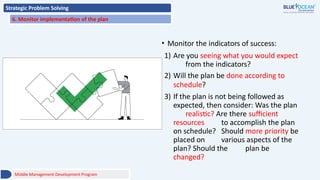
6. Monitor implementation of the plan
• Monitor the indicators of success:
1) Are you seeing what you would expect
from the indicators?
2) Will the plan be done according to
schedule?
3) If the plan is not being followed as
expected, then consider: Was the plan
realistic? Are there sufficient
resources to accomplish the plan
on schedule? Should more priority be
placed on various aspects of the
plan? Should the plan be
changed?
Middle Management Development Program
Strategic Problem Solving
7. Verify if the problem has been resolved or not
• One of the best ways to verify if a problem has
been solved or not is to resume normal
operations in the organization. Still, you should
consider:
1) What changes should be made to avoid this
type of problem in the future? Consider
changes to policies and procedures, training,
etc.
2) Lastly, consider "What did you learn from this
problem solving?" Consider new
knowledge, understanding and/or skills.
3) Consider writing a brief memo that highlights
the success of the problem solving effort,
and what you learned as a result. Share it
with your supervisor, peers and
subordinates.
Middle Management Development Program
Middle
Management
Development
Program
Strategic Problem Solving
Key takeaways?
END
Middle
Management
Development
Program
Importance of Teamwork
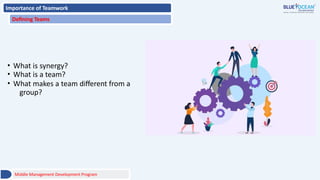
Defining Teams
• What is synergy?
• What is a team?
• What makes a team different from a
group?
Middle Management Development Program
Importance of Teamwork
Establishing Team Norms
• What are some advantages to
working as a team?
• What are some
disadvantages?
• Why do teams fail?
• What is the purpose of a team
contract?
Middle Management Development Program
Importance of Teamwork
Types of Team Members
• The Contributor
This is the detailed person who keeps track of
everything.
• The Collaborator
This is the visionary who is always looking to the
future and a better way of doing things.
• The Communicator
This type is a people person. They don’t want to
rock the boat; they just want to enjoy the boat
ride.
• The Challenger
This person wears the hat of the Devil’s
Advocate.
Middle Management Development Program
Importance of Teamwork
Building Team Trust
Trust is produced in a climate that
includes four elements:
• Honesty: Integrity, no lies, no
exaggerations
• Openness: A willingness to share and
receptivity to information,
perceptions, ideas
• Consistency: Predictable behavior
and responses
• Treating people with dignity and
fairness
Middle Management Development Program
Importance of Teamwork
Building Team Trust
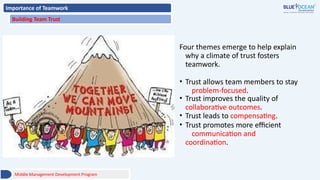
Four themes emerge to help explain
why a climate of trust fosters
teamwork.
• Trust allows team members to stay
problem-focused.
• Trust improves the quality of
collaborative outcomes.
• Trust leads to compensating.
• Trust promotes more efficient
communication and
coordination.
Middle Management Development Program
Importance of Teamwork
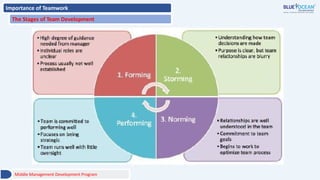
The Stages of Team Development
Middle Management Development Program
Importance of Teamwork
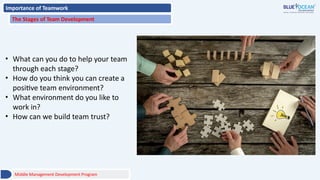
The Stages of Team Development
• What can you do to help your team
through each stage?
• How do you think you can create a
positive team environment?
• What environment do you like to
work in?
• How can we build team trust?
Middle Management Development Program
Importance of Teamwork
TORI Model
T is for Trust: interpersonal confidence
and absence of fear.
O is for Openness: free flow of
information, ideas, perceptions and
feelings.
R is for Realization: self-determination,
being role free, doing what you want to
do.
I is for Interdependence: reciprocal
influence, shared responsibility and
leadership.
Middle Management Development Program
Importance of Teamwork
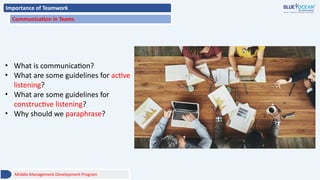
Communication in Teams
• What is communication?
• What are some guidelines for active
listening?
• What are some guidelines for
constructive listening?
• Why should we paraphrase?
Middle Management Development Program
Importance of Teamwork
Becoming a Good Team Player
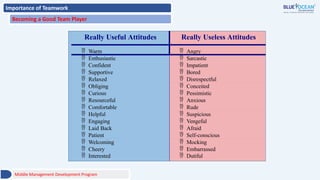
Really Useful Attitudes Really Useless Attitudes
 Warm  Angry
 Enthusiastic  Sarcastic
 Confident  Impatient
 Supportive  Bored
 Relaxed  Disrespectful
 Obliging  Conceited
 Curious  Pessimistic
 Resourceful  Anxious
 Comfortable  Rude
 Helpful  Suspicious
 Engaging  Vengeful
 Laid Back  Afraid
 Patient  Self-conscious
 Welcoming  Mocking
 Cheery  Embarrassed
 Interested  Dutiful
Middle Management Development Program
Importance of Teamwork
Types of Team Conflict
Let’s break conflict down into
three essential areas:
• Inner conflict
• Interpersonal conflict
• Group conflict
Middle Management Development Program
Importance of Teamwork
Types of Team Conflict
Inner Conflict
• Inner conflict can be difficult
to recognize.
• Yet, in many ways, this
conflict is the most difficult to
live with because it often
has an impact on our core
values (the things that are
most important to us), our
personal integrity, and ethics.
Middle Management Development Program
Importance of Teamwork
Types of Team Conflict
Interpersonal Conflict
• This is conflict between two
or more people. It may
be caused by a number
of different factors.
• What are some of the factors
you have seen?
• Since interpersonal conflict is
common in the workplace,
we will spend some time
investigating what causes
it.
Middle Management Development Program
Importance of Teamwork
Types of Team Conflict
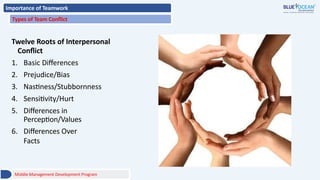
Twelve Roots of Interpersonal
Conflict
1. Basic Differences
2. Prejudice/Bias
3. Nastiness/Stubbornness
4. Sensitivity/Hurt
5. Differences in
Perception/Values
6. Differences Over
Facts
Middle Management Development Program
Importance of Teamwork
Types of Team Conflict
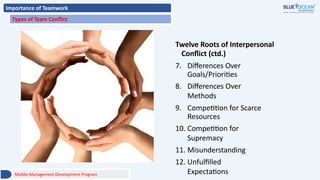
Twelve Roots of Interpersonal
Conflict (ctd.)
7. Differences Over
Goals/Priorities
8. Differences Over
Methods
9. Competition for Scarce
Resources
10. Competition for
Supremacy
11. Misunderstanding
12. Unfulfilled
Expectations
Middle Management Development Program
Importance of Teamwork
Types of Team Conflict
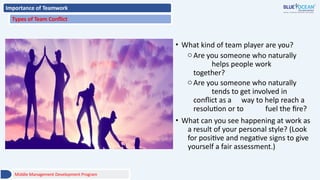
• What kind of team player are you?
oAre you someone who naturally
helps people work
together?
oAre you someone who naturally
tends to get involved in
conflict as a way to help reach a
resolution or to fuel the fire?
• What can you see happening at work as
a result of your personal style? (Look
for positive and negative signs to give
yourself a fair assessment.)
Middle Management Development Program
Importance of Teamwork
Types of Team Conflict
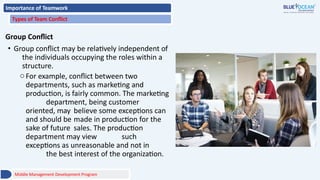
Group Conflict
• Group conflict may be relatively independent of
the individuals occupying the roles within a
structure.
oFor example, conflict between two
departments, such as marketing and
production, is fairly common. The marketing
department, being customer
oriented, may believe some exceptions can
and should be made in production for the
sake of future sales. The production
department may view such
exceptions as unreasonable and not in
the best interest of the organization.
Middle Management Development Program
Importance of Teamwork
Types of Team Conflict
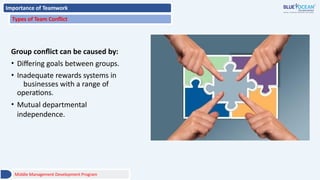
Group conflict can be caused by:
• Differing goals between groups.
• Inadequate rewards systems in
businesses with a range of
operations.
• Mutual departmental
independence.
Middle Management Development Program
Importance of Teamwork
Types of Team Conflict
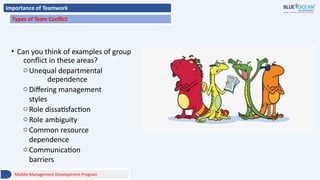
• Can you think of examples of group
conflict in these areas?
oUnequal departmental
dependence
oDiffering management
styles
oRole dissatisfaction
oRole ambiguity
oCommon resource
dependence
oCommunication
barriers
Middle Management Development Program
Importance of Teamwork
The Role of Anger in Team Conflict
• Anger is a basic human emotion, just
like happiness.
• When we are embroiled in conflict,
we can feel hurt and even
abused; sometimes, the
fastest way we can think of to
protect ourselves is by
responding in anger.
• Other times, we do not have an
opportunity to think about how
best to respond and the first
response is anger.
Middle Management Development Program
Importance of Teamwork
Stages of Team Conflict
• People must be very aware that
conflict is dynamic in nature.
• Conflict doesn’t appear suddenly, but
passes through a series of
progressive stages as tensions build.
• Conflict does not always pass
through all of these stages and the
stages can occur in a different
order than what is logically laid
out here.
• Furthermore, the participants may
not be at the same stage
simultaneously.
Five Stages of Team Conflict
Middle Management Development Program
Importance of Teamwork
Stages of Team Conflict
Latent Conflict
• At this stage, the basic conditions for
conflict exist but have not been
recognized.
oFor example, racial differences
may preclude basic
communication between two
employees.
Middle Management Development Program
Importance of Teamwork
Stages of Team Conflict
Perceived Conflict
• Here, one or both participants recognize the
cause of the conflict.
oFor example, two people are good friends,
doing lots of things together in their
free time. One of the friends gets
married and is no longer available for
lunches and Sunday morning tennis.
The unmarried friend feels left out
and feels that the marriage has
interfered with the friendship
Middle Management Development Program
Importance of Teamwork
Stages of Team Conflict
Felt Conflict
• This stage is where tension is beginning
to build between the participants,
although no real struggle has begun.
oFor example, when employees
become
short-tempered with one another,
the potential for all out conflict
begins to develop.
oThe two friends begin sniping at one
another.
Middle Management Development Program
Importance of Teamwork
Stages of Team Conflict
Manifest Conflict
• At this stage, the struggle is underway
and the behavior of the participants
makes the problem obvious to others
not directly involved.
• Arguments or damaged feelings are no
longer privately held.
• Remember that conflict is more than
disagreement and more than
something we can easily let go or
get over.
Middle Management Development Program
Importance of Teamwork
Stages of Team Conflict
Conflict Aftermath
• In the aftermath stage, the conflict has
been ended either through resolution
or suppression.
• The result may be a new condition that
will lead into more effective
cooperation or to a new conflict that
may be more severe than the first.
• In some cases the resolution can be
positive and serve to end the
issue.
Middle Management Development Program
Importance of Teamwork
LECSR Tool for Team Conflict Resolution
• The LECSR tool is a way to work through
an issue to resolve it before conflict
erupts.
• It can be used at the first sign of a
problem or as a way to intervene at any
level.
• LECSR stands for:
oListen
oEmpathize
oClarify
oSeek Permission
oResolve
Middle Management Development Program
Importance of Teamwork
LECSR Tool for Team Conflict Resolution
Listening
• Listening to someone else gives you an
opportunity to consider something
from his/her point of view.
• Instead of arguing when you hear a point you
disagree with, listen attentively to the
other person’s main points.
• These statements can help you to listen actively
and to deeply hear what someone is saying:
• “Tell me more. That’s interesting. Uh-huh.”
• “I’m not sure I understand. Could you go
over that again?”
Middle Management Development Program
Importance of Teamwork
LECSR Tool for Team Conflict Resolution
Empathizing
• Empathy is the ability to put yourself in
someone else’s position in order to
understand what they are saying and
feeling, even though you may not
agree with them.
• Statements like these can help you to
demonstrate that you empathize
with what you are hearing:
• “I don’t blame you for feeling that way.
I see what you mean.”
• “I understand how you feel. I’m sure
I’d
feel the same way if...”
Middle Management Development Program
Importance of Teamwork
LECSR Tool for Team Conflict Resolution
Clarifying the Issue
• When you address conflict in any situation,
you need a complete understanding of
all sides of the issue.
• Delve deeper to ensure that you have a
clear understanding of what the
other person is saying.
• You can explore an issue respectfully by
using statements such as:
o“Let me see if I’ve got it straight. What
you’re saying is…”
o“Is it possible that the idea you’re
proposing is…?”
Middle Management Development Program
Importance of Teamwork
LECSR Tool for Team Conflict Resolution
Seeking Permission
• When you seek to understand, you may
find you have a tendency to problem
solve instead of listen.
• Keep on track by being someone who
seeks permission.
• Before you ask questions, make sure that
you have asked the person if they are
ready for you to ask.
• Keep in mind that many of us hear a
problem and then let our minds wander
into “advice” or “problem solving”
mode.
Middle Management Development Program
Importance of Teamwork
LECSR Tool for Team Conflict Resolution
Seeking Permission (ctd’)
• Ask the other person if they want you to provide
advice before you do so.
• Respectfully ask questions or frame statements
about permission such as:
o“Now that I understand your views, can I
explain mine?”
o“I am not completely sure if you are sharing
this information with me only so that I can
understand, or if you would also like my
advice. It would be helpful if you tell me what
you need.”
o“It seems that this would be a good time to
bring up a few points you haven’t
mentioned.”
Middle Management Development Program
Importance of Teamwork
LECSR Tool for Team Conflict Resolution
Resolve the Issue
• Now that both parties have listened, empathized,
clarified the issue, asked for permission, and
discussed options – they can start to resolve
the conflict together.
• A conversation framed in this way prevents
escalation of conflicts and allows the issues to be
resolved. Sometimes we may have to agree to
disagree or have a solution that does not
satisfy all the parties completely.
• With the conflict resolution steps in LECSR,
conflict can be brought out instead of suppressed.
Conflicts can be diffused, and they may seldom
turn into destructive conflict.
Middle Management Development Program
Middle
Management
Development
Program
Importance of Teamwork
Key takeaways?
END
Middle
Management
Development
Program
Effective Delegation
What is Delegation?
• Effective delegation reduces a manager's
workload and develops employee
skills.
• Delegating prepares employees to be able
to handle your responsibilities and
allows you to advance.
• The essence of supervision and
management is getting work done through
the efforts of others.
• Delegating involves trusting someone else
to do a task for which you will be held
responsible.
Middle Management Development Program
Effective Delegation
What is Delegation?
What is responsibility?
• The accountability for reaching objectives,
using resources properly, and adhering
to organizational policy.
• The obligation of a person to carry out the
assignments and functions given him or
her by a person or persons of higher
authority.
What is accountability?
The understanding that a person accepts
responsibility for completing the task at hand
and for the results of their efforts.
Middle Management Development Program
Effective Delegation
Defining Delegation
What delegation is NOT:
• It is not giving someone else the dirty work.
• It is not giving somebody a job for a short
period to time when you are busy and
then reclaiming it again the minute you
have spare time again.
• It is not taking the job back if the delegatee
messes up.
Middle Management Development Program
Effective Delegation
Defining Delegation
Middle Management Development Program
• Delegation is the art of giving someone else
a task or responsibility that has until now
been a part of your role. This task or
responsibility is suited to the employee’s
skills and abilities and gives him/her
opportunities for growth and development.
• For many new supervisors, this is a very
difficult thing to do. Let’s take a look
at some of the facets of
delegation.
Effective Delegation
Defining Delegation
Group 1
• What are the advantages and
rewards of delegation?
• What are the disadvantages or
drawbacks of delegation?
Group 2
• Why do managers and supervisors
not delegate more often?
• Why are employees unhappy with
the delegation process?
Middle Management Development Program
Effective Delegation
Defining Delegation
Advantages of Delegating
• Frees up your time
• Good for morale
• Develops employees
• Gives you freedom to be promoted
• Can be cost effective
• Get new (and sometimes better) ideas
Worries about Delegating
• Belief that they can handle the task better
than the employee
• Poor skill in delegation
• Poor control systems
• Concern about the time that delegation
consumes
• Worry about being shown up by a
competent employee
• Fear of being out of the loop
Middle Management Development Program
Effective Delegation
Defining Delegation
Jobs That
Should Be
Delegated
• Those that you have someone else trained
and interested in doing
• Jobs that will save you time in the long
run
• Jobs that will be more cost-effective if
someone else does them
• Jobs that grow and develop
employees
• Jobs that at present have only one
person who can do them
Middle Management Development Program
Effective Delegation
Defining Delegation
What Can't Be
Delegated?
• Financial
matters
• Performanc
e reviews
and
disciplinary
actions
• Projects which have not been clearly
defined
• Assigning work
• Motivational problems
• Counseling employees and resolving
Middle Management Development Program
Effective Delegation
Defining Delegation
You Know You Should Delegate
When…
• You seem to be doing all the work
and employees have time to
spare
• Work isn’t getting done because
you have no time to do it
• You can’t take a day off or go to a
workshop because you have
nobody you can trust to mind
the shop
• Employees wait for you to make
all the decisions
Middle Management Development Program
Effective Delegation
Defining Delegation
Why do employees not want to be
delegated to?
• They aren’t trained to do the job
• You delegate only trivial tasks
• You expect others to do the job as well as
you can
• You delegate haphazardly
• You are an autocratic delegator
• You check constantly to see how things are
going and micro-manage
• You take credit for results achieved by
employees
• You overload employees
Middle Management Development Program
Effective Delegation
The Steps of Successful Delegation
• Assign work to different members
of the work group.
• Make each employee feel
accountable for the
assigned work.
• Empower each employee to do
what
they need to do to perform the
duties
Middle Management Development Program
Effective Delegation
Degrees of Delegation
1 Investigate and
report back.
• The employee investigates and brings
you the facts. You make the
appropriate decision and take action.
2- Investigate and recommend action.
• In this scenario the employee
investigates or researches, identifies
options available, and recommends a
course of action to be taken. You
evaluate the recommendation, make
the decision, and take action.
Middle Management Development Program
Effective Delegation
Degrees of Delegation
3- Investigate and advise on action planned.
• The employee researches, identifies options, and decides
on a course of action, complete with justification. You
evaluate the decision made, and approve or veto the action
to be taken.
4- Investigate and take action; advise you on the action
taken.
• The employee researches, identifies options, decides which
option is best, takes action, then advises you
immediately, so you have a firm handle on what’s going
on.
5- Investigate and take action.
• The employee is turned loose. This is full delegation and
displays your complete faith in the individual's ability. You
will be kept informed through regular reporting procedures.
Middle Management Development Program
Effective Delegation
Role Play Activity
Delegator
• You are going on a four-week cruise
vacation.
• In order to get the time off you must
train somebody else to do your job in
your absence.
• In a short role play, go over several of
the most important tasks that
he/she will be performing in
your absence.
Delegatee
• Your boss is going on a four-week
cruise vacation.
• You will need to do their job in their
absence.
• This is your only opportunity to learn
how to do this work so make sure
that you understand the
instructions.
• Take several minutes to prepare for
the instructions you are about to
receive.
Middle Management Development Program
Effective Delegation
Role Play Activity
Observer
• While the delegator gives his/her
instructions to the delegate,
watch the interaction.
• What improvements could be made
on both sides?
Middle Management Development Program
Middle
Management
Development
Program
Effective Delegation
Key takeaways?
END
Middle
Management
Development
Program
Reviewing Performance
Feedback and Evaluation
• Employees should be provided with specific performance-
related feedback to help them determine if they are
achieving their goals.
• Frequent feedback is beneficial because it allows
employees to adjust their level of effort to achieve their
goals.
• Feedback from management should consistently be
provided. However, feedback can also come
from coworkers or customers.
• It may be in the form of scores, charts, or graphs that
depict performance over time.
• Feedback not only allows employees to assess
their accomplishments, but it also provides them
with the continued motivation to achieve their
goals.
Middle Management Development Program
Reviewing Performance
Feedback and Evaluation
• Not only should the employees be evaluated,
but goals should be evaluated
periodically.
• Because organizations face many changes,
goals need to be flexible enough so
that organizations can respond to
dynamic environments.
• Objectives should be measurable and specific.
Objectives that are not measurable are
often not directly tied to the organization's
overall mission. They should be linked to
rewards that are valued by employees and
associated with specific time periods.
Middle Management Development Program
Reviewing Performance
Ways To Give Effective Employee Feedback
1. Avoid giving unsolicited advice
• Only a third of people believe the feedback
they receive is helpful. That’s because
more often than not, it’s unsolicited,
which can create an immense amount
of stress for the person receiving it.
• If your direct report doesn’t ask for feedback
directly, be sure to ask them if, when, and
how they’d like to receive it.
• By doing this, you can give the control to
your employee and increase the likelihood
that they will act on the feedback you share.
Middle Management Development Program
Reviewing Performance
Ways To Give Effective Employee Feedback
2. Be specific
• Employee feedback should be solutions oriented, crystal clear, and to the point. If
your intention is to offer corrective feedback, general comments, like “Your
work needs to be improved” or “I wasn’t very impressed with those reports".
You have to do better than that” can leave your employee confused and in
the dark as to what aspect of their work needs to be corrected.
• Be specific on what you’d like your employee to do and offer guidance on how they
can apply the feedback. For example, “I noticed you were late on your last two
deadlines. I’d like to work with you on your time management to ensure you’re
not committing to too much and completing each of your tasks in a timely
manner.”
• Pro tip: Don’t get stuck on corrective feedback. Remember to also share positive
feedback with your employees so they know the things they should continue doing
but not at the same time.
Middle Management Development Program
Reviewing Performance
Ways To Give Effective Employee Feedback
3. Come with a deep level of empathy
• Delivering feedback that exposes a wide gap in self-knowledge demands an extra
measure of sensitivity.
• Like ripping off a shell, the sting of discovering such a profound gap often elicits
strong emotions that can easily be confused as defensiveness.
• If you’re someone who bores the effect of your colleague’s difficult behavior, be
sure you can set those frustrations aside in favor of the empathy you’ll need
for this conversation.
• Before you even approach your colleague, be prepared to give them the space
they’ll need to feel shocked upon receiving your feedback.
• Remember not to interpret it as intensified resistance to your message.
Middle Management Development Program
Reviewing Performance
Ways To Give Effective Employee Feedback
4. Don’t wait for a quarterly review
• Employee feedback immediately following an event has the greatest impact on
performance. And engagement peaks when employees receive feedback on
a weekly pace.
• If issues are left unaddressed, they may multiply by a domino effect. So by the
time the quarterly performance review comes around, you’ll be confronted
with a
host of issues that could have been avoided if mentioned earlier.
• Another flaw in saving feedback for the performance review process is that
problems will be forgotten and the time for offering valuable feedback will
have passed.
• Daily or weekly feedback will help you avoid the recency bias—which mainly
reflects recent work and occurs too infrequently to align with the
employee’s
workflow—and can make tracking and analyzing a colleague’s work much easier
for all parties involved.
Middle Management Development Program
Reviewing Performance
Ways To Give Effective Employee Feedback
5. Keep it private
• Don’t criticize publicly—ever.
• For some, even praise is better delivered in a private meeting. Some people simply
don’t like being the center of attention.
• You can also consider offering employee feedback in the form of a written
response. This can give you time to reflect and offer a more thoughtful answer.
• Feedback isn’t just uncomfortable for the receiver, it can be uncomfortable for the
giver as well.
• By moving the location to a more informal area, you can help to ease some of the
underlying pressure.
Middle Management Development Program
Reviewing Performance
Ways To Give Effective Employee Feedback
6. Don’t take the “sandwich approach”
• Helping someone improve should always be the goal of feedback, but sandwiching
corrective feedback between two pieces of positive feedback won’t soften the
blow.
• This method creates confusion for the receiver, undermines your feedback,
and can decrease levels of trust.
• Although it may feel more uncomfortable for the giver, being upfront and
transparent with corrective feedback sets the foundation for an
authentic conversation.
• Focus on delivering feedback diplomatically instead of beating around
the bush.
Middle Management Development Program
Reviewing Performance
Ways To Give Effective Employee Feedback
7. Make the conversation a two-way street
• Lecturing someone on how they should improve is about as effective as talking to
a brick wall.
• Don’t forget the important element of respect when discussing vulnerable topics,
and certainly don’t talk at someone when it’s far more effective to open up
the conversation and talk with them.
• Let the receiver respond to your feedback and allow them to ask follow up
questions.
• Once the issue is clear, then you two can work together to land on a solution or
course-of-action.
Middle Management Development Program
Reviewing Performance
Ways To Give Effective Employee Feedback
8. Focus on performance, not personality
• Lecturing someone on how they should improve is about as effective as talking to
a brick wall.
• Don’t forget the important element of respect when discussing vulnerable topics,
and certainly don’t talk at someone when it’s far more effective to open up
the conversation and talk with them.
• Let the receiver respond to your feedback and allow them to ask follow up
questions.
• Once the issue is clear, then you two can work together to land on a solution or
course-of-action.
Middle Management Development Program
Reviewing Performance
Ways To Give Effective Employee Feedback
9. Keep the conversation going by following up
• Lecturing someone on how they should improve is about as effective as talking to
a brick wall.
• Don’t forget the important element of respect when discussing vulnerable topics,
and certainly don’t talk at someone when it’s far more effective to open up
the conversation and talk with them.
• Let the receiver respond to your feedback and allow them to ask follow up
questions.
• Once the issue is clear, then you two can work together to land on a solution or
course-of-action.
Middle Management Development Program
Reviewing Performance
Coaching and Counseling
• Savvy supervisors know that effective coaching and counseling builds strong working
relationships. It also encourages retention and helps employees grow in their
careers.
• In fact, a 2006 Sun Microsystems 5-year study of over 1,000 employees found that those
who mentored others were 6 times more likely to be promoted than those who
didn’t, and their mentees were 5x more likely to be promoted than those who weren’t.
• Quality mentoring increases worker satisfaction, productivity, helps the bottom line and is
necessary for transferring knowledge and expertise from seniors to newer employees.
Efforts from coaching and counseling will bear positive outcomes that outweigh any
time or financial investments when done correctly.
Middle Management Development Program
Reviewing Performance
Six Secrets for Effective Employee Coaching and Counseling
1. Every moment in the office is an opportunity for
training, coaching and counseling employees
2. Lay the groundwork of a healthy relationship for
more successful training, coaching and
counseling
3. See failures and mistakes as perfect
opportunities for training, coaching and
counseling employees
4. Provide plenty of praise and rewards
5. Your feedback needs to be detailed and
specific
6. Carpool chats are a quick route to
effectively coaching and counseling
employees
Middle Management Development Program
Reviewing Performance
Coaching Vs. Counseling
Coaching
• Future focused
• Solution focused
• Outcomes driven
• Doesn’t give advice, instead
it leads the individual to find their own
answers
• Asks: “How can you change?”
• Believes that the individual has the
answers within
• Helps the individual find their own
solutions to meet their goal
Counseling
• Past focused
• Problem focused
• Challenge/issue driven
• Gives advice, recommendations and
directives, at times, forcefully
• States: Why you must change.
• The counselor has the answers
• Gives the individual a diagnosis and
treatment or solution to fix the
problem
Middle Management Development Program
Reviewing Performance
Coaching Vs. Counseling
• The difference between coaching and counseling is all about perspective. Coaching asks:
Do you need help with attaining your work goals; whereas, counseling states: You
need help in addressing this issue that hinders your performance in the workplace.
• One is to inspire and motivate; the other is to improve and correct. One helps an
employee move forward to achieve a goal; the other helps a struggling
employee improve.
• One of the major differences between coaches and counselors is in their focus. Coaches
look to the future and work to help an individual achieve certain goals in the
workplace. They’re looking to improve the employee’s already adequate
performance.
Middle Management Development Program
Middle
Management
Development
Program
Reviewing Performance
Key takeaways?
END
Middle
Management
Development
Program
Final Thoughts?
www.blueoceanacademy.com
Middle
Management
Development
Program
January, 2024

Middle Management Development Program - Study Material (1) (2).pptx

  • 1.
  • 2.
    Middle Management DevelopmentProgram Course Agenda 1. Management and Leadership 2. Motivation 3. Goals And Goal Setting 4. Time Management and Planning 5. Strategic Problem Solving 6. Importance of Teamwork 7. Effective Delegation 8. Reviewing Performance
  • 3.
  • 4.
    Management and Leadership DefiningManagement Management can be described as the people who design an organization’s structure and determine how different aspects of the organization will interact. Is Management an Art or a Science? Middle Management Development Program
  • 5.
    Management and Leadership DefiningManagement Organizational design is largely a function based on systems thinking. A system is a set of things-- people, cells, molecules, or whatever-- interconnected in such a way that they produce their own pattern of behavior over time. Middle Management Development Program
  • 6.
    Management and Leadership DefiningManagement Perspective is essential in systems thinking: a manager’s role in organizational design is to refrain from thinking of departments, individuals, processes, and problems as separate from the system and instead think of them as indivisible components of the broader organizational process. Middle Management Development Program
  • 7.
    Management and Leadership DefiningManagement Think of connections instead of disconnections/silos; think in circles instead of in a linear manner; think in wholes instead of parts; think of synthesis instead of analysis; think of relationships instead of about things in isolation. Be big-picture. Be holistic. Middle Management Development Program
  • 8.
    Management and Leadership DefiningManagement Management must actively adapt organizations to meet various challenges, opportunities, and technological improvements to maintain competitive output. Middle Management Development Program
  • 9.
    Management and Leadership Scanningthe Environments Middle Management Development Program
  • 10.
    Management and Leadership Scanningthe Environments Middle Management Development Program
  • 11.
    Management and Leadership EssentialManagerial Functions Middle Management Development Program
  • 12.
    Management and Leadership Levelsof Planning Middle Management Development Program
  • 13.
    Management and Leadership BasicElements of Organizing Middle Management Development Program
  • 14.
    Management and Leadership Functionsof Leadership Middle Management Development Program
  • 15.
    Management and Leadership ControllingFunction of Management Middle Management Development Program
  • 16.
    Management and Leadership TheManagement Competency Value Chain Continuous Professional Development Imroving Managerial Skills & Competencies Imroving Managerial Skills & Competencies Middle Management Development Program
  • 17.
    Management and Leadership Typesof Management Styles – 1- Autocratic • This type of management follows a top-down approach, with one-way communication from bosses to employees. • This is the most controlling of the different management styles, with the management making all workplace decisions and holding all of the power. • Employees are treated as drones, to be monitored closely as they perform within clearly defined perimeters. Middle Management Development Program
  • 18.
    Management and Leadership Typesof Management Styles – 1- Autocratic Middle Management Development Program
  • 19.
    Management and Leadership Typesof Management Styles – 2- Participative • In this style, managers encourage employees to give input during the decision-making process, but are ultimately responsible for the final decision. • Communication goes both ways, top-down and bottom-up, and team cohesiveness is increased. • This process allows for diverse opinions, skills and ideas to inform decisions. Middle Management Development Program
  • 20.
    Management and Leadership Typesof Management Styles – 2- Participative Middle Management Development Program
  • 21.
    Management and Leadership TheResponsibilities of a Manager 1 Responsibilities To Management • Their projects are on time and on budget. • They are kept informed of progress and of possible problems. • You defend their position or point of view in public, while you address your criticisms to them in private. Middle Management Development Program
  • 22.
    Management and Leadership TheResponsibilities of a Manager 2- Responsibilities To Your Workgroup • Give them your support and recognition in public, while you address criticisms to them in private. • Provide a fair and consistent interpretation of rules, regulations, and policies. • Give them opportunities to grow and develop. • Provide a safe work environment. • Promote good communication. Middle Management Development Program
  • 23.
    Management and Leadership TheResponsibilities of a Manager 3- Responsibilities To Yourself • Recognize your competence and your successes. • Recognize you can’t do it all. Learn from failure and go on. • Commit to continuous learning. • Maintain balance. Middle Management Development Program
  • 24.
    Management and Leadership ManagementVs. Leadership Middle Management Development Program
  • 25.
    Management and Leadership ManagementVs. Leadership • Leadership is a process by which an executive can direct, guide and influence the behavior and work of others towards accomplishment of specific goals in a given situation. • Leadership is the ability of a manager to induce the subordinates to work with confidence and passion. • Leadership is the potential to influence behavior of others. It is also defined as the capacity to influence a group towards the realization of a goal. Leaders are required to develop future visions, and to motivate the organizational members to want to achieve the visions. • Leadership is the ability to persuade others to seek defined objectives enthusiastically. It is the human factor which binds a group together and motivates it towards goals. Middle Management Development Program
  • 26.
    Management and Leadership LeaderVs. Manager Middle Management Development Program
  • 27.
    Management and Leadership The5 Levels of Leadership Middle Management Development Program
  • 28.
    Management and Leadership Traitsof Successful Leaders Middle Management Development Program
  • 29.
    Management and Leadership Skillsto Be a Better Leader Middle Management Development Program Strategic Thinking Developing a vision of where you want to be Planning and Delivery Planning how to achieve your vision and dealing with challenges along the way People Management Finding the right people and motivating them to work towards your vision Change Management Recognizing, responding and managing changes to your vision and plan Communication Working on the best ways to communicate your vision to others and listening to ideas Persuasion and Influence Encouraging others to help you achieve your vision by demonstrating its advantages
  • 30.
    Management and Leadership LeadershipStyles Middle Management Development Program
  • 31.
    Management and Leadership SkillsRequired for Transformational Leadership Middle Management Development Program
  • 32.
    Management and Leadership Leadershipthrough Emotional Intelligence A leadership style that emphasizes the understanding and management of emotions, both in oneself and in others, to build effective relationships, inspire trust, and achieve positive outcomes. Middle Management Development Program
  • 33.
    Management and Leadership Leadershipthrough Emotional Intelligence Emotional intelligence (EI) is the ability to recognize, understand, and regulate emotions in oneself and others, and it plays a crucial role in successful leadership. Middle Management Development Program
  • 34.
    Management and Leadership Leadershipthrough Emotional Intelligence Leaders who demonstrate emotional intelligence are empathetic, self-aware, and skilled in managing their emotions and those of their team members. Middle Management Development Program
  • 35.
    Management and Leadership KeyComponents of Leadership through Emotional Intelligence Middle Management Development Program
  • 36.
    Management and Leadership JohnAdair's Action Centered Leadership Model Middle Management Development Program
  • 37.
    Management and Leadership JohnAdair's Action Centered Leadership Model Middle Management Development Program
  • 38.
    Management and Leadership JohnAdair's Action Centered Leadership Model • Adair also promotes a '50:50 rule' which he applies to various situations involving two possible influencers, e.g. the view that 50% of motivation lies with the individual and 50% comes from external factors, among them leadership from another. • This contradicts most of the motivation gurus who assert that most motivation is from within the individual. • He also suggests that 50% of team building success comes from the team and 50% from the leader. Middle Management Development Program
  • 39.
    Management and Leadership SituationalLeadership® II Model • Situational Leadership® II (SLII) is a widely recognized leadership development model developed by Dr. Paul Hersey and Dr. Ken Blanchard. • It is an extension and refinement of their original Situational Leadership® Model, which was introduced in the late 1960s. • SLII is designed to help leaders adapt their leadership style based on the development level of their team members in a given situation. Middle Management Development Program
  • 40.
    Management and Leadership SituationalLeadership® II Model Development Level: SLII identifies four distinct development levels that team members can exhibit based on their competence (skills and knowledge) and commitment (motivation and confidence) in a specific task or goal. • D1: Low Competence, High Commitment - Enthusiastic Beginners: Individuals at this level lack the required skills and experience but are highly motivated and eager to learn. • D2: Some Competence, Low Commitment - Disillusioned Learners: At this stage, team members have acquired some skills, but their confidence and commitment may be wavering. Middle Management Development Program
  • 41.
    Management and Leadership SituationalLeadership® II Model Development Level: • D3: Moderate to High Competence, Variable Commitment - Capable but Cautious Performers: These individuals possess the necessary skills but may lack full confidence or motivation to take on new challenges. • D4: High Competence, High Commitment - Self-Reliant Achievers: Team members at this level are both competent and committed, capable of working independently and guiding others. Middle Management Development Program
  • 42.
    Management and Leadership SituationalLeadership® II Model Leadership Styles: The SLII Model defines four leadership styles that correspond to each development level: • S1: Directing (Telling): Involves providing clear instructions and specific guidance to team members who are at D1 - Enthusiastic Beginners. • S2: Coaching (Selling): Involves explaining decisions, soliciting suggestions, and providing support to team members at D2 - Disillusioned Learners. • S3: Supporting (Participating): Requires offering guidance, collaborating, and empowering team members at D3 - Capable but Cautious Performers. • S4: Delegating (Observing): Involves handing over responsibility and allowing team members at D4 - Self- Reliant Achievers to work independently Middle Management Development Program
  • 43.
    Management and Leadership SituationalLeadership® II Model Leadership Flexibility: The SLII Model emphasizes that effective leaders should be flexible in their approach and adapt their leadership style based on the development level of their team members. Successful leaders can move along the leadership continuum and use different styles as needed to support and develop their team members. Middle Management Development Program
  • 44.
    Management and Leadership SituationalLeadership® II Model Development and Performance: The primary goal of the SLII Model is to increase the development level of team members, thereby enhancing their competence and commitment, leading to improved performance and job satisfaction. Middle Management Development Program
  • 45.
  • 46.
  • 47.
    Motivation What's the onlyreal way to motivate? The only way to get a person to do something is to make the person want to do it in order to get something they want or avoid something they don't want. Middle Management Development Program
  • 48.
    Motivation Middle Management DevelopmentProgram  What is motivation?  Why does a supervisor need to understand human motivation?
  • 49.
    Motivation • Motivation isa force that leads people to attempt to satisfy their important needs. • Motivation is a drive from within that prompts or incites an action. • Supervisors need to create a climate in which internal motivation will activate performance. What is motivation? Middle Management Development Program
  • 50.
    Motivation Types of Motivators Thecarrot Middle Management Development Program The Whip The Plant
  • 51.
    Motivation Types of Motivators TheCarrot The Whip The Plant Middle Management Development Program
  • 52.
    Motivation Types of Motivators TheCarrot • Represents incentives and rewards. • Examples: Time off, bonuses, gifts. • Be careful! Offering carrots can reduce productivity. Middle Management Development Program
  • 53.
    Motivation Types of Motivators TheWhip • Represents threats and consequences. • Have their place for short-term goals. • Employees never respond positively to the whip. • We must remember to recognize people when they do something good. Middle Management Development Program
  • 54.
    Motivation Types of Motivators ThePlant • Represents a positive environment. • Suggests many things a supervisor should strive for. Middle Management Development Program
  • 55.
    Motivation Motivational Theories Middle ManagementDevelopment Program What do you know about: 1. Maslow’s hierarchy of needs theory 2. Herzberg’s Two factor theory
  • 56.
    Motivation Motivational Theories -Maslow’s hierarchy of needs theory Lower order needs - mainly satisfied externally Middle Management Development Program Higher order needs - satisfied internally, i.e., within an individual.
  • 57.
    Motivation Motivational Theories -Maslow’s hierarchy of needs theory Middle Management Development Program • Human behavior is goal-directed. • Motivation cause goal-directed behavior. • It is through motivation that needs can be handled and tackled purposely. • This can be understood by understanding the hierarchy of needs by manager. • The needs of individual serves as a driving force in human behavior. • Therefore, a manager must understand the “hierarchy of needs”. Maslow has proposed “The Need Hierarchy Model”.
  • 58.
    Motivation Motivational Theories -Maslow’s hierarchy of needs theory Middle Management Development Program • According to Maslow, individuals are motivated by unsatisfied needs. • As each of these needs is significantly satisfied, it drives and forces the next need to emerge.
  • 59.
    Motivation Motivational Theories -Maslow’s hierarchy of needs theory The managers must identify the need level at which the employee is existing and then those needs can be utilized as push for motivation. Managers can give the employees challenging jobs in which the employees’ skills and competencies are fully utilized. Moreover, growth opportunities can be given to them so that they can reach the peak. Managers can appreciate and reward employees on accomplishing and exceeding their targets. The management can give the deserved employee higher job rank / position in the organization. Management should encourage teamwork and organize social events. Managers should provide the employees job security, safe and hygienic work environment, and retirement benefits so as to retain them. Managers should give employees appropriate salaries to purchase the basic necessities of life. Breaks and eating opportunities should be given to employees Middle Management Development Program
  • 60.
    Motivation Motivational Theories -Herzberg’s Two-Factor Theory • In 1959, Frederick Herzberg, a behavioral scientist proposed a two-factor theory or the motivator- hygiene theory. • According to Herzberg, there are some job factors that result in satisfaction while there are other job factors that prevent dissatisfaction. • According to Herzberg, the opposite of “Satisfaction” is “No satisfaction” and the opposite of “Dissatisfaction” is “No Dissatisfaction”. Frederick Herzberg Middle Management Development Program
  • 61.
    Motivation Motivational Theories -Herzberg’s Two-Factor Theory Middle Management Development Program
  • 62.
    Motivation Motivational Theories -Herzberg’s Two-Factor Theory Herzberg's Motivational versus Maintenance (Hygiene) Factors Motivational Factors Interesting, challenging work Good use of one’s capabilities Opportunity to do something meaningful Involvement in decision making Recognition for achievement Access to information Sense of importance to organization Middle Management Development Program
  • 63.
    Motivation Motivational Theories -Herzberg’s Two-Factor Theory Herzberg's Motivational versus Maintenance (Hygiene) Factors Maintenance (Hygiene) Factors Congenial people to work with Good working conditions Pensions Paid insurance Job security Vacations and holidays Good pay Job titles Middle Management Development Program
  • 64.
    Motivation Motivational Theories -Herzberg’s Two-Factor Theory Supervisor's versus Higher Management’s Role Higher management can merely prevent dissatisfaction by providing maintenance factors in adequate quantity and quality Middle Management Development Program Supervisors can provide satisfaction with motivation factors and cause an increased commitment of employees’ time and energy
  • 65.
    Motivation Motivational Theories Why doyou think there are so many theories on motivation? • Human behavior is very complex. • No single theory seems to explain all human behavior. • Theories are essentially different sets of glasses for looking at life. Middle Management Development Program
  • 66.
    Motivation Guidelines on motivatingpeople 1- Share your vision and set clear goals Regularly set clear and measurable goals that are framed by a clear vision so that you and your teams can track progress and they are able to see their success in a tangible way 2- Learn what people want Every employee has a different motivation for why they work. Learning what employees want will help you formulate the next step when building motivation in the workplace. 3- Communicate with your staff Communication is a two-way street and you should make sure that there is a constant flow of communication between you and your employees. This way you can not only keep them up-to-date with what needs to be done but you can also listen to their ideas, opinions and feedback. Make sure you are available to contact and be open and approachable in your attitude to communication. 4- Promote Positive Employee Self Esteem Middle Management Development Program Self-esteem has two essential components: a) Self-efficacy: Confidence in the ability to cope with life's challenges. Self- efficacy leads to a sense of control over one's life. b) Self-respect: Experience oneself as deserving of happiness, achievement, and love. Self-respect makes possible a sense of community with others.
  • 67.
    Motivation Guidelines on motivatingpeople Middle Management Development Program 5- Encourage teamwork You can do this by regularly holding team- building exercises and opportunities for your team members to bond and get to know one another. 6- A healthy office environment Create a space that is enjoyable to work in and an office where your employees want to spend their time. Be conscious of privacy, noise, air quality, natural light, areas to relax and the ambience. And don't forget about your remote employees. They need just as much attention and support from your side to create a healthy work environment for them, too - even if their office is at home. 7- Give positive feedback and reward your team When employees achieve results, put in extra effort or do outstanding work make sure to tell them that you’re grateful and be specific in your praise. Reward your team for hard work, whether this in the form of monetary rewards, gifts, bonuses or more responsibility and independence. 8- Provide opportunities for development These opportunities should be tailored specifically to suit the individual employee and can be in the form of further training, setting challenging targets, inviting an employee to shadow you or spending your own time teaching and mentoring somebody.
  • 68.
  • 69.
  • 70.
    Planning and GoalSetting Goals • Teams often fall short of meeting their goals due to a lack of consensus on the definition of success. • SMART goals use a specific set of criteria to help ensure that objectives are clearly defined and attainable within a certain timeframe. • Working through each step of creating a SMART goal can reveal instances where priorities and resources are out of alignment. Middle Management Development Program
  • 71.
    Planning and GoalSetting What are SMART goals? • The SMART in SMART goals stands for Specific, Measurable, Achievable, Relevant, and Time- Bound. • Defining these parameters as they pertain to your goal helps ensure that your objectives are attainable within a certain time frame. • This approach eliminates generalities and guesswork, sets a clear timeline, and makes it easier to track progress and identify missed milestones. Middle Management Development Program
  • 72.
    Planning and GoalSetting What are SMART goals? • An example of a SMART-goal statement might look like this: Our goal is to [quantifiable objective] by [timeframe or deadline]. [Key players or teams] will accomplish this goal by [what steps you’ll take to achieve the goal]. Accomplishing this goal will [result or benefit]. Middle Management Development Program
  • 73.
    Planning and GoalSetting S: Specific • In order for a goal to be effective, it needs to be specific. A specific goal answers questions like: o What needs to be accomplished? o Who’s responsible for it? o What steps need to be taken to achieve it? • Thinking through these questions helps get to the heart of what you’re aiming for. Middle Management Development Program
  • 74.
    Planning and GoalSetting M: Measurable • Specificity is a solid start, but quantifying your goals (that is, making sure they’re measurable) makes it easier to track progress and know when you’ve reached the finish line. • Incorporate measurable, trackable benchmarks. Middle Management Development Program
  • 75.
    Planning and GoalSetting A: Achievable • This is the point in the process when you give yourself a serious reality check. • Goals should be realistic — not pedestals from which you inevitably tumble. • Ask yourself: is your objective something you or your team can reasonably accomplish? • Safeguarding the achievability of your goal is much easier when you’re the one setting it. However, that’s not always the case. • When goals are handed down from elsewhere, make sure to communicate any restraints you may be working under. Even if you can’t shift the end goal, at least you can make your position (and any potential roadblocks) known up-front. Middle Management Development Program
  • 76.
    Planning and GoalSetting R: Relevant • Here’s where you need to think about the big picture. Why are you setting the goal that you’re setting? Middle Management Development Program
  • 77.
    Planning and GoalSetting T: Time-based • To properly measure success, you and your team need to be on the same page about when a goal has been reached. • What’s your time horizon? When will the team start creating and implementing the tasks they’ve identified? When will they finish? • SMART goals should have time-related parameters built in, so everybody knows how to stay on track within a designated time frame. Middle Management Development Program
  • 78.
    Planning and GoalSetting SMARTER Goals • S.M.A.R.T.E.R. goal setting takes this two steps further, forcing you to evaluate and readjust or revise your approach. • This added sense of measurement and readjustment is critical to the achievement of anything in life. • All too often, we tend to set our goals, but not put any type of measurement to them. • When we don’t measure and track something, it becomes far easier for the mind to trick us into either putting things off or thinking that we’ve come further along than we really have. Middle Management Development Program
  • 79.
    Planning and GoalSetting E: Evaluated • The sixth aspect of SMARTER goal setting is that goals should be evaluated. • This is where we move beyond goal characteristics and into goal interaction. • Evaluation is about reviewing and reflecting. • What’s working, what’s not. What’s gone well, what hasn’t. What’s gotten in your way, and what’s been helpful along the way. Middle Management Development Program
  • 80.
    Planning and GoalSetting R: Revised • The final aspect of SMARTER goal setting is that goals can be revised. If the goals are SMART and you’re evaluating them with your team member regularly, then you may not have to revise anything. • But goals aren’t perfect, and neither are situations. • Stuff comes up. A life event, a change in the industry, downsizing in your company, a change in materials or distributors for things that you might sell. • Revision happens during evaluation, so these two stages go hand-in-hand. • As you evaluate in general, you need to evaluate whether goals should be revised. Middle Management Development Program
  • 81.
    Planning and GoalSetting R: Revised • What should we change about upcoming goals and what should we keep the same? • How can we ensure better results than last time? • Are there different metrics we can track that better represent performance? • Do other or additional people need to be included on these goals? Middle Management Development Program
  • 82.
    Planning and GoalSetting Goal Attributes Middle Management Development Program Specificity Difficulty Acceptance Commitment
  • 83.
    Planning and GoalSetting Goal Attributes Middle Management Development Program Specificity Difficulty Acceptance Commitment • Studies show that there is a direct relationship between goal specificity and employee performance. The more specific the goal, the less ambiguity involved and the higher the performance. • When employees are given do-your-best goals, they do not have an external reference by which they can measure their own performance. • For example, telling a salesperson to "do the best you can" is an extremely vague goal that may not increase performance. However, "increase sales by 10 percent" is much more specific and encourages high performance because the employee has past sales as a reference point.
  • 84.
    Planning and GoalSetting Goal Attributes Middle Management Development Program Specificity Difficulty Acceptance Commitment • Goal difficulty also has a direct relationship with performance. Research shows that more difficult goals lead to higher performance, as long as the goals do not become so difficult that employees perceive them as impossible. Unreasonable goals frustrate, rather than motivate, employees. • On the other hand, difficult but realistic goals lead to increased performance and motivation. Research suggests that employees are highly motivated when the probability of achieving a specific goal is 50 percent.
  • 85.
    Planning and GoalSetting Goal Attributes Specificity Difficulty Acceptance Commitment Middle Management Development Program
  • 86.
    Planning and GoalSetting Goal Attributes Middle Management Development Program Specificity Difficulty Acceptance Commitment • Goal acceptance is the degree to which employees accept a goal. Employees need to feel that the goal is fair and consistent in order to make it their own. Even if a goal is specific and attainable, individual acceptance is still necessary for effectiveness. • Employees may reject goals for a multitude of reasons; they feel the work is meaningless, they do not trust the organization, or they do not receive feedback regarding their performance.
  • 87.
    Planning and GoalSetting Goal Attributes Middle Management Development Program Specificity Difficulty Acceptance Commitment • Employees must be committed to the goal in order for it to be achieved. • Commitment refers to the degree to which employees are dedicated to reaching the goal, and is determined by both situational and personal variables. • Commitment to a goal can be increased by developing goals that appeal to employees' values and needs. • Employees must be convinced that the goal is important. It should be relevant and significant to some personal value. • For example, goals that are tied to company success, and therefore job security, often appeal to employees' need for security.
  • 88.
  • 89.
  • 90.
    Time Management andPlanning What is Time Management • Time management is like any other process, it must be planned, monitored and reviewed regularly. • Effective time management is a skill that is learned and if used regularly can be improved upon. • “Time is the scarcest resource and unless it is managed nothing can be managed” – Peter Drucker Middle Management Development Program
  • 91.
    Time Management andPlanning What is Time Management • “Time Management” is actually a misnomer, because one does not manage time, for it’s beyond anyone’s control. • It moves on at a predetermined rate, no matter what we do. • It is not a question of managing the clock but managing ourselves with respect to the clock. Middle Management Development Program
  • 92.
    Time Management andPlanning Benefits of Time Management When an individual organizes and manages his/her activities focusing on the result rather than the activities, the benefits are enormous; • Greater productivity and efficiency. • A better professional reputation. • Less stress. • Increased opportunities for advancement. • Greater opportunities to achieve important life and career goals. Middle Management Development Program
  • 93.
    Time Management andPlanning Risk of Missing Time • Missed deadlines. • Inefficient workflow. • Poor work quality. • A poor professional reputation and a stalled career. • Higher stress levels. Failing to manage oneself can have some very undesirable consequences: Middle Management Development Program
  • 94.
    Time Management andPlanning Risk of Missing Time • Time management is not very difficult as a concept, but it’s surprisingly hard to do in practice. • It requires the investment of a little time upfront to prioritise and organise oneself. • But once done, you will find that with minor tweaks, your day, and indeed your week and month, fall into place in an orderly fashion, with time for everything you need to do. Middle Management Development Program
  • 95.
    Time Management andPlanning Common Time Wasters at Work • 73% of people say they waste time at work -- at least one hour per day. • Checking email wastes 50% of the workday • When people aren't at their desks, there's a good chance they're getting more coffee. The average worker drinks 3 cups per day. • They waste time by surfing the web (48%), talking with coworkers (33%), taking care of personal agendas and calls (49%), and taking long lunches (15%) • They're in the bathroom checking Facebook: 54% of women and 46% of men do this. 77% of employees who have access to Facebook from work check it daily. Middle Management Development Program
  • 96.
    Time Management andPlanning Common Time Wasters at Work • But a lot of time is also wasted on boring work tasks, like fixing coworkers' mistakes (54%), dealing with office politics (47%), waiting on colleagues (42%), getting dragged to meetings (42%), and doing administrative work (33%) Middle Management Development Program
  • 97.
    Time Management andPlanning How to Manage Time • “Time management” is the process of organizing and planning how to divide your time between specific activities. • Good time management enables you to work smarter, “not harder” so that you get more done in less time, even when time is tight, and pressures are high. • It's important that you develop effective strategies for managing your time to balance the conflicting demands of life. • Failing to manage your time damages your effectiveness and causes stress. Middle Management Development Program
  • 98.
    Time Management andPlanning Principles of Time Management The key principles for effective Time Management are: 1. Set clear goals & objectives 2. Plan your work 3. Get organized 4. Prioritize your activities 5. Destroy procrastination Middle Management Development Program
  • 99.
    Time Management andPlanning Principles of Time Management Set clear goals & objectives • Examine your present situation and assess what goals are important to you and what action you need to take to achieve your target. • Set yourself specific and clearly defined goals, and make sure that these are realistic and achievable. • Have a contingency plan or alternative route to your goal in case you have to change your plans. Middle Management Development Program
  • 100.
    Time Management andPlanning Principles of Time Management Get Organized Once the goals are set, the next step is to organize the goals into manageable targets or milestones. 1. Manage your energy and your focus 2. Create a task list that reflects your priorities 3. Plan your day, week and month 4. Divide your tasks for the day into achievable blocks 5. Set realistic deadlines for your activities 6. Allocate responsibilities (if necessary) 7. Schedule work to suit your energy cycle Middle Management Development Program
  • 101.
    Time Management andPlanning Principles of Time Management Get Organized To do list is an effective Time Management tool 1. Write down what you need to do 2. It is harder to ignore what you have written down on paper 3. It shows you everything you need to do so 4. It helps you to prioritize your jobs 5. Tick off tasks as you accomplish them Middle Management Development Program
  • 102.
    Time Management andPlanning Principles of Time Management Know your Energy Cycle • Everyone has a natural time during the day when they are "UP" (prime time) and a natural time when they are "DOWN" (down time). • During prime time, your brain is "on"; your batteries are charged and you're able to focus. • During down time, your brain feels "slow"; it's difficult to muddle through your work. Middle Management Development Program
  • 103.
    Time Management andPlanning Principles of Time Management Know your Energy Cycle • When considering a daily schedule, it is a good idea to keep your energy cycle in mind. • Some people are at their best early in the morning, others peak in the afternoon. • Whenever possible, try to plan your daily schedule to match your prime time. Middle Management Development Program
  • 104.
    Time Management andPlanning Principles of Time Management Know your Energy Cycle • Consider such ideas as doing work that requires concentration, creativity, and thought during your prime time. • Leave less-demanding activities, such as reading, responding to mail, or returning phone calls, until after lunch if your prime time is in the morning • The challenge for most people during their prime time is self discipline, resist the urge to do ‘fun”, easy, trivial things. Middle Management Development Program
  • 105.
    Time Management andPlanning Principles of Time Management How to Prioritize • Listing things is one of the most basic ways to manage time. • In a priority list, you get to rank the order of importance of each task so that you can pay attention to the most urgent ones. • The idea is to concentrate more on tasks that need to be completed earlier. • For this to work, we can’t choose to do things based on how easy it is to complete or based on our personal preferences. • Prioritization benefits your time management by first highlighting to you what needs your attention first. Middle Management Development Program
  • 106.
    Time Management andPlanning Principles of Time Management How to Prioritize What is the best way to Prioritize workload? • When looking at how to prioritize tasks best, ask which one of the quadrants they best fit in: Urgent and Important: Do these tasks as soon as possible. • Important, but not urgent: Decide when you'll do these and schedule it. • Urgent, but not important: Delegate these tasks to someone else. Middle Management Development Program
  • 107.
    Time Management andPlanning Principles of Time Management How to Prioritize • The Eisenhower Matrix, also referred to as Urgent- Important Matrix, helps to decide on and prioritize tasks by urgency and importance, sorting out less urgent and important tasks which you should either delegate or not do at all. • Quadrant 1 – Emergencies & Crises: Urgent and Important • Quadrant 2 – Long-Term Goals: Not Urgent but Important • Quadrant 3 – Interruptions: Urgent but Not Important • Quadrant 4 – Distractions: Not Urgent and Not Important Middle Management Development Program
  • 108.
    Time Management andPlanning Principles of Time Management Middle Management Development Program
  • 109.
    Time Management andPlanning Principles of Time Management Difference between Urgent & Important • Urgent means that a task requires immediate attention. These are the to-do’s that shout “Now!”. Urgent tasks put us in a reactive mode, one marked by a defensive, negative, hurried and narrowly- focused mindset. • Important tasks are things that contribute to our long-term mission, values, and goals. Sometimes important tasks are also urgent, but typically they’re not. When we focus on important activities we operate in a responsive mode, which helps us remain calm, rational, and open to new opportunities. Middle Management Development Program
  • 110.
    Time Management andPlanning Principles of Time Management Priority Matrix Quadrant 1: Urgent and Important Tasks Tasks are both urgent and important. They’re tasks that require immediate attention and also work towards fulfilling long-term goals and missions in life. Q1 tasks typically consist of crises, problems, or deadlines. Quadrant 2: Not Urgent but Important Tasks Tasks that don’t have a pressing deadline, but nonetheless help you achieve your important personal and work goals as well as help you fulfill your overall mission in life. Q2 tasks are typically centered around strengthening relationships, planning for the future and improving oneself. Middle Management Development Program
  • 111.
    Time Management andPlanning Principles of Time Management Priority Matrix Quadrant 3: Urgent and Not Important Tasks Tasks are activities that require our attention now (urgent), but don’t help us achieve our goals or fulfill our mission (not important). Most Q3 tasks are interruptions from other people and often involve helping them meet their own goals and fulfill their own priorities. Quadrant 4: Not Urgent and Not Important Tasks Tasks aren’t urgent and aren’t important. Q4 activities aren’t pressing nor do they help one achieve long-term goals or fulfill their life’s mission. They’re primarily distractions. Middle Management Development Program
  • 112.
    Time Management andPlanning Principles of Time Management Progress / Maintenance Another way tasks can be broken down is by progress or maintenance. Progress Task: You believe this task may move you towards a position which is fundamentally better than the one you are in now. These usually exist in your head, are rarely urgent, are usually new, and are often uncertain. Maintenance: These tasks do not move you forward, although they may very well keep you from falling back. We do more of these because they are obvious. They are usually urgent (such as month end financial statements), we are comfortable with them, and they are easily justifiable. These tasks Middle Management Development Program
  • 113.
    Time Management andPlanning Principles of Time Management Power of Choice – 80:20 PP • The Pareto principle is the filter that can protect us from ourselves and our natural response to having too many things on our plate. • The Pareto principle separates the vital few from the many less fruitful activities. • Pareto’s concept of focusing on what is going to make a difference is neatly captured in his own words: Middle Management Development Program
  • 114.
    Time Management andPlanning Principles of Time Management Power of Choice – 80:20 PP "If you're Noah, and your ark is about to sink, look for the elephants first, because you can throw over a bunch of cats, dogs, squirrels, and everything else that is just a small animal and your ark will keep sinking. But if you can find one elephant to get overboard, you're in much better shape." Middle Management Development Program
  • 115.
    Time Management andPlanning Principles of Time Management Power of Choice – 80:20 PP • The 80/20 rule means that in anything a few (20%) are vital, and many (80%) are trivial. 20 % of defects are causing 80% of the problem. • The Pareto principle is extremely helpful in bringing swift and easy clarity to complex situations and problems, especially when deciding where to focus effort and resources. • It's a remarkably quick easy way to assess, understand, and optimize virtually any situation involving distribution or usage of some kind. Middle Management Development Program
  • 116.
    Time Management andPlanning Principles of Time Management Power of Choice – 80:20 PP • Steps to use Pareto’s Principle 1.Identify your goals - In other words what is most important. 2. Use the Pareto principle to prioritize your tasks. 3.Ensure that you protect these vital few activities from the trivial many Middle Management Development Program
  • 117.
    Time Management andPlanning Principles of Time Management 1. Identify your Key Result Areas • In today's world of information overload and real-time response, it is not unusual to be faced with a dozen tasks that demand your attention. • Any incoming information or requests for your time need to be assessed against your goals and objectives. • Your top priorities are those that are aligned with your performance criteria, key result areas, or goals. After assessment assign the priority to the incoming task. • Your Key Results Areas are those things that you are measured against at work. In your personal life they are the pursuit of those things that matter most to you or your family. Middle Management Development Program
  • 118.
    Time Management andPlanning Principles of Time Management 2. Use the Pareto Principle to set priorities • List all the activities that you have to do over the next week. But don't fall into the trap of using your to do list as a way to manage your time. Now put an A, B or C next to them: 1.'A' is for your most important activities (those top 20%), 2.'B' are somewhat important (60%), and 3.'C' are your least important activities (bottom 20%) • Put a time limit on those activities that you have assigned as most important. How long are each of your Middle Management Development Program
  • 119.
    Time Management andPlanning Principles of Time Management 3. Protect the vital few from the trivial many • Gather up all of your top priority actions that you have to do next week (if you have followed the process, each of these actions should have a duration next to them!) • The next step is to make time for these most important activities, rather than trying to find time later on. • Note: If your goals are not aligned with the 80 20 rule, ask yourself the following questions: 1. Are these someone else's goals? 2. Do I need to add more goals/objectives? 3. Am I doing what is important? 4. Am I spending too long in the urgent/crises mode of this matrix? Middle Management Development Program
  • 120.
    Time Management andPlanning Planning – Case Study Middle Management Development Program Task List 1. You want to have lunch with your boss. 2. You were instructed the day before to prepare your equipment budget for the next 12 months. 3. You open up your e-mail and see 53 messages. 4. You need to talk to one of your staff about the new computer program coming online next month. Staff training has not been scheduled and you are afraid there will be glitches if staff isn’t trained properly. 5. You have a stack of unanswered mail that has been labeled “high priority” that you feel must be attended to urgently. 6. You'd like to catch up on the professional journals that are piled on your desk. 7. You need to prepare a presentation for a meeting slated for next month. 8. There is a meeting at 2:00 p.m. for all supervisors, but you don't know what it is about. 9. There is a rumor that there will be some major staff changes coming down the line that could affect your whole department. 10. One of the critical employees in your department is out sick today and you must find a replacement if you are to fill an important order for a client.
  • 121.
    Time Management andPlanning The Elements of Planning Planning Middle Management Development Program Resources Actions/ Strategy Implementation Goals • Plans are what come out of the planning process. • Plans are what you intend to do in the future. • Before you can develop plans, however, you must set targets – goals or objectives.
  • 122.
    Time Management andPlanning Planning There are four elements of planning: • Goals: Goals or objectives specify future conditions the planner wants to attain. • Actions/Strategy: These are the preferred means, or courses of action, to reach those objectives. • Resources: Time, equipment, people, etc. that are always in short supply and that put constraints on the action. These have to be considered as you set targets and develop your strategies. • Implementation: Ways and means, including the assignment and direction of personnel, to carry out the intended action. Middle Management Development Program
  • 123.
    Time Management andPlanning Planning • Typically, the goals you set for yourself (or that are set for you) will be a part of the company's overall objectives. They will be targets to aim for in the near future. They will pin down your department's output, quality of workmanship, and allowable expenses. • Recognizing that part of what supervisors do is get work done through the efforts of others. To achieve this, they must schedule and prioritize. They must organize resources to make sure plans hit their targets/goals: that people are at work on time, that resources aren't wasted, that machines are in good repair and able to give their expected daily output, and that services will be of the highest quality to ensure customer satisfaction. Middle Management Development Program
  • 124.
    Time Management andPlanning Planning • Your work targets/goals will be achieved through short-range planning. • Check your habits. If you are too busy to worry about anything but today, chances are you spend your time fighting fires that could be avoided by planning a week or even a month ahead of time. • Employees have confidence in someone who is willing and able to plan their work well for them. Nothing breaks down morale like continual crises. • Employees don't like change. They like going home at night fairly certain of what they will do tomorrow and that the tasks will be ones they feel able to do. If you show them you can schedule the work smoothly, employees will feel more like pitching in when the occasional emergency comes up. Middle Management Development Program
  • 125.
    Time Management andPlanning Planning • How do you remember to call Jim next Wednesday? Note it in your planner. • How do you remember to follow up with a client in six months? Note it in your planner. • How do you remember to start a project in six weeks’ time? Note it in your planner. • How do you remember not to schedule an out of town meeting for your parents’ 50th wedding anniversary? Note it in your planner. Middle Management Development Program
  • 126.
    Time Management andPlanning Planning • "Failing to plan is like planning to fail.” • Once we begin using a planner, we sometimes have a tendency to only make note of meetings we must attend or other activities that must be completed, without allotting the time required. • Tasks that will take more than 30 minutes of your time should be scheduled in your planner. Middle Management Development Program
  • 127.
    Time Management andPlanning Dealing with Procrastination 1 Salami Technique • Break-up the tasks into small manageable activities. • Eat the elephant piece by piece. • Follow the divide and rule policy. • Start small but aim big. • Don’t try to do too much too quickly. Middle Management Development Program
  • 128.
    Time Management andPlanning Dealing with Procrastination 2- Worst First Method • Swallow the large frog before swallowing the smaller ones. • Do more difficult task first, since easier ones are in any case easier to do. • Focus more on important rather than urgent. • Attack unpleasant things first. Middle Management Development Program
  • 129.
    Time Management andPlanning Dealing with Procrastination 3- Prime Time Match • Graph your energy cycle to identify the prime time. • Schedule difficult tasks during your prime time. • Protect your prime time to the maximum possible level by living like a monk. • Designate a quite hour. Middle Management Development Program
  • 130.
    Time Management andPlanning Dealing with Procrastination 4- Procrastination log • Keep a procrastination log to identify the areas of procrastination. • Accept that procrastination is common and that you can solve the problem. • Write down your strengths and weaknesses. • Don’t procrastinate on breaking the habit of procrastination. • Remember that the horse can be taken to the water but can’t be forced to drink. • Its ultimately your own desire and determination to change the matters. Middle Management Development Program
  • 131.
    Time Management andPlanning Dealing with Procrastination 5- Do it now – Approach • The best way to begin a job is to begin it now. • There is actually no ‘someday’ (the eighth day of the week). • Trade perfection for practice. • Be more decisive than right. • Don’t convert your priorities into posteriorities. Middle Management Development Program
  • 132.
    Time Management andPlanning Dealing with Procrastination Think About The Negative Consequences If You Don’t Finish • What will happen to you if this job is not done on schedule? • Both fear and desire are great motivators of human behavior. • Sometimes you can motivate yourself by the desire for the rewards of task completion. • Sometimes you can motivate yourself into action by thinking about the negative consequences and what will happen to you if do not get things done as promised. Middle Management Development Program
  • 133.
    Time Management andPlanning Managing your Workload Managing Email • We’ve become a society where we expect replies to e-mail immediately. • Many people send e-mails out to more recipients and with more frequency than is often required. • Many managers receive, reply, and create up to 100 e-mails per day. (= 300 minutes = 5 hours each day!) Middle Management Development Program
  • 134.
    Time Management andPlanning Managing your Workload Managing Email • Check your email twice a day. • Deal with each message right away. • Deal with it the right way. • Do you have additional suggestions for staying on top of e-mail traffic? Middle Management Development Program
  • 135.
    Time Management andPlanning Managing your Workload Workload Analysis • Was it hard to remember how you spent your time? • Did you take any time out just for you? • How many things did you do that you planned to? • How many things did you put off? • What is it you want to spend more time doing? Middle Management Development Program
  • 136.
    Time Management andPlanning Managing your Workload Workload Analysis • What do you want to do less? • Are you happy with the way you spent your time? • How many of these hours did you spend on the things that you said were a high priority for me? • When I look at my life so far, I’m glad I took the time to… • I regret I haven’t taken the time to… Middle Management Development Program
  • 137.
  • 138.
  • 139.
    Strategic Problem Solving RationalApproach to Problem Solving and Decision Making • Much of what people do is solve problems and make decisions. • Often, they are "under the gun", stressed and very short for time. • Consequently, when they encounter a new problem or decision they must make, they react with a decision that seemed to work before. • It's easy with this approach to get stuck in a circle of solving the same problem over and over again. Middle Management Development Program
  • 140.
    Strategic Problem Solving RationalApproach to Problem Solving and Decision Making • Therefore, it's often useful to get used to an organized approach to problem solving and decision making. • Not all problems can be solved and decisions made by the following, rather rational approach. • However, the following basic guidelines will get you started. • (Note that it might be more your nature to view a "problem" as an "opportunity". Therefore, you might substitute "problem" for "opportunity" in the following guidelines.) Middle Management Development Program
  • 141.
    Strategic Problem Solving 1.Define the Problem • This is often where people struggle. They react to what they think the problem is. Instead, seek to understand more about why you think there's a problem. Define the problem: (with input from yourself and others). Ask yourself and others, the following questions: 1. What can you see that causes you to think there's a problem? 2. Where is it happening? 3. How is it happening? 4. When is it happening? 5. With whom is it happening? (HINT: Don't jump to "Who is causing the problem?" When we're stressed, blaming is often one of our first reactions. To be an effective manager, you need to address issues more than people.) 6. Why is it happening? 7. Write down a five-sentence description of the problem in terms of "The following should be happening, but isn't ..." or "The following is happening and should be: ..." As much as possible, be specific in your description, including what is happening, where, how, with whom and why. (It may be helpful at this point to use a variety of research methods. Middle Management Development Program
  • 142.
    Strategic Problem Solving 1.Define the Problem Defining complex problems: • If the problem still seems overwhelming, break it down by repeating steps 1-7 until you have descriptions of several related problems. Verifying your understanding of the problems: • It helps a great deal to verify your problem analysis for conferring with a peer or someone else. Prioritize the problems: • If you discover that you are looking at several related problems, then prioritize which ones you should address first. • Note the difference between "important" and "urgent" problems. Often, what we consider to be important problems to consider are really just urgent problems. Important problems deserve more attention. For example, if you're continually answering "urgent" phone calls, then you've probably got a more "important" problem and that's to design a system that screens and prioritizes your phone calls. Understand your role in the problem: • Your role in the problem can greatly influence how you perceive the role of others. For example, if you're very stressed out, it'll probably look like others are, too, or, you may resort too quickly to blaming and reprimanding others. Or, you are feel very guilty about your role in the problem, you may ignore the accountabilities of others. Middle Management Development Program
  • 143.
    Strategic Problem Solving 2.Look at potential causes for the problem • It's amazing how much you don't know about what you don't know. Therefore, in this phase, it's critical to get input from other people who notice the problem and who are effected by it. • It's often useful to collect input from other individuals one at a time (at least at first). Otherwise, people tend to be inhibited about offering their impressions of the real causes of problems. Middle Management Development Program
  • 144.
    Strategic Problem Solving 2.Look at potential causes for the problem • Write down your opinions and what you've heard from others. • Regarding what you think might be performance problems associated with an employee, it's often useful to seek advice from a peer or your supervisor in order to verify your impression of the problem. • Write down a description of the cause of the problem and in terms of what is happening, where, when, how, with whom and why. Middle Management Development Program
  • 145.
    Strategic Problem Solving 3.Identify alternatives for approaches to resolve the problem • At this point, it's useful to keep others involved (unless you're facing a personal and/or employee performance problem). • Brainstorm for solutions to the problem. Very simply put, brainstorming is collecting as many ideas as possible, then screening them to find the best idea. • It's critical when collecting the ideas to not pass any judgment on the ideas -- just write them down as you hear them. Middle Management Development Program
  • 146.
    Strategic Problem Solving 4.Select an approach to resolve the problem • When selecting the best approach, consider:  Which approach is the most likely to solve the problem for the long term?  Which approach is the most realistic to accomplish for now? Do you have the resources? Are they affordable? Do you have enough time to implement the approach?  What is the extent of risk associated with each alternative?  (The nature of this step, in particular, in the problem solving process is why problem solving and decision making are highly integrated.) Middle Management Development Program
  • 147.
    Strategic Problem Solving 5.Plan the implementation of the best alternative This is your action plan: 1) Carefully consider "What will the situation look like when the problem is solved?" 2) What steps should be taken to implement the best alternative to solving the problem? What systems or processes should be changed in your organization, for example, a new policy or procedure? Don't resort to solutions where someone is "just going to try harder". Middle Management Development Program
  • 148.
    Strategic Problem Solving 5.Plan the implementation of the best alternative 5) How much time will you need to implement the solution? Write a schedule that includes the start and stop times, and when you expect to see certain indicators of success. 6) Who will primarily be responsible for ensuring implementation of the plan? 7) Write down the answers to the above questions and consider this as your action plan. 8) Communicate the plan to those who will involved in implementing it and, at least, to your immediate supervisor. • (An important aspect of this step in the problem- solving process is continuous observation and feedback.) Middle Management Development Program
  • 149.
    Strategic Problem Solving 6.Monitor implementation of the plan • Monitor the indicators of success: 1) Are you seeing what you would expect from the indicators? 2) Will the plan be done according to schedule? 3) If the plan is not being followed as expected, then consider: Was the plan realistic? Are there sufficient resources to accomplish the plan on schedule? Should more priority be placed on various aspects of the plan? Should the plan be changed? Middle Management Development Program
  • 150.
    Strategic Problem Solving 7.Verify if the problem has been resolved or not • One of the best ways to verify if a problem has been solved or not is to resume normal operations in the organization. Still, you should consider: 1) What changes should be made to avoid this type of problem in the future? Consider changes to policies and procedures, training, etc. 2) Lastly, consider "What did you learn from this problem solving?" Consider new knowledge, understanding and/or skills. 3) Consider writing a brief memo that highlights the success of the problem solving effort, and what you learned as a result. Share it with your supervisor, peers and subordinates. Middle Management Development Program
  • 151.
  • 152.
  • 153.
    Importance of Teamwork DefiningTeams • What is synergy? • What is a team? • What makes a team different from a group? Middle Management Development Program
  • 154.
    Importance of Teamwork EstablishingTeam Norms • What are some advantages to working as a team? • What are some disadvantages? • Why do teams fail? • What is the purpose of a team contract? Middle Management Development Program
  • 155.
    Importance of Teamwork Typesof Team Members • The Contributor This is the detailed person who keeps track of everything. • The Collaborator This is the visionary who is always looking to the future and a better way of doing things. • The Communicator This type is a people person. They don’t want to rock the boat; they just want to enjoy the boat ride. • The Challenger This person wears the hat of the Devil’s Advocate. Middle Management Development Program
  • 156.
    Importance of Teamwork BuildingTeam Trust Trust is produced in a climate that includes four elements: • Honesty: Integrity, no lies, no exaggerations • Openness: A willingness to share and receptivity to information, perceptions, ideas • Consistency: Predictable behavior and responses • Treating people with dignity and fairness Middle Management Development Program
  • 157.
    Importance of Teamwork BuildingTeam Trust Four themes emerge to help explain why a climate of trust fosters teamwork. • Trust allows team members to stay problem-focused. • Trust improves the quality of collaborative outcomes. • Trust leads to compensating. • Trust promotes more efficient communication and coordination. Middle Management Development Program
  • 158.
    Importance of Teamwork TheStages of Team Development Middle Management Development Program
  • 159.
    Importance of Teamwork TheStages of Team Development • What can you do to help your team through each stage? • How do you think you can create a positive team environment? • What environment do you like to work in? • How can we build team trust? Middle Management Development Program
  • 160.
    Importance of Teamwork TORIModel T is for Trust: interpersonal confidence and absence of fear. O is for Openness: free flow of information, ideas, perceptions and feelings. R is for Realization: self-determination, being role free, doing what you want to do. I is for Interdependence: reciprocal influence, shared responsibility and leadership. Middle Management Development Program
  • 161.
    Importance of Teamwork Communicationin Teams • What is communication? • What are some guidelines for active listening? • What are some guidelines for constructive listening? • Why should we paraphrase? Middle Management Development Program
  • 162.
    Importance of Teamwork Becominga Good Team Player Really Useful Attitudes Really Useless Attitudes  Warm  Angry  Enthusiastic  Sarcastic  Confident  Impatient  Supportive  Bored  Relaxed  Disrespectful  Obliging  Conceited  Curious  Pessimistic  Resourceful  Anxious  Comfortable  Rude  Helpful  Suspicious  Engaging  Vengeful  Laid Back  Afraid  Patient  Self-conscious  Welcoming  Mocking  Cheery  Embarrassed  Interested  Dutiful Middle Management Development Program
  • 163.
    Importance of Teamwork Typesof Team Conflict Let’s break conflict down into three essential areas: • Inner conflict • Interpersonal conflict • Group conflict Middle Management Development Program
  • 164.
    Importance of Teamwork Typesof Team Conflict Inner Conflict • Inner conflict can be difficult to recognize. • Yet, in many ways, this conflict is the most difficult to live with because it often has an impact on our core values (the things that are most important to us), our personal integrity, and ethics. Middle Management Development Program
  • 165.
    Importance of Teamwork Typesof Team Conflict Interpersonal Conflict • This is conflict between two or more people. It may be caused by a number of different factors. • What are some of the factors you have seen? • Since interpersonal conflict is common in the workplace, we will spend some time investigating what causes it. Middle Management Development Program
  • 166.
    Importance of Teamwork Typesof Team Conflict Twelve Roots of Interpersonal Conflict 1. Basic Differences 2. Prejudice/Bias 3. Nastiness/Stubbornness 4. Sensitivity/Hurt 5. Differences in Perception/Values 6. Differences Over Facts Middle Management Development Program
  • 167.
    Importance of Teamwork Typesof Team Conflict Twelve Roots of Interpersonal Conflict (ctd.) 7. Differences Over Goals/Priorities 8. Differences Over Methods 9. Competition for Scarce Resources 10. Competition for Supremacy 11. Misunderstanding 12. Unfulfilled Expectations Middle Management Development Program
  • 168.
    Importance of Teamwork Typesof Team Conflict • What kind of team player are you? oAre you someone who naturally helps people work together? oAre you someone who naturally tends to get involved in conflict as a way to help reach a resolution or to fuel the fire? • What can you see happening at work as a result of your personal style? (Look for positive and negative signs to give yourself a fair assessment.) Middle Management Development Program
  • 169.
    Importance of Teamwork Typesof Team Conflict Group Conflict • Group conflict may be relatively independent of the individuals occupying the roles within a structure. oFor example, conflict between two departments, such as marketing and production, is fairly common. The marketing department, being customer oriented, may believe some exceptions can and should be made in production for the sake of future sales. The production department may view such exceptions as unreasonable and not in the best interest of the organization. Middle Management Development Program
  • 170.
    Importance of Teamwork Typesof Team Conflict Group conflict can be caused by: • Differing goals between groups. • Inadequate rewards systems in businesses with a range of operations. • Mutual departmental independence. Middle Management Development Program
  • 171.
    Importance of Teamwork Typesof Team Conflict • Can you think of examples of group conflict in these areas? oUnequal departmental dependence oDiffering management styles oRole dissatisfaction oRole ambiguity oCommon resource dependence oCommunication barriers Middle Management Development Program
  • 172.
    Importance of Teamwork TheRole of Anger in Team Conflict • Anger is a basic human emotion, just like happiness. • When we are embroiled in conflict, we can feel hurt and even abused; sometimes, the fastest way we can think of to protect ourselves is by responding in anger. • Other times, we do not have an opportunity to think about how best to respond and the first response is anger. Middle Management Development Program
  • 173.
    Importance of Teamwork Stagesof Team Conflict • People must be very aware that conflict is dynamic in nature. • Conflict doesn’t appear suddenly, but passes through a series of progressive stages as tensions build. • Conflict does not always pass through all of these stages and the stages can occur in a different order than what is logically laid out here. • Furthermore, the participants may not be at the same stage simultaneously. Five Stages of Team Conflict Middle Management Development Program
  • 174.
    Importance of Teamwork Stagesof Team Conflict Latent Conflict • At this stage, the basic conditions for conflict exist but have not been recognized. oFor example, racial differences may preclude basic communication between two employees. Middle Management Development Program
  • 175.
    Importance of Teamwork Stagesof Team Conflict Perceived Conflict • Here, one or both participants recognize the cause of the conflict. oFor example, two people are good friends, doing lots of things together in their free time. One of the friends gets married and is no longer available for lunches and Sunday morning tennis. The unmarried friend feels left out and feels that the marriage has interfered with the friendship Middle Management Development Program
  • 176.
    Importance of Teamwork Stagesof Team Conflict Felt Conflict • This stage is where tension is beginning to build between the participants, although no real struggle has begun. oFor example, when employees become short-tempered with one another, the potential for all out conflict begins to develop. oThe two friends begin sniping at one another. Middle Management Development Program
  • 177.
    Importance of Teamwork Stagesof Team Conflict Manifest Conflict • At this stage, the struggle is underway and the behavior of the participants makes the problem obvious to others not directly involved. • Arguments or damaged feelings are no longer privately held. • Remember that conflict is more than disagreement and more than something we can easily let go or get over. Middle Management Development Program
  • 178.
    Importance of Teamwork Stagesof Team Conflict Conflict Aftermath • In the aftermath stage, the conflict has been ended either through resolution or suppression. • The result may be a new condition that will lead into more effective cooperation or to a new conflict that may be more severe than the first. • In some cases the resolution can be positive and serve to end the issue. Middle Management Development Program
  • 179.
    Importance of Teamwork LECSRTool for Team Conflict Resolution • The LECSR tool is a way to work through an issue to resolve it before conflict erupts. • It can be used at the first sign of a problem or as a way to intervene at any level. • LECSR stands for: oListen oEmpathize oClarify oSeek Permission oResolve Middle Management Development Program
  • 180.
    Importance of Teamwork LECSRTool for Team Conflict Resolution Listening • Listening to someone else gives you an opportunity to consider something from his/her point of view. • Instead of arguing when you hear a point you disagree with, listen attentively to the other person’s main points. • These statements can help you to listen actively and to deeply hear what someone is saying: • “Tell me more. That’s interesting. Uh-huh.” • “I’m not sure I understand. Could you go over that again?” Middle Management Development Program
  • 181.
    Importance of Teamwork LECSRTool for Team Conflict Resolution Empathizing • Empathy is the ability to put yourself in someone else’s position in order to understand what they are saying and feeling, even though you may not agree with them. • Statements like these can help you to demonstrate that you empathize with what you are hearing: • “I don’t blame you for feeling that way. I see what you mean.” • “I understand how you feel. I’m sure I’d feel the same way if...” Middle Management Development Program
  • 182.
    Importance of Teamwork LECSRTool for Team Conflict Resolution Clarifying the Issue • When you address conflict in any situation, you need a complete understanding of all sides of the issue. • Delve deeper to ensure that you have a clear understanding of what the other person is saying. • You can explore an issue respectfully by using statements such as: o“Let me see if I’ve got it straight. What you’re saying is…” o“Is it possible that the idea you’re proposing is…?” Middle Management Development Program
  • 183.
    Importance of Teamwork LECSRTool for Team Conflict Resolution Seeking Permission • When you seek to understand, you may find you have a tendency to problem solve instead of listen. • Keep on track by being someone who seeks permission. • Before you ask questions, make sure that you have asked the person if they are ready for you to ask. • Keep in mind that many of us hear a problem and then let our minds wander into “advice” or “problem solving” mode. Middle Management Development Program
  • 184.
    Importance of Teamwork LECSRTool for Team Conflict Resolution Seeking Permission (ctd’) • Ask the other person if they want you to provide advice before you do so. • Respectfully ask questions or frame statements about permission such as: o“Now that I understand your views, can I explain mine?” o“I am not completely sure if you are sharing this information with me only so that I can understand, or if you would also like my advice. It would be helpful if you tell me what you need.” o“It seems that this would be a good time to bring up a few points you haven’t mentioned.” Middle Management Development Program
  • 185.
    Importance of Teamwork LECSRTool for Team Conflict Resolution Resolve the Issue • Now that both parties have listened, empathized, clarified the issue, asked for permission, and discussed options – they can start to resolve the conflict together. • A conversation framed in this way prevents escalation of conflicts and allows the issues to be resolved. Sometimes we may have to agree to disagree or have a solution that does not satisfy all the parties completely. • With the conflict resolution steps in LECSR, conflict can be brought out instead of suppressed. Conflicts can be diffused, and they may seldom turn into destructive conflict. Middle Management Development Program
  • 186.
  • 187.
  • 188.
    Effective Delegation What isDelegation? • Effective delegation reduces a manager's workload and develops employee skills. • Delegating prepares employees to be able to handle your responsibilities and allows you to advance. • The essence of supervision and management is getting work done through the efforts of others. • Delegating involves trusting someone else to do a task for which you will be held responsible. Middle Management Development Program
  • 189.
    Effective Delegation What isDelegation? What is responsibility? • The accountability for reaching objectives, using resources properly, and adhering to organizational policy. • The obligation of a person to carry out the assignments and functions given him or her by a person or persons of higher authority. What is accountability? The understanding that a person accepts responsibility for completing the task at hand and for the results of their efforts. Middle Management Development Program
  • 190.
    Effective Delegation Defining Delegation Whatdelegation is NOT: • It is not giving someone else the dirty work. • It is not giving somebody a job for a short period to time when you are busy and then reclaiming it again the minute you have spare time again. • It is not taking the job back if the delegatee messes up. Middle Management Development Program
  • 191.
    Effective Delegation Defining Delegation MiddleManagement Development Program • Delegation is the art of giving someone else a task or responsibility that has until now been a part of your role. This task or responsibility is suited to the employee’s skills and abilities and gives him/her opportunities for growth and development. • For many new supervisors, this is a very difficult thing to do. Let’s take a look at some of the facets of delegation.
  • 192.
    Effective Delegation Defining Delegation Group1 • What are the advantages and rewards of delegation? • What are the disadvantages or drawbacks of delegation? Group 2 • Why do managers and supervisors not delegate more often? • Why are employees unhappy with the delegation process? Middle Management Development Program
  • 193.
    Effective Delegation Defining Delegation Advantagesof Delegating • Frees up your time • Good for morale • Develops employees • Gives you freedom to be promoted • Can be cost effective • Get new (and sometimes better) ideas Worries about Delegating • Belief that they can handle the task better than the employee • Poor skill in delegation • Poor control systems • Concern about the time that delegation consumes • Worry about being shown up by a competent employee • Fear of being out of the loop Middle Management Development Program
  • 194.
    Effective Delegation Defining Delegation JobsThat Should Be Delegated • Those that you have someone else trained and interested in doing • Jobs that will save you time in the long run • Jobs that will be more cost-effective if someone else does them • Jobs that grow and develop employees • Jobs that at present have only one person who can do them Middle Management Development Program
  • 195.
    Effective Delegation Defining Delegation WhatCan't Be Delegated? • Financial matters • Performanc e reviews and disciplinary actions • Projects which have not been clearly defined • Assigning work • Motivational problems • Counseling employees and resolving Middle Management Development Program
  • 196.
    Effective Delegation Defining Delegation YouKnow You Should Delegate When… • You seem to be doing all the work and employees have time to spare • Work isn’t getting done because you have no time to do it • You can’t take a day off or go to a workshop because you have nobody you can trust to mind the shop • Employees wait for you to make all the decisions Middle Management Development Program
  • 197.
    Effective Delegation Defining Delegation Whydo employees not want to be delegated to? • They aren’t trained to do the job • You delegate only trivial tasks • You expect others to do the job as well as you can • You delegate haphazardly • You are an autocratic delegator • You check constantly to see how things are going and micro-manage • You take credit for results achieved by employees • You overload employees Middle Management Development Program
  • 198.
    Effective Delegation The Stepsof Successful Delegation • Assign work to different members of the work group. • Make each employee feel accountable for the assigned work. • Empower each employee to do what they need to do to perform the duties Middle Management Development Program
  • 199.
    Effective Delegation Degrees ofDelegation 1 Investigate and report back. • The employee investigates and brings you the facts. You make the appropriate decision and take action. 2- Investigate and recommend action. • In this scenario the employee investigates or researches, identifies options available, and recommends a course of action to be taken. You evaluate the recommendation, make the decision, and take action. Middle Management Development Program
  • 200.
    Effective Delegation Degrees ofDelegation 3- Investigate and advise on action planned. • The employee researches, identifies options, and decides on a course of action, complete with justification. You evaluate the decision made, and approve or veto the action to be taken. 4- Investigate and take action; advise you on the action taken. • The employee researches, identifies options, decides which option is best, takes action, then advises you immediately, so you have a firm handle on what’s going on. 5- Investigate and take action. • The employee is turned loose. This is full delegation and displays your complete faith in the individual's ability. You will be kept informed through regular reporting procedures. Middle Management Development Program
  • 201.
    Effective Delegation Role PlayActivity Delegator • You are going on a four-week cruise vacation. • In order to get the time off you must train somebody else to do your job in your absence. • In a short role play, go over several of the most important tasks that he/she will be performing in your absence. Delegatee • Your boss is going on a four-week cruise vacation. • You will need to do their job in their absence. • This is your only opportunity to learn how to do this work so make sure that you understand the instructions. • Take several minutes to prepare for the instructions you are about to receive. Middle Management Development Program
  • 202.
    Effective Delegation Role PlayActivity Observer • While the delegator gives his/her instructions to the delegate, watch the interaction. • What improvements could be made on both sides? Middle Management Development Program
  • 203.
  • 204.
  • 205.
    Reviewing Performance Feedback andEvaluation • Employees should be provided with specific performance- related feedback to help them determine if they are achieving their goals. • Frequent feedback is beneficial because it allows employees to adjust their level of effort to achieve their goals. • Feedback from management should consistently be provided. However, feedback can also come from coworkers or customers. • It may be in the form of scores, charts, or graphs that depict performance over time. • Feedback not only allows employees to assess their accomplishments, but it also provides them with the continued motivation to achieve their goals. Middle Management Development Program
  • 206.
    Reviewing Performance Feedback andEvaluation • Not only should the employees be evaluated, but goals should be evaluated periodically. • Because organizations face many changes, goals need to be flexible enough so that organizations can respond to dynamic environments. • Objectives should be measurable and specific. Objectives that are not measurable are often not directly tied to the organization's overall mission. They should be linked to rewards that are valued by employees and associated with specific time periods. Middle Management Development Program
  • 207.
    Reviewing Performance Ways ToGive Effective Employee Feedback 1. Avoid giving unsolicited advice • Only a third of people believe the feedback they receive is helpful. That’s because more often than not, it’s unsolicited, which can create an immense amount of stress for the person receiving it. • If your direct report doesn’t ask for feedback directly, be sure to ask them if, when, and how they’d like to receive it. • By doing this, you can give the control to your employee and increase the likelihood that they will act on the feedback you share. Middle Management Development Program
  • 208.
    Reviewing Performance Ways ToGive Effective Employee Feedback 2. Be specific • Employee feedback should be solutions oriented, crystal clear, and to the point. If your intention is to offer corrective feedback, general comments, like “Your work needs to be improved” or “I wasn’t very impressed with those reports". You have to do better than that” can leave your employee confused and in the dark as to what aspect of their work needs to be corrected. • Be specific on what you’d like your employee to do and offer guidance on how they can apply the feedback. For example, “I noticed you were late on your last two deadlines. I’d like to work with you on your time management to ensure you’re not committing to too much and completing each of your tasks in a timely manner.” • Pro tip: Don’t get stuck on corrective feedback. Remember to also share positive feedback with your employees so they know the things they should continue doing but not at the same time. Middle Management Development Program
  • 209.
    Reviewing Performance Ways ToGive Effective Employee Feedback 3. Come with a deep level of empathy • Delivering feedback that exposes a wide gap in self-knowledge demands an extra measure of sensitivity. • Like ripping off a shell, the sting of discovering such a profound gap often elicits strong emotions that can easily be confused as defensiveness. • If you’re someone who bores the effect of your colleague’s difficult behavior, be sure you can set those frustrations aside in favor of the empathy you’ll need for this conversation. • Before you even approach your colleague, be prepared to give them the space they’ll need to feel shocked upon receiving your feedback. • Remember not to interpret it as intensified resistance to your message. Middle Management Development Program
  • 210.
    Reviewing Performance Ways ToGive Effective Employee Feedback 4. Don’t wait for a quarterly review • Employee feedback immediately following an event has the greatest impact on performance. And engagement peaks when employees receive feedback on a weekly pace. • If issues are left unaddressed, they may multiply by a domino effect. So by the time the quarterly performance review comes around, you’ll be confronted with a host of issues that could have been avoided if mentioned earlier. • Another flaw in saving feedback for the performance review process is that problems will be forgotten and the time for offering valuable feedback will have passed. • Daily or weekly feedback will help you avoid the recency bias—which mainly reflects recent work and occurs too infrequently to align with the employee’s workflow—and can make tracking and analyzing a colleague’s work much easier for all parties involved. Middle Management Development Program
  • 211.
    Reviewing Performance Ways ToGive Effective Employee Feedback 5. Keep it private • Don’t criticize publicly—ever. • For some, even praise is better delivered in a private meeting. Some people simply don’t like being the center of attention. • You can also consider offering employee feedback in the form of a written response. This can give you time to reflect and offer a more thoughtful answer. • Feedback isn’t just uncomfortable for the receiver, it can be uncomfortable for the giver as well. • By moving the location to a more informal area, you can help to ease some of the underlying pressure. Middle Management Development Program
  • 212.
    Reviewing Performance Ways ToGive Effective Employee Feedback 6. Don’t take the “sandwich approach” • Helping someone improve should always be the goal of feedback, but sandwiching corrective feedback between two pieces of positive feedback won’t soften the blow. • This method creates confusion for the receiver, undermines your feedback, and can decrease levels of trust. • Although it may feel more uncomfortable for the giver, being upfront and transparent with corrective feedback sets the foundation for an authentic conversation. • Focus on delivering feedback diplomatically instead of beating around the bush. Middle Management Development Program
  • 213.
    Reviewing Performance Ways ToGive Effective Employee Feedback 7. Make the conversation a two-way street • Lecturing someone on how they should improve is about as effective as talking to a brick wall. • Don’t forget the important element of respect when discussing vulnerable topics, and certainly don’t talk at someone when it’s far more effective to open up the conversation and talk with them. • Let the receiver respond to your feedback and allow them to ask follow up questions. • Once the issue is clear, then you two can work together to land on a solution or course-of-action. Middle Management Development Program
  • 214.
    Reviewing Performance Ways ToGive Effective Employee Feedback 8. Focus on performance, not personality • Lecturing someone on how they should improve is about as effective as talking to a brick wall. • Don’t forget the important element of respect when discussing vulnerable topics, and certainly don’t talk at someone when it’s far more effective to open up the conversation and talk with them. • Let the receiver respond to your feedback and allow them to ask follow up questions. • Once the issue is clear, then you two can work together to land on a solution or course-of-action. Middle Management Development Program
  • 215.
    Reviewing Performance Ways ToGive Effective Employee Feedback 9. Keep the conversation going by following up • Lecturing someone on how they should improve is about as effective as talking to a brick wall. • Don’t forget the important element of respect when discussing vulnerable topics, and certainly don’t talk at someone when it’s far more effective to open up the conversation and talk with them. • Let the receiver respond to your feedback and allow them to ask follow up questions. • Once the issue is clear, then you two can work together to land on a solution or course-of-action. Middle Management Development Program
  • 216.
    Reviewing Performance Coaching andCounseling • Savvy supervisors know that effective coaching and counseling builds strong working relationships. It also encourages retention and helps employees grow in their careers. • In fact, a 2006 Sun Microsystems 5-year study of over 1,000 employees found that those who mentored others were 6 times more likely to be promoted than those who didn’t, and their mentees were 5x more likely to be promoted than those who weren’t. • Quality mentoring increases worker satisfaction, productivity, helps the bottom line and is necessary for transferring knowledge and expertise from seniors to newer employees. Efforts from coaching and counseling will bear positive outcomes that outweigh any time or financial investments when done correctly. Middle Management Development Program
  • 217.
    Reviewing Performance Six Secretsfor Effective Employee Coaching and Counseling 1. Every moment in the office is an opportunity for training, coaching and counseling employees 2. Lay the groundwork of a healthy relationship for more successful training, coaching and counseling 3. See failures and mistakes as perfect opportunities for training, coaching and counseling employees 4. Provide plenty of praise and rewards 5. Your feedback needs to be detailed and specific 6. Carpool chats are a quick route to effectively coaching and counseling employees Middle Management Development Program
  • 218.
    Reviewing Performance Coaching Vs.Counseling Coaching • Future focused • Solution focused • Outcomes driven • Doesn’t give advice, instead it leads the individual to find their own answers • Asks: “How can you change?” • Believes that the individual has the answers within • Helps the individual find their own solutions to meet their goal Counseling • Past focused • Problem focused • Challenge/issue driven • Gives advice, recommendations and directives, at times, forcefully • States: Why you must change. • The counselor has the answers • Gives the individual a diagnosis and treatment or solution to fix the problem Middle Management Development Program
  • 219.
    Reviewing Performance Coaching Vs.Counseling • The difference between coaching and counseling is all about perspective. Coaching asks: Do you need help with attaining your work goals; whereas, counseling states: You need help in addressing this issue that hinders your performance in the workplace. • One is to inspire and motivate; the other is to improve and correct. One helps an employee move forward to achieve a goal; the other helps a struggling employee improve. • One of the major differences between coaches and counselors is in their focus. Coaches look to the future and work to help an individual achieve certain goals in the workplace. They’re looking to improve the employee’s already adequate performance. Middle Management Development Program
  • 220.
  • 221.
  • 222.