Power Automate -QA
SFSupport247.com
Power Automate -Questions & Answers-1
Q: What is Power Automate?
A: Power Automate is a Microsoft service that helps users create
automated workflows between various applications and services to
synchronize files, get notifications, collect data, and more.
Q: How do you access Power
Automate?
A: Power Automate can be accessed via the Power Automate website, the
Power Automate mobile app, or through the Office 365 app launcher.
Q: What is a flow in Power Automate? A: A flow is an automated workflow that performs tasks and processes
across different apps and services.
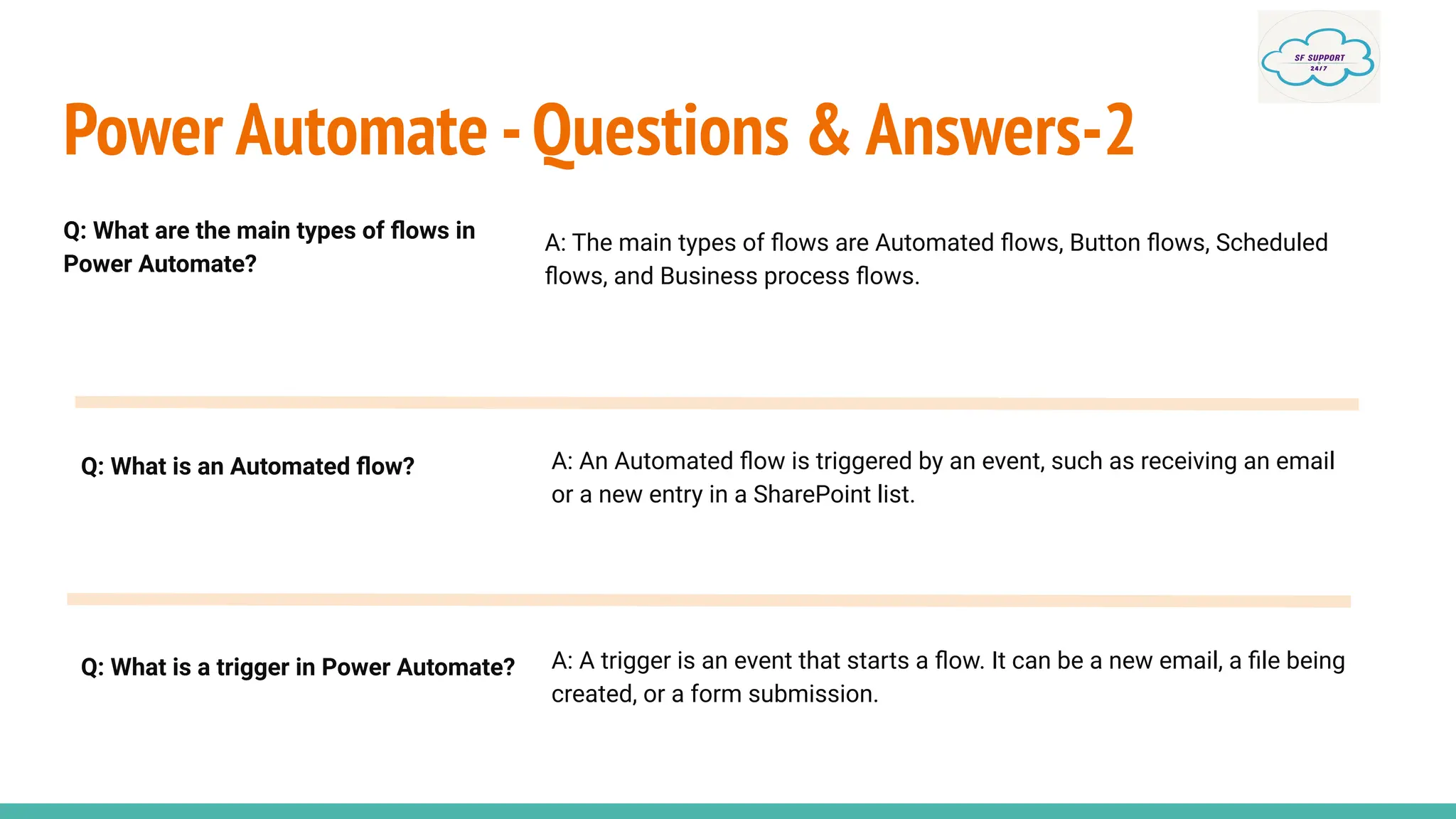
Power Automate -Questions & Answers-2
Q: What are the main types of flows in
Power Automate?
A: The main types of flows are Automated flows, Button flows, Scheduled
flows, and Business process flows.
Q: What is an Automated flow? A: An Automated flow is triggered by an event, such as receiving an email
or a new entry in a SharePoint list.
Q: What is a trigger in Power Automate? A: A trigger is an event that starts a flow. It can be a new email, a file being
created, or a form submission.
Power Automate -Questions & Answers-3
Q: What is an action in Power
Automate?
A: An action is a task that a flow performs, such as sending an email,
updating a record, or creating a file.
Q: How do you create a new flow? A: To create a new flow, go to the Power Automate website, select "Create,"
choose the type of flow you want to create, and follow the prompts.
Q: Can you share a flow with others? A: Yes, you can share a flow with others by adding them as owners or by
sharing a copy of the flow.
Power Automate -Questions & Answers-4
Q: What are templates in Power
Automate?
A: Templates are pre-built flows that you can use as a starting point to
create your own flows.
Q: What is a condition in Power
Automate?
A: A condition is a logical statement that allows you to perform different
actions based on whether a specified condition is met.
Q: What are connectors in Power
Automate?
A: Connectors are components that enable Power Automate to interact
with various apps and services.
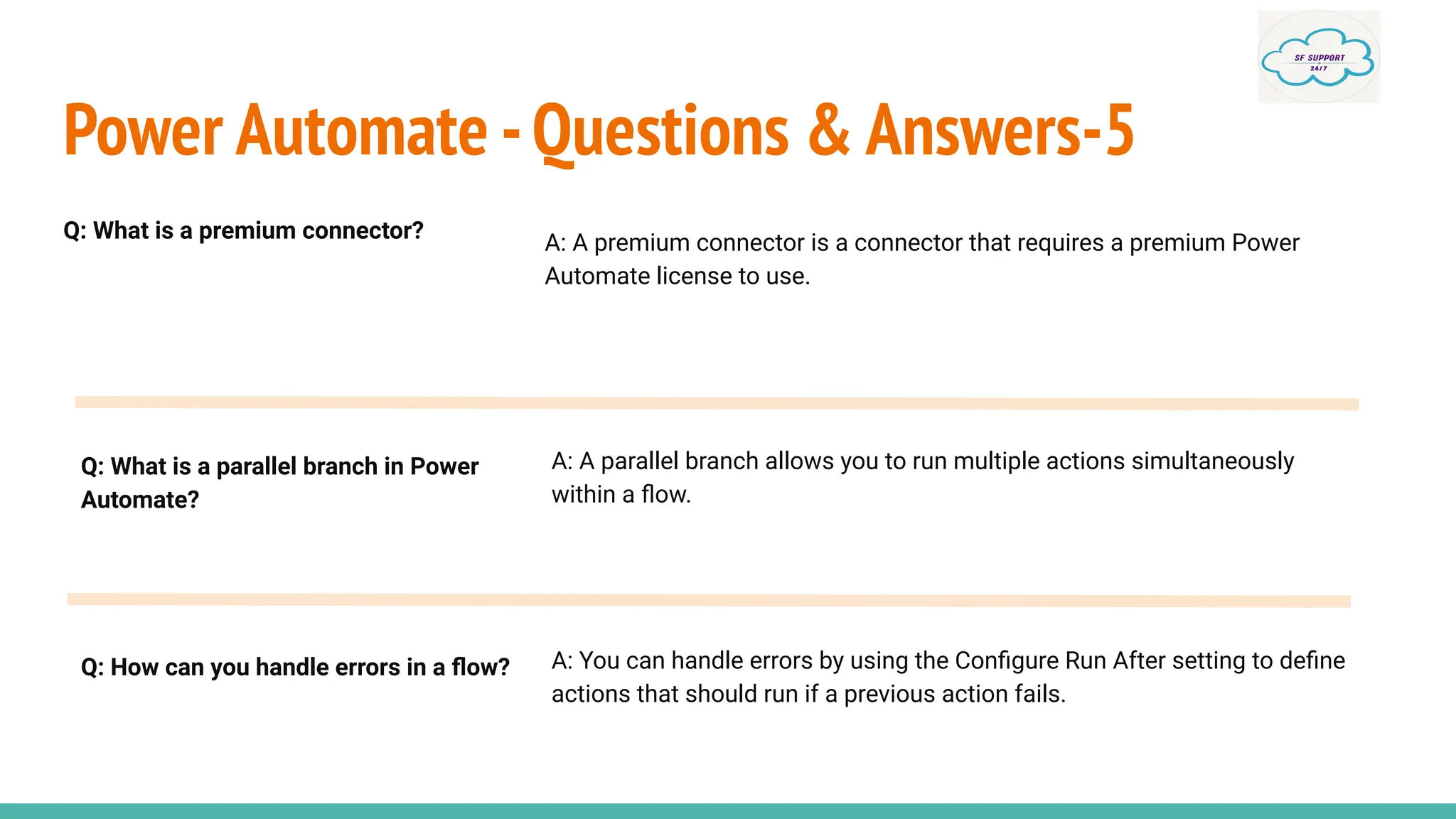
Power Automate -Questions & Answers-5
Q: What is a premium connector?
A: A premium connector is a connector that requires a premium Power
Automate license to use.
Q: What is a parallel branch in Power
Automate?
A: A parallel branch allows you to run multiple actions simultaneously
within a flow.
Q: How can you handle errors in a flow? A: You can handle errors by using the Configure Run After setting to define
actions that should run if a previous action fails.
Power Automate -Questions & Answers-6
Q: Can Power Automate integrate with
Microsoft Teams?
A: Yes, Power Automate can integrate with Microsoft Teams to automate
tasks such as sending messages or creating channels.
Q: How does Power Automate work
with SharePoint?
A: Power Automate can automate tasks such as creating items, updating
lists, and sending notifications in SharePoint.
Q: Can you use Power Automate with
Excel?
A: Yes, Power Automate can automate tasks such as adding rows,
updating cells, and creating tables in Excel.
Power Automate -Questions & Answers-7
Q: What is the role of Power Automate
in the Power Platform?
A: Power Automate is one of the key components of the Power Platform,
enabling automation of workflows across various applications and
services.
Q: Can Power Automate integrate with
non-Microsoft services?
A: Yes, Power Automate supports integration with many third-party
services and applications through connectors.
Q: How do you secure a flow in Power
Automate?
A: Flows can be secured by managing permissions, using environment
policies, and leveraging Data Loss Prevention (DLP) policies.
Power Automate -Questions & Answers-8
Q: What are Data Loss Prevention (DLP)
policies?
A: DLP policies are rules that help prevent the sharing of sensitive data by
controlling which connectors can be used together in a flow.
Q: How do you monitor the performance
of a flow?
A: The performance of a flow can be monitored through the Power
Automate portal, where you can view run history, successes, and failures.
Q: Can you schedule flows to run at
specific times?
A: Yes, Scheduled flows allow you to automate tasks that run at specific
times or intervals.
Power Automate -Questions & Answers-9
Q: What is the role of environment in
Power Automate?
A: Environments in Power Automate are used to store, manage, and share
resources like flows, connectors, and apps within a defined boundary.
Q: How can Power Automate be used in
email management?
A: Power Automate can be used to automate tasks such as sorting emails,
sending automatic replies, and creating tasks from emails.
Q: Can Power Automate be used for
social media management?
A: Yes, Power Automate can automate tasks like posting updates,
collecting social media data, and responding to comments.
Power Automate -Questions & Answers-10
Q: How can Power Automate help in
project management?
A: Power Automate can automate project management tasks such as
updating project status, sending reminders, and creating reports.
Q: What is the use of approval
workflows in Power Automate?
A: Approval workflows allow you to automate the process of requesting,
approving, and tracking approvals for various tasks.
Q: Can Power Automate automate data
entry tasks?
A: Yes, Power Automate can automate data entry tasks by integrating with
forms, spreadsheets, and databases to collect and process data.
Power Automate -Questions & Answers-11
Q: How do you troubleshoot a failed
flow?
A: To troubleshoot a failed flow, check the run history for error details,
review the flow's configuration, and test the flow with different data.
Q: What are common causes of flow
failures?
A: Common causes include incorrect configurations, missing or invalid
data, authentication issues, and service outages.
Q: How do you test a flow before using
it in production?
A: You can test a flow by running it manually with test data and reviewing
the run history to ensure it behaves as expected.
Power Automate -Questions & Answers-12
Q: Can you debug a flow in Power
Automate?
A: Yes, you can debug a flow by examining the run history, checking the
outputs of each action, and using the "Test" feature.
Q: How do you handle timeouts in a
flow?
A: Timeouts can be handled by configuring retry policies, setting
appropriate timeouts for actions, and optimizing the flow for performance.
Q: How do you test a flow before using
it in production?
A: You can test a flow by running it manually with test data and reviewing
the run history to ensure it behaves as expected.
Power Automate -Questions & Answers-13
Q: What are some best practices for
creating flows?
A: Best practices include using descriptive names, organizing actions
logically, testing flows thoroughly, and monitoring performance regularly.
Q: How do you document a flow? A: Document a flow by providing descriptions for actions, using
comments, and creating external documentation with screenshots and
explanations.
Q: How can you optimize a flow for
performance?
A: Optimize a flow by minimizing the number of actions, using efficient
data processing techniques, and reducing dependencies on external
services.
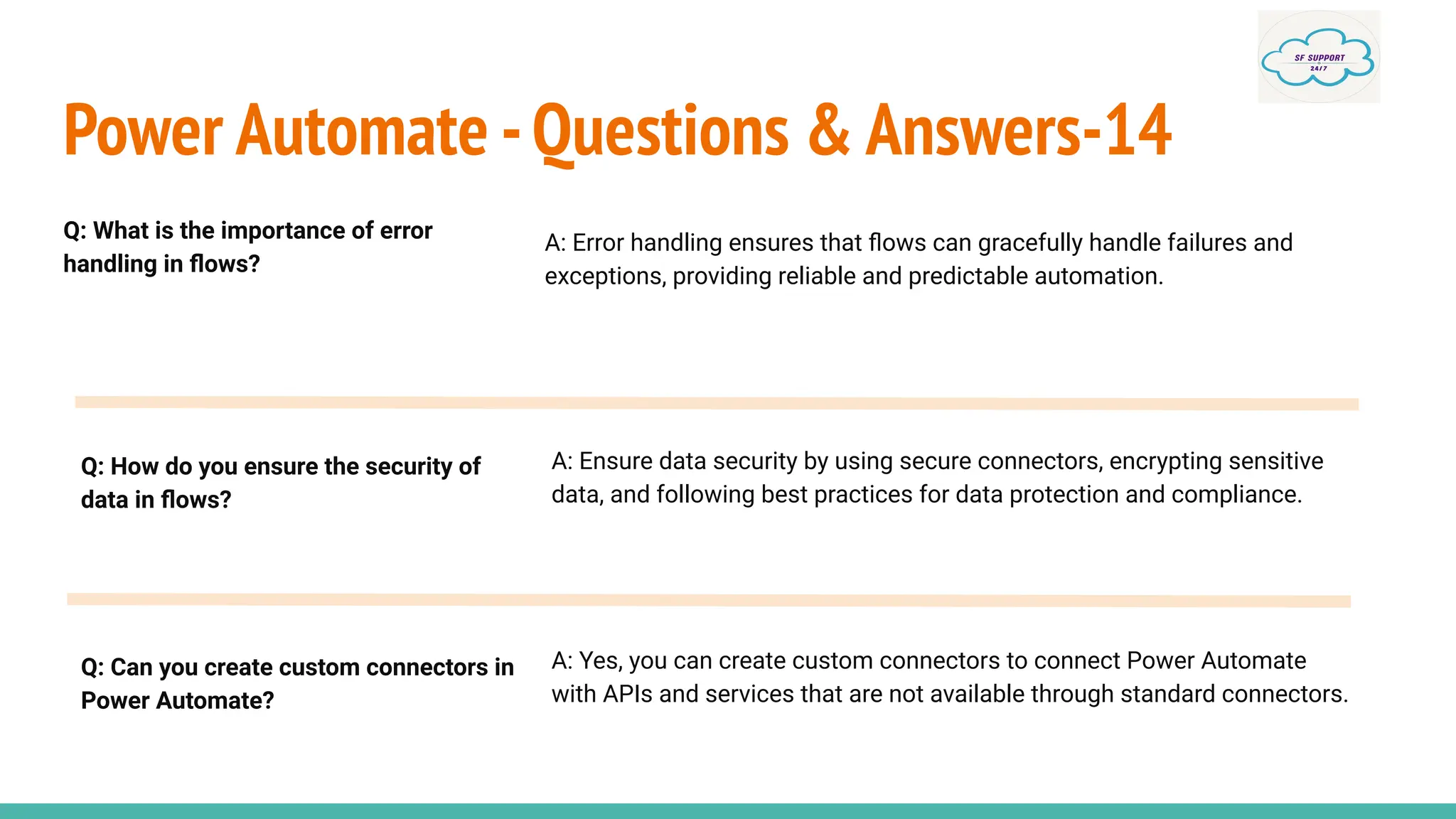
Power Automate -Questions & Answers-14
Q: What is the importance of error
handling in flows?
A: Error handling ensures that flows can gracefully handle failures and
exceptions, providing reliable and predictable automation.
Q: How do you ensure the security of
data in flows?
A: Ensure data security by using secure connectors, encrypting sensitive
data, and following best practices for data protection and compliance.
Q: Can you create custom connectors in
Power Automate?
A: Yes, you can create custom connectors to connect Power Automate
with APIs and services that are not available through standard connectors.
Power Automate -Questions & Answers-15
Q: What is a Business process flow?
A: A Business process flow is a flow that guides users through a defined
set of steps in a business process, often used in Dynamics 365.
Q: How can AI Builder enhance Power
Automate flows?
A: AI Builder can enhance flows by adding capabilities such as form
processing, object detection, and sentiment analysis using AI models.
Q: Can Power Automate work with
on-premises data?
A: Yes, Power Automate can connect to on-premises data using the
On-premises Data Gateway.
Power Automate -Questions & Answers-16
Q: What is a loop in Power Automate?
A: A loop allows you to repeat actions multiple times within a flow, either
for a set number of iterations or until a condition is met.
hat are some popular use cases for
Power Automate?
A: Popular use cases include automating repetitive tasks, integrating with
other Microsoft 365 services, managing approvals, and syncing data
between systems.

Microsoft Power Automate Questions and Answers

  • 1.
  • 2.
    Power Automate -Questions& Answers-1 Q: What is Power Automate? A: Power Automate is a Microsoft service that helps users create automated workflows between various applications and services to synchronize files, get notifications, collect data, and more. Q: How do you access Power Automate? A: Power Automate can be accessed via the Power Automate website, the Power Automate mobile app, or through the Office 365 app launcher. Q: What is a flow in Power Automate? A: A flow is an automated workflow that performs tasks and processes across different apps and services.
  • 3.
    Power Automate -Questions& Answers-2 Q: What are the main types of flows in Power Automate? A: The main types of flows are Automated flows, Button flows, Scheduled flows, and Business process flows. Q: What is an Automated flow? A: An Automated flow is triggered by an event, such as receiving an email or a new entry in a SharePoint list. Q: What is a trigger in Power Automate? A: A trigger is an event that starts a flow. It can be a new email, a file being created, or a form submission.
  • 4.
    Power Automate -Questions& Answers-3 Q: What is an action in Power Automate? A: An action is a task that a flow performs, such as sending an email, updating a record, or creating a file. Q: How do you create a new flow? A: To create a new flow, go to the Power Automate website, select "Create," choose the type of flow you want to create, and follow the prompts. Q: Can you share a flow with others? A: Yes, you can share a flow with others by adding them as owners or by sharing a copy of the flow.
  • 5.
    Power Automate -Questions& Answers-4 Q: What are templates in Power Automate? A: Templates are pre-built flows that you can use as a starting point to create your own flows. Q: What is a condition in Power Automate? A: A condition is a logical statement that allows you to perform different actions based on whether a specified condition is met. Q: What are connectors in Power Automate? A: Connectors are components that enable Power Automate to interact with various apps and services.
  • 6.
    Power Automate -Questions& Answers-5 Q: What is a premium connector? A: A premium connector is a connector that requires a premium Power Automate license to use. Q: What is a parallel branch in Power Automate? A: A parallel branch allows you to run multiple actions simultaneously within a flow. Q: How can you handle errors in a flow? A: You can handle errors by using the Configure Run After setting to define actions that should run if a previous action fails.
  • 7.
    Power Automate -Questions& Answers-6 Q: Can Power Automate integrate with Microsoft Teams? A: Yes, Power Automate can integrate with Microsoft Teams to automate tasks such as sending messages or creating channels. Q: How does Power Automate work with SharePoint? A: Power Automate can automate tasks such as creating items, updating lists, and sending notifications in SharePoint. Q: Can you use Power Automate with Excel? A: Yes, Power Automate can automate tasks such as adding rows, updating cells, and creating tables in Excel.
  • 8.
    Power Automate -Questions& Answers-7 Q: What is the role of Power Automate in the Power Platform? A: Power Automate is one of the key components of the Power Platform, enabling automation of workflows across various applications and services. Q: Can Power Automate integrate with non-Microsoft services? A: Yes, Power Automate supports integration with many third-party services and applications through connectors. Q: How do you secure a flow in Power Automate? A: Flows can be secured by managing permissions, using environment policies, and leveraging Data Loss Prevention (DLP) policies.
  • 9.
    Power Automate -Questions& Answers-8 Q: What are Data Loss Prevention (DLP) policies? A: DLP policies are rules that help prevent the sharing of sensitive data by controlling which connectors can be used together in a flow. Q: How do you monitor the performance of a flow? A: The performance of a flow can be monitored through the Power Automate portal, where you can view run history, successes, and failures. Q: Can you schedule flows to run at specific times? A: Yes, Scheduled flows allow you to automate tasks that run at specific times or intervals.
  • 10.
    Power Automate -Questions& Answers-9 Q: What is the role of environment in Power Automate? A: Environments in Power Automate are used to store, manage, and share resources like flows, connectors, and apps within a defined boundary. Q: How can Power Automate be used in email management? A: Power Automate can be used to automate tasks such as sorting emails, sending automatic replies, and creating tasks from emails. Q: Can Power Automate be used for social media management? A: Yes, Power Automate can automate tasks like posting updates, collecting social media data, and responding to comments.
  • 11.
    Power Automate -Questions& Answers-10 Q: How can Power Automate help in project management? A: Power Automate can automate project management tasks such as updating project status, sending reminders, and creating reports. Q: What is the use of approval workflows in Power Automate? A: Approval workflows allow you to automate the process of requesting, approving, and tracking approvals for various tasks. Q: Can Power Automate automate data entry tasks? A: Yes, Power Automate can automate data entry tasks by integrating with forms, spreadsheets, and databases to collect and process data.
  • 12.
    Power Automate -Questions& Answers-11 Q: How do you troubleshoot a failed flow? A: To troubleshoot a failed flow, check the run history for error details, review the flow's configuration, and test the flow with different data. Q: What are common causes of flow failures? A: Common causes include incorrect configurations, missing or invalid data, authentication issues, and service outages. Q: How do you test a flow before using it in production? A: You can test a flow by running it manually with test data and reviewing the run history to ensure it behaves as expected.
  • 13.
    Power Automate -Questions& Answers-12 Q: Can you debug a flow in Power Automate? A: Yes, you can debug a flow by examining the run history, checking the outputs of each action, and using the "Test" feature. Q: How do you handle timeouts in a flow? A: Timeouts can be handled by configuring retry policies, setting appropriate timeouts for actions, and optimizing the flow for performance. Q: How do you test a flow before using it in production? A: You can test a flow by running it manually with test data and reviewing the run history to ensure it behaves as expected.
  • 14.
    Power Automate -Questions& Answers-13 Q: What are some best practices for creating flows? A: Best practices include using descriptive names, organizing actions logically, testing flows thoroughly, and monitoring performance regularly. Q: How do you document a flow? A: Document a flow by providing descriptions for actions, using comments, and creating external documentation with screenshots and explanations. Q: How can you optimize a flow for performance? A: Optimize a flow by minimizing the number of actions, using efficient data processing techniques, and reducing dependencies on external services.
  • 15.
    Power Automate -Questions& Answers-14 Q: What is the importance of error handling in flows? A: Error handling ensures that flows can gracefully handle failures and exceptions, providing reliable and predictable automation. Q: How do you ensure the security of data in flows? A: Ensure data security by using secure connectors, encrypting sensitive data, and following best practices for data protection and compliance. Q: Can you create custom connectors in Power Automate? A: Yes, you can create custom connectors to connect Power Automate with APIs and services that are not available through standard connectors.
  • 16.
    Power Automate -Questions& Answers-15 Q: What is a Business process flow? A: A Business process flow is a flow that guides users through a defined set of steps in a business process, often used in Dynamics 365. Q: How can AI Builder enhance Power Automate flows? A: AI Builder can enhance flows by adding capabilities such as form processing, object detection, and sentiment analysis using AI models. Q: Can Power Automate work with on-premises data? A: Yes, Power Automate can connect to on-premises data using the On-premises Data Gateway.
  • 17.
    Power Automate -Questions& Answers-16 Q: What is a loop in Power Automate? A: A loop allows you to repeat actions multiple times within a flow, either for a set number of iterations or until a condition is met. hat are some popular use cases for Power Automate? A: Popular use cases include automating repetitive tasks, integrating with other Microsoft 365 services, managing approvals, and syncing data between systems.