MARIA AGRANOVSKAYA
Managing Partner
Attorney at Law, Blockchain Expert
Blockchain legal aspects and regulation:
What’s Next?
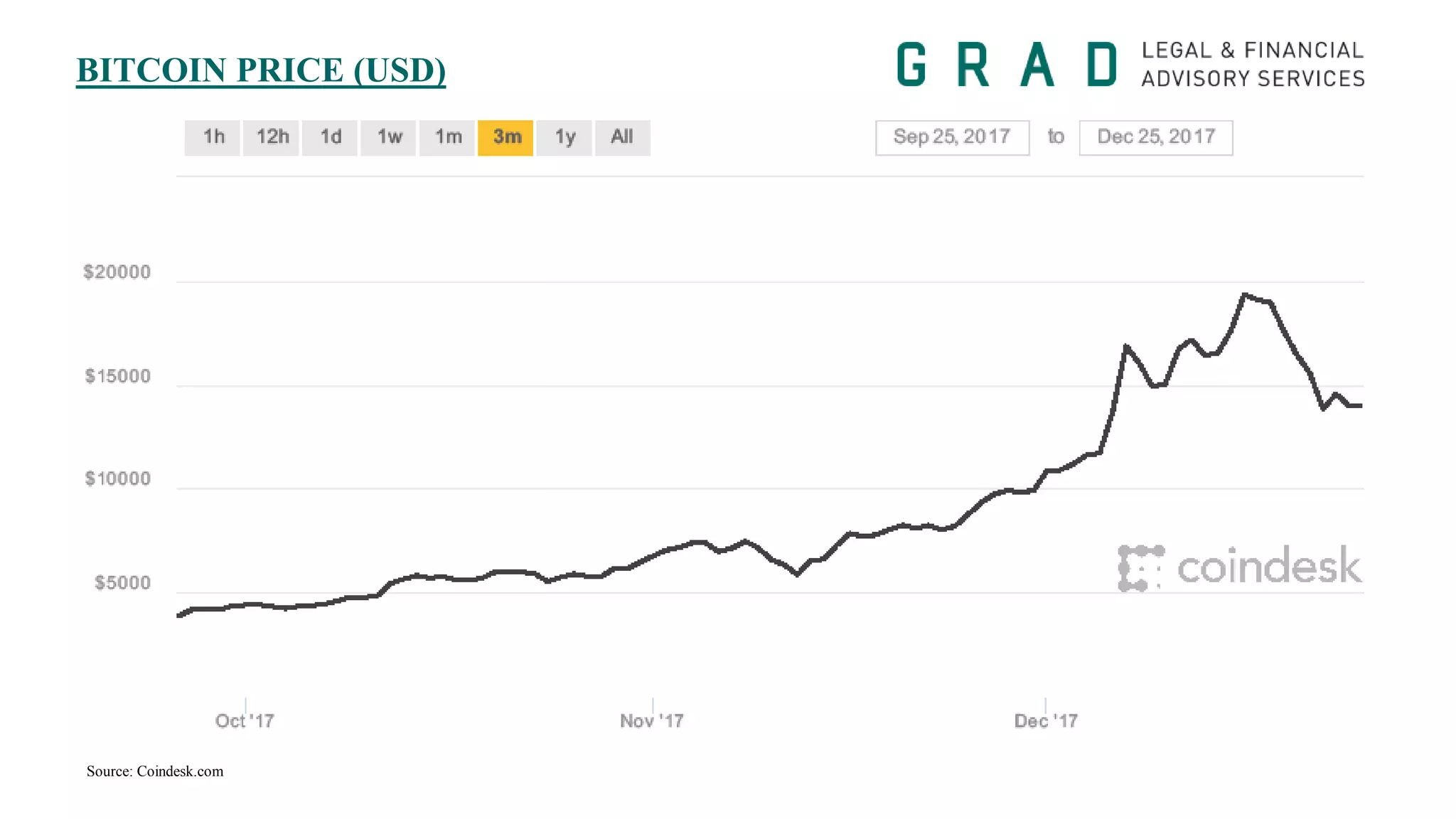
BITCOIN PRICE (USD)
Source: Coindesk.com
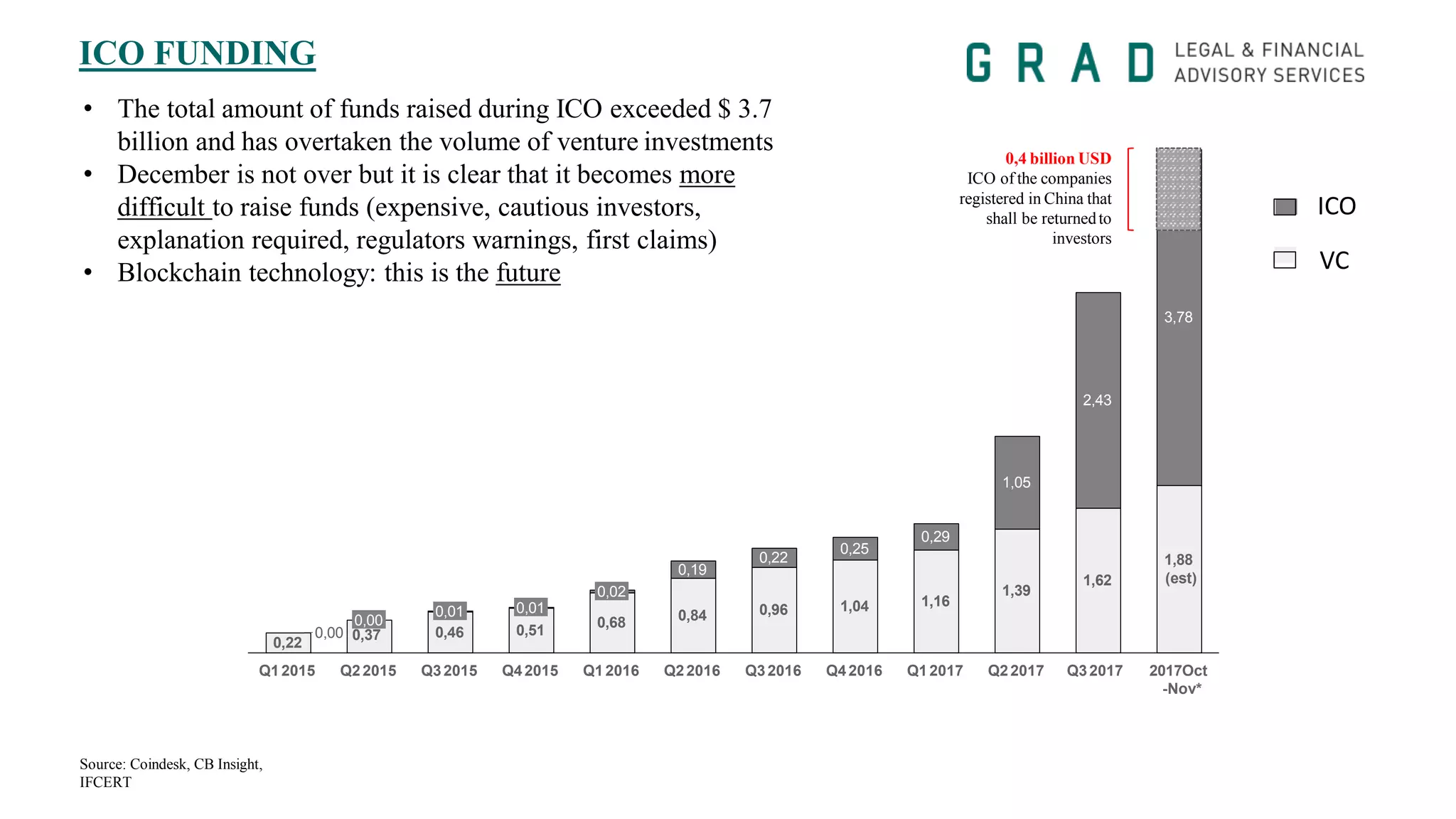
ICO FUNDING
0,19
Q32016 Q42016
3,78
0,25
Q12016
0,02
0,01
1,88
(est)
1,05
0,01
Q22015
0,68
2,43
Q12017
0,29
Q32017 2017Oct
-Nov*
0,84
0,46
1,16
Q22017Q42015
0,00
Q32015
0,51
1,39
0,22
0,96
1,62
0,22
Q12015
0,00 0,37
Q22016
1,04
0,4 billion USD
ICO of the companies
registered in China that
shall be returnedto
investors
Source: Coindesk, CB Insight,
IFCERT
• The total amount of funds raised during ICO exceeded $ 3.7
billion and has overtaken the volume of venture investments
• December is not over but it is clear that it becomes more
difficult to raise funds (expensive, cautious investors,
explanation required, regulators warnings, first claims)
• Blockchain technology: this is the future
ICO
VC
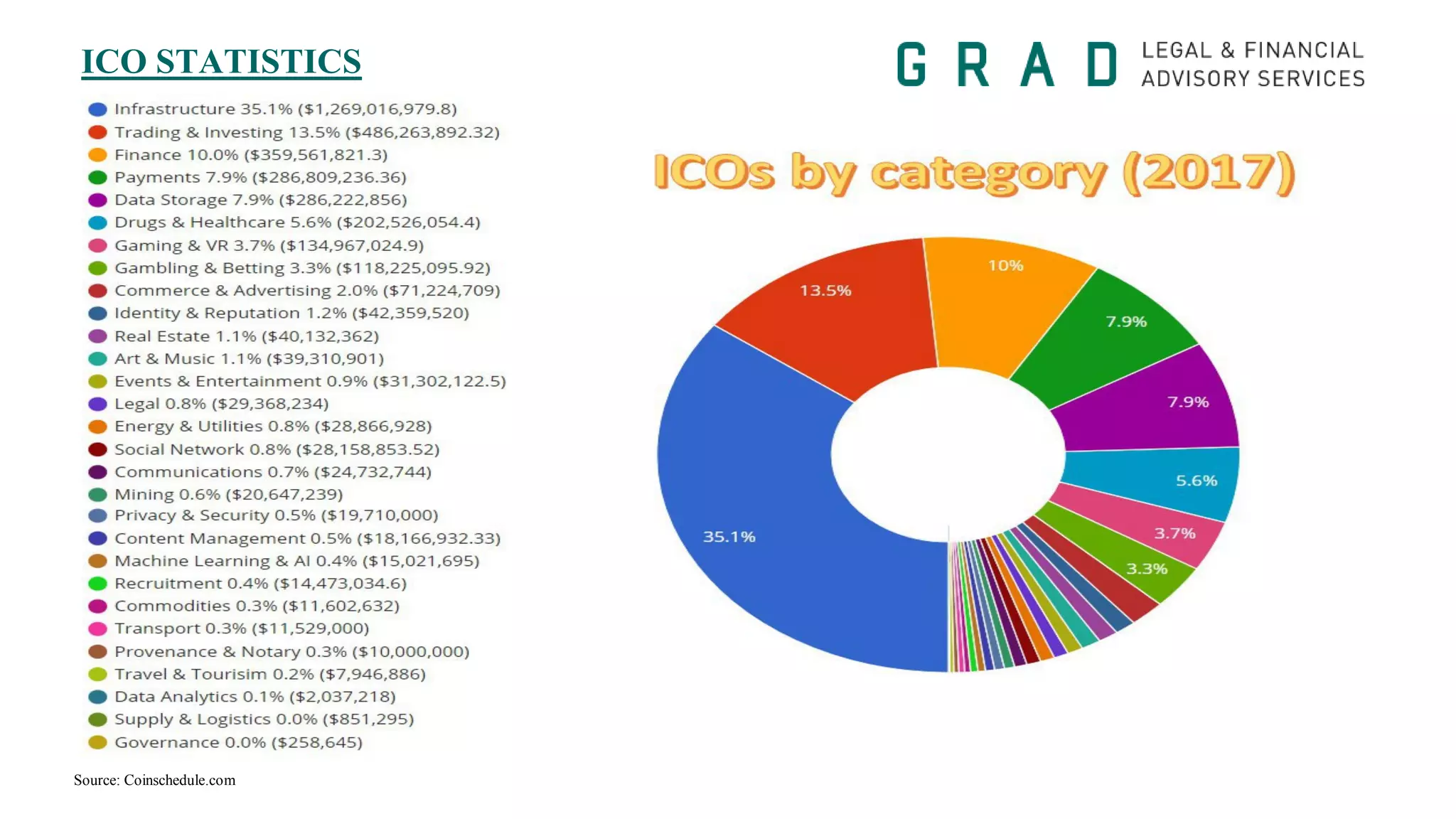
ICO STATISTICS
Source: Coinschedule.com
18
20
25
23
23
34
32
47
51
64
63
62
145
175
187
192
196
260
256
310
1,031USA
Russia
Singapore
China
HK
Israel
Germany
Canada
UK
Switzerland
Estonia
Argentina
Lithuania
Thailand
Australia
Ukraine
Spain
Costa-Rica
Lichtenstein
Slovenia
Korea
Sweden 15
Bulgaria 12
France 12
Finland 11
Czech Republic 10
Slovakia 10
Poland 8
S.Africa 7
Norway 7
Scotland 6
Netherlands 5
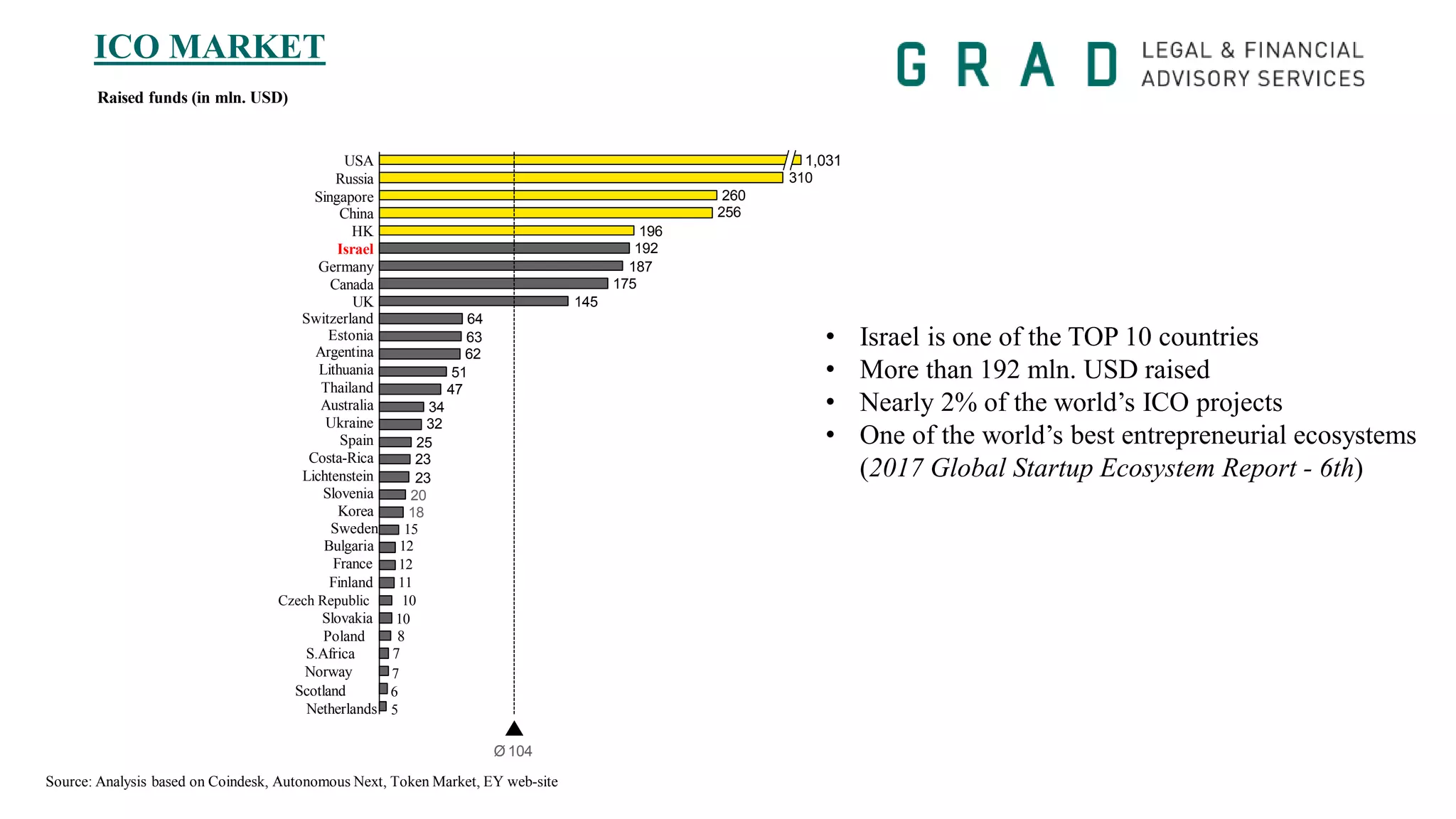
ICO MARKET
Source: Analysis based on Coindesk, Autonomous Next, Token Market, EY web-site
Ø 104
Raised funds (in mln. USD)
• Israel is one of the TOP 10 countries
• More than 192 mln. USD raised
• Nearly 2% of the world’s ICO projects
• One of the world’s best entrepreneurial ecosystems
(2017 Global Startup Ecosystem Report - 6th)
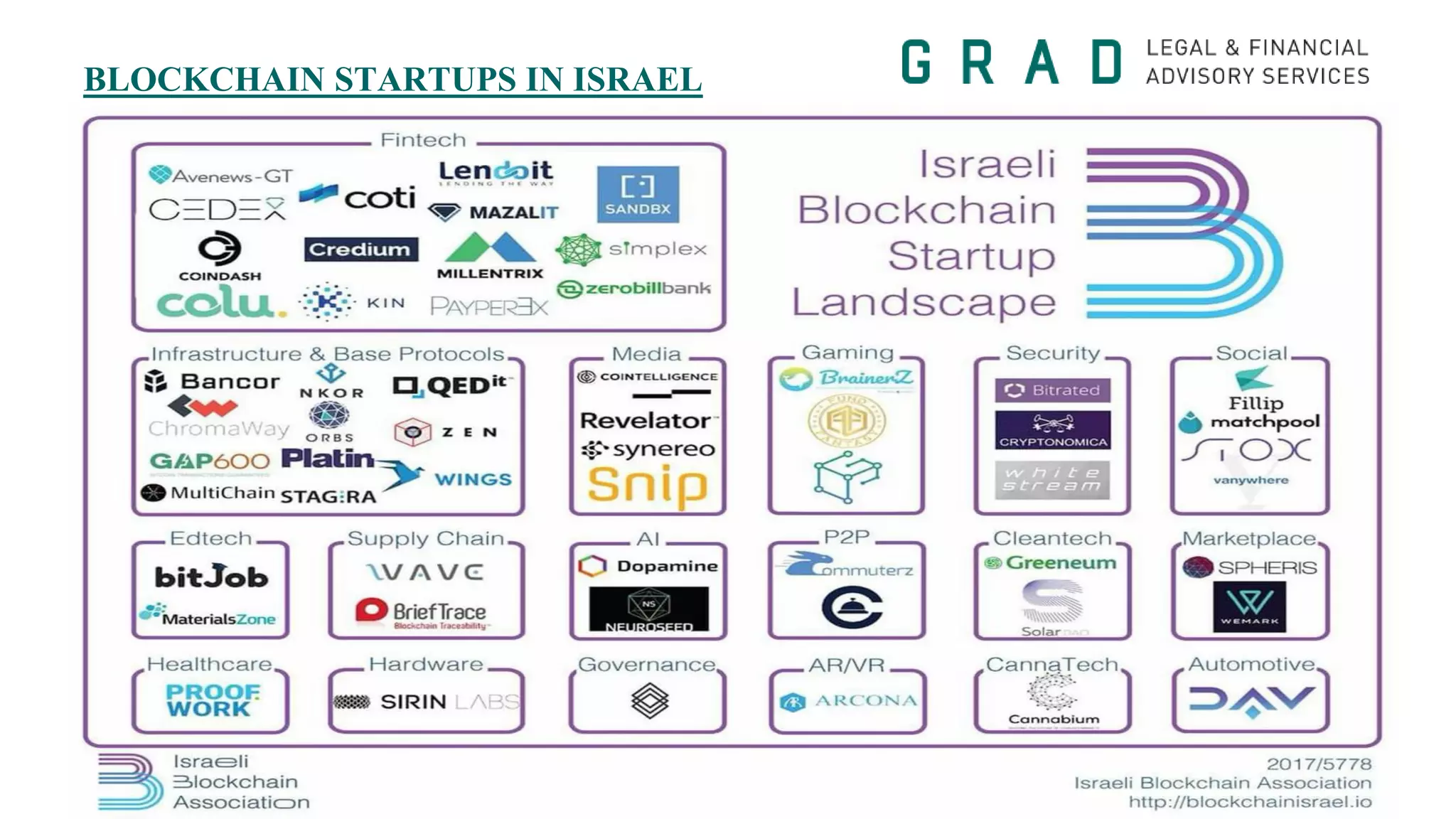
BLOCKCHAIN STARTUPS IN ISRAEL
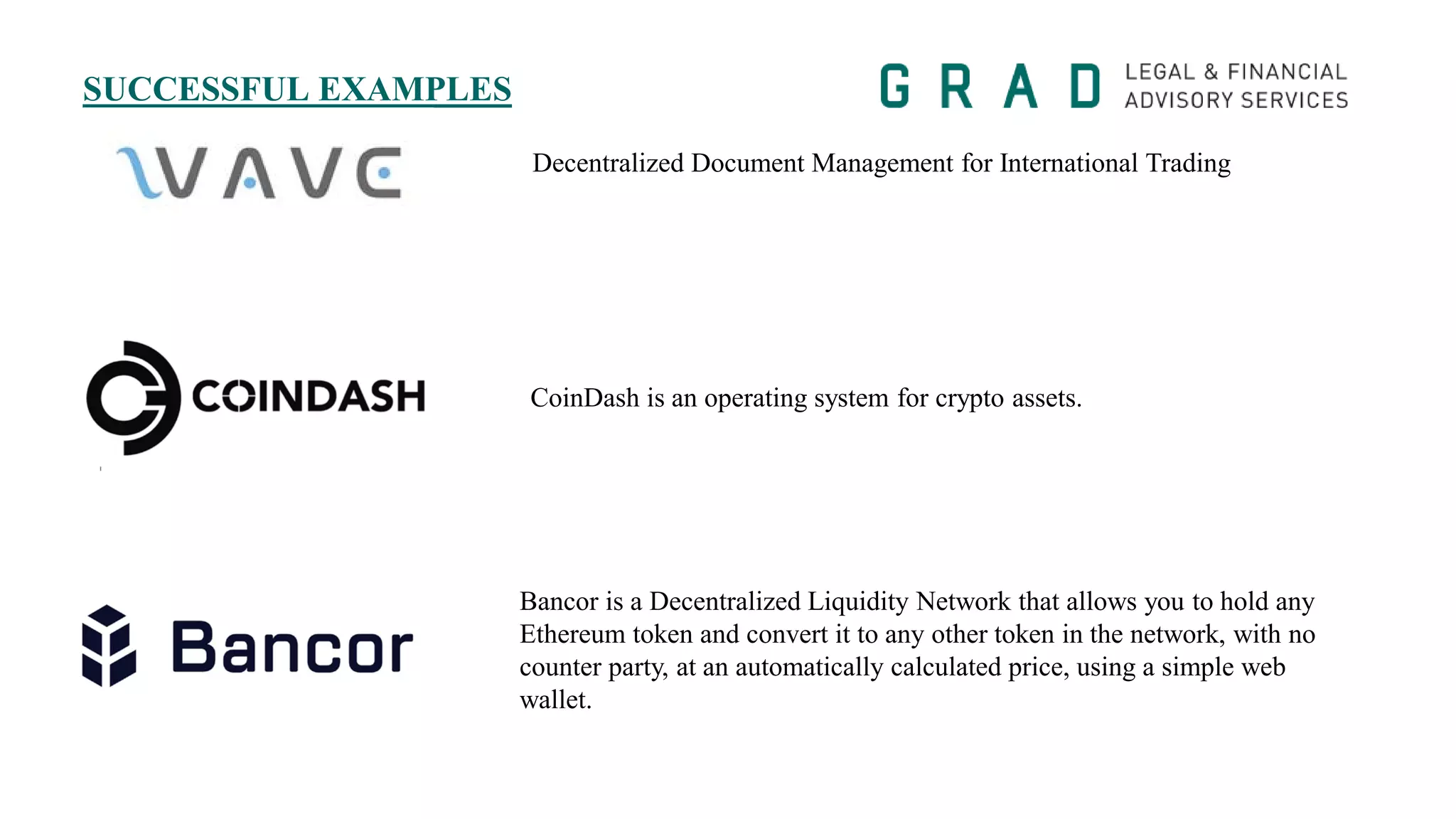
SUCCESSFUL EXAMPLES
Bancor is a Decentralized Liquidity Network that allows you to hold any
Ethereum token and convert it to any other token in the network, with no
counter party, at an automatically calculated price, using a simple web
wallet.
CoinDash is an operating system for crypto assets.
Decentralized Document Management for International Trading
THE MAIN TERMS
• Blockchain (DLT) is a ledger which is shared, distributed and cryptographically authentic. Main features:
(1) open, decentralized distributed ledger;
(2) using of cryptography;
(3) continuously growing list of records;
(4) information relates to transactions performed in the system.
(the Decree of the President of Belarus "On the development of the digital economy“ No.8 dated 21.12.2017)
• Cryptocurrency / Token – a record in blockchain or in any other distributed ledger certifying the following:
(1) possession of a token (attributed to a specific right or asset (property) and having certain functions);
(2) title to different underlying asset classes / services, a right or access to benefits; and/or is
(3) a recognized cryptocurrency (exchangeable value) within its “ecosystem”.
The token can be registered and transferred via blockchain, has coded functions governed by “smart contracts”.
Different nature results in different legal consequences that can be crucial.
• Generally accepted regulators position: the existing Laws apply even if cryptocurrency is involved.
• KEY ISSUE: token legal nature and consequences for the choice of jurisdiction.
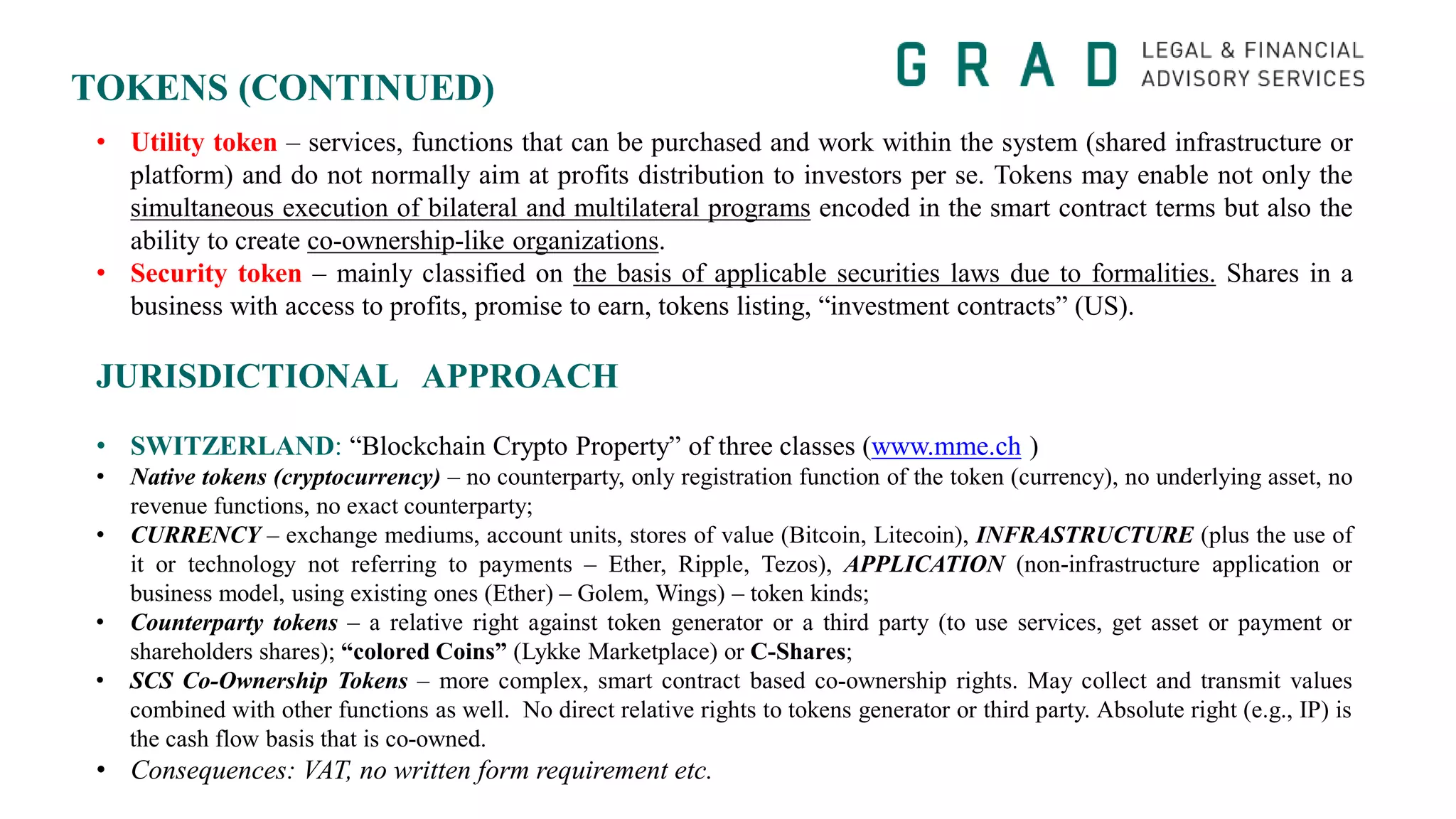
TOKENS (CONTINUED)
• Utility token – services, functions that can be purchased and work within the system (shared infrastructure or
platform) and do not normally aim at profits distribution to investors per se. Tokens may enable not only the
simultaneous execution of bilateral and multilateral programs encoded in the smart contract terms but also the
ability to create co-ownership-like organizations.
• Security token – mainly classified on the basis of applicable securities laws due to formalities. Shares in a
business with access to profits, promise to earn, tokens listing, “investment contracts” (US).
JURISDICTIONAL APPROACH
• SWITZERLAND: “Blockchain Crypto Property” of three classes (www.mme.ch )
• Native tokens (cryptocurrency) – no counterparty, only registration function of the token (currency), no underlying asset, no
revenue functions, no exact counterparty;
• CURRENCY – exchange mediums, account units, stores of value (Bitcoin, Litecoin), INFRASTRUCTURE (plus the use of
it or technology not referring to payments – Ether, Ripple, Tezos), APPLICATION (non-infrastructure application or
business model, using existing ones (Ether) – Golem, Wings) – token kinds;
• Counterparty tokens – a relative right against token generator or a third party (to use services, get asset or payment or
shareholders shares); “colored Coins” (Lykke Marketplace) or C-Shares;
• SCS Co-Ownership Tokens – more complex, smart contract based co-ownership rights. May collect and transmit values
combined with other functions as well. No direct relative rights to tokens generator or third party. Absolute right (e.g., IP) is
the cash flow basis that is co-owned.
• Consequences: VAT, no written form requirement etc.
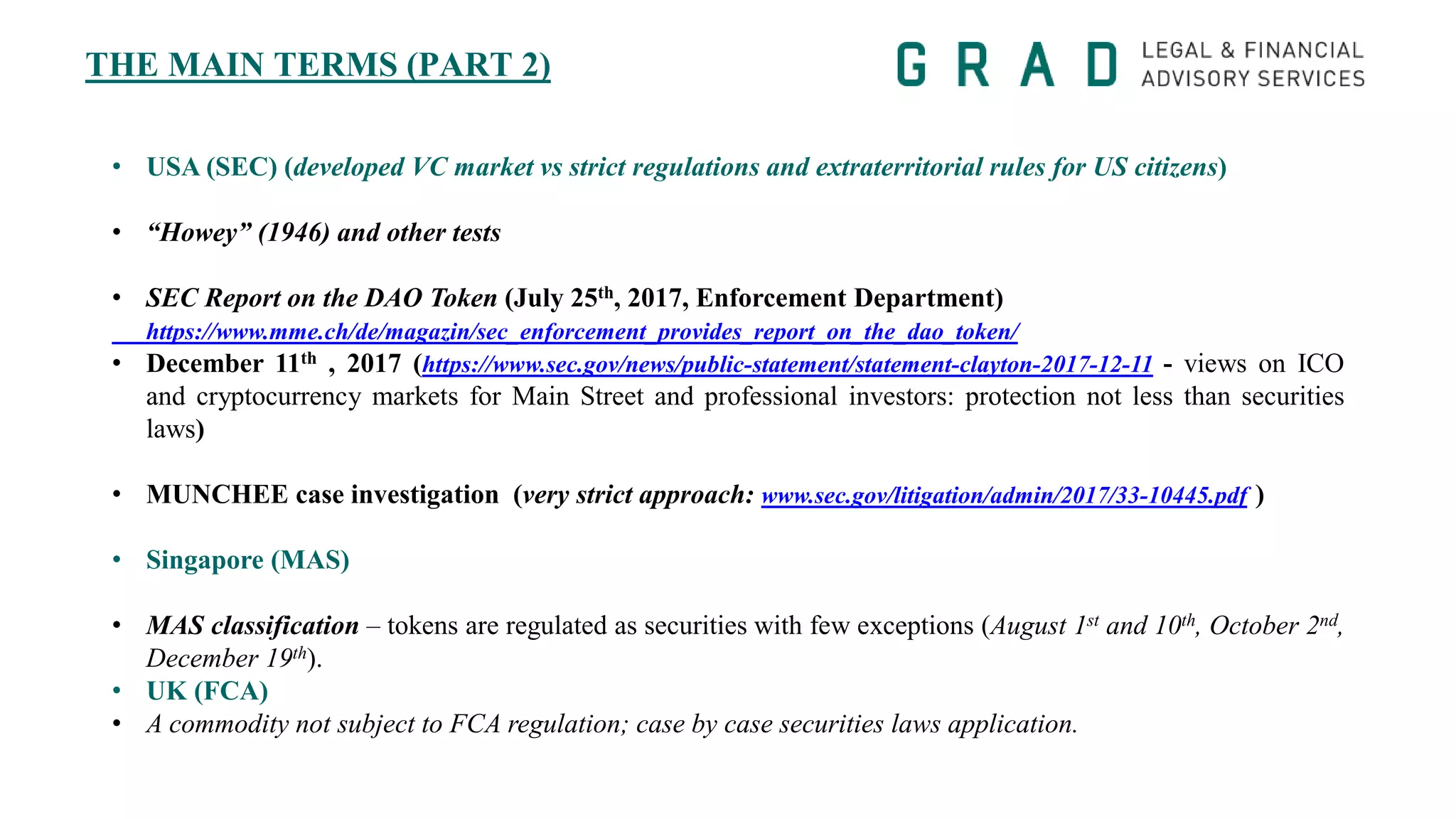
THE MAIN TERMS (PART 2)
• USA (SEC) (developed VC market vs strict regulations and extraterritorial rules for US citizens)
• “Howey” (1946) and other tests
• SEC Report on the DAO Token (July 25th, 2017, Enforcement Department)
https://www.mme.ch/de/magazin/sec_enforcement_provides_report_on_the_dao_token/
• December 11th , 2017 (https://www.sec.gov/news/public-statement/statement-clayton-2017-12-11 - views on ICO
and cryptocurrency markets for Main Street and professional investors: protection not less than securities
laws)
• MUNCHEE case investigation (very strict approach: www.sec.gov/litigation/admin/2017/33-10445.pdf )
• Singapore (MAS)
• MAS classification – tokens are regulated as securities with few exceptions (August 1st and 10th, October 2nd,
December 19th).
• UK (FCA)
• A commodity not subject to FCA regulation; case by case securities laws application.
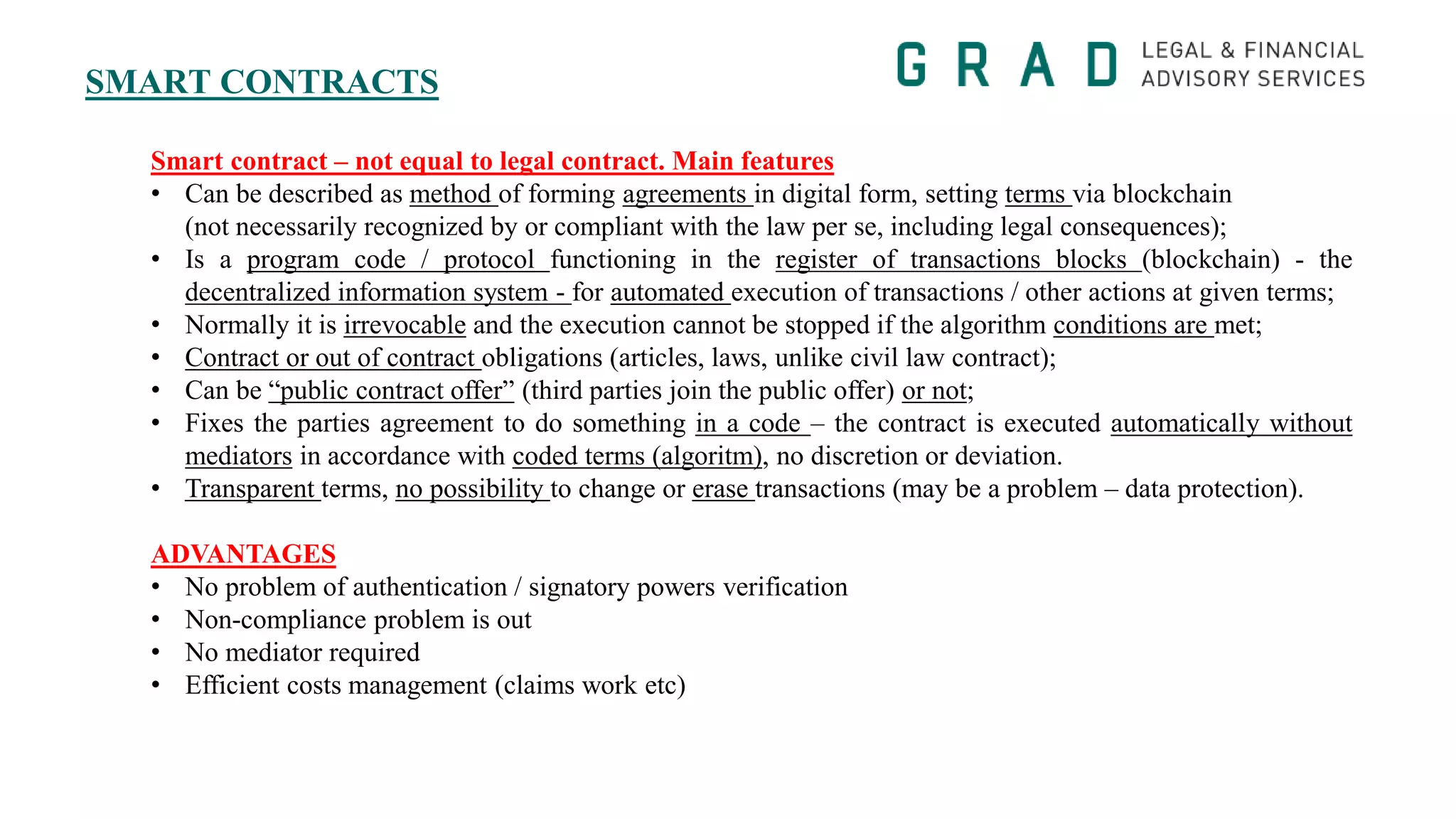
SMART CONTRACTS
Smart contract – not equal to legal contract. Main features
• Can be described as method of forming agreements in digital form, setting terms via blockchain
(not necessarily recognized by or compliant with the law per se, including legal consequences);
• Is a program code / protocol functioning in the register of transactions blocks (blockchain) - the
decentralized information system - for automated execution of transactions / other actions at given terms;
• Normally it is irrevocable and the execution cannot be stopped if the algorithm conditions are met;
• Contract or out of contract obligations (articles, laws, unlike civil law contract);
• Can be “public contract offer” (third parties join the public offer) or not;
• Fixes the parties agreement to do something in a code – the contract is executed automatically without
mediators in accordance with coded terms (algoritm), no discretion or deviation.
• Transparent terms, no possibility to change or erase transactions (may be a problem – data protection).
ADVANTAGES
• No problem of authentication / signatory powers verification
• Non-compliance problem is out
• No mediator required
• Efficient costs management (claims work etc)
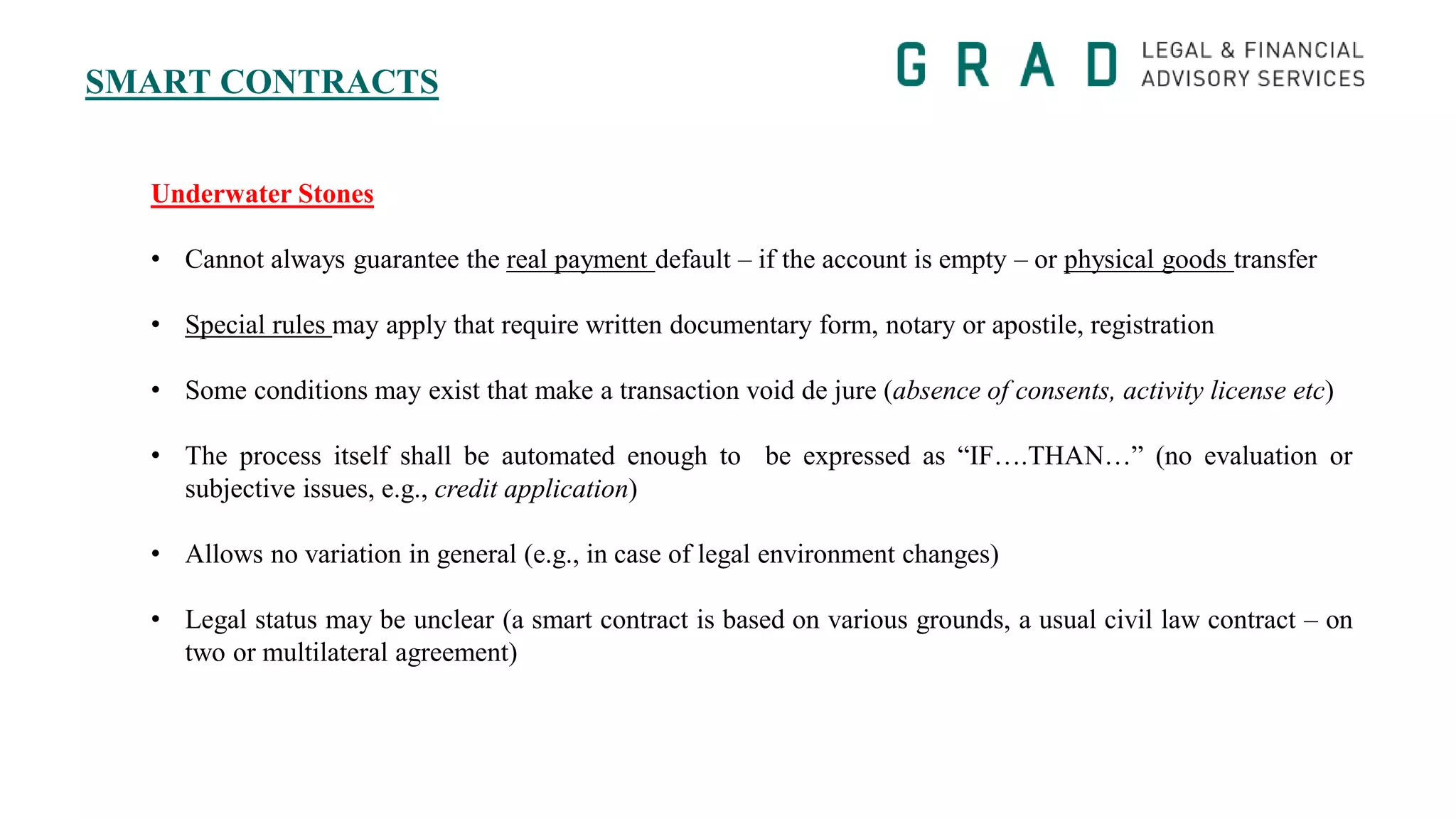
SMART CONTRACTS
Underwater Stones
• Cannot always guarantee the real payment default – if the account is empty – or physical goods transfer
• Special rules may apply that require written documentary form, notary or apostile, registration
• Some conditions may exist that make a transaction void de jure (absence of consents, activity license etc)
• The process itself shall be automated enough to be expressed as “IF….THAN…” (no evaluation or
subjective issues, e.g., credit application)
• Allows no variation in general (e.g., in case of legal environment changes)
• Legal status may be unclear (a smart contract is based on various grounds, a usual civil law contract – on
two or multilateral agreement)
PROTECTION.
SMART CONTRACT AUDIT
Smart property / blockchain projects - risks
and dangers
• Functionality & Protocol-Related risks
• Storage & Access of Private Key-Related
Risks
• Regulation & Money Laundering-Related
Risks
• Market-Related & Counterparty Risks
Protection. Smart Contract Audit – to:
• Avoid possible hackings and mistakes –
protection
• Optimize the code
• Run the code efficiently
• Re-enforce authorization
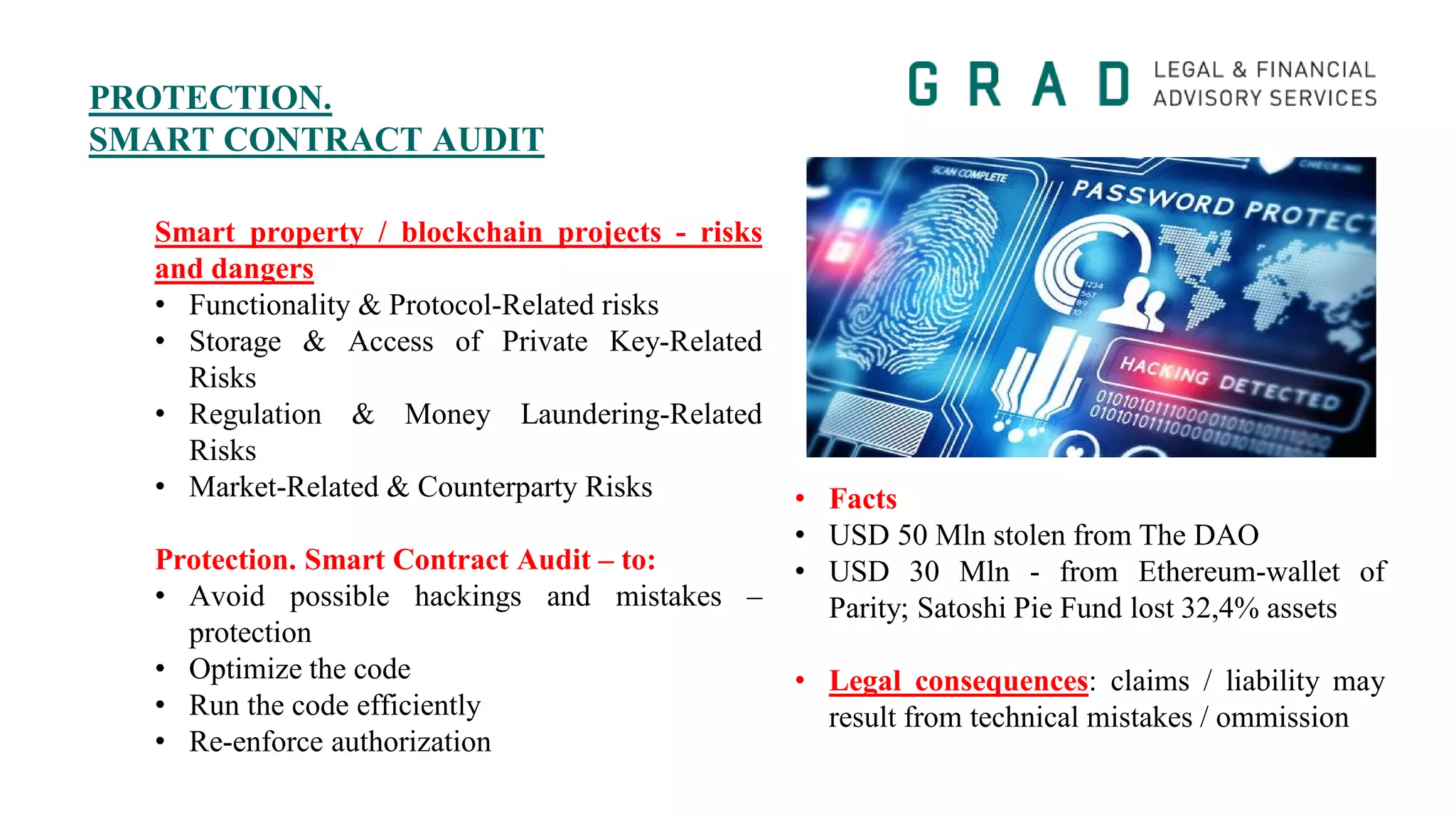
• Facts
• USD 50 Mln stolen from The DAO
• USD 30 Mln - from Ethereum-wallet of
Parity; Satoshi Pie Fund lost 32,4% assets
• Legal consequences: claims / liability may
result from technical mistakes / ommission
ICO: THE MAIN ISSUES
NEXT YEAR: more difficult and expensive to convey but the technology gains interest.
• Choice of the jurisdiction where tokens are issued (characteristics of a project,
jurisdiction, budget, token itself etc.)
• Token analysis (if required - permission from the regulator to issue securities)
• Structuring (company type or holding structure, fund etc.)
• Regulations on collective investments, prospecus et cetera
• Licensing of the underlying activity (if necessary)
• Taxes (VAT, income or capital gains tax etc.)
• Intellectual property and trademarks protection
• Data protection (e.g., EU Directive in force from May 2018)
• Disclaimers
• Compliance with potentially applicable other jurisdiction laws
REQUIRED DOCUMENTS:
• White paper
• Subscription Terms
• Disclaimers
• Subscription agreement
• Legal Opinion
• KYC policy & procedures (even on the website)
Additional documents may be required:
• Contracts with software developers, lawyers and other contractors
• Advisers agreements
• Finder’s Agreements
• Listing required documentation
WHITE PAPER
• How the raised funds are spent
• Project development after the ICO
• Road map
• Team, advisers
• Specific chapters related to your project
• Illustrations, tables, etc.
• Disclaimers
• Other
• Clear product & token description
• Business model
• Explanation of Blockchain integration
• Market analysis
• The tokens mechanism – why is it
necessary and how they are used
• Quantity and price of tokens
• Distribution of tokens
LEGAL STATUS OF CRYPTOCURRENCIES
REGULATION IN DIFFERENT JURISDICTIONS
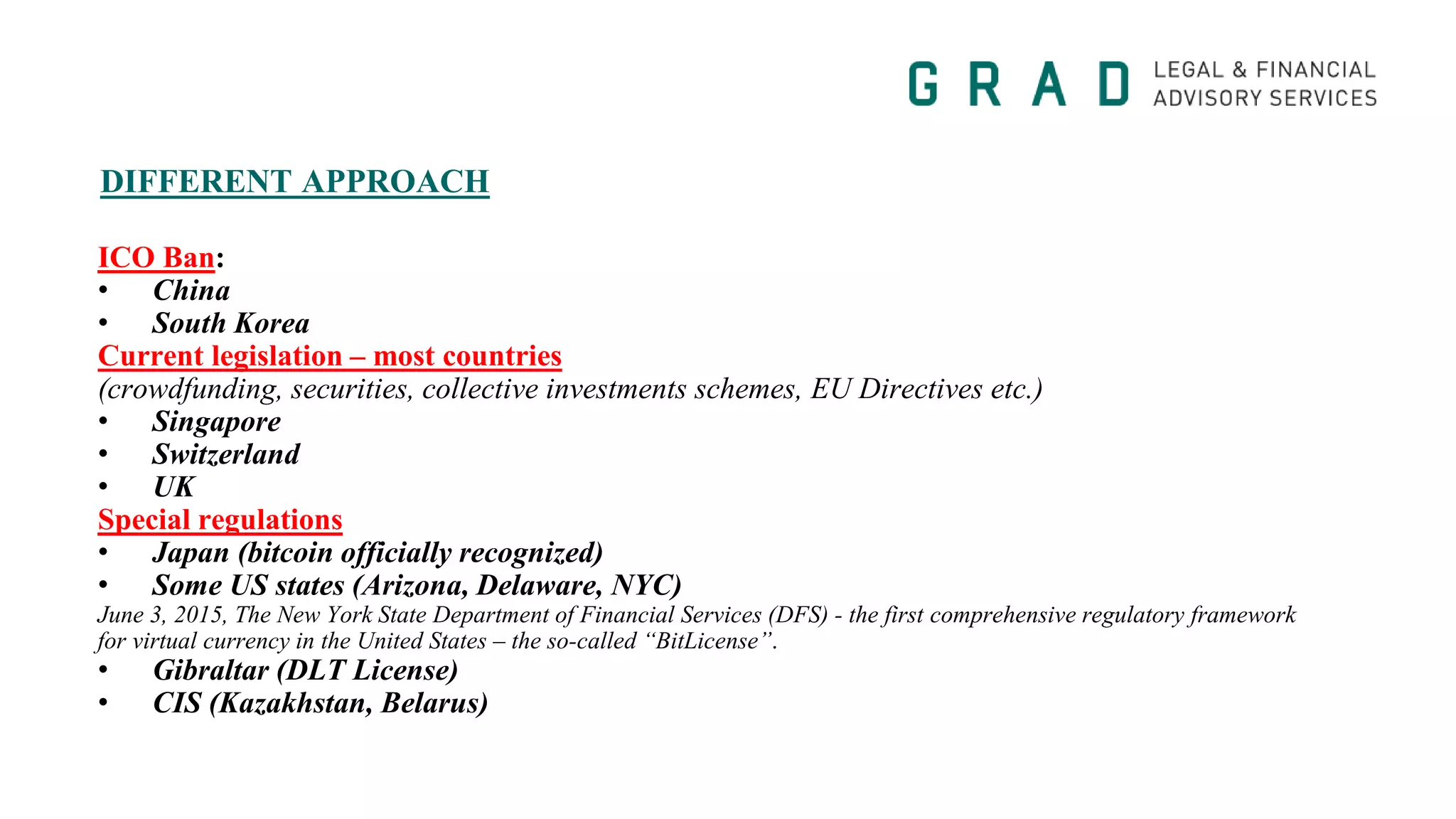
DIFFERENT APPROACH
ICO Ban:
• China
• South Korea
Current legislation – most countries
(crowdfunding, securities, collective investments schemes, EU Directives etc.)
• Singapore
• Switzerland
• UK
Special regulations
• Japan (bitcoin officially recognized)
• Some US states (Arizona, Delaware, NYC)
June 3, 2015, The New York State Department of Financial Services (DFS) - the first comprehensive regulatory framework
for virtual currency in the United States – the so-called “BitLicense”.
• Gibraltar (DLT License)
• CIS (Kazakhstan, Belarus)
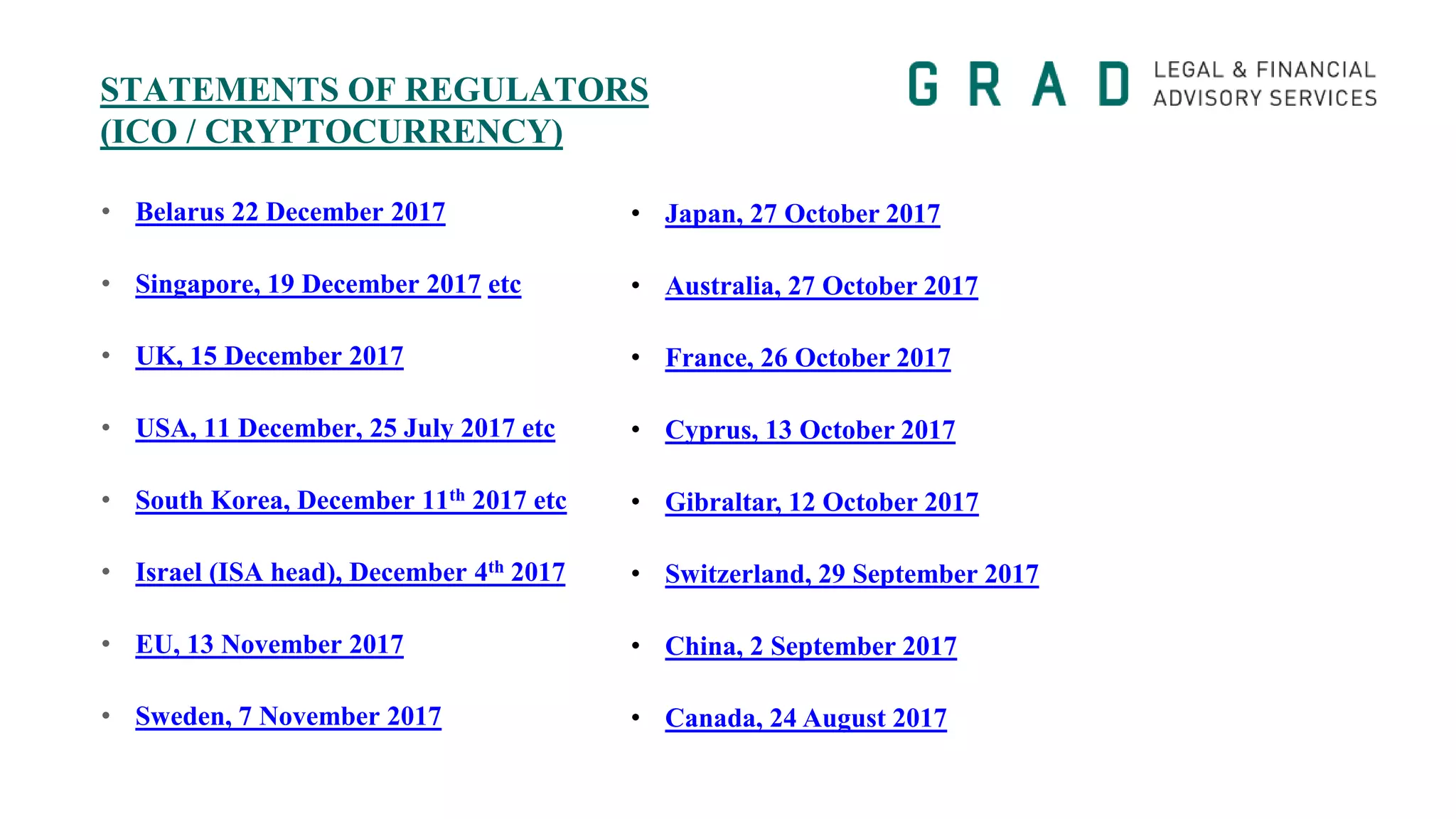
STATEMENTS OF REGULATORS
(ICO / CRYPTOCURRENCY)
• Belarus 22 December 2017
• Singapore, 19 December 2017 etc
• UK, 15 December 2017
• USA, 11 December, 25 July 2017 etc
• South Korea, December 11th 2017 etc
• Israel (ISA head), December 4th 2017
• EU, 13 November 2017
• Sweden, 7 November 2017
• Japan, 27 October 2017
• Australia, 27 October 2017
• France, 26 October 2017
• Cyprus, 13 October 2017
• Gibraltar, 12 October 2017
• Switzerland, 29 September 2017
• China, 2 September 2017
• Canada, 24 August 2017
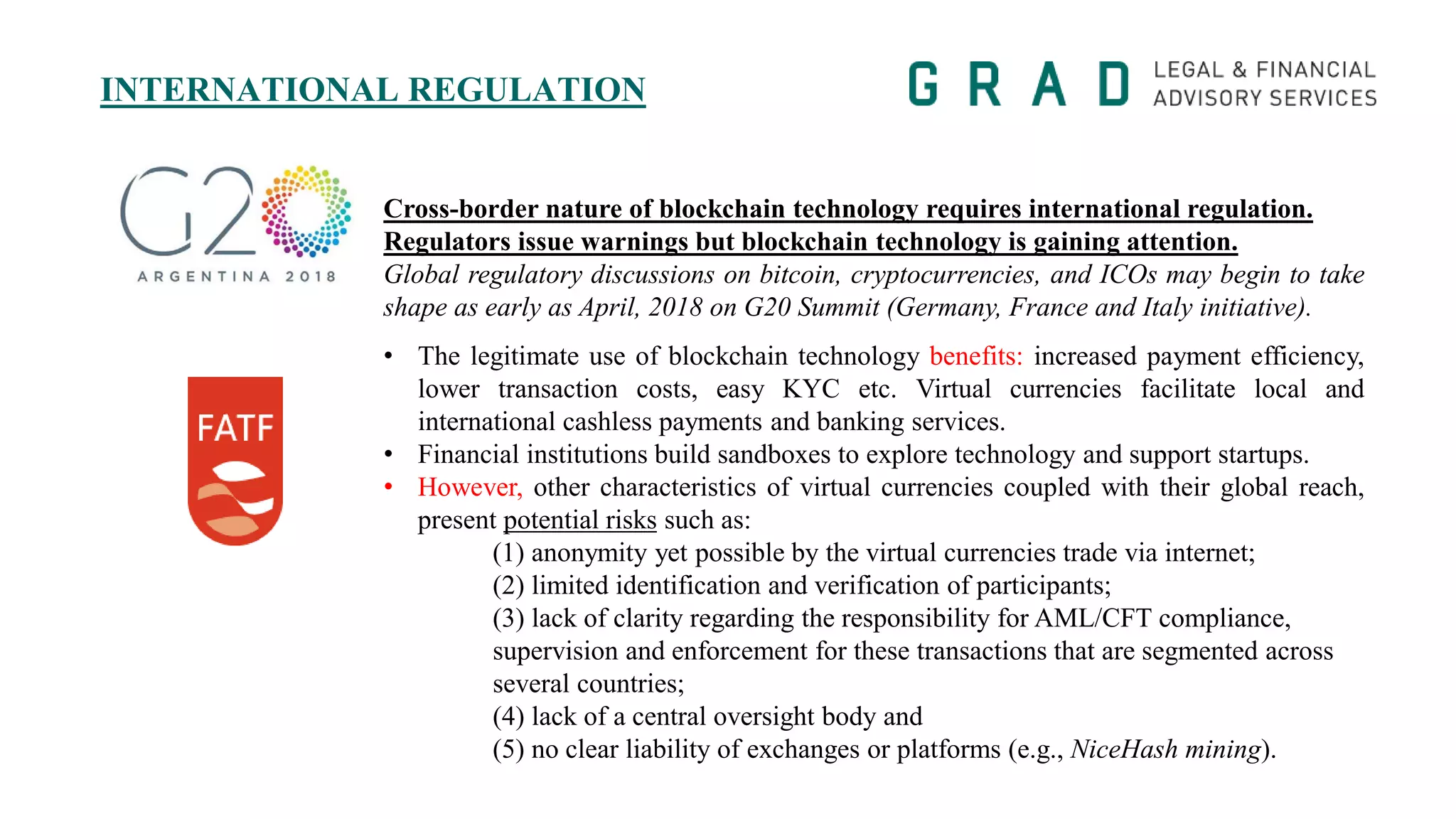
INTERNATIONAL REGULATION
Cross-border nature of blockchain technology requires international regulation.
Regulators issue warnings but blockchain technology is gaining attention.
Global regulatory discussions on bitcoin, cryptocurrencies, and ICOs may begin to take
shape as early as April, 2018 on G20 Summit (Germany, France and Italy initiative).
• The legitimate use of blockchain technology benefits: increased payment efficiency,
lower transaction costs, easy KYC etc. Virtual currencies facilitate local and
international cashless payments and banking services.
• Financial institutions build sandboxes to explore technology and support startups.
• However, other characteristics of virtual currencies coupled with their global reach,
present potential risks such as:
(1) anonymity yet possible by the virtual currencies trade via internet;
(2) limited identification and verification of participants;
(3) lack of clarity regarding the responsibility for AML/CFT compliance,
supervision and enforcement for these transactions that are segmented across
several countries;
(4) lack of a central oversight body and
(5) no clear liability of exchanges or platforms (e.g., NiceHash mining).
EUROPE
• October 2017: the European Central Bank is “watching cryptocurrency” (long time has been keeping away
from expressing its position)
• 13 September 2013 – the European Banking Authority (EBA) warning regarding “Virtual Currencies”
(risks involved when buying, holding or trading such)
• August 2017 - Mario Dragi (ECB) in response to Estonia’s application for its own cryptocurrency: “Europe has
only one currency – EURO”
• EU Commission proposal on 5 July 2016 to amend AML Directive
• Opinion of the European Central Bank (ECB) on the proposed Directive (12 October 2016) (means of
exchange rather than means of payment and not subject to its regulation)
• European Parliament Resolution dated 26 May 2016 (suggested revision of existing EU legislation (Payment
Accounts Directive and Payment Service Directive) and positive towards virtual currencies)
EXTRA TERRITORIAL APPLICATION OF LAWS - US
• US Laws protecting US citizens (in particular, as regards securities issue) apply worldwide to US investors
• Severe sanctions apply based on international agreements and US impact
• USD accounts blockage, stopping of ICOs, criminal cases, fines (e.g., Swiss company Tezos – US cases)
• Special procedures shall be met to apply sanctions and penalties in collaboration with local governments
ASIA
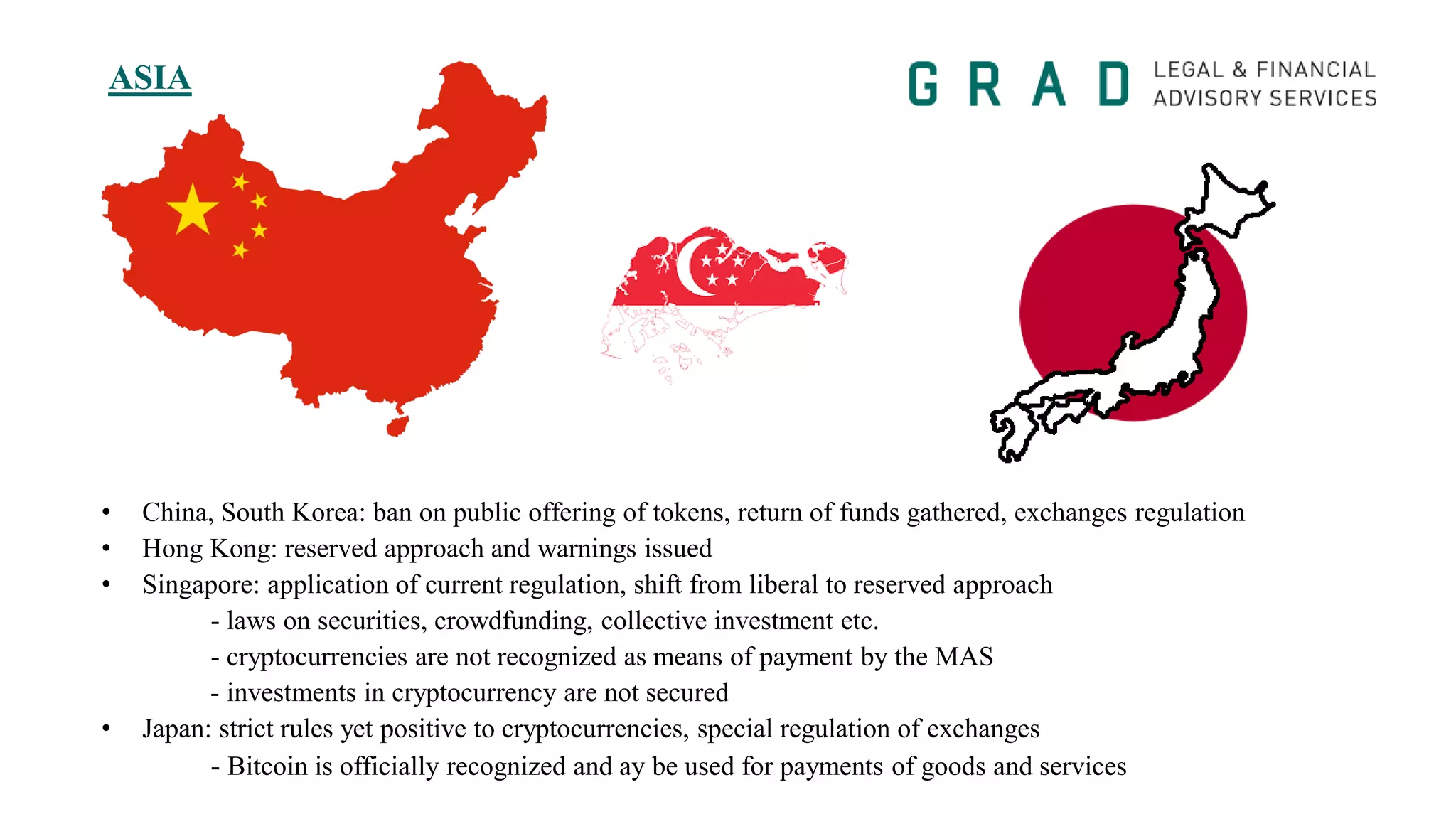
• China, South Korea: ban on public offering of tokens, return of funds gathered, exchanges regulation
• Hong Kong: reserved approach and warnings issued
• Singapore: application of current regulation, shift from liberal to reserved approach
- laws on securities, crowdfunding, collective investment etc.
- cryptocurrencies are not recognized as means of payment by the MAS
- investments in cryptocurrency are not secured
• Japan: strict rules yet positive to cryptocurrencies, special regulation of exchanges
- Bitcoin is officially recognized and ay be used for payments of goods and services
CONCLUSIONS
1. Blockchain/DLT is the real innovative technology (beyond payment sector - into the real economy) being used
more and more by businesses, financial institutions and government bodies.
2. Legislation: no need for brand new rules but existing rules shall be seriously adjusted.
3. Regulation of cryptocurrencies appears inevitable and international collaboration is important.
4. KYC and AML/FT will be applicable by all means (local regulations, international cooperation, EU Directives).
More control is expected.
5. Blockchain community initiative may be precious and is welcomed by regulators (Switzerland, Malta).
Maria Agranovskaya
Managing Partner
Mob. + 7 903 969 62 11
Tel: +7 495 229 40 92
www.gradfirm.ru
Ul.Vozdvizhenka, 7/6, Bldg.1
119019, Moscow, Russia

Microsoft Accelerator event- Maria's Legal presentation

  • 1.
    MARIA AGRANOVSKAYA Managing Partner Attorneyat Law, Blockchain Expert Blockchain legal aspects and regulation: What’s Next?
  • 2.
  • 3.
    ICO FUNDING 0,19 Q32016 Q42016 3,78 0,25 Q12016 0,02 0,01 1,88 (est) 1,05 0,01 Q22015 0,68 2,43 Q12017 0,29 Q320172017Oct -Nov* 0,84 0,46 1,16 Q22017Q42015 0,00 Q32015 0,51 1,39 0,22 0,96 1,62 0,22 Q12015 0,00 0,37 Q22016 1,04 0,4 billion USD ICO of the companies registered in China that shall be returnedto investors Source: Coindesk, CB Insight, IFCERT • The total amount of funds raised during ICO exceeded $ 3.7 billion and has overtaken the volume of venture investments • December is not over but it is clear that it becomes more difficult to raise funds (expensive, cautious investors, explanation required, regulators warnings, first claims) • Blockchain technology: this is the future ICO VC
  • 4.
  • 5.
    18 20 25 23 23 34 32 47 51 64 63 62 145 175 187 192 196 260 256 310 1,031USA Russia Singapore China HK Israel Germany Canada UK Switzerland Estonia Argentina Lithuania Thailand Australia Ukraine Spain Costa-Rica Lichtenstein Slovenia Korea Sweden 15 Bulgaria 12 France12 Finland 11 Czech Republic 10 Slovakia 10 Poland 8 S.Africa 7 Norway 7 Scotland 6 Netherlands 5 ICO MARKET Source: Analysis based on Coindesk, Autonomous Next, Token Market, EY web-site Ø 104 Raised funds (in mln. USD) • Israel is one of the TOP 10 countries • More than 192 mln. USD raised • Nearly 2% of the world’s ICO projects • One of the world’s best entrepreneurial ecosystems (2017 Global Startup Ecosystem Report - 6th)
  • 6.
  • 7.
    SUCCESSFUL EXAMPLES Bancor isa Decentralized Liquidity Network that allows you to hold any Ethereum token and convert it to any other token in the network, with no counter party, at an automatically calculated price, using a simple web wallet. CoinDash is an operating system for crypto assets. Decentralized Document Management for International Trading
  • 8.
    THE MAIN TERMS •Blockchain (DLT) is a ledger which is shared, distributed and cryptographically authentic. Main features: (1) open, decentralized distributed ledger; (2) using of cryptography; (3) continuously growing list of records; (4) information relates to transactions performed in the system. (the Decree of the President of Belarus "On the development of the digital economy“ No.8 dated 21.12.2017) • Cryptocurrency / Token – a record in blockchain or in any other distributed ledger certifying the following: (1) possession of a token (attributed to a specific right or asset (property) and having certain functions); (2) title to different underlying asset classes / services, a right or access to benefits; and/or is (3) a recognized cryptocurrency (exchangeable value) within its “ecosystem”. The token can be registered and transferred via blockchain, has coded functions governed by “smart contracts”. Different nature results in different legal consequences that can be crucial. • Generally accepted regulators position: the existing Laws apply even if cryptocurrency is involved. • KEY ISSUE: token legal nature and consequences for the choice of jurisdiction.
  • 9.
    TOKENS (CONTINUED) • Utilitytoken – services, functions that can be purchased and work within the system (shared infrastructure or platform) and do not normally aim at profits distribution to investors per se. Tokens may enable not only the simultaneous execution of bilateral and multilateral programs encoded in the smart contract terms but also the ability to create co-ownership-like organizations. • Security token – mainly classified on the basis of applicable securities laws due to formalities. Shares in a business with access to profits, promise to earn, tokens listing, “investment contracts” (US). JURISDICTIONAL APPROACH • SWITZERLAND: “Blockchain Crypto Property” of three classes (www.mme.ch ) • Native tokens (cryptocurrency) – no counterparty, only registration function of the token (currency), no underlying asset, no revenue functions, no exact counterparty; • CURRENCY – exchange mediums, account units, stores of value (Bitcoin, Litecoin), INFRASTRUCTURE (plus the use of it or technology not referring to payments – Ether, Ripple, Tezos), APPLICATION (non-infrastructure application or business model, using existing ones (Ether) – Golem, Wings) – token kinds; • Counterparty tokens – a relative right against token generator or a third party (to use services, get asset or payment or shareholders shares); “colored Coins” (Lykke Marketplace) or C-Shares; • SCS Co-Ownership Tokens – more complex, smart contract based co-ownership rights. May collect and transmit values combined with other functions as well. No direct relative rights to tokens generator or third party. Absolute right (e.g., IP) is the cash flow basis that is co-owned. • Consequences: VAT, no written form requirement etc.
  • 10.
    THE MAIN TERMS(PART 2) • USA (SEC) (developed VC market vs strict regulations and extraterritorial rules for US citizens) • “Howey” (1946) and other tests • SEC Report on the DAO Token (July 25th, 2017, Enforcement Department) https://www.mme.ch/de/magazin/sec_enforcement_provides_report_on_the_dao_token/ • December 11th , 2017 (https://www.sec.gov/news/public-statement/statement-clayton-2017-12-11 - views on ICO and cryptocurrency markets for Main Street and professional investors: protection not less than securities laws) • MUNCHEE case investigation (very strict approach: www.sec.gov/litigation/admin/2017/33-10445.pdf ) • Singapore (MAS) • MAS classification – tokens are regulated as securities with few exceptions (August 1st and 10th, October 2nd, December 19th). • UK (FCA) • A commodity not subject to FCA regulation; case by case securities laws application.
  • 11.
    SMART CONTRACTS Smart contract– not equal to legal contract. Main features • Can be described as method of forming agreements in digital form, setting terms via blockchain (not necessarily recognized by or compliant with the law per se, including legal consequences); • Is a program code / protocol functioning in the register of transactions blocks (blockchain) - the decentralized information system - for automated execution of transactions / other actions at given terms; • Normally it is irrevocable and the execution cannot be stopped if the algorithm conditions are met; • Contract or out of contract obligations (articles, laws, unlike civil law contract); • Can be “public contract offer” (third parties join the public offer) or not; • Fixes the parties agreement to do something in a code – the contract is executed automatically without mediators in accordance with coded terms (algoritm), no discretion or deviation. • Transparent terms, no possibility to change or erase transactions (may be a problem – data protection). ADVANTAGES • No problem of authentication / signatory powers verification • Non-compliance problem is out • No mediator required • Efficient costs management (claims work etc)
  • 12.
    SMART CONTRACTS Underwater Stones •Cannot always guarantee the real payment default – if the account is empty – or physical goods transfer • Special rules may apply that require written documentary form, notary or apostile, registration • Some conditions may exist that make a transaction void de jure (absence of consents, activity license etc) • The process itself shall be automated enough to be expressed as “IF….THAN…” (no evaluation or subjective issues, e.g., credit application) • Allows no variation in general (e.g., in case of legal environment changes) • Legal status may be unclear (a smart contract is based on various grounds, a usual civil law contract – on two or multilateral agreement)
  • 13.
    PROTECTION. SMART CONTRACT AUDIT Smartproperty / blockchain projects - risks and dangers • Functionality & Protocol-Related risks • Storage & Access of Private Key-Related Risks • Regulation & Money Laundering-Related Risks • Market-Related & Counterparty Risks Protection. Smart Contract Audit – to: • Avoid possible hackings and mistakes – protection • Optimize the code • Run the code efficiently • Re-enforce authorization • Facts • USD 50 Mln stolen from The DAO • USD 30 Mln - from Ethereum-wallet of Parity; Satoshi Pie Fund lost 32,4% assets • Legal consequences: claims / liability may result from technical mistakes / ommission
  • 14.
    ICO: THE MAINISSUES NEXT YEAR: more difficult and expensive to convey but the technology gains interest. • Choice of the jurisdiction where tokens are issued (characteristics of a project, jurisdiction, budget, token itself etc.) • Token analysis (if required - permission from the regulator to issue securities) • Structuring (company type or holding structure, fund etc.) • Regulations on collective investments, prospecus et cetera • Licensing of the underlying activity (if necessary) • Taxes (VAT, income or capital gains tax etc.) • Intellectual property and trademarks protection • Data protection (e.g., EU Directive in force from May 2018) • Disclaimers • Compliance with potentially applicable other jurisdiction laws
  • 15.
    REQUIRED DOCUMENTS: • Whitepaper • Subscription Terms • Disclaimers • Subscription agreement • Legal Opinion • KYC policy & procedures (even on the website) Additional documents may be required: • Contracts with software developers, lawyers and other contractors • Advisers agreements • Finder’s Agreements • Listing required documentation
  • 16.
    WHITE PAPER • Howthe raised funds are spent • Project development after the ICO • Road map • Team, advisers • Specific chapters related to your project • Illustrations, tables, etc. • Disclaimers • Other • Clear product & token description • Business model • Explanation of Blockchain integration • Market analysis • The tokens mechanism – why is it necessary and how they are used • Quantity and price of tokens • Distribution of tokens
  • 17.
    LEGAL STATUS OFCRYPTOCURRENCIES REGULATION IN DIFFERENT JURISDICTIONS
  • 18.
    DIFFERENT APPROACH ICO Ban: •China • South Korea Current legislation – most countries (crowdfunding, securities, collective investments schemes, EU Directives etc.) • Singapore • Switzerland • UK Special regulations • Japan (bitcoin officially recognized) • Some US states (Arizona, Delaware, NYC) June 3, 2015, The New York State Department of Financial Services (DFS) - the first comprehensive regulatory framework for virtual currency in the United States – the so-called “BitLicense”. • Gibraltar (DLT License) • CIS (Kazakhstan, Belarus)
  • 19.
    STATEMENTS OF REGULATORS (ICO/ CRYPTOCURRENCY) • Belarus 22 December 2017 • Singapore, 19 December 2017 etc • UK, 15 December 2017 • USA, 11 December, 25 July 2017 etc • South Korea, December 11th 2017 etc • Israel (ISA head), December 4th 2017 • EU, 13 November 2017 • Sweden, 7 November 2017 • Japan, 27 October 2017 • Australia, 27 October 2017 • France, 26 October 2017 • Cyprus, 13 October 2017 • Gibraltar, 12 October 2017 • Switzerland, 29 September 2017 • China, 2 September 2017 • Canada, 24 August 2017
  • 20.
    INTERNATIONAL REGULATION Cross-border natureof blockchain technology requires international regulation. Regulators issue warnings but blockchain technology is gaining attention. Global regulatory discussions on bitcoin, cryptocurrencies, and ICOs may begin to take shape as early as April, 2018 on G20 Summit (Germany, France and Italy initiative). • The legitimate use of blockchain technology benefits: increased payment efficiency, lower transaction costs, easy KYC etc. Virtual currencies facilitate local and international cashless payments and banking services. • Financial institutions build sandboxes to explore technology and support startups. • However, other characteristics of virtual currencies coupled with their global reach, present potential risks such as: (1) anonymity yet possible by the virtual currencies trade via internet; (2) limited identification and verification of participants; (3) lack of clarity regarding the responsibility for AML/CFT compliance, supervision and enforcement for these transactions that are segmented across several countries; (4) lack of a central oversight body and (5) no clear liability of exchanges or platforms (e.g., NiceHash mining).
  • 21.
    EUROPE • October 2017:the European Central Bank is “watching cryptocurrency” (long time has been keeping away from expressing its position) • 13 September 2013 – the European Banking Authority (EBA) warning regarding “Virtual Currencies” (risks involved when buying, holding or trading such) • August 2017 - Mario Dragi (ECB) in response to Estonia’s application for its own cryptocurrency: “Europe has only one currency – EURO” • EU Commission proposal on 5 July 2016 to amend AML Directive • Opinion of the European Central Bank (ECB) on the proposed Directive (12 October 2016) (means of exchange rather than means of payment and not subject to its regulation) • European Parliament Resolution dated 26 May 2016 (suggested revision of existing EU legislation (Payment Accounts Directive and Payment Service Directive) and positive towards virtual currencies) EXTRA TERRITORIAL APPLICATION OF LAWS - US • US Laws protecting US citizens (in particular, as regards securities issue) apply worldwide to US investors • Severe sanctions apply based on international agreements and US impact • USD accounts blockage, stopping of ICOs, criminal cases, fines (e.g., Swiss company Tezos – US cases) • Special procedures shall be met to apply sanctions and penalties in collaboration with local governments
  • 22.
    ASIA • China, SouthKorea: ban on public offering of tokens, return of funds gathered, exchanges regulation • Hong Kong: reserved approach and warnings issued • Singapore: application of current regulation, shift from liberal to reserved approach - laws on securities, crowdfunding, collective investment etc. - cryptocurrencies are not recognized as means of payment by the MAS - investments in cryptocurrency are not secured • Japan: strict rules yet positive to cryptocurrencies, special regulation of exchanges - Bitcoin is officially recognized and ay be used for payments of goods and services
  • 23.
    CONCLUSIONS 1. Blockchain/DLT isthe real innovative technology (beyond payment sector - into the real economy) being used more and more by businesses, financial institutions and government bodies. 2. Legislation: no need for brand new rules but existing rules shall be seriously adjusted. 3. Regulation of cryptocurrencies appears inevitable and international collaboration is important. 4. KYC and AML/FT will be applicable by all means (local regulations, international cooperation, EU Directives). More control is expected. 5. Blockchain community initiative may be precious and is welcomed by regulators (Switzerland, Malta).
  • 24.
    Maria Agranovskaya Managing Partner Mob.+ 7 903 969 62 11 Tel: +7 495 229 40 92 www.gradfirm.ru Ul.Vozdvizhenka, 7/6, Bldg.1 119019, Moscow, Russia