Blockchain: Beyond the Hype
- Permissioned & Permissionless
Feb-2019, Amsterdam
https://github.com/vikpande
Agenda
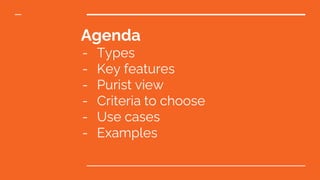
- Types
- Key features
- Purist view
- Criteria to choose
- Use cases
- Examples
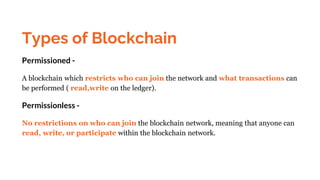
Types of Blockchain
Permissioned -
A blockchain which restricts who can join the network and what transactions can
be performed ( read,write on the ledger).
Permissionless -
No restrictions on who can join the blockchain network, meaning that anyone can
read, write, or participate within the blockchain network.
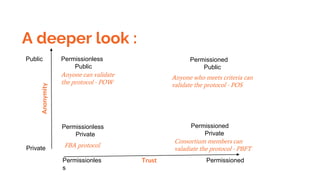
A deeper look :
Private
Public
Permissionles
s
Permissioned
Anonymity
Trust
Permissionless
Public
Permissioned
Public
Permissionless
Private
Permissioned
Private
Anyone can validate
the protocol - POW
Anyone who meets criteria can
validate the protocol - POS
FBA protocol
Consortium members can
valadiate the protocol - PBFT
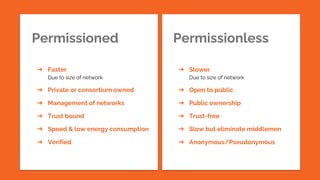
Permissioned
➔ Faster
Due to size of network
➔ Private or consortium owned
➔ Management of networks
➔ Trust bound
➔ Speed & low energy consumption
➔ Verified
Permissionless
➔ Slower
Due to size of network
➔ Open to public
➔ Public ownership
➔ Trust-free
➔ Slow but eliminate middlemen
➔ Anonymous/Pseudonymous
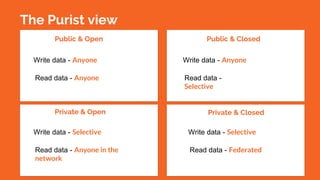
The Purist view
Public & Open
Private & Open
Public & Closed
Private & Closed
Write data - Anyone
Read data -
Selective
Write data - Anyone
Read data - Anyone
Write data - Selective
Read data - Federated
Write data - Selective
Read data - Anyone in the
network
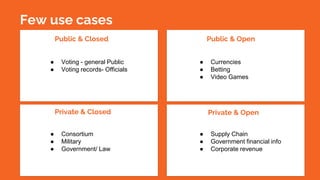
Few use cases
Public & Closed
Private & Closed
Public & Open
Private & Open
● Voting - general Public
● Voting records- Officials
● Consortium
● Military
● Government/ Law
● Currencies
● Betting
● Video Games
● Supply Chain
● Government financial info
● Corporate revenue
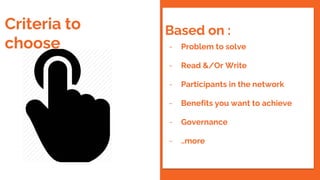
Criteria to
choose
Based on :
- Problem to solve
- Read &/Or Write
- Participants in the network
- Benefits you want to achieve
- Governance
- ..more
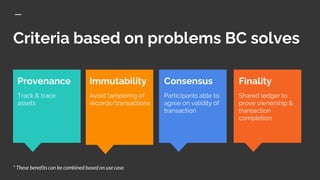
Criteria based on problems BC solves
Consensus
Participants able to
agree on validity of
transaction
* These benefits can be combined based on use case.
Finality
Shared ledger to
prove ownership &
transaction
completion
Immutability
Avoid tampering of
records/transactions
Provenance
Track & trace
assets
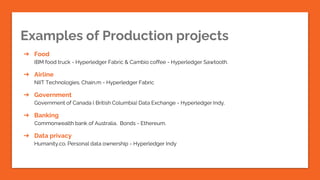
Examples of Production projects
➔ Food
IBM food truck - Hyperledger Fabric & Cambio coffee - Hyperledger Sawtooth.
➔ Airline
NIIT Technologies. Chain.m - Hyperledger Fabric
➔ Government
Government of Canada ( British Columbia) Data Exchange - Hyperledger Indy.
➔ Banking
Commonwealth bank of Australia. Bonds - Ethereum.
➔ Data privacy
Humanity.co. Personal data ownership - Hyperledger Indy
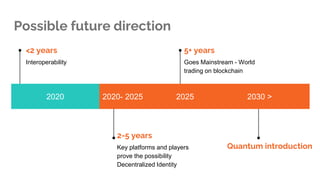
Possible future direction
2020 2020- 2025 2025 2030 >
<2 years
Interoperability
2-5 years
Key platforms and players
prove the possibility
Decentralized Identity
5+ years
Goes Mainstream - World
trading on blockchain
Quantum introduction
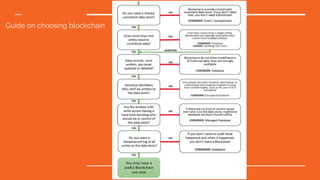
Guide on choosing blockchain
Contact me
● vikpande@gmail.com
● https://nl.linkedin.com/in/vikpande
● https://github.com/vikpande

Permissonless & Permissioned blockchain

  • 1.
    Blockchain: Beyond theHype - Permissioned & Permissionless Feb-2019, Amsterdam https://github.com/vikpande
  • 2.
    Agenda - Types - Keyfeatures - Purist view - Criteria to choose - Use cases - Examples
  • 3.
    Types of Blockchain Permissioned- A blockchain which restricts who can join the network and what transactions can be performed ( read,write on the ledger). Permissionless - No restrictions on who can join the blockchain network, meaning that anyone can read, write, or participate within the blockchain network.
  • 4.
    A deeper look: Private Public Permissionles s Permissioned Anonymity Trust Permissionless Public Permissioned Public Permissionless Private Permissioned Private Anyone can validate the protocol - POW Anyone who meets criteria can validate the protocol - POS FBA protocol Consortium members can valadiate the protocol - PBFT
  • 5.
    Permissioned ➔ Faster Due tosize of network ➔ Private or consortium owned ➔ Management of networks ➔ Trust bound ➔ Speed & low energy consumption ➔ Verified Permissionless ➔ Slower Due to size of network ➔ Open to public ➔ Public ownership ➔ Trust-free ➔ Slow but eliminate middlemen ➔ Anonymous/Pseudonymous
  • 6.
    The Purist view Public& Open Private & Open Public & Closed Private & Closed Write data - Anyone Read data - Selective Write data - Anyone Read data - Anyone Write data - Selective Read data - Federated Write data - Selective Read data - Anyone in the network
  • 7.
    Few use cases Public& Closed Private & Closed Public & Open Private & Open ● Voting - general Public ● Voting records- Officials ● Consortium ● Military ● Government/ Law ● Currencies ● Betting ● Video Games ● Supply Chain ● Government financial info ● Corporate revenue
  • 8.
    Criteria to choose Based on: - Problem to solve - Read &/Or Write - Participants in the network - Benefits you want to achieve - Governance - ..more
  • 9.
    Criteria based onproblems BC solves Consensus Participants able to agree on validity of transaction * These benefits can be combined based on use case. Finality Shared ledger to prove ownership & transaction completion Immutability Avoid tampering of records/transactions Provenance Track & trace assets
  • 10.
    Examples of Productionprojects ➔ Food IBM food truck - Hyperledger Fabric & Cambio coffee - Hyperledger Sawtooth. ➔ Airline NIIT Technologies. Chain.m - Hyperledger Fabric ➔ Government Government of Canada ( British Columbia) Data Exchange - Hyperledger Indy. ➔ Banking Commonwealth bank of Australia. Bonds - Ethereum. ➔ Data privacy Humanity.co. Personal data ownership - Hyperledger Indy
  • 11.
    Possible future direction 20202020- 2025 2025 2030 > <2 years Interoperability 2-5 years Key platforms and players prove the possibility Decentralized Identity 5+ years Goes Mainstream - World trading on blockchain Quantum introduction
  • 12.
  • 13.
    Contact me ● vikpande@gmail.com ●https://nl.linkedin.com/in/vikpande ● https://github.com/vikpande