1
CRYPTOCURRENCIES:
STATE OF THE US
REGULATORY
ENVIRONMENT
FENNIE WANG
September 5, 2017
Berlin
2
THIS IS NOT LEGAL ADVICE.
Although lawyers in this space will very likely overcharge you and underserve you,
please do not take the information here as legal advice in lieu of consulting with a
lawyer on issues specific to your situation. In short, do not sue me or blame me for
anything in this document because I am not giving you legal advice. I disclaim any
representations or warranties as to the accuracy of any information in this document.
Some of it may be wrong. Some of it is my opinion and musing. Finally, be aware that
the regulatory and legal environment is rapidly changing and in flux, and no one really
knows what they are talking about or can be sure of how things will play out with
respect to regulators, lawmakers and judges. Good luck and god speed.
3
Meet Howey, killer of sh*tcoins
● SEC v. W. J. Howey Co. is 1946 Supreme Court case defining
investment contract under 1933 Securities Act:
a. Investment of money into a
b. Common Enterprise with an
c. Expectation of profits primarily through the
d. Efforts of third parties
● No landmark new litigation on Howey in context of ICOs but
SEC has published several key analysis of Howey:
a. TheDAO report (July 2017)
b. Munchee enforcement action (December 2017)
4
Like unicorns, utility tokens do not exist
● What is utility? Anything can have utility but so long as
the hallmarks of a security are present, it’s a security.
● SAFT is dead: “Utility” does not magically transform a
security into a non-security
● SEC is looking at the economic realities of a transaction
i.e. substance over form
○ Ability for a secondary market for tokens to develop
with significant early stage control of project team =
security
● IndieGoGo recently pulled its sale of a “consumer token”
which it had claimed was not a security
5
Move over ICO, STO is the new girl in town
● Going assumption: All projects, especially DApp tokens, are securities
○ If the project is not a public blockchain, what is the essential
economic necessity of a token?
○ Tokens are risk capital used to incentivize early adopters much like
equity compensation is used as incentives
○ Airdrops & bounties count as securities offerings
● STO = Security Token Offering
○ Rise of broker-dealer compliant
alternative trading systems (ATS)
to issue and trade STOs
6
The menu: Security offering options
● Regulation D: Accredited investors (rich people) only
○ Exemption to registration i.e. restricted securities not for resale
■ Rule 144 safe harbor: 12 month lock on trading
○ Accredited investor = $200K income/year or $1mn in assets excl house
○ 506(b): Private solicitation only
○ 506(c): Public solicitation OK but burden shifts to issuer to prove accredited
investor status
● Regulation A+
○ Can offer to unlimited number of non-accredited investors
○ Tier 1: Up to $20mn in 12 month period
○ Tier 2: Up to $50mn in 12 month period, but non accredited investors can invest up
to 10% of annual salary or net worth
○ Must go through SEC approval
○ Some restrictions on resales (limited by amount in first 12 month period)
7
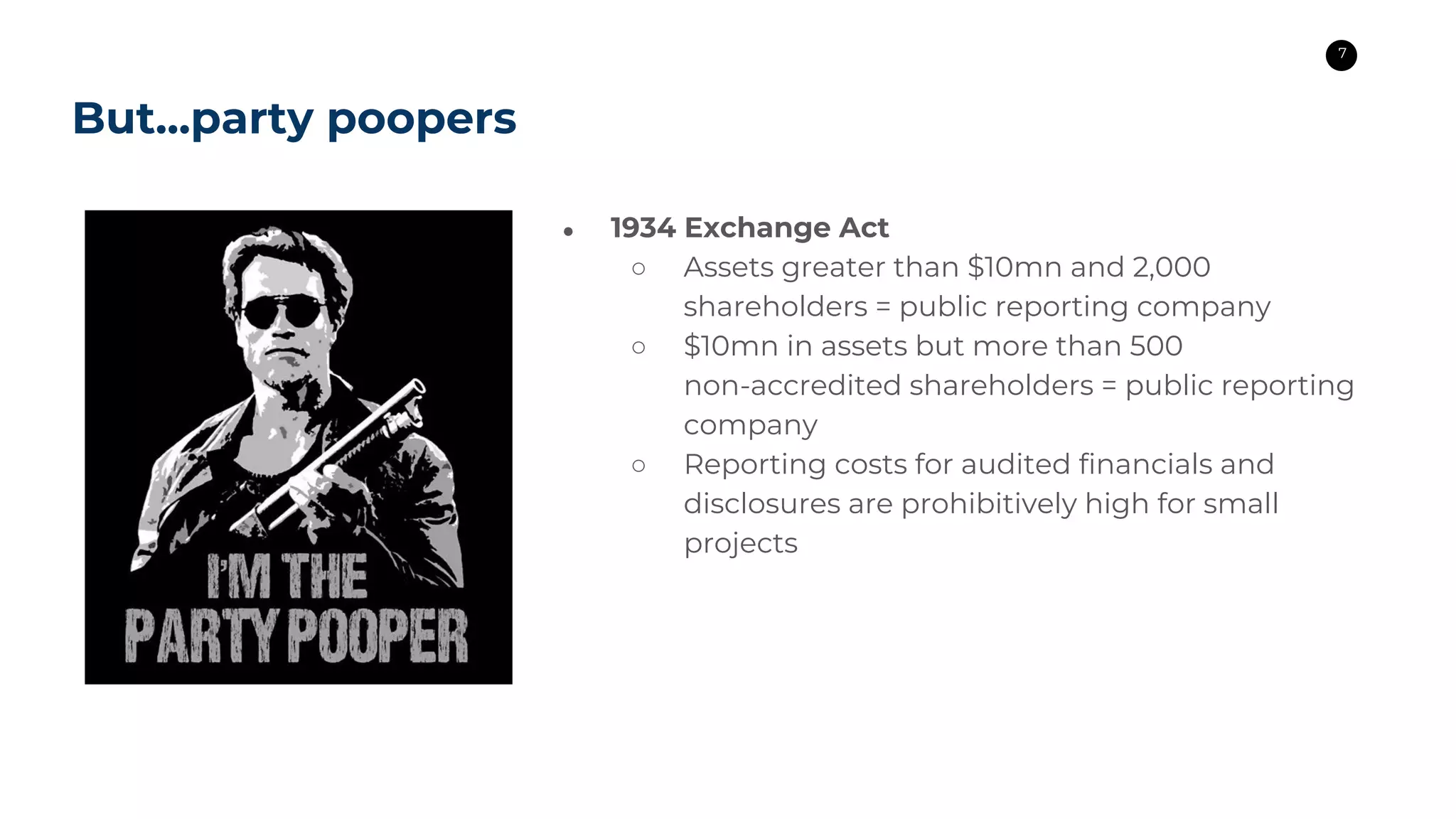
● 1934 Exchange Act
○ Assets greater than $10mn and 2,000
shareholders = public reporting company
○ $10mn in assets but more than 500
non-accredited shareholders = public reporting
company
○ Reporting costs for audited financials and
disclosures are prohibitively high for small
projects
But...party poopers
8
Death and taxes
● IRS treats cryptocurrencies as property
a. This means every time you have a
transaction it is a taxable event i.e. taxes
payable in real fiat cash even if the trade is
not exiting your cryptocurrency into fiat
b. Death by audit - until there is clear
legislation, IRS will enforce its position
through audits and simply showing
screenshots of trades may not be sufficient
9
OPENWATER
CAPITAL™
Turf wars amongst all the cops in town
● FinCEN enforces the Bank Secrecy Act
a. AML, KYC requirements
b. License as a money services business - ICO issuer is a money transmitter
if tokens are exchangeable for other tokens that substitute money
c. You can be both a security and a “currency” for purposes of FinCEN??
● CFTC and tokens as commodities
a. Influential federal judge said Bitcoin and Litecoin were commodities
b. CFTC has jurisdiction over futures, options & derivatives e.g. Bitcoin
futures
c. Commodities are generally less regulated
i. CFTC does not oversee spot transactions of virtual currencies that
don’t involve margin, leverage, financing
ii. Otherwise oversees fraud and market manipulation
● Plus state securities and money services regulations - love federalism!
10
BLOCKCHAIN
AND BAHAMAS
Appetite for technological tools to
eliminate corruption and advance
transparency
Implicit need for digital financial and
payment services
Active national strategies to stimulate
financial sector, attract startups, and
reduce the cost of doing business
BUT THERE’S HOPE: ETH IS NOT A SECURITY!
● Hinman’s speech
a. Glimmer of hope for public blockchains that require an endogenous economic
incentive for block production and security of the ledger
● First principles
a. An object itself may not be a security but how it is sold or packaged may be a
security instrument e.g. a house is not a security but mortgage backed securities are
b. Decentralization & governance is important for reducing information
asymmetry: necessary to defeat the last prong of Howey test (efforts of others)
i. Sufficient decentralization = active participation and changing the
agent/principal relationship
ii. Digital asset transactions may start as securities due to lack of sufficient
decentralization but may no longer be securities offerings over time due to
dissipation of central role of token issuers - but what is the legal test???
iii. Subtle difference from SAFT reasoning based on level of operational
readiness/utility
11
Governance, decentralization & security laws
● The cooperative model?
a. How do we finance and govern the internet commons? Much like farmers got
together to finance and govern public commons or public utilities through the
cooperative model
b. RChain is a cooperative, others include DappHubb (MakerDao)
c. A cooperative member as owner is a principal and actively engaged in the
development of the common enterprise, not primarily through efforts of others
● Substance over form - governance & adoption
a. Open source to encourage permissionless development
b. Governance and economic gains should not be structurally controlled by identifiable
central parties with outsized influence
● Creative new funding models
a. Even if project is a public, open source chain, initially it may still be a security due to
insufficient decentralization at beginning -- traditional startup financing
b. When ready to stand up the network, tokens are issued
12
THE WAY FORWARD?
● Legislative framework is needed
a. Don’t let the sharks & whales do all the
lobbying
b. Public web infrastructure financing should
have a legally defined category for orderly
enforcement of rules
c. DApp tokens should be security tokens
d. Broaden scope of crowdfunding and/or
accredited investor - democratize
investment opportunities
e. Legislation for data and identity
self-sovereignty - new “labor” laws for data
production and digital economy
@fennie_wang
LET’S MAKE IT HAPPEN!
https://medium.com
/@fenniewang
https://www.linkedin.
com/in/fennie-wang-
3323061/
@dafenster

Cryptocurrencies: State of the US Regulatory Environment

  • 1.
    1 CRYPTOCURRENCIES: STATE OF THEUS REGULATORY ENVIRONMENT FENNIE WANG September 5, 2017 Berlin
  • 2.
    2 THIS IS NOTLEGAL ADVICE. Although lawyers in this space will very likely overcharge you and underserve you, please do not take the information here as legal advice in lieu of consulting with a lawyer on issues specific to your situation. In short, do not sue me or blame me for anything in this document because I am not giving you legal advice. I disclaim any representations or warranties as to the accuracy of any information in this document. Some of it may be wrong. Some of it is my opinion and musing. Finally, be aware that the regulatory and legal environment is rapidly changing and in flux, and no one really knows what they are talking about or can be sure of how things will play out with respect to regulators, lawmakers and judges. Good luck and god speed.
  • 3.
    3 Meet Howey, killerof sh*tcoins ● SEC v. W. J. Howey Co. is 1946 Supreme Court case defining investment contract under 1933 Securities Act: a. Investment of money into a b. Common Enterprise with an c. Expectation of profits primarily through the d. Efforts of third parties ● No landmark new litigation on Howey in context of ICOs but SEC has published several key analysis of Howey: a. TheDAO report (July 2017) b. Munchee enforcement action (December 2017)
  • 4.
    4 Like unicorns, utilitytokens do not exist ● What is utility? Anything can have utility but so long as the hallmarks of a security are present, it’s a security. ● SAFT is dead: “Utility” does not magically transform a security into a non-security ● SEC is looking at the economic realities of a transaction i.e. substance over form ○ Ability for a secondary market for tokens to develop with significant early stage control of project team = security ● IndieGoGo recently pulled its sale of a “consumer token” which it had claimed was not a security
  • 5.
    5 Move over ICO,STO is the new girl in town ● Going assumption: All projects, especially DApp tokens, are securities ○ If the project is not a public blockchain, what is the essential economic necessity of a token? ○ Tokens are risk capital used to incentivize early adopters much like equity compensation is used as incentives ○ Airdrops & bounties count as securities offerings ● STO = Security Token Offering ○ Rise of broker-dealer compliant alternative trading systems (ATS) to issue and trade STOs
  • 6.
    6 The menu: Securityoffering options ● Regulation D: Accredited investors (rich people) only ○ Exemption to registration i.e. restricted securities not for resale ■ Rule 144 safe harbor: 12 month lock on trading ○ Accredited investor = $200K income/year or $1mn in assets excl house ○ 506(b): Private solicitation only ○ 506(c): Public solicitation OK but burden shifts to issuer to prove accredited investor status ● Regulation A+ ○ Can offer to unlimited number of non-accredited investors ○ Tier 1: Up to $20mn in 12 month period ○ Tier 2: Up to $50mn in 12 month period, but non accredited investors can invest up to 10% of annual salary or net worth ○ Must go through SEC approval ○ Some restrictions on resales (limited by amount in first 12 month period)
  • 7.
    7 ● 1934 ExchangeAct ○ Assets greater than $10mn and 2,000 shareholders = public reporting company ○ $10mn in assets but more than 500 non-accredited shareholders = public reporting company ○ Reporting costs for audited financials and disclosures are prohibitively high for small projects But...party poopers
  • 8.
    8 Death and taxes ●IRS treats cryptocurrencies as property a. This means every time you have a transaction it is a taxable event i.e. taxes payable in real fiat cash even if the trade is not exiting your cryptocurrency into fiat b. Death by audit - until there is clear legislation, IRS will enforce its position through audits and simply showing screenshots of trades may not be sufficient
  • 9.
    9 OPENWATER CAPITAL™ Turf wars amongstall the cops in town ● FinCEN enforces the Bank Secrecy Act a. AML, KYC requirements b. License as a money services business - ICO issuer is a money transmitter if tokens are exchangeable for other tokens that substitute money c. You can be both a security and a “currency” for purposes of FinCEN?? ● CFTC and tokens as commodities a. Influential federal judge said Bitcoin and Litecoin were commodities b. CFTC has jurisdiction over futures, options & derivatives e.g. Bitcoin futures c. Commodities are generally less regulated i. CFTC does not oversee spot transactions of virtual currencies that don’t involve margin, leverage, financing ii. Otherwise oversees fraud and market manipulation ● Plus state securities and money services regulations - love federalism!
  • 10.
    10 BLOCKCHAIN AND BAHAMAS Appetite fortechnological tools to eliminate corruption and advance transparency Implicit need for digital financial and payment services Active national strategies to stimulate financial sector, attract startups, and reduce the cost of doing business BUT THERE’S HOPE: ETH IS NOT A SECURITY! ● Hinman’s speech a. Glimmer of hope for public blockchains that require an endogenous economic incentive for block production and security of the ledger ● First principles a. An object itself may not be a security but how it is sold or packaged may be a security instrument e.g. a house is not a security but mortgage backed securities are b. Decentralization & governance is important for reducing information asymmetry: necessary to defeat the last prong of Howey test (efforts of others) i. Sufficient decentralization = active participation and changing the agent/principal relationship ii. Digital asset transactions may start as securities due to lack of sufficient decentralization but may no longer be securities offerings over time due to dissipation of central role of token issuers - but what is the legal test??? iii. Subtle difference from SAFT reasoning based on level of operational readiness/utility
  • 11.
    11 Governance, decentralization &security laws ● The cooperative model? a. How do we finance and govern the internet commons? Much like farmers got together to finance and govern public commons or public utilities through the cooperative model b. RChain is a cooperative, others include DappHubb (MakerDao) c. A cooperative member as owner is a principal and actively engaged in the development of the common enterprise, not primarily through efforts of others ● Substance over form - governance & adoption a. Open source to encourage permissionless development b. Governance and economic gains should not be structurally controlled by identifiable central parties with outsized influence ● Creative new funding models a. Even if project is a public, open source chain, initially it may still be a security due to insufficient decentralization at beginning -- traditional startup financing b. When ready to stand up the network, tokens are issued
  • 12.
    12 THE WAY FORWARD? ●Legislative framework is needed a. Don’t let the sharks & whales do all the lobbying b. Public web infrastructure financing should have a legally defined category for orderly enforcement of rules c. DApp tokens should be security tokens d. Broaden scope of crowdfunding and/or accredited investor - democratize investment opportunities e. Legislation for data and identity self-sovereignty - new “labor” laws for data production and digital economy
  • 13.
    @fennie_wang LET’S MAKE ITHAPPEN! https://medium.com /@fenniewang https://www.linkedin. com/in/fennie-wang- 3323061/ @dafenster