Microservices.
Microservices
Everywhere!
Jérôme Petazzoni — @jpetazzo
Docker Inc. — @docker
Who am I?
French software engineer living in California
Joined Docker (dotCloud) more than 4 years ago
(I was at Docker before it was cool!)
I have built and scaled the dotCloud PaaS
I learned a few things about running containers
(in production)
Outline
What are microservices?
What are their challenges?
How does Docker help?
How can we do this today?
What are microservices?
Microservices: a style of software architecture
Break big application down into many small services
Example: e-commerce
- web front-end
- catalog of products
- inventory/stock management
- shipping calculator
- payment processor
- billing/invoicing
- recommendation engine
- user profiles
Why are we doing this? (1/2)
Use different stacks for different services
(use the right language/tool for the job)
Replace or refactor individual services easily
Less coordination required when deploying
- deploy more often
- less risk
- more agility and speed
Why are we doing this? (2/2)
Promotes many small teams instead of one big army
- smaller teams = less communication overhead
- see Jeff Bezos' "two-pizza rule"
Enables effective ownership of services
- a service always has an "owner" (=team)
- the owner is responsible (=on call)
- the owner is empowered (=can fix things)
What are the challenges
associated with microservices?
Fast, efficient RPC calls
Docker does not help with that. See instead:
- ZeroRPC
- Cap'n Proto
- XMLRPC
- SOAP
- Dnode
- REST
- Queues (like AMQP), for long-running/async operations
Architecturing the application in small blocks
Docker does not help with that.
Some tips:
- Pretend that you're outsourcing parts of your stack
- Wrap database access;
each object (or table) = one service
Efficient deployment system
Instead of deploying one monolith once in a while,
we deploy many services very frequently
The manual, tedious, uniquely tailored deployment system
has to be replaced with something simple and reliable
It must be easy to add new components and deploy them
Docker does help with that.
Network plumbing
Instead of one monolith talking to a database,
we now have 100s of services talking to each other
Those services will often be scaled independently
Instead of direct, deterministic library calls,
we now have network calls across load balancers
Scaling, load balancing, monitoring must be easy to do
Docker does help with that.
More challenges
See Microservices: not a free lunch[1],
by Benjamin Wootton.
[1] http://highscalability.com/blog/2014/4/8/microservices-not-a-free-lunch.html
How does Docker help us to
implement microservices?
Building code, without Docker
Deployment scripts are fragile
Configuration management is hard
(and not a silver bullet)
Environments differ:
- from dev to dev
- from dev to prod
Building code, with Docker
Write a Dockerfile for each component
Builds are fast
- each build step is saved
- future builds will reuse saved steps
Builds are reproducible
- build environment can be well-defined
- outside context is limited
class: picture
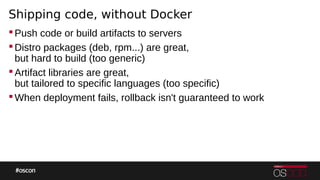
Shipping code, without Docker
Push code or build artifacts to servers
Distro packages (deb, rpm...) are great,
but hard to build (too generic)
Artifact libraries are great,
but tailored to specific languages (too specific)
When deployment fails, rollback isn't guaranteed to work
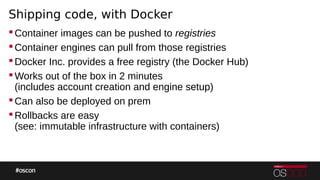
Shipping code, with Docker
Container images can be pushed to registries
Container engines can pull from those registries
Docker Inc. provides a free registry (the Docker Hub)
Works out of the box in 2 minutes
(includes account creation and engine setup)
Can also be deployed on prem
Rollbacks are easy
(see: immutable infrastructure with containers)
class: picture
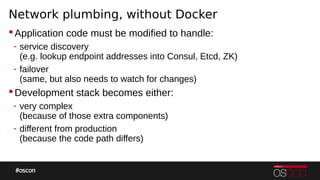
Network plumbing, without Docker
Application code must be modified to handle:
- service discovery
(e.g. lookup endpoint addresses into Consul, Etcd, ZK)
- failover
(same, but also needs to watch for changes)
Development stack becomes either:
- very complex
(because of those extra components)
- different from production
(because the code path differs)
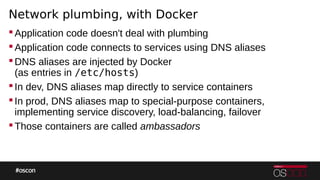
Network plumbing, with Docker
Application code doesn't deal with plumbing
Application code connects to services using DNS aliases
DNS aliases are injected by Docker
(as entries in /etc/hosts)
In dev, DNS aliases map directly to service containers
In prod, DNS aliases map to special-purpose containers,
implementing service discovery, load-balancing, failover
Those containers are called ambassadors
class: picture
How can we do this today?
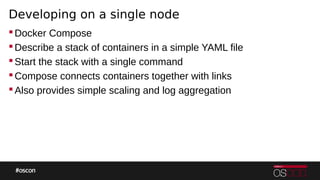
Developing on a single node
Docker Compose
Describe a stack of containers in a simple YAML file
Start the stack with a single command
Compose connects containers together with links
Also provides simple scaling and log aggregation
class: picture
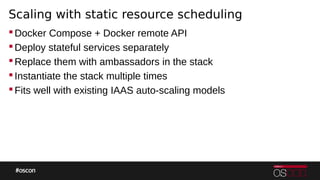
Scaling with static resource scheduling
Docker Compose + Docker remote API
Deploy stateful services separately
Replace them with ambassadors in the stack
Instantiate the stack multiple times
Fits well with existing IAAS auto-scaling models
class: picture
Scaling with dynamic resource scheduling
Docker Compose + Docker Swarm
Swarm consolidates multiple Docker hosts into a single one
Swarm "looks like" a Docker daemon, but it dispatches (schedules)
your containers on multiple daemons
Swarm speaks the Docker API front and back
Swarm is open source and written in Go (like Docker)
Swarm was started by two of the original Docker authors
(@aluzzardi and @vieux)
Swarm is not stable yet (version 0.3 right now)
No live demo
Video from DockerCon 2015, last month
(10 minutes)
https://www.youtube.com/watch?v=at72dhg-SZY&t=2600
Thanks!
Questions?
@jpetazzo — @docker

Microservices. Microservices everywhere! (At OSCON 2015)

  • 1.
  • 2.
    Who am I? Frenchsoftware engineer living in California Joined Docker (dotCloud) more than 4 years ago (I was at Docker before it was cool!) I have built and scaled the dotCloud PaaS I learned a few things about running containers (in production)
  • 3.
    Outline What are microservices? Whatare their challenges? How does Docker help? How can we do this today?
  • 4.
  • 5.
    Microservices: a styleof software architecture Break big application down into many small services Example: e-commerce - web front-end - catalog of products - inventory/stock management - shipping calculator - payment processor - billing/invoicing - recommendation engine - user profiles
  • 6.
    Why are wedoing this? (1/2) Use different stacks for different services (use the right language/tool for the job) Replace or refactor individual services easily Less coordination required when deploying - deploy more often - less risk - more agility and speed
  • 7.
    Why are wedoing this? (2/2) Promotes many small teams instead of one big army - smaller teams = less communication overhead - see Jeff Bezos' "two-pizza rule" Enables effective ownership of services - a service always has an "owner" (=team) - the owner is responsible (=on call) - the owner is empowered (=can fix things)
  • 8.
    What are thechallenges associated with microservices?
  • 9.
    Fast, efficient RPCcalls Docker does not help with that. See instead: - ZeroRPC - Cap'n Proto - XMLRPC - SOAP - Dnode - REST - Queues (like AMQP), for long-running/async operations
  • 10.
    Architecturing the applicationin small blocks Docker does not help with that. Some tips: - Pretend that you're outsourcing parts of your stack - Wrap database access; each object (or table) = one service
  • 11.
    Efficient deployment system Insteadof deploying one monolith once in a while, we deploy many services very frequently The manual, tedious, uniquely tailored deployment system has to be replaced with something simple and reliable It must be easy to add new components and deploy them Docker does help with that.
  • 12.
    Network plumbing Instead ofone monolith talking to a database, we now have 100s of services talking to each other Those services will often be scaled independently Instead of direct, deterministic library calls, we now have network calls across load balancers Scaling, load balancing, monitoring must be easy to do Docker does help with that.
  • 13.
    More challenges See Microservices:not a free lunch[1], by Benjamin Wootton. [1] http://highscalability.com/blog/2014/4/8/microservices-not-a-free-lunch.html
  • 14.
    How does Dockerhelp us to implement microservices?
  • 15.
    Building code, withoutDocker Deployment scripts are fragile Configuration management is hard (and not a silver bullet) Environments differ: - from dev to dev - from dev to prod
  • 16.
    Building code, withDocker Write a Dockerfile for each component Builds are fast - each build step is saved - future builds will reuse saved steps Builds are reproducible - build environment can be well-defined - outside context is limited
  • 17.
  • 18.
    Shipping code, withoutDocker Push code or build artifacts to servers Distro packages (deb, rpm...) are great, but hard to build (too generic) Artifact libraries are great, but tailored to specific languages (too specific) When deployment fails, rollback isn't guaranteed to work
  • 19.
    Shipping code, withDocker Container images can be pushed to registries Container engines can pull from those registries Docker Inc. provides a free registry (the Docker Hub) Works out of the box in 2 minutes (includes account creation and engine setup) Can also be deployed on prem Rollbacks are easy (see: immutable infrastructure with containers)
  • 20.
  • 21.
    Network plumbing, withoutDocker Application code must be modified to handle: - service discovery (e.g. lookup endpoint addresses into Consul, Etcd, ZK) - failover (same, but also needs to watch for changes) Development stack becomes either: - very complex (because of those extra components) - different from production (because the code path differs)
  • 22.
    Network plumbing, withDocker Application code doesn't deal with plumbing Application code connects to services using DNS aliases DNS aliases are injected by Docker (as entries in /etc/hosts) In dev, DNS aliases map directly to service containers In prod, DNS aliases map to special-purpose containers, implementing service discovery, load-balancing, failover Those containers are called ambassadors
  • 23.
  • 24.
    How can wedo this today?
  • 25.
    Developing on asingle node Docker Compose Describe a stack of containers in a simple YAML file Start the stack with a single command Compose connects containers together with links Also provides simple scaling and log aggregation
  • 26.
  • 27.
    Scaling with staticresource scheduling Docker Compose + Docker remote API Deploy stateful services separately Replace them with ambassadors in the stack Instantiate the stack multiple times Fits well with existing IAAS auto-scaling models
  • 28.
  • 29.
    Scaling with dynamicresource scheduling Docker Compose + Docker Swarm Swarm consolidates multiple Docker hosts into a single one Swarm "looks like" a Docker daemon, but it dispatches (schedules) your containers on multiple daemons Swarm speaks the Docker API front and back Swarm is open source and written in Go (like Docker) Swarm was started by two of the original Docker authors (@aluzzardi and @vieux) Swarm is not stable yet (version 0.3 right now)
  • 30.
    No live demo Videofrom DockerCon 2015, last month (10 minutes) https://www.youtube.com/watch?v=at72dhg-SZY&t=2600
  • 31.