Microservice
17 Media
Viney Shih, Sr. Engineering Manager
Agenda
● What’s Microservice and the relation with organization
● What’s the challenge moving to Microservice
● Distributed data
● Event-driven messaging
● Consistency
● Summary
● Q&A
What’s Microservice
When to Microservice
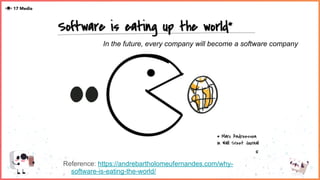
Reference: https://andrebartholomeufernandes.com/why-
software-is-eating-the-world/
In the future, every company will become a software company
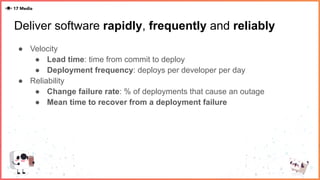
Deliver software rapidly, frequently and reliably
● Velocity
● Lead time: time from commit to deploy
● Deployment frequency: deploys per developer per day
● Reliability
● Change failure rate: % of deployments that cause an outage
● Mean time to recover from a deployment failure
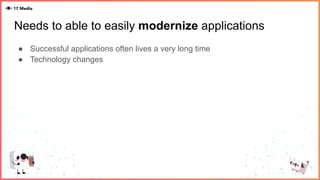
Needs to able to easily modernize applications
● Successful applications often lives a very long time
● Technology changes
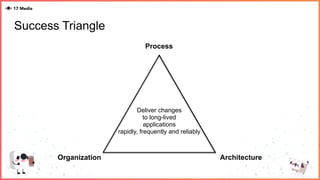
Success Triangle
Deliver changes
to long-lived
applications
rapidly, frequently and reliably
Process
ArchitectureOrganization
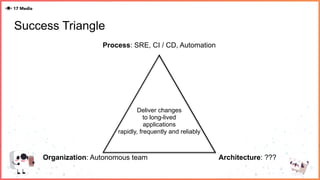
Success Triangle
Deliver changes
to long-lived
applications
rapidly, frequently and reliably
Process: SRE, CI / CD, Automation
Architecture: ???Organization: Autonomous team
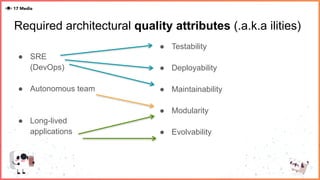
● SRE
(DevOps)
● Autonomous team
● Long-lived
applications
Required architectural quality attributes (.a.k.a ilities)
● Testability
● Deployability
● Maintainability
● Modularity
● Evolvability
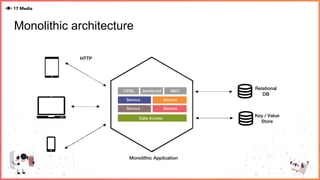
Monolithic architecture
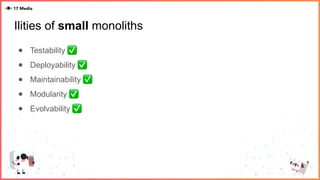
Ilities of small monoliths
● Testability ✅
● Deployability ✅
● Maintainability ✅
● Modularity ✅
● Evolvability ✅
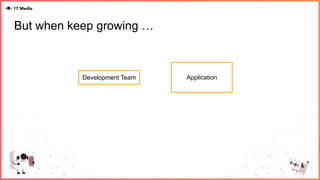
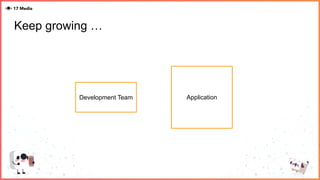
But when keep growing …
Development Team Application
Keep growing …
ApplicationDevelopment Team
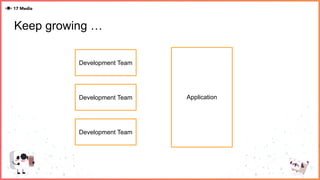
Keep growing …
Development Team
ApplicationDevelopment Team
Development Team
Reference: http://www.laputan.org/pub/foote/mud.pdf
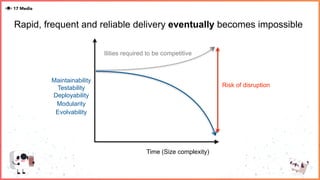
Rapid, frequent and reliable delivery eventually becomes impossible
Maintainability
Testability
Deployability
Modularity
Evolvability
Time (Size complexity)
Ilities required to be competitive
Risk of disruption
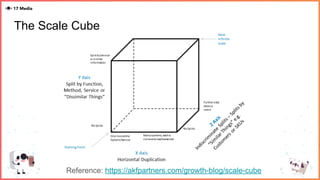
The Scale Cube
Reference: https://akfpartners.com/growth-blog/scale-cube
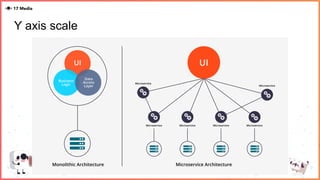
Y axis scale
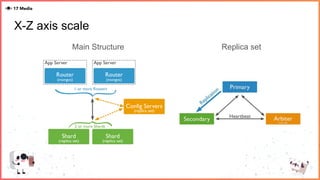
X-Z axis scale
Main Structure Replica set
Homework
● What’s X-Y axis scale?
● What’s X-Y-Z axis scale?
The microservice architecture is an architectural style that
structures an application as a set of loosely coupled services
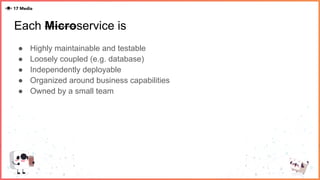
Each Microservice is
● Highly maintainable and testable
● Loosely coupled (e.g. database)
● Independently deployable
● Organized around business capabilities
● Owned by a small team
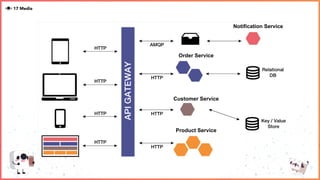
Order Service
Customer Service
Product Service
Notification Service
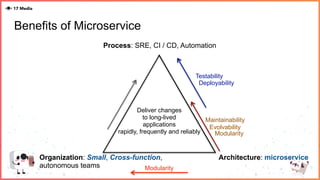
Benefits of Microservice
Deliver changes
to long-lived
applications
rapidly, frequently and reliably
Process: SRE, CI / CD, Automation
Architecture: microserviceOrganization: Small, Cross-function,
autonomous teams
Testability
Deployability
Maintainability
Modularity
Evolvability
Modularity
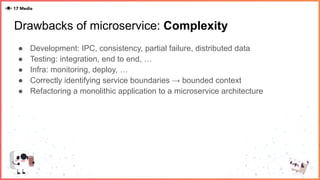
Drawbacks of microservice: Complexity
● Development: IPC, consistency, partial failure, distributed data
● Testing: integration, end to end, …
● Infra: monitoring, deploy, …
● Correctly identifying service boundaries → bounded context
● Refactoring a monolithic application to a microservice architecture
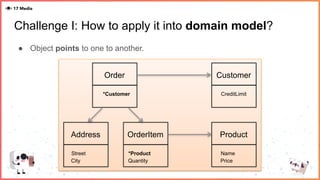
Challenge I: How to apply it into domain model?
● Object points to one to another.
Order
*Customer
Address
City
Street
OrderItem
Quantity
*Product
Customer
CreditLimit
Product
Price
Name
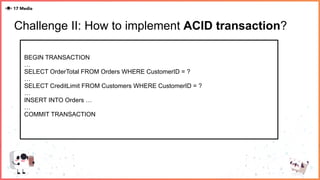
Challenge II: How to implement ACID transaction?
BEGIN TRANSACTION
…
SELECT OrderTotal FROM Orders WHERE CustomerID = ?
…
SELECT CreditLimit FROM Customers WHERE CustomerID = ?
…
INSERT INTO Orders …
…
COMMIT TRANSACTION
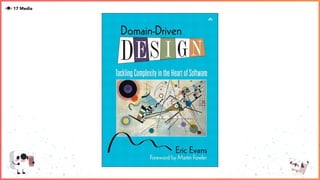
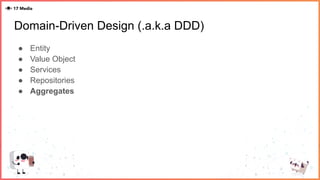
Domain-Driven Design (.a.k.a DDD)
● Entity
● Value Object
● Services
● Repositories
● Aggregates
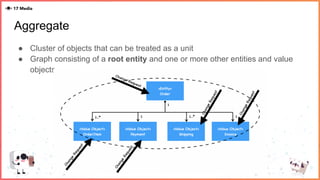
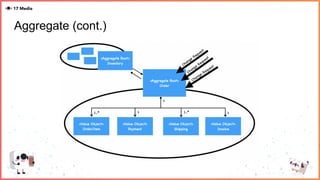
Aggregate
● Cluster of objects that can be treated as a unit
● Graph consisting of a root entity and one or more other entities and value
objects.
Aggregate (cont.)
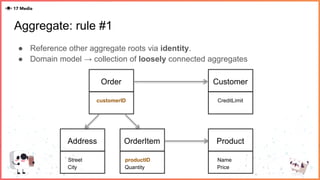
Aggregate: rule #1
● Reference other aggregate roots via identity.
● Domain model → collection of loosely connected aggregates
Order
customerID
Address
City
Street
OrderItem
Quantity
productID
Customer
CreditLimit
Product
Price
Name
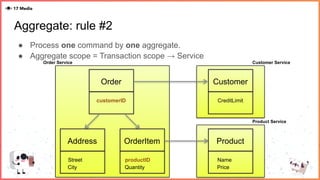
Aggregate: rule #2
● Process one command by one aggregate.
● Aggregate scope = Transaction scope → Service
Order
customerID
Address
City
Street
OrderItem
Quantity
productID
Customer
CreditLimit
Product
Price
Name
Order Service Customer Service
Product Service
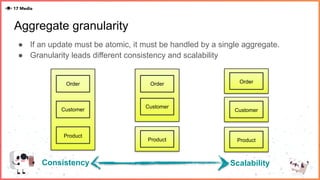
Aggregate granularity
● If an update must be atomic, it must be handled by a single aggregate.
● Granularity leads different consistency and scalability
Customer
Order
Product
Customer
Order
Product
Order
Customer
Product
Consistency Scalability
Two-Phase Commit (.a.k.a 2PC) is not a viable option
● Guarantees consistency
● Not supported by many NoSQL and MQ
● Impacts availability in CAP Theorem
● …
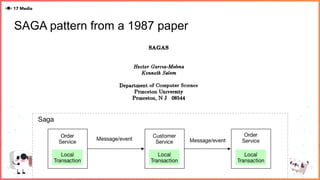
SAGA pattern from a 1987 paper
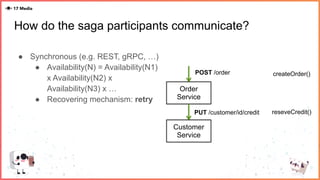
How do the saga participants communicate?
● Synchronous (e.g. REST, gRPC, …)
● Availability(N) = Availability(N1)
x Availability(N2) x
Availability(N3) x …
● Recovering mechanism: retry
Order
Service
Customer
Service
createOrder()POST /order
reseveCredit()PUT /customer/id/credit
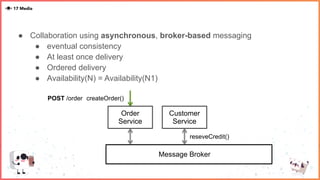
● Collaboration using asynchronous, broker-based messaging
● eventual consistency
● At least once delivery
● Ordered delivery
● Availability(N) = Availability(N1)
Order
Service
Customer
Service
createOrder()POST /order
reseveCredit()
Message Broker
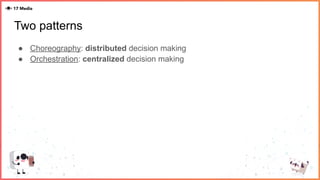
Two patterns
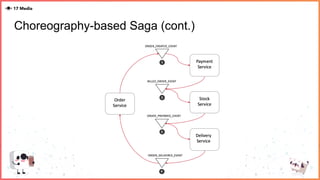
● Choreography: distributed decision making
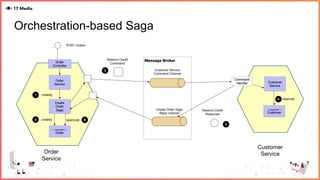
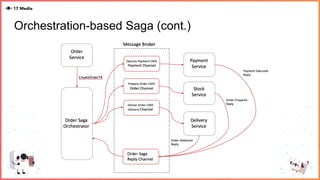
● Orchestration: centralized decision making
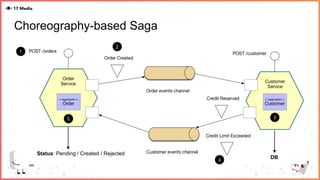
Choreography-based Saga
Status: Pending / Created / Rejected
DB
Choreography-based Saga (cont.)
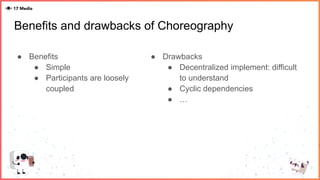
Benefits and drawbacks of Choreography
● Benefits
● Simple
● Participants are loosely
coupled
● Drawbacks
● Decentralized implement: difficult
to understand
● Cyclic dependencies
● …
Orchestration-based Saga
Orchestration-based Saga (cont.)
Benefits and drawbacks of Orchestration
● Benefits
● Centralized coordination
logic is easier to
understand
● Reduce cyclic
dependencies
● Simplified the business
logic
● Drawbacks
● smart orchestrator tells dumb
services what to do
Homework
● Synchronous RESTful API initiates asynchronous SAGA
● Rollback strategy
● SAGAs are ACD → No Isolation
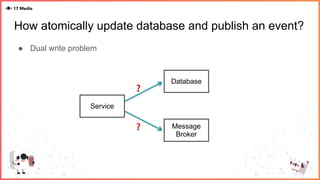
How atomically update database and publish an event?
● Dual write problem
Service
Database
Message
Broker
❓
❓
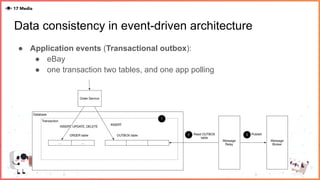
Data consistency in event-driven architecture
● Application events (Transactional outbox):
● eBay
● one transaction two tables, and one app polling
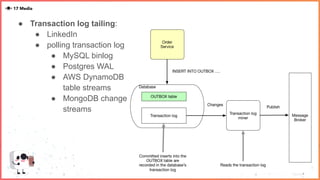
● Transaction log tailing:
● LinkedIn
● polling transaction log
● MySQL binlog
● Postgres WAL
● AWS DynamoDB
table streams
● MongoDB change
streams
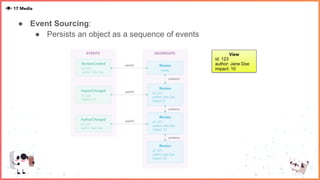
● Event Sourcing:
● Persists an object as a sequence of events
View
id: 123
author: Jane Doe
impact: 10
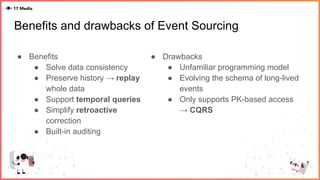
Benefits and drawbacks of Event Sourcing
● Benefits
● Solve data consistency
● Preserve history → replay
whole data
● Support temporal queries
● Simplify retroactive
correction
● Built-in auditing
● Drawbacks
● Unfamiliar programming model
● Evolving the schema of long-lived
events
● Only supports PK-based access
→ CQRS
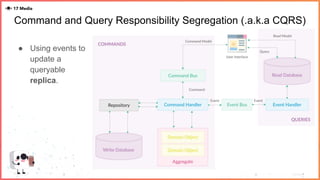
Command and Query Responsibility Segregation (.a.k.a CQRS)
● Using events to
update a
queryable
replica.
Summary
● Microservice enables whole business, team and architecture
● Data is distributed which create challenges
● Use event-driven architecture for eventual consistency
● Use Sagas to maintain data consistency across service
● Understand Event Sourcing and CQRS
Q & A
Thanks for your Time!

Microservice

  • 1.
    Microservice 17 Media Viney Shih,Sr. Engineering Manager
  • 4.
    Agenda ● What’s Microserviceand the relation with organization ● What’s the challenge moving to Microservice ● Distributed data ● Event-driven messaging ● Consistency ● Summary ● Q&A
  • 5.
  • 6.
  • 7.
  • 8.
    Deliver software rapidly,frequently and reliably ● Velocity ● Lead time: time from commit to deploy ● Deployment frequency: deploys per developer per day ● Reliability ● Change failure rate: % of deployments that cause an outage ● Mean time to recover from a deployment failure
  • 9.
    Needs to ableto easily modernize applications ● Successful applications often lives a very long time ● Technology changes
  • 10.
    Success Triangle Deliver changes tolong-lived applications rapidly, frequently and reliably Process ArchitectureOrganization
  • 11.
    Success Triangle Deliver changes tolong-lived applications rapidly, frequently and reliably Process: SRE, CI / CD, Automation Architecture: ???Organization: Autonomous team
  • 12.
    ● SRE (DevOps) ● Autonomousteam ● Long-lived applications Required architectural quality attributes (.a.k.a ilities) ● Testability ● Deployability ● Maintainability ● Modularity ● Evolvability
  • 13.
  • 14.
    Ilities of smallmonoliths ● Testability ✅ ● Deployability ✅ ● Maintainability ✅ ● Modularity ✅ ● Evolvability ✅
  • 15.
    But when keepgrowing … Development Team Application
  • 16.
  • 17.
    Keep growing … DevelopmentTeam ApplicationDevelopment Team Development Team
  • 18.
  • 20.
    Rapid, frequent andreliable delivery eventually becomes impossible Maintainability Testability Deployability Modularity Evolvability Time (Size complexity) Ilities required to be competitive Risk of disruption
  • 22.
    The Scale Cube Reference:https://akfpartners.com/growth-blog/scale-cube
  • 23.
  • 24.
    X-Z axis scale MainStructure Replica set
  • 25.
    Homework ● What’s X-Yaxis scale? ● What’s X-Y-Z axis scale?
  • 26.
    The microservice architectureis an architectural style that structures an application as a set of loosely coupled services
  • 27.
    Each Microservice is ●Highly maintainable and testable ● Loosely coupled (e.g. database) ● Independently deployable ● Organized around business capabilities ● Owned by a small team
  • 28.
    Order Service Customer Service ProductService Notification Service
  • 29.
    Benefits of Microservice Deliverchanges to long-lived applications rapidly, frequently and reliably Process: SRE, CI / CD, Automation Architecture: microserviceOrganization: Small, Cross-function, autonomous teams Testability Deployability Maintainability Modularity Evolvability Modularity
  • 30.
    Drawbacks of microservice:Complexity ● Development: IPC, consistency, partial failure, distributed data ● Testing: integration, end to end, … ● Infra: monitoring, deploy, … ● Correctly identifying service boundaries → bounded context ● Refactoring a monolithic application to a microservice architecture
  • 31.
    Challenge I: Howto apply it into domain model? ● Object points to one to another. Order *Customer Address City Street OrderItem Quantity *Product Customer CreditLimit Product Price Name
  • 32.
    Challenge II: Howto implement ACID transaction? BEGIN TRANSACTION … SELECT OrderTotal FROM Orders WHERE CustomerID = ? … SELECT CreditLimit FROM Customers WHERE CustomerID = ? … INSERT INTO Orders … … COMMIT TRANSACTION
  • 34.
    Domain-Driven Design (.a.k.aDDD) ● Entity ● Value Object ● Services ● Repositories ● Aggregates
  • 35.
    Aggregate ● Cluster ofobjects that can be treated as a unit ● Graph consisting of a root entity and one or more other entities and value objects.
  • 36.
  • 37.
    Aggregate: rule #1 ●Reference other aggregate roots via identity. ● Domain model → collection of loosely connected aggregates Order customerID Address City Street OrderItem Quantity productID Customer CreditLimit Product Price Name
  • 38.
    Aggregate: rule #2 ●Process one command by one aggregate. ● Aggregate scope = Transaction scope → Service Order customerID Address City Street OrderItem Quantity productID Customer CreditLimit Product Price Name Order Service Customer Service Product Service
  • 39.
    Aggregate granularity ● Ifan update must be atomic, it must be handled by a single aggregate. ● Granularity leads different consistency and scalability Customer Order Product Customer Order Product Order Customer Product Consistency Scalability
  • 40.
    Two-Phase Commit (.a.k.a2PC) is not a viable option ● Guarantees consistency ● Not supported by many NoSQL and MQ ● Impacts availability in CAP Theorem ● …
  • 41.
    SAGA pattern froma 1987 paper
  • 42.
    How do thesaga participants communicate? ● Synchronous (e.g. REST, gRPC, …) ● Availability(N) = Availability(N1) x Availability(N2) x Availability(N3) x … ● Recovering mechanism: retry Order Service Customer Service createOrder()POST /order reseveCredit()PUT /customer/id/credit
  • 43.
    ● Collaboration usingasynchronous, broker-based messaging ● eventual consistency ● At least once delivery ● Ordered delivery ● Availability(N) = Availability(N1) Order Service Customer Service createOrder()POST /order reseveCredit() Message Broker
  • 44.
    Two patterns ● Choreography:distributed decision making ● Orchestration: centralized decision making
  • 45.
  • 46.
  • 47.
    Benefits and drawbacksof Choreography ● Benefits ● Simple ● Participants are loosely coupled ● Drawbacks ● Decentralized implement: difficult to understand ● Cyclic dependencies ● …
  • 48.
  • 49.
  • 50.
    Benefits and drawbacksof Orchestration ● Benefits ● Centralized coordination logic is easier to understand ● Reduce cyclic dependencies ● Simplified the business logic ● Drawbacks ● smart orchestrator tells dumb services what to do
  • 51.
    Homework ● Synchronous RESTfulAPI initiates asynchronous SAGA ● Rollback strategy ● SAGAs are ACD → No Isolation
  • 52.
    How atomically updatedatabase and publish an event? ● Dual write problem Service Database Message Broker ❓ ❓
  • 53.
    Data consistency inevent-driven architecture ● Application events (Transactional outbox): ● eBay ● one transaction two tables, and one app polling
  • 54.
    ● Transaction logtailing: ● LinkedIn ● polling transaction log ● MySQL binlog ● Postgres WAL ● AWS DynamoDB table streams ● MongoDB change streams
  • 55.
    ● Event Sourcing: ●Persists an object as a sequence of events View id: 123 author: Jane Doe impact: 10
  • 56.
    Benefits and drawbacksof Event Sourcing ● Benefits ● Solve data consistency ● Preserve history → replay whole data ● Support temporal queries ● Simplify retroactive correction ● Built-in auditing ● Drawbacks ● Unfamiliar programming model ● Evolving the schema of long-lived events ● Only supports PK-based access → CQRS
  • 57.
    Command and QueryResponsibility Segregation (.a.k.a CQRS) ● Using events to update a queryable replica.
  • 58.
    Summary ● Microservice enableswhole business, team and architecture ● Data is distributed which create challenges ● Use event-driven architecture for eventual consistency ● Use Sagas to maintain data consistency across service ● Understand Event Sourcing and CQRS
  • 59.
    Q & A Thanksfor your Time!