MICRO-
ORGANIS
MS
By Kiaan, Pranaya,
Aarna, Aaryav
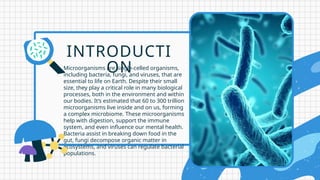
• Microorganisms are single-celled organisms,
including bacteria, fungi, and viruses, that are
essential to life on Earth. Despite their small
size, they play a critical role in many biological
processes, both in the environment and within
our bodies. It’s estimated that 60 to 300 trillion
microorganisms live inside and on us, forming
a complex microbiome. These microorganisms
help with digestion, support the immune
system, and even influence our mental health.
Bacteria assist in breaking down food in the
gut, fungi decompose organic matter in
ecosystems, and viruses can regulate bacterial
populations.
INTRODUCTI
ON
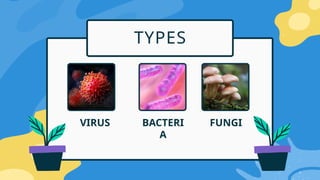
TYPES
VIRUS BACTERI
A
FUNGI
01
Viruses are much smaller than bacteria, typically about
one-thousandth the size of a human cell. They are
found everywhere, in the air, water, and living
organisms. Viruses can't survive or reproduce on their
own; instead, they invade the cells of living organisms.
Once inside a host cell, the virus takes over the cell’s
machinery, turning it into a factory that produces more
virus particles. These new viruses are then released to
infect other cells. Unlike bacteria, viruses require a host
to replicate, and they can cause various diseases in
plants, animals, and humans.
VIRUS
02 Bacteria are some of the smallest living organisms, typically
about one-tenth the size of a human cell. They can be found
in a wide range of environments, including soil, water, and
within the human body. While bacteria come in different
shapes, such as spheres, rods, and spirals, they are all
single-celled organisms. Bacteria feed on organic matter,
respire to generate energy, and excrete waste products like
carbon dioxide. They grow by absorbing nutrients from their
surroundings, and once they've reached a certain size, they
reproduce by splitting in two. This rapid reproduction allows
bacteria to multiply quickly and thrive in many different
habitats.
BACTERIA
03
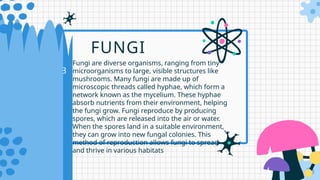
Fungi are diverse organisms, ranging from tiny
microorganisms to large, visible structures like
mushrooms. Many fungi are made up of
microscopic threads called hyphae, which form a
network known as the mycelium. These hyphae
absorb nutrients from their environment, helping
the fungi grow. Fungi reproduce by producing
spores, which are released into the air or water.
When the spores land in a suitable environment,
they can grow into new fungal colonies. This
method of reproduction allows fungi to spread
and thrive in various habitats
FUNGI
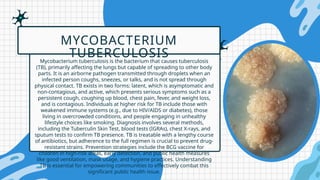
Mycobacterium tuberculosis is the bacterium that causes tuberculosis
(TB), primarily affecting the lungs but capable of spreading to other body
parts. It is an airborne pathogen transmitted through droplets when an
infected person coughs, sneezes, or talks, and is not spread through
physical contact. TB exists in two forms: latent, which is asymptomatic and
non-contagious, and active, which presents serious symptoms such as a
persistent cough, coughing up blood, chest pain, fever, and weight loss,
and is contagious. Individuals at higher risk for TB include those with
weakened immune systems (e.g., due to HIV/AIDS or diabetes), those
living in overcrowded conditions, and people engaging in unhealthy
lifestyle choices like smoking. Diagnosis involves several methods,
including the Tuberculin Skin Test, blood tests (IGRAs), chest X-rays, and
sputum tests to confirm TB presence. TB is treatable with a lengthy course
of antibiotics, but adherence to the full regimen is crucial to prevent drug-
resistant strains. Prevention strategies include the BCG vaccine for
children in high-risk areas, early detection, and public health measures
like good ventilation, mask usage, and hygiene practices. Understanding
TB is essential for empowering communities to effectively combat this
significant public health issue.
MYCOBACTERIUM
TUBERCULOSIS
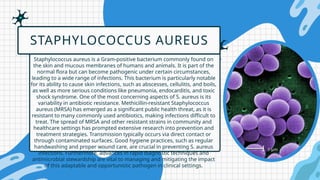
Staphylococcus aureus is a Gram-positive bacterium commonly found on
the skin and mucous membranes of humans and animals. It is part of the
normal flora but can become pathogenic under certain circumstances,
leading to a wide range of infections. This bacterium is particularly notable
for its ability to cause skin infections, such as abscesses, cellulitis, and boils,
as well as more serious conditions like pneumonia, endocarditis, and toxic
shock syndrome. One of the most concerning aspects of S. aureus is its
variability in antibiotic resistance. Methicillin-resistant Staphylococcus
aureus (MRSA) has emerged as a significant public health threat, as it is
resistant to many commonly used antibiotics, making infections difficult to
treat. The spread of MRSA and other resistant strains in community and
healthcare settings has prompted extensive research into prevention and
treatment strategies. Transmission typically occurs via direct contact or
through contaminated surfaces. Good hygiene practices, such as regular
handwashing and proper wound care, are crucial in preventing S. aureus
infections. Furthermore, advances in rapid diagnostic techniques and
antimicrobial stewardship are vital to managing and mitigating the impact
of this adaptable and opportunistic pathogen in clinical settings.
STAPHYLOCOCCUS AUREUS
Microorganisms, which include bacteria, viruses, fungi, and protozoa,
play crucial roles in various processes that sustain life on Earth. They
are integral to nutrient cycling, decomposition, and soil health,
contributing to the ecological balance. Additionally, microorganisms
are essential in diverse applications such as food production
(fermentation), biotechnology (production of antibiotics), and
environmental management.
While some microorganisms can cause diseases in humans, animals,
and plants, many are beneficial and necessary for human health, as
they are essential components of our microbiome, aiding in digestion
and immune function. Moreover, advancements in microbiology and
genetic engineering have opened new avenues for harnessing
microorganisms for clean energy production, waste treatment, and
sustainable agriculture. In conclusion, microorganisms are diverse and
fundamental life forms that significantly influence ecosystem
dynamics, human health, and technological innovations. Continued
research and understanding of these organisms are essential for
addressing global challenges such as food security, disease
management, and environmental sustainability.
CONCLUSION
THANK
YOU!
Any questions? Don't
hesitate to ask for our
help

Microorganisms for 6th Grade with experiments.pptx

  • 1.
  • 2.
    • Microorganisms aresingle-celled organisms, including bacteria, fungi, and viruses, that are essential to life on Earth. Despite their small size, they play a critical role in many biological processes, both in the environment and within our bodies. It’s estimated that 60 to 300 trillion microorganisms live inside and on us, forming a complex microbiome. These microorganisms help with digestion, support the immune system, and even influence our mental health. Bacteria assist in breaking down food in the gut, fungi decompose organic matter in ecosystems, and viruses can regulate bacterial populations. INTRODUCTI ON
  • 3.
  • 4.
    01 Viruses are muchsmaller than bacteria, typically about one-thousandth the size of a human cell. They are found everywhere, in the air, water, and living organisms. Viruses can't survive or reproduce on their own; instead, they invade the cells of living organisms. Once inside a host cell, the virus takes over the cell’s machinery, turning it into a factory that produces more virus particles. These new viruses are then released to infect other cells. Unlike bacteria, viruses require a host to replicate, and they can cause various diseases in plants, animals, and humans. VIRUS
  • 5.
    02 Bacteria aresome of the smallest living organisms, typically about one-tenth the size of a human cell. They can be found in a wide range of environments, including soil, water, and within the human body. While bacteria come in different shapes, such as spheres, rods, and spirals, they are all single-celled organisms. Bacteria feed on organic matter, respire to generate energy, and excrete waste products like carbon dioxide. They grow by absorbing nutrients from their surroundings, and once they've reached a certain size, they reproduce by splitting in two. This rapid reproduction allows bacteria to multiply quickly and thrive in many different habitats. BACTERIA
  • 6.
    03 Fungi are diverseorganisms, ranging from tiny microorganisms to large, visible structures like mushrooms. Many fungi are made up of microscopic threads called hyphae, which form a network known as the mycelium. These hyphae absorb nutrients from their environment, helping the fungi grow. Fungi reproduce by producing spores, which are released into the air or water. When the spores land in a suitable environment, they can grow into new fungal colonies. This method of reproduction allows fungi to spread and thrive in various habitats FUNGI
  • 7.
    Mycobacterium tuberculosis isthe bacterium that causes tuberculosis (TB), primarily affecting the lungs but capable of spreading to other body parts. It is an airborne pathogen transmitted through droplets when an infected person coughs, sneezes, or talks, and is not spread through physical contact. TB exists in two forms: latent, which is asymptomatic and non-contagious, and active, which presents serious symptoms such as a persistent cough, coughing up blood, chest pain, fever, and weight loss, and is contagious. Individuals at higher risk for TB include those with weakened immune systems (e.g., due to HIV/AIDS or diabetes), those living in overcrowded conditions, and people engaging in unhealthy lifestyle choices like smoking. Diagnosis involves several methods, including the Tuberculin Skin Test, blood tests (IGRAs), chest X-rays, and sputum tests to confirm TB presence. TB is treatable with a lengthy course of antibiotics, but adherence to the full regimen is crucial to prevent drug- resistant strains. Prevention strategies include the BCG vaccine for children in high-risk areas, early detection, and public health measures like good ventilation, mask usage, and hygiene practices. Understanding TB is essential for empowering communities to effectively combat this significant public health issue. MYCOBACTERIUM TUBERCULOSIS
  • 8.
    Staphylococcus aureus isa Gram-positive bacterium commonly found on the skin and mucous membranes of humans and animals. It is part of the normal flora but can become pathogenic under certain circumstances, leading to a wide range of infections. This bacterium is particularly notable for its ability to cause skin infections, such as abscesses, cellulitis, and boils, as well as more serious conditions like pneumonia, endocarditis, and toxic shock syndrome. One of the most concerning aspects of S. aureus is its variability in antibiotic resistance. Methicillin-resistant Staphylococcus aureus (MRSA) has emerged as a significant public health threat, as it is resistant to many commonly used antibiotics, making infections difficult to treat. The spread of MRSA and other resistant strains in community and healthcare settings has prompted extensive research into prevention and treatment strategies. Transmission typically occurs via direct contact or through contaminated surfaces. Good hygiene practices, such as regular handwashing and proper wound care, are crucial in preventing S. aureus infections. Furthermore, advances in rapid diagnostic techniques and antimicrobial stewardship are vital to managing and mitigating the impact of this adaptable and opportunistic pathogen in clinical settings. STAPHYLOCOCCUS AUREUS
  • 9.
    Microorganisms, which includebacteria, viruses, fungi, and protozoa, play crucial roles in various processes that sustain life on Earth. They are integral to nutrient cycling, decomposition, and soil health, contributing to the ecological balance. Additionally, microorganisms are essential in diverse applications such as food production (fermentation), biotechnology (production of antibiotics), and environmental management. While some microorganisms can cause diseases in humans, animals, and plants, many are beneficial and necessary for human health, as they are essential components of our microbiome, aiding in digestion and immune function. Moreover, advancements in microbiology and genetic engineering have opened new avenues for harnessing microorganisms for clean energy production, waste treatment, and sustainable agriculture. In conclusion, microorganisms are diverse and fundamental life forms that significantly influence ecosystem dynamics, human health, and technological innovations. Continued research and understanding of these organisms are essential for addressing global challenges such as food security, disease management, and environmental sustainability. CONCLUSION
  • 10.