Competitiveness:
                                    A New Economic Strategy for Peru


                                                                                                               Professor Michael E. Porter
                                                                                                                 Harvard Business School

                                                                                                                                    Lima, Peru
                                                                                                                              November 30, 2009

             This presentation draws on ideas from Professor Porter’s books and articles, in particular, Competitive Strategy (The Free Press, 1980); Competitive
             Advantage (The Free Press, 1985); “What is Strategy?” (Harvard Business Review, Nov/Dec 1996); “Strategy and the Internet” (Harvard Business
             Review, March 2001); and a forthcoming book. No part of this publication may be reproduced, stored in a retrieval system, or transmitted in any form or
             by any means—electronic, mechanical, photocopying, recording, or otherwise—without the permission of Michael E. Porter. Additional information may
             be found at the website of the Institute for Strategy and Competitiveness, www.isc.hbs.edu. Version: November 27, 2009


20091130 – Peru.ppt                                                                     1                                                           Copyright 2009 © Professor Michael E. Porter
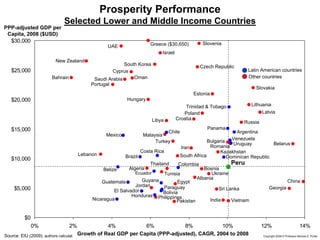
Prosperity Performance
                         Selected Lower and Middle Income Countries
PPP-adjusted GDP per
 Capita, 2008 ($USD)
  $30,000                                                                                         Slovenia
                                               UAE                  Greece ($30,650)
                                                                          Israel
                      New Zealand
                                                     South Korea                                 Czech Republic
  $25,000                                       Cyprus                                                                    Latin American countries
                    Bahrain             Saudi Arabia     Oman                                                             Other countries
                                       Portugal
                                                                                                                              Slovakia
                                                                                               Estonia
  $20,000                                                Hungary
                                                                                       Trinidad & Tobago                    Lithuania
                                                                                      Poland                                      Latvia
                                                                      Libya        Croatia
                                                                                                                         Russia
  $15,000                                                                                           Panama
                                                                           Chile                                    Argentina
                                              Mexico             Malaysia
                                                                                                                  Venezuela
                                                                      Turkey                     Bulgaria
                                                                                                                  Uruguay    Belarus
                                                                                        Iran      Romania
                                                                Costa Rica                             Kazakhstan
                                   Lebanon             Brazil                       South Africa
  $10,000                                                                                                 Dominican Republic
                                                                    Thailand        Colombia                      Peru
                                             Belize      Algeria                                   Bosnia
                                                            Ecuador           Tunisia                 Ukraine
                                                             Guyana                             Albania
                                             Guatemala                     Egypt                                                                     China
                                                          Jordan    Paraguay                                                          Georgia
    $5,000                                       El Salvador                                                 Sri Lanka
                                                                    Bolivia
                                                         Honduras Philippines
                                        Nicaragua                          Pakistan                      India    Vietnam


        $0
             0%               2%                     4%            6%             8%            10%                               12%                          14%
Source: Peru.ppt                          Growth of Real GDP per Capita (PPP-adjusted), CAGR, 2004 to 2008
20091130 – EIU (2009), authors calculations                             2                                                         Copyright 2009 © Professor Michael E. Porter
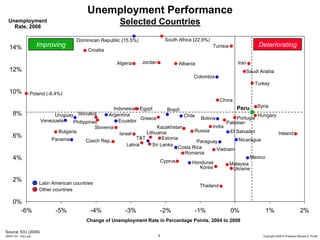
Unemployment Performance
  Unemployment
    Rate, 2008
                                                           Selected Countries
                                       Dominican Republic (15.5%)                  South Africa (22.9%)
  14%                 Improving                                                                           Tunisia             Deteriorating
                                            Croatia

                                                         Algeria     Jordan              Albania                      Iran
  12%                                                                                                                    Saudi Arabia
                                                                                               Colombia
                                                                                                                             Turkey
  10%             Poland (-8.4%)
                                                                                                              China
                                                        Indonesia Egypt           Brazil                          Peru Syria
     8%                     Uruguay Slovakia         Argentina                           Chile                             Hungary
                                                                      Greece                     Bolivia          Portugal
                       Venezuela     Philippines          Ecuador                                            Pakistan
                                               Slovenia                      Kazakhstan                India
                              Bulgaria                                  Lithuania             Russia           El Salvador
                                                           Israel                                                                  Ireland
     6%                                                            T&T          Estonia
                           Panama          Czech Rep.                                          Paraguay            Nicaragua
                                                               Latvia      Sri Lanka
                                                                                       Costa Rica        Vietnam
                                                                                         Romania
     4%                                                                        Cyprus
                                                                                                                        Mexico
                                                                                             Honduras          Malaysia
                                                                                                Korea           Ukraine

     2%
                      Latin American countries
                                                                                                   Thailand
                      Other countries

     0%
       -6%                   -5%             -4%             -3%                  -2%           -1%                 0%           1%                          2%
                                           Change of Unemployment Rate in Percentage Points, 2004 to 2008

Source: EIU (2009)
20091130 – Peru.ppt                                                           3                                                 Copyright 2009 © Professor Michael E. Porter
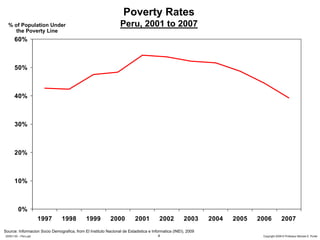
Poverty Rates
  % of Population Under                                          Peru, 2001 to 2007
     the Poverty Line
      60%


      50%


      40%


      30%


      20%


      10%


         0%
                      1997      1998          1999         2000          2001          2002          2003     2004   2005   2006           2007
Source: Informacion Socio Demografica, from El Instituto Nacional de Estadistica e Informatica (INEI), 2009
20091130 – Peru.ppt                                                                   4                                      Copyright 2009 © Professor Michael E. Porter
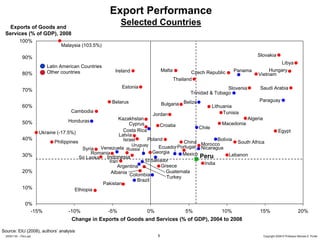
Export Performance
   Exports of Goods and
                                                            Selected Countries
 Services (% of GDP), 2008
           100%
                                Malaysia (103.5%)

             90%                                                                                                              Slovakia
                                                                                                                                        Libya
                          Latin American Countries
                          Other countries              Ireland                  Malta           Czech Republic      Panama          Hungary
             80%                                                                                                               Vietnam
                                                                                        Thailand
                                                            Estonia                                            Slovenia        Saudi Arabia
             70%
                                                                                               Trinidad & Tobago
                                                      Belarus                                                                  Paraguay
             60%                                                                Bulgaria Belize           Lithuania
                                     Cambodia                                                                  Tunisia
                                                                          Jordan
                                   Honduras                Kazakhstan                                                     Algeria
             50%                                                Cyprus                                        Macedonia
                                                                             Croatia              Chile
                       Ukraine (-17.5%)                      Costa Rica                                                                         Egypt
                                                           Latvia
             40%                                             Israel     Poland                     Bolivia
                             Philippines                                             China Morocco          South Africa
                                                             Uruguay       Ecuador Portugal Nicaragua
                                         Syria   Venezuela Russia
                                              Romania                    Georgia     Mexico
             30%                                    Indonesia                               Peru         Lebanon
                                        Sri Lanka
                                                     Iran            El Salvador
                                                                                                     India
                                                         Argentina           Greece
             20%                                      Albania Colombia         Guatemala
                                                                               Turkey
                                                                  Brazil
                                                  Pakistan
             10%                      Ethiopia

               0%
                 -15%              -10%              -5%               0%                    5%               10%              15%                              20%
                                     Change in Exports of Goods and Services (% of GDP), 2004 to 2008

Source: EIU (2008), authors’ analysis
 20091130 – Peru.ppt                                                        5                                                       Copyright 2009 © Professor Michael E. Porter
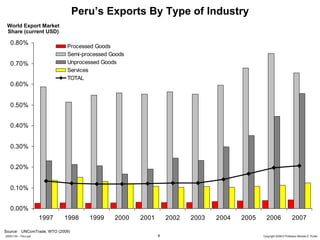
Peru’s Exports By Type of Industry
 World Export Market
 Share (current USD)

   0.80%
                             Processed Goods
                             Semi-processed Goods
   0.70%                     Unprocessed Goods
                             Services
                             TOTAL
   0.60%


   0.50%


   0.40%


   0.30%


   0.20%


   0.10%


   0.00%
                      1997   1998   1999     2000   2001       2002   2003   2004   2005     2006                 2007

Source: UNComTrade, WTO (2009)
20091130 – Peru.ppt                                        6                               Copyright 2009 © Professor Michael E. Porter
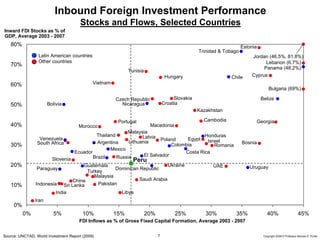
Inbound Foreign Investment Performance
                                       Stocks and Flows, Selected Countries
Inward FDI Stocks as % of
GDP, Average 2003 - 2007
   80%                                                                                                               Estonia
                                                                                                 Trinidad & Tobago
                 Latin American countries                                                                                 Jordan (46.5%, 81.8%)
                 Other countries                                                                                                Lebanon (6.7%)
   70%
                                                                                                                               Panama (48.2%)
                                                             Tunisia
                                                                                  Hungary                     Chile       Cyprus
   60%                                       Vietnam
                                                                                                                                    Bulgaria (69%)

                                                       Czech Republic                 Slovakia                                 Belize
   50%                 Bolivia                           Nicaragua               Croatia
                                                                                                 Kazakhstan

                                                        Portugal                                   Cambodia                Georgia
   40%                                Morocco                           Macedonia
                                                           Malaysia
                                             Thailand            Latvia                    Honduras
                  Venezuela                                              Poland     Egypt   Israel
                 South Africa                 Argentina    Lithuania                                                 Bosnia
   30%                                                                        Colombia         Romania
                                                   Mexico
                                    Ecuador                                        Costa Rica
                                            Brazil    Russia      El Salvador
                         Slovenia                              Peru
   20%                              Guatemala                           Ukraine                        UAE               Uruguay
                 Paraguay                        Dominican Republic
                                     Turkey
                                        Malaysia
                               China                       Saudi Arabia
   10%          Indonesia Sri Lanka      Pakistan
                         India                     Libya
                Iran
     0%
          0%              5%            10%            15%             20%            25%           30%         35%                40%                      45%
                                      FDI Inflows as % of Gross Fixed Capital Formation, Average 2003 - 2007


Source: UNCTAD, World Investment Report (2009)
 20091130 – Peru.ppt                                                         7                                                  Copyright 2009 © Professor Michael E. Porter
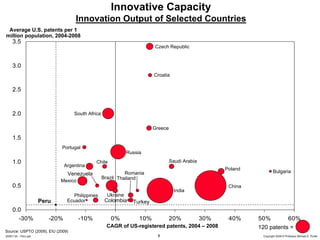
Innovative Capacity
                                     Innovation Output of Selected Countries
 Average U.S. patents per 1
million population, 2004-2008
     3.5
                                                                          Czech Republic


     3.0
                                                                          Croatia


     2.5


     2.0                            South Africa

                                                                          Greece

     1.5
                             Portugal
                                                               Russia
     1.0                                      Chile                                Saudi Arabia
                                Argentina
                                                                                                        Poland
                                 Venezuela                   Romania                                                     Bulgaria
                                                   Brazil Thailand
                             Mexico
     0.5                                                                                                 China
                                                                                     India
                                    Philippines      Ukraine
                      Peru       Ecuador            Colombia     Turkey
     0.0
       -30%              -20%         -10%            0%            10%            20%            30%    40%     50%        60%
                                                     CAGR of US-registered patents, 2004 – 2008                  120 patents =
Source: USPTO (2009), EIU (2009)
20091130 – Peru.ppt                                                        8                                      Copyright 2009 © Professor Michael E. Porter
The Peruvian Economy in 2009
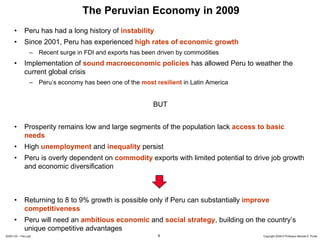
      •       Peru has had a long history of instability
      •       Since 2001, Peru has experienced high rates of economic growth
                 – Recent surge in FDI and exports has been driven by commodities
      •       Implementation of sound macroeconomic policies has allowed Peru to weather the
              current global crisis
                 – Peru’s economy has been one of the most resilient in Latin America


                                                           BUT


      •       Prosperity remains low and large segments of the population lack access to basic
              needs
      •       High unemployment and inequality persist
      •       Peru is overly dependent on commodity exports with limited potential to drive job growth
              and economic diversification


      •       Returning to 8 to 9% growth is possible only if Peru can substantially improve
              competitiveness
      •       Peru will need an ambitious economic and social strategy, building on the country’s
              unique competitive advantages
20091130 – Peru.ppt                                          9                            Copyright 2009 © Professor Michael E. Porter
What is Competitiveness?
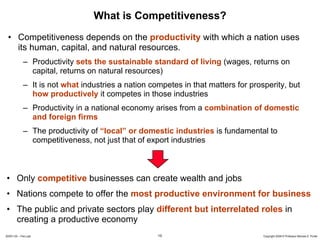
 • Competitiveness depends on the productivity with which a nation uses
   its human, capital, and natural resources.
             – Productivity sets the sustainable standard of living (wages, returns on
               capital, returns on natural resources)
             – It is not what industries a nation competes in that matters for prosperity, but
               how productively it competes in those industries
             – Productivity in a national economy arises from a combination of domestic
               and foreign firms
             – The productivity of “local” or domestic industries is fundamental to
               competitiveness, not just that of export industries


• Only competitive businesses can create wealth and jobs
• Nations compete to offer the most productive environment for business
• The public and private sectors play different but interrelated roles in
  creating a productive economy
20091130 – Peru.ppt                                 10                             Copyright 2009 © Professor Michael E. Porter
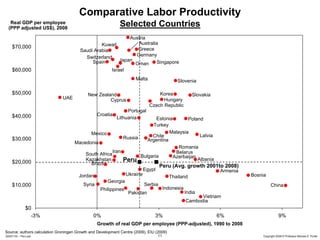
Comparative Labor Productivity
   Real GDP per employee
  (PPP adjusted US$), 2008
                                                            Selected Countries
                                                           Austria
                                                Kuwait        Australia
    $70,000                                                   Greece
                                       Saudi Arabia
                                         Switzerland         Germany
                                            Spain      Japan           Singapore
                                                             Oman
    $60,000                                             Israel
                                                                     Malta               Slovenia

    $50,000                                 New Zealand                          Korea         Slovakia
                              UAE                    Cyprus                        Hungary
                                                                             Czech Republic
                                                                Portugal
    $40,000                                     Croatia
                                                           Lithuania     Estonia        Poland
                                                                       Turkey
                                           Mexico                              Malaysia
                                                          Russia       Chile                 Latvia
    $30,000                                                          Argentina
                                    Macedonia
                                                                                   Romania
                                                     Iran                         Belarus
                                        South Africa             Bulgaria        Azerbaijan
    $20,000                             Kazakhstan        Peru                              Albania
                                           Brazil
                                                                          Peru (Avg. growth 2001to 2008)
                                                                   Egypt                             Armenia
                                     Jordan                Ukraine                                             Bosnia
                                                                               Thailand
                                                  Georgia
    $10,000                            Syria                       Serbia                                               China
                                              Philippines                  Indonesia
                                                            Pakistan                  India
                                                                                              Vietnam
                                                                                       Cambodia
              $0
                -3%                           0%                               3%                         6%                   9%
                                                Growth of real GDP per employee (PPP-adjusted), 1990 to 2008
Source: authors calculation Groningen Growth and Development Centre (2009), EIU (2009)
20091130 – Peru.ppt                                                              11                                Copyright 2009 © Professor Michael E. Porter
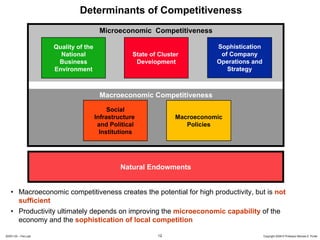
Determinants of Competitiveness
                                        Microeconomic Competitiveness

                      Quality of the                                         Sophistication
                        National                    State of Cluster          of Company
                       Business                      Development             Operations and
                      Environment                                               Strategy


                                        Macroeconomic Competitiveness

                                            Social
                                       Infrastructure             Macroeconomic
                                        and Political                Policies
                                         Institutions


                                                Natural Endowments


   • Macroeconomic competitiveness creates the potential for high productivity, but is not
     sufficient
   • Productivity ultimately depends on improving the microeconomic capability of the
     economy and the sophistication of local competition

20091130 – Peru.ppt                                         12                                Copyright 2009 © Professor Michael E. Porter
Determinants of Competitiveness


                              Microeconomic Competitiveness
                      Quality of the                                            Sophistication
                        National                    State of Cluster             of Company
                       Business                      Development                Operations and
                      Environment                                                  Strategy
                                                                                                     Macroeconomic
                                                                                                         Policy
                              Macroeconomic Competitiveness
                                            Social
                                       Infrastructure           Macroeconomic
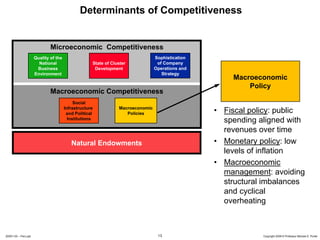
                                        and Political              Policies                      • Fiscal policy: public
                                         Institutions
                                                                                                   spending aligned with
                                                                                                   revenues over time
                                          Natural Endowments                                     • Monetary policy: low
                                                                                                   levels of inflation
                                                                                                 • Macroeconomic
                                                                                                   management: avoiding
                                                                                                   structural imbalances
                                                                                                   and cyclical
                                                                                                   overheating


20091130 – Peru.ppt                                                              13                          Copyright 2009 © Professor Michael E. Porter
Determinants of Competitiveness


                                                             Microeconomic Competitiveness
                                                   Quality of the                                            Sophistication
                                                     National                    State of Cluster             of Company
                           Social                   Business                      Development                Operations and
                                                   Environment                                                  Strategy
                      Infrastructure
                       and Political
                        Institutions                         Macroeconomic Competitiveness
                                                                         Social
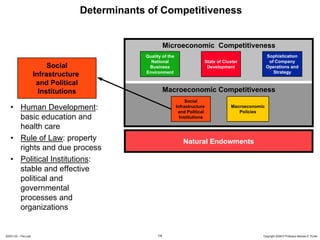
   • Human Development:                                             Infrastructure
                                                                     and Political
                                                                                             Macroeconomic
                                                                                                Policies
     basic education and                                              Institutions

     health care
   • Rule of Law: property                                             Natural Endowments
     rights and due process
   • Political Institutions:
     stable and effective
     political and
     governmental
     processes and
     organizations


20091130 – Peru.ppt                                     14                                               Copyright 2009 © Professor Michael E. Porter
Determinants of Competitiveness


                              Microeconomic Competitiveness
                      Quality of the                                            Sophistication
                        National                    State of Cluster             of Company
                       Business                      Development                Operations and
                                                                                                      Sophistication
                      Environment                                                  Strategy            of Company
                                                                                                      Operations and
                              Macroeconomic Competitiveness                                              Strategy
                                            Social
                                       Infrastructure
                                        and Political
                                                                Macroeconomic
                                                                   Policies
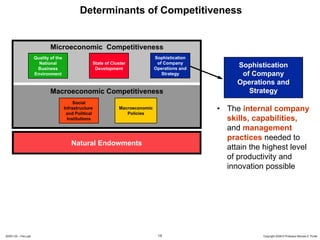
                                                                                                 • The internal company
                                         Institutions                                              skills, capabilities,
                                                                                                   and management
                                                                                                   practices needed to
                                          Natural Endowments
                                                                                                   attain the highest level
                                                                                                   of productivity and
                                                                                                   innovation possible


20091130 – Peru.ppt                                                              15                           Copyright 2009 © Professor Michael E. Porter
Determinants of Competitiveness


                                                   Microeconomic Competitiveness
                                         Quality of the                                            Sophistication
                                           National                    State of Cluster             of Company
                                          Business                      Development                Operations and
                Quality of the           Environment                                                  Strategy
              National Business
                Environment                        Macroeconomic Competitiveness
                                                               Social
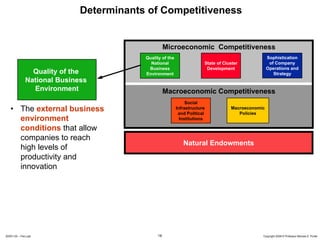
   • The external business                                Infrastructure
                                                           and Political
                                                                                   Macroeconomic
                                                                                      Policies
     environment                                            Institutions

     conditions that allow
     companies to reach
                                                             Natural Endowments
     high levels of
     productivity and
     innovation


20091130 – Peru.ppt                           16                                               Copyright 2009 © Professor Michael E. Porter
Determinants of Competitiveness


                                                       Microeconomic Competitiveness
                                             Quality of the                                            Sophistication
                                               National                    State of Cluster             of Company
                                              Business                      Development                Operations and
                                             Environment                                                  Strategy


                                                       Macroeconomic Competitiveness
                                                                   Social
                                                              Infrastructure           Macroeconomic
                  State of Cluster                             and Political              Policies
                   Development                                  Institutions


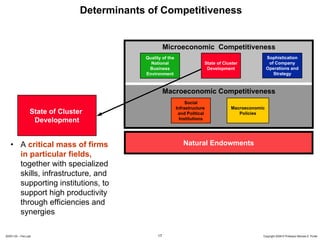
   • A critical mass of firms                                    Natural Endowments
     in particular fields,
     together with specialized
     skills, infrastructure, and
     supporting institutions, to
     support high productivity
     through efficiencies and
     synergies

20091130 – Peru.ppt                               17                                               Copyright 2009 © Professor Michael E. Porter
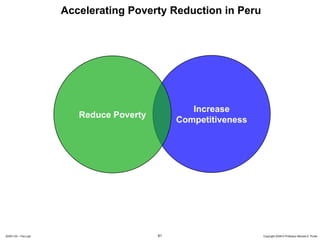
Competitiveness and Poverty Reduction


                           Economic                 Social
                          Development            Development


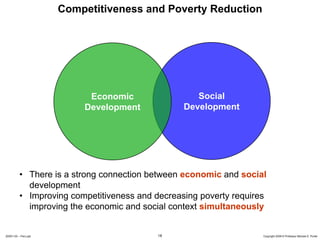
          • There is a strong connection between economic and social
            development
          • Improving competitiveness and decreasing poverty requires
            improving the economic and social context simultaneously


20091130 – Peru.ppt                        18                       Copyright 2009 © Professor Michael E. Porter
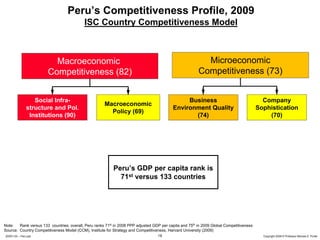
Peru’s Competitiveness Profile, 2009
                                           ISC Country Competitiveness Model


                         Macroeconomic                                                                     Microeconomic
                       Competitiveness (82)                                                              Competitiveness (73)


                  Social Infra-                                                                 Business                                    Company
                                                      Macroeconomic
               structure and Pol.                                                          Environment Quality                            Sophistication
                                                        Policy (69)
                Institutions (90)                                                                 (74)                                        (70)


                                                           Peru’s GDP per capita rank is
                                                             71st versus 133 countries


Note:   Rank versus 133 countries; overall, Peru ranks 71st in 2008 PPP adjusted GDP per capita and 75th in 2009 Global Competitiveness
Source: Country Competitiveness Model (CCM), Institute for Strategy and Competitiveness, Harvard University (2009)
20091130 – Peru.ppt                                                                19                                                       Copyright 2009 © Professor Michael E. Porter
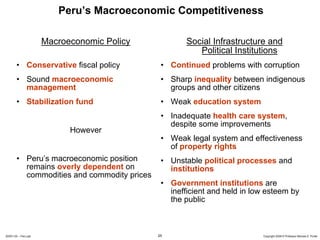
Peru’s Macroeconomic Competitiveness

                      Macroeconomic Policy

        • Conservative fiscal policy


20091130 – Peru.ppt                          20             Copyright 2009 © Professor Michael E. Porter
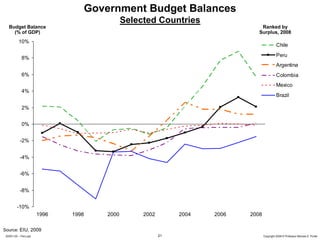
Government Budget Balances
                                                Selected Countries
   Budget Balance                                                                  Ranked by
     (% of GDP)                                                                   Surplus, 2008
          10%
                                                                                                Chile
                                                                                                Peru
             8%
                                                                                                Argentina
             6%                                                                                 Colombia
                                                                                                Mexico
             4%
                                                                                                Brazil

             2%


             0%


           -2%


           -4%


           -6%


           -8%


         -10%
                       1996   1998       2000        2002        2004   2006   2008

Source: EIU, 2009
 20091130 – Peru.ppt                                        21                        Copyright 2009 © Professor Michael E. Porter
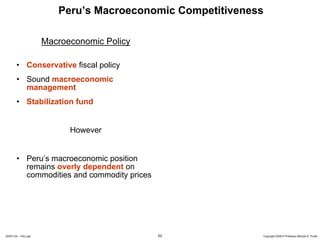
Peru’s Macroeconomic Competitiveness

                      Macroeconomic Policy

        • Conservative fiscal policy
        • Sound macroeconomic
          management
        • Stabilization fund


                            However


        • Peru’s macroeconomic position
          remains overly dependent on
          commodities and commodity prices


20091130 – Peru.ppt                          22             Copyright 2009 © Professor Michael E. Porter
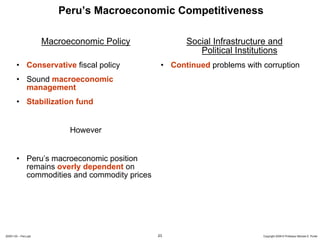
Peru’s Macroeconomic Competitiveness

                      Macroeconomic Policy          Social Infrastructure and
                                                       Political Institutions
        • Conservative fiscal policy          • Continued problems with corruption
        • Sound macroeconomic
          management
        • Stabilization fund


                            However


        • Peru’s macroeconomic position
          remains overly dependent on
          commodities and commodity prices


20091130 – Peru.ppt                          23                         Copyright 2009 © Professor Michael E. Porter
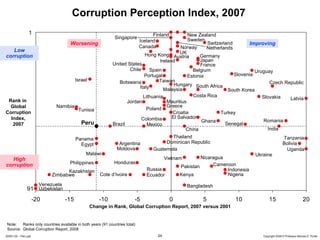
Corruption Perception Index, 2007
                 1                                                                 Finland        New Zealand
                                                              Singapore                           Sweden
                                                                             Iceland                       Switzerland
                                     Worsening                                                                                Improving
                                                                             Canada           Norway       Netherlands
   Low                                                                                        UK
corruption                                                                   Hong Kong Austria         Germany
                                                                                    Ireland            Japan
                                                             United States                              France
                                                                     Chile      Spain               Belgium                     Uruguay
                                                                            Portugal              Estonia              Slovenia
                                          Israel                Botswana            Taiwan
                                                                                           Hungary South Africa                        Czech Republic
                                                                          Italy       Malaysia                      South Korea
                                                                            Lithuania               Costa Rica                     Slovakia
 Rank in                                                                                                                                       Latvia
                                                                    Jordan              Mauritius
  Global                      Namibia                                                   Greece
                                           Tunisia                            Poland
Corruption                                                                                Croatia                Turkey
  Index,                                                                   Colombia       El Salvador
                                             Peru                                                       Ghana                      Romania
   2007                                                      Brazil           Mexico                               Senegal
                                                                                                 China                                India

                                          Panama                                          Thailand                                                Tanzania
                                            Egypt               Argentina               Dominican Republic                                        Bolivia
                                                               Moldova             Guatemala                                                       Uganda
                                               Malawi                                                                           Ukraine
   High                                                                                   Vietnam         Nicaragua
                                     Philippines              Honduras                                         Cameroon
corruption                                                                                       Pakistan
                                   Kazakhstan                                   Russia                              Indonesia
                             Zimbabwe                  Cote d’Ivoire            Ecuador          Kenya              Nigeria

                        Venezuela                                                                   Bangladesh
                91 Uzbekistan
                      -20           -15                -10               -5                  0            5            10              15                          20
                                                   Change in Rank, Global Corruption Report, 2007 versus 2001


 Note:   Ranks only countries available in both years (91 countries total)
 Source: Global Corruption Report, 2008
20091130 – Peru.ppt                                                                  24                                            Copyright 2009 © Professor Michael E. Porter
Peru’s Macroeconomic Competitiveness

                      Macroeconomic Policy           Social Infrastructure and
                                                        Political Institutions
        • Conservative fiscal policy          • Continued problems with corruption
        • Sound macroeconomic                 • Sharp inequality between indigenous
          management                            groups and other citizens
        • Stabilization fund                  • Weak education system
                                              • Inadequate health care system,
                                                despite some improvements
                            However
                                              • Weak legal system and effectiveness
                                                of property rights
        • Peru’s macroeconomic position       • Unstable political processes and
          remains overly dependent on           institutions
          commodities and commodity prices
                                              • Government institutions are
                                                inefficient and held in low esteem by
                                                the public


20091130 – Peru.ppt                          25                           Copyright 2009 © Professor Michael E. Porter
Peru’s Macroeconomic Competitiveness
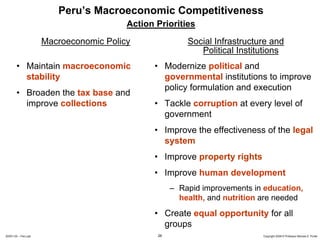
                                         Action Priorities
                      Macroeconomic Policy               Social Infrastructure and
                                                            Political Institutions
        • Maintain macroeconomic               • Modernize political and
          stability                              governmental institutions to improve
                                                 policy formulation and execution
        • Broaden the tax base and
          improve collections                  • Tackle corruption at every level of
                                                 government
                                               • Improve the effectiveness of the legal
                                                 system
                                               • Improve property rights
                                               • Improve human development
                                                     – Rapid improvements in education,
                                                       health, and nutrition are needed
                                               • Create equal opportunity for all
                                                 groups
20091130 – Peru.ppt                             26                          Copyright 2009 © Professor Michael E. Porter
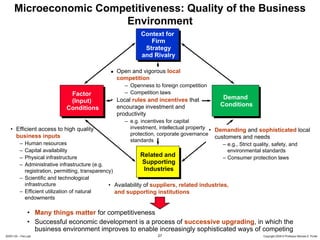
Microeconomic Competitiveness: Quality of the Business
                        Environment
                                                            Context for
                                                            Context for
                                                                Firm
                                                                 Firm
                                                              Strategy
                                                              Strategy
                                                            and Rivalry
                                                             and Rivalry

                                                  Open and vigorous local
                                                   competition
                                                     – Openness to foreign competition
                              Factor                 – Competition laws
                               Factor                                                         Demand
                              (Input)          • Local rules and incentives that              Demand
                               (Input)                                                       Conditions
                             Conditions          encourage investment and                    Conditions
                             Conditions
                                                 productivity
                                                     – e.g. incentives for capital
   • Efficient access to high quality                  investment, intellectual property • Demanding and sophisticated local
     business inputs                                   protection, corporate governance
                                                                                           customers and needs
                                                       standards
          – Human resources                                                                   – e.g., Strict quality, safety, and
          – Capital availability                                                                environmental standards
          – Physical infrastructure                         Related and
                                                             Related and                      – Consumer protection laws
          – Administrative infrastructure (e.g.                Supporting
                                                                Supporting
            registration, permitting, transparency)             Industries
                                                                 Industries
          – Scientific and technological
            infrastructure                       • Availability of suppliers, related industries,
          – Efficient utilization of natural        and supporting institutions
            endowments

                • Many things matter for competitiveness
                • Successful economic development is a process of successive upgrading, in which the
                  business environment improves to enable increasingly sophisticated ways of competing
20091130 – Peru.ppt                                                27                                        Copyright 2009 © Professor Michael E. Porter
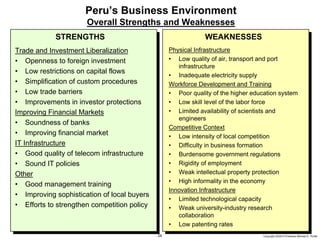
Peru’s Business Environment
                             Overall Strengths and Weaknesses
                      STRENGTHS                                      WEAKNESSES
       Trade and Investment Liberalization               Physical Infrastructure
       • Openness to foreign investment                  • Low quality of air, transport and port
                                                            infrastructure
       • Low restrictions on capital flows
                                                         • Inadequate electricity supply
       • Simplification of custom procedures             Workforce Development and Training
       • Low trade barriers                              • Poor quality of the higher education system
       • Improvements in investor protections            • Low skill level of the labor force
       Improving Financial Markets                       • Limited availability of scientists and
                                                            engineers
       • Soundness of banks
                                                         Competitive Context
       • Improving financial market                      • Low intensity of local competition
       IT Infrastructure                                 • Difficulty in business formation
       • Good quality of telecom infrastructure          • Burdensome government regulations
       • Sound IT policies                               • Rigidity of employment
       Other                                             • Weak intellectual property protection
                                                         • High informality in the economy
       • Good management training
                                                         Innovation Infrastructure
       • Improving sophistication of local buyers
                                                         • Limited technological capacity
       • Efforts to strengthen competition policy        • Weak university-industry research
                                                            collaboration
                                                         • Low patenting rates
20091130 – Peru.ppt                                 28                                   Copyright 2009 © Professor Michael E. Porter
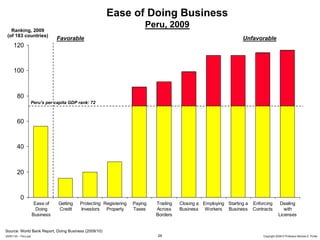
Ease of Doing Business
                                                                         Peru, 2009
   Ranking, 2009
 (of 183 countries)
                                 Favorable                                                                        Unfavorable
      120


      100


        80
                  Peru’s per capita GDP rank: 72


        60


        40


        20


           0
                       Ease of   Getting   Protecting Registering   Paying   Trading   Closing a Employing Starting a   Enforcing        Dealing
                        Doing    Credit    Investors   Property     Taxes    Across    Business Workers Business        Contracts          with
                      Business                                               Borders                                                    Licenses


Source: World Bank Report, Doing Business (2009/10)
20091130 – Peru.ppt                                                          29                                             Copyright 2009 © Professor Michael E. Porter
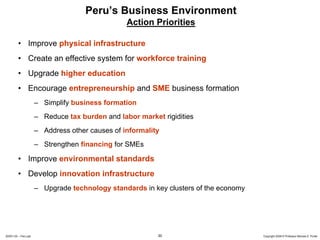
Peru’s Business Environment
                                                 Action Priorities

         • Improve physical infrastructure
         • Create an effective system for workforce training
         • Upgrade higher education
         • Encourage entrepreneurship and SME business formation
                      – Simplify business formation
                      – Reduce tax burden and labor market rigidities
                      – Address other causes of informality
                      – Strengthen financing for SMEs

         • Improve environmental standards
         • Develop innovation infrastructure
                      – Upgrade technology standards in key clusters of the economy


20091130 – Peru.ppt                                       30                          Copyright 2009 © Professor Michael E. Porter
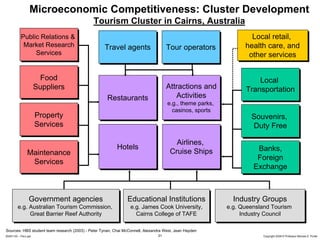
Microeconomic Competitiveness: Cluster Development
                                             Tourism Cluster in Cairns, Australia
           Public Relations &
           Public Relations &                                                                                    Local retail,
                                                                                                                 Local retail,
            Market Research
            Market Research                        Travel agents                    Tour operators             health care, and
                                                                                                               health care, and
                                                   Travel agents                    Tour operators
                Services
                 Services                                                                                       other services
                                                                                                                other services

                       Food
                        Food                                                                                       Local
                                                                                                                   Local
                      Suppliers
                      Suppliers                                                     Attractions and
                                                                                    Attractions and            Transportation
                                                                                                               Transportation
                                                     Restaurants                       Activities
                                                                                        Activities
                                                     Restaurants                    e.g., theme parks,
                                                                                    e.g., theme parks,
                                                                                      casinos, sports
                                                                                      casinos, sports
                      Property
                      Property                                                                                   Souvenirs,
                                                                                                                 Souvenirs,
                      Services
                      Services                                                                                   Duty Free
                                                                                                                  Duty Free

                                                                                        Airlines,
                                                                                        Airlines,
                                                          Hotels
                                                          Hotels                                                   Banks,
                                                                                                                    Banks,
                Maintenance
                Maintenance                                                           Cruise Ships
                                                                                      Cruise Ships
                                                                                                                   Foreign
                                                                                                                   Foreign
                 Services
                  Services                                                                                        Exchange
                                                                                                                  Exchange


                 Government agencies
                 Government agencies                           Educational Institutions
                                                               Educational Institutions                    Industry Groups
                                                                                                            Industry Groups
         e.g. Australian Tourism Commission,
         e.g. Australian Tourism Commission,                     e.g. James Cook University,
                                                                 e.g. James Cook University,             e.g. Queensland Tourism
                                                                                                         e.g. Queensland Tourism
              Great Barrier Reef Authority
               Great Barrier Reef Authority                        Cairns College of TAFE
                                                                    Cairns College of TAFE                    Industry Council
                                                                                                               Industry Council

Sources: HBS student team research (2003) - Peter Tynan, Chai McConnell, Alexandra West, Jean Hayden
20091130 – Peru.ppt                                                            31                                    Copyright 2009 © Professor Michael E. Porter
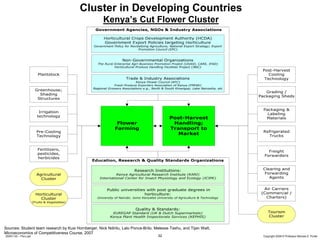
Cluster in Developing Countries
                                                      Kenya’s Cut Flower Cluster


Sources: Student team research by Kusi Hornberger, Nick Ndiritu, Lalo Ponce-Brito, Melesse Tashu, and Tijan Watt,
Microeconomics of Competitiveness Course, 2007
20091130 – Peru.ppt                                                                 32                              Copyright 2009 © Professor Michael E. Porter
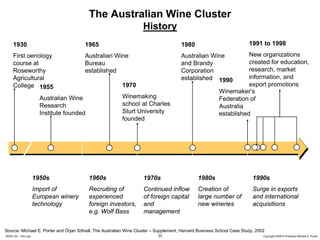
The Australian Wine Cluster
                                                                   History
     1930                               1965                                          1980                             1991 to 1998
     First oenology                     Australian Wine                               Australian Wine              New organizations
     course at                          Bureau                                        and Brandy                   created for education,
     Roseworthy                         established                                   Corporation                  research, market
     Agricultural                                                                     established 1990             information, and
     College 1955                                        1970                                                      export promotions
                                                                                                        Winemaker’s
                        Australian Wine                  Winemaking                                     Federation of
                        Research                         school at Charles                              Australia
                        Institute founded                Sturt University                               established
                                                         founded


                      1950s                 1960s                  1970s                      1980s                      1990s
                      Import of             Recruiting of          Continued inflow           Creation of                Surge in exports
                      European winery       experienced            of foreign capital         large number of            and international
                      technology            foreign investors,     and                        new wineries               acquisitions
                                            e.g. Wolf Bass         management


Source: Michael E. Porter and Örjan Sölvell, The Australian Wine Cluster – Supplement, Harvard Business School Case Study, 2002
20091130 – Peru.ppt                                                       33                                                  Copyright 2009 © Professor Michael E. Porter
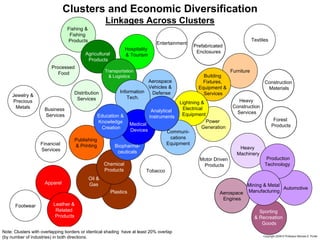
Clusters and Economic Diversification
                                                    Linkages Across Clusters
                                Fishing &
                                 Fishing
                                Products                                                                                       Textiles
                                                                                 Entertainment
                                                                                                 Prefabricated
                                                               Hospitality
                                          Agricultural                                            Enclosures
                                                               & Tourism
                                           Products
                        Processed
                           Food                     Transportation                                                 Furniture
                                                      & Logistics                                     Building
                                                                         Aerospace                   Fixtures,                       Construction
                                                                         Vehicles &                 Equipment &                       Materials
                                    Distribution             Information  Defense                     Services
     Jewelry &                                                  Tech.
     Precious                        Services                                                                          Heavy
                                                                                            Lightning &
      Metals                                                                                 Electrical             Construction
                     Business                                                  Analytical
                                                                                             Equipment                Services
                     Services                    Education &                  Instruments
                                                 Knowledge                                            Power                                Forest
                                                                    Medical                                                               Products
                                                  Creation                                           Generation
                                                                    Devices          Communi-
                                    Publishing                                        cations
                   Financial        & Printing                                       Equipment
                                                           Biopharma-                                                  Heavy
                   Services                                 ceuticals                                                 Machinery
                                                                                                    Motor Driven                      Production
                                                    Chemical                                         Products                        Technology
                                                    Products              Tobacco
                                            Oil &
                     Apparel                Gas                                                                       Mining & Metal
                                                                                                                                     Automotive
                                                         Plastics                                           Aerospace Manufacturing
                                                                                                             Engines
      Footwear           Leather &
                          Related                                                                                                 Sporting
                          Products                                                                                              & Recreation
                                                                                                                                   Goods
Note: Clusters with overlapping borders or identical shading have at least 20% overlap
  20091130 – Peru.ppt
(by number of industries) in both directions.                                  34                                                   Copyright 2009 © Professor Michael E. Porter
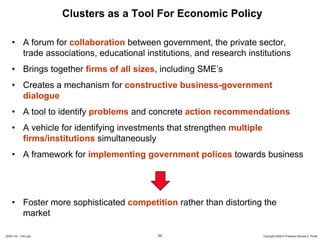
Clusters as a Tool For Economic Policy

    • A forum for collaboration between government, the private sector,
      trade associations, educational institutions, and research institutions
    • Brings together firms of all sizes, including SME’s
    • Creates a mechanism for constructive business-government
      dialogue
    • A tool to identify problems and concrete action recommendations
    • A vehicle for identifying investments that strengthen multiple
      firms/institutions simultaneously
    • A framework for implementing government polices towards business


    • Foster more sophisticated competition rather than distorting the
      market

20091130 – Peru.ppt                       35                           Copyright 2009 © Professor Michael E. Porter
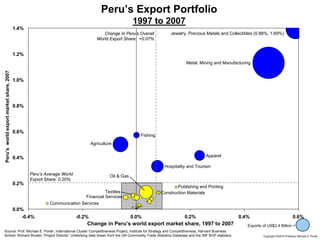
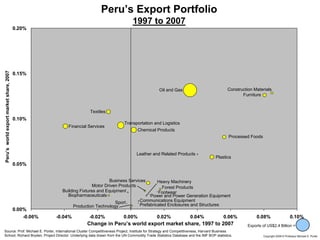
Peru’s Export Portfolio
                                                                                                     1997 to 2007
                                         1.4%
                                                                                     Change In Peru’s Overall         Jewelry, Precious Metals and Collectibles (0.88%, 1.69%)
                                                                                  World Export Share: +0.07%


                                         1.2%
                                                                                                                              Metal, Mining and Manufacturing
Peru’s world export market share, 2007


                                         1.0%


                                         0.8%


                                         0.6%
                                                                                                        Fishing
                                                                               Agriculture


                                         0.4%                                                                                           Apparel

                                                                                                                   Hospitality and Tourism
                                                Peru’s Average World                     Oil & Gas
                                                Export Share: 0.20%
                                         0.2%
                                                                                                                          Publishing and Printing
                                                                                   Textiles                       Construction Materials
                                                                         Financial Services
                                                         Communication Services
                                         0.0%
                                             -0.4%                     -0.2%                         0.0%                    0.2%                      0.4%                                0.6%
                                                                           Change in Peru’s world export market share, 1997 to 2007                         Exports of US$2.4 Billion =
Source: Prof. Michael E. Porter, International Cluster Competitiveness Project, Institute for Strategy and Competitiveness, Harvard Business
School; Richard Bryden, Project Director. Underlying data drawn from the UN Commodity Trade Statistics Database and the IMF BOP statistics.
20091130 – Peru.ppt                                                                                 36                                                              Copyright 2009 © Professor Michael E. Porter
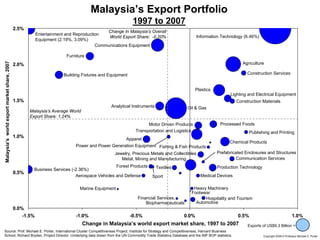
Peru’s Export Portfolio
                                                                                         1997 to 2007
                                         0.20%
Peru’s world export market share, 2007


                                         0.15%


                                                                                                      Oil and Gas                        Construction Materials
                                                                                                                                                Furniture


                                                                     Textiles
                                         0.10%
                                                                                     Transportation and Logistics
                                                          Financial Services
                                                                                           Chemical Products
                                                                                                                                         Processed Foods


                                                                                           Leather and Related Products
                                                                                                                                 Plastics
                                         0.05%


                                                                                Business Services       Heavy Machinery
                                                                        Motor Driven Products             Forest Products
                                                        Building Fixtures and Equipment                 Footwear
                                                          Biopharmaceuticals                        Power and Power Generation Equipment
                                                                                   Sport       Communications Equipment
                                                              Production Technology            Prefabricated Enclosures and Structures
                                         0.00%
                                             -0.06%   -0.04%        -0.02%           0.00%           0.02%          0.04%             0.06%             0.08%                   0.10%
                                                                   Change in Peru’s world export market share, 1997 to 2007                        Exports of US$2.4 Billion =
Source: Prof. Michael E. Porter, International Cluster Competitiveness Project, Institute for Strategy and Competitiveness, Harvard Business
School; Richard Bryden, Project Director. Underlying data drawn from the UN Commodity Trade Statistics Database and the IMF BOP statistics.
20091130 – Peru.ppt                                                                                 37                                                     Copyright 2009 © Professor Michael E. Porter
Malaysia’s Export Portfolio
                                                                                                        1997 to 2007
                                             2.5%
                                                                                        Change In Malaysia’s Overall
                                                        Entertainment and Reproduction
                                                                                         World Export Share: -0.20%                     Information Technology (6.46%)
                                                        Equipment (2.19%, 3.09%)
                                                                                    Communications Equipment

                                                                      Furniture
Malaysia’s world export market share, 2007


                                             2.0%                                                                                                              Agriculture

                                                                     Building Fixtures and Equipment                                                             Construction Services


                                                                                                                                        Plastics
                                                                                                                                                         Lighting and Electrical Equipment
                                             1.5%                                                                                                           Construction Materials
                                                                                            Analytical Instruments                 Oil & Gas
                                                    Malaysia’s Average World
                                                    Export Share: 1.24%
                                                                                                               Motor Driven Products                Processed Foods
                                                                                                         Transportation and Logistics                               Publishing and Printing
                                             1.0%
                                                                                                   Apparel
                                                                                                                                                         Chemical Products
                                                                          Power and Power Generation Equipment Fishing & Fish Products
                                                                                             Jewelry, Precious Metals and Collectibles             Prefabricated Enclosures and Structures
                                                                                                Metal, Mining and Manufacturing                              Communication Services
                                                                                             Forest Products         Textiles                      Production Technology
                                                      Business Services (-2.36%)
                                             0.5%
                                                                          Aerospace Vehicles and Defense         Sport                    Medical Devices

                                                                            Marine Equipment                                         Heavy Machinery
                                                                                                                                    Footwear
                                                                                                          Financial Services              Hospitality and Tourism
                                                                                                              Biopharmaceuticals      Automotive
                                             0.0%
                                                -1.5%                     -1.0%                        -0.5%                    0.0%                         0.5%                                 1.0%
                                                                               Change in Malaysia’s world export market share, 1997 to 2007                       Exports of US$9.3 Billion =
Source: Prof. Michael E. Porter, International Cluster Competitiveness Project, Institute for Strategy and Competitiveness, Harvard Business
School; Richard Bryden, Project Director. Underlying data drawn from the UN Commodity Trade Statistics Database and the IMF BOP statistics.
20091130 – Peru.ppt                                                                                 38                                                                     Copyright 2009 © Professor Michael E. Porter
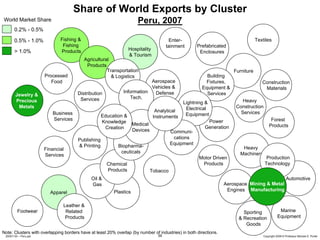
Share of World Exports by Cluster
World Market Share                                                   Peru, 2007
       0.2% - 0.5%

       0.5% - 1.0%            Fishing &                                               Enter-                                     Textiles
                               Fishing                                               tainment       Prefabricated
       > 1.0%                 Products                          Hospitality
                                                                                                     Enclosures
                                                                & Tourism
                                          Agricultural
                                           Products
                                                     Transportation                                                  Furniture
                       Processed                       & Logistics                                      Building
                          Food                                            Aerospace                    Fixtures,                    Construction
                                                                          Vehicles &                  Equipment &                    Materials
                                      Distribution            Information  Defense                      Services
        Jewelry &
                                       Services                  Tech.
        Precious                                                                             Lightning &                 Heavy
         Metals                                                                               Electrical              Construction
                                                                         Analytical                                     Services
                          Business                                                            Equipment
                                                  Education &           Instruments
                          Services                                                                       Power                            Forest
                                                  Knowledge Medical
                                                   Creation                                             Generation                       Products
                                                                Devices          Communi-
                                       Publishing                                 cations
                                       & Printing                               Equipment
                                                         Biopharma-                                                      Heavy
                       Financial
                                                           ceuticals                                                    Machinery
                       Services
                                                                                                     Motor Driven                      Production
                                                     Chemical                                         Products                        Technology
                                                     Products               Tobacco
                                             Oil &                                                                                                     Automotive
                                             Gas                                                                  Aerospace Mining & Metal
                                                         Plastics                                                  Engines Manufacturing
                         Apparel

                               Leather &
         Footwear               Related                                                                                  Sporting                Marine
                                Products                                                                               & Recreation             Equipment
                                                                                                                          Goods
Note: Clusters with overlapping borders have at least 20% overlap (by number of industries) in both directions.
 20091130 – Peru.ppt                                                            39                                                   Copyright 2009 © Professor Michael E. Porter
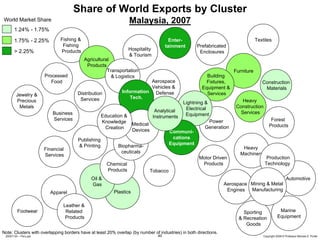
Share of World Exports by Cluster
World Market Share                                               Malaysia, 2007
       1.24% - 1.75%

       1.75% - 2.25%          Fishing &                                                Enter-                                     Textiles
                               Fishing                                               tainment       Prefabricated
       > 2.25%                Products                          Hospitality
                                                                                                     Enclosures
                                                                & Tourism
                                          Agricultural
                                           Products
                                                     Transportation                                                   Furniture
                       Processed                       & Logistics                                      Building
                          Food                                          Aerospace                       Fixtures,                    Construction
                                                                        Vehicles &                    Equipment &                     Materials
                                      Distribution           Information Defense                        Services
        Jewelry &
                                       Services                  Tech.
        Precious                                                                             Lightning &                  Heavy
         Metals                                                                               Electrical               Construction
                                                                         Analytical                                      Services
                          Business                                                            Equipment
                                                  Education &           Instruments
                          Services                                                                       Power                             Forest
                                                  Knowledge Medical
                                                   Creation                                             Generation                        Products
                                                                Devices         Communi-
                                       Publishing                                 cations
                                       & Printing                               Equipment
                                                         Biopharma-                                                       Heavy
                       Financial
                                                           ceuticals                                                     Machinery
                       Services
                                                                                                     Motor Driven                       Production
                                                     Chemical                                         Products                         Technology
                                                     Products               Tobacco
                                             Oil &                                                                                                      Automotive
                                             Gas                                                                  Aerospace Mining & Metal
                                                         Plastics                                                  Engines Manufacturing
                         Apparel

                               Leather &
         Footwear               Related                                                                                   Sporting                Marine
                                Products                                                                                & Recreation             Equipment
                                                                                                                           Goods
Note: Clusters with overlapping borders have at least 20% overlap (by number of industries) in both directions.
 20091130 – Peru.ppt                                                            40                                                    Copyright 2009 © Professor Michael E. Porter
State of Cluster Development in Peru

       • Peru has strengths in several clusters, including mining, fishing,
         agribusiness, tourism, jewelry and apparel


       • Peru’s clusters are based heavily on natural endowments, with limited
         further upgrading


       • Peru’s clusters are shallow, with weak supplier bases and supporting
         institutions

       • The limited cluster development efforts underway in Peru suffer from
         poor coordination between the private and public sectors


       • Clusters are so far an unexploited dimension of economic policy at
         the national and regional levels
20091130 – Peru.ppt                        41                         Copyright 2009 © Professor Michael E. Porter
Cluster Development in Peru
                                               Action Priorities

       • Adopt cluster development as a central tool for organizing business
         development and implementation of economic policies supporting businesses

       • Use cluster development to encourage value-add upgrading within existing
         clusters
                  – Promote spillovers and synergies to upgrade local economies


       • Apply a cluster based approach to economic diversification


20091130 – Peru.ppt                                     42                        Copyright 2009 © Professor Michael E. Porter
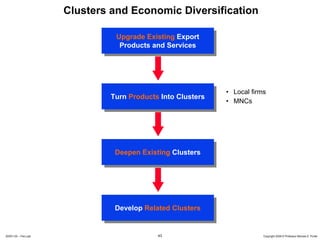
Clusters and Economic Diversification

                                Upgrade Existing Export
                                 Upgrade Existing Export
                                 Products and Services
                                  Products and Services


                                                             • Local firms
                              Turn Products Into Clusters
                               Turn Products Into Clusters   • MNCs


                               Deepen Existing Clusters
                                Deepen Existing Clusters


                               Develop Related Clusters
                                Develop Related Clusters


20091130 – Peru.ppt                        43                            Copyright 2009 © Professor Michael E. Porter
Cluster Development in Peru
                                                Action Priorities

       • Adopt cluster development as a central tool for organizing business
         development and implementation of economic policies supporting businesses

       • Use cluster development to encourage value-add upgrading within existing
         clusters
                  – Promote spillovers and synergies to upgrade local economies

       • Apply a cluster based approach to economic diversification

       • Leverage clusters to attract FDI and facilitate integration with the global
         economy

       • Use cluster initiatives to engage the private sector in more effective
         collaboration with government at the national and regional levels
                  – Cluster development is an effective approach to promote private sector-led
                    growth
                  – Create Institutions for Collaboration (e.g., trade associations) to organize cluster
                    participants


20091130 – Peru.ppt                                       44                                Copyright 2009 © Professor Michael E. Porter
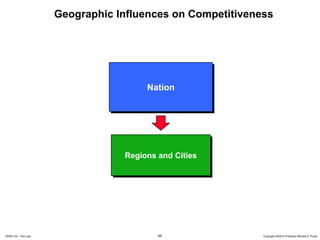
Geographic Influences on Competitiveness


                                       Nation
                                       Nation


                                  Regions and Cities
                                  Regions and Cities


20091130 – Peru.ppt                       45                Copyright 2009 © Professor Michael E. Porter
Regions and Competitiveness

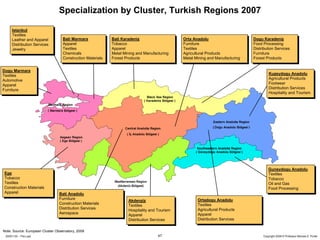
       • Economic performance varies significantly across sub-national
         regions (e.g., provinces, states, metropolitan areas)
       • Many essential levers of competitiveness reside at the regional level
       • Region’s specialize in different sets of clusters


20091130 – Peru.ppt                         46                       Copyright 2009 © Professor Michael E. Porter
Specialization by Cluster, Turkish Regions 2007

     Istanbul
      Istanbul
     Textiles
      Textiles
     Leather and Apparel           Bati Marmara
                                    Bati Marmara             Bati Karadeniz
                                                              Bati Karadeniz                    Orta Anadolu
                                                                                                 Orta Anadolu                     Dogu Karadeniz
                                                                                                                                   Dogu Karadeniz
      Leather and Apparel
     Distribution Services         Apparel
                                    Apparel                  Tobacco
                                                              Tobacco                           Furniture
                                                                                                 Furniture                        Food Processing
                                                                                                                                   Food Processing
      Distribution Services
     Jewelry                       Textiles
                                    Textiles                 Apparel
                                                              Apparel                           Textiles
                                                                                                 Textiles                         Distribution Services
                                                                                                                                   Distribution Services
      Jewelry
                                   Chemicals
                                    Chemicals                Metal Mining and Manufacturing
                                                              Metal Mining and Manufacturing    Agricultural Products
                                                                                                 Agricultural Products            Furniture
                                                                                                                                   Furniture
                                   Construction Materials
                                    Construction Materials   Forest Products
                                                              Forest Products                   Metal Mining and Manufacturing
                                                                                                 Metal Mining and Manufacturing   Forest Products
                                                                                                                                   Forest Products

Dogu Marmara
 Dogu Marmara
Textiles                                                                                                                                   Kuzeydogu Anadolu
                                                                                                                                            Kuzeydogu Anadolu
 Textiles                                                                                                                                  Agricultural Products
Automotive
 Automotive                                                                                                                                 Agricultural Products
Apparel                                                                                                                                    Footwear
                                                                                                                                            Footwear
 Apparel                                                                                                                                   Distribution Services
Furniture
 Furniture                                                                                                                                  Distribution Services
                                                                                                                                           Hospitality and Tourism
                                                                                                                                            Hospitality and Tourism


                                                                                                                                           Guneydogu Anadolu
                                                                                                                                            Guneydogu Anadolu
Ege
 Ege                                                                                                                                       Textiles
                                                                                                                                            Textiles
Tobacco
 Tobacco                                                                                                                                   Tobacco
                                                                                                                                            Tobacco
Textiles
 Textiles                                                                                                                                  Oil and Gas
                                                                                                                                            Oil and Gas
Construction Materials
 Construction Materials                                                                                                                    Food Processing
                                                                                                                                            Food Processing
Apparel
 Apparel                         Bati Anadolu
                                  Bati Anadolu
                                 Furniture
                                  Furniture                                                            Ortadogu Anadolu
                                                                     Akdenziz
                                                                      Akdenziz                          Ortadogu Anadolu
                                 Construction Materials
                                  Construction Materials                                               Textiles
                                                                     Textiles
                                                                      Textiles                          Textiles
                                 Distribution Services
                                  Distribution Services                                                Agricultural Products
                                                                     Hospitality and Tourism
                                                                      Hospitality and Tourism           Agricultural Products
                                 Aerospace
                                  Aerospace                                                            Apparel
                                                                     Apparel
                                                                      Apparel                           Apparel
                                                                     Distribution Services
                                                                      Distribution Services            Distribution Services
                                                                                                        Distribution Services

Note: Source: European Cluster Observatory, 2009
 20091130 – Peru.ppt                                                                 47                                                Copyright 2009 © Professor Michael E. Porter
Regions and Competitiveness

       • Economic performance varies significantly across sub-national
         regions (e.g., provinces, states, metropolitan areas)
       • Many essential levers of competitiveness reside at the regional level
       • Region’s specialize in different sets of clusters
       • Cluster strength directly impacts regional performance
       • Each region requires its own distinctive competitiveness agenda
       • Improving competitiveness requires effective policy collaboration
         between regions and the national government


       • Decentralization of economic policy is especially important in larger
         countries to foster regional specialization, internal competition, and
         greater government accountability


20091130 – Peru.ppt                         48                         Copyright 2009 © Professor Michael E. Porter
Competitiveness of Peru’s Regions
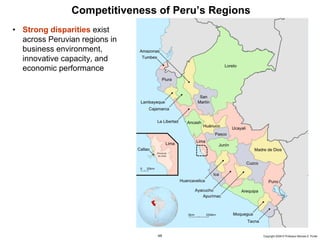
     • Strong disparities exist
       across Peruvian regions in
       business environment,
       innovative capacity, and
       economic performance


20091130 – Peru.ppt                  49                   Copyright 2009 © Professor Michael E. Porter
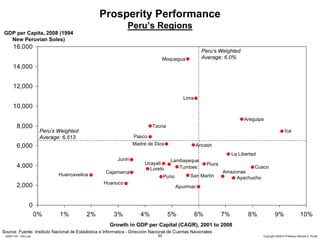
Prosperity Performance
                                                               Peru’s Regions
GDP per Capita, 2008 (1994
  New Peruvian Soles)
      16,000
                                                                                                      Peru’s Weighted
                                                                                   Moquegua           Average: 6.0%
      14,000


      12,000
                                                                                             Lima
      10,000

                                                                                                                           Areguipa
         8,000                                                             Tacna
                        Peru’s Weighted                                                                                                              Ica
                        Average: 6,513                            Pasco
         6,000                                                    Madre de Dios                     Ancash
                                                                                                                      La Libertad
                                                          Junin                      Lambayeque
                                                                        Ucayali                          Piura
         4,000                                                            Loreto        Tumbes                               Cusco
                                                    Cajamarca                                                    Amazonas
                               Huancavelica                                        Puno        San Martin             Ayachucho
                                                   Huanuco
         2,000                                                                            Apurimac


                  0
                       0%      1%         2%            3%           4%             5%              6%           7%          8%              9%                  10%
                                                      Growth in GDP per Capital (CAGR), 2001 to 2008
Source: Fuente: Instituto Nacional de Estadistica e Informatica - Dirección Nacional de Cuentas Nacionales
 20091130 – Peru.ppt                                                          50                                                    Copyright 2009 © Professor Michael E. Porter
Competitiveness of Peru’s Regions
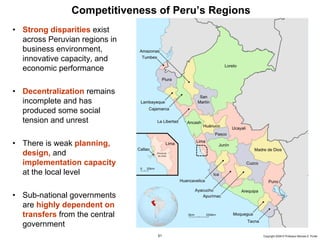
     • Strong disparities exist
       across Peruvian regions in
       business environment,
       innovative capacity, and
       economic performance

     • Decentralization remains
       incomplete and has
       produced some social
       tension and unrest

     • There is weak planning,
       design, and
       implementation capacity
       at the local level

     • Sub-national governments
       are highly dependent on
       transfers from the central
       government
20091130 – Peru.ppt                  51                   Copyright 2009 © Professor Michael E. Porter
Peru’s Regions
                                           Action Priorities

                  • Continue decentralization of responsibilities and resources to
                    sub-national governments
                  • Improve the capacity of local governments to plan, design
                    and implement development polices
                  • Improve national-regional collaboration to implement
                    regional programs
                  • Adopt specific steps to reduce corruption at the regional level
                  • Improve physical connections among regions to support
                    economic and social integration
                  • Promote greater linkages between resource clusters and
                    regional economies
                  • Address the underlying causes of inequality between the
                    highland, coastal and Amazon regions
                      – Strengthen human development in the poorer highland regions


20091130 – Peru.ppt                                52                          Copyright 2009 © Professor Michael E. Porter
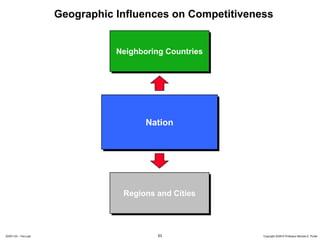
Geographic Influences on Competitiveness


                                 Neighboring Countries
                                 Neighboring Countries


                                        Nation
                                        Nation


                                  Regions and Cities
                                  Regions and Cities


20091130 – Peru.ppt                       53                Copyright 2009 © Professor Michael E. Porter
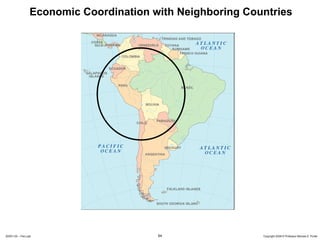
Economic Coordination with Neighboring Countries


20091130 – Peru.ppt                      54                 Copyright 2009 © Professor Michael E. Porter
Competitiveness and the Neighborhood

  • Opening trade and investment among neighbors fuels growth and
    specialization
             – A country’s neighbors are its most natural trading and investment partners
             – The most natural path for internationalization by local firms is the
               neighborhood
             – Open trade and investment make each country a more attractive location for
               foreign investment


  • Economic coordination with neighbors drives improvements in the
    business environment
             – Capturing synergies in policy and infrastructure
             – Gaining greater clout in international negotiations


  • External agreements help overcome domestic political barriers to
    reform

20091130 – Peru.ppt                               55                            Copyright 2009 © Professor Michael E. Porter
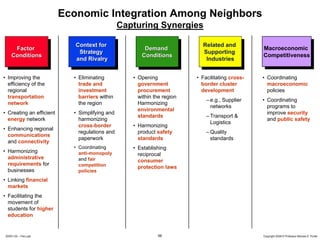
Economic Integration Among Neighbors
                                                Capturing Synergies

                             Context for
                              Context for                                  Related and
                                                                            Related and
       Factor
        Factor                                         Demand
                                                        Demand                                   Macroeconomic
                                                                                                  Macroeconomic
                              Strategy
                               Strategy                                    Supporting
                                                                            Supporting
     Conditions
      Conditions                                      Conditions
                                                       Conditions                                Competitiveness
                                                                                                  Competitiveness
                             and Rivalry
                              and Rivalry                                   Industries
                                                                             Industries

• Improving the             • Eliminating          • Opening             • Facilitating cross-   • Coordinating
  efficiency of the           trade and              government            border cluster          macroeconomic
  regional                    investment             procurement           development             policies
  transportation              barriers within        within the region
                                                                             – e.g., Supplier    • Coordinating
  network                     the region             Harmonizing
                                                                               networks            programs to
                                                     environmental
• Creating an efficient     • Simplifying and                                                      improve security
                                                     standards               – Transport &
  energy network              harmonizing                                                          and public safety
                                                                               Logistics
                              cross-border         • Harmonizing
• Enhancing regional
                              regulations and        product safety          – Quality
  communications
                              paperwork              standards                 standards
  and connectivity
                            • Coordinating         • Establishing
• Harmonizing                 anti-monopoly          reciprocal
  administrative              and fair               consumer
  requirements for            competition            protection laws
  businesses                  policies
• Linking financial
  markets
• Facilitating the
  movement of
  students for higher
  education


 20091130 – Peru.ppt                                         56                                  Copyright 2009 © Professor Michael E. Porter
Peru and the Neighborhood
              Assessment
              • Peru remains a relatively isolated country for geographic reasons
              • Peru has weak relations with some of its neighbors
              • Peru has taken some positive steps to improve relations with some
                neighbors
              • Peru’s recent trade liberalization program, including with the U.S. and
                China, has created significant opportunities for new economic
                linkages with neighbors

              Action Agenda
              • Economic coordination with neighboring countries is an important
                tool in economic development
              • Peru can take a proactive leadership role in promoting trade
                liberalization efforts with particular neighbors and the region
              • Peru can be a platform for South American firms seeking to access
                the U.S. and Asian markets
              • Leverage inbound and outbound FDI with neighbors to upgrade
                local competitiveness
20091130 – Peru.ppt                             57                         Copyright 2009 © Professor Michael E. Porter
The Need for an Economic Strategy


                         Policy                          Economic
                      Improvement                         Strategy


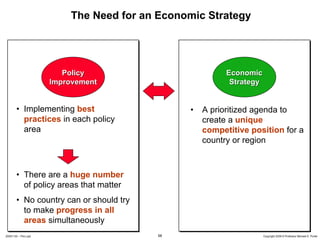
        • Implementing best                    •   A prioritized agenda to
          practices in each policy                 create a unique
          area                                     competitive position for a
                                                   country or region


        • There are a huge number
          of policy areas that matter
        • No country can or should try
          to make progress in all
          areas simultaneously
20091130 – Peru.ppt                      58                          Copyright 2009 © Professor Michael E. Porter
The Need for an Economic Strategy

                                             National Value Proposition
                                             National Value Proposition

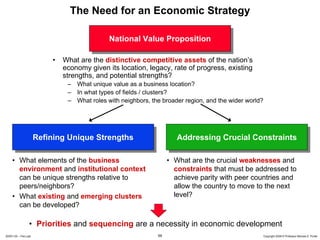
                          •   What are the distinctive competitive assets of the nation’s
                              economy given its location, legacy, rate of progress, existing
                              strengths, and potential strengths?
                               – What unique value as a business location?
                               – In what types of fields / clusters?
                               – What roles with neighbors, the broader region, and the wider world?


                      Refining Unique Strengths
                      Refining Unique Strengths                       Addressing Crucial Constraints
                                                                      Addressing Crucial Constraints

     • What elements of the business                               • What are the crucial weaknesses and
       environment and institutional context                         constraints that must be addressed to
       can be unique strengths relative to                           achieve parity with peer countries and
       peers/neighbors?                                              allow the country to move to the next
     • What existing and emerging clusters                           level?
       can be developed?

                 • Priorities and sequencing are a necessity in economic development
20091130 – Peru.ppt                                           59                                       Copyright 2009 © Professor Michael E. Porter
Toward a Peruvian Economic Strategy
                        Unique Strengths                             Implications
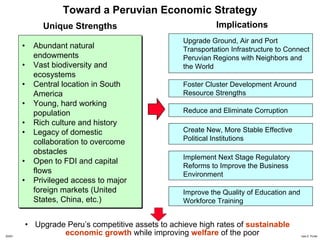
                                                           Upgrade Ground, Air and Port
            •         Abundant natural                     Transportation Infrastructure to Connect
                      endowments                           Peruvian Regions with Neighbors and
            •         Vast biodiversity and                the World
                      ecosystems
            •         Central location in South            Foster Cluster Development Around
                      America                              Resource Strengths
            •         Young, hard working
                      population                           Reduce and Eliminate Corruption
            •         Rich culture and history
            •         Legacy of domestic                   Create New, More Stable Effective
                                                           Political Institutions
                      collaboration to overcome
                      obstacles
                                                           Implement Next Stage Regulatory
            •         Open to FDI and capital
                                                           Reforms to Improve the Business
                      flows                                Environment
            •         Privileged access to major
                      foreign markets (United              Improve the Quality of Education and
                      States, China, etc.)                 Workforce Training


                • Upgrade Peru’s competitive assets to achieve high rates of sustainable
20091130 – Peru.ppt
                         economic growth while improving welfare of the poor
                                                   60                               Copyright 2009 © Professor Michael E. Porter
Accelerating Poverty Reduction in Peru


                                                  Increase
                         Reduce Poverty
                                               Competitiveness


20091130 – Peru.ppt                       61                     Copyright 2009 © Professor Michael E. Porter
The Process of Economic Development
                           Shifting Roles and Responsibilities


                      Old Model
                      Old Model                               New Model
                                                              New Model


        •• The central government drives
            The central government drives         •• Economic development is a
                                                     Economic development is a
           economic development through
            economic development through             collaborative process involving
                                                      collaborative process involving
           policy decisions, spending and
            policy decisions, spending and           government at multiple levels,
                                                      government at multiple levels,
           incentives
            incentives                               companies, educational and
                                                      companies, educational and
                                                     research institutions, and private
                                                      research institutions, and private
                                                     sector organizations
                                                      sector organizations


        • Competitiveness must be a bottom-up process in which many
          individuals, companies, and institutions take responsibility and act

20091130 – Peru.ppt                          62                              Copyright 2009 © Professor Michael E. Porter
Organizing for Competitiveness in Peru
                                                  Assessment


              • Peru has weak coordination among government ministries and
                agencies responsible for improving competitiveness
                      – Across different ministries to align policies
                      – Across geographic levels of government


              • The National Council on Competitiveness was created in 2002,
                a positive step, but it has had limited impact

              • There are few competitiveness initiatives at the regional level to
                mobilize strategic thinking and drive action

              • The private sector has limited engagement in competitiveness
                development


20091130 – Peru.ppt                                      63                Copyright 2009 © Professor Michael E. Porter
Revitalizing Peru’s Organization to Drive Competitiveness
                                              Action Agenda
      • Create an effective coordination structure within government
        across ministries and agencies

      • Restart the National Council on Competitiveness to build consensus
        on an overall economic strategy and track implementation
                  – The council will require strong private sector leadership


      • Create Regional Competitiveness Councils to drive consensus on
        state plans and monitor implementation
                  – Involve representatives from the private, public and academic sectors as
                    well as federal government participation


      • The private sector must assume a catalytic role in economic
        strategy formulation and implementation


20091130 – Peru.ppt                                   64                           Copyright 2009 © Professor Michael E. Porter
Integrating Business and the Society


                               Economic            Social
                               Objectives         Objectives


          • There is an inevitable link between business and society
          • A healthy business depends on a healthy community to create
            demand for its products and provide a supportive business
            environment
          • A healthy society depends on competitive companies that can
            create jobs, support high wages, build wealth, buy local goods, and
            pay taxes


          • There is a long-term synergy between economic and social objectives


20091130 – Peru.ppt                          65                         Copyright 2009 © Professor Michael E. Porter
Competitiveness and Social Issues

                                                   Worker
                                                Education and
                                  Poverty in        Skills
                                the Company’s                   Worker Safety
                                 Communities


                      Environmental              Company                    Gender Equity
                         Impact                 Productivity


                                                                 Employee
                                 Energy Use
                                                                  Health

                                                  Water Use


20091130 – Peru.ppt                                   66                            Copyright 2009 © Professor Michael E. Porter
Corporate Role in Competitiveness
                               The Concept of Shared Value


                      Shared Value: Policies and practices that enhance the
                      competitiveness of a company while simultaneously
                      advancing economic and social conditions in the
                      communities in which it operates


          • Find the points of convergence between economic and social objectives, not
            assumed tradeoffs or the need for redistribution
              – These points of convergence are growing

          • Achieving shared value requires new thinking, new technologies, and new
            approaches to management

          • Shared value opportunities are even greater in developing countries

          • Shared value thinking applies equally to NGOs and governments

20091130 – Peru.ppt                            67                           Copyright 2009 © Professor Michael E. Porter
Corporate Role in Competitiveness
                                      Action Agenda

            • Organize the private sector to have a collective voice in
              competitiveness
            • Participate actively in national and regional competitiveness
              initiatives
            • Inform government on business needs and constraints bearing
              on company and cluster development
            • Nurture local suppliers and attract foreign suppliers
            • Work closely with local educational and research institutions to
              improve their quality and create specialized programs
              addressing the cluster’s needs
            • Collaborate with other companies to enhance competitiveness
              through trade associations and other mechanisms
            • Focus corporate social responsibility initiatives on enhancing
              the business environment
20091130 – Peru.ppt                           68                          Copyright 2009 © Professor Michael E. Porter

Michael Porter - Peru

  • 1.
    Competitiveness: A New Economic Strategy for Peru Professor Michael E. Porter Harvard Business School Lima, Peru November 30, 2009 This presentation draws on ideas from Professor Porter’s books and articles, in particular, Competitive Strategy (The Free Press, 1980); Competitive Advantage (The Free Press, 1985); “What is Strategy?” (Harvard Business Review, Nov/Dec 1996); “Strategy and the Internet” (Harvard Business Review, March 2001); and a forthcoming book. No part of this publication may be reproduced, stored in a retrieval system, or transmitted in any form or by any means—electronic, mechanical, photocopying, recording, or otherwise—without the permission of Michael E. Porter. Additional information may be found at the website of the Institute for Strategy and Competitiveness, www.isc.hbs.edu. Version: November 27, 2009 20091130 – Peru.ppt 1 Copyright 2009 © Professor Michael E. Porter
  • 2.
    Prosperity Performance Selected Lower and Middle Income Countries PPP-adjusted GDP per Capita, 2008 ($USD) $30,000 Slovenia UAE Greece ($30,650) Israel New Zealand South Korea Czech Republic $25,000 Cyprus Latin American countries Bahrain Saudi Arabia Oman Other countries Portugal Slovakia Estonia $20,000 Hungary Trinidad & Tobago Lithuania Poland Latvia Libya Croatia Russia $15,000 Panama Chile Argentina Mexico Malaysia Venezuela Turkey Bulgaria Uruguay Belarus Iran Romania Costa Rica Kazakhstan Lebanon Brazil South Africa $10,000 Dominican Republic Thailand Colombia Peru Belize Algeria Bosnia Ecuador Tunisia Ukraine Guyana Albania Guatemala Egypt China Jordan Paraguay Georgia $5,000 El Salvador Sri Lanka Bolivia Honduras Philippines Nicaragua Pakistan India Vietnam $0 0% 2% 4% 6% 8% 10% 12% 14% Source: Peru.ppt Growth of Real GDP per Capita (PPP-adjusted), CAGR, 2004 to 2008 20091130 – EIU (2009), authors calculations 2 Copyright 2009 © Professor Michael E. Porter
  • 3.
    Unemployment Performance Unemployment Rate, 2008 Selected Countries Dominican Republic (15.5%) South Africa (22.9%) 14% Improving Tunisia Deteriorating Croatia Algeria Jordan Albania Iran 12% Saudi Arabia Colombia Turkey 10% Poland (-8.4%) China Indonesia Egypt Brazil Peru Syria 8% Uruguay Slovakia Argentina Chile Hungary Greece Bolivia Portugal Venezuela Philippines Ecuador Pakistan Slovenia Kazakhstan India Bulgaria Lithuania Russia El Salvador Israel Ireland 6% T&T Estonia Panama Czech Rep. Paraguay Nicaragua Latvia Sri Lanka Costa Rica Vietnam Romania 4% Cyprus Mexico Honduras Malaysia Korea Ukraine 2% Latin American countries Thailand Other countries 0% -6% -5% -4% -3% -2% -1% 0% 1% 2% Change of Unemployment Rate in Percentage Points, 2004 to 2008 Source: EIU (2009) 20091130 – Peru.ppt 3 Copyright 2009 © Professor Michael E. Porter
  • 4.
    Poverty Rates % of Population Under Peru, 2001 to 2007 the Poverty Line 60% 50% 40% 30% 20% 10% 0% 1997 1998 1999 2000 2001 2002 2003 2004 2005 2006 2007 Source: Informacion Socio Demografica, from El Instituto Nacional de Estadistica e Informatica (INEI), 2009 20091130 – Peru.ppt 4 Copyright 2009 © Professor Michael E. Porter
  • 5.
    Export Performance Exports of Goods and Selected Countries Services (% of GDP), 2008 100% Malaysia (103.5%) 90% Slovakia Libya Latin American Countries Other countries Ireland Malta Czech Republic Panama Hungary 80% Vietnam Thailand Estonia Slovenia Saudi Arabia 70% Trinidad & Tobago Belarus Paraguay 60% Bulgaria Belize Lithuania Cambodia Tunisia Jordan Honduras Kazakhstan Algeria 50% Cyprus Macedonia Croatia Chile Ukraine (-17.5%) Costa Rica Egypt Latvia 40% Israel Poland Bolivia Philippines China Morocco South Africa Uruguay Ecuador Portugal Nicaragua Syria Venezuela Russia Romania Georgia Mexico 30% Indonesia Peru Lebanon Sri Lanka Iran El Salvador India Argentina Greece 20% Albania Colombia Guatemala Turkey Brazil Pakistan 10% Ethiopia 0% -15% -10% -5% 0% 5% 10% 15% 20% Change in Exports of Goods and Services (% of GDP), 2004 to 2008 Source: EIU (2008), authors’ analysis 20091130 – Peru.ppt 5 Copyright 2009 © Professor Michael E. Porter
  • 6.
    Peru’s Exports ByType of Industry World Export Market Share (current USD) 0.80% Processed Goods Semi-processed Goods 0.70% Unprocessed Goods Services TOTAL 0.60% 0.50% 0.40% 0.30% 0.20% 0.10% 0.00% 1997 1998 1999 2000 2001 2002 2003 2004 2005 2006 2007 Source: UNComTrade, WTO (2009) 20091130 – Peru.ppt 6 Copyright 2009 © Professor Michael E. Porter
  • 7.
    Inbound Foreign InvestmentPerformance Stocks and Flows, Selected Countries Inward FDI Stocks as % of GDP, Average 2003 - 2007 80% Estonia Trinidad & Tobago Latin American countries Jordan (46.5%, 81.8%) Other countries Lebanon (6.7%) 70% Panama (48.2%) Tunisia Hungary Chile Cyprus 60% Vietnam Bulgaria (69%) Czech Republic Slovakia Belize 50% Bolivia Nicaragua Croatia Kazakhstan Portugal Cambodia Georgia 40% Morocco Macedonia Malaysia Thailand Latvia Honduras Venezuela Poland Egypt Israel South Africa Argentina Lithuania Bosnia 30% Colombia Romania Mexico Ecuador Costa Rica Brazil Russia El Salvador Slovenia Peru 20% Guatemala Ukraine UAE Uruguay Paraguay Dominican Republic Turkey Malaysia China Saudi Arabia 10% Indonesia Sri Lanka Pakistan India Libya Iran 0% 0% 5% 10% 15% 20% 25% 30% 35% 40% 45% FDI Inflows as % of Gross Fixed Capital Formation, Average 2003 - 2007 Source: UNCTAD, World Investment Report (2009) 20091130 – Peru.ppt 7 Copyright 2009 © Professor Michael E. Porter
  • 8.
    Innovative Capacity Innovation Output of Selected Countries Average U.S. patents per 1 million population, 2004-2008 3.5 Czech Republic 3.0 Croatia 2.5 2.0 South Africa Greece 1.5 Portugal Russia 1.0 Chile Saudi Arabia Argentina Poland Venezuela Romania Bulgaria Brazil Thailand Mexico 0.5 China India Philippines Ukraine Peru Ecuador Colombia Turkey 0.0 -30% -20% -10% 0% 10% 20% 30% 40% 50% 60% CAGR of US-registered patents, 2004 – 2008 120 patents = Source: USPTO (2009), EIU (2009) 20091130 – Peru.ppt 8 Copyright 2009 © Professor Michael E. Porter
  • 9.
    The Peruvian Economyin 2009 • Peru has had a long history of instability • Since 2001, Peru has experienced high rates of economic growth – Recent surge in FDI and exports has been driven by commodities • Implementation of sound macroeconomic policies has allowed Peru to weather the current global crisis – Peru’s economy has been one of the most resilient in Latin America BUT • Prosperity remains low and large segments of the population lack access to basic needs • High unemployment and inequality persist • Peru is overly dependent on commodity exports with limited potential to drive job growth and economic diversification • Returning to 8 to 9% growth is possible only if Peru can substantially improve competitiveness • Peru will need an ambitious economic and social strategy, building on the country’s unique competitive advantages 20091130 – Peru.ppt 9 Copyright 2009 © Professor Michael E. Porter
  • 10.
    What is Competitiveness? • Competitiveness depends on the productivity with which a nation uses its human, capital, and natural resources. – Productivity sets the sustainable standard of living (wages, returns on capital, returns on natural resources) – It is not what industries a nation competes in that matters for prosperity, but how productively it competes in those industries – Productivity in a national economy arises from a combination of domestic and foreign firms – The productivity of “local” or domestic industries is fundamental to competitiveness, not just that of export industries • Only competitive businesses can create wealth and jobs • Nations compete to offer the most productive environment for business • The public and private sectors play different but interrelated roles in creating a productive economy 20091130 – Peru.ppt 10 Copyright 2009 © Professor Michael E. Porter
  • 11.
    Comparative Labor Productivity Real GDP per employee (PPP adjusted US$), 2008 Selected Countries Austria Kuwait Australia $70,000 Greece Saudi Arabia Switzerland Germany Spain Japan Singapore Oman $60,000 Israel Malta Slovenia $50,000 New Zealand Korea Slovakia UAE Cyprus Hungary Czech Republic Portugal $40,000 Croatia Lithuania Estonia Poland Turkey Mexico Malaysia Russia Chile Latvia $30,000 Argentina Macedonia Romania Iran Belarus South Africa Bulgaria Azerbaijan $20,000 Kazakhstan Peru Albania Brazil Peru (Avg. growth 2001to 2008) Egypt Armenia Jordan Ukraine Bosnia Thailand Georgia $10,000 Syria Serbia China Philippines Indonesia Pakistan India Vietnam Cambodia $0 -3% 0% 3% 6% 9% Growth of real GDP per employee (PPP-adjusted), 1990 to 2008 Source: authors calculation Groningen Growth and Development Centre (2009), EIU (2009) 20091130 – Peru.ppt 11 Copyright 2009 © Professor Michael E. Porter
  • 12.
    Determinants of Competitiveness Microeconomic Competitiveness Quality of the Sophistication National State of Cluster of Company Business Development Operations and Environment Strategy Macroeconomic Competitiveness Social Infrastructure Macroeconomic and Political Policies Institutions Natural Endowments • Macroeconomic competitiveness creates the potential for high productivity, but is not sufficient • Productivity ultimately depends on improving the microeconomic capability of the economy and the sophistication of local competition 20091130 – Peru.ppt 12 Copyright 2009 © Professor Michael E. Porter
  • 13.
    Determinants of Competitiveness Microeconomic Competitiveness Quality of the Sophistication National State of Cluster of Company Business Development Operations and Environment Strategy Macroeconomic Policy Macroeconomic Competitiveness Social Infrastructure Macroeconomic and Political Policies • Fiscal policy: public Institutions spending aligned with revenues over time Natural Endowments • Monetary policy: low levels of inflation • Macroeconomic management: avoiding structural imbalances and cyclical overheating 20091130 – Peru.ppt 13 Copyright 2009 © Professor Michael E. Porter
  • 14.
    Determinants of Competitiveness Microeconomic Competitiveness Quality of the Sophistication National State of Cluster of Company Social Business Development Operations and Environment Strategy Infrastructure and Political Institutions Macroeconomic Competitiveness Social • Human Development: Infrastructure and Political Macroeconomic Policies basic education and Institutions health care • Rule of Law: property Natural Endowments rights and due process • Political Institutions: stable and effective political and governmental processes and organizations 20091130 – Peru.ppt 14 Copyright 2009 © Professor Michael E. Porter
  • 15.
    Determinants of Competitiveness Microeconomic Competitiveness Quality of the Sophistication National State of Cluster of Company Business Development Operations and Sophistication Environment Strategy of Company Operations and Macroeconomic Competitiveness Strategy Social Infrastructure and Political Macroeconomic Policies • The internal company Institutions skills, capabilities, and management practices needed to Natural Endowments attain the highest level of productivity and innovation possible 20091130 – Peru.ppt 15 Copyright 2009 © Professor Michael E. Porter
  • 16.
    Determinants of Competitiveness Microeconomic Competitiveness Quality of the Sophistication National State of Cluster of Company Business Development Operations and Quality of the Environment Strategy National Business Environment Macroeconomic Competitiveness Social • The external business Infrastructure and Political Macroeconomic Policies environment Institutions conditions that allow companies to reach Natural Endowments high levels of productivity and innovation 20091130 – Peru.ppt 16 Copyright 2009 © Professor Michael E. Porter
  • 17.
    Determinants of Competitiveness Microeconomic Competitiveness Quality of the Sophistication National State of Cluster of Company Business Development Operations and Environment Strategy Macroeconomic Competitiveness Social Infrastructure Macroeconomic State of Cluster and Political Policies Development Institutions • A critical mass of firms Natural Endowments in particular fields, together with specialized skills, infrastructure, and supporting institutions, to support high productivity through efficiencies and synergies 20091130 – Peru.ppt 17 Copyright 2009 © Professor Michael E. Porter
  • 18.
    Competitiveness and PovertyReduction Economic Social Development Development • There is a strong connection between economic and social development • Improving competitiveness and decreasing poverty requires improving the economic and social context simultaneously 20091130 – Peru.ppt 18 Copyright 2009 © Professor Michael E. Porter
  • 19.
    Peru’s Competitiveness Profile,2009 ISC Country Competitiveness Model Macroeconomic Microeconomic Competitiveness (82) Competitiveness (73) Social Infra- Business Company Macroeconomic structure and Pol. Environment Quality Sophistication Policy (69) Institutions (90) (74) (70) Peru’s GDP per capita rank is 71st versus 133 countries Note: Rank versus 133 countries; overall, Peru ranks 71st in 2008 PPP adjusted GDP per capita and 75th in 2009 Global Competitiveness Source: Country Competitiveness Model (CCM), Institute for Strategy and Competitiveness, Harvard University (2009) 20091130 – Peru.ppt 19 Copyright 2009 © Professor Michael E. Porter
  • 20.
    Peru’s Macroeconomic Competitiveness Macroeconomic Policy • Conservative fiscal policy 20091130 – Peru.ppt 20 Copyright 2009 © Professor Michael E. Porter
  • 21.
    Government Budget Balances Selected Countries Budget Balance Ranked by (% of GDP) Surplus, 2008 10% Chile Peru 8% Argentina 6% Colombia Mexico 4% Brazil 2% 0% -2% -4% -6% -8% -10% 1996 1998 2000 2002 2004 2006 2008 Source: EIU, 2009 20091130 – Peru.ppt 21 Copyright 2009 © Professor Michael E. Porter
  • 22.
    Peru’s Macroeconomic Competitiveness Macroeconomic Policy • Conservative fiscal policy • Sound macroeconomic management • Stabilization fund However • Peru’s macroeconomic position remains overly dependent on commodities and commodity prices 20091130 – Peru.ppt 22 Copyright 2009 © Professor Michael E. Porter
  • 23.
    Peru’s Macroeconomic Competitiveness Macroeconomic Policy Social Infrastructure and Political Institutions • Conservative fiscal policy • Continued problems with corruption • Sound macroeconomic management • Stabilization fund However • Peru’s macroeconomic position remains overly dependent on commodities and commodity prices 20091130 – Peru.ppt 23 Copyright 2009 © Professor Michael E. Porter
  • 24.
    Corruption Perception Index,2007 1 Finland New Zealand Singapore Sweden Iceland Switzerland Worsening Improving Canada Norway Netherlands Low UK corruption Hong Kong Austria Germany Ireland Japan United States France Chile Spain Belgium Uruguay Portugal Estonia Slovenia Israel Botswana Taiwan Hungary South Africa Czech Republic Italy Malaysia South Korea Lithuania Costa Rica Slovakia Rank in Latvia Jordan Mauritius Global Namibia Greece Tunisia Poland Corruption Croatia Turkey Index, Colombia El Salvador Peru Ghana Romania 2007 Brazil Mexico Senegal China India Panama Thailand Tanzania Egypt Argentina Dominican Republic Bolivia Moldova Guatemala Uganda Malawi Ukraine High Vietnam Nicaragua Philippines Honduras Cameroon corruption Pakistan Kazakhstan Russia Indonesia Zimbabwe Cote d’Ivoire Ecuador Kenya Nigeria Venezuela Bangladesh 91 Uzbekistan -20 -15 -10 -5 0 5 10 15 20 Change in Rank, Global Corruption Report, 2007 versus 2001 Note: Ranks only countries available in both years (91 countries total) Source: Global Corruption Report, 2008 20091130 – Peru.ppt 24 Copyright 2009 © Professor Michael E. Porter
  • 25.
    Peru’s Macroeconomic Competitiveness Macroeconomic Policy Social Infrastructure and Political Institutions • Conservative fiscal policy • Continued problems with corruption • Sound macroeconomic • Sharp inequality between indigenous management groups and other citizens • Stabilization fund • Weak education system • Inadequate health care system, despite some improvements However • Weak legal system and effectiveness of property rights • Peru’s macroeconomic position • Unstable political processes and remains overly dependent on institutions commodities and commodity prices • Government institutions are inefficient and held in low esteem by the public 20091130 – Peru.ppt 25 Copyright 2009 © Professor Michael E. Porter
  • 26.
    Peru’s Macroeconomic Competitiveness Action Priorities Macroeconomic Policy Social Infrastructure and Political Institutions • Maintain macroeconomic • Modernize political and stability governmental institutions to improve policy formulation and execution • Broaden the tax base and improve collections • Tackle corruption at every level of government • Improve the effectiveness of the legal system • Improve property rights • Improve human development – Rapid improvements in education, health, and nutrition are needed • Create equal opportunity for all groups 20091130 – Peru.ppt 26 Copyright 2009 © Professor Michael E. Porter
  • 27.
    Microeconomic Competitiveness: Qualityof the Business Environment Context for Context for Firm Firm Strategy Strategy and Rivalry and Rivalry  Open and vigorous local competition – Openness to foreign competition Factor – Competition laws Factor Demand (Input) • Local rules and incentives that Demand (Input) Conditions Conditions encourage investment and Conditions Conditions productivity – e.g. incentives for capital • Efficient access to high quality investment, intellectual property • Demanding and sophisticated local business inputs protection, corporate governance customers and needs standards – Human resources – e.g., Strict quality, safety, and – Capital availability environmental standards – Physical infrastructure Related and Related and – Consumer protection laws – Administrative infrastructure (e.g. Supporting Supporting registration, permitting, transparency) Industries Industries – Scientific and technological infrastructure • Availability of suppliers, related industries, – Efficient utilization of natural and supporting institutions endowments • Many things matter for competitiveness • Successful economic development is a process of successive upgrading, in which the business environment improves to enable increasingly sophisticated ways of competing 20091130 – Peru.ppt 27 Copyright 2009 © Professor Michael E. Porter
  • 28.
    Peru’s Business Environment Overall Strengths and Weaknesses STRENGTHS WEAKNESSES Trade and Investment Liberalization Physical Infrastructure • Openness to foreign investment • Low quality of air, transport and port infrastructure • Low restrictions on capital flows • Inadequate electricity supply • Simplification of custom procedures Workforce Development and Training • Low trade barriers • Poor quality of the higher education system • Improvements in investor protections • Low skill level of the labor force Improving Financial Markets • Limited availability of scientists and engineers • Soundness of banks Competitive Context • Improving financial market • Low intensity of local competition IT Infrastructure • Difficulty in business formation • Good quality of telecom infrastructure • Burdensome government regulations • Sound IT policies • Rigidity of employment Other • Weak intellectual property protection • High informality in the economy • Good management training Innovation Infrastructure • Improving sophistication of local buyers • Limited technological capacity • Efforts to strengthen competition policy • Weak university-industry research collaboration • Low patenting rates 20091130 – Peru.ppt 28 Copyright 2009 © Professor Michael E. Porter
  • 29.
    Ease of DoingBusiness Peru, 2009 Ranking, 2009 (of 183 countries) Favorable Unfavorable 120 100 80 Peru’s per capita GDP rank: 72 60 40 20 0 Ease of Getting Protecting Registering Paying Trading Closing a Employing Starting a Enforcing Dealing Doing Credit Investors Property Taxes Across Business Workers Business Contracts with Business Borders Licenses Source: World Bank Report, Doing Business (2009/10) 20091130 – Peru.ppt 29 Copyright 2009 © Professor Michael E. Porter
  • 30.
    Peru’s Business Environment Action Priorities • Improve physical infrastructure • Create an effective system for workforce training • Upgrade higher education • Encourage entrepreneurship and SME business formation – Simplify business formation – Reduce tax burden and labor market rigidities – Address other causes of informality – Strengthen financing for SMEs • Improve environmental standards • Develop innovation infrastructure – Upgrade technology standards in key clusters of the economy 20091130 – Peru.ppt 30 Copyright 2009 © Professor Michael E. Porter
  • 31.
    Microeconomic Competitiveness: ClusterDevelopment Tourism Cluster in Cairns, Australia Public Relations & Public Relations & Local retail, Local retail, Market Research Market Research Travel agents Tour operators health care, and health care, and Travel agents Tour operators Services Services other services other services Food Food Local Local Suppliers Suppliers Attractions and Attractions and Transportation Transportation Restaurants Activities Activities Restaurants e.g., theme parks, e.g., theme parks, casinos, sports casinos, sports Property Property Souvenirs, Souvenirs, Services Services Duty Free Duty Free Airlines, Airlines, Hotels Hotels Banks, Banks, Maintenance Maintenance Cruise Ships Cruise Ships Foreign Foreign Services Services Exchange Exchange Government agencies Government agencies Educational Institutions Educational Institutions Industry Groups Industry Groups e.g. Australian Tourism Commission, e.g. Australian Tourism Commission, e.g. James Cook University, e.g. James Cook University, e.g. Queensland Tourism e.g. Queensland Tourism Great Barrier Reef Authority Great Barrier Reef Authority Cairns College of TAFE Cairns College of TAFE Industry Council Industry Council Sources: HBS student team research (2003) - Peter Tynan, Chai McConnell, Alexandra West, Jean Hayden 20091130 – Peru.ppt 31 Copyright 2009 © Professor Michael E. Porter
  • 32.
    Cluster in DevelopingCountries Kenya’s Cut Flower Cluster Sources: Student team research by Kusi Hornberger, Nick Ndiritu, Lalo Ponce-Brito, Melesse Tashu, and Tijan Watt, Microeconomics of Competitiveness Course, 2007 20091130 – Peru.ppt 32 Copyright 2009 © Professor Michael E. Porter
  • 33.
    The Australian WineCluster History 1930 1965 1980 1991 to 1998 First oenology Australian Wine Australian Wine New organizations course at Bureau and Brandy created for education, Roseworthy established Corporation research, market Agricultural established 1990 information, and College 1955 1970 export promotions Winemaker’s Australian Wine Winemaking Federation of Research school at Charles Australia Institute founded Sturt University established founded 1950s 1960s 1970s 1980s 1990s Import of Recruiting of Continued inflow Creation of Surge in exports European winery experienced of foreign capital large number of and international technology foreign investors, and new wineries acquisitions e.g. Wolf Bass management Source: Michael E. Porter and Örjan Sölvell, The Australian Wine Cluster – Supplement, Harvard Business School Case Study, 2002 20091130 – Peru.ppt 33 Copyright 2009 © Professor Michael E. Porter
  • 34.
    Clusters and EconomicDiversification Linkages Across Clusters Fishing & Fishing Products Textiles Entertainment Prefabricated Hospitality Agricultural Enclosures & Tourism Products Processed Food Transportation Furniture & Logistics Building Aerospace Fixtures, Construction Vehicles & Equipment & Materials Distribution Information Defense Services Jewelry & Tech. Precious Services Heavy Lightning & Metals Electrical Construction Business Analytical Equipment Services Services Education & Instruments Knowledge Power Forest Medical Products Creation Generation Devices Communi- Publishing cations Financial & Printing Equipment Biopharma- Heavy Services ceuticals Machinery Motor Driven Production Chemical Products Technology Products Tobacco Oil & Apparel Gas Mining & Metal Automotive Plastics Aerospace Manufacturing Engines Footwear Leather & Related Sporting Products & Recreation Goods Note: Clusters with overlapping borders or identical shading have at least 20% overlap 20091130 – Peru.ppt (by number of industries) in both directions. 34 Copyright 2009 © Professor Michael E. Porter
  • 35.
    Clusters as aTool For Economic Policy • A forum for collaboration between government, the private sector, trade associations, educational institutions, and research institutions • Brings together firms of all sizes, including SME’s • Creates a mechanism for constructive business-government dialogue • A tool to identify problems and concrete action recommendations • A vehicle for identifying investments that strengthen multiple firms/institutions simultaneously • A framework for implementing government polices towards business • Foster more sophisticated competition rather than distorting the market 20091130 – Peru.ppt 35 Copyright 2009 © Professor Michael E. Porter
  • 36.
    Peru’s Export Portfolio 1997 to 2007 1.4% Change In Peru’s Overall Jewelry, Precious Metals and Collectibles (0.88%, 1.69%) World Export Share: +0.07% 1.2% Metal, Mining and Manufacturing Peru’s world export market share, 2007 1.0% 0.8% 0.6% Fishing Agriculture 0.4% Apparel Hospitality and Tourism Peru’s Average World Oil & Gas Export Share: 0.20% 0.2% Publishing and Printing Textiles Construction Materials Financial Services Communication Services 0.0% -0.4% -0.2% 0.0% 0.2% 0.4% 0.6% Change in Peru’s world export market share, 1997 to 2007 Exports of US$2.4 Billion = Source: Prof. Michael E. Porter, International Cluster Competitiveness Project, Institute for Strategy and Competitiveness, Harvard Business School; Richard Bryden, Project Director. Underlying data drawn from the UN Commodity Trade Statistics Database and the IMF BOP statistics. 20091130 – Peru.ppt 36 Copyright 2009 © Professor Michael E. Porter
  • 37.
    Peru’s Export Portfolio 1997 to 2007 0.20% Peru’s world export market share, 2007 0.15% Oil and Gas Construction Materials Furniture Textiles 0.10% Transportation and Logistics Financial Services Chemical Products Processed Foods Leather and Related Products Plastics 0.05% Business Services Heavy Machinery Motor Driven Products Forest Products Building Fixtures and Equipment Footwear Biopharmaceuticals Power and Power Generation Equipment Sport Communications Equipment Production Technology Prefabricated Enclosures and Structures 0.00% -0.06% -0.04% -0.02% 0.00% 0.02% 0.04% 0.06% 0.08% 0.10% Change in Peru’s world export market share, 1997 to 2007 Exports of US$2.4 Billion = Source: Prof. Michael E. Porter, International Cluster Competitiveness Project, Institute for Strategy and Competitiveness, Harvard Business School; Richard Bryden, Project Director. Underlying data drawn from the UN Commodity Trade Statistics Database and the IMF BOP statistics. 20091130 – Peru.ppt 37 Copyright 2009 © Professor Michael E. Porter
  • 38.
    Malaysia’s Export Portfolio 1997 to 2007 2.5% Change In Malaysia’s Overall Entertainment and Reproduction World Export Share: -0.20% Information Technology (6.46%) Equipment (2.19%, 3.09%) Communications Equipment Furniture Malaysia’s world export market share, 2007 2.0% Agriculture Building Fixtures and Equipment Construction Services Plastics Lighting and Electrical Equipment 1.5% Construction Materials Analytical Instruments Oil & Gas Malaysia’s Average World Export Share: 1.24% Motor Driven Products Processed Foods Transportation and Logistics Publishing and Printing 1.0% Apparel Chemical Products Power and Power Generation Equipment Fishing & Fish Products Jewelry, Precious Metals and Collectibles Prefabricated Enclosures and Structures Metal, Mining and Manufacturing Communication Services Forest Products Textiles Production Technology Business Services (-2.36%) 0.5% Aerospace Vehicles and Defense Sport Medical Devices Marine Equipment Heavy Machinery Footwear Financial Services Hospitality and Tourism Biopharmaceuticals Automotive 0.0% -1.5% -1.0% -0.5% 0.0% 0.5% 1.0% Change in Malaysia’s world export market share, 1997 to 2007 Exports of US$9.3 Billion = Source: Prof. Michael E. Porter, International Cluster Competitiveness Project, Institute for Strategy and Competitiveness, Harvard Business School; Richard Bryden, Project Director. Underlying data drawn from the UN Commodity Trade Statistics Database and the IMF BOP statistics. 20091130 – Peru.ppt 38 Copyright 2009 © Professor Michael E. Porter
  • 39.
    Share of WorldExports by Cluster World Market Share Peru, 2007 0.2% - 0.5% 0.5% - 1.0% Fishing & Enter- Textiles Fishing tainment Prefabricated > 1.0% Products Hospitality Enclosures & Tourism Agricultural Products Transportation Furniture Processed & Logistics Building Food Aerospace Fixtures, Construction Vehicles & Equipment & Materials Distribution Information Defense Services Jewelry & Services Tech. Precious Lightning & Heavy Metals Electrical Construction Analytical Services Business Equipment Education & Instruments Services Power Forest Knowledge Medical Creation Generation Products Devices Communi- Publishing cations & Printing Equipment Biopharma- Heavy Financial ceuticals Machinery Services Motor Driven Production Chemical Products Technology Products Tobacco Oil & Automotive Gas Aerospace Mining & Metal Plastics Engines Manufacturing Apparel Leather & Footwear Related Sporting Marine Products & Recreation Equipment Goods Note: Clusters with overlapping borders have at least 20% overlap (by number of industries) in both directions. 20091130 – Peru.ppt 39 Copyright 2009 © Professor Michael E. Porter
  • 40.
    Share of WorldExports by Cluster World Market Share Malaysia, 2007 1.24% - 1.75% 1.75% - 2.25% Fishing & Enter- Textiles Fishing tainment Prefabricated > 2.25% Products Hospitality Enclosures & Tourism Agricultural Products Transportation Furniture Processed & Logistics Building Food Aerospace Fixtures, Construction Vehicles & Equipment & Materials Distribution Information Defense Services Jewelry & Services Tech. Precious Lightning & Heavy Metals Electrical Construction Analytical Services Business Equipment Education & Instruments Services Power Forest Knowledge Medical Creation Generation Products Devices Communi- Publishing cations & Printing Equipment Biopharma- Heavy Financial ceuticals Machinery Services Motor Driven Production Chemical Products Technology Products Tobacco Oil & Automotive Gas Aerospace Mining & Metal Plastics Engines Manufacturing Apparel Leather & Footwear Related Sporting Marine Products & Recreation Equipment Goods Note: Clusters with overlapping borders have at least 20% overlap (by number of industries) in both directions. 20091130 – Peru.ppt 40 Copyright 2009 © Professor Michael E. Porter
  • 41.
    State of ClusterDevelopment in Peru • Peru has strengths in several clusters, including mining, fishing, agribusiness, tourism, jewelry and apparel • Peru’s clusters are based heavily on natural endowments, with limited further upgrading • Peru’s clusters are shallow, with weak supplier bases and supporting institutions • The limited cluster development efforts underway in Peru suffer from poor coordination between the private and public sectors • Clusters are so far an unexploited dimension of economic policy at the national and regional levels 20091130 – Peru.ppt 41 Copyright 2009 © Professor Michael E. Porter
  • 42.
    Cluster Development inPeru Action Priorities • Adopt cluster development as a central tool for organizing business development and implementation of economic policies supporting businesses • Use cluster development to encourage value-add upgrading within existing clusters – Promote spillovers and synergies to upgrade local economies • Apply a cluster based approach to economic diversification 20091130 – Peru.ppt 42 Copyright 2009 © Professor Michael E. Porter
  • 43.
    Clusters and EconomicDiversification Upgrade Existing Export Upgrade Existing Export Products and Services Products and Services • Local firms Turn Products Into Clusters Turn Products Into Clusters • MNCs Deepen Existing Clusters Deepen Existing Clusters Develop Related Clusters Develop Related Clusters 20091130 – Peru.ppt 43 Copyright 2009 © Professor Michael E. Porter
  • 44.
    Cluster Development inPeru Action Priorities • Adopt cluster development as a central tool for organizing business development and implementation of economic policies supporting businesses • Use cluster development to encourage value-add upgrading within existing clusters – Promote spillovers and synergies to upgrade local economies • Apply a cluster based approach to economic diversification • Leverage clusters to attract FDI and facilitate integration with the global economy • Use cluster initiatives to engage the private sector in more effective collaboration with government at the national and regional levels – Cluster development is an effective approach to promote private sector-led growth – Create Institutions for Collaboration (e.g., trade associations) to organize cluster participants 20091130 – Peru.ppt 44 Copyright 2009 © Professor Michael E. Porter
  • 45.
    Geographic Influences onCompetitiveness Nation Nation Regions and Cities Regions and Cities 20091130 – Peru.ppt 45 Copyright 2009 © Professor Michael E. Porter
  • 46.
    Regions and Competitiveness • Economic performance varies significantly across sub-national regions (e.g., provinces, states, metropolitan areas) • Many essential levers of competitiveness reside at the regional level • Region’s specialize in different sets of clusters 20091130 – Peru.ppt 46 Copyright 2009 © Professor Michael E. Porter
  • 47.
    Specialization by Cluster,Turkish Regions 2007 Istanbul Istanbul Textiles Textiles Leather and Apparel Bati Marmara Bati Marmara Bati Karadeniz Bati Karadeniz Orta Anadolu Orta Anadolu Dogu Karadeniz Dogu Karadeniz Leather and Apparel Distribution Services Apparel Apparel Tobacco Tobacco Furniture Furniture Food Processing Food Processing Distribution Services Jewelry Textiles Textiles Apparel Apparel Textiles Textiles Distribution Services Distribution Services Jewelry Chemicals Chemicals Metal Mining and Manufacturing Metal Mining and Manufacturing Agricultural Products Agricultural Products Furniture Furniture Construction Materials Construction Materials Forest Products Forest Products Metal Mining and Manufacturing Metal Mining and Manufacturing Forest Products Forest Products Dogu Marmara Dogu Marmara Textiles Kuzeydogu Anadolu Kuzeydogu Anadolu Textiles Agricultural Products Automotive Automotive Agricultural Products Apparel Footwear Footwear Apparel Distribution Services Furniture Furniture Distribution Services Hospitality and Tourism Hospitality and Tourism Guneydogu Anadolu Guneydogu Anadolu Ege Ege Textiles Textiles Tobacco Tobacco Tobacco Tobacco Textiles Textiles Oil and Gas Oil and Gas Construction Materials Construction Materials Food Processing Food Processing Apparel Apparel Bati Anadolu Bati Anadolu Furniture Furniture Ortadogu Anadolu Akdenziz Akdenziz Ortadogu Anadolu Construction Materials Construction Materials Textiles Textiles Textiles Textiles Distribution Services Distribution Services Agricultural Products Hospitality and Tourism Hospitality and Tourism Agricultural Products Aerospace Aerospace Apparel Apparel Apparel Apparel Distribution Services Distribution Services Distribution Services Distribution Services Note: Source: European Cluster Observatory, 2009 20091130 – Peru.ppt 47 Copyright 2009 © Professor Michael E. Porter
  • 48.
    Regions and Competitiveness • Economic performance varies significantly across sub-national regions (e.g., provinces, states, metropolitan areas) • Many essential levers of competitiveness reside at the regional level • Region’s specialize in different sets of clusters • Cluster strength directly impacts regional performance • Each region requires its own distinctive competitiveness agenda • Improving competitiveness requires effective policy collaboration between regions and the national government • Decentralization of economic policy is especially important in larger countries to foster regional specialization, internal competition, and greater government accountability 20091130 – Peru.ppt 48 Copyright 2009 © Professor Michael E. Porter
  • 49.
    Competitiveness of Peru’sRegions • Strong disparities exist across Peruvian regions in business environment, innovative capacity, and economic performance 20091130 – Peru.ppt 49 Copyright 2009 © Professor Michael E. Porter
  • 50.
    Prosperity Performance Peru’s Regions GDP per Capita, 2008 (1994 New Peruvian Soles) 16,000 Peru’s Weighted Moquegua Average: 6.0% 14,000 12,000 Lima 10,000 Areguipa 8,000 Tacna Peru’s Weighted Ica Average: 6,513 Pasco 6,000 Madre de Dios Ancash La Libertad Junin Lambayeque Ucayali Piura 4,000 Loreto Tumbes Cusco Cajamarca Amazonas Huancavelica Puno San Martin Ayachucho Huanuco 2,000 Apurimac 0 0% 1% 2% 3% 4% 5% 6% 7% 8% 9% 10% Growth in GDP per Capital (CAGR), 2001 to 2008 Source: Fuente: Instituto Nacional de Estadistica e Informatica - Dirección Nacional de Cuentas Nacionales 20091130 – Peru.ppt 50 Copyright 2009 © Professor Michael E. Porter
  • 51.
    Competitiveness of Peru’sRegions • Strong disparities exist across Peruvian regions in business environment, innovative capacity, and economic performance • Decentralization remains incomplete and has produced some social tension and unrest • There is weak planning, design, and implementation capacity at the local level • Sub-national governments are highly dependent on transfers from the central government 20091130 – Peru.ppt 51 Copyright 2009 © Professor Michael E. Porter
  • 52.
    Peru’s Regions Action Priorities • Continue decentralization of responsibilities and resources to sub-national governments • Improve the capacity of local governments to plan, design and implement development polices • Improve national-regional collaboration to implement regional programs • Adopt specific steps to reduce corruption at the regional level • Improve physical connections among regions to support economic and social integration • Promote greater linkages between resource clusters and regional economies • Address the underlying causes of inequality between the highland, coastal and Amazon regions – Strengthen human development in the poorer highland regions 20091130 – Peru.ppt 52 Copyright 2009 © Professor Michael E. Porter
  • 53.
    Geographic Influences onCompetitiveness Neighboring Countries Neighboring Countries Nation Nation Regions and Cities Regions and Cities 20091130 – Peru.ppt 53 Copyright 2009 © Professor Michael E. Porter
  • 54.
    Economic Coordination withNeighboring Countries 20091130 – Peru.ppt 54 Copyright 2009 © Professor Michael E. Porter
  • 55.
    Competitiveness and theNeighborhood • Opening trade and investment among neighbors fuels growth and specialization – A country’s neighbors are its most natural trading and investment partners – The most natural path for internationalization by local firms is the neighborhood – Open trade and investment make each country a more attractive location for foreign investment • Economic coordination with neighbors drives improvements in the business environment – Capturing synergies in policy and infrastructure – Gaining greater clout in international negotiations • External agreements help overcome domestic political barriers to reform 20091130 – Peru.ppt 55 Copyright 2009 © Professor Michael E. Porter
  • 56.
    Economic Integration AmongNeighbors Capturing Synergies Context for Context for Related and Related and Factor Factor Demand Demand Macroeconomic Macroeconomic Strategy Strategy Supporting Supporting Conditions Conditions Conditions Conditions Competitiveness Competitiveness and Rivalry and Rivalry Industries Industries • Improving the • Eliminating • Opening • Facilitating cross- • Coordinating efficiency of the trade and government border cluster macroeconomic regional investment procurement development policies transportation barriers within within the region – e.g., Supplier • Coordinating network the region Harmonizing networks programs to environmental • Creating an efficient • Simplifying and improve security standards – Transport & energy network harmonizing and public safety Logistics cross-border • Harmonizing • Enhancing regional regulations and product safety – Quality communications paperwork standards standards and connectivity • Coordinating • Establishing • Harmonizing anti-monopoly reciprocal administrative and fair consumer requirements for competition protection laws businesses policies • Linking financial markets • Facilitating the movement of students for higher education 20091130 – Peru.ppt 56 Copyright 2009 © Professor Michael E. Porter
  • 57.
    Peru and theNeighborhood Assessment • Peru remains a relatively isolated country for geographic reasons • Peru has weak relations with some of its neighbors • Peru has taken some positive steps to improve relations with some neighbors • Peru’s recent trade liberalization program, including with the U.S. and China, has created significant opportunities for new economic linkages with neighbors Action Agenda • Economic coordination with neighboring countries is an important tool in economic development • Peru can take a proactive leadership role in promoting trade liberalization efforts with particular neighbors and the region • Peru can be a platform for South American firms seeking to access the U.S. and Asian markets • Leverage inbound and outbound FDI with neighbors to upgrade local competitiveness 20091130 – Peru.ppt 57 Copyright 2009 © Professor Michael E. Porter
  • 58.
    The Need foran Economic Strategy Policy Economic Improvement Strategy • Implementing best • A prioritized agenda to practices in each policy create a unique area competitive position for a country or region • There are a huge number of policy areas that matter • No country can or should try to make progress in all areas simultaneously 20091130 – Peru.ppt 58 Copyright 2009 © Professor Michael E. Porter
  • 59.
    The Need foran Economic Strategy National Value Proposition National Value Proposition • What are the distinctive competitive assets of the nation’s economy given its location, legacy, rate of progress, existing strengths, and potential strengths? – What unique value as a business location? – In what types of fields / clusters? – What roles with neighbors, the broader region, and the wider world? Refining Unique Strengths Refining Unique Strengths Addressing Crucial Constraints Addressing Crucial Constraints • What elements of the business • What are the crucial weaknesses and environment and institutional context constraints that must be addressed to can be unique strengths relative to achieve parity with peer countries and peers/neighbors? allow the country to move to the next • What existing and emerging clusters level? can be developed? • Priorities and sequencing are a necessity in economic development 20091130 – Peru.ppt 59 Copyright 2009 © Professor Michael E. Porter
  • 60.
    Toward a PeruvianEconomic Strategy Unique Strengths Implications Upgrade Ground, Air and Port • Abundant natural Transportation Infrastructure to Connect endowments Peruvian Regions with Neighbors and • Vast biodiversity and the World ecosystems • Central location in South Foster Cluster Development Around America Resource Strengths • Young, hard working population Reduce and Eliminate Corruption • Rich culture and history • Legacy of domestic Create New, More Stable Effective Political Institutions collaboration to overcome obstacles Implement Next Stage Regulatory • Open to FDI and capital Reforms to Improve the Business flows Environment • Privileged access to major foreign markets (United Improve the Quality of Education and States, China, etc.) Workforce Training • Upgrade Peru’s competitive assets to achieve high rates of sustainable 20091130 – Peru.ppt economic growth while improving welfare of the poor 60 Copyright 2009 © Professor Michael E. Porter
  • 61.
    Accelerating Poverty Reductionin Peru Increase Reduce Poverty Competitiveness 20091130 – Peru.ppt 61 Copyright 2009 © Professor Michael E. Porter
  • 62.
    The Process ofEconomic Development Shifting Roles and Responsibilities Old Model Old Model New Model New Model •• The central government drives The central government drives •• Economic development is a Economic development is a economic development through economic development through collaborative process involving collaborative process involving policy decisions, spending and policy decisions, spending and government at multiple levels, government at multiple levels, incentives incentives companies, educational and companies, educational and research institutions, and private research institutions, and private sector organizations sector organizations • Competitiveness must be a bottom-up process in which many individuals, companies, and institutions take responsibility and act 20091130 – Peru.ppt 62 Copyright 2009 © Professor Michael E. Porter
  • 63.
    Organizing for Competitivenessin Peru Assessment • Peru has weak coordination among government ministries and agencies responsible for improving competitiveness – Across different ministries to align policies – Across geographic levels of government • The National Council on Competitiveness was created in 2002, a positive step, but it has had limited impact • There are few competitiveness initiatives at the regional level to mobilize strategic thinking and drive action • The private sector has limited engagement in competitiveness development 20091130 – Peru.ppt 63 Copyright 2009 © Professor Michael E. Porter
  • 64.
    Revitalizing Peru’s Organizationto Drive Competitiveness Action Agenda • Create an effective coordination structure within government across ministries and agencies • Restart the National Council on Competitiveness to build consensus on an overall economic strategy and track implementation – The council will require strong private sector leadership • Create Regional Competitiveness Councils to drive consensus on state plans and monitor implementation – Involve representatives from the private, public and academic sectors as well as federal government participation • The private sector must assume a catalytic role in economic strategy formulation and implementation 20091130 – Peru.ppt 64 Copyright 2009 © Professor Michael E. Porter
  • 65.
    Integrating Business andthe Society Economic Social Objectives Objectives • There is an inevitable link between business and society • A healthy business depends on a healthy community to create demand for its products and provide a supportive business environment • A healthy society depends on competitive companies that can create jobs, support high wages, build wealth, buy local goods, and pay taxes • There is a long-term synergy between economic and social objectives 20091130 – Peru.ppt 65 Copyright 2009 © Professor Michael E. Porter
  • 66.
    Competitiveness and SocialIssues Worker Education and Poverty in Skills the Company’s Worker Safety Communities Environmental Company Gender Equity Impact Productivity Employee Energy Use Health Water Use 20091130 – Peru.ppt 66 Copyright 2009 © Professor Michael E. Porter
  • 67.
    Corporate Role inCompetitiveness The Concept of Shared Value Shared Value: Policies and practices that enhance the competitiveness of a company while simultaneously advancing economic and social conditions in the communities in which it operates • Find the points of convergence between economic and social objectives, not assumed tradeoffs or the need for redistribution – These points of convergence are growing • Achieving shared value requires new thinking, new technologies, and new approaches to management • Shared value opportunities are even greater in developing countries • Shared value thinking applies equally to NGOs and governments 20091130 – Peru.ppt 67 Copyright 2009 © Professor Michael E. Porter
  • 68.
    Corporate Role inCompetitiveness Action Agenda • Organize the private sector to have a collective voice in competitiveness • Participate actively in national and regional competitiveness initiatives • Inform government on business needs and constraints bearing on company and cluster development • Nurture local suppliers and attract foreign suppliers • Work closely with local educational and research institutions to improve their quality and create specialized programs addressing the cluster’s needs • Collaborate with other companies to enhance competitiveness through trade associations and other mechanisms • Focus corporate social responsibility initiatives on enhancing the business environment 20091130 – Peru.ppt 68 Copyright 2009 © Professor Michael E. Porter