“CAMBRIDGE ANALYTICA”
Submitted by
Kachkad Narender
December, 2018
SUMMARY
ON MARCH 17, 2018, The New York Times, alongside The Guardian and The Observer,
reported that Cambridge Analytica, a data analysis firm that worked on President Trump's 2016
campaign, and its related company, Strategic Communications Laboratories, pilfered the data of
50 million Facebook users and secretly kept it. This revelation and its implications, that
Facebook allowed data from millions of its users to be captured and improperly used to influence
the presidential election, ignited a conflagration that threatens to engulf the already tattered
reputation of the embattled social media giant.
For five days, Mark Zuckerberg, Facebook’s CEO, remained what many called “deafeningly
silent,” before finally posting a lengthy response to his personal Facebook page. He then spoke
to a small handful of news outlets, offering apologies, conceding mistakes, and surprisingly,
even entertaining regulation for his sprawling company.
Nearly a year later, in October 2017, news broke that Cambridge Analytica’s CEO, Alexander
Nix, had approached Wikileaks founder Julian Assange in 2016 to exploit Hillary Clinton’s
private emails, a revelation that raised concerns about Cambridge's role in Trump's 2016
campaign. People who worked with Trump’s campaign quickly moved to downplay
Cambridge’s role, saying that the Republican National Campaign was the primary source of
voter data, and “Any claims that voter data from any other source played a key role in the victory
are false.” This prompted a lot of questions about who did what when.
Facebook is in another awkward situation. The company claims that it wasn’t breached, and that
while it has suspended Cambridge Analytica from its service, the social giant is not at fault.
Facebook contends that its technology worked exactly how Facebook built it to work, but that
bad actors, like Cambridge Analytica, violated the company’s terms of service.
On the other hand, Facebook has since changed those terms of service to cut down on
information third parties can collect, essentially admitting that its prior terms weren’t very good.
INTRODUCTION TO COMPANY
Cambridge Analytica Ltd (CA) was a British political consulting firm which combined data
mining, data brokerage, and data analysis with strategic communication during the electoral
processes. It was started in 2013 as an offshoot of the SCL Group. The company closed
operations in 2018, although related firms continued in existence
HISTORY
Cambridge Analytica (SCL USA) was incorporated in January 2015 with its registered office in
Westferry Circus, London and just one staff member, its director and CEO Alexander James
Ashburner Nix. Nix is also the director of nine similar companies sharing the same registered
offices in London, including Firecrest technologies, Emerdata and six SCL Group companies
including "SCL elections limited". Nigel Oakes founded SCL Group, which is the parent
company of Cambridge Analytica.
Cambridge Analytica CEO Alexander Nix speaking in November 2017. Publicly, SCL Group
called itself a "global election management agency", Politico reported it was known for
involvement "in military disinformation campaigns to social media branding and voter
targeting". SCL's involvement in the political world has been primarily in the developing world
where it has been used by the military and politicians to study and manipulate public opinion and
political will. Slate writer Sharon Weinberger compared one of SCL's hypothetical test scenarios
to fomenting a coup.
Cambridge Analytica was founded by conservative businessmen Steve Bannon and Robert
Mercer. A minimum of 15 million dollars has been invested into the company by Mercer,
according to The New York Times. Bannon's stake in the company was estimated at 1 to 5
million dollars, but he divested his holdings in April 2017 as required by his role as White House
Chief Strategist. In March 2018, Jennifer Mercer and Rebekah Anne Mercer became directors of
Emerdata limited. In March 2018 it became public by Whistleblower Christopher Wylie, that
Cambridge Analytica's first activities where founded on a data set, which its parent company
SCL bought 2014 from a company named Global Science Research founded by Aleksandr
Kogan who worked as an psychologist at Cambridge.
Per the Associated Press, Data Propria, a data analysis firm launched May 2018, is run by former
officials at Cambridge Analytica.
In July 2018, several former Cambridge Analytica staff launched Auspex International, a
company intended to influence politics and society in Africa and the Middle East
Facebook-Cambridge Analytica data scandal
Political data firm Cambridge Analytica obtained the data of 50 million Facebook users,
constructed 30 million personality profiles, and sold the data to US politicians seeking election to
influence voters, without the users’ consent. Although this was revealed in 2015, in March 2018
a former employee of the firm came forward with more details, placing Facebook's practices
under intense scrutiny, and raising questions as to the responsibility of the Internet industry.
2014 — 'Thisisyourdigitallife'
In June 2014, Cambridge academic Aleksandr Kogan and his company Global Science Research
created an app called "thisisyourdigitallife" in 2013. The app prompted users to answer questions
for a psychological profile. Almost 300,000 users were thought to have been paid to take the
psychological test — with the app then harvesting their personal data. It also gathered data from
their Facebook friends, which reportedly resulted in Kogan having access to the data of millions
of Facebook profiles.
It was heavily influenced by a similar personality-quiz app made by the Psychometrics Centre, a
Cambridge University laboratory where Kogan worked. About 270,000 people installed Kogan’s
app on their Facebook account. But as with any Facebook developer at the time, Kogan could
access data about those users or their friends. And when Kogan’s app asked for that data, it saved
that information into a private database instead of immediately deleting it. Kogan provided that
private database, containing information about 50 million Facebook users, to the voter-profiling
company Cambridge Analytica. Cambridge Analytica used it to make 30 million
“psychographic” profiles about voters.
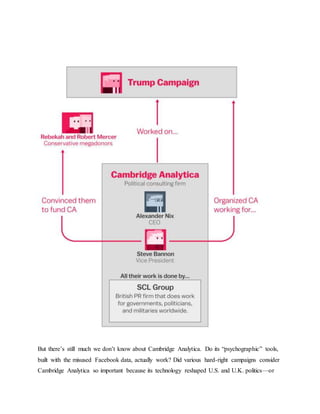
Cambridge Analytica has significant ties to some of President Trump’s most prominent
supporters and advisers. Rebekah Mercer, a Republican donor and a co-owner of Breitbart News,
sits on the board of Cambridge Analytica. Her father, Robert Mercer, invested $15 million in
Cambridge Analytica on the recommendation of his political adviser, Steve Bannon, according to
the Times. On Monday, hidden-camera footage appeared to show Alexander Nix, Cambridge
Analytica’s CEO, offering to bribe and blackmail public officials around the world. If Nix did so,
it would violate U.K. law. Cambridge Analytica suspended Nix on Tuesday.
Cambridge Analytica also used its “psychographic” tools to make targeted online ad buys for the
Brexit “Leave” campaign, the 2016 presidential campaign of Ted Cruz, and the 2016 Trump
campaign. If any British Cambridge Analytica employees without a green card worked on those
two U.S. campaigns, they did so in violation of federal law.
But there’s still much we don’t know about Cambridge Analytica. Do its “psychographic” tools,
built with the misused Facebook data, actually work? Did various hard-right campaigns consider
Cambridge Analytica so important because its technology reshaped U.S. and U.K. politics—or
because using it ingratiated campaigns to Robert and Rebekah Mercer, two of the richest people
in the world? And if Cambridge Analytica really was a voter-profiling company, what was its
chief executive doing apparently promising to bribe and blackmail public officials?
Questions remain about Facebook’s role, too. Since the 2016 elections, public ire has focused on
the company’s powerful News Feed and the role it played in amplifying Russian propaganda and
other hoaxes. Lawmakers have also criticized the company’s lax sale of political advertisements
to purchasers literally paying with Russian rubles. Political ads are not regulated as closely
online as they are on the TV or radio.
But the Cambridge Analytica scandal opens a new front for the company. Before Facebook
became a distributor of news, it was a platform for online applications, like personality quizzes
and social games like Farmville. Facebook has allowed third-party app developers to access
some private user data since May 2007, when it first opened the Facebook platform. Users must
consent to giving apps their data, but sometimes—as in the case of Kogan’s app—developers can
access data about a consenting user’s friends, without getting those friends’ consent.
During the ensuing decade, Facebook has occasionally tweaked how much data apps can access.
But over that time, how many developers abided by Facebook’s rules? How many followed
Kogan’s route, caching the data and making their own private databases? Where is that
information now? And if all that private user data is as powerful as Cambridge Analytica once
said it was, what has it been used to do?
Why Cambridge Analytica
When trump started on the campaign (second week of June) the Trump campaign had no
speakable data infrastructure.
 No database of record
 Many disparate data source
 No data science program (models)
 No proper digital marketing apparatus
 Research being done by upto 5 pollsters at one point
Kaiser said Cambridge Analytica staff told her they were stunned when they arrived at Trump’s
headquarters in Trump Tower, New York.
“There was no database of record. There were many disparate data sources that were not
connected or matched ,” she said of the process of ordering, sorting and cleaning enormous data
sets. “There was no data science program, so they weren’t undertaking any modelling. There was
no digital marketing team.”
One of the first things Cambridge Analytica did, she said, was work with data supplied by the
party’s data trust and other data acquired through an initiative called Project Alamo.
The document contains very little information about how the campaign used Facebook data. One
page, however, suggests Cambridge Analytica was able to constantly monitor the effectiveness
of its messaging on different types of voters, giving the company and the campaign constant
feedback about levels of engagement on platforms such as Twitter, Facebook and Snapchat.
How was the data used?
Kogan violated his agreement by giving the data to political data firm Cambridge Analytica,
which was co-founded by Republican donor Robert Mercer. The firm reportedly funded $7
million for Kogan’s exercise.
Once in Cambridge Analytica’s hands, the data of 30 million users (out of the original 50
million) was matched with other records to construct personality profiles on millions of
American voters. Cambridge Analytica classified voters using five personality traits known as
ocean – Openness, Conscientiousness, Extraversion, Agreeableness, and Neuroticism. The aim
was to identify the personalities of American voters and influence their behaviour, using
psychographic modelling techniques.
In December 2015, The guardian revealed that Cambridge Analytica was selling psychological
data to Ted Cruz’s presidential campaign. Although the New York Times reported that Facebook
did not verify how the information was being used, Facebook said it had removed the app in
2015 after learning of the subsequent violation of platform policies. Kogan, Cambridge
Analytica, and another former employee Christopher Wylie certified to Facebook that they had
deleted the data.
Once Donald Trump became the presumptive nominee, Cambridge Analytica made contact with,
and was later engaged by, his campaign team. The first payment of $100,000 was made in July
2016. The relationship is now under scrutiny by the Special Council investigating the alleged
Russian interference in the US election. There may also be ties with the UK’s Leave. EU
Campaign, the group which campaigned for Brexit in 2016.
In March 2018, the former Cambridge Analytica employee, Christopher Wylie, provided
documents and first-person testimony to The Times and the Observer which confirmed the
details. He also confirmed that a large amount of the data was still on the company’s servers.
How much the data actually contributed to influencing voters is still being debated and is unclear
India-Cambridge Analytica data scandal
Cambridge Analytica, the controversial UK political consultancy, claims on its website that it
worked on the Bihar assembly elections in 2010, and its clients won a landslide victory.
Formed in 2013, Cambridge Analytica’s parent firm is Strategic Communication Laboratories
(SCL). It has worked in India through an Indian company called Strategic Communication
Laboratories Private Limited. Company records show the firm has four directors: Alexander
James Ashburner Nix, Alexander Waddington Oakes, Amrish Kumar Tyagi, and Avneesh
Kumar Rai.
The first two are British citizens who were among the four co-founders of SCL in the UK in
2005. Amrish Tyagi is the son of Janata Dal (United) leader K.C. Tyagi. He also runs the firm
Ovleno Business Intelligence, which now works with Cambridge Analytica in India.But who is
Avneesh Kumar Rai, the fourth director of SCL India?Hailing from Bihar, Rai has been working
as an election consultant with politicians across party lines since 1984. He is so low-profile that
the internet will barely tell you anything about him. In an interview with ThePrint, he narrated
his full account of how SCL India started, what it tried to do, and why it failed.
A 2009 mystery
For the 2009 Lok Sabha elections, Rai was working with BJP leader Mahesh Sharma, currently
the minister of state (independent charge) for culture. Rai was dead sure that Sharma would win
the Gautam Buddh Nagar seat, but lost by a margin of fewer than 16,000 votes to the Bahujan
Samaj Party’s Surendra Singh Nagar.
Rai couldn’t understand why Sharma lost the seat, and was telling a London-based friend about
the mystery. The friend suggested he should get experts in political behaviour from the UK to
come down to Gautam Buddh Nagar and find out. This is how Rai got in touch with Dan
Muresan, head of elections at SCL UK.
Muresan, a Romanian national, came to India with another three experts from the Behavioural
Dynamics Institute. This institute had been founded by Nigel Oakes in 1993. Oakes and his
brother Alexander Oakes later became co-founders of SCL with Alexander Nix.
Muresan’s team conducted interviews through translators in the Jewar Vidhan Sabha segment,
the part of Gautam Buddh Nagar Lok Sabha constituency, where the votes for Sharma had been
unexpectedly low.
The month-long research included interviewing voters on video and then analysing the video for
facial movements as they answered questions, to figure out if they were lying. The research
found that people saw Sharma not as a politician or even a doctor, but a rich businessman (he
owned a hospital in Noida, which has now grown to a chain of hospitals across northern India).
Sharma had failed to show people any development dreams, make any specific promises, and
only vaguely said he would serve them.
Sharma had an associate, also a Brahmin like him, but he was so disliked by some Brahmins in
one area that they decided to vote for the BSP candidate just to spite him. Also, Brahmin voters
made so much noise about making Sharma win that there was a counter-consolidation of other
castes. Faults were found in the way BJP workers campaigned – Sharma’s door-to-door
campaigning was weak.
Rai was impressed by the London team’s methods, and Muresan said he was keen to do more
work in India. They decided to continue the conversation.
Alexander Nix comes to India
In 2010, Rai says he was working with a few candidates in Bihar. When not busy with elections,
Rai used to work with a family friend, Amrish Tyagi, on business intelligence – mainly detecting
counterfeit medicines in the market for pharma companies.
One day, Muresan came down to Delhi with Alexander Nix, and met Rai in the office of Ovleno
Business Intelligence. Tyagi was present too, and was involved in the conversation.
Muresan knew that Rai had been involved in creating a database of households in many states,
profiling them with their demographic details (including such details as their caste) and their
political preferences. Such a database is a goldmine for any candidate contesting an election.
Muresan and his team proposed expanding the project and creating such a database for 28 seats,
with an eye for selling them to parties and politicians for the 2014 Lok Sabha elections, which
were about four years away. Rai proposed creating a mobile app to make the database easily
accessible to clients.
Rai says the SCL team never went to Bihar, nor did any work in the Bihar elections. It was Rai
who, in his individual capacity, worked with around 27 candidates from different parties (on
either side of the political divide).
Claims of having worked in Bihar 2010, and other elections such as Rajasthan and Madhya
Pradesh in 2003, were added to the SCL’s powerpoint presentations to make a stronger sales
pitch. He has shared one such presentation with ThePrint. This was Rai’s own work.
Around the same time, in 2010-11, SCL UK was contracted by a political party in Ghana to do a
campaign for them. Surveys of English-speaking people in Ghana would arrive at Rai’s office in
Indirapuram, Ghaziabad. Through Ovleno Business Intelligence, Rai and Tyagi had thus begun
working with Nix’s company.The survey data would be analysed by a team in Ghaziabad, which
would then give feedback for the campaign narrative the party in Ghana should adopt.
Looking for a client
Work on the project began in 2011. Nix and Muresan would often come down to Delhi, as would
their staff from London. For the staff, a house in Indirapuram’s Shipra Sun City was rented.
Nix and Muresan, along with Rai and Tyagi, started meeting politicians, selling them their
services. These were:
What we have:
– Local knowledge and global expertise
– Global reputation and expertise – credibility
– Software for political intelligence & election management
– Android application for organisation and election management where information can
be updated in real time on mobile
– Access to the foremost behavioural change communications methodology in India
– The complete package – ‘A to Z’ of election Management services
Voter demographic data collection and analysis
Behavioural polling
Media monitoring
Target audience analysis – campaign strategy
Campaign consultancy – strategy and intervention management
Poll planning & management
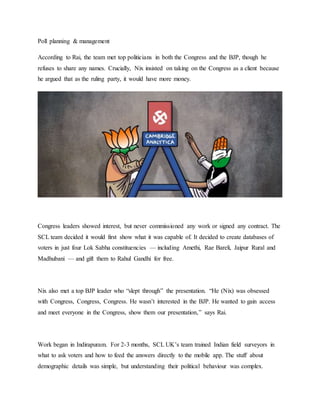
According to Rai, the team met top politicians in both the Congress and the BJP, though he
refuses to share any names. Crucially, Nix insisted on taking on the Congress as a client because
he argued that as the ruling party, it would have more money.
Congress leaders showed interest, but never commissioned any work or signed any contract. The
SCL team decided it would first show what it was capable of. It decided to create databases of
voters in just four Lok Sabha constituencies — including Amethi, Rae Bareli, Jaipur Rural and
Madhubani — and gift them to Rahul Gandhi for free.
Nix also met a top BJP leader who “slept through” the presentation. “He (Nix) was obsessed
with Congress, Congress, Congress. He wasn’t interested in the BJP. He wanted to gain access
and meet everyone in the Congress, show them our presentation,” says Rai.
Work began in Indirapuram. For 2-3 months, SCL UK’s team trained Indian field surveyors in
what to ask voters and how to feed the answers directly to the mobile app. The stuff about
demographic details was simple, but understanding their political behaviour was complex.
Testiomony
During his testimony before Congress on April 10, 2018, Mark Zuckerberg said it was his
personal mistake that he did not do enough to prevent Facebook from being used for harm. “That
goes for fake news, foreign interference in elections and hate speech.” During the testimony,
Mark Zuckerberg publicly apologized for the breach of private data: “It was my mistake, and I’m
sorry. I started Facebook, I run it, and I’m responsible for what happens here.” Zuckerberg said
that in 2013 researcher Aleksandar Kogan from Cambridge University created a personality quiz
app, which was installed by 300,000 people. The app was then able to retrieve Facebook
information, including that of the users' friends, and this was obtained by Kogan. It was not until
2015 that Zuckerberg learned that these users' information was shared by Kogan to Aleksandar
Kogan. Cambridge Analytica was subsequently asked to remove all the data. It was later
rediscovered by The Guardian, The New York Times and channel 4 that the data was in fact not
deleted.
REFERENCES
- Cambridge anaylitica History (https://en.wikipedia.org/wiki/Cambridge_Analytic)
- https://www.nytimes.com/2018/03/19/technology/facebook-cambridge-analytica-
explained.html
- https://www.theguardian.com/uk-news/2018/mar/23/leaked-cambridge-analyticas-
blueprint-for-trump-victory
- https://dig.watch/trends/cambridge-analytica
- https://www.recode.net/2018/3/17/17134072/facebook-cambridge-analytica-trump-
explained-user-data
- https://theprint.in/politics/exclusive-inside-story-cambridge-analytica-actually-
india/44012/

Cambridge analytica

  • 1.
  • 2.
    SUMMARY ON MARCH 17,2018, The New York Times, alongside The Guardian and The Observer, reported that Cambridge Analytica, a data analysis firm that worked on President Trump's 2016 campaign, and its related company, Strategic Communications Laboratories, pilfered the data of 50 million Facebook users and secretly kept it. This revelation and its implications, that Facebook allowed data from millions of its users to be captured and improperly used to influence the presidential election, ignited a conflagration that threatens to engulf the already tattered reputation of the embattled social media giant. For five days, Mark Zuckerberg, Facebook’s CEO, remained what many called “deafeningly silent,” before finally posting a lengthy response to his personal Facebook page. He then spoke to a small handful of news outlets, offering apologies, conceding mistakes, and surprisingly, even entertaining regulation for his sprawling company. Nearly a year later, in October 2017, news broke that Cambridge Analytica’s CEO, Alexander Nix, had approached Wikileaks founder Julian Assange in 2016 to exploit Hillary Clinton’s private emails, a revelation that raised concerns about Cambridge's role in Trump's 2016 campaign. People who worked with Trump’s campaign quickly moved to downplay Cambridge’s role, saying that the Republican National Campaign was the primary source of voter data, and “Any claims that voter data from any other source played a key role in the victory are false.” This prompted a lot of questions about who did what when. Facebook is in another awkward situation. The company claims that it wasn’t breached, and that while it has suspended Cambridge Analytica from its service, the social giant is not at fault. Facebook contends that its technology worked exactly how Facebook built it to work, but that bad actors, like Cambridge Analytica, violated the company’s terms of service. On the other hand, Facebook has since changed those terms of service to cut down on information third parties can collect, essentially admitting that its prior terms weren’t very good.
  • 3.
    INTRODUCTION TO COMPANY CambridgeAnalytica Ltd (CA) was a British political consulting firm which combined data mining, data brokerage, and data analysis with strategic communication during the electoral processes. It was started in 2013 as an offshoot of the SCL Group. The company closed operations in 2018, although related firms continued in existence HISTORY Cambridge Analytica (SCL USA) was incorporated in January 2015 with its registered office in Westferry Circus, London and just one staff member, its director and CEO Alexander James Ashburner Nix. Nix is also the director of nine similar companies sharing the same registered offices in London, including Firecrest technologies, Emerdata and six SCL Group companies including "SCL elections limited". Nigel Oakes founded SCL Group, which is the parent company of Cambridge Analytica. Cambridge Analytica CEO Alexander Nix speaking in November 2017. Publicly, SCL Group called itself a "global election management agency", Politico reported it was known for involvement "in military disinformation campaigns to social media branding and voter targeting". SCL's involvement in the political world has been primarily in the developing world where it has been used by the military and politicians to study and manipulate public opinion and political will. Slate writer Sharon Weinberger compared one of SCL's hypothetical test scenarios to fomenting a coup. Cambridge Analytica was founded by conservative businessmen Steve Bannon and Robert Mercer. A minimum of 15 million dollars has been invested into the company by Mercer, according to The New York Times. Bannon's stake in the company was estimated at 1 to 5 million dollars, but he divested his holdings in April 2017 as required by his role as White House Chief Strategist. In March 2018, Jennifer Mercer and Rebekah Anne Mercer became directors of Emerdata limited. In March 2018 it became public by Whistleblower Christopher Wylie, that
  • 4.
    Cambridge Analytica's firstactivities where founded on a data set, which its parent company SCL bought 2014 from a company named Global Science Research founded by Aleksandr Kogan who worked as an psychologist at Cambridge. Per the Associated Press, Data Propria, a data analysis firm launched May 2018, is run by former officials at Cambridge Analytica. In July 2018, several former Cambridge Analytica staff launched Auspex International, a company intended to influence politics and society in Africa and the Middle East Facebook-Cambridge Analytica data scandal Political data firm Cambridge Analytica obtained the data of 50 million Facebook users, constructed 30 million personality profiles, and sold the data to US politicians seeking election to influence voters, without the users’ consent. Although this was revealed in 2015, in March 2018 a former employee of the firm came forward with more details, placing Facebook's practices under intense scrutiny, and raising questions as to the responsibility of the Internet industry.
  • 5.
    2014 — 'Thisisyourdigitallife' InJune 2014, Cambridge academic Aleksandr Kogan and his company Global Science Research created an app called "thisisyourdigitallife" in 2013. The app prompted users to answer questions for a psychological profile. Almost 300,000 users were thought to have been paid to take the psychological test — with the app then harvesting their personal data. It also gathered data from their Facebook friends, which reportedly resulted in Kogan having access to the data of millions of Facebook profiles. It was heavily influenced by a similar personality-quiz app made by the Psychometrics Centre, a Cambridge University laboratory where Kogan worked. About 270,000 people installed Kogan’s app on their Facebook account. But as with any Facebook developer at the time, Kogan could access data about those users or their friends. And when Kogan’s app asked for that data, it saved that information into a private database instead of immediately deleting it. Kogan provided that private database, containing information about 50 million Facebook users, to the voter-profiling company Cambridge Analytica. Cambridge Analytica used it to make 30 million “psychographic” profiles about voters. Cambridge Analytica has significant ties to some of President Trump’s most prominent supporters and advisers. Rebekah Mercer, a Republican donor and a co-owner of Breitbart News, sits on the board of Cambridge Analytica. Her father, Robert Mercer, invested $15 million in Cambridge Analytica on the recommendation of his political adviser, Steve Bannon, according to the Times. On Monday, hidden-camera footage appeared to show Alexander Nix, Cambridge Analytica’s CEO, offering to bribe and blackmail public officials around the world. If Nix did so, it would violate U.K. law. Cambridge Analytica suspended Nix on Tuesday. Cambridge Analytica also used its “psychographic” tools to make targeted online ad buys for the Brexit “Leave” campaign, the 2016 presidential campaign of Ted Cruz, and the 2016 Trump campaign. If any British Cambridge Analytica employees without a green card worked on those two U.S. campaigns, they did so in violation of federal law.
  • 6.
    But there’s stillmuch we don’t know about Cambridge Analytica. Do its “psychographic” tools, built with the misused Facebook data, actually work? Did various hard-right campaigns consider Cambridge Analytica so important because its technology reshaped U.S. and U.K. politics—or
  • 7.
    because using itingratiated campaigns to Robert and Rebekah Mercer, two of the richest people in the world? And if Cambridge Analytica really was a voter-profiling company, what was its chief executive doing apparently promising to bribe and blackmail public officials? Questions remain about Facebook’s role, too. Since the 2016 elections, public ire has focused on the company’s powerful News Feed and the role it played in amplifying Russian propaganda and other hoaxes. Lawmakers have also criticized the company’s lax sale of political advertisements to purchasers literally paying with Russian rubles. Political ads are not regulated as closely online as they are on the TV or radio. But the Cambridge Analytica scandal opens a new front for the company. Before Facebook became a distributor of news, it was a platform for online applications, like personality quizzes and social games like Farmville. Facebook has allowed third-party app developers to access some private user data since May 2007, when it first opened the Facebook platform. Users must consent to giving apps their data, but sometimes—as in the case of Kogan’s app—developers can access data about a consenting user’s friends, without getting those friends’ consent. During the ensuing decade, Facebook has occasionally tweaked how much data apps can access. But over that time, how many developers abided by Facebook’s rules? How many followed Kogan’s route, caching the data and making their own private databases? Where is that information now? And if all that private user data is as powerful as Cambridge Analytica once said it was, what has it been used to do? Why Cambridge Analytica When trump started on the campaign (second week of June) the Trump campaign had no speakable data infrastructure.  No database of record  Many disparate data source  No data science program (models)  No proper digital marketing apparatus  Research being done by upto 5 pollsters at one point
  • 8.
    Kaiser said CambridgeAnalytica staff told her they were stunned when they arrived at Trump’s headquarters in Trump Tower, New York. “There was no database of record. There were many disparate data sources that were not connected or matched ,” she said of the process of ordering, sorting and cleaning enormous data sets. “There was no data science program, so they weren’t undertaking any modelling. There was no digital marketing team.” One of the first things Cambridge Analytica did, she said, was work with data supplied by the party’s data trust and other data acquired through an initiative called Project Alamo. The document contains very little information about how the campaign used Facebook data. One page, however, suggests Cambridge Analytica was able to constantly monitor the effectiveness of its messaging on different types of voters, giving the company and the campaign constant feedback about levels of engagement on platforms such as Twitter, Facebook and Snapchat. How was the data used? Kogan violated his agreement by giving the data to political data firm Cambridge Analytica, which was co-founded by Republican donor Robert Mercer. The firm reportedly funded $7 million for Kogan’s exercise. Once in Cambridge Analytica’s hands, the data of 30 million users (out of the original 50 million) was matched with other records to construct personality profiles on millions of American voters. Cambridge Analytica classified voters using five personality traits known as ocean – Openness, Conscientiousness, Extraversion, Agreeableness, and Neuroticism. The aim was to identify the personalities of American voters and influence their behaviour, using psychographic modelling techniques. In December 2015, The guardian revealed that Cambridge Analytica was selling psychological data to Ted Cruz’s presidential campaign. Although the New York Times reported that Facebook did not verify how the information was being used, Facebook said it had removed the app in 2015 after learning of the subsequent violation of platform policies. Kogan, Cambridge Analytica, and another former employee Christopher Wylie certified to Facebook that they had deleted the data. Once Donald Trump became the presumptive nominee, Cambridge Analytica made contact with, and was later engaged by, his campaign team. The first payment of $100,000 was made in July 2016. The relationship is now under scrutiny by the Special Council investigating the alleged Russian interference in the US election. There may also be ties with the UK’s Leave. EU Campaign, the group which campaigned for Brexit in 2016.
  • 9.
    In March 2018,the former Cambridge Analytica employee, Christopher Wylie, provided documents and first-person testimony to The Times and the Observer which confirmed the details. He also confirmed that a large amount of the data was still on the company’s servers. How much the data actually contributed to influencing voters is still being debated and is unclear India-Cambridge Analytica data scandal Cambridge Analytica, the controversial UK political consultancy, claims on its website that it worked on the Bihar assembly elections in 2010, and its clients won a landslide victory. Formed in 2013, Cambridge Analytica’s parent firm is Strategic Communication Laboratories (SCL). It has worked in India through an Indian company called Strategic Communication Laboratories Private Limited. Company records show the firm has four directors: Alexander James Ashburner Nix, Alexander Waddington Oakes, Amrish Kumar Tyagi, and Avneesh Kumar Rai. The first two are British citizens who were among the four co-founders of SCL in the UK in 2005. Amrish Tyagi is the son of Janata Dal (United) leader K.C. Tyagi. He also runs the firm Ovleno Business Intelligence, which now works with Cambridge Analytica in India.But who is Avneesh Kumar Rai, the fourth director of SCL India?Hailing from Bihar, Rai has been working as an election consultant with politicians across party lines since 1984. He is so low-profile that the internet will barely tell you anything about him. In an interview with ThePrint, he narrated his full account of how SCL India started, what it tried to do, and why it failed.
  • 10.
    A 2009 mystery Forthe 2009 Lok Sabha elections, Rai was working with BJP leader Mahesh Sharma, currently the minister of state (independent charge) for culture. Rai was dead sure that Sharma would win the Gautam Buddh Nagar seat, but lost by a margin of fewer than 16,000 votes to the Bahujan Samaj Party’s Surendra Singh Nagar. Rai couldn’t understand why Sharma lost the seat, and was telling a London-based friend about the mystery. The friend suggested he should get experts in political behaviour from the UK to come down to Gautam Buddh Nagar and find out. This is how Rai got in touch with Dan Muresan, head of elections at SCL UK. Muresan, a Romanian national, came to India with another three experts from the Behavioural Dynamics Institute. This institute had been founded by Nigel Oakes in 1993. Oakes and his brother Alexander Oakes later became co-founders of SCL with Alexander Nix.
  • 11.
    Muresan’s team conductedinterviews through translators in the Jewar Vidhan Sabha segment, the part of Gautam Buddh Nagar Lok Sabha constituency, where the votes for Sharma had been unexpectedly low. The month-long research included interviewing voters on video and then analysing the video for facial movements as they answered questions, to figure out if they were lying. The research found that people saw Sharma not as a politician or even a doctor, but a rich businessman (he owned a hospital in Noida, which has now grown to a chain of hospitals across northern India). Sharma had failed to show people any development dreams, make any specific promises, and only vaguely said he would serve them. Sharma had an associate, also a Brahmin like him, but he was so disliked by some Brahmins in one area that they decided to vote for the BSP candidate just to spite him. Also, Brahmin voters made so much noise about making Sharma win that there was a counter-consolidation of other castes. Faults were found in the way BJP workers campaigned – Sharma’s door-to-door campaigning was weak. Rai was impressed by the London team’s methods, and Muresan said he was keen to do more work in India. They decided to continue the conversation. Alexander Nix comes to India In 2010, Rai says he was working with a few candidates in Bihar. When not busy with elections, Rai used to work with a family friend, Amrish Tyagi, on business intelligence – mainly detecting counterfeit medicines in the market for pharma companies. One day, Muresan came down to Delhi with Alexander Nix, and met Rai in the office of Ovleno Business Intelligence. Tyagi was present too, and was involved in the conversation.
  • 12.
    Muresan knew thatRai had been involved in creating a database of households in many states, profiling them with their demographic details (including such details as their caste) and their political preferences. Such a database is a goldmine for any candidate contesting an election. Muresan and his team proposed expanding the project and creating such a database for 28 seats, with an eye for selling them to parties and politicians for the 2014 Lok Sabha elections, which were about four years away. Rai proposed creating a mobile app to make the database easily accessible to clients. Rai says the SCL team never went to Bihar, nor did any work in the Bihar elections. It was Rai who, in his individual capacity, worked with around 27 candidates from different parties (on either side of the political divide). Claims of having worked in Bihar 2010, and other elections such as Rajasthan and Madhya Pradesh in 2003, were added to the SCL’s powerpoint presentations to make a stronger sales pitch. He has shared one such presentation with ThePrint. This was Rai’s own work. Around the same time, in 2010-11, SCL UK was contracted by a political party in Ghana to do a campaign for them. Surveys of English-speaking people in Ghana would arrive at Rai’s office in Indirapuram, Ghaziabad. Through Ovleno Business Intelligence, Rai and Tyagi had thus begun working with Nix’s company.The survey data would be analysed by a team in Ghaziabad, which would then give feedback for the campaign narrative the party in Ghana should adopt.
  • 13.
    Looking for aclient Work on the project began in 2011. Nix and Muresan would often come down to Delhi, as would their staff from London. For the staff, a house in Indirapuram’s Shipra Sun City was rented. Nix and Muresan, along with Rai and Tyagi, started meeting politicians, selling them their services. These were: What we have: – Local knowledge and global expertise – Global reputation and expertise – credibility – Software for political intelligence & election management – Android application for organisation and election management where information can be updated in real time on mobile – Access to the foremost behavioural change communications methodology in India – The complete package – ‘A to Z’ of election Management services Voter demographic data collection and analysis Behavioural polling Media monitoring Target audience analysis – campaign strategy Campaign consultancy – strategy and intervention management
  • 14.
    Poll planning &management According to Rai, the team met top politicians in both the Congress and the BJP, though he refuses to share any names. Crucially, Nix insisted on taking on the Congress as a client because he argued that as the ruling party, it would have more money. Congress leaders showed interest, but never commissioned any work or signed any contract. The SCL team decided it would first show what it was capable of. It decided to create databases of voters in just four Lok Sabha constituencies — including Amethi, Rae Bareli, Jaipur Rural and Madhubani — and gift them to Rahul Gandhi for free. Nix also met a top BJP leader who “slept through” the presentation. “He (Nix) was obsessed with Congress, Congress, Congress. He wasn’t interested in the BJP. He wanted to gain access and meet everyone in the Congress, show them our presentation,” says Rai. Work began in Indirapuram. For 2-3 months, SCL UK’s team trained Indian field surveyors in what to ask voters and how to feed the answers directly to the mobile app. The stuff about demographic details was simple, but understanding their political behaviour was complex.
  • 15.
    Testiomony During his testimonybefore Congress on April 10, 2018, Mark Zuckerberg said it was his personal mistake that he did not do enough to prevent Facebook from being used for harm. “That goes for fake news, foreign interference in elections and hate speech.” During the testimony, Mark Zuckerberg publicly apologized for the breach of private data: “It was my mistake, and I’m sorry. I started Facebook, I run it, and I’m responsible for what happens here.” Zuckerberg said that in 2013 researcher Aleksandar Kogan from Cambridge University created a personality quiz app, which was installed by 300,000 people. The app was then able to retrieve Facebook information, including that of the users' friends, and this was obtained by Kogan. It was not until 2015 that Zuckerberg learned that these users' information was shared by Kogan to Aleksandar Kogan. Cambridge Analytica was subsequently asked to remove all the data. It was later rediscovered by The Guardian, The New York Times and channel 4 that the data was in fact not deleted.
  • 16.
    REFERENCES - Cambridge anayliticaHistory (https://en.wikipedia.org/wiki/Cambridge_Analytic) - https://www.nytimes.com/2018/03/19/technology/facebook-cambridge-analytica- explained.html - https://www.theguardian.com/uk-news/2018/mar/23/leaked-cambridge-analyticas- blueprint-for-trump-victory - https://dig.watch/trends/cambridge-analytica - https://www.recode.net/2018/3/17/17134072/facebook-cambridge-analytica-trump- explained-user-data - https://theprint.in/politics/exclusive-inside-story-cambridge-analytica-actually- india/44012/