Abstract
At the annual meeting of the
Functioning and Disability
Reference Group (FDRG) of the
World Health Organization’s Family of
International Classifications Nertwork
(WHO-FIC) in 2013, it was agreed to
encourage the development of a
collaborative to investigate the
development of a mobile
application for ICF. Currently the
International mICF Partnership
includes 284 partners from 39
countries.
In 2015, a transprofessional mICF
consortium of 19 partners from
Europe, Africa, Americas and Asia
designed a detailed work plan
and applied for Horizon 2020 funding
to develop the user-friendly
ICanFunction (mICF) health service
platform.
mICF work program summary
17-23 October 2015
Manchester
United Kingdom
Poster Number: 000
WHO - FAMILY OF INTERNATIONAL CLASSIFICATIONS NETWORK ANNUAL MEETING 2015
Anttila H1, Kraus de Camargo O2, Maribo T3, Saranto K4, Snyman S5,
Paltamaa J6, Valerius J7, Weckström P6, on behalf of International mICF Partnership
Title
Methods
We developed a work plan divided into
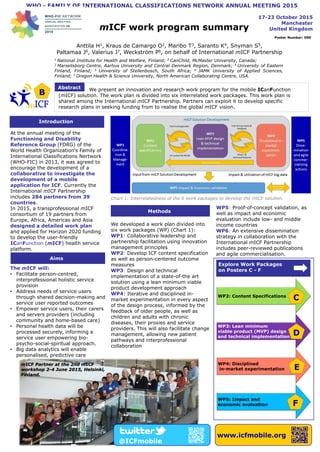
six work packages (WP) (Chart 1):
WP1: Collaborative leadership and
partnership facilitation using innovation
management principles
WP2: Develop ICF content specification
as well as person-centered outcome
measures
WP3: Design and technical
implementation of a state-of-the art
solution using a lean minimum viable
product development approach
WP4: Iterative and disciplined in-
market experimentation in every aspect
of the design process, informed by the
feedback of older people, as well as
children and adults with chronic
diseases, their proxies and service
providers. This will also facilitate change
management, allowing new patient
pathways and interprofessional
collaboration
We present an innovation and research work program for the mobile ICanFunction
(mICF) solution. The work plan is divided into six interrelated work packages. This work plan is
shared among the International mICF Partnership. Partners can exploit it to develop specific
research plans in seeking funding from to realise the global mICF vision.
Introduction
Chart 1: Interrelatedness of the 6 work packages to develop the mICF solution.
Explore Work Packages
on Posters C - FThe mICF will:
• Facilitate person-centred,
interprofessional holistic service
provision
• Address needs of service users
through shared decision-making and
service user reported outcomes
• Empower service users, their carers
and servers providers (including
community and home-based care)
• Personal health data will be
processed securely, informing a
service user empowering bio-
psycho-social-spiritual approach.
• Big data analytics will enable
personalised, predictive care
WP3: Lean minimum
viable product (MVP) design
and technical implementation
B
D
1 National Institute for Health and Welfare, Finland; 2 CanChild, McMaster University, Canada;
3 Marselisborg Centre, Aarhus University and Central Denmark Region, Denmark; 4 University of Eastern
Finland, Finland; 5 University of Stellenbosch, South Africa; 6 JAMK University of Applied Sciences,
Finland; 7 Oregon Health & Science University, North American Collaborating Centre, USA.
Aims
WP5: Proof-of-concept validation, as
well as impact and economic
evaluation include low- and middle
income countries
WP6: An extensive dissemination
strategy in collaboration with the
International mICF Partnership
includes peer-reviewed publications
and agile commercialisation.
@ICFmobile
WP2: Content Specifications
C
WP5: Impact and
economic evaluation
WP4: Disciplined
in-market experimentation E
F
www.icfmobile.org
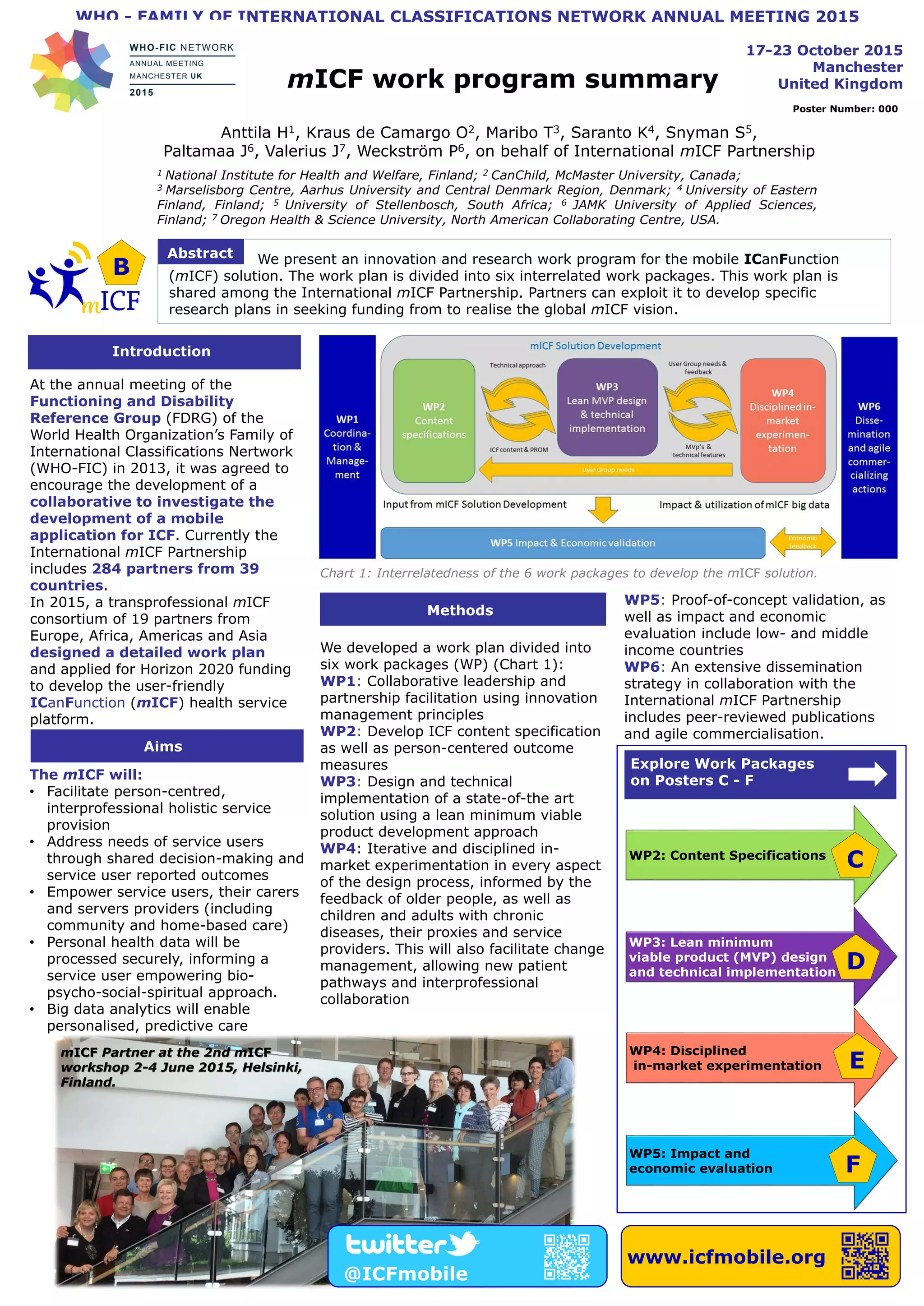
mICF Partner at the 2nd mICF
workshop 2-4 June 2015, Helsinki,
Finland.

mICF work plan summary

  • 1.
    Abstract At the annualmeeting of the Functioning and Disability Reference Group (FDRG) of the World Health Organization’s Family of International Classifications Nertwork (WHO-FIC) in 2013, it was agreed to encourage the development of a collaborative to investigate the development of a mobile application for ICF. Currently the International mICF Partnership includes 284 partners from 39 countries. In 2015, a transprofessional mICF consortium of 19 partners from Europe, Africa, Americas and Asia designed a detailed work plan and applied for Horizon 2020 funding to develop the user-friendly ICanFunction (mICF) health service platform. mICF work program summary 17-23 October 2015 Manchester United Kingdom Poster Number: 000 WHO - FAMILY OF INTERNATIONAL CLASSIFICATIONS NETWORK ANNUAL MEETING 2015 Anttila H1, Kraus de Camargo O2, Maribo T3, Saranto K4, Snyman S5, Paltamaa J6, Valerius J7, Weckström P6, on behalf of International mICF Partnership Title Methods We developed a work plan divided into six work packages (WP) (Chart 1): WP1: Collaborative leadership and partnership facilitation using innovation management principles WP2: Develop ICF content specification as well as person-centered outcome measures WP3: Design and technical implementation of a state-of-the art solution using a lean minimum viable product development approach WP4: Iterative and disciplined in- market experimentation in every aspect of the design process, informed by the feedback of older people, as well as children and adults with chronic diseases, their proxies and service providers. This will also facilitate change management, allowing new patient pathways and interprofessional collaboration We present an innovation and research work program for the mobile ICanFunction (mICF) solution. The work plan is divided into six interrelated work packages. This work plan is shared among the International mICF Partnership. Partners can exploit it to develop specific research plans in seeking funding from to realise the global mICF vision. Introduction Chart 1: Interrelatedness of the 6 work packages to develop the mICF solution. Explore Work Packages on Posters C - FThe mICF will: • Facilitate person-centred, interprofessional holistic service provision • Address needs of service users through shared decision-making and service user reported outcomes • Empower service users, their carers and servers providers (including community and home-based care) • Personal health data will be processed securely, informing a service user empowering bio- psycho-social-spiritual approach. • Big data analytics will enable personalised, predictive care WP3: Lean minimum viable product (MVP) design and technical implementation B D 1 National Institute for Health and Welfare, Finland; 2 CanChild, McMaster University, Canada; 3 Marselisborg Centre, Aarhus University and Central Denmark Region, Denmark; 4 University of Eastern Finland, Finland; 5 University of Stellenbosch, South Africa; 6 JAMK University of Applied Sciences, Finland; 7 Oregon Health & Science University, North American Collaborating Centre, USA. Aims WP5: Proof-of-concept validation, as well as impact and economic evaluation include low- and middle income countries WP6: An extensive dissemination strategy in collaboration with the International mICF Partnership includes peer-reviewed publications and agile commercialisation. @ICFmobile WP2: Content Specifications C WP5: Impact and economic evaluation WP4: Disciplined in-market experimentation E F www.icfmobile.org mICF Partner at the 2nd mICF workshop 2-4 June 2015, Helsinki, Finland.