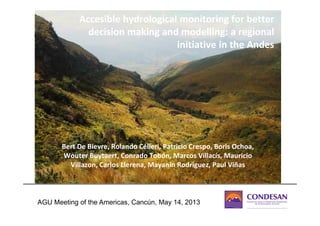
Accesible hydrological monitoring for better
decision making and modelling: a regional
initiative in the Andes
Bert De Bievre, Rolando Célleri, Patricio Crespo, Boris Ochoa,
Wouter Buytaert, Conrado Tobón, Marcos Villacís, Mauricio
Villazon, Carlos Llerena, Mayanín Rodriguez, Paul Viñas
AGU Meeting of the Americas, Cancún, May 14, 2013
History
• Research component of Proyecto Páramo Andino
• Quickly interest from several partners to extend beyond
paramo to other Andean ecosystems
• Integrated in Climate Change Monitoring Program of the
Andean Community (SGCAN)
• Validated in II World Paramo Congress, Loja, Ecuador, 2009
• Workshop in Cuenca, Ecuador, to fine tune proposal, July 2010
Iniciativa Regional de Monitoreo Hidrológico
de Ecosistemas Andinos – iMHEA
BIG knowledge gaps on Andean ecosystems
hydrology
• We don’t know many basic things on hydrological processes
in Andean ecosystems, this is more evident when Climate
Change catches us being unprepared
• Many “water conservation” practices have not been
evaluated for their hydrological benefit
• Bad misunderstandings and mistakes because of lack of good
information, e.g. on (re)forestation
• Efficiency of water conservation investment is low
• Lack of information for modellers
• More recently big efforts for glacier monitoring
Traditional hydrometeorological monitoring
• National scale
• Location in function of infrastructure presence (airports,
hydropower, irrigation, …)
• Therefore huge gap in high altitude areas
• Processing of long time series, statistics, little attention for
hydrological processes
What do we need then?
• Local information
• Monitoring of watersheds and ecosystems, effect of land use
and vegetation cover
• Main focus on highlands: the “water sources”
• Information that allows to give some answers to burning
questions, and decision making on the short or mid term
Some burning questions that decision makers and
watershed managers have
• Short term (a few years)
– How does land use change affect water yield and water
regulation?
– What kind of land use change?
- Conversion of natural ecosystem to agricultural land
- Livestock/overgrazing
- Deforestation, Reforestation, Forestation, introduced vs native species
• Long term (10+ years)
– Climate change: changes in rainfall AND hydrological response to it.
Principles guiding this proposal
• It is better to have simple hydrological monitoring at many
sites than detailed monitoring on a few ones
• This will take us to regional conclusions and not leave big
gaps
• Low complexity threshold, to make it accesible for many
stakeholders
• Guarantee quality through followup from a technical
coordination
• Not just identify the changes in hydrology, but provide
information that improves management action efficiency
• Develop simple indicators that qualify the quality of the
hydrological service
Proposal
• Minimum = Rainfall &
Runoff
• 3 well distributed rain
gauges and an automatic
discharge gauging station
per microcatchment
• Paired catchment design
wherever feasible,
catchments differ in the
most relevant land use
regime
Propuesta de la Iniciativa MHEA
Paired catchments
Propuesta de la Iniciativa MHEA
• Monitoring that can give us policy-relevant conclusions in a
short monitoring period
0
100
200
300
400
500
600
09/09/2004
0:00
10/09/2004
6:00
11/09/2004
12:00
12/09/2004
18:00
14/09/2004
0:00
15/09/2004
6:00
16/09/2004
12:00
Tiempo
Caudal(L/s)
0
2
4
6
8
10
12
14
16
Precipitación(mm)
Precipitación
Cuenca con pajonal
Cuenca con pinos
Buytaert, Iñiguez, De Bièvre, 2007, The effects of afforestation and cultivation on water yield in the
Andean paramo, Forest Ecology and Management 251(1-2): 22-30
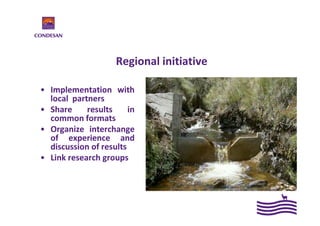
Regional initiative
• Implementation with
local partners
• Share results in
common formats
• Organize interchange
of experience and
discussion of results
• Link research groups
Current partners
• A dozen of local NGO’s, local governments, from Mérida
(Venezuela), to Bolivia
• Universidad de los Andes, Mérida, Venezuela
• Universidad Nacional de Colombia, Medellin, Colombia
• Universidad de Cuenca, Cuenca, Ecuador
• Universidad Agraria La Molina, Lima, Peru
• Universidad Mayor San Simón, Cochabamba, Bolivia
• Imperial College, London
• Please tell us if you are interested to join!
Socios de la Iniciativa MHEA
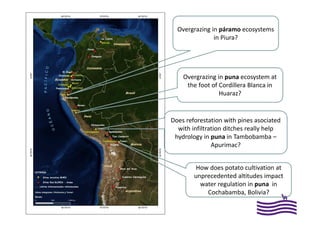
Overgrazing in páramo ecosystems
in Piura?
Overgrazing in puna ecosystem at
the foot of Cordillera Blanca in
Huaraz?
Does reforestation with pines asociated
with infiltration ditches really help
hydrology in puna in Tambobamba –
Apurimac?
How does potato cultivation at
unprecedented altitudes impact
water regulation in puna in
Cochabamba, Bolivia?
Keys for success (so far …)
• Being able to combine local stakeholders’ information needs
(key for sustainability), with more regional Andean
knowledge gaps and advancement of science
• Organizing technical backstopping to local partners,
benefiting quality and information gaps
• Monitoring new technologies/sensor market
• Simple indicators – building discussion language among
participants with different backgrounds
mriMountain
research
initiative
London, 26 March 2012
updated Rigi Kulm, 25 April 2013
A Global Fair and Workshop
on
Long-Term Observing Systems of Mountain Social-
Ecological Systems
What: A multi-day event bringing together researchers, managers and
funders of mountain observatories, field stations, transects and observing
networks that gather data on mountain social systems, on mountain
ecosystems (from climate to genetics), on mountain abiotic environments or
all of the above to
• describe their work
• explain sensors and protocols (flagship stations, crowd-sourcing, etc.)
• discuss data management, access and presentation
• explore the questions and phenomena driving observations
• visit exemplary transects and observatories
• create new collaborations
• formalize cooperative arrangements.
When: Summer 2014 (between July and September)
Where: Reno, Nevada, USA (and surrounding Sierra Nevada, Cascade and
Great Basin mountain ranges)

Accesible hydrological monitoring for better decision making and modelling: a regional initiative in the Andes

  • 1.
    Accesible hydrological monitoringfor better decision making and modelling: a regional initiative in the Andes Bert De Bievre, Rolando Célleri, Patricio Crespo, Boris Ochoa, Wouter Buytaert, Conrado Tobón, Marcos Villacís, Mauricio Villazon, Carlos Llerena, Mayanín Rodriguez, Paul Viñas AGU Meeting of the Americas, Cancún, May 14, 2013
  • 2.
    History • Research componentof Proyecto Páramo Andino • Quickly interest from several partners to extend beyond paramo to other Andean ecosystems • Integrated in Climate Change Monitoring Program of the Andean Community (SGCAN) • Validated in II World Paramo Congress, Loja, Ecuador, 2009 • Workshop in Cuenca, Ecuador, to fine tune proposal, July 2010
  • 3.
    Iniciativa Regional deMonitoreo Hidrológico de Ecosistemas Andinos – iMHEA
  • 4.
    BIG knowledge gapson Andean ecosystems hydrology • We don’t know many basic things on hydrological processes in Andean ecosystems, this is more evident when Climate Change catches us being unprepared • Many “water conservation” practices have not been evaluated for their hydrological benefit • Bad misunderstandings and mistakes because of lack of good information, e.g. on (re)forestation • Efficiency of water conservation investment is low • Lack of information for modellers • More recently big efforts for glacier monitoring
  • 5.
    Traditional hydrometeorological monitoring •National scale • Location in function of infrastructure presence (airports, hydropower, irrigation, …) • Therefore huge gap in high altitude areas • Processing of long time series, statistics, little attention for hydrological processes
  • 6.
    What do weneed then? • Local information • Monitoring of watersheds and ecosystems, effect of land use and vegetation cover • Main focus on highlands: the “water sources” • Information that allows to give some answers to burning questions, and decision making on the short or mid term
  • 7.
    Some burning questionsthat decision makers and watershed managers have • Short term (a few years) – How does land use change affect water yield and water regulation? – What kind of land use change? - Conversion of natural ecosystem to agricultural land - Livestock/overgrazing - Deforestation, Reforestation, Forestation, introduced vs native species • Long term (10+ years) – Climate change: changes in rainfall AND hydrological response to it.
  • 8.
    Principles guiding thisproposal • It is better to have simple hydrological monitoring at many sites than detailed monitoring on a few ones • This will take us to regional conclusions and not leave big gaps • Low complexity threshold, to make it accesible for many stakeholders • Guarantee quality through followup from a technical coordination • Not just identify the changes in hydrology, but provide information that improves management action efficiency • Develop simple indicators that qualify the quality of the hydrological service
  • 9.
    Proposal • Minimum =Rainfall & Runoff • 3 well distributed rain gauges and an automatic discharge gauging station per microcatchment • Paired catchment design wherever feasible, catchments differ in the most relevant land use regime
  • 10.
    Propuesta de laIniciativa MHEA
  • 11.
  • 12.
    • Monitoring thatcan give us policy-relevant conclusions in a short monitoring period 0 100 200 300 400 500 600 09/09/2004 0:00 10/09/2004 6:00 11/09/2004 12:00 12/09/2004 18:00 14/09/2004 0:00 15/09/2004 6:00 16/09/2004 12:00 Tiempo Caudal(L/s) 0 2 4 6 8 10 12 14 16 Precipitación(mm) Precipitación Cuenca con pajonal Cuenca con pinos Buytaert, Iñiguez, De Bièvre, 2007, The effects of afforestation and cultivation on water yield in the Andean paramo, Forest Ecology and Management 251(1-2): 22-30
  • 13.
    Regional initiative • Implementationwith local partners • Share results in common formats • Organize interchange of experience and discussion of results • Link research groups
  • 14.
    Current partners • Adozen of local NGO’s, local governments, from Mérida (Venezuela), to Bolivia • Universidad de los Andes, Mérida, Venezuela • Universidad Nacional de Colombia, Medellin, Colombia • Universidad de Cuenca, Cuenca, Ecuador • Universidad Agraria La Molina, Lima, Peru • Universidad Mayor San Simón, Cochabamba, Bolivia • Imperial College, London • Please tell us if you are interested to join!
  • 15.
    Socios de laIniciativa MHEA
  • 16.
    Overgrazing in páramoecosystems in Piura? Overgrazing in puna ecosystem at the foot of Cordillera Blanca in Huaraz? Does reforestation with pines asociated with infiltration ditches really help hydrology in puna in Tambobamba – Apurimac? How does potato cultivation at unprecedented altitudes impact water regulation in puna in Cochabamba, Bolivia?
  • 17.
    Keys for success(so far …) • Being able to combine local stakeholders’ information needs (key for sustainability), with more regional Andean knowledge gaps and advancement of science • Organizing technical backstopping to local partners, benefiting quality and information gaps • Monitoring new technologies/sensor market • Simple indicators – building discussion language among participants with different backgrounds
  • 18.
    mriMountain research initiative London, 26 March2012 updated Rigi Kulm, 25 April 2013
  • 19.
    A Global Fairand Workshop on Long-Term Observing Systems of Mountain Social- Ecological Systems What: A multi-day event bringing together researchers, managers and funders of mountain observatories, field stations, transects and observing networks that gather data on mountain social systems, on mountain ecosystems (from climate to genetics), on mountain abiotic environments or all of the above to • describe their work • explain sensors and protocols (flagship stations, crowd-sourcing, etc.) • discuss data management, access and presentation • explore the questions and phenomena driving observations • visit exemplary transects and observatories • create new collaborations • formalize cooperative arrangements. When: Summer 2014 (between July and September) Where: Reno, Nevada, USA (and surrounding Sierra Nevada, Cascade and Great Basin mountain ranges)