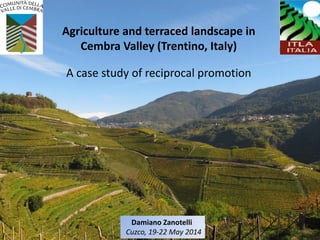
Agriculture and terraced landscape in
Cembra Valley (Trentino, Italy)
A case study of reciprocal promotion
Damiano Zanotelli
Cuzco, 19-22 May 2014
Where we are
Val di Cembra
Main Features of Cembra Valley
WINE PRODUCTION
PORFID ROCK and NATURAL RESOURCES
Grape harvest
Sustainable Development Project
• 3 actions:
1. Valorizazion of local agricultural products
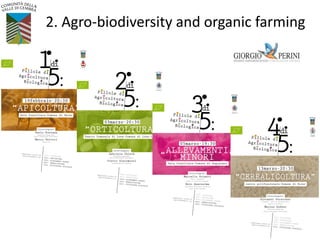
2. Agro-biodiversity and organic farming
3. Collaborations with ITLA
Financed by:
1. Valorization of traditional
agricultural products
• Objectives
– Improve cohesion between producers and economic operators
– Diffusion of concepts related to a sustainable development an
to the importance of maintaining the traditional terraced system
• Methods
– Courses on economic and environmental aspects of Cembra
Valley
– Meetings to reinforce relationships among different
stakeholders
• Risultati:
– The map „Navigare in Valle di Cembra“ represents a good
synthesis of the results.
2. Agro-biodiversity and organic farming
Collaborations with ITLA
• Objectives:
• To Tranfer the founding principles of ITLA
• Reinforce a netwoork among different terraced areas of Italy
to promote the contemporary value of terraced landscapes
• Results:
• Survey and interviews about the traditional knowledge
(small publication „Working the Landscape“)
• ITLA conference, Albiano (Cembra Valley) May 2013
• A dry stone course:
http://www.youtube.com/watch?v=nUB8g6-6NQg
• Documentary and website „Talking stones“
a BLIND TEST
Influence of the Landscape
quality on wine preference
degradato monotono
ben conservato evocativo
Prof. T. Tempesta
(University of Padova)
Albiano (Cembra Valley)
5 maggio 2013
Study conducted in Veneto region (Italy) with the «conjoint analysis» methodology on 224
interviews, 5 series of tasting and 4wines per serie
CONCLUSIONS
• Due to the high costs of cultivating on terraces there is
a need of a cultural maturation of the whole
community, which should understand all the benefits
of a well maintained landscape and consider the option
of sustain the system either by a fair trade or by public
contributions
• There is a general increasing interest on the agricultural
sector made. The agricultural activity should be also
economically sustainable to make any restoration
project durable for years.
• It is important to keep going the debate about the
contemporary value of the terraces and the work done
by ITLA in this field is particularly remarkable
And thank you for your hospitality and your attention 
Thanks to the main collaborators:

Zanotelli

  • 1.
    Agriculture and terracedlandscape in Cembra Valley (Trentino, Italy) A case study of reciprocal promotion Damiano Zanotelli Cuzco, 19-22 May 2014
  • 2.
  • 3.
    Main Features ofCembra Valley WINE PRODUCTION PORFID ROCK and NATURAL RESOURCES
  • 4.
  • 5.
    Sustainable Development Project •3 actions: 1. Valorizazion of local agricultural products 2. Agro-biodiversity and organic farming 3. Collaborations with ITLA Financed by:
  • 6.
    1. Valorization oftraditional agricultural products • Objectives – Improve cohesion between producers and economic operators – Diffusion of concepts related to a sustainable development an to the importance of maintaining the traditional terraced system • Methods – Courses on economic and environmental aspects of Cembra Valley – Meetings to reinforce relationships among different stakeholders • Risultati: – The map „Navigare in Valle di Cembra“ represents a good synthesis of the results.
  • 9.
    2. Agro-biodiversity andorganic farming
  • 10.
    2. Agro-biodiversity andorganic farming
  • 11.
    Collaborations with ITLA •Objectives: • To Tranfer the founding principles of ITLA • Reinforce a netwoork among different terraced areas of Italy to promote the contemporary value of terraced landscapes • Results: • Survey and interviews about the traditional knowledge (small publication „Working the Landscape“) • ITLA conference, Albiano (Cembra Valley) May 2013 • A dry stone course: http://www.youtube.com/watch?v=nUB8g6-6NQg • Documentary and website „Talking stones“
  • 12.
    a BLIND TEST Influenceof the Landscape quality on wine preference degradato monotono ben conservato evocativo Prof. T. Tempesta (University of Padova) Albiano (Cembra Valley) 5 maggio 2013 Study conducted in Veneto region (Italy) with the «conjoint analysis» methodology on 224 interviews, 5 series of tasting and 4wines per serie
  • 13.
    CONCLUSIONS • Due tothe high costs of cultivating on terraces there is a need of a cultural maturation of the whole community, which should understand all the benefits of a well maintained landscape and consider the option of sustain the system either by a fair trade or by public contributions • There is a general increasing interest on the agricultural sector made. The agricultural activity should be also economically sustainable to make any restoration project durable for years. • It is important to keep going the debate about the contemporary value of the terraces and the work done by ITLA in this field is particularly remarkable
  • 14.
    And thank youfor your hospitality and your attention  Thanks to the main collaborators: