Major Histocompatibility Complex
(MHC)
Major Histocompatibility Complex (MHC)
* The MHC is a closely linked complex of genes that
govern production of the major histocompatibility
* In humans, MHC resides on the short arm of
chromosome 6
* Three genes (HLA-A, HLA-B, HLA-C) code for
the class I MHC proteins
* Several HLA-D loci determine the class II MHC proteins
i.e. DP, DQ and DR
* HLA genes are very diverse (polymorphic)
i.e. there are many alleles of the class I and II genes
The Human Leukocyte Antigen
(HLA) System
 Essential to immune function: HLA
molecules present peptide antigens to
the immune system (T-cells)
 Important for self versus non-self
distinction
Major Histocompatibility Complex (MHC)
* Between the class I and class II gene loci, there is a
third locus (Class III)
* This locus contains genes encoding tumor necrosis
factor, lymphotoxin and two complement components
(C2 and C4)
* Class III antigens do not participate in MHC restriction
or graft rejection
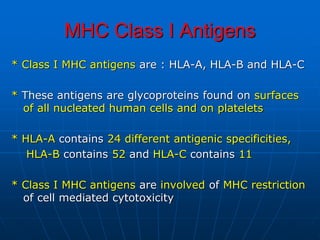
MHC Class I Antigens
* Class I MHC antigens are : HLA-A, HLA-B and HLA-C
* These antigens are glycoproteins found on surfaces
of all nucleated human cells and on platelets
* HLA-A contains 24 different antigenic specificities,
HLA-B contains 52 and HLA-C contains 11
* Class I MHC antigens are involved of MHC restriction
of cell mediated cytotoxicity
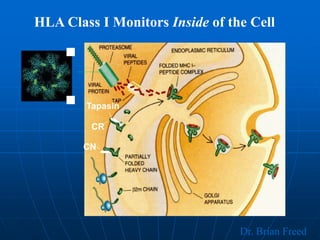
HLA Class I Monitors Inside of the Cell
CN
CR
Tapasin
Dr. Brian Freed
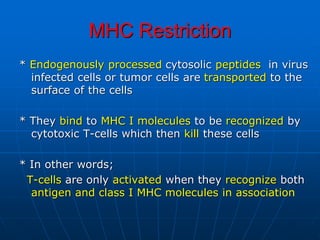
MHC Restriction
* Endogenously processed cytosolic peptides in virus
infected cells or tumor cells are transported to the
surface of the cells
* They bind to MHC I molecules to be recognized by
cytotoxic T-cells which then kill these cells
* In other words;
T-cells are only activated when they recognize both
antigen and class I MHC molecules in association
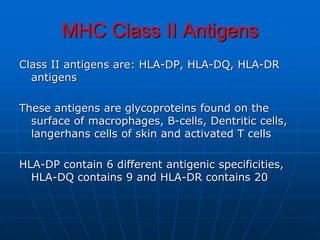
MHC Class II Antigens
Class II antigens are: HLA-DP, HLA-DQ, HLA-DR
antigens
These antigens are glycoproteins found on the
surface of macrophages, B-cells, Dentritic cells,
langerhans cells of skin and activated T cells
HLA-DP contain 6 different antigenic specificities,
HLA-DQ contains 9 and HLA-DR contains 20
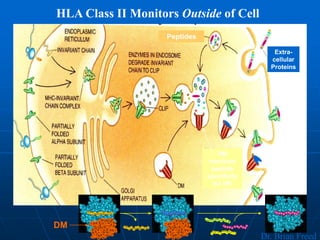
HLA Class II Monitors Outside of Cell
DM
monitors
peptide
specificity
for DR
Peptides
Extra-
cellular
Proteins
DM
Dr. Brian Freed
MHC Class II Antigens
* Helper T-cells recognize antigens on antigen-
presenting cells only when the antigens are
presented on the surface of cells in association
with class II MHC
* Class II antigens react with the CD4 molecule
on the helper T-cells which secrete cytokines
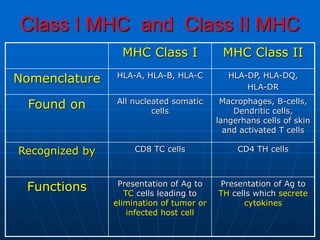
Class I MHC and Class II MHC
MHC Class I MHC Class II
Nomenclature HLA-A, HLA-B, HLA-C HLA-DP, HLA-DQ,
HLA-DR
Found on All nucleated somatic
cells
Macrophages, B-cells,
Dendritic cells,
langerhans cells of skin
and activated T cells
Recognized by CD8 TC cells CD4 TH cells
Functions Presentation of Ag to
TC cells leading to
elimination of tumor or
infected host cell
Presentation of Ag to
TH cells which secrete
cytokines
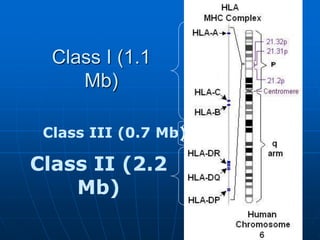
Class I (1.1
Mb)
Class II (2.2
Mb)
Class III (0.7 Mb)
Complement
& cytokines
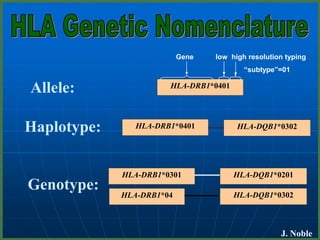
HLA-DQB1*0302
HLA-DRB1*0401
HLA-DRB1*0401
Allele:
Haplotype:
Genotype:
J. Noble
Gene low high resolution typing
“subtype”=01
HLA-DQB1*0302
HLA-DRB1*0301 DRB1*02
HLA-DRB1*04
HLA-DQB1*0201
3
2
  



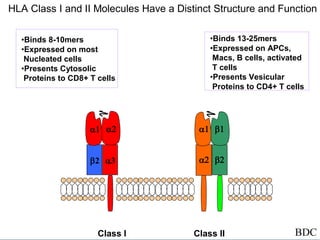
•Binds 8-10mers
•Expressed on most
Nucleated cells
•Presents Cytosolic
Proteins to CD8+ T cells
•Binds 13-25mers
•Expressed on APCs,
Macs, B cells, activated
T cells
•Presents Vesicular
Proteins to CD4+ T cells
Class I Class II
HLA Class I and II Molecules Have a Distinct Structure and Function
BDC
Teaching slides: www.barbaradaviscenter.com
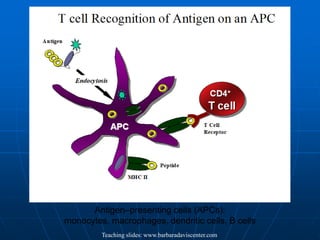
Antigen–presenting cells (APCs):
monocytes, macrophages, dendritic cells, B cells
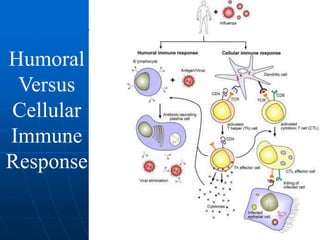
Humoral
Versus
Cellular
Immune
Response
Transplantation
and
Graft Rejection
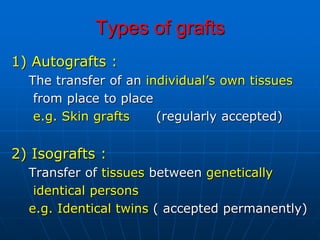
Types of grafts
1) Autografts :
The transfer of an individual’s own tissues
from place to place
e.g. Skin grafts (regularly accepted)
2) Isografts :
Transfer of tissues between genetically
identical persons
e.g. Identical twins ( accepted permanently)
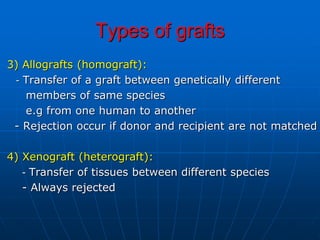
Types of grafts
3) Allografts (homograft):
- Transfer of a graft between genetically different
members of same species
e.g from one human to another
- Rejection occur if donor and recipient are not matched
4) Xenograft (heterograft):
- Transfer of tissues between different species
- Always rejected
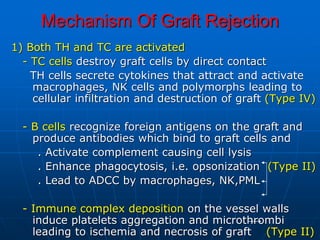
Mechanism Of Graft Rejection
1) Both TH and TC are activated
- TC cells destroy graft cells by direct contact
TH cells secrete cytokines that attract and activate
macrophages, NK cells and polymorphs leading to
cellular infiltration and destruction of graft (Type IV)
- B cells recognize foreign antigens on the graft and
produce antibodies which bind to graft cells and
. Activate complement causing cell lysis
. Enhance phagocytosis, i.e. opsonization (Type II)
. Lead to ADCC by macrophages, NK,PML
- Immune complex deposition on the vessel walls
induce platelets aggregation and microthrombi
leading to ischemia and necrosis of graft (Type II)
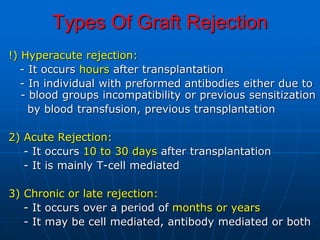
Types Of Graft Rejection
!) Hyperacute rejection:
- It occurs hours after transplantation
- In individual with preformed antibodies either due to
- blood groups incompatibility or previous sensitization
by blood transfusion, previous transplantation
2) Acute Rejection:
- It occurs 10 to 30 days after transplantation
- It is mainly T-cell mediated
3) Chronic or late rejection:
- It occurs over a period of months or years
- It may be cell mediated, antibody mediated or both
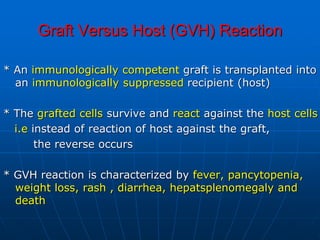
Graft Versus Host (GVH) Reaction
* An immunologically competent graft is transplanted into
an immunologically suppressed recipient (host)
* The grafted cells survive and react against the host cells
i.e instead of reaction of host against the graft,
the reverse occurs
* GVH reaction is characterized by fever, pancytopenia,
weight loss, rash , diarrhea, hepatsplenomegaly and
death

MHC and graft rejection modified.ppt

  • 1.
  • 2.
    Major Histocompatibility Complex(MHC) * The MHC is a closely linked complex of genes that govern production of the major histocompatibility * In humans, MHC resides on the short arm of chromosome 6 * Three genes (HLA-A, HLA-B, HLA-C) code for the class I MHC proteins * Several HLA-D loci determine the class II MHC proteins i.e. DP, DQ and DR * HLA genes are very diverse (polymorphic) i.e. there are many alleles of the class I and II genes
  • 3.
    The Human LeukocyteAntigen (HLA) System  Essential to immune function: HLA molecules present peptide antigens to the immune system (T-cells)  Important for self versus non-self distinction
  • 4.
    Major Histocompatibility Complex(MHC) * Between the class I and class II gene loci, there is a third locus (Class III) * This locus contains genes encoding tumor necrosis factor, lymphotoxin and two complement components (C2 and C4) * Class III antigens do not participate in MHC restriction or graft rejection
  • 5.
    MHC Class IAntigens * Class I MHC antigens are : HLA-A, HLA-B and HLA-C * These antigens are glycoproteins found on surfaces of all nucleated human cells and on platelets * HLA-A contains 24 different antigenic specificities, HLA-B contains 52 and HLA-C contains 11 * Class I MHC antigens are involved of MHC restriction of cell mediated cytotoxicity
  • 6.
    HLA Class IMonitors Inside of the Cell CN CR Tapasin Dr. Brian Freed
  • 7.
    MHC Restriction * Endogenouslyprocessed cytosolic peptides in virus infected cells or tumor cells are transported to the surface of the cells * They bind to MHC I molecules to be recognized by cytotoxic T-cells which then kill these cells * In other words; T-cells are only activated when they recognize both antigen and class I MHC molecules in association
  • 8.
    MHC Class IIAntigens Class II antigens are: HLA-DP, HLA-DQ, HLA-DR antigens These antigens are glycoproteins found on the surface of macrophages, B-cells, Dentritic cells, langerhans cells of skin and activated T cells HLA-DP contain 6 different antigenic specificities, HLA-DQ contains 9 and HLA-DR contains 20
  • 9.
    HLA Class IIMonitors Outside of Cell DM monitors peptide specificity for DR Peptides Extra- cellular Proteins DM Dr. Brian Freed
  • 10.
    MHC Class IIAntigens * Helper T-cells recognize antigens on antigen- presenting cells only when the antigens are presented on the surface of cells in association with class II MHC * Class II antigens react with the CD4 molecule on the helper T-cells which secrete cytokines
  • 11.
    Class I MHCand Class II MHC MHC Class I MHC Class II Nomenclature HLA-A, HLA-B, HLA-C HLA-DP, HLA-DQ, HLA-DR Found on All nucleated somatic cells Macrophages, B-cells, Dendritic cells, langerhans cells of skin and activated T cells Recognized by CD8 TC cells CD4 TH cells Functions Presentation of Ag to TC cells leading to elimination of tumor or infected host cell Presentation of Ag to TH cells which secrete cytokines
  • 12.
    Class I (1.1 Mb) ClassII (2.2 Mb) Class III (0.7 Mb) Complement & cytokines
  • 13.
    HLA-DQB1*0302 HLA-DRB1*0401 HLA-DRB1*0401 Allele: Haplotype: Genotype: J. Noble Gene lowhigh resolution typing “subtype”=01 HLA-DQB1*0302 HLA-DRB1*0301 DRB1*02 HLA-DRB1*04 HLA-DQB1*0201
  • 14.
    3 2       •Binds8-10mers •Expressed on most Nucleated cells •Presents Cytosolic Proteins to CD8+ T cells •Binds 13-25mers •Expressed on APCs, Macs, B cells, activated T cells •Presents Vesicular Proteins to CD4+ T cells Class I Class II HLA Class I and II Molecules Have a Distinct Structure and Function BDC
  • 15.
    Teaching slides: www.barbaradaviscenter.com Antigen–presentingcells (APCs): monocytes, macrophages, dendritic cells, B cells
  • 16.
  • 17.
  • 18.
    Types of grafts 1)Autografts : The transfer of an individual’s own tissues from place to place e.g. Skin grafts (regularly accepted) 2) Isografts : Transfer of tissues between genetically identical persons e.g. Identical twins ( accepted permanently)
  • 19.
    Types of grafts 3)Allografts (homograft): - Transfer of a graft between genetically different members of same species e.g from one human to another - Rejection occur if donor and recipient are not matched 4) Xenograft (heterograft): - Transfer of tissues between different species - Always rejected
  • 20.
    Mechanism Of GraftRejection 1) Both TH and TC are activated - TC cells destroy graft cells by direct contact TH cells secrete cytokines that attract and activate macrophages, NK cells and polymorphs leading to cellular infiltration and destruction of graft (Type IV) - B cells recognize foreign antigens on the graft and produce antibodies which bind to graft cells and . Activate complement causing cell lysis . Enhance phagocytosis, i.e. opsonization (Type II) . Lead to ADCC by macrophages, NK,PML - Immune complex deposition on the vessel walls induce platelets aggregation and microthrombi leading to ischemia and necrosis of graft (Type II)
  • 21.
    Types Of GraftRejection !) Hyperacute rejection: - It occurs hours after transplantation - In individual with preformed antibodies either due to - blood groups incompatibility or previous sensitization by blood transfusion, previous transplantation 2) Acute Rejection: - It occurs 10 to 30 days after transplantation - It is mainly T-cell mediated 3) Chronic or late rejection: - It occurs over a period of months or years - It may be cell mediated, antibody mediated or both
  • 22.
    Graft Versus Host(GVH) Reaction * An immunologically competent graft is transplanted into an immunologically suppressed recipient (host) * The grafted cells survive and react against the host cells i.e instead of reaction of host against the graft, the reverse occurs * GVH reaction is characterized by fever, pancytopenia, weight loss, rash , diarrhea, hepatsplenomegaly and death