CONGENITAL
DISEASES
Dr. Meg-angela Christi Amores
Congenital Heart Disease
 0.5-0.8% of live births
 incidence is higher in stillborns (3-4%),
abortuses (10-25%), and premature infants
(about 2%)
 diagnosis is established by 1 wk of age in 40-
50% of patients with congenital heart disease
and by 1 mo of age in 50-60%
Relative frequency of Major
Congenital lesions
 Ventricular septal defect25-30
 Atrial septal defect (secundum)6-8
 Patent ductus arteriosus6-8
 Coarctation of aorta5-7
 Tetralogy of Fallot5-7
 Pulmonary valve stenosis5-7
 Aortic valve stenosis4-7
Relative Frequency of Major
Congenital lesions
 d-Transposition of great arteries3-5
 Hypoplastic left ventricle1-3
 Hypoplastic right ventricle1-3
 Truncus arteriosus1-2
 Total anomalous pulmonary venous return1-2
 Tricuspid atresia1-2
 Single ventricle1-2
 Double-outlet right ventricle1-2 Others5-10
Fetal circulation
Congenital Disease
 Most congenital defects are well
tolerated in the fetus because of
the parallel nature of the fetal
circulation
 only after birth when the fetal
pathways (ductus arteriosus
and foramen ovale) are closed
that the full hemodynamic
impact of an anatomic
abnormality becomes apparent
Etiology
 Cause is unknown
 There is progress in identifying genetic basis
of many congenital heart lesions
 small percentage - related to chromosomal
abnormalities, in particular, trisomy 21, 13, and
18 and Turner syndrome
 2-4% -associated with known environmental or
adverse maternal conditions and teratogenic
influences, including maternal diabetes
mellitus, phenylketonuria, or systemic lupus
erythematosus
 diabetic mothers are five times more likely to
have congenital cardiovascular malformations
 most congenital heart disease is still relegated
to a multifactorial inheritance pattern
 Fetal echocardiography improves the rate of
detection
2 major groups
1. Acyanotic Congenital heart lesions
2. Cyanotic Congenital heart lesions
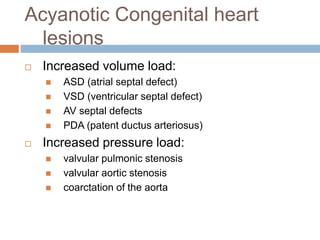
Acyanotic Congenital heart
lesions
 Increased volume load:
 ASD (atrial septal defect)
 VSD (ventricular septal defect)
 AV septal defects
 PDA (patent ductus arteriosus)
 Increased pressure load:
 valvular pulmonic stenosis
 valvular aortic stenosis
 coarctation of the aorta
Cyanotic Congenital heart
lesions
 Decreased Pulmonary Blood Flow -
obstruction to pulmonary blood flow and a
pathway by which systemic venous blood can
shunt from right to left and enter the systemic
circulation
 tricuspid atresia
 Tetralogy of Fallot
 single ventricle with pulmonary stenosis
 Increased Pulmonary Blood flow
 Transposition of the great vessels
 Total anomalous pulmonary venous return
 Truncus arteriosus
PDA (patent ductus arteriosus)
Pathophysiology
 blood shunts left to right through the ductus
 from the aorta to the pulmonary artery
 pulmonary artery pressure may be elevated to
systemic levels during both systole and
diastole
 risk for the development of pulmonary vascular
disease if left unoperated
Manifestations
 small patent ductus does not usually have any
symptoms
 large PDA will result in heart failure
 Cardiac enlargement
 Classic continuous murmur (machinery-like)
Diagnosis
 ECG
 Left ventricular hypertrophy
 Xray
 prominent pulmonary artery with increased
intrapulmonary vascular markings
 2D echocardiography
 left atrial and left ventricular dimensions are
increased
 Visualization of the patent ductus
Treatment
 Irrespective of age, patients with PDA require
surgical or catheter closure
 should not be unduly postponed after
adequate medical therapy for cardiac failure
has been instituted
 thoracoscopic techniques to minimize scarring
and reduce postoperative discomfort
Other congenital lesions -
acyanotic
Other congenital lesions -
acyanotic
Other congenital lesions -
acyanotic
Other congenital lesions -
cyanotic
Other congenital lesions -
cyanotic

congenital-diseases.pptx

  • 1.
  • 2.
    Congenital Heart Disease 0.5-0.8% of live births  incidence is higher in stillborns (3-4%), abortuses (10-25%), and premature infants (about 2%)  diagnosis is established by 1 wk of age in 40- 50% of patients with congenital heart disease and by 1 mo of age in 50-60%
  • 3.
    Relative frequency ofMajor Congenital lesions  Ventricular septal defect25-30  Atrial septal defect (secundum)6-8  Patent ductus arteriosus6-8  Coarctation of aorta5-7  Tetralogy of Fallot5-7  Pulmonary valve stenosis5-7  Aortic valve stenosis4-7
  • 4.
    Relative Frequency ofMajor Congenital lesions  d-Transposition of great arteries3-5  Hypoplastic left ventricle1-3  Hypoplastic right ventricle1-3  Truncus arteriosus1-2  Total anomalous pulmonary venous return1-2  Tricuspid atresia1-2  Single ventricle1-2  Double-outlet right ventricle1-2 Others5-10
  • 5.
  • 6.
    Congenital Disease  Mostcongenital defects are well tolerated in the fetus because of the parallel nature of the fetal circulation  only after birth when the fetal pathways (ductus arteriosus and foramen ovale) are closed that the full hemodynamic impact of an anatomic abnormality becomes apparent
  • 7.
    Etiology  Cause isunknown  There is progress in identifying genetic basis of many congenital heart lesions  small percentage - related to chromosomal abnormalities, in particular, trisomy 21, 13, and 18 and Turner syndrome  2-4% -associated with known environmental or adverse maternal conditions and teratogenic influences, including maternal diabetes mellitus, phenylketonuria, or systemic lupus erythematosus
  • 8.
     diabetic mothersare five times more likely to have congenital cardiovascular malformations  most congenital heart disease is still relegated to a multifactorial inheritance pattern  Fetal echocardiography improves the rate of detection
  • 9.
    2 major groups 1.Acyanotic Congenital heart lesions 2. Cyanotic Congenital heart lesions
  • 10.
    Acyanotic Congenital heart lesions Increased volume load:  ASD (atrial septal defect)  VSD (ventricular septal defect)  AV septal defects  PDA (patent ductus arteriosus)  Increased pressure load:  valvular pulmonic stenosis  valvular aortic stenosis  coarctation of the aorta
  • 11.
    Cyanotic Congenital heart lesions Decreased Pulmonary Blood Flow - obstruction to pulmonary blood flow and a pathway by which systemic venous blood can shunt from right to left and enter the systemic circulation  tricuspid atresia  Tetralogy of Fallot  single ventricle with pulmonary stenosis  Increased Pulmonary Blood flow  Transposition of the great vessels  Total anomalous pulmonary venous return  Truncus arteriosus
  • 12.
    PDA (patent ductusarteriosus)
  • 13.
    Pathophysiology  blood shuntsleft to right through the ductus  from the aorta to the pulmonary artery  pulmonary artery pressure may be elevated to systemic levels during both systole and diastole  risk for the development of pulmonary vascular disease if left unoperated
  • 14.
    Manifestations  small patentductus does not usually have any symptoms  large PDA will result in heart failure  Cardiac enlargement  Classic continuous murmur (machinery-like)
  • 15.
    Diagnosis  ECG  Leftventricular hypertrophy  Xray  prominent pulmonary artery with increased intrapulmonary vascular markings  2D echocardiography  left atrial and left ventricular dimensions are increased  Visualization of the patent ductus
  • 16.
    Treatment  Irrespective ofage, patients with PDA require surgical or catheter closure  should not be unduly postponed after adequate medical therapy for cardiac failure has been instituted  thoracoscopic techniques to minimize scarring and reduce postoperative discomfort
  • 17.
  • 18.
  • 19.
  • 20.
  • 21.