Michael Ghoorchian
EdsgerW. Dijkstra (1930-2002)
• Dutch Computer Scientist
• ReceivedTuring Award for contribution to
developing programming languages.
Contributed to :
• Shortest path-algorithm, also known as
Dijkstra's algorithm;
• Reverse Polish Notation and related
Shunting yard algorithm; t
• THE multiprogramming system;
• Banker's algorithm;
• Self-stabilization – an alternative way to
ensure the reliability of the system.
www.math.bas.bg/.../EWDwww.jpg
Dijkstra's algorithm is used in SPF, Shortest Path First,
which is used in the routing protocolOSPF, Open
Shortest Path First
Routing :
A protocol that specifies how routers communicate
with each other, disseminating information that
enables them to select routes between any two nodes
on a computer network.
www.criticalblue.com
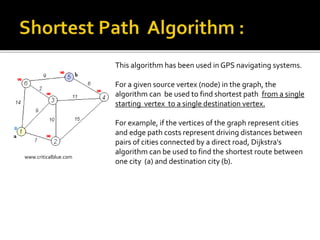
This algorithm has been used in GPS navigating systems.
For a given source vertex (node) in the graph, the
algorithm can be used to find shortest path from a single
starting vertex to a single destination vertex.
For example, if the vertices of the graph represent cities
and edge path costs represent driving distances between
pairs of cities connected by a direct road, Dijkstra's
algorithm can be used to find the shortest route between
one city (a) and destination city (b).
• This algorithm is widely used in routing protocol systems
• It is also called the single-source shortest path problem , in which the
shortest paths from a single source (vertex) to all other vertices has to be
found.
• In the next example; for a given source vertex (node) in the graph, the
algorithm finds the path with the shortest path between that vertex and
every other vertex. A Java applet has been used to show the process step by
step.
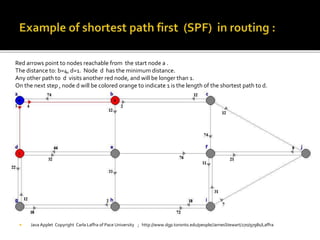
 Java Applet Copyright Carla Laffra of Pace University ; http://www.dgp.toronto.edu/people/JamesStewart/270/9798s/Laffra
Red arrows point to nodes reachable from the start node a .
The distance to: b=4, d=1. Node d has the minimum distance.
Any other path to d visits another red node, and will be longer than 1.
On the next step , node d will be colored orange to indicate 1 is the length of the shortest path to d.
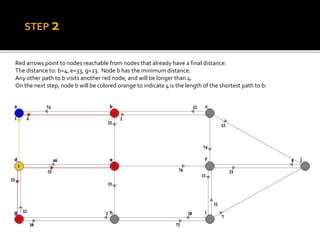
Red arrows point to nodes reachable from nodes that already have a final distance.
The distance to: b=4, e=33, g=23. Node b has the minimum distance.
Any other path to b visits another red node, and will be longer than 4.
On the next step, node b will be colored orange to indicate 4 is the length of the shortest path to b.
STEP 2
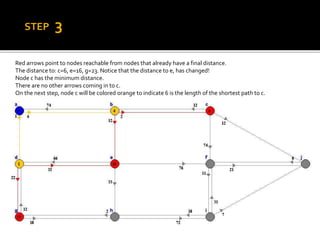
Red arrows point to nodes reachable from nodes that already have a final distance.
The distance to: c=6, e=16, g=23. Notice that the distance to e, has changed!
Node c has the minimum distance.
There are no other arrows coming in to c.
On the next step, node c will be colored orange to indicate 6 is the length of the shortest path to c.
STEP 3
Red arrows point to nodes reachable from nodes that already have a final distance.
The distance to: e=16, f=80, g=23, j=18. Node e has the minimum distance.
There are no other arrows coming in to e.
On the next step , e will be colored orange to indicate 16 is the length of the shortest path to e.
STEP 4
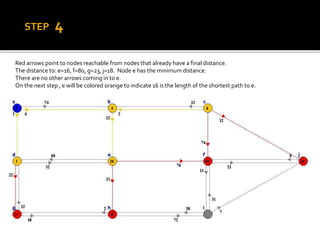
Red arrows point to nodes reachable from nodes that already have a final distance.
The distance to: f=80, g=23, h=49, j=18. Node j has the minimum distance.
Any other path to j visits another red node, and will be longer than 18.
Node j will be colored orange to indicate 18 is the length of the shortest path to j.
STEP 5
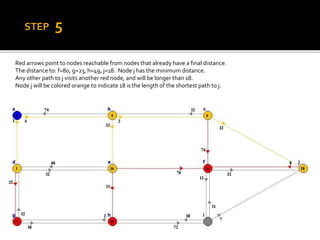
Red arrows point to nodes reachable from nodes that already have a final distance.
The distance to: f=26, g=23, h=49. Notice that the distance to f, has changed!
Node g has the minimum distance.
Any other path to g visits another red node, and will be longer than 23.
Node g will be colored orange to indicate 23 is the length of the shortest path to g.
STEP 6
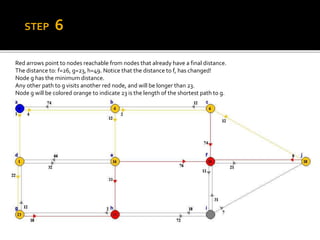
Step 7: Red arrows point to nodes reachable from nodes that already have a final distance.
The distance to: f=26, h=33. Notice that the distance to h, has changed!
Node f has the minimum distance.
Any other path to f visits another red node, and will be longer than 26.
Node f will be colored orange to indicate 26 is the length of the shortest path to f.
STEP 7
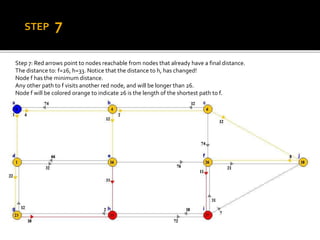
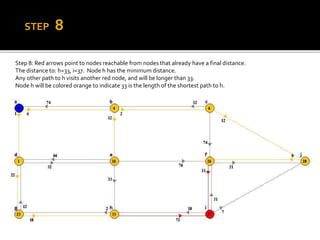
Step 8: Red arrows point to nodes reachable from nodes that already have a final distance.
The distance to: h=33, i=37. Node h has the minimum distance.
Any other path to h visits another red node, and will be longer than 33.
Node h will be colored orange to indicate 33 is the length of the shortest path to h.
STEP 8
Step 9: Red arrows point to nodes reachable from nodes that already have a final distance.
The distance to: i=37. There are no other arrows coming in to i.
Node i will be colored orange to indicate 37 is the length of the shortest path toi.
Algorithm has finished, follow orange arrows from start node to any node to get
the shortest path to the node.The length of the path is written in the node.
Last step
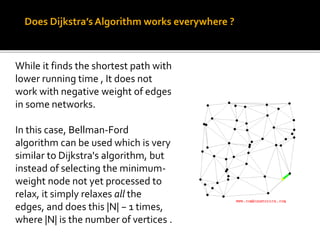
While it finds the shortest path with
lower running time , It does not
work with negative weight of edges
in some networks.
In this case, Bellman-Ford
algorithm can be used which is very
similar to Dijkstra's algorithm, but
instead of selecting the minimum-
weight node not yet processed to
relax, it simply relaxes all the
edges, and does this |N| − 1 times,
where |N| is the number of vertices .
Does Dijkstra’s Algorithm works everywhere ?
 Introduction to Algorithms by Cormen, Leiserson and Rivest
(MIT Press/McGraw-Hill 1994, ISBN 0-262-03141-8 (MIT
Press) and ISBN 0-07-013143-0 (McGraw-Hill).
 http://en.wikipedia.org/wiki/BellmanFord_algorithm
 http://en.wikipedia.org/wiki/Dijkstra_algorithm
 www.Criticalblue.com
 http://www.cs.mcgill.ca/~cs251/OldCourses/1997/topic29/
 Introduction to Algorithms by Cormen, Leiserson and Rivest
(MIT Press/McGraw-Hill 1994, ISBN 0-262-03141-8 (MIT
Press) and ISBN 0-07-013143-0 (McGraw-Hill).

(MG_39)DijkstraAlgorithm.pptx

  • 1.
  • 2.
    EdsgerW. Dijkstra (1930-2002) •Dutch Computer Scientist • ReceivedTuring Award for contribution to developing programming languages. Contributed to : • Shortest path-algorithm, also known as Dijkstra's algorithm; • Reverse Polish Notation and related Shunting yard algorithm; t • THE multiprogramming system; • Banker's algorithm; • Self-stabilization – an alternative way to ensure the reliability of the system. www.math.bas.bg/.../EWDwww.jpg
  • 3.
    Dijkstra's algorithm isused in SPF, Shortest Path First, which is used in the routing protocolOSPF, Open Shortest Path First Routing : A protocol that specifies how routers communicate with each other, disseminating information that enables them to select routes between any two nodes on a computer network.
  • 4.
    www.criticalblue.com This algorithm hasbeen used in GPS navigating systems. For a given source vertex (node) in the graph, the algorithm can be used to find shortest path from a single starting vertex to a single destination vertex. For example, if the vertices of the graph represent cities and edge path costs represent driving distances between pairs of cities connected by a direct road, Dijkstra's algorithm can be used to find the shortest route between one city (a) and destination city (b).
  • 5.
    • This algorithmis widely used in routing protocol systems • It is also called the single-source shortest path problem , in which the shortest paths from a single source (vertex) to all other vertices has to be found. • In the next example; for a given source vertex (node) in the graph, the algorithm finds the path with the shortest path between that vertex and every other vertex. A Java applet has been used to show the process step by step.
  • 6.
     Java AppletCopyright Carla Laffra of Pace University ; http://www.dgp.toronto.edu/people/JamesStewart/270/9798s/Laffra Red arrows point to nodes reachable from the start node a . The distance to: b=4, d=1. Node d has the minimum distance. Any other path to d visits another red node, and will be longer than 1. On the next step , node d will be colored orange to indicate 1 is the length of the shortest path to d.
  • 7.
    Red arrows pointto nodes reachable from nodes that already have a final distance. The distance to: b=4, e=33, g=23. Node b has the minimum distance. Any other path to b visits another red node, and will be longer than 4. On the next step, node b will be colored orange to indicate 4 is the length of the shortest path to b. STEP 2
  • 8.
    Red arrows pointto nodes reachable from nodes that already have a final distance. The distance to: c=6, e=16, g=23. Notice that the distance to e, has changed! Node c has the minimum distance. There are no other arrows coming in to c. On the next step, node c will be colored orange to indicate 6 is the length of the shortest path to c. STEP 3
  • 9.
    Red arrows pointto nodes reachable from nodes that already have a final distance. The distance to: e=16, f=80, g=23, j=18. Node e has the minimum distance. There are no other arrows coming in to e. On the next step , e will be colored orange to indicate 16 is the length of the shortest path to e. STEP 4
  • 10.
    Red arrows pointto nodes reachable from nodes that already have a final distance. The distance to: f=80, g=23, h=49, j=18. Node j has the minimum distance. Any other path to j visits another red node, and will be longer than 18. Node j will be colored orange to indicate 18 is the length of the shortest path to j. STEP 5
  • 11.
    Red arrows pointto nodes reachable from nodes that already have a final distance. The distance to: f=26, g=23, h=49. Notice that the distance to f, has changed! Node g has the minimum distance. Any other path to g visits another red node, and will be longer than 23. Node g will be colored orange to indicate 23 is the length of the shortest path to g. STEP 6
  • 12.
    Step 7: Redarrows point to nodes reachable from nodes that already have a final distance. The distance to: f=26, h=33. Notice that the distance to h, has changed! Node f has the minimum distance. Any other path to f visits another red node, and will be longer than 26. Node f will be colored orange to indicate 26 is the length of the shortest path to f. STEP 7
  • 13.
    Step 8: Redarrows point to nodes reachable from nodes that already have a final distance. The distance to: h=33, i=37. Node h has the minimum distance. Any other path to h visits another red node, and will be longer than 33. Node h will be colored orange to indicate 33 is the length of the shortest path to h. STEP 8
  • 14.
    Step 9: Redarrows point to nodes reachable from nodes that already have a final distance. The distance to: i=37. There are no other arrows coming in to i. Node i will be colored orange to indicate 37 is the length of the shortest path toi. Algorithm has finished, follow orange arrows from start node to any node to get the shortest path to the node.The length of the path is written in the node. Last step
  • 15.
    While it findsthe shortest path with lower running time , It does not work with negative weight of edges in some networks. In this case, Bellman-Ford algorithm can be used which is very similar to Dijkstra's algorithm, but instead of selecting the minimum- weight node not yet processed to relax, it simply relaxes all the edges, and does this |N| − 1 times, where |N| is the number of vertices . Does Dijkstra’s Algorithm works everywhere ?
  • 17.
     Introduction toAlgorithms by Cormen, Leiserson and Rivest (MIT Press/McGraw-Hill 1994, ISBN 0-262-03141-8 (MIT Press) and ISBN 0-07-013143-0 (McGraw-Hill).  http://en.wikipedia.org/wiki/BellmanFord_algorithm  http://en.wikipedia.org/wiki/Dijkstra_algorithm  www.Criticalblue.com  http://www.cs.mcgill.ca/~cs251/OldCourses/1997/topic29/  Introduction to Algorithms by Cormen, Leiserson and Rivest (MIT Press/McGraw-Hill 1994, ISBN 0-262-03141-8 (MIT Press) and ISBN 0-07-013143-0 (McGraw-Hill).