Introduction 
As you probably know, mutual funds have become extremely 
popular over the last 20 years. What was once just another 
obscure financial instrument is now apart of our daily lives. More 
than 80 million people, or one half of the households in America, 
invest in mutual funds. That means that, in the United States 
alone, trillions of dollars are invested in mutual funds. In fact, to 
many people, investing means buying mutual funds. After all, it's 
common knowledge that investing in mutual funds is (or at least 
should be) better than simply letting your cash waste away in a 
savings account, but, for most people, that's where the 
understanding of funds ends. It doesn't help that mutual fund 
salespeople speak a strange language that is interspersed with 
jargon that many investors don't understand. Originally, mutual 
funds were heralded as a way for the little guy to get a piece of 
the market. Instead of spending all your free time buried in the 
financial pages of the Wall Street Journal, all you had to do was 
buy a mutual fund and you'd be set on your way to financial 
freedom. As you might have guessed, it's not that easy. 
Mutual funds are an excellent idea in theory, but, in reality, they 
haven't always delivered. Not all mutual funds are created equal, 
and investing in mutuals isn't as easy as throwing your money at 
the first salesperson who solicits your business. In this Project , 
I'll explain the basics of mutual funds and hopefully clear up 
along with the real example of Mutual Fund. 
some of the myths around them. You can then decide whether or 
not they are right for you.
History of mutual funds 
The mutual fund industry in India started in 1963 with the 
formation of Unit Trust of India, at the initiative of the 
Government of India and Reserve Bank 
The history of mutual funds in India can be broadly divided into 
four distinct phases 
First Phase – 1964-87 
Unit Trust of India (UTI) was established on 1963 by an Act of 
Parliament 
In 1978 UTI was de-linked from the RBI and the IDBI took over 
the regulatory and administrative control 
The first scheme launched by UTI was Unit Scheme 1964 
At the end of 1988 UTI had Rs.6,700 crores of assets under 
management 
Second Phase – 1987-1993 
1987 marked the entry of non- UTI, public sector mutual funds 
SBI Mutual Fund June 1987 
Canbank Mutual Fund Dec 87 
LIC Mutual Fund June 1989 
GIC Mutual Fund Dec 1990
At the end of 1993, the mutual fund industry had assets under 
management of Rs.47,004 Cr. 
Third Phase – 1993-2003 (Entry of Private Sector Funds) 
With the entry of private sector funds in 1993, a new era 
started in the Indian mutual fund industry, giving the Indian 
investors a wider choice of fund families 
It was also the year in which the first Mutual Fund 
Regulations came into being, under which all mutual funds, 
except UTI were to be registered and governed 
The erstwhile Kothari Pioneer (now merged with Franklin 
Templeton) was the first private sector mutual fund 
registered in July 1993 
Fourth Phase – since February 2003 
In February 2003, following the repeal of the Unit Trust of 
India Act 1963, UTI was bifurcated into two separate entities 
One is the Specified Undertaking of the Unit Trust of India 
representing broadly, the assets of US 64 scheme, assured 
return and certain other schemes (AUM : Rs.29,835 crores 
as at the end of January 2003) 
It functions under the rules framed by Government of India 
and does not come under the purview of SEBI 
The second is the UTI Mutual Fund Ltd, sponsored by SBI, 
PNB, BOB and LIC 
It is registered with SEBI and functions under the Mutual 
Fund Regulations 
The mutual fund industry has entered its current phase of 
consolidation and growth
As at the end of October, 2007, there were 32 funds, whichd 
managed assets of Rs.5,56,730 crores under about 500 
schemes
25 
4564 
47000 
79464 
139616 
149554 
231862 
538500 
326388 
493300 
600000 
500000 
400000 
300000 
200000 
100000 
0 
Mar-65 Mar-87 Mar-93 Mar-03 Mar-04 Mar-05 Mar-06 Mar-07 Mar-08 Mar-09 
R 
s 
i 
n 
C 
r 
o 
r 
e 
s 
Years
Organization of Mutual fund
1. The Sponsor: 
The trust is established by a sponsor or more than one 
sponsor who is like promoter of a company 
The trustees of the mutual fund hold its property for the 
benefit of the unitholders 
The trustees are vested with the general power of 
superintendence and direction over AMC 
They monitor the performance and compliance of SEBI 
Regulations by the mutual fund. 
2. Asset Management Company (AMC) 
Asset Management Company (AMC) approved by SEBI 
manages the funds by making investments in various types of 
securities 
3. Custodian: 
Custodian, who is registered with SEBI, holds the securities 
of various schemes of the fund in its custody. It is generally a 
corporate body. 
1. It receives and delivers securities 
2. It collects income on the securities 
3. It holds and processes cash
4. Registrars and Transfer Agents: 
1. He receives and processes the application form of 
investors 
2. He issues unit certificate 
3. He maintains detailed records of unit holders 
4. He purchases, sells, transfers and redeems the unit 
certificates 
5. He issues income warrants, broker cheques, etc. 
6. He creates security interest on units for allowing loans 
against them. 
Advisor / Manager: 
It is generally a corporate entity who does the following 
jobs: 
1. It extends professional advice on the fund’s 
investments 
2. It advises on Asset Management Services
Different Types Of Mutual Funds 
No matter what type of investor you are, there is bound to be a 
mutual fund that fits your style. According to the last count there 
are more than 10,000 mutual funds in North America! That 
means there are more mutual funds than stocks. It's important to 
understand that each mutual fund has different risks and 
rewards. In general, the higher the potential return, the higher 
the risk of loss. Although some funds are less risky than others, 
all funds have some level of risk - it's never possible to diversify 
away all risk. This is a fact for all investments. Each fund has a 
predetermined investment objective that tailors the fund's assets, 
regions of investments and investment strategies. At the 
fundamental level. 
All mutual funds are variations of these three asset classes. For 
example, while equity funds that invest in fast-growing 
companies are known as growth funds, 
equity funds that invest only in companies of the same sector or 
region are known as specialty funds. 
Let's go over the many different flavors of funds. We'll start with 
the safest and then work through to the more risky.
Money Market Funds 
The money market consists of short-term debt instruments, 
mostly Treasury bills. This is a safe place to park your money. 
You won't get great returns, but you won't have to worry about 
losing your principal. A typical return is twice the amount you 
would earn in a regular checking/savings account and a little less 
than the average certificate of deposit (CD). 
Bond/Income Funds 
Income funds are named appropriately: their purpose is to 
provide current income on a steady basis. When referring to 
mutual funds, the terms "fixed-income," "bond," and "income" 
are synonymous. These terms denote funds that invest primarily 
in government and corporate debt. While fund holdings may 
appreciate in value, the primary objective of these funds is to 
provide a steady cashflow to investors. As such, the audience for 
these funds consists of conservative investors and retirees. 
Bond funds are likely to pay higher returns than certificates of 
deposit and money market investments, but bond funds aren't 
without risk. Because there are many different types of bonds, 
bond funds can vary dramatically depending on where they 
invest. For example, a fund specializing in high-yield junk bonds 
is much more risky than a fund that invests in government 
securities. Furthermore, nearly all bond funds are subject to 
interest rate risk, which means that if rates go up the value of the 
fund goes down.
Balanced Funds 
The objective of these funds is to provide a balanced mixture of 
safety, income and capital appreciation. The strategy of balanced 
funds is to invest in a combination of fixed income and equities. A 
typical balanced fund might have a weighting of 60% equity and 
40% fixed income. The weighting might also be restricted to a 
specified maximum or minimum for each asset class. A similar 
type of fund is known as an asset allocation fund. Objectives are 
similar to those of a balanced fund, but these kinds of funds 
typically do not have to hold a specified percentage of any asset 
class. The portfolio manager is therefore given freedom to switch 
the ratio of asset classes as the economy moves through the 
business cycle. 
Equity Funds 
Funds that invest in stocks represent the largest category of 
mutual funds. Generally, the investment objective of this class of 
funds is long-term capital growth with some income. There are, 
however, many different types of equity funds because there are 
many different types of equities. A great way to understand the 
universe of equity funds is to use a style box, an example of 
which is below. 
The idea is to classify funds based on both the size of the 
companies invested in and the investment style of the manager. 
The term value refers to a style of investing that looks for high 
quality companies that are out of favor with the market. These 
companies are characterized by low P/E and price-to-book ratios 
and high dividend yields. The opposite of value is growth, which 
refers to companies that have had (and are expected to continue 
to have) strong growth in earnings, sales and cash flow. A
compromise between value and growth is blend, which simply 
refers to companies that are neither value nor growth stocks and 
are classified as being somewhere in the middle. 
For example, a mutual fund that invests in large-cap companies 
that are in strong financial shape but have recently seen their 
share prices fall would be placed in the upper left quadrant of the 
style box (large and value). The opposite of this would be a fund 
that invests in startup technology companies with excellent 
growth prospects. Such a mutual fund would reside in the bottom 
right quadrant (small and growth). 
Global/International Funds 
An international fund (or foreign fund) invests only outside your 
home country. Global funds invest anywhere around the world, 
including your home country. It's tough to classify these funds as 
either riskier or safer than domestic investments. They do tend to 
be more volatile and have unique country and/or political risks. 
But, on the flip side, they can, as part of a well-balanced 
portfolio, actually reduce risk by increasing diversification. 
Although the world's economies are becoming more inter-related, 
it is likely that another economy somewhere is outperforming the 
economy of your home country.
Specialty Funds 
This classification of mutual funds is more of an all-encompassing 
category that consists of funds that have proved to be popular 
but don't necessarily belong to the categories we've described so 
far. This type of mutual fund forgoes broad diversification to 
concentrate on a certain segment of the economy. 
Sector funds are targeted at specific sectors of the economy such 
as financial, technology, health, etc. Sector funds are extremely 
volatile. There is a greater possibility of big gains, but you have 
to accept that your sector may tank. Regional funds make it 
easier to focus on a specific area of the world. This may mean 
focusing on a region (say Latin America) or an individual country 
(for example, only Brazil). An advantage of these funds is that 
they make it easier to buy stock in foreign countries, which is 
otherwise difficult and expensive. Just like for sector funds, you 
have to accept the high risk of loss, which occurs if the region 
goes into a bad recession. Socially-responsible funds (or ethical 
funds) invest only in companies that meet the criteria of certain 
guidelines or beliefs. Most socially responsible funds don't invest 
in industries such as tobacco, alcoholic beverages, weapons or 
nuclear power. The idea is to get a competitive performance while 
still maintaining a healthy conscience.
Index Funds 
The last but certainly not the least important are index funds. 
This type of mutual fund replicates the performance of a broad 
market index such as the S&P 500 or Dow Jones Industrial 
Average (DJIA). An investor in an index fund figures that most 
managers can't beat the market. An index fund merely replicates 
he market return and benefits investors in the form of low fees.
Costs involved 
Costs are the biggest problem with mutual funds. These costs eat 
into your return, and they are the main reason why the majority 
of funds end up with sub-par performance. What's even more 
disturbing is the way the fund industry hides costs through a 
layer of financial complexity and jargon. Some critics of the 
industry say that mutual fund companies get away with the fees 
they charge only because the average investor does not 
understand what he/she is paying for. Fees can be broken down 
into two categories: 
1. Ongoing yearly fees to keep you invested in the fund. 
2. Transaction fees paid when you buy or sell shares in a fund 
(Entry Exit loads). 
The Expense Ratio 
The ongoing expenses of a mutual fund is represented by the 
expense ratio. This is sometimes also referred to as the 
management expense ratio (MER). The expense ratio is 
composed of the following: 
• The cost of hiring the fund manager(s) - Also known as the 
management fee, this cost is between 0.5% and 1% of assets on 
average. While it sounds small, this fee ensures that mutual fund 
managers remain in the country's top echelon of earners. Think 
about it for a second: 1% of 250 million (a small mutual fund) is 
$2.5 million - fund managers are definitely not going hungry! It's 
true that paying managers is a necessary fee, but don't think that 
a high fee assures superior performance.
• Administrative costs - These include necessities such as 
postage, record keeping, customer service, cappuccino machines, 
etc. Some funds are excellent at minimizing these costs while 
others (the ones with the cappuccino machines in the office) are 
not. 
• The last part of the ongoing fee (in the United States anyway) 
is known as the 12B-1 fee. This expense goes toward paying 
brokerage commissions and toward advertising and promoting 
the fund. That's right, if you invest in a fund with a 12B-1 fee, 
you are paying for the fund to run commercials and sell itself! On 
the whole, expense ratios range from as low as 0.2% (usually for 
index funds) to as high as 2%. The average equity mutual fund 
charges around 1.3%-1.5%. You'll generally pay more for 
specialty or international funds, which require more expertise 
from managers.
The Value of Your Fund 
Net asset value (NAV), which is a fund's assets minus liabilities, is 
the value of a mutual fund. NAV per share is the value of one 
share in the mutual fund, and it is the number that is quoted in 
newspapers. You can basically just think of NAV per share as the 
price of a mutual fund. It fluctuates everyday as fund holdings 
and shares outstanding change. 
When you buy shares, you pay the current NAV per share plus 
any sales front-end load. When you sell your shares, the fund will 
pay you NAV less any back-end load.
How To Read A Mutual Fund Table 
Columns 1 & 2: 52-Week Hi and Low - These show the highest 
and lowest prices the mutual fund has experienced over the 
previous 52-weeks (one year). This typically does not include the 
previous day's price. 
Column 3: Fund Name - This column lists the name of the mutual 
fund. The company that manages the fund is written above in 
bold type. 
Column 4: Fund Specifics - Different letters and symbols have 
various meanings. For example, "N" means no load, "F" is front 
end load, and "B" means the fund has both front and back-end 
fees. For other symbols see the legend in the newspaper in which 
you found the table. 
Column 5: Dollar Change - This states the dollar change in the 
price of the mutual fund from the previous day's trading. 
Column 6: % Change - This states the percentage change in the 
price of the mutual fund from the previous day's trading. 
Column 7: Week High - This is the highest price the fund traded 
at during the past week. 
Column 8: Week Low - This is the lowest price the fund traded at 
during the past week. 
Column 9: Close - The last price at which the fund was traded is 
shown in this column. 
Column 10: Week's Dollar Change - This represents the dollar 
change in the price of the mutual fund from the previous week.
How mutual funds work
HDFC top 200 Mutual fund 
The HDFC Top 200 Fund is one of the mutual fund schemes from HDFC Asset 
Management Company Ltd. The fund is an Open ended Equity and Diversified 
fund scheme. The main objective of the fund is to generate long term 
capital appreciation by investing in a portfolio of equities and equity linked 
instruments drawn from the companies in BSE 200 Index which is its 
benchmark. This is one of the top performing fund for many years and has been 
featured in the top funds list of many mutual funds rating companies as well as 
on various finance magazines and the Value Research. It was launched on Aug 
19, 1996. It has a fund value of over 8500 crores and has been a consistent 
performer since inception. This fund has given a return of 26.3% for a five year 
period and 18.3% for 3 year period at the moment. 
HDFC Top 200 is being managed by Prashant Jain who has proven to be the top 
fund manager among the lot and has proven his talent in the long run and also 
runs another successful fund from the house of HDFC MF namely HDFC Equity 
Fund which in fact also is one of the top fund at the moment.
Fund Commentary 
fund maintains a diversified portfolio of 
predominantly large cap stocks. It invests in 
fundamentally strong companies for longer horizon. It 
does not take high cash exposure 
long term horizon and does not see much downside 
from current levels. However, the return expectation 
from the equity market should be tapered down as 
the interest rates also have moved up significantly. 
these companies have witnessed steady growth in top 
line and bottom line. 
equity and debt investments would narrow due to rise 
in interest rates. 
finance, IT, oil & Gas, Pharma and FMCG. 
banking and has 25% weight to the sector as this is a 
quasi play on infrastructure
the benchmark BSE 200 index and the fund is 
recommended for moderate and conservative 
investors with a horizon of 2-3 yrs
Investment Objective 
To generate long term capital appreciation from a portfolio of equity and equity-linked 
instruments primarily drawn from the companies in BSE 200 index 
Basic Scheme Information 
Nature of Scheme Open Ended Growth Scheme 
Inception Date October 11, 1996 
Option/Plan Dividend Option,Growth Option. The Dividend Option 
offers Dividend Payout and Reinvestment Facility. 
Entry Load 
(purchase / additional purchase / 
switch-in) 
(click here for SIP Details) 
NIL 
(With effect from August 1, 2009) 
Please click here to go through the addendum. 
Exit Load 
(as a % of the Applicable 
NAV) 
(click here for SIP Details) 
 In respect of each purchase / switchin of units, an Exit Load 
of 1.00% is payable if Units are redeemed / switched-out 
within 1 year from the date of allotment.. 
 No Exit Load is payable if Units are redeemed / switched-out 
after 1 year from the date of allotment. 
Minimum Application 
Amount 
(click here for SIP Details) 
For new investors :Rs.5000 and any amount thereafter. 
For existing investors : Rs. 1000 and any amount thereafter. 
Lock-In-Period Nil 
Net Asset Value Periodicity Every Business Day. 
Redemption Proceeds Normally despatched within 3 Business days 
Tax Benefits 
Nil 
(As per present Laws) 
Current Expense Ratio (#) 
(Effective Date 22nd May 
2009) 
On the first 100 crores average weekly net assets 2.5000% 
On the next 300 crores average weekly net assets 2.25% 
On the next 300 crores average weekly net assets 2.00% 
On the balance of the assets 1.75% 
(#) Any change in the expense ratio will be updated within two working days.
Investment Strategy 
The investment strategy of primarily restricting the equity portfolio to 
the BSE 200 Index scrips is intended to reduce risks while maintaining 
steady growth. Stock specific risk will be minimised by investing only 
in those companies / industries that have been thoroughly researched 
by the investment manager's research team. Risk will also be reduced 
through a diversification of the portfolio 
Fund Manager 
Mr. Prashant Jain (since Jun 19, 03) 
Mr. Miten Lathia - Dedicated Fund Manager - Foreign Securities
Portfolio - Holdings (as on January 31, 2011) 
Company Industry+ % to 
NAV 
EQUITY & EQUITY RELATED 
State Bank of India Banks 7.68 
ICICI Bank Ltd. Banks 6.18 
Infosys Technologies Ltd. Software 6.06 
Reliance Industries Ltd. Petroleum 
Products 
4.94 
Bank of Baroda Banks 4.08 
ITC Ltd. Consumer Non 
Durables 
3.43 
Titan Industries Ltd. Consumer Non 
Durables 
3.27 
Larsen & Toubro Ltd. Construction 
Project 
3.08 
Tata Consultancy Services Ltd. Software 3.03 
Oil & Natural Gas Corporation Ltd. Oil 2.83 
Total of Top Ten Equity Holdings 44.58 
Total Equity & Equity Related Holdings 97.22 
Total Money Market Instrument & Other Credit 
0.00 
Exposures (aggregated holdings in a single issuer) 
Cash margin / Earmarked cash for Futures & Options 0.31 
Other Cash, Cash Equivalents and Net Current Assets 2.47 
Grand Total 100.00
HDFC Top 
200 Fund 
(NAV as at evaluation date 31-Jan-11, Rs.205.882 Per unit) 
Date Period NAV Per Unit 
(Rs.) 
Returns (%) 
$$ ^ 
Benchmark 
Returns (%) # 
July 30, 2010 Last Six months 
(185 days) 
199.278 3.31* -0.5* 
January 29, 
2010 
Last 1 Year (367 
days) 
171.855 19.68** 9.87** 
January 31, 
2008 
Last 3 Years (1096 
days) 
147.718 11.69** 0.59** 
January 31, 
2006 
Last 5 Years (1826 
days) 
84.599 19.46** 12.65** 
January 31, 
2001 
Last 10 Years 
(3652 days) 
15.860 29.2** 16.92** 
October 11, 
1996 
Since Inception 
(5225 days) 
10.000 25.25** 14.83** 
SIP Returns 
SIP Investments Since Inception 10 Year 5 Year 3 Year 1 Year 
Total Amount Invested 
172,000 120,000 60,000 36,000 12,000 
(Rs.) 
Market Value as on 
January 31, 2011 (Rs.) 
1,535,924.69 639,312.08 97,927.93 52,419.37 12,395.30 
Returns 
(Annualised)*(%) 
27.20% 31.43% 19.67% 25.98% 6.14% 
Benchmark Returns 
(Annualised)(%)# 
17.06% 20.35% 11.21% 16.32% -2.67% 
Market Value of SIP in 
Benchmark# 
656,961.95 351,178.04 79,527.19 45,834.77 11,825.68
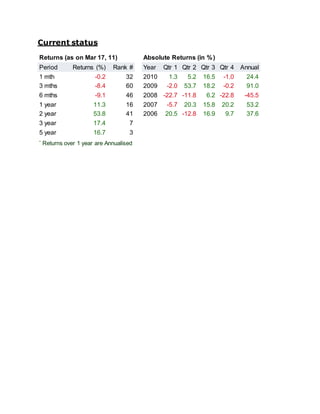
Current status 
Returns (as on Mar 17, 11) 
Period Returns (%) Rank # 
1 mth -0.2 32 
3 mths -8.4 60 
6 mths -9.1 46 
1 year 11.3 16 
2 year 53.8 41 
3 year 17.4 7 
5 year 16.7 3 
* Returns over 1 year are Annualised 
Absolute Returns (in %) 
Year Qtr 1 Qtr 2 Qtr 3 Qtr 4 Annual 
2010 1.3 5.2 16.5 -1.0 24.4 
2009 -2.0 53.7 18.2 -0.2 91.0 
2008 -22.7 -11.8 6.2 -22.8 -45.5 
2007 -5.7 20.3 15.8 20.2 53.2 
2006 20.5 -12.8 16.9 9.7 37.6
Conclusion 
Once couldn't find better time to write about this top performing 
fund than now, as its Net Asset Value (NAV) hits all-time high . 
Yes ! HDFC Top 200 Fundwhich has outperformed most of the 
funds in its category, reaches NAV of Rs.200. Though the fund 
has dividend option and you would have got regular dividends, 
we are analyzing the performance of the Growth option. 
The interesting point to note here is that, the NAV of this fund 
was Rs.170 when the Sensex hit all-time high of 21,000 in 2008 
and now the NAV is Rs.200. Which means even if you had 
invested in this fund at the peak of 21,000, you are still making 
good 18% returns above that, while the Sensex is stil l at 18,000.. 
Disciplined Systematic Investment in this fund has certainly 
generated spectacular returns, which are one of the best for a 
passive investor. Hence even if you haven't invested in this fund 
yet, you can invest through a SIP method for long term. It is one 
of the best funds to be in, for long term. 
investors looking for low-risk equity options can consider 
investing in HDFC Top 200 Fund. The fund has an impressive 
track record of performance over the long-term and across 
market cycles. 
The exposure to quality large-cap stocks it offers — 
predominantly from the BSE 200 basket — also makes it a 
suitable investment option at this juncture. 
The fund's one-year returns, pegged at about 32 per cent, are 
superior to other large-cap fund focussed funds such as DSPBR 
Top 100 and Birla Sun Life Frontline Equity as well as the BSE- 
200, its benchmark.
Suitability: It is best suited for conservative investors, looking for 
steady returns. That the fund has more often than not arrested 
downsides better than its category also makes it suitable 
investment for such investors. Given the elevated market levels 
at present, investors can consider adopting the SIP route and 
continue their investments through market declines and rallies. 
Performance: The fund's three and five-year compounded 
annualised returns of about 17 per cent and 27 per cent puts it 
among the top five performers in the diversified funds category. 
During these periods, it has outpaced most of the other large-cap 
focussed funds such as DSPBR Top 100, Birla Sun Life Frontline 
Equity and Franklin India Blue Chip. 
What's more, even on a one-year basis, it has managed to 
maintain its lead over both peers as well benchmark. Note that 
the fund unlike most peers doesn't make any cash calls and 
remains fully invested in equities at all times. 
That it had fallen lower than most peer funds in spite of 
remaining largely invested in equities during the 2008 meltdown 
(down only by about by 45 per cent) reflects positively on its 
manager's stock and sector selection skills as well as market 
manoeuvrability. While the fund has had its share of mild hiccups, 
it has been a pretty consistent performer in the long run. On a 
monthly rolling five-year compounded returns basis, it has 
consistently scored over its benchmark each time. Stock choices, 
some outside of the BSE-200 basket as well as sector weightages 
seem to have aided the fund's returns. 
Portfolio: Mid-caps make up just about 5 per cent of the total 
portfolio; stocks such as Federal Bank, Procter & Gamble 
Hygiene, Jet Airways, Punj Lloyd make up that list. The large-caps 
are primarily index and blue-chip stocks. 
On the whole, however, the fund's portfolio seems fairly 
concentrated, what with the top three sectors making up more
than half the portfolio and top ten stocks accounting for about 43 
per cent. 
That however hasn't hindered its performance as the focussed 
approach has been backed by well-timed sector choices. 
For instance, while the fund went into the rally with a portfolio 
stacked up heavily in favour of banks, consumer non-durables, 
pharma and software stocks, it cut its exposure to software and 
increased that in banks as the rally proceeded. Its now has a 
portfolio which features stocks from financials, energy and 
technology as its top choices.
BIBLIOGRAPHY 
www.moneycontrol.com 
www.hdfcfund.com 
www.investopedia.com 
www.google.com 
www.amfiindia.com
A PROJECT REPORT 
ON 
MUTUAL FUND OVERVIEW 
SUBMITTED TO 
ABEDA INAMDAR SENIOR COLLEGE 
BY 
JAINULABEDIN KADRI 
(2010 – 2011) 
ABEDA INAMDAR SENIOR COLLEGE 
University of Pune
AKNOWLEDGEMENT 
I take the opportunity to express my sincere gratitude to 
Mr. …………………………………………….. for allowing me to help me in my Project 
of Bachelors of Business Administration(BBA) at HDFC BANK, MG Road, 
Pune. 
I would also like to give my special thanks to Mr. ……………………………………….. 
for guiding at HDFC BANK. For his invaluable support and suggestions 
throughout the course of the project 
I also appreciate the cooperation rendered from time to time by the staff of 
HDFC 
Last but not least I am grateful to ABEDA INAMDAR SENIOR COLLEGE for 
giving me such an opportunity, guidance and encouragement.
DECLARATION 
I, JAINULABEDIN KADRI hereby declare that the project report titled “MUTUAL 
FUND OVERVIEW” carried out at HDFC is an organized and authentic work done 
by me for the partial fulfillment of Bachelors of Business Administration degree 
program at University of Pune. All the endeavors put in the fulfillment of the task 
are genuine and original to the best of my knowledge. 
Date: KADRI JAINUL ABEDIN 
Place: PUNE

Mutual fund

  • 1.
    Introduction As youprobably know, mutual funds have become extremely popular over the last 20 years. What was once just another obscure financial instrument is now apart of our daily lives. More than 80 million people, or one half of the households in America, invest in mutual funds. That means that, in the United States alone, trillions of dollars are invested in mutual funds. In fact, to many people, investing means buying mutual funds. After all, it's common knowledge that investing in mutual funds is (or at least should be) better than simply letting your cash waste away in a savings account, but, for most people, that's where the understanding of funds ends. It doesn't help that mutual fund salespeople speak a strange language that is interspersed with jargon that many investors don't understand. Originally, mutual funds were heralded as a way for the little guy to get a piece of the market. Instead of spending all your free time buried in the financial pages of the Wall Street Journal, all you had to do was buy a mutual fund and you'd be set on your way to financial freedom. As you might have guessed, it's not that easy. Mutual funds are an excellent idea in theory, but, in reality, they haven't always delivered. Not all mutual funds are created equal, and investing in mutuals isn't as easy as throwing your money at the first salesperson who solicits your business. In this Project , I'll explain the basics of mutual funds and hopefully clear up along with the real example of Mutual Fund. some of the myths around them. You can then decide whether or not they are right for you.
  • 2.
    History of mutualfunds The mutual fund industry in India started in 1963 with the formation of Unit Trust of India, at the initiative of the Government of India and Reserve Bank The history of mutual funds in India can be broadly divided into four distinct phases First Phase – 1964-87 Unit Trust of India (UTI) was established on 1963 by an Act of Parliament In 1978 UTI was de-linked from the RBI and the IDBI took over the regulatory and administrative control The first scheme launched by UTI was Unit Scheme 1964 At the end of 1988 UTI had Rs.6,700 crores of assets under management Second Phase – 1987-1993 1987 marked the entry of non- UTI, public sector mutual funds SBI Mutual Fund June 1987 Canbank Mutual Fund Dec 87 LIC Mutual Fund June 1989 GIC Mutual Fund Dec 1990
  • 3.
    At the endof 1993, the mutual fund industry had assets under management of Rs.47,004 Cr. Third Phase – 1993-2003 (Entry of Private Sector Funds) With the entry of private sector funds in 1993, a new era started in the Indian mutual fund industry, giving the Indian investors a wider choice of fund families It was also the year in which the first Mutual Fund Regulations came into being, under which all mutual funds, except UTI were to be registered and governed The erstwhile Kothari Pioneer (now merged with Franklin Templeton) was the first private sector mutual fund registered in July 1993 Fourth Phase – since February 2003 In February 2003, following the repeal of the Unit Trust of India Act 1963, UTI was bifurcated into two separate entities One is the Specified Undertaking of the Unit Trust of India representing broadly, the assets of US 64 scheme, assured return and certain other schemes (AUM : Rs.29,835 crores as at the end of January 2003) It functions under the rules framed by Government of India and does not come under the purview of SEBI The second is the UTI Mutual Fund Ltd, sponsored by SBI, PNB, BOB and LIC It is registered with SEBI and functions under the Mutual Fund Regulations The mutual fund industry has entered its current phase of consolidation and growth
  • 4.
    As at theend of October, 2007, there were 32 funds, whichd managed assets of Rs.5,56,730 crores under about 500 schemes
  • 5.
    25 4564 47000 79464 139616 149554 231862 538500 326388 493300 600000 500000 400000 300000 200000 100000 0 Mar-65 Mar-87 Mar-93 Mar-03 Mar-04 Mar-05 Mar-06 Mar-07 Mar-08 Mar-09 R s i n C r o r e s Years
  • 6.
  • 7.
    1. The Sponsor: The trust is established by a sponsor or more than one sponsor who is like promoter of a company The trustees of the mutual fund hold its property for the benefit of the unitholders The trustees are vested with the general power of superintendence and direction over AMC They monitor the performance and compliance of SEBI Regulations by the mutual fund. 2. Asset Management Company (AMC) Asset Management Company (AMC) approved by SEBI manages the funds by making investments in various types of securities 3. Custodian: Custodian, who is registered with SEBI, holds the securities of various schemes of the fund in its custody. It is generally a corporate body. 1. It receives and delivers securities 2. It collects income on the securities 3. It holds and processes cash
  • 8.
    4. Registrars andTransfer Agents: 1. He receives and processes the application form of investors 2. He issues unit certificate 3. He maintains detailed records of unit holders 4. He purchases, sells, transfers and redeems the unit certificates 5. He issues income warrants, broker cheques, etc. 6. He creates security interest on units for allowing loans against them. Advisor / Manager: It is generally a corporate entity who does the following jobs: 1. It extends professional advice on the fund’s investments 2. It advises on Asset Management Services
  • 9.
    Different Types OfMutual Funds No matter what type of investor you are, there is bound to be a mutual fund that fits your style. According to the last count there are more than 10,000 mutual funds in North America! That means there are more mutual funds than stocks. It's important to understand that each mutual fund has different risks and rewards. In general, the higher the potential return, the higher the risk of loss. Although some funds are less risky than others, all funds have some level of risk - it's never possible to diversify away all risk. This is a fact for all investments. Each fund has a predetermined investment objective that tailors the fund's assets, regions of investments and investment strategies. At the fundamental level. All mutual funds are variations of these three asset classes. For example, while equity funds that invest in fast-growing companies are known as growth funds, equity funds that invest only in companies of the same sector or region are known as specialty funds. Let's go over the many different flavors of funds. We'll start with the safest and then work through to the more risky.
  • 10.
    Money Market Funds The money market consists of short-term debt instruments, mostly Treasury bills. This is a safe place to park your money. You won't get great returns, but you won't have to worry about losing your principal. A typical return is twice the amount you would earn in a regular checking/savings account and a little less than the average certificate of deposit (CD). Bond/Income Funds Income funds are named appropriately: their purpose is to provide current income on a steady basis. When referring to mutual funds, the terms "fixed-income," "bond," and "income" are synonymous. These terms denote funds that invest primarily in government and corporate debt. While fund holdings may appreciate in value, the primary objective of these funds is to provide a steady cashflow to investors. As such, the audience for these funds consists of conservative investors and retirees. Bond funds are likely to pay higher returns than certificates of deposit and money market investments, but bond funds aren't without risk. Because there are many different types of bonds, bond funds can vary dramatically depending on where they invest. For example, a fund specializing in high-yield junk bonds is much more risky than a fund that invests in government securities. Furthermore, nearly all bond funds are subject to interest rate risk, which means that if rates go up the value of the fund goes down.
  • 11.
    Balanced Funds Theobjective of these funds is to provide a balanced mixture of safety, income and capital appreciation. The strategy of balanced funds is to invest in a combination of fixed income and equities. A typical balanced fund might have a weighting of 60% equity and 40% fixed income. The weighting might also be restricted to a specified maximum or minimum for each asset class. A similar type of fund is known as an asset allocation fund. Objectives are similar to those of a balanced fund, but these kinds of funds typically do not have to hold a specified percentage of any asset class. The portfolio manager is therefore given freedom to switch the ratio of asset classes as the economy moves through the business cycle. Equity Funds Funds that invest in stocks represent the largest category of mutual funds. Generally, the investment objective of this class of funds is long-term capital growth with some income. There are, however, many different types of equity funds because there are many different types of equities. A great way to understand the universe of equity funds is to use a style box, an example of which is below. The idea is to classify funds based on both the size of the companies invested in and the investment style of the manager. The term value refers to a style of investing that looks for high quality companies that are out of favor with the market. These companies are characterized by low P/E and price-to-book ratios and high dividend yields. The opposite of value is growth, which refers to companies that have had (and are expected to continue to have) strong growth in earnings, sales and cash flow. A
  • 12.
    compromise between valueand growth is blend, which simply refers to companies that are neither value nor growth stocks and are classified as being somewhere in the middle. For example, a mutual fund that invests in large-cap companies that are in strong financial shape but have recently seen their share prices fall would be placed in the upper left quadrant of the style box (large and value). The opposite of this would be a fund that invests in startup technology companies with excellent growth prospects. Such a mutual fund would reside in the bottom right quadrant (small and growth). Global/International Funds An international fund (or foreign fund) invests only outside your home country. Global funds invest anywhere around the world, including your home country. It's tough to classify these funds as either riskier or safer than domestic investments. They do tend to be more volatile and have unique country and/or political risks. But, on the flip side, they can, as part of a well-balanced portfolio, actually reduce risk by increasing diversification. Although the world's economies are becoming more inter-related, it is likely that another economy somewhere is outperforming the economy of your home country.
  • 13.
    Specialty Funds Thisclassification of mutual funds is more of an all-encompassing category that consists of funds that have proved to be popular but don't necessarily belong to the categories we've described so far. This type of mutual fund forgoes broad diversification to concentrate on a certain segment of the economy. Sector funds are targeted at specific sectors of the economy such as financial, technology, health, etc. Sector funds are extremely volatile. There is a greater possibility of big gains, but you have to accept that your sector may tank. Regional funds make it easier to focus on a specific area of the world. This may mean focusing on a region (say Latin America) or an individual country (for example, only Brazil). An advantage of these funds is that they make it easier to buy stock in foreign countries, which is otherwise difficult and expensive. Just like for sector funds, you have to accept the high risk of loss, which occurs if the region goes into a bad recession. Socially-responsible funds (or ethical funds) invest only in companies that meet the criteria of certain guidelines or beliefs. Most socially responsible funds don't invest in industries such as tobacco, alcoholic beverages, weapons or nuclear power. The idea is to get a competitive performance while still maintaining a healthy conscience.
  • 14.
    Index Funds Thelast but certainly not the least important are index funds. This type of mutual fund replicates the performance of a broad market index such as the S&P 500 or Dow Jones Industrial Average (DJIA). An investor in an index fund figures that most managers can't beat the market. An index fund merely replicates he market return and benefits investors in the form of low fees.
  • 15.
    Costs involved Costsare the biggest problem with mutual funds. These costs eat into your return, and they are the main reason why the majority of funds end up with sub-par performance. What's even more disturbing is the way the fund industry hides costs through a layer of financial complexity and jargon. Some critics of the industry say that mutual fund companies get away with the fees they charge only because the average investor does not understand what he/she is paying for. Fees can be broken down into two categories: 1. Ongoing yearly fees to keep you invested in the fund. 2. Transaction fees paid when you buy or sell shares in a fund (Entry Exit loads). The Expense Ratio The ongoing expenses of a mutual fund is represented by the expense ratio. This is sometimes also referred to as the management expense ratio (MER). The expense ratio is composed of the following: • The cost of hiring the fund manager(s) - Also known as the management fee, this cost is between 0.5% and 1% of assets on average. While it sounds small, this fee ensures that mutual fund managers remain in the country's top echelon of earners. Think about it for a second: 1% of 250 million (a small mutual fund) is $2.5 million - fund managers are definitely not going hungry! It's true that paying managers is a necessary fee, but don't think that a high fee assures superior performance.
  • 16.
    • Administrative costs- These include necessities such as postage, record keeping, customer service, cappuccino machines, etc. Some funds are excellent at minimizing these costs while others (the ones with the cappuccino machines in the office) are not. • The last part of the ongoing fee (in the United States anyway) is known as the 12B-1 fee. This expense goes toward paying brokerage commissions and toward advertising and promoting the fund. That's right, if you invest in a fund with a 12B-1 fee, you are paying for the fund to run commercials and sell itself! On the whole, expense ratios range from as low as 0.2% (usually for index funds) to as high as 2%. The average equity mutual fund charges around 1.3%-1.5%. You'll generally pay more for specialty or international funds, which require more expertise from managers.
  • 17.
    The Value ofYour Fund Net asset value (NAV), which is a fund's assets minus liabilities, is the value of a mutual fund. NAV per share is the value of one share in the mutual fund, and it is the number that is quoted in newspapers. You can basically just think of NAV per share as the price of a mutual fund. It fluctuates everyday as fund holdings and shares outstanding change. When you buy shares, you pay the current NAV per share plus any sales front-end load. When you sell your shares, the fund will pay you NAV less any back-end load.
  • 18.
    How To ReadA Mutual Fund Table Columns 1 & 2: 52-Week Hi and Low - These show the highest and lowest prices the mutual fund has experienced over the previous 52-weeks (one year). This typically does not include the previous day's price. Column 3: Fund Name - This column lists the name of the mutual fund. The company that manages the fund is written above in bold type. Column 4: Fund Specifics - Different letters and symbols have various meanings. For example, "N" means no load, "F" is front end load, and "B" means the fund has both front and back-end fees. For other symbols see the legend in the newspaper in which you found the table. Column 5: Dollar Change - This states the dollar change in the price of the mutual fund from the previous day's trading. Column 6: % Change - This states the percentage change in the price of the mutual fund from the previous day's trading. Column 7: Week High - This is the highest price the fund traded at during the past week. Column 8: Week Low - This is the lowest price the fund traded at during the past week. Column 9: Close - The last price at which the fund was traded is shown in this column. Column 10: Week's Dollar Change - This represents the dollar change in the price of the mutual fund from the previous week.
  • 19.
  • 20.
    HDFC top 200Mutual fund The HDFC Top 200 Fund is one of the mutual fund schemes from HDFC Asset Management Company Ltd. The fund is an Open ended Equity and Diversified fund scheme. The main objective of the fund is to generate long term capital appreciation by investing in a portfolio of equities and equity linked instruments drawn from the companies in BSE 200 Index which is its benchmark. This is one of the top performing fund for many years and has been featured in the top funds list of many mutual funds rating companies as well as on various finance magazines and the Value Research. It was launched on Aug 19, 1996. It has a fund value of over 8500 crores and has been a consistent performer since inception. This fund has given a return of 26.3% for a five year period and 18.3% for 3 year period at the moment. HDFC Top 200 is being managed by Prashant Jain who has proven to be the top fund manager among the lot and has proven his talent in the long run and also runs another successful fund from the house of HDFC MF namely HDFC Equity Fund which in fact also is one of the top fund at the moment.
  • 21.
    Fund Commentary fundmaintains a diversified portfolio of predominantly large cap stocks. It invests in fundamentally strong companies for longer horizon. It does not take high cash exposure long term horizon and does not see much downside from current levels. However, the return expectation from the equity market should be tapered down as the interest rates also have moved up significantly. these companies have witnessed steady growth in top line and bottom line. equity and debt investments would narrow due to rise in interest rates. finance, IT, oil & Gas, Pharma and FMCG. banking and has 25% weight to the sector as this is a quasi play on infrastructure
  • 22.
    the benchmark BSE200 index and the fund is recommended for moderate and conservative investors with a horizon of 2-3 yrs
  • 23.
    Investment Objective Togenerate long term capital appreciation from a portfolio of equity and equity-linked instruments primarily drawn from the companies in BSE 200 index Basic Scheme Information Nature of Scheme Open Ended Growth Scheme Inception Date October 11, 1996 Option/Plan Dividend Option,Growth Option. The Dividend Option offers Dividend Payout and Reinvestment Facility. Entry Load (purchase / additional purchase / switch-in) (click here for SIP Details) NIL (With effect from August 1, 2009) Please click here to go through the addendum. Exit Load (as a % of the Applicable NAV) (click here for SIP Details)  In respect of each purchase / switchin of units, an Exit Load of 1.00% is payable if Units are redeemed / switched-out within 1 year from the date of allotment..  No Exit Load is payable if Units are redeemed / switched-out after 1 year from the date of allotment. Minimum Application Amount (click here for SIP Details) For new investors :Rs.5000 and any amount thereafter. For existing investors : Rs. 1000 and any amount thereafter. Lock-In-Period Nil Net Asset Value Periodicity Every Business Day. Redemption Proceeds Normally despatched within 3 Business days Tax Benefits Nil (As per present Laws) Current Expense Ratio (#) (Effective Date 22nd May 2009) On the first 100 crores average weekly net assets 2.5000% On the next 300 crores average weekly net assets 2.25% On the next 300 crores average weekly net assets 2.00% On the balance of the assets 1.75% (#) Any change in the expense ratio will be updated within two working days.
  • 24.
    Investment Strategy Theinvestment strategy of primarily restricting the equity portfolio to the BSE 200 Index scrips is intended to reduce risks while maintaining steady growth. Stock specific risk will be minimised by investing only in those companies / industries that have been thoroughly researched by the investment manager's research team. Risk will also be reduced through a diversification of the portfolio Fund Manager Mr. Prashant Jain (since Jun 19, 03) Mr. Miten Lathia - Dedicated Fund Manager - Foreign Securities
  • 25.
    Portfolio - Holdings(as on January 31, 2011) Company Industry+ % to NAV EQUITY & EQUITY RELATED State Bank of India Banks 7.68 ICICI Bank Ltd. Banks 6.18 Infosys Technologies Ltd. Software 6.06 Reliance Industries Ltd. Petroleum Products 4.94 Bank of Baroda Banks 4.08 ITC Ltd. Consumer Non Durables 3.43 Titan Industries Ltd. Consumer Non Durables 3.27 Larsen & Toubro Ltd. Construction Project 3.08 Tata Consultancy Services Ltd. Software 3.03 Oil & Natural Gas Corporation Ltd. Oil 2.83 Total of Top Ten Equity Holdings 44.58 Total Equity & Equity Related Holdings 97.22 Total Money Market Instrument & Other Credit 0.00 Exposures (aggregated holdings in a single issuer) Cash margin / Earmarked cash for Futures & Options 0.31 Other Cash, Cash Equivalents and Net Current Assets 2.47 Grand Total 100.00
  • 26.
    HDFC Top 200Fund (NAV as at evaluation date 31-Jan-11, Rs.205.882 Per unit) Date Period NAV Per Unit (Rs.) Returns (%) $$ ^ Benchmark Returns (%) # July 30, 2010 Last Six months (185 days) 199.278 3.31* -0.5* January 29, 2010 Last 1 Year (367 days) 171.855 19.68** 9.87** January 31, 2008 Last 3 Years (1096 days) 147.718 11.69** 0.59** January 31, 2006 Last 5 Years (1826 days) 84.599 19.46** 12.65** January 31, 2001 Last 10 Years (3652 days) 15.860 29.2** 16.92** October 11, 1996 Since Inception (5225 days) 10.000 25.25** 14.83** SIP Returns SIP Investments Since Inception 10 Year 5 Year 3 Year 1 Year Total Amount Invested 172,000 120,000 60,000 36,000 12,000 (Rs.) Market Value as on January 31, 2011 (Rs.) 1,535,924.69 639,312.08 97,927.93 52,419.37 12,395.30 Returns (Annualised)*(%) 27.20% 31.43% 19.67% 25.98% 6.14% Benchmark Returns (Annualised)(%)# 17.06% 20.35% 11.21% 16.32% -2.67% Market Value of SIP in Benchmark# 656,961.95 351,178.04 79,527.19 45,834.77 11,825.68
  • 27.
    Current status Returns(as on Mar 17, 11) Period Returns (%) Rank # 1 mth -0.2 32 3 mths -8.4 60 6 mths -9.1 46 1 year 11.3 16 2 year 53.8 41 3 year 17.4 7 5 year 16.7 3 * Returns over 1 year are Annualised Absolute Returns (in %) Year Qtr 1 Qtr 2 Qtr 3 Qtr 4 Annual 2010 1.3 5.2 16.5 -1.0 24.4 2009 -2.0 53.7 18.2 -0.2 91.0 2008 -22.7 -11.8 6.2 -22.8 -45.5 2007 -5.7 20.3 15.8 20.2 53.2 2006 20.5 -12.8 16.9 9.7 37.6
  • 28.
    Conclusion Once couldn'tfind better time to write about this top performing fund than now, as its Net Asset Value (NAV) hits all-time high . Yes ! HDFC Top 200 Fundwhich has outperformed most of the funds in its category, reaches NAV of Rs.200. Though the fund has dividend option and you would have got regular dividends, we are analyzing the performance of the Growth option. The interesting point to note here is that, the NAV of this fund was Rs.170 when the Sensex hit all-time high of 21,000 in 2008 and now the NAV is Rs.200. Which means even if you had invested in this fund at the peak of 21,000, you are still making good 18% returns above that, while the Sensex is stil l at 18,000.. Disciplined Systematic Investment in this fund has certainly generated spectacular returns, which are one of the best for a passive investor. Hence even if you haven't invested in this fund yet, you can invest through a SIP method for long term. It is one of the best funds to be in, for long term. investors looking for low-risk equity options can consider investing in HDFC Top 200 Fund. The fund has an impressive track record of performance over the long-term and across market cycles. The exposure to quality large-cap stocks it offers — predominantly from the BSE 200 basket — also makes it a suitable investment option at this juncture. The fund's one-year returns, pegged at about 32 per cent, are superior to other large-cap fund focussed funds such as DSPBR Top 100 and Birla Sun Life Frontline Equity as well as the BSE- 200, its benchmark.
  • 29.
    Suitability: It isbest suited for conservative investors, looking for steady returns. That the fund has more often than not arrested downsides better than its category also makes it suitable investment for such investors. Given the elevated market levels at present, investors can consider adopting the SIP route and continue their investments through market declines and rallies. Performance: The fund's three and five-year compounded annualised returns of about 17 per cent and 27 per cent puts it among the top five performers in the diversified funds category. During these periods, it has outpaced most of the other large-cap focussed funds such as DSPBR Top 100, Birla Sun Life Frontline Equity and Franklin India Blue Chip. What's more, even on a one-year basis, it has managed to maintain its lead over both peers as well benchmark. Note that the fund unlike most peers doesn't make any cash calls and remains fully invested in equities at all times. That it had fallen lower than most peer funds in spite of remaining largely invested in equities during the 2008 meltdown (down only by about by 45 per cent) reflects positively on its manager's stock and sector selection skills as well as market manoeuvrability. While the fund has had its share of mild hiccups, it has been a pretty consistent performer in the long run. On a monthly rolling five-year compounded returns basis, it has consistently scored over its benchmark each time. Stock choices, some outside of the BSE-200 basket as well as sector weightages seem to have aided the fund's returns. Portfolio: Mid-caps make up just about 5 per cent of the total portfolio; stocks such as Federal Bank, Procter & Gamble Hygiene, Jet Airways, Punj Lloyd make up that list. The large-caps are primarily index and blue-chip stocks. On the whole, however, the fund's portfolio seems fairly concentrated, what with the top three sectors making up more
  • 30.
    than half theportfolio and top ten stocks accounting for about 43 per cent. That however hasn't hindered its performance as the focussed approach has been backed by well-timed sector choices. For instance, while the fund went into the rally with a portfolio stacked up heavily in favour of banks, consumer non-durables, pharma and software stocks, it cut its exposure to software and increased that in banks as the rally proceeded. Its now has a portfolio which features stocks from financials, energy and technology as its top choices.
  • 31.
    BIBLIOGRAPHY www.moneycontrol.com www.hdfcfund.com www.investopedia.com www.google.com www.amfiindia.com
  • 32.
    A PROJECT REPORT ON MUTUAL FUND OVERVIEW SUBMITTED TO ABEDA INAMDAR SENIOR COLLEGE BY JAINULABEDIN KADRI (2010 – 2011) ABEDA INAMDAR SENIOR COLLEGE University of Pune
  • 33.
    AKNOWLEDGEMENT I takethe opportunity to express my sincere gratitude to Mr. …………………………………………….. for allowing me to help me in my Project of Bachelors of Business Administration(BBA) at HDFC BANK, MG Road, Pune. I would also like to give my special thanks to Mr. ……………………………………….. for guiding at HDFC BANK. For his invaluable support and suggestions throughout the course of the project I also appreciate the cooperation rendered from time to time by the staff of HDFC Last but not least I am grateful to ABEDA INAMDAR SENIOR COLLEGE for giving me such an opportunity, guidance and encouragement.
  • 34.
    DECLARATION I, JAINULABEDINKADRI hereby declare that the project report titled “MUTUAL FUND OVERVIEW” carried out at HDFC is an organized and authentic work done by me for the partial fulfillment of Bachelors of Business Administration degree program at University of Pune. All the endeavors put in the fulfillment of the task are genuine and original to the best of my knowledge. Date: KADRI JAINUL ABEDIN Place: PUNE