Contrasting Patterns of Genetic Differentiation among
Blackcaps (Sylvia atricapilla) with Divergent Migratory
Orientations in Europe
Raeann Mettler1*
, H. Martin Schaefer1
, Nikita Chernetsov2
, Wolfgang Fiedler3,4
, Keith A. Hobson5
, Mihaela
Ilieva6
, Elisabeth Imhof7
, Arild Johnsen8
, Swen C. Renner9,10
, Gregor Rolshausen11
, David Serrano12
,
Tomasz Wesołowski13
, Gernot Segelbacher7
1 Department of Evolutionary Biology and Animal Ecology, University of Freiburg, Freiburg, Germany, 2 Biological Station Rybachy, Zoological Institute,
Rybachy, Kaliningrad Region, Russia, 3 Max Planck Institute for Ornithology, Vogelwarte, Radolfzell, Germany, 4 University of Konstanz, Department of Biology,
Konstanz, Germany, 5 Environment Canada, Science and Technology Branch, Saskatoon, Saskatchewan, Canada, 6 Institute of Biodiversity and Ecosystem
Research, Bulgarian Academy of Sciences, Sofia, Bulgaria, 7 Wildlife Ecology and Management, University of Freiburg, Freiburg, Germany, 8 Natural History
Museum, University of Oslo, Oslo, Norway, 9 Institute of Experimental Ecology, Ulm University, Ulm, Germany, 10 Smithsonian Conservation Biology Institute,
Front Royal, United States of America, 11 Redpath Museum & Department of Biology, McGill University, Montreal, Quebec, Canada, 12 Department of
Conservation Biology, Estación Biológica de Doñana (EBD-CSIC), Sevilla, Spain, 13 Laboratory of Forest Biology, Wrocław University, Wrocław, Poland
Abstract
Migratory divides are thought to facilitate behavioral, ecological, and genetic divergence among populations with
different migratory routes. However, it is currently contentious how much genetic divergence is needed to maintain
distinct migratory behavior across migratory divides. Here we investigate patterns of neutral genetic differentiation
among Blackcap (Sylvia atricapilla) populations with different migratory strategies across Europe. We compare the
level of genetic divergence of populations migrating to southwestern (SW) or southeastern (SE) wintering areas with
birds wintering in the British Isles following a recently established northwesterly (NW) migration route. The migratory
divide between SW and SE wintering areas can be interpreted as a result of a re-colonization process after the last
glaciation. Thus we predicted greater levels of genetic differentiation among the SW/SE populations. However, a lack
of genetic differentiation was found between SW and SE populations, suggesting that interbreeding likely occurs
among Blackcaps with different migratory orientations across a large area; therefore the SW/SE migratory divide can
be seen as diffuse, broad band and is, at best, a weak isolating barrier. Conversely, weak, albeit significant genetic
differentiation was evident between NW and SW migrants breeding sympatrically in southern Germany, suggesting a
stronger isolating mechanism may be acting in this population. Populations located within/near the SW/SE contact
zone were the least genetically divergent from NW migrants, confirming NW migrants likely originated from within the
contact zone. Significant isolation-by-distance was found among eastern Blackcap populations (i.e. SE migrants), but
not among western populations (i.e. NW and SW migrants), revealing different patterns of genetic divergence among
Blackcap populations in Europe. We discuss possible explanations for the genetic structure of European Blackcaps
and how gene flow influences the persistence of divergent migratory behaviors.
Citation: Mettler R, Schaefer HM, Chernetsov N, Fiedler W, Hobson KA, et al. (2013) Contrasting Patterns of Genetic Differentiation among Blackcaps
(Sylvia atricapilla) with Divergent Migratory Orientations in Europe. PLoS ONE 8(11): e81365. doi:10.1371/journal.pone.0081365
Editor: Nicola Saino, University of Milan, Italy
Received July 5, 2013; Accepted October 11, 2013; Published November 21, 2013
Copyright: © 2013 Mettler et al. This is an open-access article distributed under the terms of the Creative Commons Attribution License, which permits
unrestricted use, distribution, and reproduction in any medium, provided the original author and source are credited.
Funding: This research was supported by a grant from the Deutsche Forschungsgemeinschaft to H. M. Schaefer (grant Scha 1008/6-1), an operating
grant from Environment Canada to K. A. Hobson, an internal grant from Wrocław University to T. Wesołowski (grant 1067/S/PBLas/2012), a project grant
from the Bulgarian Science Fund (grant DO02-277), and by the Deutsche Ornithologen-Gesellschaft. The funders had no role in study design, data
collection and analysis, decision to publish, or preparation of the manuscript.
Competing interests: The authors have declared that no competing interests exist.
* E-mail: raeann.mettler@gmail.com
Introduction
Patterns of geographic isolation during the Pleistocene in
temperate areas have allowed behavioral, ecological, and
genetic divergence among geographically isolated populations
in a range of taxa [1,2]. However, panmixia is often found
within highly mobile vertebrate populations, despite presumed
geographic barriers to dispersal and divergent migratory
pathways [3–5]. While geographic barriers are instrumental in
the formation of initial reproductive isolation, further isolating
barriers are needed for continued genetic divergence in the
PLOS ONE | www.plosone.org 1 November 2013 | Volume 8 | Issue 11 | e81365
face of gene flow, for example in the case of secondary contact
between previously isolated populations at contact zones [6].
Migratory divides represent the locations at which
populations maintain divergent migratory routes, often
originating during periods of allopatry, but can also evolve into
hybrid zones as a result of secondary contact and
interbreeding between populations [7]. If isolating barriers are
sufficiently strong to maintain some degree of reproductive
isolation between divergent populations, the level of genetic
divergence among populations with distinct migratory routes
may be high [8]. However, migratory divides are also known to
be leaky barriers to gene flow, despite divergent migratory
routes utilized by organisms, such as those found in migratory
butterflies [9] and birds [10,11]. Where interbreeding does
occur between different migrant types, it is hypothesized that
migratory divides can also represent hybrid zones maintained
by selection against hybrids as a form of reproductive isolation
[12–14]. While migratory behavior does not appear to be a
strong isolation barrier, it is among the best examples of a
mechanism promoting adaptive microevolution [15,16]. For
example, assortative mating based upon allochronic spring
arrival to the breeding grounds can facilitate adaptive
microevolution in passerines and promote genetic divergence
within sympatric breeding populations [17–20] .
The Blackcap (Sylvia atricapilla) is a common European
passerine and serves as a model species to study the evolution
of migratory behavior because it spans the full spectrum of
migratory distances (from sedentary to long-distance
migrations) and migratory orientations. Several migratory traits
have been shown to be under genetic control in Blackcaps,
including timing of migration, direction, and duration/length of
migration [21–24], while moderate-to-high heritabilities have
been found for some of these traits in both wild and
experimental populations [15,22]. In central Europe, Blackcaps
exhibit a southwest/southeast (SW/SE) migratory divide
resulting from the geographic isolation of potential glacial
refugia in the Iberian Peninsula and Balkan Peninsula during
the Pleistocene, followed by post-glacial expansion [21,25–27].
Weak but significant genetic structure in mitochondrial DNA
(mtDNA) has been found to occur between Blackcap
populations sampled on opposing sides of this divide [28].
As recently as during the latter half of the last century, a
portion of SW migrant Blackcaps shifted their autumn migration
route to the northwest (NW), overwintering on the British Isles.
It has been hypothesized by Helbig [27] that these NW
migrants originated from within the SW/SE contact zone.
Currently a novel northwest/southwest (NW/SW) migratory
polymorphism exists where these different migrants breed
sympatrically in southern Germany [29]. This change in
orientation has facilitated rapid morphological, behavioral, and
genetic divergence between migrants from different wintering
grounds and may promote assortative mating as an isolating
barrier in sympatry [17,18,20,30]. In this study, we investigate
genetic variation in 12 populations of wild Blackcaps using 14
polymorphic microsatellite loci. Sampling sites spanned both
the historical SW/SE migratory divide in central Europe and the
novel NW/SW migratory polymorphism present in southern
Germany (Figure 1). By simultaneously characterizing levels of
neutral genetic differentiation across the SW/SE migratory
divide as well as the NW/SW polymorphism, we investigated
two competing hypotheses: 1) if the migratory divide represents
an adequate isolating barrier, genetic divergence between SW
and SE migrants should be detectable (as found in [28]) and,
given the long history of this divide, would be larger than that
found at the novel NW/SW migratory polymorphism; 2) if the
migratory divide is an incomplete barrier to gene flow, levels of
genetic divergence should be lower across the SW/SE
migratory divide (as found in other European passerines,
[12,31]) compared to the novel NW/SW migratory
polymorphism experiencing rapid, adaptive divergence in
sympatry [17,18,20].
Methods
Ethics Statement
Samples from the Schwäbische Alb (Münsingen) and
Freiburg have been collected under field work and animal
experiment permits granted by the responsible state
environmental offices of Baden-Württemberg (RPT
Tierversuch-Nr. 1056 and 55-8853.17/0, respectively).
Samples collected in Kefermarkt, Austria were approved from
the district Freistadt permit Nr. N10-75-2010. Sampling in
Rybachy (Russia) was performed under the license from
Kaliningrad Regional Agency for Protection, Reproduction and
Use of Animal World and Forests. Trapping and sampling
permits in Spain were granted by the Consejería de Medio
Ambiente of the government of Andalucía and in Bulgaria
under permit N243/1.03.2010 from Bulgarian Ministry of
Environment and Waters.
Sample collection and allocation
Blood samples from 502 Blackcaps were collected at 12
sample sites across Europe from 2001 - 2011 (Figure 1 and
Table 1). Individuals captured in Sevilla, Spain (Sv) during the
non-breeding season (January) were determined to be
overwintering, short-distance migrants based on two lines of
evidence: 1) Sevilla birds had relatively short wings compared
to other breeding populations in central Europe, thus travelled
a shorter distance during migration, and 2) they were found to
be genetically differentiated (at microsatellite loci) from resident
Spanish Blackcaps identified in a previous study [20]. The
remaining 11 sites were sampled during the breeding season
(Table 1). While we assume most to be breeding individuals
(supported by our ringing data (data not shown)), we cannot
rule out that some spring migrants may have been caught as
well. All birds captured at a single sampling site were
considered as populations in the following analyses.
Stable isotope values from avian tissues can be used to
discriminate between possible wintering grounds of migratory
birds in Europe [32]. In particular, stable hydrogen isotope
values (δ2
H) in keratins (claws and feathers) vary by latitude in
Europe and have been previously used to distinguish which
individuals winter at either northern or southern latitudes
among sympatrically breeding Blackcaps in southern Germany
[17,18,20]. To distinguish among NW and SW migrants
breeding sympatrically in the Freiburg, Germany (Fr)
Genetic Differentiation among European Blackcaps
PLOS ONE | www.plosone.org 2 November 2013 | Volume 8 | Issue 11 | e81365
population in this study, approximately 2 mm of claw material
was collected from Blackcaps in the spring of 2011 and
analyzed for δ2
H at the Environment Canada stable isotope
facility in Saskatoon, Canada, using the comparative
equilibrium method [33]. Claw δ2
H from eight Blackcaps caught
in Sevilla, Spain (in Jan. 2011) for this study was used as a
southern reference to identify SW migrants (mean δ2
H: -51.6‰,
SD: 5.8). Due to the observed interannual variation in claw δ2
H
Figure 1. Sampling localities of Blackcaps captured in Europe. Population codes: Sv = Sevilla, ES; Ub = Uebersyren, LU; Fr =
Freiburg, DE; Wh = Wilhelmshaven, DE; Mn = Münsingen, DE; Os = Oslo, NO; Kf = Kefermarkt, AT; Vn = Vienna, AT; Ry =
Rybachy, RU; Bw = Białowieża Forest, PL; Km = Kalimok, BG. Individuals collected in Freiburg, Germany (Fr), indicated with the
open symbol, were divided into populations of NW and SW migrants by stable isotope δ2
H values in claws. The thick, grey band
represents approximate location of SW/SE migratory divide, centered at 13°E (according to[25,27,50]). Degrees East and North are
shown on the X and Y axes, respectively.
doi: 10.1371/journal.pone.0081365.g001
Genetic Differentiation among European Blackcaps
PLOS ONE | www.plosone.org 3 November 2013 | Volume 8 | Issue 11 | e81365
and the absence of Blackcap reference claws from the British
Isles during the 2010-2011 winter, δ2
H was analyzed from
overwintering Blackcaps and other species (Cyanistes
caeruleus, Parus major, Fringilla coelebs, Prunella modularis,
Carduelis spinus) captured in Britain, Ireland and Scotland
between 2002-2010 as part of this study (unpublished) and a
previous study of Bearhop et al. [17]. We used the Bearhop et
al. [17] estimate of overwintering C. caeruleus and P. major
(2002-2003) as a northern reference (mean δ2
H: -94.3, SD:
4.9) and best approximation of the wintering ground signature
of NW migrants in this study. Blackcaps caught in Freiburg in
the spring of 2011 were assigned to wintering grounds using a
75% probability criterion based on reference claw δ2
H ( Figure
S1), as previously described in Rolshausen et al. [20].
In addition to Freiburg, Blackcaps from three other collecting
sites were analyzed for variation in claw δ2
H (Ub, Kf, and Bw –
see Figure S1). The distributions of δ2
H were found to differ
significantly among these four populations (Kruskal-Wallis P <
0.05). Apart from the Freiburg population (see above), only one
individual caught in Uebersyren, LU was marginally
categorized (78.4% probability) with a NW claw δ2
H value
among the other populations tested; therefore, we found little
indication of NW migrants present at these three additional
locations during spring sampling. Due to the lack of longitudinal
spatial resolution in claw δ2
H for birds in Europe, Blackcap
populations (excluding Fr) were therefore categorized as SW or
SE migrants using the approximate location of the SW/SE
migratory divide in central Europe found in other studies
[26–28] and published ring recoveries for this species
[25,34–36] as classification criteria. The autumn migratory
direction of Blackcaps breeding on the southern coast of
Norway (Os) likely encompasses a broad front spanning SW –
SE orientations [36,37] and so, while we initially analyzed this
population as SW migrants, we also repeated the analyses by
considering this population as SE migrants.
PCR and genotyping
Genomic DNA was extracted from blood samples using
DNeasy Blood and Tissue kits (Qiagen) following
manufacturer’s protocol. A total of 14 microsatellite markers
were utilized (Table S1), comprising nine markers developed
for this study (Syla1, Syla2, Syla3, Syla12, Syla14, Syla15,
Syla18, Syla19, Syla20 [38]) and five markers previously
developed for this species (Syl1, Syl2, Syl6, Syl9, and Syl10
[39]). Microsatellite loci were amplified with polymerase chain
reaction (PCR) for all individuals in 20µl reactions including: 1x
Qiagen CoralLoad Concentrate, 1x Qiagen PCR Buffer
(containing KCl and (NH4)2SO4), 0.25 µM labeled forward
primer, 0.25 µM reverse primer, 200 µM of each dNTP, 1.25 U
Qiagen Top Taq DNA polymerase, and 1.0µl DNA template.
Mastercycler Gradient Thermocyclers (Eppendorf GmbH,
Hamburg Germany) were used to run PCR under the following
conditions: initial denaturing at 94 °C for 5 min, followed by 20
cycles of 94°C for 30 s, 60°C for 30 s (decreased by 0.5°C per
cycle), and 72°C for 45 s, followed by 15 cycles of 94°C for 30
s, 50°C for 30 s, and 72°C for 45 s with a final extension of
72°C for 3 min. Forward primers were labeled with FAM or
HEX florescent dyes (Applied Biosystems), PCR products were
genotyped on an ABI3130xl Genetic Analyzer (Applied
Biosystems), and genotypes were analyzed with PeakScanner
v1.0 software (Applied Biosystems). Raw genotype sizes were
rounded and binned according to repeat size using TANDEM
[40]. The mean number of effective alleles (AE) and observed
and expected heterozygosities (HO and HE) were estimated for
each population with GenAlEx v6.41[41]. Deviations from
Hardy Weinberg Equilibrium (HWE), genotypic linkage
disequilibrium (LD) between loci, and the frequency of null
alleles were estimated with Genepop v4.1.2 [42]. Estimated P-
values from HWE and LD tests were corrected for false
discovery rate using the Qvalue program [43].
Table 1. Sampling locations of Blackcaps and summary statistics of population genetics.
Code Population N Lat Long Sampling Period Year AE (SE) HO(SE) HE (SE) MigDir MigDist
Sv Sevilla, ES1 8 37.65 -5.58 25 Jan 2011 3.79 (0.40) 0.65 (0.06) 0.76 (0.02) SW short
Ub Uebersyren, LU 43 49.63 6.28 25 Mar – 2 Apr 2011 4.33 (0.50) 0.72 (0.03) 0.74 (0.03) SW intermed
FrNW Freiburg, DE 23 48.03 7.82 23 Mar – 19 Apr 2011 4.15 (0.47) 0.66 (0.05) 0.73 (0.03) NW intermed
FrSW Freiburg, DE 82 48.03 7.82 23 Mar – 19 Apr 2011 4.62 (0.54) 0.70 (0.02) 0.76 (0.02) SW intermed
Wh Wilhelmshaven, DE 24 53.52 8.12 Summer2 2007 4.17 (0.40) 0.60 (0.03) 0.75 (0.02) SW long
Mn Münsingen, DE 25 48.40 10.00 16 Jun – 13 Jul 2011 4.32 (0.56) 0.72 (0.03) 0.74 (0.03) SW intermed
Os Oslo, NO 25 59.84 10.86 4 May – 13 Jul 2001, 2004, 2008, 2010 4.11 (0.46) 0.68 (0.03) 0.73 (0.03) SW long
Kf Kefermarkt, AT 105 48.44 14.54 14 Apr – 2 May 2011 4.63 (0.50) 0.69 (0.03) 0.76 (0.02) SE intermed
Vn Vienna, AT 35 48.22 16.28 12 May – 21 May 2010 4.39 (0.50) 0.72 (0.02) 0.75 (0.03) SE intermed
Ry Rybachy, RU 51 55.15 20.85 20 Apr – 24 Apr 2011 4.32 (0.52) 0.66 (0.03) 0.74 (0.03) SE long
Bw Białowieża, PL 61 52.7 23.87 14 Apr – 6 May 2011 4.48 (0.45) .73 (0.03) 0.76 (0.02) SE long
Km Kalimok, BG 20 44.00 26.26 16 Apr – 7 Jun 2010, 2011 3.87 (0.38) 0.71 (0.04) 0.73 (0.03) SE long
N: sample size; Lat: decimal degree latitude; Long: decimal degree longitude; Sampling Period: dates samples collected; Year: year(s) samples collected; Ae: effective
number of alleles = 1 / (Sum pi^2), where Sum pi2 is the sum of the squared population allele frequencies; Ho: observed heterozygosity; He: unbiased expected
heterozygosity = (2N / (2N-1)) x expected heterozygosity; (SE): standard error; MigDir: autumn migratory direction; MigDist: migratory distance 1. population sampled during
the non-breeding season 2. precise sampling period information not available.
doi: 10.1371/journal.pone.0081365.t001
Genetic Differentiation among European Blackcaps
PLOS ONE | www.plosone.org 4 November 2013 | Volume 8 | Issue 11 | e81365
Genetic structure
Pairwise genetic differentiation among Blackcap populations
was estimated with the fixation index Dest (the unbiased
estimator of D, [44]) using the R package “DEMEtics” [44,45];
complementary FST values estimated with Arlequin v3.5.1.3 [46]
were found to be highly correlated with Dest values (Kendall’s
tau = 0.637, P < 0.0001) and so, we report only Dest values
hereafter. Locus Syl10 has been shown to deviate from HWE
in a previous study [20]. We included this marker in our dataset
as it has been proven to be highly variable. However, we ran
Dest analyses including and excluding this marker for all
comparisons and found that Dest values were highly correlated
between analyses (Kendall’s tau = 0.842, P < 0.0001).
Wilcoxon Sum Rank tests were implemented to investigate the
independence of the distributions of Dest values within and
among migratory orientations; the Uebersyren NW migrant
identified via claw δ2
H was excluded from these analyzes.
Isolation-by-distance among Blackcap populations was
explored with Mantel tests using Isolation by Distance Web
Service v3.23 [47] to investigate the relationship between
geographic distance and genetic distance: Euclidean
geographic distance among all 12 populations was calculated
with the R package “fossil” [48], pairwise genetic distance
between populations was calculated as Dest /(1- Dest) following
Slatkin [49], and 10,000 randomizations were implemented.
Additional Mantel tests were run for only those populations
west of the SW/SE migratory divide and those populations east
of the divide to investigate differential effects of isolation-by-
distance on either side of the SW/SE divide.
The relationship between genetic distance and longitudinal
geographic distance was investigated between Blackcap
populations located on opposing sides of the SW/SE migratory
divide, which was approximated at 13°E (Figure 1); we
acknowledge that the contact zone between SW and SE
migrants is potentially a broad, diffuse zone where migrants
come into contact and here use this precise position as an
approximate zone center (consistent with Blackcap ring
recovery data [25–27,50]) for analytical purposes only. The
latitude of each population was set to zero and the Euclidean
(longitudinal) distance between populations was calculated with
the R package “fossil” [48]. Spearman-Rank correlations were
used to explore the relationship between genetic distance and
longitudinal geographic distance between populations. To
determine if the relationship between genetic distance and
geographic distance was significantly different from random,
measures of geographic distance were resampled 10,000x and
tested against pairwise genetic distances with Spearman rank
correlations. True rho values determined for genetic distance
vs. geographic distance were then compared to confidence
intervals constructed from random distributions to determine
significance of true values. Statistical analyses were conducted
with R statistical computing environment [51].
Genetic structure was further investigated from genotype
data using a MCMC model-based clustering method
implemented with STRUCTURE software v2.3.4 [52]. The most
likely number of genetic clusters (K) was assessed assuming
admixture and locprior of the individual populations and five
iterations were run per K (Burn-in: 100,000; Repetitions:
500,000).
Hierarchical structuring of genetic variance
Populations were grouped by autumn migratory orientation
(i.e. NW, SW, SE) and migratory distance (i.e. short-,
intermediate-, long-distance) inferred from ring-recoveries
(Table 1 and Figure 1; [25,35]). We investigated the effect of
hierarchical structuring on the partitioning of genetic
differentiation by categorizing individuals by migratory
orientation, migratory distance, and the population level (in
decreasing hierarchical order) using the R package “HierFstat”
[53]. Here, the population level was nested within the level of
migratory distance, and migratory distance was nested within
the migratory direction level (population/distance/direction); the
effect of each level was tested with 10,000 permutations to
determine the level of significance of this structuring. Hierarchy
A categorizes the Norwegian population (Os) with a SW
migratory direction, while Hierarchy B categorizes the same
population with a SE migratory direction. The Uebersyren NW
migrant identified via claw δ2
H was excluded from these
analyses.
Results
Genetic diversity
Observed multilocus population heterozygosities were high
and ranged from 0.60 - 0.73, with a mean observed
heterozygosity of 0.69 and mean number of effective alleles of
4.26 (Table 1). Only 18 of 168 total HWE tests indicated a
deficiency of heterozygotes (Q < 0.01), although patterns were
not consistent across populations (Table S1). The Syl10 locus
deviated from HWE at a high frequency (i.e. in nine
populations). In a global analysis including all populations, one
comparison was in linkage disequilibrium (Q < 0.05: Syl2/Syl6),
but found to be significant only in the Kefermarkt population
when populations were analyzed separately. Overall we thus
can assume independence between loci used in this study.
Allele frequencies at each population per locus are listed in
Table S2.
Genetic structure
All birds could be assigned to one single population as
STRUCTURE analysis identified the highest posterior
probability for the number of genetic clusters to be K=1 (Table
S3). Despite this lack of resolution in genetic structure,
significant neutral genetic differentiation was evident among
some population comparisons (Table 2). Most notably, genetic
differentiation was significant between sympatric NW and SW
migrants in Freiburg, with Dest = 0.029 (FST = 0.007). NW
migrants breeding in Freiburg were also found to be
significantly differentiated from allopatric populations in
Uebersyren, Kalimok, and Sevilla, while SW migrants in
Freiburg were undifferentiated from all allopatric populations.
Freiburg NW migrants were most genetically similar to
populations within/near the contact zone at the SW/SE
migratory divide (Table 2).
Genetic Differentiation among European Blackcaps
PLOS ONE | www.plosone.org 5 November 2013 | Volume 8 | Issue 11 | e81365
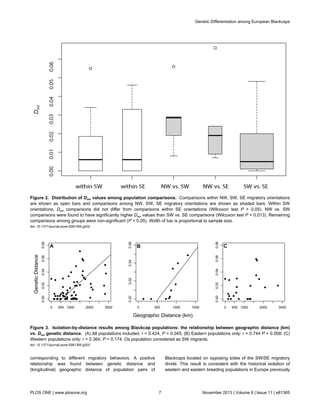
Within the migrant groups, comparisons among SE migrants
had higher Dest values than SW migrants, although distributions
did not differ significantly between the groups (Wilcoxon test P
> 0.05; Figure 2). Among the migrant groups, comparisons
among NW vs. SW migrants had the highest Dest values and
significantly differed from lower Dest values estimated from SW
vs. SE migrant comparisons (Wilcoxon test P = 0.013; Figure
2). Levels of genetic differentiation among NW vs. SW
comparisons did not significantly differ from NW vs. SE
comparisons; similarly, NW vs. SE comparisons did not
significantly differ from SW vs. SE comparisons (Wilcoxon tests
P > 0.05; Figure 2).
Isolation-by-distance
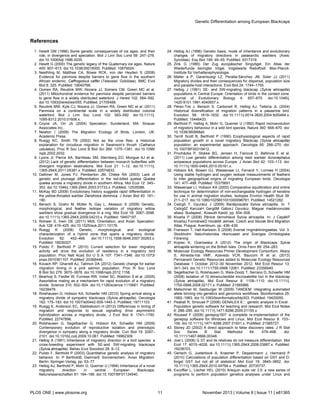
Mantel tests revealed significant isolation-by-distance among
all 12 Blackcap populations (Figure 3A: r = 0.424, P = 0.045),
although the relationship no longer occurred when the non-
breeding, short-distance migrant population in Sevilla is
excluded (r = 0.285, P = 0.117). Among the five eastern
populations (i.e. those east of the SW/SE divide), isolation-by-
distance was found significant (Figure 3B: r = 0.744, P =
0.008). Conversely, isolation-by-distance was non-significant
among the seven western populations (Figure 3C: r = 0.364, P
= 0.174), even when excluding the non-breeding Sevilla
population (r = -0.275, P = 0.754).
By exploring the relationship between genetic distance and
the longitudinal geographic distance of population pairs located
on opposing sides of the SW/SE divide, a strong, positive
correlation was evident (Figure 4, rho = 0.467 P = 0.005). The
least genetic distance was found between populations near the
center of the SW/SE divide (approximated at 13°E) and genetic
distance increased significantly with increased geographic
distance between populations. For example, all pairwise Dest
comparisons between Münsingen (Mn), Kefermarkt (Kf), and
Vienna (Vn) were found to be non-significant and for the
majority of these estimates (5/6 comparisons) Dest = 0,
indicating a lack of genetic differentiation between these
populations near the center of the zone (Table 2). Permuting
the geographic distances between populations determined that
the true rho values for genetic distance vs. geographic distance
lie outside the confidence interval generated from randomly-
sampled rho values (95% CI: -0.337 - 0.333), affirming the
observed relationship between genetic and geographic
distance is not a random effect. A positive relationship between
pairwise genetic distance vs. geographic distance was also
apparent after excluding the non-breeding Sevilla population
(rho = 0.377, P = 0.040).
Hierarchical structuring of genetic variance
No evidence of hierarchical structuring of genetic variation
was found by grouping the populations by three migratory
directions and three migratory distances (all F-statistics P >
0.05; Table S4). These results indicate the underlying genetic
structure among populations is more complex than simply
classifying populations into three migratory orientations and
three migratory distances. HierFstat analysis was additionally
repeated by categorizing the Norwegian population (Os) as SE
migrants (as opposed to SW migrants), but similarly resulted in
weak genetic structure; marginally better support for underlying
genetic structure was found by categorizing this population as
SW migrants (i.e. slightly higher F-statistics, albeit still non-
significant).
Discussion
Genetic structure among Blackcap populations
Overall, genetic differentiation across all the sampled
populations was low and Bayesian clustering, pairwise
comparisons and hierarchical analyses all failed to show
consistent, significant genetic structure among populations
Table 2. Pairwise genetic differentiation between sampled populations.
western populations eastern populations
Code Sv Ub FrNW FrSW Wh Mn Os Kf Vn Ry Bw Km
Sv - 0.057 0.059 0.035 0.017 0.029 0.020 0.022 0.014 0.051 0.038 0.008
Ub 0.054 - 0.028 0.004 0.004 0.000 0.000 0.005 0.000 0.001 0.000 0.041
FrNW 0.056 0.027 - 0.030 0.030 0.008 0.020 0.007 0.009 0.025 0.020 0.071
FrSW 0.034 0.004 0.029 - 0.018 0.000 0.000 0.000 0.004 0.010 0.001 0.021
Wh 0.017 0.004 0.029 0.017 - 0.009 0.000 0.004 0.000 0.013 0.000 0.032
Mn 0.029 0.000 0.008 0.000 0.009 - 0.000 0.004 0.000 0.005 0.005 0.025
Os 0.020 0.000 0.019 0.000 0.000 0.000 - 0.006 0.000 0.007 0.000 0.002
Kf 0.022 0.005 0.007 0.000 0.004 0.004 0.006 - 0.000 0.010 0.001 0.040
Vn 0.014 0.000 0.009 0.004 0.000 0.000 0.000 0.000 - 0.003 0.000 0.034
Ry 0.048 0.001 0.024 0.010 0.013 0.005 0.007 0.009 0.003 - 0.000 0.049
Bw 0.036 0.000 0.019 0.001 0.000 0.005 0.000 0.001 0.000 0.000 - 0.016
Km 0.008 0.040 0.066 0.020 0.031 0.025 0.002 0.038 0.033 0.046 0.016 -
Pairwise Dest values of genetic differentiation (below diagonal) and genetic distance (above diagonal) measured as Dest /(1- Dest) following Slatkin (1995). Populations are
sorted by longitude. Western Populations: Sv, Ub, FrNW, FrSW, Wh, Mn, Os. Eastern Populations: Kf, Vn, Ry, Bw, Km. Significance: P < 0.05 in bold; P < 0.01 in bold and
underlined
doi: 10.1371/journal.pone.0081365.t002
Genetic Differentiation among European Blackcaps
PLOS ONE | www.plosone.org 6 November 2013 | Volume 8 | Issue 11 | e81365
corresponding to different migratory behaviors. A positive
relationship was found between genetic distance and
(longitudinal) geographic distance of population pairs of
Blackcaps located on opposing sides of the SW/SE migratory
divide. This result is consistent with the historical isolation of
western and eastern breeding populations in Europe previously
Figure 2. Distribution of Dest values among population comparisons. Comparisons within NW, SW, SE migratory orientations
are shown as open bars and comparisons among NW, SW, SE migratory orientations are shown as shaded bars. Within SW
orientations, Dest comparisons did not differ from comparisons within SE orientations (Wilcoxon test P > 0.05). NW vs. SW
comparisons were found to have significantly higher Dest values than SW vs. SE comparisons (Wilcoxon test P = 0.013). Remaining
comparisons among groups were non-significant (P > 0.05). Width of bar is proportional to sample size.
doi: 10.1371/journal.pone.0081365.g002
Figure 3. Isolation-by-distance results among Blackcap populations: the relationship between geographic distance (km)
vs. Dest genetic distance. (A) All populations included: r = 0.424, P = 0.045; (B) Eastern populations only: r = 0.744 P = 0.008; (C)
Western populations only: r = 0.364, P = 0.174. Os population considered as SW migrants.
doi: 10.1371/journal.pone.0081365.g003
Genetic Differentiation among European Blackcaps
PLOS ONE | www.plosone.org 7 November 2013 | Volume 8 | Issue 11 | e81365
restricted to potential glacial refugia on the Iberian and Balkan
peninsulas, respectively [2,7,54]. Despite this observed
relationship between genetic and geographic distance, the only
SW/SE pairwise Dest comparison found to be significantly
differentiated was between Ub and Km (over 2000km apart).
Such results indicate a lack of neutral genetic divergence
between populations of SW and SE migrants and, in fact, many
populations within/near the approximated SW/SE contact zone
cannot be differentiated with our marker set. We suggest
therefore that the SW/SE migratory divide is an ineffective
barrier to neutral gene flow across this zone of contact.
Although isolation-by-distance appears to be maintained
among eastern populations, this pattern is not found among
western populations and is potentially confounded by the
occurrence of sympatrically-breeding populations of NW and
SW migrants (as observed in Freiburg, DE). Indeed, NW vs.
SW Dest comparisons were found to significantly differ from SW
vs. SE comparisons, confirming beliefs that different dynamics
of genetic divergence occur with the NW/SW migratory
polymorphism and across the SW/SE migratory divide. In
southern Germany (i.e. Freiburg), weak, albeit significant,
genetic differentiation was found between NW and SW
migrants breeding sympatrically, corroborating results of a
previous study by Rolshausen et al. [20], who suggest that only
low levels of genetic divergence may be needed to maintain
differences in migratory behavior.
The low nuclear genetic differentiation found across the
SW/SE migratory divide in the Blackcap is consistent with
similar patterns found across migratory divides in Eurasian
Reed Warblers (Acrocephalus scirpaceus) in central Europe
[31] and Willow Warblers (Phylloscopus trochilus) in
Scandinavia [12]. A lack of neutral genetic differentiation was
similarly found across the Red-billed Quelea (Quelea quelea)
migratory divide in Africa [10] and between populations of
Black-throated Blue Warblers (Setophaga caerulescens) with
different migratory routes in North America [55]. In addition,
complete introgression has recently occurred between
populations of Savi’s Warblers (Locustella luscinioides) in
Iberia despite Pleistocene divergence and long periods of
geographic isolation between populations [56]. Without
sufficient contemporary reproductive barriers it thus seems that
interbreeding often occurs across migratory divides, regardless
of historical geographic divergence between populations.
Potentially, NW migrant Blackcaps may also contribute to
breeding populations in other areas in central Europe (e.g. in
upper Austria, see 27,57 and Czech/Slovak Republics, see 35).
Our pairwise Dest comparisons suggest the FrNW population is
most genetically similar to the Kf population (i.e. the least
genetic distance was found among FrNW comparisons). This
would support the hypothesized origination of NW migrants
from within the SW/SE contact zone, first proposed by Helbig
[27] from observations of hand-raised Blackcaps from Linz, AU
(~25km SW of Kefermarkt) orienting SW-NW directions (mean
268°) during the autumn migratory period. Alternatively, since
our δ2
H assignment method did not indicate a presence of NW
migrants in the Kefermarkt population, this result may indicate
Figure 4. Relationship between geographic distance (km) and Dest genetic distance. Pairwise measurements estimated
between population pairs located on opposing sides of the SW/SE migratory divide revealed a positive relationship (rho = 0.467, P =
0.005). All 12 populations included with the Os population considered as a ‘western’ population.
doi: 10.1371/journal.pone.0081365.g004
Genetic Differentiation among European Blackcaps
PLOS ONE | www.plosone.org 8 November 2013 | Volume 8 | Issue 11 | e81365
that the location of the Blackcap migratory divide has shifted
eastward; the low genetic divergence found between FrNW vs.
Vn supports this hypothesis, potentially being driven by the
expansion of SW migrants into eastern European populations,
as proposed previously by Wesołowski [58].
Isolation-by-distance (IBD) was found to be non-significant
among the 11 breeding populations (after excluding Sevilla).
However, patterns of IBD differed on either side of the SW/SE
migratory divide: significant IBD was evident among eastern
populations (with greater levels pairwise genetic divergence),
but not among western populations (with lower levels of
pairwise genetic divergence); this result is consistent with the
genetic structure of Blackcap mtDNA by Pérez-Tris et al. [28],
who found no relationship between genetic and geographic
distance among western continental populations (although
results may be influenced by the different sets of populations
sampled in each study). The relationships between geographic
and genetic distance were similarly found to contrast among
populations of Eurasian Reed Warblers (Acrocephalus
scirpaceus) located on opposing sides of their migratory divide
in central Europe [31]. Such contradictory patterns
geographically spanning migratory divides may be indicative of
different ecological and/or evolutionary dynamics acting on
opposing sides of migratory divides in central Europe. Unlike
that found for eastern Blackcap populations, the lack of IBD
demonstrated among western Blackcap populations (i.e. both
SW and NW migrants) suggests a mechanism other than
geographic isolation may be promoting genetic divergence
among western Blackcap populations in the face of gene flow.
Mechanisms promoting / preventing genetic divergence
Our results provide little evidence that the historical migratory
divide in central Europe provides sufficient reproductive
isolation to influence mating preferences based on migratory
orientation in the Blackcap. Rather, it appears that
interbreeding between SW and SE migrants (and potentially
also NW migrants) results in high levels of gene flow across the
migratory divide where populations come into contact.
Asymmetrical gene flow across the SW/SE migratory divide
(i.e. SW migrant Blackcaps outcompeting SE migrants) has
been argued to be responsible for recent demographic
changes at Polish breeding grounds (e.g. advanced arrival time
and increased population size)[58]; interbreeding between
Blackcaps with different migratory strategies could therefore
potentially occur across an even larger area, resulting not in a
divide per se, but a gradual transition between migratory
orientations across central Europe. Our results indicate an
absence of NW migrants in the Białowieża population (from
isotope analysis), but cannot exclude the occurrence of SW
migrants occurring at this location. In fact, low levels of genetic
divergence are found between Białowieża Blackcaps and
several SW migrant populations (Ub, FrSW, Mn) as well as SE
migrant populations (Kf, Vn, Ry), suggesting Białowieża birds
are genetically similar to many other European population due
to introgression. Additionally, the distribution of claw δ2
H from
Białowieża birds is roughly consistent with the δ2
H distribution
of Freiburg SW migrants (although we are unable to distinguish
SW from SE migrants based solely on claw δ2
H). Our results,
together with those of Wesołowski [58], may provide evidence
for either an eastward shift in the geographic position of the
divide/contact zone (i.e. asymmetrical hybridization) or a
widening of the zone in both east and west directions (i.e.
symmetrical hybridization) [59,60]. While further studies are
needed to better characterize the dynamics of this zone,
movement of the SW/SE contact zone remains plausible for
Blackcaps.
Recent studies are now utilizing geolocators to record the
annual cycle of long-distance passerine migrants, including
migratory routes, durations, and strategies [61,62], as for
example in the Swainson’s Thrush (Catharus ustulatus) where
the existence of a migratory divide in North America has been
found [63]. At this narrow migratory divide, low frequencies of
Swainson’s Thrush hybrids may be suggestive of post-mating
isolation, while evidence for pre-mating isolation (e.g.
ecological selection and difference in arrival time) indicates an
important role for reinforcement in the maintenance of this
hybrid zone which spans a migratory divide [14,19]. Similarly,
in Blackcaps both pre- and post-mating isolating mechanisms
may likely influence genetic divergence among populations.
Crosses between SW and SE migrant Blackcaps produced
viable F1 hybrids with intermediate (southerly) orientations [64],
but wild-caught Blackcaps from the center of the contact zone
(Linz, AT) were found to orient SW-NW (mean 268°)
suggesting selection against S-SE orientations (and thus
selection against hybrid or SE x SE pairings) at this location
[27]. Still, 58% of Blackcaps ringed in the Czech Republic and
Slovakia were recovered at SE locations during the non-
breeding period [35]. Nevertheless, within the SW/SE contact
zone, female preference for males with SE orientations could
be responsible for eastward introgression of SW migrant
Blackcaps into eastern breeding populations (e.g. Poland) [58].
Rapid genetic divergence between sympatric NW and SW
migrant Blackcaps may be promoted by pre-mating isolation.
Temporal isolation in spring arrival to breeding grounds in
southern Germany has been documented between NW and
SW migrants [17,18,30] and presents also an effective isolating
mechanism among Swainson’s Thrushes breeding in North
America [19]. Such phenological changes can be further
affected by global climate change which is impacting the
phenology of migratory birds and influencing the advancement
of spring migration and arrival to the breeding grounds
[58,65,66]. It remains unclear however, if such temporal
divergence is locally adaptive in sympatry only, or if NW and
SW migrants reflect significant divergence also in allopatry.
We not only find evidence of significant genetic differentiation
between NW and SW migrant Blackcaps in sympatry, but NW
migrants were significantly differentiated from other populations
of SW migrants in western Europe. The observed divergence
between NW and SW migrants may be the consequence of a
founder effect resulting from a small number of genetically
distinct individuals initially establishing the NW migratory route.
Allopatric genetic differentiation demonstrated between FrNW
and SW migrants (i.e. Sv and Ub) may indicate that such
divergence is not locally adaptive, but that this polymorphism
has evolved repeatedly, independent of adaptive pressures on
the breeding ground. The behavioral, morphological, and
Genetic Differentiation among European Blackcaps
PLOS ONE | www.plosone.org 9 November 2013 | Volume 8 | Issue 11 | e81365
genetic traits observed to be diverging in the Blackcap may be
part of a ‘migratory syndrome’ or ‘migratory gene package’ in
this species whereby a suite of correlated traits that evolve
together are targeted by correlational selection [67–69].
Whether such syndromes are common and generalized among
migratory birds may be debatable [70], but provide an exciting
frontier to explore.
Although our Bayesian clustering and hierarchical analyses
failed to find significant genetic structure among populations
corresponding to the different migratory behaviors investigated,
significant (but weak) genetic structure in mtDNA was found
among eastern (including SE migrants) and western Blackcap
populations (including SW and NW migrants) in a previous
study (although only two eastern populations were considered)
[28]. Maternally-inherited mtDNA is less likely to introgress
across a contact zone than autosomal DNA [71], and reflects
only uni-parental gene flow which limits interpretation among
populations with highly dynamic migratory behaviors. Migratory
orientation may instead be controlled by very few genes
[22,24], and the possibility that one or few of microsatellite loci
used in our study are linked to functional loci cannot be ruled
out, though we did not find any evidence using outlier detection
methods (data not shown). Although microsatellites were found
to be undifferentiated across the Willow Warbler migratory
divide, two AFLPs were shown to exhibit clinal variation
corresponding to phenotypic differences [12]. Developing large
sets of genetic markers spanning the entire genome and
searching for informative markers associated with migratory
behavior will provide better resolution in the genetic variation
and structure of recently divergent populations, such as the
Blackcap [69]. Furthermore, combining molecular and stable
isotope markers (e.g. see 72) with data obtained from ring
recoveries and geolocators may greatly improve the spatial
resolution of species’ movements and thus provide a better
understanding of the ecology and evolution of migratory
divides.
Supporting Information
Figure S1. Stable isotope assignments. Claw δ2
H was used
to categorize Spring 2011 Blackcaps caught at four locales
(Ub, Fr, Kf, Bw) as inhabiting northern wintering grounds on
the British Isles (i.e. NW migrants) or southern wintering
grounds on Iberian or Balkan Peninsulas (i.e. SW or SE
migrants) based on reference claw δ2
H from British Isles and
Spain, respectively (see Methods). (A) Isotope assignment
results per population. Uebersyren, LU (Ub): NW = 1, SW = 42;
Freiburg, DE (Fr): NW = 23, SW = 176, Unassigned (?) = 10;
Kefermarkt, AT (Kf): South = 105; Białowieża, PL (Bw): South =
61. (B) Distribution of raw claw δ2
H isotopes from each
population, Ub = 61; Fr = 209; Kf = 105; Bw = 61. Claw δ2
H
from Ub, Kf, and Bw was found to significantly differ from Fr
δ2
H distribution (Wilcoxon Rank Sum Test P < 0.05), while only
Kf and Bw were found to significantly differ among remaining
comparisons. (C) δ2
H Distribution of N = 23 NW migrants and
N = 82 SW migrants selected from Freiburg, Fr population for
genetic analyses Width of bars are proportional to sample size.
(TIF)
Table S1. Characteristics of 14 microsatellite markers.
Accession No.: GenBank accession numbers; N alleles:
number of alleles per marker; Ho / He: Observed / Expected
Heterozygosities; HWE by pop: populations that were found to
deviate significantly for HWE; Null Allele Freq: mean frequency
of null alleles per marker.
(DOCX)
Table S2. Allele frequency comparison over populations.
(XLS)
Table S3. Summary of STRUCTURE results. #K: number of
clusters; Mean LnP(K): mean posterior probability of given K;
Stdev LnP(K): standard deviation of mean posterior probability
of given K.
(DOCX)
Table S4. F-statistics of hierarchical structuring of genetic
variance. Relationship between hierarchy levels are indicated
in rows with ‘/’ indicating ‘within’; Hierarchy A: 3 migratory
directions (NW, SW, SE) and 3 migratory distances (short-,
intermediate-, long-distance) with the Os population
characterized having SW migratory direction (dir); Hierarchy
B: 3 migratory directions (NW, SW, SE) and 3 migratory
distances (short-, intermediate-, long-distance) with the Os
population characterized having SE migratory direction (dir).
(DOCX)
Acknowledgements
The authors thank Heidi Kurz, Hans Winkler, Diego Santiago-
Alarcon, Michael W. Stracco, P. Rowiński, G. Hebda, and
several students at Universität Freiburg for field assistance. We
also thank Jan T. Lifjeld for providing samples and the staff at
Universität Freiburg Institute für Rechtsmedizin for technical
laboratory assistance. RM, HMS, and GS were funded through
a DFG grant (Scha 1008/6-1) and the DO-G has supported the
collection of samples in Poland.
Author Contributions
Conceived and designed the experiments: HMS GS RM.
Performed the experiments: RM GS. Analyzed the data: RM
GS. Contributed reagents/materials/analysis tools: RM KAH
NC MI EI AJ SCR DS GR TW WF. Wrote the manuscript: RM
GS HMS. Analyzed isotope samples: KAH.
Genetic Differentiation among European Blackcaps
PLOS ONE | www.plosone.org 10 November 2013 | Volume 8 | Issue 11 | e81365
References
1. Hewitt GM (1996) Some genetic consequences of ice ages, and their
role, in divergence and speciation. Biol J Linn Soc Lond 58: 247–276.
doi:10.1006/bijl.1996.0035.
2. Hewitt G (2000) The genetic legacy of the Quaternary ice ages. Nature
405: 907–913. doi:10.1038/35016000. PubMed: 10879524.
3. Neethling M, Matthee CA, Bowie RCK, von der Heyden S (2008)
Evidence for panmixia despite barriers to gene flow in the southern
African endemic, Caffrogobius caffer (Teleostei: Gobiidae). BMC Evol
Biol 8: 325. PubMed: 19040766.
4. Oomen RA, Reudink MW, Nocera JJ, Somers CM, Green MC et al.
(2011) Mitochondrial evidence for panmixia despite perceived barriers
to gene flow in a widely distributed waterbird. J Hered 102: 584–592.
doi:10.1093/jhered/esr055. PubMed: 21705489.
5. Reudink MW, Kyle CJ, Nocera JJ, Oomen RA, Green MC et al. (2011)
Panmixia on a continental scale in a widely distributed colonial
waterbird. Biol J Linn Soc Lond 102: 583–592. doi:10.1111/j.
1095-8312.2010.01608.x.
6. Coyne JA, Orr JA (2004) Speciation. Sunderland, MA: Sinauer
Associates Inc..
7. Newton I (2008) The Migration Ecology of Birds. London, UK:
Academic Press.
8. Ruegg KC, Smith TB (2002) Not as the crow flies: a historical
explanation for circuitous migration in Swainson’s thrush (Catharus
ustulatus). Proc R Soc Lond B Biol Sci 269: 1375–1381. doi:10.1098/
rspb.2002.2032.
9. Lyons JI, Pierce AA, Barribeau SM, Sternberg ED, Mongue AJ et al.
(2012) Lack of genetic differentiation between monarch butterflies with
divergent migration destinations. Mol Ecol 21: 1–12. doi:10.1111/j.
1365-294X.2011.05381.x. PubMed: 22574833.
10. Dallimer M, Jones PJ, Pemberton JM, Cheke RA (2003) Lack of
genetic and plumage differentiation in the red-billed quelea Quelea
quelea across a migratory divide in southern Africa. Mol Ecol 12: 345–
353. doi:10.1046/j.1365-294X.2003.01733.x. PubMed: 12535086.
11. McKay BD (2009) Evolutionary history suggests rapid differentiation in
the yellow-throated warbler Dendroica dominica. J Avian Biol 40: 181–
190.
12. Bensch S, Grahn M, Müller N, Gay L, Akesson S (2009) Genetic,
morphological, and feather isotope variation of migratory willow
warblers show gradual divergence in a ring. Mol Ecol 18: 3087–3096.
doi:10.1111/j.1365-294X.2009.04210.x. PubMed: 19457197.
13. Rohwer S, Irwin DE (2011) Molt, Orientation, and Avian Speciation.
Auk 128: 419–425. doi:10.1525/auk.2011.10176.
14. Ruegg K (2008) Genetic, morphological, and ecological
characterization of a hybrid zone that spans a migratory divide.
Evolution 62: 452–466. doi:10.1111/j.1558-5646.2007.00263.x.
PubMed: 18039327.
15. Pulido F, Berthold P (2010) Current selection for lower migratory
activity will drive the evolution of residency in a migratory bird
population. Proc Natl Acad Sci U S A 107: 7341–7346. doi:10.1073/
pnas.0910361107. PubMed: 20368446.
16. Kovach RP, Gharrett AJ, Tallmon DA (2012) Genetic change for earlier
migration timing in a pink salmon population. Proc R Soc Lond
B Biol Sci 279: 3870–3878. doi:10.1098/rspb.2012.1158.
17. Bearhop S, Fiedler W, Furness RW, Votier SC, Waldron S et al. (2005)
Assortative mating as a mechanism for rapid evolution of a migratory
divide. Science 310: 502–504. doi:10.1126/science.1115661. PubMed:
16239479.
18. Rolshausen G, Hobson KA, Schaefer HM (2010) Spring arrival along a
migratory divide of sympatric blackcaps (Sylvia atricapilla). Oecologia
162: 175–183. doi:10.1007/s00442-009-1445-3. PubMed: 19711103.
19. Ruegg K, Anderson EC, Slabbekoorn H (2012) Differences in timing of
migration and response to sexual signalling drive asymmetric
hybridization across a migratory divide. J Evol Biol 9: 1741–1750.
PubMed: 22747896.
20. Rolshausen G, Segelbacher G, Hobson KA, Schaefer HM (2009)
Contemporary evolution of reproductive isolation and phenotypic
divergence in sympatry along a migratory divide. Curr Biol 19: 2097–
2101. doi:10.1016/j.cub.2009.10.061. PubMed: 19962309.
21. Helbig A (1991) Inheritance of migratory direction in a bird species: a
cross-breeding experiment with SE-and SW-migrating blackcaps
(Sylvia atricapilla). Behav Ecol Sociobiol 28: 9–12.
22. Pulido F, Berthold P (2003) Quantitative genetic analysis of migratory
behavior. In: P BertholdE GwinnerE Sonnenschein. Avian Migration.
Berlin: Springer-Verlag. pp. 53–77.
23. Helbig AJ, Berthold P, Mohr G, Querner U (1994) Inheritance of a novel
migratory direction in central European Blackcaps.
Naturwissenschaften 81: 184–186. doi:10.1007/BF01134540.
24. Helbig AJ (1996) Genetic basis, mode of inheritance and evolutionary
changes of migratory directions in palaearctic warblers (Aves:
Sylviidae). Exp Biol 199: 49–55. PubMed: 9317319.
25. Zink G (1985) Der Zug europäischer Singvögel. Ein Atlas der
Wiederfunde beringter Vögel. Vogelwarte Radolfzell: Max-Planck-
Institute für Verhaltensphysiologie.
26. Møller a P, Garamszegi LZ, Peralta-Sánchez JM, Soler JJ (2011)
Migratory divides and their consequences for dispersal, population size
and parasite-host interactions. Evol Biol 24: 1744–1755
27. Helbig J (1991) SE- and SW-migrating blackcap (Sylvia atricapilla)
populations in Central Europe: Orientation of birds in the contact zone.
Journal of Evolutionary Biology 4: 657–670. doi:10.1046/j.
1420-9101.1991.4040657.x.
28. Pérez-Tris J, Bensch S, Carbonell R, Helbig AJ, Tellería JL (2004)
Historical diversification of migration patterns in a passerine bird.
Evolution 58: 1819–1832. doi:10.1111/j.0014-3820.2004.tb00464.x.
PubMed: 15446433.
29. Berthold P, Helbig A, Mohr G, Querner U (1992) Rapid microevolution
of migratory behaviour in a wild bird species. Nature 360: 668–670. doi:
10.1038/360668a0.
30. Terrill Scott B, Berthold P (1990) Ecophysiological aspects of rapid
population growth in a novel migratory Blackcap (Sylvia atricapilla)
population: an experimental approach. Oecologia 85: 266–270. doi:
10.1007/BF00319412.
31. Procházka P, Stokke BG, Jensen H, Fainová D, Bellinvia E et al.
(2011) Low genetic differentiation among reed warbler Acrocephalus
scirpaceus populations across Europe. J Avian Biol 42: 103–113. doi:
10.1111/j.1600-048X.2010.05161.x.
32. Hobson KA, Bowen GJ, Wassenaar LI, Ferrand Y, Lormee H (2004)
Using stable hydrogen and oxygen isotope measurements of feathers
to infer geographical origins of migrating European birds. Oecologia
141: 477–488. PubMed: 15375691.
33. Wassenaar LI, Hobson KA (2003) Comparative equilibration and online
technique for determination of non-exchangeable hydrogen of keratins
for use in animal migration studies. Isotopes Environ Health Stud 39:
211–217. doi:10.1080/1025601031000096781. PubMed: 14521282.
34. Csörgő T, Gyurácz J (2009) Barátposzáta Sylvia atricapilla. In: T
CsörgőZ KarczaH GergőM GáborJ Gyurácz. Magyar madárvonulási
atlasz. Budapest.: Kossuth Kaidó. pp. 504–508.
35. Klvaňa P (2008) Pěnice černohlavá Sylvia atricapilla. In: J CepákP
KlvaňaJ FormánekD HorákM Jelínek. Czech and Slovak Bird Migration
Atlas. Prague: Aventinum. pp. 436–439.
36. Fransson T, Hall-Karlsson S (2008) Svensk ringmärkningsatlas. Vol. 3.
Stockholm: Naturhistoriska riksmuseet and Sveriges Ornitologiska
Förening
37. Kopiec K, Ozarowska A (2012) The origin of Blackcaps Sylvia
atricapilla wintering on the British Isles. Ornis Fenn 89: 254–263.
38. Molecular Ecology Resources Primer Development Consortium, Aksoy
S, Almeida-Val VMF, Azevedo VCR, Baucom R et al. (2013)
Permanent Genetic Resources added to Molecular Ecology Resources
Database 1 October 2012–30 November 2012. Mol Ecol Resour 13:
341–343. doi:10.1111/1755-0998.12061. PubMed: 23356940.
39. Segelbacher G, Rolshausen G, Weis-Dootz T, Serrano D, Schaefer HM
(2008) Isolation of 10 tetranucleotide microsatellite loci in the blackcap
(Sylvia atricapilla). Mol Ecol Resour 8: 1108–1110. doi:10.1111/j.
1755-0998.2008.02171.x. PubMed: 21585986.
40. Matschiner M, Salzburger W (2009) TANDEM: integrating automated
allele binning into genetics and genomics workflows. Bioinformatics 25:
1982–1983. doi:10.1093/bioinformatics/btp303. PubMed: 19420055.
41. Peakall R, Smouse P (2006) GENALEX 6 : genetic analysis in Excel .
Population genetic software for teaching and research. Mol Ecol Notes
6: 288–295. doi:10.1111/j.1471-8286.2005.01155.x.
42. Rousset F (2008) genepop’007: a complete re-implementation of the
genepop software for Windows and Linux. Mol Ecol Resour 8: 103–
106. doi:10.1111/j.1471-8286.2007.01931.x. PubMed: 21585727.
43. Storey JD (2002) A direct approach to false discovery rates. J R Stat
Soc Series B Stat Methodol 64: 479–498. doi:
10.1111/1467-9868.00346.
44. Jost L (2008) G ST and its relatives do not measure differentiation. Mol
Ecol 17: 4015–4026. doi:10.1111/j.1365-294X.2008.03887.x. PubMed:
19238703.
45. Gerlach G, Jueterbock A, Kraemer P, Deppermann J, Harmand P
(2010) Calculations of population differentiation based on GST and D:
forget GST but not all of statistics! Mol Ecol 19: 3845–3852. doi:
10.1111/j.1365-294X.2010.04784.x. PubMed: 20735737.
46. Excoffier L, Lischer HEL (2010) Arlequin suite ver 3.5: a new series of
programs to perform population genetics analyses under Linux and
Genetic Differentiation among European Blackcaps
PLOS ONE | www.plosone.org 11 November 2013 | Volume 8 | Issue 11 | e81365
Windows. Mol Ecol Resour 10: 564–567. doi:10.1111/j.
1755-0998.2010.02847.x. PubMed: 21565059.
47. Jensen JL, Bohonak AJ, Kelley ST (2005) Isolation by distance, web
service. BMC Genet 6: 13 v 3.23 http://ibdws.sdsu.edu/.
48. Vavrek MJ (2011) fossil: palaeoecological and palaeogeographical
analysis tools. Palaeontol Electronica: 14: 1T.
49. Slatkin M (1995) A measure of population subdivision based on
microsatellite allele frequencies. Genetics 139: 457–462. PubMed:
7705646.
50. Cramp S (1992) Handbook of the birds of Europe, the Middle East and
North Africa: The birds of the Western Palearctic, Vol. 6. Oxford: Oxford
University Press.
51. R Development Core Team (2013) R: A language and environment for
statistical computing. Available: http://www.r-project.org/.
52. Pritchard JK, Stephens M, Donnelly P (2000) Inference of population
structure using multilocus genotype data. Genetics 155: 945–959.
PubMed: 10835412.
53. Goudet J (2005) HIERFSTAT, a package for R to compute and test
hierarchical F -statistics. Mol Ecol Notes 2: 184–186.
54. Hewitt G (1999) Post-glacial re-colonization of European biota. Biol J
Linn Soc Lond 68: 87–112. doi:10.1111/j.1095-8312.1999.tb01160.x.
55. Davis LA, Roalson EH, Cornell KL, McClanahan KD, Webster MS
(2006) Genetic divergence and migration patterns in a North American
passerine bird: implications for evolution and conservation. Mol Ecol
15: 2141–2152. doi:10.1111/j.1365-294X.2006.02914.x. PubMed:
16780431.
56. Neto JM, Arroyo JL, Bargain B, Monrós JS, Mátrai N et al. (2012)
Phylogeography of a habitat specialist with high dispersal capability:
the Savi’s Warbler Locustella luscinioides. PLOS ONE 7: e38497. doi:
10.1371/journal.pone.0038497. PubMed: 22701653.
57. Helbig AJ (1992) Population differentiation of migratory directions in
birds: comparison between ringing results and orientation behaviour of
hand-raised migrants. Oecologia 90: 483–488. doi:10.1007/
BF01875441.
58. Wesołowski T (2011) Blackcap Sylvia atricapilla numbers, phenology
and reproduction in a primeval forest—a 33-year study. J Ornithol 152:
319–329. doi:10.1007/s10336-010-0585-x.
59. Barton NH, Hewitt GM (1985) Analysis of Hybrid Zones. Annu Rev Ecol
Syst 16: 113–148. doi:10.1146/annurev.es.16.110185.000553.
60. Buggs RJ (2007) Empirical study of hybrid zone movement. Heredity
(Edinb) 99: 301–312. doi:10.1038/sj.hdy.6800997. PubMed: 17611495.
61. Stutchbury BJM, Tarof SA, Done T, Gow E, Kramer PM et al. (2009)
Tracking long-distance songbird migration by using geolocators.
Science 323: 896. doi:10.1126/science.1166664. PubMed: 19213909.
62. Tøttrup AP, Klaassen RHG, Strandberg R, Thorup K, Kristensen MW et
al. (2012) The annual cycle of a trans-equatorial Eurasian-African
passerine migrant: different spatio-temporal strategies for autumn and
spring migration. Proc Biol Sci 279: 1008–1016. doi:10.1098/rspb.
2011.1323. PubMed: 21900322.
63. Delmore KE, Fox JW, Irwin DE (2012) Dramatic intraspecific
differences in migratory routes, stopover sites and wintering areas,
revealed using light-level geolocators. P Proc Biol Sci 279: 4582–4589
64. Helbig AJ (1991) Inheritance of migratory direction in a bird species: a
cross-breeding experiment with SE- and SW-migrating blackcaps
(Sylvia atricapilla). Behav Ecol Sociobiol 28: 9–12.
65. Payevsky V (1999) Breeding biology, morphometrics, and population
dynamics of Sylvia warblers in the Eastern Baltic. Avian Ecol Behav 2:
19–50.
66. Sokolov LV (2006) Effect of global warming on the timing of migration
and breeding of passerine birds in the 20th century. Entomol Rev 86:
S59–S81. doi:10.1134/S0013873806100058.
67. Dingle H (2006) Animal migration: is there a common migratory
syndrome? J Ornithol 147: 212–220. doi:10.1007/s10336-005-0052-2.
68. Pulido F (2007) The genetics and evolution of avian migration.
BioScience 57: 165–174.
69. Liedvogel M, Akesson S, Bensch S (2011) The genetics of migration on
the move. Trends Ecol Evol 26: 561–569. doi:10.1016/j.tree.
2011.07.009. PubMed: 21862171.
70. Piersma T, Pérez-Tris J, Mouritsen H, Bauchinger U, Bairlein F (2005)
Is there a “migratory syndrome” common to all migrant birds? Ann N Y
Acad Sci 1046: 282–293. doi:10.1196/annals.1343.026. PubMed:
16055861.
71. Rheindt FE, Edwards SV (2011) Genetic introgression : an integral but
neglected component of speciation in birds. Auk 128: 620–632. doi:
10.1525/auk.2011.128.4.620.
72. Chabot AA, Hobson KA, Van Wilgenburg SL, McQuat GJ, Lougheed
SC (2012) Advances in linking wintering migrant birds to their breeding-
ground origins using combined analyses of genetic and stable isotope
markers. PLOS ONE 7: e43627. doi:10.1371/journal.pone.0043627.
PubMed: 22916285.
Genetic Differentiation among European Blackcaps
PLOS ONE | www.plosone.org 12 November 2013 | Volume 8 | Issue 11 | e81365

Mettler_et_al_2013

  • 1.
    Contrasting Patterns ofGenetic Differentiation among Blackcaps (Sylvia atricapilla) with Divergent Migratory Orientations in Europe Raeann Mettler1* , H. Martin Schaefer1 , Nikita Chernetsov2 , Wolfgang Fiedler3,4 , Keith A. Hobson5 , Mihaela Ilieva6 , Elisabeth Imhof7 , Arild Johnsen8 , Swen C. Renner9,10 , Gregor Rolshausen11 , David Serrano12 , Tomasz Wesołowski13 , Gernot Segelbacher7 1 Department of Evolutionary Biology and Animal Ecology, University of Freiburg, Freiburg, Germany, 2 Biological Station Rybachy, Zoological Institute, Rybachy, Kaliningrad Region, Russia, 3 Max Planck Institute for Ornithology, Vogelwarte, Radolfzell, Germany, 4 University of Konstanz, Department of Biology, Konstanz, Germany, 5 Environment Canada, Science and Technology Branch, Saskatoon, Saskatchewan, Canada, 6 Institute of Biodiversity and Ecosystem Research, Bulgarian Academy of Sciences, Sofia, Bulgaria, 7 Wildlife Ecology and Management, University of Freiburg, Freiburg, Germany, 8 Natural History Museum, University of Oslo, Oslo, Norway, 9 Institute of Experimental Ecology, Ulm University, Ulm, Germany, 10 Smithsonian Conservation Biology Institute, Front Royal, United States of America, 11 Redpath Museum & Department of Biology, McGill University, Montreal, Quebec, Canada, 12 Department of Conservation Biology, Estación Biológica de Doñana (EBD-CSIC), Sevilla, Spain, 13 Laboratory of Forest Biology, Wrocław University, Wrocław, Poland Abstract Migratory divides are thought to facilitate behavioral, ecological, and genetic divergence among populations with different migratory routes. However, it is currently contentious how much genetic divergence is needed to maintain distinct migratory behavior across migratory divides. Here we investigate patterns of neutral genetic differentiation among Blackcap (Sylvia atricapilla) populations with different migratory strategies across Europe. We compare the level of genetic divergence of populations migrating to southwestern (SW) or southeastern (SE) wintering areas with birds wintering in the British Isles following a recently established northwesterly (NW) migration route. The migratory divide between SW and SE wintering areas can be interpreted as a result of a re-colonization process after the last glaciation. Thus we predicted greater levels of genetic differentiation among the SW/SE populations. However, a lack of genetic differentiation was found between SW and SE populations, suggesting that interbreeding likely occurs among Blackcaps with different migratory orientations across a large area; therefore the SW/SE migratory divide can be seen as diffuse, broad band and is, at best, a weak isolating barrier. Conversely, weak, albeit significant genetic differentiation was evident between NW and SW migrants breeding sympatrically in southern Germany, suggesting a stronger isolating mechanism may be acting in this population. Populations located within/near the SW/SE contact zone were the least genetically divergent from NW migrants, confirming NW migrants likely originated from within the contact zone. Significant isolation-by-distance was found among eastern Blackcap populations (i.e. SE migrants), but not among western populations (i.e. NW and SW migrants), revealing different patterns of genetic divergence among Blackcap populations in Europe. We discuss possible explanations for the genetic structure of European Blackcaps and how gene flow influences the persistence of divergent migratory behaviors. Citation: Mettler R, Schaefer HM, Chernetsov N, Fiedler W, Hobson KA, et al. (2013) Contrasting Patterns of Genetic Differentiation among Blackcaps (Sylvia atricapilla) with Divergent Migratory Orientations in Europe. PLoS ONE 8(11): e81365. doi:10.1371/journal.pone.0081365 Editor: Nicola Saino, University of Milan, Italy Received July 5, 2013; Accepted October 11, 2013; Published November 21, 2013 Copyright: © 2013 Mettler et al. This is an open-access article distributed under the terms of the Creative Commons Attribution License, which permits unrestricted use, distribution, and reproduction in any medium, provided the original author and source are credited. Funding: This research was supported by a grant from the Deutsche Forschungsgemeinschaft to H. M. Schaefer (grant Scha 1008/6-1), an operating grant from Environment Canada to K. A. Hobson, an internal grant from Wrocław University to T. Wesołowski (grant 1067/S/PBLas/2012), a project grant from the Bulgarian Science Fund (grant DO02-277), and by the Deutsche Ornithologen-Gesellschaft. The funders had no role in study design, data collection and analysis, decision to publish, or preparation of the manuscript. Competing interests: The authors have declared that no competing interests exist. * E-mail: raeann.mettler@gmail.com Introduction Patterns of geographic isolation during the Pleistocene in temperate areas have allowed behavioral, ecological, and genetic divergence among geographically isolated populations in a range of taxa [1,2]. However, panmixia is often found within highly mobile vertebrate populations, despite presumed geographic barriers to dispersal and divergent migratory pathways [3–5]. While geographic barriers are instrumental in the formation of initial reproductive isolation, further isolating barriers are needed for continued genetic divergence in the PLOS ONE | www.plosone.org 1 November 2013 | Volume 8 | Issue 11 | e81365
  • 2.
    face of geneflow, for example in the case of secondary contact between previously isolated populations at contact zones [6]. Migratory divides represent the locations at which populations maintain divergent migratory routes, often originating during periods of allopatry, but can also evolve into hybrid zones as a result of secondary contact and interbreeding between populations [7]. If isolating barriers are sufficiently strong to maintain some degree of reproductive isolation between divergent populations, the level of genetic divergence among populations with distinct migratory routes may be high [8]. However, migratory divides are also known to be leaky barriers to gene flow, despite divergent migratory routes utilized by organisms, such as those found in migratory butterflies [9] and birds [10,11]. Where interbreeding does occur between different migrant types, it is hypothesized that migratory divides can also represent hybrid zones maintained by selection against hybrids as a form of reproductive isolation [12–14]. While migratory behavior does not appear to be a strong isolation barrier, it is among the best examples of a mechanism promoting adaptive microevolution [15,16]. For example, assortative mating based upon allochronic spring arrival to the breeding grounds can facilitate adaptive microevolution in passerines and promote genetic divergence within sympatric breeding populations [17–20] . The Blackcap (Sylvia atricapilla) is a common European passerine and serves as a model species to study the evolution of migratory behavior because it spans the full spectrum of migratory distances (from sedentary to long-distance migrations) and migratory orientations. Several migratory traits have been shown to be under genetic control in Blackcaps, including timing of migration, direction, and duration/length of migration [21–24], while moderate-to-high heritabilities have been found for some of these traits in both wild and experimental populations [15,22]. In central Europe, Blackcaps exhibit a southwest/southeast (SW/SE) migratory divide resulting from the geographic isolation of potential glacial refugia in the Iberian Peninsula and Balkan Peninsula during the Pleistocene, followed by post-glacial expansion [21,25–27]. Weak but significant genetic structure in mitochondrial DNA (mtDNA) has been found to occur between Blackcap populations sampled on opposing sides of this divide [28]. As recently as during the latter half of the last century, a portion of SW migrant Blackcaps shifted their autumn migration route to the northwest (NW), overwintering on the British Isles. It has been hypothesized by Helbig [27] that these NW migrants originated from within the SW/SE contact zone. Currently a novel northwest/southwest (NW/SW) migratory polymorphism exists where these different migrants breed sympatrically in southern Germany [29]. This change in orientation has facilitated rapid morphological, behavioral, and genetic divergence between migrants from different wintering grounds and may promote assortative mating as an isolating barrier in sympatry [17,18,20,30]. In this study, we investigate genetic variation in 12 populations of wild Blackcaps using 14 polymorphic microsatellite loci. Sampling sites spanned both the historical SW/SE migratory divide in central Europe and the novel NW/SW migratory polymorphism present in southern Germany (Figure 1). By simultaneously characterizing levels of neutral genetic differentiation across the SW/SE migratory divide as well as the NW/SW polymorphism, we investigated two competing hypotheses: 1) if the migratory divide represents an adequate isolating barrier, genetic divergence between SW and SE migrants should be detectable (as found in [28]) and, given the long history of this divide, would be larger than that found at the novel NW/SW migratory polymorphism; 2) if the migratory divide is an incomplete barrier to gene flow, levels of genetic divergence should be lower across the SW/SE migratory divide (as found in other European passerines, [12,31]) compared to the novel NW/SW migratory polymorphism experiencing rapid, adaptive divergence in sympatry [17,18,20]. Methods Ethics Statement Samples from the Schwäbische Alb (Münsingen) and Freiburg have been collected under field work and animal experiment permits granted by the responsible state environmental offices of Baden-Württemberg (RPT Tierversuch-Nr. 1056 and 55-8853.17/0, respectively). Samples collected in Kefermarkt, Austria were approved from the district Freistadt permit Nr. N10-75-2010. Sampling in Rybachy (Russia) was performed under the license from Kaliningrad Regional Agency for Protection, Reproduction and Use of Animal World and Forests. Trapping and sampling permits in Spain were granted by the Consejería de Medio Ambiente of the government of Andalucía and in Bulgaria under permit N243/1.03.2010 from Bulgarian Ministry of Environment and Waters. Sample collection and allocation Blood samples from 502 Blackcaps were collected at 12 sample sites across Europe from 2001 - 2011 (Figure 1 and Table 1). Individuals captured in Sevilla, Spain (Sv) during the non-breeding season (January) were determined to be overwintering, short-distance migrants based on two lines of evidence: 1) Sevilla birds had relatively short wings compared to other breeding populations in central Europe, thus travelled a shorter distance during migration, and 2) they were found to be genetically differentiated (at microsatellite loci) from resident Spanish Blackcaps identified in a previous study [20]. The remaining 11 sites were sampled during the breeding season (Table 1). While we assume most to be breeding individuals (supported by our ringing data (data not shown)), we cannot rule out that some spring migrants may have been caught as well. All birds captured at a single sampling site were considered as populations in the following analyses. Stable isotope values from avian tissues can be used to discriminate between possible wintering grounds of migratory birds in Europe [32]. In particular, stable hydrogen isotope values (δ2 H) in keratins (claws and feathers) vary by latitude in Europe and have been previously used to distinguish which individuals winter at either northern or southern latitudes among sympatrically breeding Blackcaps in southern Germany [17,18,20]. To distinguish among NW and SW migrants breeding sympatrically in the Freiburg, Germany (Fr) Genetic Differentiation among European Blackcaps PLOS ONE | www.plosone.org 2 November 2013 | Volume 8 | Issue 11 | e81365
  • 3.
    population in thisstudy, approximately 2 mm of claw material was collected from Blackcaps in the spring of 2011 and analyzed for δ2 H at the Environment Canada stable isotope facility in Saskatoon, Canada, using the comparative equilibrium method [33]. Claw δ2 H from eight Blackcaps caught in Sevilla, Spain (in Jan. 2011) for this study was used as a southern reference to identify SW migrants (mean δ2 H: -51.6‰, SD: 5.8). Due to the observed interannual variation in claw δ2 H Figure 1. Sampling localities of Blackcaps captured in Europe. Population codes: Sv = Sevilla, ES; Ub = Uebersyren, LU; Fr = Freiburg, DE; Wh = Wilhelmshaven, DE; Mn = Münsingen, DE; Os = Oslo, NO; Kf = Kefermarkt, AT; Vn = Vienna, AT; Ry = Rybachy, RU; Bw = Białowieża Forest, PL; Km = Kalimok, BG. Individuals collected in Freiburg, Germany (Fr), indicated with the open symbol, were divided into populations of NW and SW migrants by stable isotope δ2 H values in claws. The thick, grey band represents approximate location of SW/SE migratory divide, centered at 13°E (according to[25,27,50]). Degrees East and North are shown on the X and Y axes, respectively. doi: 10.1371/journal.pone.0081365.g001 Genetic Differentiation among European Blackcaps PLOS ONE | www.plosone.org 3 November 2013 | Volume 8 | Issue 11 | e81365
  • 4.
    and the absenceof Blackcap reference claws from the British Isles during the 2010-2011 winter, δ2 H was analyzed from overwintering Blackcaps and other species (Cyanistes caeruleus, Parus major, Fringilla coelebs, Prunella modularis, Carduelis spinus) captured in Britain, Ireland and Scotland between 2002-2010 as part of this study (unpublished) and a previous study of Bearhop et al. [17]. We used the Bearhop et al. [17] estimate of overwintering C. caeruleus and P. major (2002-2003) as a northern reference (mean δ2 H: -94.3, SD: 4.9) and best approximation of the wintering ground signature of NW migrants in this study. Blackcaps caught in Freiburg in the spring of 2011 were assigned to wintering grounds using a 75% probability criterion based on reference claw δ2 H ( Figure S1), as previously described in Rolshausen et al. [20]. In addition to Freiburg, Blackcaps from three other collecting sites were analyzed for variation in claw δ2 H (Ub, Kf, and Bw – see Figure S1). The distributions of δ2 H were found to differ significantly among these four populations (Kruskal-Wallis P < 0.05). Apart from the Freiburg population (see above), only one individual caught in Uebersyren, LU was marginally categorized (78.4% probability) with a NW claw δ2 H value among the other populations tested; therefore, we found little indication of NW migrants present at these three additional locations during spring sampling. Due to the lack of longitudinal spatial resolution in claw δ2 H for birds in Europe, Blackcap populations (excluding Fr) were therefore categorized as SW or SE migrants using the approximate location of the SW/SE migratory divide in central Europe found in other studies [26–28] and published ring recoveries for this species [25,34–36] as classification criteria. The autumn migratory direction of Blackcaps breeding on the southern coast of Norway (Os) likely encompasses a broad front spanning SW – SE orientations [36,37] and so, while we initially analyzed this population as SW migrants, we also repeated the analyses by considering this population as SE migrants. PCR and genotyping Genomic DNA was extracted from blood samples using DNeasy Blood and Tissue kits (Qiagen) following manufacturer’s protocol. A total of 14 microsatellite markers were utilized (Table S1), comprising nine markers developed for this study (Syla1, Syla2, Syla3, Syla12, Syla14, Syla15, Syla18, Syla19, Syla20 [38]) and five markers previously developed for this species (Syl1, Syl2, Syl6, Syl9, and Syl10 [39]). Microsatellite loci were amplified with polymerase chain reaction (PCR) for all individuals in 20µl reactions including: 1x Qiagen CoralLoad Concentrate, 1x Qiagen PCR Buffer (containing KCl and (NH4)2SO4), 0.25 µM labeled forward primer, 0.25 µM reverse primer, 200 µM of each dNTP, 1.25 U Qiagen Top Taq DNA polymerase, and 1.0µl DNA template. Mastercycler Gradient Thermocyclers (Eppendorf GmbH, Hamburg Germany) were used to run PCR under the following conditions: initial denaturing at 94 °C for 5 min, followed by 20 cycles of 94°C for 30 s, 60°C for 30 s (decreased by 0.5°C per cycle), and 72°C for 45 s, followed by 15 cycles of 94°C for 30 s, 50°C for 30 s, and 72°C for 45 s with a final extension of 72°C for 3 min. Forward primers were labeled with FAM or HEX florescent dyes (Applied Biosystems), PCR products were genotyped on an ABI3130xl Genetic Analyzer (Applied Biosystems), and genotypes were analyzed with PeakScanner v1.0 software (Applied Biosystems). Raw genotype sizes were rounded and binned according to repeat size using TANDEM [40]. The mean number of effective alleles (AE) and observed and expected heterozygosities (HO and HE) were estimated for each population with GenAlEx v6.41[41]. Deviations from Hardy Weinberg Equilibrium (HWE), genotypic linkage disequilibrium (LD) between loci, and the frequency of null alleles were estimated with Genepop v4.1.2 [42]. Estimated P- values from HWE and LD tests were corrected for false discovery rate using the Qvalue program [43]. Table 1. Sampling locations of Blackcaps and summary statistics of population genetics. Code Population N Lat Long Sampling Period Year AE (SE) HO(SE) HE (SE) MigDir MigDist Sv Sevilla, ES1 8 37.65 -5.58 25 Jan 2011 3.79 (0.40) 0.65 (0.06) 0.76 (0.02) SW short Ub Uebersyren, LU 43 49.63 6.28 25 Mar – 2 Apr 2011 4.33 (0.50) 0.72 (0.03) 0.74 (0.03) SW intermed FrNW Freiburg, DE 23 48.03 7.82 23 Mar – 19 Apr 2011 4.15 (0.47) 0.66 (0.05) 0.73 (0.03) NW intermed FrSW Freiburg, DE 82 48.03 7.82 23 Mar – 19 Apr 2011 4.62 (0.54) 0.70 (0.02) 0.76 (0.02) SW intermed Wh Wilhelmshaven, DE 24 53.52 8.12 Summer2 2007 4.17 (0.40) 0.60 (0.03) 0.75 (0.02) SW long Mn Münsingen, DE 25 48.40 10.00 16 Jun – 13 Jul 2011 4.32 (0.56) 0.72 (0.03) 0.74 (0.03) SW intermed Os Oslo, NO 25 59.84 10.86 4 May – 13 Jul 2001, 2004, 2008, 2010 4.11 (0.46) 0.68 (0.03) 0.73 (0.03) SW long Kf Kefermarkt, AT 105 48.44 14.54 14 Apr – 2 May 2011 4.63 (0.50) 0.69 (0.03) 0.76 (0.02) SE intermed Vn Vienna, AT 35 48.22 16.28 12 May – 21 May 2010 4.39 (0.50) 0.72 (0.02) 0.75 (0.03) SE intermed Ry Rybachy, RU 51 55.15 20.85 20 Apr – 24 Apr 2011 4.32 (0.52) 0.66 (0.03) 0.74 (0.03) SE long Bw Białowieża, PL 61 52.7 23.87 14 Apr – 6 May 2011 4.48 (0.45) .73 (0.03) 0.76 (0.02) SE long Km Kalimok, BG 20 44.00 26.26 16 Apr – 7 Jun 2010, 2011 3.87 (0.38) 0.71 (0.04) 0.73 (0.03) SE long N: sample size; Lat: decimal degree latitude; Long: decimal degree longitude; Sampling Period: dates samples collected; Year: year(s) samples collected; Ae: effective number of alleles = 1 / (Sum pi^2), where Sum pi2 is the sum of the squared population allele frequencies; Ho: observed heterozygosity; He: unbiased expected heterozygosity = (2N / (2N-1)) x expected heterozygosity; (SE): standard error; MigDir: autumn migratory direction; MigDist: migratory distance 1. population sampled during the non-breeding season 2. precise sampling period information not available. doi: 10.1371/journal.pone.0081365.t001 Genetic Differentiation among European Blackcaps PLOS ONE | www.plosone.org 4 November 2013 | Volume 8 | Issue 11 | e81365
  • 5.
    Genetic structure Pairwise geneticdifferentiation among Blackcap populations was estimated with the fixation index Dest (the unbiased estimator of D, [44]) using the R package “DEMEtics” [44,45]; complementary FST values estimated with Arlequin v3.5.1.3 [46] were found to be highly correlated with Dest values (Kendall’s tau = 0.637, P < 0.0001) and so, we report only Dest values hereafter. Locus Syl10 has been shown to deviate from HWE in a previous study [20]. We included this marker in our dataset as it has been proven to be highly variable. However, we ran Dest analyses including and excluding this marker for all comparisons and found that Dest values were highly correlated between analyses (Kendall’s tau = 0.842, P < 0.0001). Wilcoxon Sum Rank tests were implemented to investigate the independence of the distributions of Dest values within and among migratory orientations; the Uebersyren NW migrant identified via claw δ2 H was excluded from these analyzes. Isolation-by-distance among Blackcap populations was explored with Mantel tests using Isolation by Distance Web Service v3.23 [47] to investigate the relationship between geographic distance and genetic distance: Euclidean geographic distance among all 12 populations was calculated with the R package “fossil” [48], pairwise genetic distance between populations was calculated as Dest /(1- Dest) following Slatkin [49], and 10,000 randomizations were implemented. Additional Mantel tests were run for only those populations west of the SW/SE migratory divide and those populations east of the divide to investigate differential effects of isolation-by- distance on either side of the SW/SE divide. The relationship between genetic distance and longitudinal geographic distance was investigated between Blackcap populations located on opposing sides of the SW/SE migratory divide, which was approximated at 13°E (Figure 1); we acknowledge that the contact zone between SW and SE migrants is potentially a broad, diffuse zone where migrants come into contact and here use this precise position as an approximate zone center (consistent with Blackcap ring recovery data [25–27,50]) for analytical purposes only. The latitude of each population was set to zero and the Euclidean (longitudinal) distance between populations was calculated with the R package “fossil” [48]. Spearman-Rank correlations were used to explore the relationship between genetic distance and longitudinal geographic distance between populations. To determine if the relationship between genetic distance and geographic distance was significantly different from random, measures of geographic distance were resampled 10,000x and tested against pairwise genetic distances with Spearman rank correlations. True rho values determined for genetic distance vs. geographic distance were then compared to confidence intervals constructed from random distributions to determine significance of true values. Statistical analyses were conducted with R statistical computing environment [51]. Genetic structure was further investigated from genotype data using a MCMC model-based clustering method implemented with STRUCTURE software v2.3.4 [52]. The most likely number of genetic clusters (K) was assessed assuming admixture and locprior of the individual populations and five iterations were run per K (Burn-in: 100,000; Repetitions: 500,000). Hierarchical structuring of genetic variance Populations were grouped by autumn migratory orientation (i.e. NW, SW, SE) and migratory distance (i.e. short-, intermediate-, long-distance) inferred from ring-recoveries (Table 1 and Figure 1; [25,35]). We investigated the effect of hierarchical structuring on the partitioning of genetic differentiation by categorizing individuals by migratory orientation, migratory distance, and the population level (in decreasing hierarchical order) using the R package “HierFstat” [53]. Here, the population level was nested within the level of migratory distance, and migratory distance was nested within the migratory direction level (population/distance/direction); the effect of each level was tested with 10,000 permutations to determine the level of significance of this structuring. Hierarchy A categorizes the Norwegian population (Os) with a SW migratory direction, while Hierarchy B categorizes the same population with a SE migratory direction. The Uebersyren NW migrant identified via claw δ2 H was excluded from these analyses. Results Genetic diversity Observed multilocus population heterozygosities were high and ranged from 0.60 - 0.73, with a mean observed heterozygosity of 0.69 and mean number of effective alleles of 4.26 (Table 1). Only 18 of 168 total HWE tests indicated a deficiency of heterozygotes (Q < 0.01), although patterns were not consistent across populations (Table S1). The Syl10 locus deviated from HWE at a high frequency (i.e. in nine populations). In a global analysis including all populations, one comparison was in linkage disequilibrium (Q < 0.05: Syl2/Syl6), but found to be significant only in the Kefermarkt population when populations were analyzed separately. Overall we thus can assume independence between loci used in this study. Allele frequencies at each population per locus are listed in Table S2. Genetic structure All birds could be assigned to one single population as STRUCTURE analysis identified the highest posterior probability for the number of genetic clusters to be K=1 (Table S3). Despite this lack of resolution in genetic structure, significant neutral genetic differentiation was evident among some population comparisons (Table 2). Most notably, genetic differentiation was significant between sympatric NW and SW migrants in Freiburg, with Dest = 0.029 (FST = 0.007). NW migrants breeding in Freiburg were also found to be significantly differentiated from allopatric populations in Uebersyren, Kalimok, and Sevilla, while SW migrants in Freiburg were undifferentiated from all allopatric populations. Freiburg NW migrants were most genetically similar to populations within/near the contact zone at the SW/SE migratory divide (Table 2). Genetic Differentiation among European Blackcaps PLOS ONE | www.plosone.org 5 November 2013 | Volume 8 | Issue 11 | e81365
  • 6.
    Within the migrantgroups, comparisons among SE migrants had higher Dest values than SW migrants, although distributions did not differ significantly between the groups (Wilcoxon test P > 0.05; Figure 2). Among the migrant groups, comparisons among NW vs. SW migrants had the highest Dest values and significantly differed from lower Dest values estimated from SW vs. SE migrant comparisons (Wilcoxon test P = 0.013; Figure 2). Levels of genetic differentiation among NW vs. SW comparisons did not significantly differ from NW vs. SE comparisons; similarly, NW vs. SE comparisons did not significantly differ from SW vs. SE comparisons (Wilcoxon tests P > 0.05; Figure 2). Isolation-by-distance Mantel tests revealed significant isolation-by-distance among all 12 Blackcap populations (Figure 3A: r = 0.424, P = 0.045), although the relationship no longer occurred when the non- breeding, short-distance migrant population in Sevilla is excluded (r = 0.285, P = 0.117). Among the five eastern populations (i.e. those east of the SW/SE divide), isolation-by- distance was found significant (Figure 3B: r = 0.744, P = 0.008). Conversely, isolation-by-distance was non-significant among the seven western populations (Figure 3C: r = 0.364, P = 0.174), even when excluding the non-breeding Sevilla population (r = -0.275, P = 0.754). By exploring the relationship between genetic distance and the longitudinal geographic distance of population pairs located on opposing sides of the SW/SE divide, a strong, positive correlation was evident (Figure 4, rho = 0.467 P = 0.005). The least genetic distance was found between populations near the center of the SW/SE divide (approximated at 13°E) and genetic distance increased significantly with increased geographic distance between populations. For example, all pairwise Dest comparisons between Münsingen (Mn), Kefermarkt (Kf), and Vienna (Vn) were found to be non-significant and for the majority of these estimates (5/6 comparisons) Dest = 0, indicating a lack of genetic differentiation between these populations near the center of the zone (Table 2). Permuting the geographic distances between populations determined that the true rho values for genetic distance vs. geographic distance lie outside the confidence interval generated from randomly- sampled rho values (95% CI: -0.337 - 0.333), affirming the observed relationship between genetic and geographic distance is not a random effect. A positive relationship between pairwise genetic distance vs. geographic distance was also apparent after excluding the non-breeding Sevilla population (rho = 0.377, P = 0.040). Hierarchical structuring of genetic variance No evidence of hierarchical structuring of genetic variation was found by grouping the populations by three migratory directions and three migratory distances (all F-statistics P > 0.05; Table S4). These results indicate the underlying genetic structure among populations is more complex than simply classifying populations into three migratory orientations and three migratory distances. HierFstat analysis was additionally repeated by categorizing the Norwegian population (Os) as SE migrants (as opposed to SW migrants), but similarly resulted in weak genetic structure; marginally better support for underlying genetic structure was found by categorizing this population as SW migrants (i.e. slightly higher F-statistics, albeit still non- significant). Discussion Genetic structure among Blackcap populations Overall, genetic differentiation across all the sampled populations was low and Bayesian clustering, pairwise comparisons and hierarchical analyses all failed to show consistent, significant genetic structure among populations Table 2. Pairwise genetic differentiation between sampled populations. western populations eastern populations Code Sv Ub FrNW FrSW Wh Mn Os Kf Vn Ry Bw Km Sv - 0.057 0.059 0.035 0.017 0.029 0.020 0.022 0.014 0.051 0.038 0.008 Ub 0.054 - 0.028 0.004 0.004 0.000 0.000 0.005 0.000 0.001 0.000 0.041 FrNW 0.056 0.027 - 0.030 0.030 0.008 0.020 0.007 0.009 0.025 0.020 0.071 FrSW 0.034 0.004 0.029 - 0.018 0.000 0.000 0.000 0.004 0.010 0.001 0.021 Wh 0.017 0.004 0.029 0.017 - 0.009 0.000 0.004 0.000 0.013 0.000 0.032 Mn 0.029 0.000 0.008 0.000 0.009 - 0.000 0.004 0.000 0.005 0.005 0.025 Os 0.020 0.000 0.019 0.000 0.000 0.000 - 0.006 0.000 0.007 0.000 0.002 Kf 0.022 0.005 0.007 0.000 0.004 0.004 0.006 - 0.000 0.010 0.001 0.040 Vn 0.014 0.000 0.009 0.004 0.000 0.000 0.000 0.000 - 0.003 0.000 0.034 Ry 0.048 0.001 0.024 0.010 0.013 0.005 0.007 0.009 0.003 - 0.000 0.049 Bw 0.036 0.000 0.019 0.001 0.000 0.005 0.000 0.001 0.000 0.000 - 0.016 Km 0.008 0.040 0.066 0.020 0.031 0.025 0.002 0.038 0.033 0.046 0.016 - Pairwise Dest values of genetic differentiation (below diagonal) and genetic distance (above diagonal) measured as Dest /(1- Dest) following Slatkin (1995). Populations are sorted by longitude. Western Populations: Sv, Ub, FrNW, FrSW, Wh, Mn, Os. Eastern Populations: Kf, Vn, Ry, Bw, Km. Significance: P < 0.05 in bold; P < 0.01 in bold and underlined doi: 10.1371/journal.pone.0081365.t002 Genetic Differentiation among European Blackcaps PLOS ONE | www.plosone.org 6 November 2013 | Volume 8 | Issue 11 | e81365
  • 7.
    corresponding to differentmigratory behaviors. A positive relationship was found between genetic distance and (longitudinal) geographic distance of population pairs of Blackcaps located on opposing sides of the SW/SE migratory divide. This result is consistent with the historical isolation of western and eastern breeding populations in Europe previously Figure 2. Distribution of Dest values among population comparisons. Comparisons within NW, SW, SE migratory orientations are shown as open bars and comparisons among NW, SW, SE migratory orientations are shown as shaded bars. Within SW orientations, Dest comparisons did not differ from comparisons within SE orientations (Wilcoxon test P > 0.05). NW vs. SW comparisons were found to have significantly higher Dest values than SW vs. SE comparisons (Wilcoxon test P = 0.013). Remaining comparisons among groups were non-significant (P > 0.05). Width of bar is proportional to sample size. doi: 10.1371/journal.pone.0081365.g002 Figure 3. Isolation-by-distance results among Blackcap populations: the relationship between geographic distance (km) vs. Dest genetic distance. (A) All populations included: r = 0.424, P = 0.045; (B) Eastern populations only: r = 0.744 P = 0.008; (C) Western populations only: r = 0.364, P = 0.174. Os population considered as SW migrants. doi: 10.1371/journal.pone.0081365.g003 Genetic Differentiation among European Blackcaps PLOS ONE | www.plosone.org 7 November 2013 | Volume 8 | Issue 11 | e81365
  • 8.
    restricted to potentialglacial refugia on the Iberian and Balkan peninsulas, respectively [2,7,54]. Despite this observed relationship between genetic and geographic distance, the only SW/SE pairwise Dest comparison found to be significantly differentiated was between Ub and Km (over 2000km apart). Such results indicate a lack of neutral genetic divergence between populations of SW and SE migrants and, in fact, many populations within/near the approximated SW/SE contact zone cannot be differentiated with our marker set. We suggest therefore that the SW/SE migratory divide is an ineffective barrier to neutral gene flow across this zone of contact. Although isolation-by-distance appears to be maintained among eastern populations, this pattern is not found among western populations and is potentially confounded by the occurrence of sympatrically-breeding populations of NW and SW migrants (as observed in Freiburg, DE). Indeed, NW vs. SW Dest comparisons were found to significantly differ from SW vs. SE comparisons, confirming beliefs that different dynamics of genetic divergence occur with the NW/SW migratory polymorphism and across the SW/SE migratory divide. In southern Germany (i.e. Freiburg), weak, albeit significant, genetic differentiation was found between NW and SW migrants breeding sympatrically, corroborating results of a previous study by Rolshausen et al. [20], who suggest that only low levels of genetic divergence may be needed to maintain differences in migratory behavior. The low nuclear genetic differentiation found across the SW/SE migratory divide in the Blackcap is consistent with similar patterns found across migratory divides in Eurasian Reed Warblers (Acrocephalus scirpaceus) in central Europe [31] and Willow Warblers (Phylloscopus trochilus) in Scandinavia [12]. A lack of neutral genetic differentiation was similarly found across the Red-billed Quelea (Quelea quelea) migratory divide in Africa [10] and between populations of Black-throated Blue Warblers (Setophaga caerulescens) with different migratory routes in North America [55]. In addition, complete introgression has recently occurred between populations of Savi’s Warblers (Locustella luscinioides) in Iberia despite Pleistocene divergence and long periods of geographic isolation between populations [56]. Without sufficient contemporary reproductive barriers it thus seems that interbreeding often occurs across migratory divides, regardless of historical geographic divergence between populations. Potentially, NW migrant Blackcaps may also contribute to breeding populations in other areas in central Europe (e.g. in upper Austria, see 27,57 and Czech/Slovak Republics, see 35). Our pairwise Dest comparisons suggest the FrNW population is most genetically similar to the Kf population (i.e. the least genetic distance was found among FrNW comparisons). This would support the hypothesized origination of NW migrants from within the SW/SE contact zone, first proposed by Helbig [27] from observations of hand-raised Blackcaps from Linz, AU (~25km SW of Kefermarkt) orienting SW-NW directions (mean 268°) during the autumn migratory period. Alternatively, since our δ2 H assignment method did not indicate a presence of NW migrants in the Kefermarkt population, this result may indicate Figure 4. Relationship between geographic distance (km) and Dest genetic distance. Pairwise measurements estimated between population pairs located on opposing sides of the SW/SE migratory divide revealed a positive relationship (rho = 0.467, P = 0.005). All 12 populations included with the Os population considered as a ‘western’ population. doi: 10.1371/journal.pone.0081365.g004 Genetic Differentiation among European Blackcaps PLOS ONE | www.plosone.org 8 November 2013 | Volume 8 | Issue 11 | e81365
  • 9.
    that the locationof the Blackcap migratory divide has shifted eastward; the low genetic divergence found between FrNW vs. Vn supports this hypothesis, potentially being driven by the expansion of SW migrants into eastern European populations, as proposed previously by Wesołowski [58]. Isolation-by-distance (IBD) was found to be non-significant among the 11 breeding populations (after excluding Sevilla). However, patterns of IBD differed on either side of the SW/SE migratory divide: significant IBD was evident among eastern populations (with greater levels pairwise genetic divergence), but not among western populations (with lower levels of pairwise genetic divergence); this result is consistent with the genetic structure of Blackcap mtDNA by Pérez-Tris et al. [28], who found no relationship between genetic and geographic distance among western continental populations (although results may be influenced by the different sets of populations sampled in each study). The relationships between geographic and genetic distance were similarly found to contrast among populations of Eurasian Reed Warblers (Acrocephalus scirpaceus) located on opposing sides of their migratory divide in central Europe [31]. Such contradictory patterns geographically spanning migratory divides may be indicative of different ecological and/or evolutionary dynamics acting on opposing sides of migratory divides in central Europe. Unlike that found for eastern Blackcap populations, the lack of IBD demonstrated among western Blackcap populations (i.e. both SW and NW migrants) suggests a mechanism other than geographic isolation may be promoting genetic divergence among western Blackcap populations in the face of gene flow. Mechanisms promoting / preventing genetic divergence Our results provide little evidence that the historical migratory divide in central Europe provides sufficient reproductive isolation to influence mating preferences based on migratory orientation in the Blackcap. Rather, it appears that interbreeding between SW and SE migrants (and potentially also NW migrants) results in high levels of gene flow across the migratory divide where populations come into contact. Asymmetrical gene flow across the SW/SE migratory divide (i.e. SW migrant Blackcaps outcompeting SE migrants) has been argued to be responsible for recent demographic changes at Polish breeding grounds (e.g. advanced arrival time and increased population size)[58]; interbreeding between Blackcaps with different migratory strategies could therefore potentially occur across an even larger area, resulting not in a divide per se, but a gradual transition between migratory orientations across central Europe. Our results indicate an absence of NW migrants in the Białowieża population (from isotope analysis), but cannot exclude the occurrence of SW migrants occurring at this location. In fact, low levels of genetic divergence are found between Białowieża Blackcaps and several SW migrant populations (Ub, FrSW, Mn) as well as SE migrant populations (Kf, Vn, Ry), suggesting Białowieża birds are genetically similar to many other European population due to introgression. Additionally, the distribution of claw δ2 H from Białowieża birds is roughly consistent with the δ2 H distribution of Freiburg SW migrants (although we are unable to distinguish SW from SE migrants based solely on claw δ2 H). Our results, together with those of Wesołowski [58], may provide evidence for either an eastward shift in the geographic position of the divide/contact zone (i.e. asymmetrical hybridization) or a widening of the zone in both east and west directions (i.e. symmetrical hybridization) [59,60]. While further studies are needed to better characterize the dynamics of this zone, movement of the SW/SE contact zone remains plausible for Blackcaps. Recent studies are now utilizing geolocators to record the annual cycle of long-distance passerine migrants, including migratory routes, durations, and strategies [61,62], as for example in the Swainson’s Thrush (Catharus ustulatus) where the existence of a migratory divide in North America has been found [63]. At this narrow migratory divide, low frequencies of Swainson’s Thrush hybrids may be suggestive of post-mating isolation, while evidence for pre-mating isolation (e.g. ecological selection and difference in arrival time) indicates an important role for reinforcement in the maintenance of this hybrid zone which spans a migratory divide [14,19]. Similarly, in Blackcaps both pre- and post-mating isolating mechanisms may likely influence genetic divergence among populations. Crosses between SW and SE migrant Blackcaps produced viable F1 hybrids with intermediate (southerly) orientations [64], but wild-caught Blackcaps from the center of the contact zone (Linz, AT) were found to orient SW-NW (mean 268°) suggesting selection against S-SE orientations (and thus selection against hybrid or SE x SE pairings) at this location [27]. Still, 58% of Blackcaps ringed in the Czech Republic and Slovakia were recovered at SE locations during the non- breeding period [35]. Nevertheless, within the SW/SE contact zone, female preference for males with SE orientations could be responsible for eastward introgression of SW migrant Blackcaps into eastern breeding populations (e.g. Poland) [58]. Rapid genetic divergence between sympatric NW and SW migrant Blackcaps may be promoted by pre-mating isolation. Temporal isolation in spring arrival to breeding grounds in southern Germany has been documented between NW and SW migrants [17,18,30] and presents also an effective isolating mechanism among Swainson’s Thrushes breeding in North America [19]. Such phenological changes can be further affected by global climate change which is impacting the phenology of migratory birds and influencing the advancement of spring migration and arrival to the breeding grounds [58,65,66]. It remains unclear however, if such temporal divergence is locally adaptive in sympatry only, or if NW and SW migrants reflect significant divergence also in allopatry. We not only find evidence of significant genetic differentiation between NW and SW migrant Blackcaps in sympatry, but NW migrants were significantly differentiated from other populations of SW migrants in western Europe. The observed divergence between NW and SW migrants may be the consequence of a founder effect resulting from a small number of genetically distinct individuals initially establishing the NW migratory route. Allopatric genetic differentiation demonstrated between FrNW and SW migrants (i.e. Sv and Ub) may indicate that such divergence is not locally adaptive, but that this polymorphism has evolved repeatedly, independent of adaptive pressures on the breeding ground. The behavioral, morphological, and Genetic Differentiation among European Blackcaps PLOS ONE | www.plosone.org 9 November 2013 | Volume 8 | Issue 11 | e81365
  • 10.
    genetic traits observedto be diverging in the Blackcap may be part of a ‘migratory syndrome’ or ‘migratory gene package’ in this species whereby a suite of correlated traits that evolve together are targeted by correlational selection [67–69]. Whether such syndromes are common and generalized among migratory birds may be debatable [70], but provide an exciting frontier to explore. Although our Bayesian clustering and hierarchical analyses failed to find significant genetic structure among populations corresponding to the different migratory behaviors investigated, significant (but weak) genetic structure in mtDNA was found among eastern (including SE migrants) and western Blackcap populations (including SW and NW migrants) in a previous study (although only two eastern populations were considered) [28]. Maternally-inherited mtDNA is less likely to introgress across a contact zone than autosomal DNA [71], and reflects only uni-parental gene flow which limits interpretation among populations with highly dynamic migratory behaviors. Migratory orientation may instead be controlled by very few genes [22,24], and the possibility that one or few of microsatellite loci used in our study are linked to functional loci cannot be ruled out, though we did not find any evidence using outlier detection methods (data not shown). Although microsatellites were found to be undifferentiated across the Willow Warbler migratory divide, two AFLPs were shown to exhibit clinal variation corresponding to phenotypic differences [12]. Developing large sets of genetic markers spanning the entire genome and searching for informative markers associated with migratory behavior will provide better resolution in the genetic variation and structure of recently divergent populations, such as the Blackcap [69]. Furthermore, combining molecular and stable isotope markers (e.g. see 72) with data obtained from ring recoveries and geolocators may greatly improve the spatial resolution of species’ movements and thus provide a better understanding of the ecology and evolution of migratory divides. Supporting Information Figure S1. Stable isotope assignments. Claw δ2 H was used to categorize Spring 2011 Blackcaps caught at four locales (Ub, Fr, Kf, Bw) as inhabiting northern wintering grounds on the British Isles (i.e. NW migrants) or southern wintering grounds on Iberian or Balkan Peninsulas (i.e. SW or SE migrants) based on reference claw δ2 H from British Isles and Spain, respectively (see Methods). (A) Isotope assignment results per population. Uebersyren, LU (Ub): NW = 1, SW = 42; Freiburg, DE (Fr): NW = 23, SW = 176, Unassigned (?) = 10; Kefermarkt, AT (Kf): South = 105; Białowieża, PL (Bw): South = 61. (B) Distribution of raw claw δ2 H isotopes from each population, Ub = 61; Fr = 209; Kf = 105; Bw = 61. Claw δ2 H from Ub, Kf, and Bw was found to significantly differ from Fr δ2 H distribution (Wilcoxon Rank Sum Test P < 0.05), while only Kf and Bw were found to significantly differ among remaining comparisons. (C) δ2 H Distribution of N = 23 NW migrants and N = 82 SW migrants selected from Freiburg, Fr population for genetic analyses Width of bars are proportional to sample size. (TIF) Table S1. Characteristics of 14 microsatellite markers. Accession No.: GenBank accession numbers; N alleles: number of alleles per marker; Ho / He: Observed / Expected Heterozygosities; HWE by pop: populations that were found to deviate significantly for HWE; Null Allele Freq: mean frequency of null alleles per marker. (DOCX) Table S2. Allele frequency comparison over populations. (XLS) Table S3. Summary of STRUCTURE results. #K: number of clusters; Mean LnP(K): mean posterior probability of given K; Stdev LnP(K): standard deviation of mean posterior probability of given K. (DOCX) Table S4. F-statistics of hierarchical structuring of genetic variance. Relationship between hierarchy levels are indicated in rows with ‘/’ indicating ‘within’; Hierarchy A: 3 migratory directions (NW, SW, SE) and 3 migratory distances (short-, intermediate-, long-distance) with the Os population characterized having SW migratory direction (dir); Hierarchy B: 3 migratory directions (NW, SW, SE) and 3 migratory distances (short-, intermediate-, long-distance) with the Os population characterized having SE migratory direction (dir). (DOCX) Acknowledgements The authors thank Heidi Kurz, Hans Winkler, Diego Santiago- Alarcon, Michael W. Stracco, P. Rowiński, G. Hebda, and several students at Universität Freiburg for field assistance. We also thank Jan T. Lifjeld for providing samples and the staff at Universität Freiburg Institute für Rechtsmedizin for technical laboratory assistance. RM, HMS, and GS were funded through a DFG grant (Scha 1008/6-1) and the DO-G has supported the collection of samples in Poland. Author Contributions Conceived and designed the experiments: HMS GS RM. Performed the experiments: RM GS. Analyzed the data: RM GS. Contributed reagents/materials/analysis tools: RM KAH NC MI EI AJ SCR DS GR TW WF. Wrote the manuscript: RM GS HMS. Analyzed isotope samples: KAH. Genetic Differentiation among European Blackcaps PLOS ONE | www.plosone.org 10 November 2013 | Volume 8 | Issue 11 | e81365
  • 11.
    References 1. Hewitt GM(1996) Some genetic consequences of ice ages, and their role, in divergence and speciation. Biol J Linn Soc Lond 58: 247–276. doi:10.1006/bijl.1996.0035. 2. Hewitt G (2000) The genetic legacy of the Quaternary ice ages. Nature 405: 907–913. doi:10.1038/35016000. PubMed: 10879524. 3. Neethling M, Matthee CA, Bowie RCK, von der Heyden S (2008) Evidence for panmixia despite barriers to gene flow in the southern African endemic, Caffrogobius caffer (Teleostei: Gobiidae). BMC Evol Biol 8: 325. PubMed: 19040766. 4. Oomen RA, Reudink MW, Nocera JJ, Somers CM, Green MC et al. (2011) Mitochondrial evidence for panmixia despite perceived barriers to gene flow in a widely distributed waterbird. J Hered 102: 584–592. doi:10.1093/jhered/esr055. PubMed: 21705489. 5. Reudink MW, Kyle CJ, Nocera JJ, Oomen RA, Green MC et al. (2011) Panmixia on a continental scale in a widely distributed colonial waterbird. Biol J Linn Soc Lond 102: 583–592. doi:10.1111/j. 1095-8312.2010.01608.x. 6. Coyne JA, Orr JA (2004) Speciation. Sunderland, MA: Sinauer Associates Inc.. 7. Newton I (2008) The Migration Ecology of Birds. London, UK: Academic Press. 8. Ruegg KC, Smith TB (2002) Not as the crow flies: a historical explanation for circuitous migration in Swainson’s thrush (Catharus ustulatus). Proc R Soc Lond B Biol Sci 269: 1375–1381. doi:10.1098/ rspb.2002.2032. 9. Lyons JI, Pierce AA, Barribeau SM, Sternberg ED, Mongue AJ et al. (2012) Lack of genetic differentiation between monarch butterflies with divergent migration destinations. Mol Ecol 21: 1–12. doi:10.1111/j. 1365-294X.2011.05381.x. PubMed: 22574833. 10. Dallimer M, Jones PJ, Pemberton JM, Cheke RA (2003) Lack of genetic and plumage differentiation in the red-billed quelea Quelea quelea across a migratory divide in southern Africa. Mol Ecol 12: 345– 353. doi:10.1046/j.1365-294X.2003.01733.x. PubMed: 12535086. 11. McKay BD (2009) Evolutionary history suggests rapid differentiation in the yellow-throated warbler Dendroica dominica. J Avian Biol 40: 181– 190. 12. Bensch S, Grahn M, Müller N, Gay L, Akesson S (2009) Genetic, morphological, and feather isotope variation of migratory willow warblers show gradual divergence in a ring. Mol Ecol 18: 3087–3096. doi:10.1111/j.1365-294X.2009.04210.x. PubMed: 19457197. 13. Rohwer S, Irwin DE (2011) Molt, Orientation, and Avian Speciation. Auk 128: 419–425. doi:10.1525/auk.2011.10176. 14. Ruegg K (2008) Genetic, morphological, and ecological characterization of a hybrid zone that spans a migratory divide. Evolution 62: 452–466. doi:10.1111/j.1558-5646.2007.00263.x. PubMed: 18039327. 15. Pulido F, Berthold P (2010) Current selection for lower migratory activity will drive the evolution of residency in a migratory bird population. Proc Natl Acad Sci U S A 107: 7341–7346. doi:10.1073/ pnas.0910361107. PubMed: 20368446. 16. Kovach RP, Gharrett AJ, Tallmon DA (2012) Genetic change for earlier migration timing in a pink salmon population. Proc R Soc Lond B Biol Sci 279: 3870–3878. doi:10.1098/rspb.2012.1158. 17. Bearhop S, Fiedler W, Furness RW, Votier SC, Waldron S et al. (2005) Assortative mating as a mechanism for rapid evolution of a migratory divide. Science 310: 502–504. doi:10.1126/science.1115661. PubMed: 16239479. 18. Rolshausen G, Hobson KA, Schaefer HM (2010) Spring arrival along a migratory divide of sympatric blackcaps (Sylvia atricapilla). Oecologia 162: 175–183. doi:10.1007/s00442-009-1445-3. PubMed: 19711103. 19. Ruegg K, Anderson EC, Slabbekoorn H (2012) Differences in timing of migration and response to sexual signalling drive asymmetric hybridization across a migratory divide. J Evol Biol 9: 1741–1750. PubMed: 22747896. 20. Rolshausen G, Segelbacher G, Hobson KA, Schaefer HM (2009) Contemporary evolution of reproductive isolation and phenotypic divergence in sympatry along a migratory divide. Curr Biol 19: 2097– 2101. doi:10.1016/j.cub.2009.10.061. PubMed: 19962309. 21. Helbig A (1991) Inheritance of migratory direction in a bird species: a cross-breeding experiment with SE-and SW-migrating blackcaps (Sylvia atricapilla). Behav Ecol Sociobiol 28: 9–12. 22. Pulido F, Berthold P (2003) Quantitative genetic analysis of migratory behavior. In: P BertholdE GwinnerE Sonnenschein. Avian Migration. Berlin: Springer-Verlag. pp. 53–77. 23. Helbig AJ, Berthold P, Mohr G, Querner U (1994) Inheritance of a novel migratory direction in central European Blackcaps. Naturwissenschaften 81: 184–186. doi:10.1007/BF01134540. 24. Helbig AJ (1996) Genetic basis, mode of inheritance and evolutionary changes of migratory directions in palaearctic warblers (Aves: Sylviidae). Exp Biol 199: 49–55. PubMed: 9317319. 25. Zink G (1985) Der Zug europäischer Singvögel. Ein Atlas der Wiederfunde beringter Vögel. Vogelwarte Radolfzell: Max-Planck- Institute für Verhaltensphysiologie. 26. Møller a P, Garamszegi LZ, Peralta-Sánchez JM, Soler JJ (2011) Migratory divides and their consequences for dispersal, population size and parasite-host interactions. Evol Biol 24: 1744–1755 27. Helbig J (1991) SE- and SW-migrating blackcap (Sylvia atricapilla) populations in Central Europe: Orientation of birds in the contact zone. Journal of Evolutionary Biology 4: 657–670. doi:10.1046/j. 1420-9101.1991.4040657.x. 28. Pérez-Tris J, Bensch S, Carbonell R, Helbig AJ, Tellería JL (2004) Historical diversification of migration patterns in a passerine bird. Evolution 58: 1819–1832. doi:10.1111/j.0014-3820.2004.tb00464.x. PubMed: 15446433. 29. Berthold P, Helbig A, Mohr G, Querner U (1992) Rapid microevolution of migratory behaviour in a wild bird species. Nature 360: 668–670. doi: 10.1038/360668a0. 30. Terrill Scott B, Berthold P (1990) Ecophysiological aspects of rapid population growth in a novel migratory Blackcap (Sylvia atricapilla) population: an experimental approach. Oecologia 85: 266–270. doi: 10.1007/BF00319412. 31. Procházka P, Stokke BG, Jensen H, Fainová D, Bellinvia E et al. (2011) Low genetic differentiation among reed warbler Acrocephalus scirpaceus populations across Europe. J Avian Biol 42: 103–113. doi: 10.1111/j.1600-048X.2010.05161.x. 32. Hobson KA, Bowen GJ, Wassenaar LI, Ferrand Y, Lormee H (2004) Using stable hydrogen and oxygen isotope measurements of feathers to infer geographical origins of migrating European birds. Oecologia 141: 477–488. PubMed: 15375691. 33. Wassenaar LI, Hobson KA (2003) Comparative equilibration and online technique for determination of non-exchangeable hydrogen of keratins for use in animal migration studies. Isotopes Environ Health Stud 39: 211–217. doi:10.1080/1025601031000096781. PubMed: 14521282. 34. Csörgő T, Gyurácz J (2009) Barátposzáta Sylvia atricapilla. In: T CsörgőZ KarczaH GergőM GáborJ Gyurácz. Magyar madárvonulási atlasz. Budapest.: Kossuth Kaidó. pp. 504–508. 35. Klvaňa P (2008) Pěnice černohlavá Sylvia atricapilla. In: J CepákP KlvaňaJ FormánekD HorákM Jelínek. Czech and Slovak Bird Migration Atlas. Prague: Aventinum. pp. 436–439. 36. Fransson T, Hall-Karlsson S (2008) Svensk ringmärkningsatlas. Vol. 3. Stockholm: Naturhistoriska riksmuseet and Sveriges Ornitologiska Förening 37. Kopiec K, Ozarowska A (2012) The origin of Blackcaps Sylvia atricapilla wintering on the British Isles. Ornis Fenn 89: 254–263. 38. Molecular Ecology Resources Primer Development Consortium, Aksoy S, Almeida-Val VMF, Azevedo VCR, Baucom R et al. (2013) Permanent Genetic Resources added to Molecular Ecology Resources Database 1 October 2012–30 November 2012. Mol Ecol Resour 13: 341–343. doi:10.1111/1755-0998.12061. PubMed: 23356940. 39. Segelbacher G, Rolshausen G, Weis-Dootz T, Serrano D, Schaefer HM (2008) Isolation of 10 tetranucleotide microsatellite loci in the blackcap (Sylvia atricapilla). Mol Ecol Resour 8: 1108–1110. doi:10.1111/j. 1755-0998.2008.02171.x. PubMed: 21585986. 40. Matschiner M, Salzburger W (2009) TANDEM: integrating automated allele binning into genetics and genomics workflows. Bioinformatics 25: 1982–1983. doi:10.1093/bioinformatics/btp303. PubMed: 19420055. 41. Peakall R, Smouse P (2006) GENALEX 6 : genetic analysis in Excel . Population genetic software for teaching and research. Mol Ecol Notes 6: 288–295. doi:10.1111/j.1471-8286.2005.01155.x. 42. Rousset F (2008) genepop’007: a complete re-implementation of the genepop software for Windows and Linux. Mol Ecol Resour 8: 103– 106. doi:10.1111/j.1471-8286.2007.01931.x. PubMed: 21585727. 43. Storey JD (2002) A direct approach to false discovery rates. J R Stat Soc Series B Stat Methodol 64: 479–498. doi: 10.1111/1467-9868.00346. 44. Jost L (2008) G ST and its relatives do not measure differentiation. Mol Ecol 17: 4015–4026. doi:10.1111/j.1365-294X.2008.03887.x. PubMed: 19238703. 45. Gerlach G, Jueterbock A, Kraemer P, Deppermann J, Harmand P (2010) Calculations of population differentiation based on GST and D: forget GST but not all of statistics! Mol Ecol 19: 3845–3852. doi: 10.1111/j.1365-294X.2010.04784.x. PubMed: 20735737. 46. Excoffier L, Lischer HEL (2010) Arlequin suite ver 3.5: a new series of programs to perform population genetics analyses under Linux and Genetic Differentiation among European Blackcaps PLOS ONE | www.plosone.org 11 November 2013 | Volume 8 | Issue 11 | e81365
  • 12.
    Windows. Mol EcolResour 10: 564–567. doi:10.1111/j. 1755-0998.2010.02847.x. PubMed: 21565059. 47. Jensen JL, Bohonak AJ, Kelley ST (2005) Isolation by distance, web service. BMC Genet 6: 13 v 3.23 http://ibdws.sdsu.edu/. 48. Vavrek MJ (2011) fossil: palaeoecological and palaeogeographical analysis tools. Palaeontol Electronica: 14: 1T. 49. Slatkin M (1995) A measure of population subdivision based on microsatellite allele frequencies. Genetics 139: 457–462. PubMed: 7705646. 50. Cramp S (1992) Handbook of the birds of Europe, the Middle East and North Africa: The birds of the Western Palearctic, Vol. 6. Oxford: Oxford University Press. 51. R Development Core Team (2013) R: A language and environment for statistical computing. Available: http://www.r-project.org/. 52. Pritchard JK, Stephens M, Donnelly P (2000) Inference of population structure using multilocus genotype data. Genetics 155: 945–959. PubMed: 10835412. 53. Goudet J (2005) HIERFSTAT, a package for R to compute and test hierarchical F -statistics. Mol Ecol Notes 2: 184–186. 54. Hewitt G (1999) Post-glacial re-colonization of European biota. Biol J Linn Soc Lond 68: 87–112. doi:10.1111/j.1095-8312.1999.tb01160.x. 55. Davis LA, Roalson EH, Cornell KL, McClanahan KD, Webster MS (2006) Genetic divergence and migration patterns in a North American passerine bird: implications for evolution and conservation. Mol Ecol 15: 2141–2152. doi:10.1111/j.1365-294X.2006.02914.x. PubMed: 16780431. 56. Neto JM, Arroyo JL, Bargain B, Monrós JS, Mátrai N et al. (2012) Phylogeography of a habitat specialist with high dispersal capability: the Savi’s Warbler Locustella luscinioides. PLOS ONE 7: e38497. doi: 10.1371/journal.pone.0038497. PubMed: 22701653. 57. Helbig AJ (1992) Population differentiation of migratory directions in birds: comparison between ringing results and orientation behaviour of hand-raised migrants. Oecologia 90: 483–488. doi:10.1007/ BF01875441. 58. Wesołowski T (2011) Blackcap Sylvia atricapilla numbers, phenology and reproduction in a primeval forest—a 33-year study. J Ornithol 152: 319–329. doi:10.1007/s10336-010-0585-x. 59. Barton NH, Hewitt GM (1985) Analysis of Hybrid Zones. Annu Rev Ecol Syst 16: 113–148. doi:10.1146/annurev.es.16.110185.000553. 60. Buggs RJ (2007) Empirical study of hybrid zone movement. Heredity (Edinb) 99: 301–312. doi:10.1038/sj.hdy.6800997. PubMed: 17611495. 61. Stutchbury BJM, Tarof SA, Done T, Gow E, Kramer PM et al. (2009) Tracking long-distance songbird migration by using geolocators. Science 323: 896. doi:10.1126/science.1166664. PubMed: 19213909. 62. Tøttrup AP, Klaassen RHG, Strandberg R, Thorup K, Kristensen MW et al. (2012) The annual cycle of a trans-equatorial Eurasian-African passerine migrant: different spatio-temporal strategies for autumn and spring migration. Proc Biol Sci 279: 1008–1016. doi:10.1098/rspb. 2011.1323. PubMed: 21900322. 63. Delmore KE, Fox JW, Irwin DE (2012) Dramatic intraspecific differences in migratory routes, stopover sites and wintering areas, revealed using light-level geolocators. P Proc Biol Sci 279: 4582–4589 64. Helbig AJ (1991) Inheritance of migratory direction in a bird species: a cross-breeding experiment with SE- and SW-migrating blackcaps (Sylvia atricapilla). Behav Ecol Sociobiol 28: 9–12. 65. Payevsky V (1999) Breeding biology, morphometrics, and population dynamics of Sylvia warblers in the Eastern Baltic. Avian Ecol Behav 2: 19–50. 66. Sokolov LV (2006) Effect of global warming on the timing of migration and breeding of passerine birds in the 20th century. Entomol Rev 86: S59–S81. doi:10.1134/S0013873806100058. 67. Dingle H (2006) Animal migration: is there a common migratory syndrome? J Ornithol 147: 212–220. doi:10.1007/s10336-005-0052-2. 68. Pulido F (2007) The genetics and evolution of avian migration. BioScience 57: 165–174. 69. Liedvogel M, Akesson S, Bensch S (2011) The genetics of migration on the move. Trends Ecol Evol 26: 561–569. doi:10.1016/j.tree. 2011.07.009. PubMed: 21862171. 70. Piersma T, Pérez-Tris J, Mouritsen H, Bauchinger U, Bairlein F (2005) Is there a “migratory syndrome” common to all migrant birds? Ann N Y Acad Sci 1046: 282–293. doi:10.1196/annals.1343.026. PubMed: 16055861. 71. Rheindt FE, Edwards SV (2011) Genetic introgression : an integral but neglected component of speciation in birds. Auk 128: 620–632. doi: 10.1525/auk.2011.128.4.620. 72. Chabot AA, Hobson KA, Van Wilgenburg SL, McQuat GJ, Lougheed SC (2012) Advances in linking wintering migrant birds to their breeding- ground origins using combined analyses of genetic and stable isotope markers. PLOS ONE 7: e43627. doi:10.1371/journal.pone.0043627. PubMed: 22916285. Genetic Differentiation among European Blackcaps PLOS ONE | www.plosone.org 12 November 2013 | Volume 8 | Issue 11 | e81365