This document discusses methods of soil phosphorus (P) analysis in archaeology. It begins with an overview of anthropogenic sources of P in soils from human activities like refuse, waste, burials, and agriculture. P is a sensitive and persistent indicator of human occupation because it accumulates in soils from human additions. The document then reviews the various forms and fractions of soil P, and the different chemical extraction methods used to analyze soil P in laboratories and field tests. It presents comparative data analyzing samples from three archaeological sites using four different P extraction methods. The stronger extractants yielded more P but results varied by site, suggesting factors like occupation intensity and post-depositional weathering influence P levels. The document aims to clarify soil P


![Methods of soil P analysis in archaeology
Vance T. Holliday a,*, William G. Gartner b
a
Departments of Anthropology and Geosciences, University of Arizona, Tucson, AZ 85721, USA
b
Department of Anthropology, Beloit College, Beloit, WI, USA
Received 28 October 2005; received in revised form 15 May 2006; accepted 16 May 2006
Abstract
Phosphorus (P) is unique among the elements in being a sensitive and persistent indicator of human activity. It has long been of interest to
archaeologists because of its potential to inform them about the presence of past human occupation and to offer clues regarding the type and
intensity of human activity. A wide variety of methods have been developed in both soil science and in archaeology to extract and measure soil P,
resulting in a tremendous amount of data and a wide array of interpretations, but also considerable confusion over appropriateness of methods
and terminology. The primary purpose of this paper is to address these issues by clarifying soil P analyses. Anthropogenic additions of phos-
phorus to the soil come from human refuse and waste, burials, the products of animal husbandry in barns, pens, and on livestock paths, or in-
tentional enrichment from soil fertilizer. Once added to the soil, phosphorus in its common form as phosphate is stable and generally immobile in
soils. Soil P comes in many forms, organized for the purposes of this paper on the basis of extraction and measurement procedures as (1)
extraction for available P (Pav); (2) portable field techniques (the spot test or ring test); (3) chemical digestion of a soil sample for total P (Ptot);
(4) extractions of inorganic P (Pin) for fractionation studies and extractions to look at individual compounds of P; (5) measurements of
organic P (Porg); and (6) extractions for total elemental analysis. To compare the suitability of various extractants as the ‘‘best’’ indicator
of human input and activity we subjected samples from three very different archaeological sites (Lubbock Lake, TX; Hulburt Creek, IA;
British Camp, WA) to four methods of soil P extraction: perchloric acid digestion (Ptot), sulfuricenitric acid extraction Ptot), hydrochloric
acid extraction after ignition (Pin), and citric acid extraction (Pav). Further, methods of measurement were compared via colorimetry vs.
Inductively Coupled Plasma (ICP) spectrometry, and the two methods of supposed ‘‘total P’’ were both measured via ICP. In general, the
stronger extractants yielded more soil P, but the result are not clear-cut. Likely variables include the intensity of occupation, nature of the
parent material, and postdepositional weathering (e.g., the addition of dust).
Ó 2006 Elsevier Ltd. All rights reserved.
Keywords: Phosphate; Soil phosphorus; Lubbock Lake site; Hulburt Creek site; British Camp site
1. Introduction
Phosphorus (P) is an archaeologically significant indicator
of human activity among agricultural and pre-agricultural
societies. Many elements are left in the soil by humans (e.g.
[65,150,235,245]); but few are as ubiquitous, as sensitive, and
as persistent of an indicator of human activity as phosphorus.
As a result, the analysis of phosphorus has long been of interest
to archaeologists as a means of detecting and interpreting
evidence for human activity. The literature on the topic of
archaeological P is vast (e.g., Tables 1 and 2) and likely to
be significantly larger than any other single aspect of soil
science in archaeology. Moreover, phosphorus is important
in plant growth and has been the topic of considerable research
in soil science, resulting in another very large literature (e.g.
[201]).
A wide variety of methods have been developed in both soil
science and in archaeology to extract and measure soil P. The
result is a tremendous amount of data and a wide array of
interpretations, but also considerable confusion over the
* Corresponding author. Tel.: þ1 520 621 4734; fax: þ1 520 621 2088.
E-mail addresses: vthollid@email.arizona.edu (V.T. Holliday), gartnerw@
beloit.edu (W.G. Gartner).
0305-4403/$ - see front matter Ó 2006 Elsevier Ltd. All rights reserved.
doi:10.1016/j.jas.2006.05.004
Journal of Archaeological Science 34 (2007) 301e333
http://www.elsevier.com/locate/jas](https://image.slidesharecdn.com/methodsofsoilpanalysisinarchaeology-230826052815-4b666c15/85/Methods_of_soil_P_analysis_in_archaeology-pdf-2-320.jpg)
![terminology, and the appropriateness and meaning of individ-
ual procedures. The primary purpose of this paper is to address
these issues by clarifying soil P analyses. This will be done in
several ways, following significant revision of a discussion by
Holliday [96, pp. 304e314, 343e362]. First is a set of review
discussions of the sources of anthropogenic P, the basic chem-
istry of soil P, a brief history of soil P research in archaeology,
and soil P dynamics. This is followed by an in-depth review of
the most common methods of soil P analysis in soil science
and especially in archaeology. That section is followed by a re-
view of some comparative studies of the various methods in
archaeological contexts, and then a presentation and discus-
sion of comparative data generated by the authors. Compara-
tive studies of soil P analyses are important as a means of
understanding the implications of soil P data. Most such stud-
ies are based on analyses of samples from one site using sev-
eral different methods. We took the approach a step further by
subjecting samples from very different archaeological sites to
a battery of soil P analyses. Finally, throughout the discussion,
we attempt to clarify the often bewildering array of terminol-
ogy used in soil P studies.
2. Anthropogenic phosphorus
General sources of anthropogenic phosphorus among pre-
Industrial era peoples include: human waste; refuse, especially
organic discard derived from bone, meat, fish, and plants;
burials; and ash from fires [18,59 (pp. 29e30),175,176]. The
development of agricultural economies necessitated fertiliza-
tion in many areas, with techniques ranging from burning
and the use of ‘‘green manures’’ to the application of guano,
human waste, animal products, and chemical fertilizers (see
Miller and Gleason [152] for a review discussion of fertilizer
in archaeological contexts). The products of animal husbandry
may also be added to fields as well as accumulate in barns,
pens, and on livestock paths. While the above may add signif-
icant amounts of phosphorus to archaeological deposits, as de-
tailed in a later section, many human activities either do not
affect or may deplete soil phosphorus levels.
The most common chemical elements affected by human
activity are carbon, nitrogen, sodium, phosphorus, and cal-
cium, with lesser amounts of potassium, magnesium, sulphur,
copper, zinc, and other metals [35 (pp. 1e3),59 (pp. 25e
27),60,245 (pp. 1396e1399)]. These elements can be used
as indicators of past human activity (e.g. [65,189,235,245]).
Phosphorus in its common form as phosphate,1
however, is
often less susceptible than most of these elements to leaching,
oxidation, reduction or plant uptake [28 (pp. 127e131), 58];
with the nature and rates of transformations or losses from
the soil determined by local biological and pedological
processes.
When people add P to the soil as organic products or inor-
ganic compounds, the P quickly bonds with Fe, Al, or Ca ions
(depending on local chemical conditions, particularly pH and
microbial activity) to form relatively stable chemical com-
pounds of inorganic phosphate minerals and organic phosphate
esters [18,175]. Some forms of soil P are highly resistant to nor-
mal oxidation, reduction, or leaching processes [58e60,175].
When humans add P to the soil, therefore, it often accumulates
at the site of the deposition. With prolonged occupation, the
accumulation of anthropogenic P can become quite large (by
orders of magnitude) in comparison to the content of natural P
in the soil. This is because P is one element that is cycled mainly
in geological time [58 (p. 1327), 233], while many other
elements are often cycled much more rapidly.
Although some forms of soil phosphorus are relatively sta-
ble in terms of biochemical weathering, as detailed in a later
section, soil P transformations and leaching have been docu-
mented in sandy soils, some redoximorphic soils, neutral pH
soils, and in soils with certain organic amendments or regimes
of land-use. Natural and cultural processes may redistribute or
remove particles that host P compounds. There are also com-
plex relationships between the forms of P, landscape position,
time, and total soil phosphorus content [205,233]. Neverthe-
less, in many relatively undisturbed settings, people can add
Table 1
Soil P, selected general references in soil chemistry and archaeologya
Type of study References
Phosphorus chemistry
in soils
[129 (ch9)b
,23,30,31,48,83c
,86,104,118,
147,148,172b
,192,204,205,217 (ch9)b
,
222,223,232,233,242]
Early investigations [2e4,35,44,49,56,129e132,142,210]
Summaries and reviews [18b,c
,28(ch4),35,58,59b
,60c
,61,80c
,
82b
,91 (ch9)b
,122,175b
,176,185,202b
,
224,238,243c
,244b,c
,245]
Methods for archaeology [20,57e59b
,60c
,61,63e65,82b
,84,110d
,
123e
,127,176b
,179,187,224,229,238,243,244]
a
Modified from Holliday [96, table 11.4].
b
Good review discussion of soil P and/or archaeological P.
c
Extensive list of references.
d
Good historical review of methods.
e
Based largely on the work of Eidt [57,58].
Table 2
Selected case studies of soil P in Archaeologya
Type of study References
North America [1,17,20,28,32,35,39,52,56,74,76,77,
88e90,99,101,111,115,116,124,144,
153,182,185,186,189,203,220,221,
229,245,246]
Central America [6,35,37,53,139,140,157,169,170,
207,224b
,237c
]
South America [59,61,110,118,126,128,154,180,181]
Europe [5,29,34,38,39,42e46,50,51,63e65,
80e82,110,122,124,125,127,135,138,
160e162,164,174,176,177,179,183,
193e196,231]
Africa [84,124]
Asia/Pacific [24,141,166,219,239,240]
a
Modified from Holliday [96, table 11.4].
b
Good review of chemical analyses of anthrosols.
c
Good review of P studies in Mesoamerican archaeology.
1
Phosphorus exists in soils as the phosphate ion. Some organic P com-
pounds are not phosphates, however, so the term ‘‘phosphorus’’ should be
used when referring to total soil P [18, p. 5].
302 V.T. Holliday, W.G. Gartner / Journal of Archaeological Science 34 (2007) 301e333](https://image.slidesharecdn.com/methodsofsoilpanalysisinarchaeology-230826052815-4b666c15/85/Methods_of_soil_P_analysis_in_archaeology-pdf-3-320.jpg)
![so much P to occupation surfaces that the above may not com-
promise P analysis.
The relationship between natural and anthropogenic P in
the soil and the movement of P through natural and cultural
environments is nicely encapsulated by Bethell and Máté
[18, p. 9]:
‘‘Human activities can strongly redistribute P in soils.
Plants take up P from the soil. They can be eaten by ani-
mals or harvested. The animals themselves can be moved
or ‘harvested’; they can be enfolded, concentrating P in
a particular area. Dung residues can be collected and
used as manures, respread over the fields; on the other
hand they may be used as a fuel, as a walling material, or
ignored.As part of the produce of an economic system,
P is very mobile; it’s importance lies in the strong fixative
powers of the soil. When P enters the soil system it is rel-
atively immobile compared to other elements concentrated
by the activities of humans.’’
Another factor which makes P suitable for geoarchaeolog-
ical study is that anthropogenic P can exist in the pH range of
most soils. Under acidic condition, P combines with iron and
aluminum, whereas under basic conditions, P combines with
calcium. Consequently, soil P analysis can be used success-
fully in a wide variety of archaeological contexts. Indeed, as
described below, where there is little or no surface evidence
of human occupation, soil P analysis may be an appropriate
tool for detecting traces of human activity, and for determining
the particular form and function associated with that presence,
though many caveats apply.
3. Soil P basics
Soil P chemistry is very complex and many aspects of it are
poorly understood. Further, research by archaeologists, geo-
archaeologists, and soil chemists since the middle of the
20th Century has resulted in a bewildering array of terms for
referring to soil P. In part this is because of the various forms
of phosphorus in the soil, and in part because of the different
chemical fractions that can be extracted both in field tests and
in lab analyses. The resulting nomenclature refers to P in
terms of its chemistry (e.g. organic P, inorganic P, total P),
its place in a biogeochemical cycle (e.g., labile P, available
P, occluded P), or in terms of sequential extraction (e.g. Ca-P,
recalcitrant P). Understanding the difference between the
forms of P and the extractions or fractions of P is a key to un-
derstanding soil P in archaeological contexts. The discussions
below sort through the basic chemistry of soil P and soil P dy-
namics. The following section then focuses on the laboratory
methods for extracting P and the nature of the extractants.
Fig. 1 is an attempt to organize the different forms of soil P
and their common linkages in the soil P cycle. There are many
classifications of soil P and depictions of the soil P cycle. The
nomenclature and even the categorization of P forms vary sig-
nificantly [41, pp. 204e206]. Fig. 1 is thus highly selective,
though we believe it highlights those components and path-
ways of the soil P cycle that are of primary interest to most
archaeologists. We adopted the basic schema used by Steven-
son and Cole [217, p. 292] and Bethell and Máté [18] as they
are reasonably descriptive in terms of chemistry and the place-
ment of P compounds within a soil. Iyamuremye and Dick
[103, pp. 140e144] well summarize the different forms of
organic P and the importance of microorganisms in soil P
transformations. Modifications of the Hedley fractionation
procedure (I, II, III in the left column of Fig. 1) ([86] discussed
below) seem to differentiate between soil P ‘‘pools’’, or group-
ings of soil P types based on activity levels, though uncer-
tainties remain. Lehmann et al. [118, pp. 115e118] offer
a concise summary of the general links between the chemical
extractants used in fractionation studies and soil P pools (see
also Beuler et al. [25, p. 868]).
As shown in Fig. 1, both organic and inorganic phosphorus
compounds can persist in soils for an extended period of time
and occur in a variety of forms. Inorganic soil P (Pin) may be
found dissolved in soil solution, as a chemical precipitate, as
orthophosphate ions (H2PO4
, HPO4
2
, PO4
3
) adsorped onto
particle surfaces, or as orthophosphate ions occluded within
particles. Sorption refers to the association of a chemical
with soil solids, typically the surface of a particle, and is ac-
complished through chemical and biological mechanisms
(see Scow and Johnson [188] for a thorough review of sorption
dynamics). Occluded P refers to orthophosphate ions that have
become physically incorporated or chemically entrapped
within particles, generally clays composed of amorphous hy-
drated oxides of iron and aluminum or amorphous aluminosil-
icates. Organic phosphorus (Porg) often accounts for 20e80%
of total P (Ptot) and, like Pin, is found dissolved in soil solu-
tion and sorped to soil particles. Phosphate esters, especially
inositol phosphates, nucleic acid phosphorus, and phospho-
lipids are the most common Porg compounds in soils. Porg es-
ters strongly bound to clay minerals and organic matter are
highly stable and may persist in soils for a long time, particu-
larly if they are immobilized or aggregate protected [103, pp.
143e144; 164].
Precipitation, sorption, and occlusion processes are revers-
ible by dissolution and desorption. The extent of P dissolu-
tion or desorption is controlled by biological and chemical
mechanisms, the equilibria between dissolved P and particu-
late P, and the type and strength of P bonds to soil particles
[103,217]. P adsorped to the surface of a soil particle is di-
rectly exposed to microorganisms and chemical compounds
and is therefore more likely to dissolve or desorp than oc-
cluded P. Weakly sorped P is more likely to break free
from a soil particle than strongly sorped P. Physical, chemi-
cal, and biological weathering of soil solids may affect P ex-
posure to microorganisms and chemical compounds or the
strength of the P bond to a particle. However, the dissolution
or desorption of phosphorus does not necessarily result in the
loss of soil P. Rather, P commonly ‘‘resorpts’’ to a particle, if
P receptor sites are available, or precipitates out again from
solution. Dissolution, desorption, and the transformation of
soil P forms by microorganisms are also favored by certain
soil conditions and human activities as detailed in the next
section.
303
V.T. Holliday, W.G. Gartner / Journal of Archaeological Science 34 (2007) 301e333](https://image.slidesharecdn.com/methodsofsoilpanalysisinarchaeology-230826052815-4b666c15/85/Methods_of_soil_P_analysis_in_archaeology-pdf-4-320.jpg)
![Microorganisms are particularly important for the transfor-
mation of one soil P form into another. Two of the more
important microbial transformations of soil P are mineraliza-
tion, the breakdown or conversion of Porg forms to ‘‘weakly
adsorped, inorganic P’’, and immobilization, the formation
of a relatively stable form of Porg P that is highly resistant
to desorption and dissolution (Fig. 1). ‘‘Weakly adsorped, in-
organic P’’ readily dissolves and is taken up by plants. Immo-
bilized P can be a significant portion of the Ptot at an
archaeological site.
Fig. 1 organizes soil P forms into ‘‘activity pools’’, though
once again uncertainties exist about assigning specific soil P
forms to specific activity pools. Soluble and weakly adsorped
forms of P, are shown near the top of Fig. 1. They are labeled
‘‘Available P Pool’’ (Pav) in Fig. 1 because they are highly
mobile and very susceptible to dissolution, desorption, and
transformation. Pav is easily extracted by mild reagents such
as resin. Despite its mobility, Pav is often present at archaeo-
logical sites (e.g. [186]). We have grouped inorganic and or-
ganic forms of soil P with moderately strong bonds to the
surface of soil particles into the ‘‘Active P Pool’’ (Pact). P
molecules in the Active Pool are susceptible to dissolution,
desorption, and transformation with prolonged exposure to mi-
croorganisms and weathering and in certain soil environments.
Most Pact can be extracted by bicarbonates and hydroxides.
The sequential extraction of soil P at archaeology sites (e.g.,
Fraction I in Lillios [125]) and from anthrosols (e.g., bicarbon-
ate-Pi, bicarbonate-Po, hydroxide Pi, and hydroxide Po in
Fig. 1. Selected components and pathways of the soil P cycle. The different forms of soil P, encased in rectangles, are grouped into activity pools. Arrows show
most major microbial and weathering pathways between soil P forms and/or pools. The left-hand side pentagons show the sequential chemical extraction (I, II, III)
of soil P forms based on a highly generalized abstraction of the Hedley procedure [86] (and are not the same as Fractions I, II, and III of Eidt [59]). After Bethel and
Máté [18], Iyamuremye and Dick [103], Stephenson and Cole [217], Lehmann et al. [118], and this paper.
304 V.T. Holliday, W.G. Gartner / Journal of Archaeological Science 34 (2007) 301e333](https://image.slidesharecdn.com/methodsofsoilpanalysisinarchaeology-230826052815-4b666c15/85/Methods_of_soil_P_analysis_in_archaeology-pdf-5-320.jpg)
![Lehmann et al. [118] indicate that the Active Pool may com-
prise the largest proportion of soil P at a site. The ‘‘Relatively
Stable P Pool’’ (Psta) consists of inorganic P that is occluded,
strongly adsorped, or part of mineral matrices as well as Porg
that is immobilized or aggregate protected. Psta is not very
susceptible to dissolution, desorption, and transformation.
Nevertheless, in certain soil environments, or with prolonged
exposure to weathering and microorganisms, Psta may still cir-
culate within the soil P cycle. In comparison to the other soil P
pools, concentrated reagents are needed to extract Psta from
a sample during laboratory analysis. Psta may also constitute
a relatively large percentage of soil P in archaeological sites
(e.g., Fraction II from the sequential extraction procedure of
Eidt [59], or solutions ‘‘C’’ and ‘‘D’’ from the sequential ex-
traction procedure of Woods [244].
A further comment on terminology of soil P is in order. The
terms ‘‘available P’’ and ‘‘labile P’’ are sometimes used inter-
changeably (e.g. [91, p. 182]) along with terms such as solution
P, soluble P, non-fixed P, and non-occluded P. These various
forms of P are related but are not necessarily the same thing.
Solution P is the P already in solution, but soluble P is the soil
P that is soluble but not yet in solution. Solution P is the direct
source of P for plants. The soluble P comes from the much larger
labile pool. The labile pool includes but is not necessarily the
same thing as the non-fixed P or the non-occluded P. Some of
these forms of P are more labile or more easily converted to
soluble P than other forms. The available P includes the solution
P and the labile P [217, pp. 292e293, 294e300].
4. Soil P in archaeology
The study of archaeological phosphorus evolved through-
out the 20th century (well summarized by Bethell and Máté
[18], Eidt [59], and Woods [243]). Most of the early research
was by O. Arrehnius and W. Lorch (Table 1) working in north-
western Europe. After the Second World War, British and
American investigators applied some of the evolving methods
of soil P analysis (e.g., Solecki, Dauncy, Dietz, and Mattingly
and Williams; Table 1). Following this pioneering work, there
were several landmark studies that influenced most subsequent
phosphorus work. Cook and Heizer [35] published what still
remains one of the most comprehensive and extensive studies
of soil P, and one of the first multi-element studies in archae-
ological contexts. They published data on sites in the western
U.S. and Mexico. Unfortunately, they do not mention their
methods nor do they discuss their results in terms of different
forms or fractions of P. However, they provided the first sys-
tematic discussion of soil chemistry, including P chemistry,
with an archaeological focus, and showed that P in archaeo-
logical sites must be considered relative to other elements
and to the environments of deposition.
Archaeological P studies gained further attention in the
1970s with the rapid expansion of methods and applications,
particularly the work of Eidt [57e60], Eidt and Woods [61],
and Woods [243,244], and the review paper by Proudfoot
[175]. Of particular significance in this work was the recogni-
tion and incorporation of the extensive research into soil P and
P fractionation by soil scientists, especially the work of Chang,
Jackson, Stevenson, Syers, Smeck, and Walker (Table 1). A
more recent soil science development is the Hedley sequential
fractionation procedure [86], which segregates both organic
and inorganic forms of soil P into stability pools. A modified
version of the Hedley fractionation technique [226] has prom-
ising, though so far limited, archaeological applications (e.g.
[118]).
5. Soil characteristics and soil P dynamics
Our understanding of soil P dynamics at an archaeological
site has improved markedly in recent years by: (1) the sequen-
tial extraction of various P forms from anthrosols as well as
from soils under different land-use regimes; (2) the volumi-
nous research devoted to the influence of environmental fac-
tors on P mobilization, which has significant implications for
agricultural practices and aquatic ecosystem management;
and (3) ethnoarchaeological studies of soil chemistry and hu-
man behavior. This research shows that organic amendments
to soils, microbial activity, weathering, and land-use all affect
the forms, interactions, and redistribution of P compounds.
The susceptibility of soil P forms to dissolution, desorption,
and transformation is affected by organic matter, pH, soil
moisture, particle size, and mineral content. These variables
can dramatically affect the interpretation of soil P trends at
archaeological sites [42,43].
5.1. Organic matter
The addition of organic matter to a soil significantly affects
the forms, interactions, and redistribution of P [103, figure 1].
Organic matter is a major biological and anthropogenic source
of soil P. Moreover, the type of organic amendment seems to
influence the forms of soil P [25] through biological and
chemical cycling.
Organic matter decay stimulates microbial and biotic activ-
ity critical to the soil P cycle [103 (pp. 142e144),218]. Bacte-
ria and fungi, for example, respond to particulate organic
matter in different ways, with fungal colonization of particu-
late organic matter dramatically increasing P immobilization
[178]. The decay of organic matter releases organic particu-
lates and chemical compounds to the soil that influence the
number and availability of P receptor sites [79,103 (pp.
148e154)] as well as the interactions between soil minerals,
organic matter, and microorganisms that stabilize soil P [102
(pp. 426e431),218]. The release of organic compounds also
affects desorption and dissolution of soil P through a number
of chemical reactions [103, pp. 156e167].
Land-use and the type of organic amendment can strongly
influence soil P forms and mobility. For example, both the Pav
and Pact pools (Fig. 1) may be sensitive to crop rotations [249]
and types of leaf litter in agroforestry systems [119]. The
decomposition of organic matter may produce phosphate-
mobilizing enzymes and chelating agents that replace phos-
phate with other salts of calcium, iron, or aluminum (sensu
Huang [102, pp. 410e418]).
305
V.T. Holliday, W.G. Gartner / Journal of Archaeological Science 34 (2007) 301e333](https://image.slidesharecdn.com/methodsofsoilpanalysisinarchaeology-230826052815-4b666c15/85/Methods_of_soil_P_analysis_in_archaeology-pdf-6-320.jpg)
![Bronze-Age peoples at Tofts Ness, located in the northeast-
ern Orkney Islands, added grassy turf, human waste, ash, and
organic discard to the calcareous wind-blown sand deposits
there in order to improve cultivating conditions. These organic
inputs significantly elevated phosphorus levels in the remnant
cultivated soils there, which were preserved below mounds
[195]. Although there is long history of cultivation in Scot-
land, plaggen-like anthrosols have, thus far, only been reported
in some Bronze-Age [195] or in Medieval [194] field systems
there. This suggests that only specific organic amendments
and manuring strategies will result in a soil with long-term el-
evated phosphorus levels [33,168]. Indeed, ancient agriculture
depleted soil P, and changed other soil properties across much
of northwest Europe in ways that continue to affect modern
forests [55,230].
Organic discard and microbial action play a significant role
in the development of a family of anthrosols in the Amazon
basin known as terra preta [71,120,143]. Among the more im-
portant additions to the soil is black carbon, which is produced
by the incomplete combustion of organic matter. Terra preta
often has an order of magnitude more black carbon than adja-
cent Oxisols. Black carbon is resistant to chemical and micro-
bial breakdown, elevates soil cation exchange capacity, slowly
oxidizes into carboxylic acid which readily forms esters im-
portant to organic P chemistry, and may forge organo-mineral
complexes with silt and clay sized particles that retain P and
other nutrients [72,73]. The importance of black carbon, fish
and animal bone discard, and microbial action for the high
soil P content of terra preta is documented by thin section
and electron microprobe analysis [184].
However, many organic amendments to the soil do not re-
sult in elevated levels of soil P [103, pp. 148e154]. Dissolved
organic carbon and phosphorus may compete for receptor
sites in acidic forest soils [107,108] and in iron- and alumi-
num-rich humic soils [70]. Ash beds in slash and burn agro-
forestry may increase the amount of plant-available P near
the ground surface over the short-term. Yet fire can destroy
organic matter and disrupt illuviation in ways that affects P
forms and cycling within deeper mineral horizons over the
long-term [27]. These different outcomes show that the spe-
cific type of organic amendment [121], the entire suite of
chemical compounds released during organic decomposition
[79], and the local soil environment [41] determine the forms
and amounts of soil P.
5.2. pH
pH has long been known to play a major role in P solubility
and precipitation [103, p. 142]. An increase in pH decreases
the P-binding capacity of Fe and Al compounds in acidic soils.
Under these circumstances, P mobilization is primarily due to
ligand exchange reactions where hydroxide ions replace phos-
phorus at receptor sites [103, pp. 156e159]. In neutral and al-
kaline soils, an increase in pH increases the number of soil P
receptor sites by stimulating calcite and apatite formation. In
sum, phosphorus solubility and mobilization is greatest in soils
with a neutral pH.
Stable forms of P can be mobilized if there is a change in
pH. Butzer [26, p. 156], for example, noted that phosphorus
peaks were upwards of 80 cm below major occupation levels
at Cueva Morin, Spain due to the mobilization of phosphorus
in neutral pH cave sediments.
5.3. Soil moisture
Soil moisture conditions affect soil P solubility and mobili-
zation through chemical and biological mechanisms, although
the lack of consensus suggests that many variables are at play
[85,103 (pp. 171e176)]. Moderately well-drained soils often
retain more Pin than poorly-drained soils in adjacent riparian
settings (e.g. [133]). This tendency is partially due to the re-
lease of P when Fe3þ
is reduced to Fe2þ
during saturation.
Soil redox reactions may produce compounds that influence
the number of available soil P receptors. Periodic saturation
favors the sequestration of nitrogen and carbon in some set-
tings, which in turn affects the forms and amounts of Porg
[40]. Soil moisture conditions also affect vegetative decompo-
sition, organic acid formation, and microbial activity [156],
which in turn influence P levels, solubility, sorption, mobiliza-
tion, and resorption [103].
Floodwater sediment was an important source of nutrients,
including P, for the fields of many pre-Industrial era agricultur-
alists. Periodic saturation may have a ‘‘buffering effect’’ that
minimizes soil P losses, as shown by the analysis of soils
from experimental shifting cultivation plots located in the
Amazon River floodplain and adjacent uplands [248]. How-
ever, the precise relationships between soil moisture, soil P
forms, and soil P cycling there await further study. Soil mois-
ture, along with organic inputs and microbial activity, limited
soil degradation in traditional Zuni agricultural fields over
long periods, as shown by the analysis of soils from upland
and alluvial sites in New Mexico [100,159].
5.4. Particle size and mineralogy
Particle size is directly related to the number and efficacy
of P receptors. Clay particles have more surface area per
unit mass and are more highly charged than sand. Clay is
thus highly reactive in soils. Finely-textured soils have a higher
P sorption capacity since surface-precipitated and adsorped P
are common in most soils. As aforementioned, clays readily
combine with organic compounds to form organo-mineral
complexes high in soil P.
Many, but not all clays, are composed of Fe- and Al-
hydroxy oxides that readily bind with soil P. Clay mineralogy
can be just as important as particle size for P retention, with
lower rates of adsorption and desorption associated with kao-
linite than with Fe- and Al-hydroxy oxides [171].
Solomon et al. [212] examined the covariation between par-
ticle size and soil P forms across a land-use transect of primary
forest, degraded woodland, and cultivated fields in northern
Tanzania. They sequentially extracted P from individual parti-
cle size classes at each site and found that forest clearance and
agriculture depleted far more soil P from sands than silts or
306 V.T. Holliday, W.G. Gartner / Journal of Archaeological Science 34 (2007) 301e333](https://image.slidesharecdn.com/methodsofsoilpanalysisinarchaeology-230826052815-4b666c15/85/Methods_of_soil_P_analysis_in_archaeology-pdf-7-320.jpg)
![clays. Both organic and inorganic forms of soil P were de-
pleted from coarsely textured particles. In addition, different
forms of Porg exhibited differential rates of mineralization
during cultivation [211].
The sequential extraction of P from anthrosols that have
formed in calcium- and gypsum-rich sediments in the Maya
lowlands well illustrates the influence of parent materials on
soil P forms [54, pp. 259e260]. Organic additions of P to
ground surfaces are quickly mineralized in limestone-derived
soils with a high base saturation there (see also Weisbach
et al. [234] for details on the relationship between calcareous
parent materials, soil moisture, organic matter, and P sorp-
tion). The ancient Maya intensively added organic materials,
and in some cases terraced, infields in the Petexbatun region
to combat rapid rates of P mineralization. Parent materials
may also influence laboratory results. The sequential extrac-
tion of soil P produced ambiguous results in samples with
very high levels of Ca in the above study of Maya land-use.
P can re-bond with free cations such as Ca in the sample ex-
tract, if they are not removed during sample pre-treatment.
However, strong chemical pre-treatment to eliminate Ca
from the sample can also remove Ca-bound phosphates [53,
pp. 207].
5.5. Time
Soil P forms can change with the passage of time (e.g. [19,
pp. 211e213]). More specifically, there is an overall decrease
in Ptot and a general shift, in percentage terms, from Pact to
Psta over time [233]. Several innovative P fractionation studies
have used this relationship to distinguish between ancient and
modern inputs of P [59, pp. 42e43]. Early Bronze-Age settle-
ments in central Portugal had less soil P and a higher ratio of
occluded P to ‘‘easily extractable P’’ than Middle Age settle-
ments [125]. A similar soil P relationship differentiates ancient
from modern Maya agriculture, although the diverse topo-
graphic settings around Chunchucmil are also a source of
soil P variation there [13].
6. Human activities and soil P dynamics
Many archaeological studies have been concerned with
documenting elevated levels of soil P. However, ethnographic
observations, historical data, and experimental archaeology all
show that some human activities increase levels of soil P while
others decrease it or have no affect on soil P values. Human
activity may affect soil P levels at an archaeological site
through multiple indirect means. As detailed above, changes
in land-use or discard may change the pH or organic matter
content of soils and thus affect soil P forms, interactions,
and redistribution. The variable distribution of P and other el-
ements across a site, augmented by other data and an under-
standing of the local soil environment, have proven
invaluable for interpreting activity areas at scales ranging
from individual rooms (e.g. [231]) to intrasettlement land-
use [6] and settlement hierarchies [225].
The cold climate and poor drainage of delta soils in the
Arctic favors retention of P and other elements at modern
Cupiit Eskimo fishing camps in Alaska [113]. P was an order
of magnitude higher in soils below roof-covered fish drying
racks at the Chevik site than in nearby control samples. Fish
drippings also significantly elevated the levels of K, Mg, Ba,
Ca, K, and Na there, while hearths had elevated levels of P,
K, and Mg. Yet P was not elevated in the fish smokehouse,
in part because of high pedestrian traffic and in part because
the mud floor there was refurbished. The use of fire barrels
and the voracity of dogs in devouring fish discard also affected
P levels at modern Cupiit sites.
Elevated levels of organic matter and soil P have been
documented in other Arctic archaeological sites with middens
and house basins (e.g. [32]). Since human activities vary, we
can expect soil P values to also vary across a site. Natural
factors must be taken into account, however. The influence
of topography on soil moisture, organic decomposition, and
microbial populations has been shown to affect sodium bicar-
bonate-extractable phosphorus values across ancient Dorset
and Thule sites in Arctic Canada [47]. Bird droppings around
perch rocks there had soil P levels nearly as high as human
habitation areas. The anthropogenic enrichment of soil P af-
fects vegetation e an important component of the P cycle e for
many centuries in the Canadian Arctic. Nevertheless, despite the
influence of natural factors, villages had between 5 and 7 times
more soil P than nearby control areas [47].
Several investigators combined the spatial distribution of
organic carbon, Ca, Mg, and P from Iroquoian sites with his-
toric documents to identify activity areas at the scale of the
long house and also the village [77,88,89]. Hearths and mid-
dens containing ashes are particularly important in the above
studies as are the relationships between hearths and families
in the multi-family long house. Historic accounts of Iroquoian
peoples using fire and other organic amendments to manage
soil fertility were confirmed by excavation of the Creemore
Corn Hill site, though the affect of such practices on soil P var-
ied widely across the relict fields [87, p. 387].
Luis Barba and his colleagues have long carried out exem-
plary ethnographic and archaeological studies of soil chemistry
and human behavior in different Mesoamerican environments
including Tlaxcala [8], Chiapas [7], and the Yucatan [11].
Modern observations of human behavior are combined with
maps of P concentrations and those of other inorganic ele-
ments such as Ca and Fe, carbonates, soil parameters such
as pH and color, and organic compounds such as fatty acids,
carbohydrates, and protein-rich albumin residues to chemi-
cally characterize activity areas. Despite variation between
sites, there are several generalities with respect to P that
emerge from this research. Hearths, cooking features, and
middens with wood ash generally have elevated levels of P,
K, and other elements. Organic residues in food preparation,
consumption, and disposal areas also elevate soil P levels.
Food preparation may affect many soil characteristics, partic-
ularly if nixtamal (dough made from lime, maize, and water) is
prepared in one place for an extended period of time (see also
Middleton and Price [150, pp. 678e679]). Yet, this work also
307
V.T. Holliday, W.G. Gartner / Journal of Archaeological Science 34 (2007) 301e333](https://image.slidesharecdn.com/methodsofsoilpanalysisinarchaeology-230826052815-4b666c15/85/Methods_of_soil_P_analysis_in_archaeology-pdf-8-320.jpg)
![shows that many human activities, both within the house and
around the farmstead, do not influence soil P values.
Interdisciplinary research and the remarkable preservation
of stucco floors at Teotihuacán, near modern day Mexico
City, offer an unusual opportunity to apply the ethnographic
observations to archaeological contexts [9,139]. Chemical
compounds are readily fixed into the porous matrix of stucco
floors, which are chemically ‘‘clean’’ after construction. The
authors combined high-interval geophysical, geochemical, ar-
chaeological, floral and faunal analyses in each room of
a multi-family apartment compound at Teotihuacán. They
found high P levels in cooking and animal butchering areas,
around patio drains, in most refuse areas, and in certain house-
hold cult zones with archaeological evidence for burials,
organic offerings, and perhaps the burning of incense. In con-
trast, a significant portion of the apartment compound, includ-
ing storage facilities, craft production areas, large sections of
house floors, parts of the cult zone, and pathways generally
exhibited little or no change in P levels.
The relationships between daily life and soil chemistry in
the Maya region are somewhat variable. An ethnoarchaeology
and soil chemistry study at the Q’eqchi’ Maya village of Las
Pozas, Guatemala readily identified food preparation and con-
sumption areas, as well as middens, by their high soil P values
[66]. Ash and discard elevated levels of K, Mg, and pH in the
kitchen area, while organic table droppings lowered pH in the
eating area. High traffic areas exhibited low P and trace ele-
ment levels. Ethnographic observations and soil analyses of
a modern Maya farmstead near San Pedro, Belize, also docu-
ment elevated soil P levels with food preparation, consumption,
and disposal areas [247, pp. 4e8]. At San Pedro, however, the
kitchen was the center of social life and there was little spatial
segregation of activity areas. The kitchen was the only activity
area at San Pedro identifiable by elevated levels of phospho-
rus, as well as other elements. Paths and courtyards were
either phosphate neutral or exhibited slightly lower levels of
soil P. Middens did not have a consistent chemical signature,
though only a small proportion of the modern trash there
was biodegradable over short time periods. Soil P levels
were not helpful in identifying structures at San Pedro, unlike
Teotihuacán, though a low ratio of Al to Ca consistently pre-
dicted structures with marl floors [247, pp. 4e8].
Archaeological research at the Classic Maya site of Piedras
Negras shows that variation in soil P levels at site is due to
many cultural factors as well as soil P dynamics [169,237].
The ‘‘C group’’ is an elite residential cluster of house-mounds
at Pedras Negras. High levels of soil P were associated with
organic discard here, with moderate levels in a storage area,
and low levels elsewhere. The ‘‘J group’’ is a residential group
that also exhibited elevated levels of soil P in midden areas.
However, the highest soil P concentrations did not correlate
with artifact density there. ‘‘J group’’ middens exhibiting
post-occupation soil development, rather than those covered
by post-occupation building collapse, had the highest soil P
levels [169, p. 865]. The ‘‘O N’’ residential group is associ-
ated with a royal acropolis. The highest soil P levels correlated
with the kitchen middens there, while the lowest levels were
found near the entrance to the acropolis. Presumably, the
low levels are related to courtyard sweeping and the presence
of a path.
Interdisciplinary research that includes soil chemistry also
refined our understanding of ceremonial life in ancient Meso-
america [170]. Some ritual activity may deplete soil P due to
prescriptions on social behavior and the vigorous cleaning and
sweeping of sacred surfaces. For example, an elaborately con-
structed patio and a painted building (U-17) associated with
the royal acropolis at Piedras Negras exhibited comparatively
low soil P levels. The painted building also exhibited high
levels of heavy metals such as mercury [237, pp. 456e458];
the Maya used mercury sulfide [HgS] to make red pigments.
Low levels of soil P and elevated levels of heavy metals
have been documented in other painted buildings, such as at
the Classic Period Maya site of Cerén.
Ritual activities may significantly elevate soil P levels.
Analyses of artifacts and soil elements at the Maya site of
El Coyote [235], plus ethnoarchaeological studies [236], sug-
gest that ritual feasts account for the high values of soil P in
the southeastern part of the plaza. The low values of K and
Ca values in the southeastern portion of the plaza indicate
that the food was prepared elsewhere on the site [235, pp.
75e77].
Historic documents indicate that plant and animal products,
food and beverage offerings, and human sacrifices were all
part of the Aztec rites performed in the Hall of the Eagle War-
riors, located in the Aztec capital of Tenochtitlán. Barba et al.
[10] used a suite of analytical techniques, including P analysis,
to map the chemical signatures across stuccoed floors. They
found high P values around the stairs and columns of Room
1, around the main altar and a charcoal and ash pit in Room
2, and around the braziers and offerings box in Room 4. P
values were also elevated in front of representations of Mict-
lantecuhtli (the Death God) and Eagle Warriors. Room 3 gen-
erally had low P values, and P values around the altar there
were only slightly elevated. Some corners in rooms throughout
the temple and short segments of pedestrian paths were also
low in P. Room 2 was a major locus for many Aztec rites de-
scribed in historic documents, given the high concentration of
fatty acids, carbohydrates, and albumin as well as the compar-
atively low levels of carbonate there.
Historic documents also suggest that relationships between
soil P levels and activity areas are not always straightforward.
Entwistle et al. [65] found that enrichments of K, Th, Rb, and
Cs were often associated with habitation areas on an 18th cen-
tury Hebridean estate. Elevated levels of Ca and Sr were found
in the fields. Soil P levels did not vary in a consistent fashion
in either set of activity areas, perhaps because the existence of
a croft kailyard and the conversion of byres led to superim-
posed P signatures from domestic and agricultural activities
on the same soil surface.
Experimental archaeology in Britain clearly demonstrates
the importance of the local soil environment for P studies.
In 1960, researchers built two earthworks in different British
environmental settings to investigate the formation of the
archaeological record [14]. The earthwork constructed at
308 V.T. Holliday, W.G. Gartner / Journal of Archaeological Science 34 (2007) 301e333](https://image.slidesharecdn.com/methodsofsoilpanalysisinarchaeology-230826052815-4b666c15/85/Methods_of_soil_P_analysis_in_archaeology-pdf-9-320.jpg)
![Wareham Heath, Dorset, was built with extremely acidic,
coarsely textured, Fe-deficient podzols that were generally
low in soil P. After 33 years, 200 features with known quanti-
ties of bone and other materials were excavated from the pre-
mound surface and also the earthwork proper. Only one
feature within the earthwork proper had elevated levels of
soil P, due to the lack of suitable soil P receptors and the
high rates of leaching in the sandy soils of the mound [43].
Earthwork construction had no appreciable affect on soil P
levels from the buried pre-mound soil, despite mound con-
struction creating favorable conditions for soil moisture reten-
tion, microbial and nematode activity, and the formation of
organo-mineral complexes there [136].
Analyses at Butser Farm, a reconstructed Iron Age farm-
stead near Hampshire, suggest that microscopic crust forma-
tion is an import characteristic for P retention in animal
stables [137]. Animal waste promotes localized and short-
lived anaerobic conditions on those portions of the stable floor
which promotes crust formation. P compounds, particularly
hydroxyl-apatite, become fixed in a crust consisting of inter-
bedded plant fragments, silt particles, and secondary calcite.
Crusts have nearly twice the P values of other portions of
the stable floor. Analyses of domestic floors at Butser Farm
suggest that the degree of floor compaction and its mineralog-
ical content largely explain the variability in P depletion from
surfaces exposed to pedestrian traffic and house cleaning.
7. Soil P methods in archaeological contexts
Macphail et al. [138, p. 72] note that there ‘‘appears to be as
many methods of extracting P from the soil as there have been
workers in the field.’’ They exaggerate, of course, but a grain
of truth lies at the heart of their comment. Over 50 methods
are published in general soil chemistry [96, tA2.1], and of
these over 30 have been applied in archaeology (Table 3).
No comprehensive review is available for soil P methods in ar-
chaeology, but very useful summaries of a wide variety of
them are provided by Keeley [110], Hamond [82], Eidt [59],
Gurney [80], Bethell and Máté [18], and Macphail et al.
[138]. In soil science, several very useful compendia of labo-
ratory methods are available, and all include discussion of P
analyses [21,167,172,208,214]. The following discussion is
a review commentary on the methods used in soil P analysis,
focusing on methods most commonly employed in archaeo-
logical contexts. A following section summarizes some com-
parison studies of these methods. An important point of this
discussion, and an important aspect of all geoarchaeological
P research and publication, are to clearly spell out and refer-
ence the procedures used in order to understand what fraction
is extracted and for comparison with the work of others.
There are two basic components to P analyses: the extraction
of P from the soil and the measurement of P in the extractant.
The basic idea for extracting P from the sample is to break the
bonds between P molecules and their hosts with one or more re-
agents. The capacity for all reagents to liberate P molecules de-
pends on concentration, or the relative amount of reagent in
solution, and strength, which is the relative ease that reagents
ionize, or disassociate, in solution. Most research on soil P has
focused on the extraction procedures because they help to obtain
the amount of P added to the soil or P available for plant uptake
or both. The various archaeological approaches to extracting P
can be grouped into four to six basic categories, depending on
how the methods are segregated (following Gurney [80, pp.
2e3], Bethell and Máté [18, pp. 10e13], and Terry et al. [224,
p. 153]). The following groupings, which are a mix of extraction
and measurement procedures, are made for this discussion based
on the most widely used methods in the literature: (1) extraction
for available P; (2) portable field techniques (the spot test or ring
test); (3) chemical digestion of a soil sample for total P (Ptot); (4)
extractions of inorganic P (Pin) for fractionation studies and
extractions to look at individual compounds of P; (5) measure-
ments of organic P (Porg); and (6) extractions for total elemental
analysis by ICP. For the most part, the chemical extracts repre-
sent some portion of Pin, but ‘‘most commonly used extractants
do not yield clean separations nor discrete groupings of P forms
in soils’’ [205, p. 186]. This is not always understood and mis-
statements regarding the nature of soil P in archaeological con-
texts are all too common. As discussed below, some chemical
fractions measured in the laboratory appear to approximate
specific forms of P (e.g. [30,59,86], but others clearly do not.
Further, all methods are presumed to extract some or all anthro-
pogenic P, yet one of the greatest challenges of soil P analysis is
understanding how a specific method targets a specific form of
soil P and its source.
Approaches to measurement of most P extractions fall into
two basic categories: colorimetry and ICP. In addition, Mar-
wick [141] reports use of X-ray fluorescence for samples
with very low levels of P, and Direct Coupled Plasma spec-
trometry (DCP) apparently was used in some archaeological
analyses of soil P, but details are sketchy. Most colorimetry
is based on the technique of Murphy and Riley [158] (see
discussion in Kuo [117, pp. 906e910]). The basic idea is to
reduce molybdophosphoric compounds in an acidic environ-
ment. Chemical reduction of molybdophosphoric compounds
creates a blue-colored sample solution, the shade of which is
proportional to the P content of the particular fraction that
was extracted (e.g., Pav, Ptot). A spectrophotometer measures
the capacity of each sample solution to either absorb or trans-
mit a specific wavelength of light. The P content of each sam-
ple solution is calculated by means of a standard curve. A
standard curve for each trial is calculated through an ordinary
least squares regression line, the points of which are deter-
mined by spectrophotometer readings on samples of a known
P concentration. The parameters of the regression equation are
then used to plot the archaeological samples on the standard
curve.
The ICP (Inductively Coupled Plasma) spectrometer mea-
sures the light spectra emitted by elements super-heated in
a plasma torch [213]. As with a colorimeter, a sample solution
is extracted with an acid digestion procedure. It is then sprayed
into an argon gas, which is heated to10,000 K (the argon is
heated by means of ohmic resistance when it is introduced
into a high frequency electromagnetic field). The sample is in-
stantly atomized at this temperature and forms plasma
309
V.T. Holliday, W.G. Gartner / Journal of Archaeological Science 34 (2007) 301e333](https://image.slidesharecdn.com/methodsofsoilpanalysisinarchaeology-230826052815-4b666c15/85/Methods_of_soil_P_analysis_in_archaeology-pdf-10-320.jpg)
![Table 3
Some methods for analysis of soil phosphorous used in archaeologya
Methodb
References and commentsc,d
Archaeological application
Total P (Colorimetry)
Sodium carbonate (Na2CO3) fusion [15,117,163 (24-2.2)] [45,52,194]
Sodium hydroxide (NaOH) fusion [206] [46,195,196]
Digest with perchloric acid (HClO4) [15,117,163 (24-2.30)] [1,34,37,142,182,203,219,220]
Digest with sulfuric acid (H2SO4)ehydrogen
peroxide (H2O2)ehydroflouric acid (HF)
[22,117] [122,126]
Oxidize with sodium hypobromite (NaOBr),
dissolve in dilute sulfuric acid (H2SO4)
[15,48,117] [42,80,110,180,181]
Total P? (Colorimetry)e
Ignition at 240
C, extract w/hydrochloric acid
(HCl)
[162]; can be part of Porg procedure [76,190f
]
Ignition at 550
C, extract w/hydrochloric acid
(HCl)
[32g
,82g
,149]; Bethell and Máté [18] use
550
C for noncalcareous soils, 400
C
for any soil
[32,82,231]
Ignition at 550
C, extract w/2% citric acid
(C6H8O7) and HCl in calcareous soils;
R. Macphail, pers. comm., 2000)
[138] [62,134 (table 1), 138]
Extract by boiling in H2SO4 [36 (pp. 174e176)]; Shackley
[191, (pp. 69)] describes this method
as a measure of total P
Extract with concentrated H2SO4 and
concentrated HNO3
[114]; adapted from Greenberg et al.
[75, pp. 4e108 e 4e117)] (see also
Pote and Daniel [173])
[99]
Total P (ICP)
Digest with HCl þ HNO3 [124]
Digest with HNO3 þ HF [144]
Total P? (ICP)
Digest with hydroflouric acid (HF) [127] [127]
Extract with nitric acid (HNO3) [127]; developed in lieu of HF extraction
for ICPeAES; results approach the total
dissolution of HF
[127]
Digest with nitric acideperchloric acid
(HNO3eHClO3)
‘‘Double acid’’ extraction [63e65] [63e65,124,170]
Total Inorganic P by Fractionation (Colorimetry)
‘‘Chang Jackson Fractionation’’h
[30] (subsequently modified by Williams
et al. [242], Bender and Wood [15] and
others; see Kuo [117])h
[111,122]
1. Extract with ammonium chloride Water soluble/labile phosphate
(easily soluble P)
2. Extract with ammonium fluoride Al-phosphate; exclude this step in
calcareous soils (NH4F-P)
3. Extract with sodium hydroxide Fe-phosphate (1st NaOH-P)
(1 þ 2 þ 3) (non-occluded P)
4. Extract with sodium citrate þ sodium dithionite
(extract with sodium citrate þ sodium dithionite þ
sodium bicarbonate ‘‘CDB’’)
Reductant-soluble P
(reductant-soluble P)
5. (Extract with sodium hydroxide) (2nd NaOH-P)
6. Extract with 0.5 N sulfuric acid (H2SO4)
(extract with 0.5 N HCl, then 1 N HCl)
Ca-phosphate
(acid-extractable Ca-P or Pca)
7. (Ignition at 550
C then extract with HCl) (residual organic P)
8. (Digest with Na2CO3 fusion) (residual inorganic P after 1e7;
total P of original sample)
(4 þ 5 þ 8) (occluded P)
(1 þ 2 þ 3 þ 4 þ 5 þ 6 þ 8) (organic P)
(total P e inorganic P)
‘‘Eidt Fractionation’’ [59] [24,53,59,99,125,153,166,182i
,186,207]
Eidt I or NaOH þ CB fraction: extract with NaOH
and sodium citrateesodium bicarbonate
Easily extractable P; mainly loosely
bound Al-phosphate and Fe-phosphate
and that resorbed by CaCO3, as well as
the minute amount in solution; Pav
310 V.T. Holliday, W.G. Gartner / Journal of Archaeological Science 34 (2007) 301e333](https://image.slidesharecdn.com/methodsofsoilpanalysisinarchaeology-230826052815-4b666c15/85/Methods_of_soil_P_analysis_in_archaeology-pdf-11-320.jpg)
![Table 3 (continued)
Methodb
References and commentsc,d
Archaeological application
Eidt II or CBD fraction: extract w/NaOH and
sodium citrateesodium bicarbonateesodium
dithionite
Tightly bound or occluded P; absorbed by
diffusive penetration or by incorporation with
Al and Fe oxides.
Eidt III or HCl fraction: extract w/HCl Fixed P within apatite or tightly bound to
Ca-phosphate.
‘‘Hedley Fractionation’’ Chang Jackson/Williams/Syers technique
modified by Hedley et al. [86]
(in turn modified by Tiessen and Moir [226])
[118]
Anion exchange resin Extractable Pin
Extract with NaHCO3 Labile Porg and Pin, some microbial Pin
Chloroform (CHCl3) þ NaHCO3 microbial P
Extract with NaOH Porg and Pin adsorbed to Fe and Al minerals
Ultrasonification and extract w/NaOH Porg and Pin from internal surfaces of soil aggregates
Extract with HCl P from apatite; occluded P in weathered soils
Digest with H2SO4 and oxidize w/H2O2 stable Porg and highly insoluble mineral P
Organic P (Colorimetry)
H2SO4 extract for Pinorg; ignite at 550
;
add H2SO4 for Pt; Porg ¼ Pt-Pin
[151,163 (24-3.3)] [38j
,81,185]
Extract with concentrated sulfuric acid (H2SO4)
and dilute sodium hydroxide (NaOH) for Pin;
digest extract in perchloric acid for Ptot;
difference is Porg
[69] [122]
Available or extractable P (Colorimetry)
Extract with hydrochloric acid (HCl) [32k
]; described as Pin, used with ignition
Ptot for Porg
[32]
Extract by boiling in hydrochloric acid (HCl)
(total Pin?)
[39,176,193] [29,39,51,50,80,176,193,239,240]
Extract with HCl in ultrasonic bath [179]
Extract by boiling in H2SO4 [36, pp. 174e176] [90l
, 175]
Extract with 0.002 N H2SO4 buffered at pH 3
with (NH4)2SO4
‘‘Truog P’’ [109,227]; removes Ca-P; used
in a widely available and popular field kit
[203]
Extract with sodium hydroxide (NaOH) and
hydrochloric acid (HCl)
unpublished except for Woods [246, pp. 69],
W. Woods, pers. comm., 2002
[246]
Extract with acetic acid (CH3COOH) [34] [34]
Extract with acetic acid (CH3COOH) þ sodium
acetate (NaC2H3O2); measure by comparison
with color chips
Morgan ‘‘double acid’’ extract [109,155];
Used in LaMotte STH series soil test kits;
from www.lamotte.com; tends to extract less
Pav than Olsen P or Bray-1.
Extract with sulfuric acid (H2SO4) þ hydrochloric
acid (HCl)
Mehlich-1 or ‘‘double acid’’ or ‘‘North Carolina’’
soil test [109,117,147,163 (24-5.2),197]; removes
Ca-P and strongly fixed P in acid soils; extracts
much more P than Bray-1; also used in LaMotte
AST and DCL series soil test kits; www.lamotte.com
[84,126]
Extract with acetic acid (CH3COOH) þ NH4F þ
NH4Cl þ HCl ammonium fluoride þ ammonium chloride
Mehlich-2, dilute acid solution [147]
‘‘soluble and readily-labile P’’ of
Terry et al. [224, pp. 155]
[169,170,224,237]
Extract with acetic acid (CH3COOH) þ NH4F þ
NH4NO3 þ HNO3 ammonium fluoride þ
ammonium nitrate þ nitric acid
Mehlich-3 [148,198]; results comparable to
Mehlich-1, Bray-1 and Olsen P
[37,126]
Extract with water or dilute salt solution CaCl2 P soluble in water (soil-solution P)
[117,163 (24-5.3),190]; very small fraction of Pav
[56m
]
Extract with sodium bicarbonate (NaHCO3) ‘‘Olsen P’’ [109,117,163 (24-5.40),199]; measures
Al-P and Ca-P in calcareous, alkaline, or neutral
soils; comparable to Bray-1
[52,122,181]
Extract with 0.025 N HCl þ 0.03 N ammonium
fluoride (NH4F) in 1:10 soil solution
‘‘Bray Kurtz P-1’’ or ‘‘Bray-1’’ (absorbed P)
[145 (4.45),163 (24-5.1),200,208 (6S3n
)];
easily acid-soluble P, largely Ca-phosphates and
a portion of the Al- and Fe-phosphates; comparable
to Olsen P
[1,157,220,221]
Extract with 0.1 N HCl þ 0.03 N NH4F in 1:17
soil/solution
‘‘Bray-2’’ or ‘‘medium strength’’ Bray [145 (4.43)];
easily acid-soluble P, largely Ca-phosphates and a
portion of the Al- and Fe-phosphates
[221,229]
(continued on next page)
311
V.T. Holliday, W.G. Gartner / Journal of Archaeological Science 34 (2007) 301e333](https://image.slidesharecdn.com/methodsofsoilpanalysisinarchaeology-230826052815-4b666c15/85/Methods_of_soil_P_analysis_in_archaeology-pdf-12-320.jpg)
![consisting of ‘‘excited’’ ionized atoms. Each ‘‘excited’’ ion-
ized atom emits a distinctive light spectrum as it relaxes
back to its base state and is then introduced to the mass spec-
trometer. The mass spectrometer separates and collects ions
according to their mass to charge ratios. It then counts the
number of individual ions. Three approaches are used in ICP
work: Direct Coupled PlasmaeOptical Emission Spectroscopy
(DCPeOES), Inductively Coupled PlasmaeMass Spectrome-
try (ICPeMS) and Inductively Coupled PlasmaeAtomic
Emission Spectrometry (ICPeAES). DCPeOES uses an opti-
cal spectrometer to measure wavelengths emitted by atoms as
they relax to their base state, with certain measurements pro-
portional to the concentration of particular elements in the
sample solution. In ICPeAES the plasma heats the atom
and a phototube measures the intensity of the color of the el-
ement. ICPeMS uses a plasma only to ionize the atoms and
then sucks them into a magnet at high voltage, which bends
them around a curve to an ion detector, sorting them by
mass (the paths of light atoms bend more than the paths of
heavier ones). They do the same thing in different ways.
DCPeOES is an older method, though it is still used today.
In practice ICPeAES is best for elements that easily glow
when hot; generally the top and left part of the periodic table.
ICPeMS is more sensitive and can measure less abundant el-
ements and works well with heavy ions; generally the bottom
and right side of the table [213, J. Burton, personal communi-
cation, 2002]. Although the ICP measurements are highly pre-
cise, an accurate measure of P concentration is partially
dependent on the capacity of the reagent to liberate P mole-
cules from the sample during digestion. Sample digestion
thus affects methods employing the colorimeter and the ICP.
In sum, an accurate measure of Ptot during ICP analysis requires
that the sample be completely obliterated prior to atomization.
There are sources of error unique to ICP analysis e elemental
spectra can overlap and doubly-charged ions can complicate ele-
ment identification. However, these problems are uncommon.
The following discussion is organized around the sixfold
categorization of extraction and measurement procedures pre-
sented above. The categorization is not a mutually exclusive
list of approaches, but rather summarizes the extraction and
measurement methods as they are most commonly presented
in the literature.
7.1. Available P
Much of the archaeological interest in soil P has focused on
available P (Pav). This is because of the wide variety of rela-
tively easy techniques for identifying or measuring Pav and
because of the long interest of agricultural scientists in Pav.
Essentially all of the early work on P in archaeology focused
Table 3 (continued)
Methodb
References and commentsc,d
Archaeological application
Extract with 0.1 N HCl þ 0.05 N NH4F ‘‘Strong Bray’’ [145 (4.460)]; easily
acid-soluble P, largely Ca-phosphates and
a portion of the Al- and Fe-phosphates
[153]
Extract with citric acid (C6H8O7) [208 (6S5)] [4,62,74,126,134,138]
Extract with nitric acid (HNO3) þ ammonium molybdate;
reduce with ascorbic acid (C6H8O6)o
Spot test or Ring test or ‘‘Gundlach method’’
[57,78,187,243]
[5,20,57,58,80,82,110,128,139,165,187,
207,243,246]
Extract with sulfuric acid (H2SO4) þ ammonium
molybdate; reduce with ascorbic acid
The original extraction and measurement
method of Murphy and Riley [158]
[183]
Extractable P (ICP)
Extract with HCl [150]; probably yields some form of
extractable P or Pav.
[101,150,225]
a
Modified from Holliday [96, table A2.1].
b
Categories are subdivided on the basis of measurement technique (mostly colorimetry or ICP). A variety of methods for colorimetry are available [117,163,208]
most based on Murphy and Riley [158]. ICP extractions are for simultaneous measurement of a wide array of trace elements. Reagents: acetic acid (CH3COOH);
ammonium bicarbonate (NH4HCO3); ammonium chloride (NH4Cl); ammonium fluoride (NH4F); ammonium nitrate (NH4NO3); ascorbic acid (C6H8O6); boric
acid (B(OH3)); chloroform (CHCl3) (C6H8O7); citric acid (C6H8O7); hydrochloric acid (HCl); hydrogen fluoride (hydroflouric acid) (HF); hydrogen peroxide
(H2O2); nitric acid (HNO3); perchloric acid (HClO4); sodium acetate (NaC2H3O2); sodium bicarbonate (NaHCO3); sodium carbonate (Na2CO3); sodium citrate
(Na3C6H5O7); sodium dithionite (Na2S2O4); sodium hydroxide (NaOH); sulfuric acid (H2SO4).
c
Number following [163] is the identification system they used to refer to specific methods. Kuo [117] does not follow this system.
d
Number following [208] is the identification system used by the Soil Survey Laboratory Staff.
e
These methods are described as measuring total P, but they probably do not measure true total P.
f
Heidenerich et al. [90] do not indicate ignition temperature.
g
Chaya [32] and Hamond [82] each used different colorimetry.
h
Methods and terms in parenthesis represent significant modifications of original Chang and Jackson [30] procedure by Williams et al. [242].
i
Sandor et al. [182] used Eidt I only for Pin or ‘‘moderately available P.’’
j
Courty and Nørnberg [38] do not indicate ignition temperature.
k
Method not referenced, but possibly following Olsen and Sommers [163, 24-3.2.3].
l
Heidenrich et al. [90] note that their method is a modification of Cornwall’s method but do not indicate the nature of the modification.
m
Eddy and Dregne [56] do not describe specific procedures for extraction or measurement; they may not be equivalent to the Soil Survey Laboratory Staff [208]
procedure.
n
6S3 Bray P-1 can be measured with a spectrophotometer or with a flow-injection automated ion analyzer.
o
The original Gundlach [78] procedure extracted with nitric acid. Eidt [57] and Woods [243] discuss substitution of nitric with hydrochloric acid for recovery of
a greater variety and quantity of P compounds. Note also the following method which uses sulfuric acid.
312 V.T. Holliday, W.G. Gartner / Journal of Archaeological Science 34 (2007) 301e333](https://image.slidesharecdn.com/methodsofsoilpanalysisinarchaeology-230826052815-4b666c15/85/Methods_of_soil_P_analysis_in_archaeology-pdf-13-320.jpg)
![on Pav (though some erroneously described the measurements
as total P) (e.g., Arrhenius, Lorch, Dauncy, Solecki, Eddy and
Dregne, Cook and Heizer in Tables 1 and 2). Measurement of
Pav was developed in the agricultural sciences to measure
plant-nutrient availability (i.e., it is an estimate of the small
amount of Pav for plant growth) [18 (p. 6),59 (p. 35)]. Soil sci-
entists asked to analyze the P content of archaeological soils
but not otherwise familiar with geoarchaeological techniques
or questions typically provide data on the easily Pav. Kam-
prath and Watson [109] present a useful review discussion of
testing soils for Pav.
There are several significant problems in measuring and inter-
preting Pav, and it may not be the best archaeological indicator
(summarized byHamond [82,pp. 61e62]). Available P measures
soil-solution P and labile Pin, which is not a single simple chem-
ical, compound or mineral, and represents only a minute portion
(w1e3%)ofPtotP[18,p.6].Moreover,availabilityofPtoplants
dependsonsoilchemistry,water,texture,andstructure,andvaries
from soil to soil [12,217]. Different plants also extract different
amounts of P from the same soil. Determination of Pav, therefore,
may indicate roughly the P status of a soil, but does not correlate
with any particular P fraction that exists in nature [18 (p. 6),59 (p.
35)] nor does it necessarily measure anthropogenic inputs of P.
Estimates of easily extractable Pav are ‘‘extremely difficult to
makebecause they attemptartificiallytorecreatechemicalcondi-
tions around plant roots’’ [59, p. 35]. Moreover, the variety of
methods for extracting Pav yields different amounts of P. This
is largely because the different extractants get at different forms
of Pav, depending on the strength of the extraction reagent and
on the degree of solubility of the P [117, p. 890]. For example,
a simple water wash will get at the most easily extractable P,
and progressively more vigorous techniques (e.g., citric acid ex-
traction, boiling in HCl for 10 min, boiling in HCl for 2 h) will
yield progressively more P. The stronger reagents are probably
extracting surface-precipitated or moderately sorped Pin in addi-
tion to soluble and labile P.
The early geoarchaeological work on soil P dealt with
citrate-soluble P, which is one of the more easily extractable
forms. Some investigators question whether easily extract-
able Pav data have any utility in geoarchaeological research
(summarized by Bethell and Máté [18, p. 11]). In spite of
the reservations about the utility or meaning of the easily
extractable P, it does seem to be broadly indicative of human
activity. In one of the earlier applications, Eddy and Dregne
[56] measured the Pav extracted by a simple water wash
(water-extractable P; Table 3). Their data correlate well
with occupation zones in late prehistoric sites in southwest-
ern Colorado and northwestern New Mexico. Further, the re-
quirement for elevated levels of citrate-soluble phosphate in
the ‘‘Anthropic epipedon’’ of the U.S.D.A. soil classification
system [209, p. 22] is a measure of easily extractable Pav
[18 (p. 11),138 (p. 72)] and these can be quite high in ar-
chaeological contexts though exactly why is unclear. Mac-
phail et al. [138, p. 72] illustrate this for several sites in
Britain. Further, at the Wilson-Leonard site in central Texas,
levels of citrate-soluble Pav from occupation zones were sig-
nificantly higher than in non-occupation zones [74,96 (table
11.5)]. But these zones high in Pav were also buried A ho-
rizons likely naturally higher in Pav. No off-site control
samples were analyzed. In summary, measurement of Pav
as an indicator of human activity seems to work well in
drier environments, such as the southwestern U.S. (e.g.
[99]), but may be more problematic in wetter, leaching en-
vironments (e.g. [82]).
7.2. Portable P techniques
A significant amount of soil P research in archaeology has
been devoted to analytical methods that can be applied in the
field. The attraction of these approaches is the potential ability
to use P levels to prospect for sites and to map activity areas.
An important step toward these ends was development of the
spot test or ring test (or ‘‘Gundlach method,’’ Table 3) for
quick field evaluation of P levels on archaeological sites [18,
p. 12]. The method tests for easily extractable Pav. As a result,
the meaning of the spot test can be ambiguous (summarized by
Hamond [82, pp. 55e61]), given the vagaries of Pav interpre-
tation noted above. Further, the results are qualitative and not
always reproducible [58,59 (pp. 36e38),80 (p. 2)]. The origi-
nal spot test described by Gundlach [78] used HNO3; but Eidt
[57] showed that HCl gives better results, while Hassan [84]
states that either H2SO4 or HCl is appropriate for a rapid field
test. The problems of using the spot test are well illustrated by
Keeley [110]. In 20 applications of the spot test there were10
successful attempts at locating or defining occupation zones
(in the UK and Sicily), four ‘‘partial successes’’ (i.e., slight en-
hancement of P allowed some inferences about occupation
zones) (in the UK and Peru), and six failures where no rela-
tionship between soil P and occupations (in the UK) could
be identified.
These drawbacks have lead to outright rejection of the spot
test by some archaeologists (e.g. [202, p. 451]). Others take
a more realistic approach and recognize the utility of the
method given its simplicity and portability, but also its limita-
tions, and view the method as an important component of field
investigations (e.g. [18 (p. 12),80 (p. 2),82 (p. 61),165 (pp.
268e269]). Lippi [128], for example, applied the test at the re-
mote site of Nambillo in Ecuador. A systematic coring strategy
was used to establish the site stratigraphy and identify buried
land forms. Soil samples recovered during coring were sub-
jected to in-field phosphate analysis, and the results were
used to identify areas of human activity. These data were
then used to design an excavation strategy for the site. Bjelajac
et al. [20] also showed how the spot test could be calibrated at
known sites to determine a minimum ‘‘site value’’ in a given
region and then be used locally to aid in identifying or delim-
iting other sites. Thurston [225], in an analysis of settlement
hierarchies and sociopolitical integration, used a rapid P test
to determine the areal extent of Iron Age settlements on the
Jutland Peninsula of Denmark.
Another significant improvement in field-based, portable P
analysis was development of a semi-quantitative procedure
based on the extraction of P and measurement using colorim-
etry [18, p. 12] (a fully quantitative technique requires sample
313
V.T. Holliday, W.G. Gartner / Journal of Archaeological Science 34 (2007) 301e333](https://image.slidesharecdn.com/methodsofsoilpanalysisinarchaeology-230826052815-4b666c15/85/Methods_of_soil_P_analysis_in_archaeology-pdf-14-320.jpg)
![drying and pre-treatment which defeats the purpose of having
a quick and easy field test). Like the spot test, the method
is relatively portable, quick, and easy, but it is also semi-
quantitative, so it is a popular technique for on-site analyses
(e.g. [39,80,84,169,176,224,237]). A wide variety of proce-
dures for extractions and measurement are now available
(Table 3 ‘‘Available or Extractable P-Colorimetry’’). As a re-
sult, the forms of P extracted can vary considerably. Many of
the methods measure Pav [18, p. 12], well-described by Terry
et al. [224, p. 153] as ‘‘soluble and readily labile P.’’ Terry
et al. [224] further note that their extraction ‘‘is not always pro-
portional to the total P of the soil; however, for archaeological
prospection and activity area research, the spatial patterns of
phosphate levels are important, rather than the absolute con-
centration.’’ That is probably a fair comment, given the many
variables that affect P levels in soil (e.g. [12,18,175,217,238]).
7.3. Total P
Once geoarchaeologists began following the P research
from soil science, work on soil P in archaeology began to fo-
cus on Ptot [18]. Until the late 1980s and 1990s, however, Ptot
analysis in archaeology was limited because the procedures
were tedious and involved strong and dangerous reagents
such as perchloric acid and hydrofluoric acid [18 (pp. 12e
13),32,34,48,67 (p. 88),80 (p. 3),110,117 (p. 874),138]. Further,
some methods described as extracting Ptot probably do not.
Widely used methods for determination of Ptot include di-
gestion in perchloric acid (HClO4), fusion with sodium car-
bonate (Na2CO3), and sequential digestion in sulfuric acid
(H2SO4), hydrogen peroxide (H2O2), and hydrofluoric acid
(HF) (Table 3). The perchloric acid digestion does not extract
all P however, unless HF is added to the digestion solution to
fully destroy minerals containing phosphate [48]. Dick and Ta-
batabai [48] developed an alkali oxidation method that is sim-
pler and safer than the others: boil with sodium hypobromite
(NaOBreNaOH), extract P with H2SO4, and determine P col-
orimetrically (Table 3). They compared the results from this
method to those from the other procedures and they compared
favorably to HClO4 digestion. The advent of ICP technology
also provides a means of relatively simple and safe measure-
ment of Ptot and is discussed in a separate section below.
Measurements of Ptot, along with total Pin (discussed be-
low) are used in determination of Porg. The difference between
Ptot and Pin is taken as Porg (discussed below). The Ptot is mea-
sured by colorimetry following ignition and then acid extrac-
tion. This procedure alone is rarely mentioned as a method of
Ptot determination, probably because it is not a true measure
of Ptot. Chaya [32], however, used ignition and HCl extraction
(Table 3) to determine Ptot. A comparison with ‘‘total P’’ deter-
mined by electron microprobe showed generally similar results,
but the microprobe method was not explained.
A variety of analytical methods for soil P have been de-
scribed as measuring Ptot, but clearly they do not. Most of
these methods involve a strong acid such as hydrochloric
(HCl) or sulfuric (H2SO4). Cornwall [36, pp. 174e176] dis-
cusses a method of phosphate analysis using 3 M H2SO4 and
colorimetry; described by Shackley [191, p. 69] as measuring
‘‘total P’’. And Meixner [149] presents a method using HCl
extraction described as measuring Ptot (similar to Chaya [32],
noted above). The reagents employed in these methods are inca-
pable of fully digesting all P-bearing minerals and compounds in
the soil, however. This point is further elaborated upon in our
own research, described and discussed below.
Measurement of Ptot produces quantitative, comparable re-
sults, in contrast to many measures of Pav or the spot test, and
may be the best indicator of human inputs of P when compar-
isons are made with natural soils [18, p. 20]. For example, fol-
lowing a comparison of methods, Skinner [203] concluded that
Ptot produced the highest correlation with anthrosols, but pos-
itive only 60% of the time. Alternatively, Terry et al. [224]
present data that suggest that Pin extractions may be more sen-
sitive to human inputs than Ptot. In a related study, Parnell
et al. [170] argue that extractable P is indeed more sensitive
than Ptot. This may be because Ptot includes all mineral P,
which can be significantly higher than anthropogenic P. Soil
parent materials high in P (e.g., high in apatite) will yield
Ptot levels that overwhelm any signatures of human activity.
This can be a significant drawback to soil-geoarchaeological
work in areas with high natural P.
7.4. Fractionation of inorganic P
There are many procedures for extracting various forms or
fractions of Pin (Table 3). Each method probably gets at differ-
ent forms of P. In comparing results with that of other investi-
gators, considerable care must be taken to reproduce the
methods used. For example, Heidenreich et al. [90] compared
an extraction from a non-ignited H2SO4 treatment (based on
Cornwall [36, pp. 174e176, Table 3]) with an ignited HCl ex-
traction. The ignited HCl extraction yielded higher P; in part
because of the oxidation of Porg during ignition.
A well-known approach to measuring Pin fractions in both
soil science and pedology is the sequential extraction proce-
dure developed by Chang and Jackson [30], modified by
a number of investigators (e.g.[86,226 (Table 3),241,242]).
The best known of the fractionation methods in geoarchaeol-
ogy is that of Eidt [58,59], based on Williams et al. [241]
[166, p. 123]. The basic fractionation scheme involves extrac-
tion of: Fraction I, or solution P, P resorped by CaCO3, and
loosely bound Al and Fe phosphates (Inorganic P from the
Available and Active pools in Fig. 1); Fraction II, or tightly
bound or occluded forms of Al and Fe oxides and hydrous ox-
ides (Inorganic P from the Relatively Stable Pool in Fig. 1);
and Fraction III, or occluded Ca phosphates (Inorganic P
from the Relatively Stable Pool in Fig. 1)2
[59, p. 42]. Eidt
[59, pp. 41, 43] further proposed that sequential extraction
of various forms of Pin provide a measure of total inorganic
P. According to Sandor et al. [182, p. 178] Eidt’s inorganic
P probably does not extract all inorganic phosphorus.
2
Fractions I, II, and III of Eidt [59] are not the same as extractions I, II, and
III in Fig. 1.
314 V.T. Holliday, W.G. Gartner / Journal of Archaeological Science 34 (2007) 301e333](https://image.slidesharecdn.com/methodsofsoilpanalysisinarchaeology-230826052815-4b666c15/85/Methods_of_soil_P_analysis_in_archaeology-pdf-15-320.jpg)
![The fractionation method developed by Eidt [58,59] proba-
bly generated more interest and controversy than any other
single P procedure in archaeology (e.g. [18,82,112,122]).
The fractionation method also has had relatively minimal ap-
plication, probably because it is labor-intensive, time consum-
ing, and expensive (e.g. [80 (p. 3),99 (p. 142),122 (p. 352)])
and because of questions concerning the meaning of the re-
sults. Eidt’s [58 (p. 1328),59 (pp. 40e42)] approach is based
on the idea that total Pin is the best indicator of anthropogenic
activity. The basic theory is probably sound: human inputs of
P-bearing materials are probably quickly converted to Pin.
High levels of Pin are reported from archaeological sites in
comparison to local natural soils [111,125,186].
Eidt [59, pp. 41, 43] further proposed that sequential extrac-
tion of various forms of Pin may reveal clues to human activity
based on a purported close correlation between land-use and in-
organic P levels. This issue is problematic, however. Eidt [59, p.
43], building on the work of Lorch (Table 1) asserted that low
levels of Pto (10e220 ppm) corresponded to ranching and farm-
ing; moderate levels of Pto (200e2000 ppm) from more intense
activities as would be found around dwellings, gardens, and
manufacturing areas; and very high levels (2000 ppm) from
burials, garbage pits, slaughter areas, and urbanized zones.
Eidt [59, p. 43] also noted that the P data could be used to iden-
tify crop and forest types. All of these correlations were asserted,
not demonstrated. Yet in field studies Eidt [59, pp. 55e72, 87e
106] presented data on Pto for less than a dozen samples of con-
temporary gardens and residences in order to infer crop or plant
types (e.g., manioc, yucca, rice) from archaeological zones.
Given the small sample size, and the great diversity of
agricultural techniques, additional research is needed to justify
his conclusions. Much more information is needed on: (1) the
range of variation of Pto for different types of activities and
for natural soils in any given study area; and (2) the nature of
the soils associated with the contemporary and archaeological
activity areas, e.g., mineralogy and pH. Lillios [125], for
example, gathered a sizeable data set on Pto for contemporary
vegetation before trying to interpret her archaeological Pto data.
7.5. Organic P
Few studies focus on the relationship of Porg to human oc-
cupation. Porg represents a large part of the Ptot pool and human
activity can produce Porg. Of the archaeological studies that
have determined both Porg and Ptot, Porg (as a percentage of
Ptot) was low in the soils with archaeological contexts (summa-
rized by Bethell and Máté [18, p. 18]). This is attributed to the
high content of P derived from bone (hence high Pin) at most
archaeological sites. Porg can mineralize relatively rapidly de-
pending on microbial activity. Higher Porg to Pin ratios do
seem to be associated with crop residues. Courty and Nørnberg
[38] and Engelmark and Linderholm [62] provide two of the few
studies of Porg. In comparisons with uncultivated soil they
found elevated levels of Porg in abandoned agricultural fields.
Most measures of Porg are indirect and based on ignition or
acidebase extraction. Both approaches are described by Olsen
and Sommers [163], but the acidebase extractions were later
modified significantly based on the discussion by Kuo [117].
In the ignition method, P is extracted with HCl following ig-
nition (at 240
C [162] or 550
C [32,149]) or with H2SO4
following ignition at 550
C [163]; a variant of the method
for archaeological applications is described by Mikkelsen
[151] and then measured by colorimetry. Porg was calculated
as the difference between Pin in the ignited and unignited sam-
ples, while residual P, assumed to represent Porg, was calcu-
lated as the difference between Ptot and Pin in the ignited
sample. The extraction following ignition is assumed to repre-
sent Ptot. A non-ignited sample is also extracted for Pin. Porg
is the difference between the Ptot and Pin. As noted above, the
ignition and acid extraction probably is not a true measure of
Ptot. Indeed, Walker [232] uses the difference between H2SO4
extraction following ignition and without ignition as a mean of
estimating Porg, but uses the HFeHNO3 digestion for Ptot.
The ignition process probably does oxidize most Porg and
the difference between the ignited and non-ignited sample
probably provides a rough estimate of Porg. All of the
methods vary in their efficiency and accuracy. A decision on
choice of methods probably will depend on availability of
lab facilities and desired accuracy.
7.6. ICP approaches to soil P
The advent of ICP (Inductively Coupled Plasma) spectrom-
etry in the 1980s and 1990s, provides a relatively rapid method
of measuring all elements, including P, in a sample. As a result,
measurement of Ptot in archaeological soils has become com-
mon (e.g. [63,65,127,144]). The ICP studies of archaeological
soils are almost always done in the context of multi-element
analyses and, unfortunately, most of the method discussions
do not specify or otherwise deal with the form of P being an-
alyzed, though some inferences are possible based on the ex-
traction procedure. Linderholm and Lundberg [127] argue that
trends in elemental concentration of P using total digestion of
samples by hydroflouric acid (HF) (i.e., probably yielding
Ptot) can be reproduced more quickly by analyzing extracts
made from nitric acid (HNO3) (i.e., some form of extractable
P, rather than Ptot). Subsequent research by others [63e65] in-
volved a nitric acideperchloric acid (HNO3eHClO3) diges-
tion for the extract, which may approximate Ptot given that
perchloric extraction is a common method for Ptot. Entwistle
et al. [65] recovered low levels of P, however, due to the lack
of manure and the superpositioning of activity areas (see Sec-
tion 6). A simple HCl extract was used by Middleton and Price
[150], the concentration of which should liberate all P from
the Pav, and most Pin from the Pact and Psta pools (Fig. 1).
Several investigators have noted some problems or poten-
tial problems with P analysis by means of ICP spectrometry.
One is that anthropogenic P may be present in too high a con-
centration to be determined along with trace elements [63].
The P can be analyzed as a single element, but this may be dif-
ficult to justify economically. Entwistle and Abrahams [63, p.
415], as part of their ICP research, determined P by one of the
standard colorimetric methods. Another issue is chemical in-
teraction among elements [144]. Phosphorus, for example,
315
V.T. Holliday, W.G. Gartner / Journal of Archaeological Science 34 (2007) 301e333](https://image.slidesharecdn.com/methodsofsoilpanalysisinarchaeology-230826052815-4b666c15/85/Methods_of_soil_P_analysis_in_archaeology-pdf-16-320.jpg)
![has a tendency to strongly bind with other elements such as Ca
to form insoluble compounds. Depending on extraction proce-
dures, therefore, elevated levels of P may or may not be
detected.
ICP analysis is relatively straightforward and efficient and,
with the growing availability of ICP spectrometers, an impor-
tant component of soil chemical analysis. Those interested in
using the ICP for anthropogenic P analyses should be aware of
potential problems, however.
8. P comparisons e previous studies
There are surprisingly few comparative studies that explore
the influence of laboratory methods on soil P trends in archae-
ological contexts. Despite the many methods available to ex-
tract and measure soil P, it is still uncertain: (1) which
methods produce more or less similar values; (2) which
methods produce the highest levels of P; (3) which methods
yield results that best correlate with anthropogenically altered
soils; and (4) which methods yield sound results and also are
the most efficient and suitable for the field. The following dis-
cussion summarizes some of the handfull of studies that are
available.
The earliest method of P extraction used in archaeological
context, and one still used today, is based on 2% citric acid.
Though citric acid is traditionally viewed as an extractant
for Pav, Macphail et al. [138] argue that it liberates Pin found
in acid soils. Their summary discussion (p. 72) certainly
makes a good case that the method removes large amounts
of P, but they do not clearly indicate which forms of soil P
are extracted by citric acid. Bakkevig [5, p. 86] notes that
2 N HCl extracts 10 times as much P as 2% citric acid.
Ahler [1] presents one of the earlier studies comparing P
methods in an archaeological context. Samples were taken
from fill at Rodgers Shelter, Missouri. The study compared
the results of Ptot by perchloric acid digestion to Pav by the
Bray-1 acid extraction (Table 3). He then compared both re-
sults to the density of occupation debris. Ptot varied as a func-
tion of artifact density through the stratigraphic sequence.
Elevated Pav correlated with artifact density only in the lower
levels, but not the upper deposits. The upper levels accumu-
lated much more slowly than the lower ones, however, and
the relatively low levels of Pav in the upper deposits were at-
tributed to weathering.
Skinner [203] compared a wide variety of P methods to de-
termine which was most reliable for identification of anthropo-
genicaly modified soils in Ohio. The methods included the
spot test, a Hellige-Truog kit (a commercially-available kit
for field analysis of soils; the P method is the Truog H2SO4 ex-
traction for Pav, Table 3), perchloric acid extraction for Ptot,
and HCl extraction for Pin. The perchloric acid extraction pro-
duced the highest correlation with anthrosols, but was positive
only 60% of the time.
Leonardi et al. [122] compared different forms and extrac-
tions of P to determine which best supported the interpretation
of ancient agricultural use of buried soils. They looked at Porg
vs. Ptot as well as the fractionation of P. The results of both the
Porg and Ptot analyses supported the interpretation of agricul-
tural use of the soils, but the latter method is quicker and less
expensive than the fractionation scheme [122, p. 352].
Terry et al. [224] evaluated a soil test kit for use in an ar-
chaeological field laboratory. The P method in the kit was
based on the Mehlich-2 dilute acid procedure (Table 3) and
was compared to a bicarbonate extraction (for a Pin fraction)
[163, procedure 24-5.4, Table 3], perchloric acid digestion (for
Ptot), and the ring test (rated on a 1e5 scale) of Eidt [57]. The
trends in both the Mehlich and bicarbonate procedures are
similar, but the Mehlich procedure produced more extractable
P than the bicarbonate method. The Ptot digestion produced
roughly 100 times the P of the Mehlich procedure, which
was expected because the method dissolves all P in the parent
material. The values from the Mehlich method could not be
used to estimate Ptot. However, both of the Pin fractions
(Mehlich and bicarbonate) better reflected anthropogenic alter-
ations of the soil than did the Ptot. The ring test results had
only a moderate correlation with the Mehlich results. In the
end, Terry et al. [224] decided to use the Mehlich-2 kit because
of its apparent sensitivity to human inputs of P, its efficiency and
cost, and its portability.
Several studies have compared methods of extracting and
measuring Pav. Kamprath and Watson [109] show that the
‘‘Bray-1’’, Olsen P, and North Carolina (or ‘‘Mehlich-1’’) tests
(Table 3) produce generally comparable results. In a geoarch-
aeological context, Proudfoot [175, p. 95] compared Pav
levels based on a variety of extractants (using calcium lactate,
hydrochloric acid, acetic acid, citric acid, and distilled water).
The values generally ranged significantly, due to variable P
levels as well as chemical reactions during the extraction
processes.
In a comparison that is not in an archaeological context, Kuo
[117, pp. 870, 874] summarizes the results of the various
methods of Ptot measurement. The perchloric acid and sodium
hypobromite digestions yield comparable results, but both
methods may underestimate Ptot in proportion to P embedded
in the matrix of silicate minerals such as quartz. Sodium carbon-
ate fusion and the H2SO4eH2O2eHF method both tend to ex-
tract more P than the perchloric acid and sodium hypobromite
digestions. The difference between Ptot determined by fusion
and that determined by perchloric acid digestion was greatest
in samples with a high sand content (see also Section 5.4).
9. P comparisons e this paper
To further comparative studies of soil P analyses in archae-
ological contexts, we subjected samples from three very differ-
ent archaeological sites to a variety of soil P extractions and
measurements. The samples are from: the Lubbock Lake site
(41LU1), Texas; the Hulburt Creek site (47SK292), Wiscon-
sin; and the British Camp site (45SJ24) on San Juan Island,
Washington.
Lubbock Lake is in a dry valley on the semiarid Southern
High Plains of northwestern Texas [105]. The samples are
from a stratified sequence of well-drained buried soils devel-
oped in calcareous, quartzose, and sandy eolian (and some
316 V.T. Holliday, W.G. Gartner / Journal of Archaeological Science 34 (2007) 301e333](https://image.slidesharecdn.com/methodsofsoilpanalysisinarchaeology-230826052815-4b666c15/85/Methods_of_soil_P_analysis_in_archaeology-pdf-17-320.jpg)
![slopewash) sediment (Table 4) that comprise much of the late
Holocene valley fill there [92e94]. Geologic and anthropo-
genic sources of P are minor. The late Holocene pre-
European occupation was largely by hunteregatherers who
produced temporary campsites, some including bison kill/
butchery locales.
The Hulburt Creek site consists of remnant agricultural
fields (ridges and ditches) and earth ovens across the modern
ground surface. They were built w1000 RCYBP (radiocarbon
years B.P.) in coarse-textured, nutrient-poor, shallow soils on
uplands (Table 4). The parent material is sand and re-worked
sandy sediment exfoliated from exposed Mt. Simon Formation
sandstone. The samples include a buried pre-agricultural soil,
the initial construction of the ridges in eroded sediments and
pre-agricultural deposits, and a relict planting surface which
native peoples periodically refurbished with ditch deposits
and repeated burning [69, pp. 673e675]. Anthropogenic sour-
ces of soil P were primarily from the construction and
Table 4
Soil characteristics of the study sites (see text for references)
Stratum Horizon Soil Textureb
Diagnostic horizonc
Classificationc
Lubbock Lake site
Tr 95
5B A Singer SCL ochric Ustochrept
Bw SCL cambic
5A Ab1 Apache SCL ochric
Bkb1 SCL cambic; calcic
4B A1b2 Lubbock Lake L ochrica
A2b2 fSL ochrica
Tr 104
5B A Singer SCL ochric Ustochrept
ABw SCL cambic
Ab1 fSL ochric
ABwb1 SCL cambic
5A Ab2 Apache SCL ochric
Bw1b2 SCL cambic
Bw2b2 SCL cambic
Bw3b2 SCL cambic
Ab3 SCL ochric
Cb3 SCL
4B A1b4 Lubbock Lake SCL ochrica
A2b4 SCL ochrica
Horizon Textureb
Diagnostic horizonc
Classificationc
Hulburt Creek site
Raised field profile
OA SiL ochric Hapludalf
Bw SiL cambic
Ab SiL ochric
Bwb SL cambic
2BCb S
2Cb S
Control profile
OA SL
Bw SL
2C S
3R sandstone
Stratum Textured
Diagnostic horizonc
Classificationc
British Camp site
C L/SiL anthropic Udoll?
D L anthropic Udoll?
J L anthropic Udoll?
K SiL anthropic Udoll?
M L/SiL anthropic Udoll?
N CL anthropic Udoll?
a
Probably mollic before burial.
b
Following the U.S. Soil Taxonomy [209]; classification for surface soil only.
c
S ¼ sand; SL ¼ sandy loam, fSL ¼ fine sandy loam; SCL ¼ sandy clay loam; L ¼ loam; SiL ¼ silty loam; clay loam.
d
Based on 2 mm fraction free of shell fragments.
317
V.T. Holliday, W.G. Gartner / Journal of Archaeological Science 34 (2007) 301e333](https://image.slidesharecdn.com/methodsofsoilpanalysisinarchaeology-230826052815-4b666c15/85/Methods_of_soil_P_analysis_in_archaeology-pdf-18-320.jpg)
![maintenance of ridged fields during the 11th century AD. Geo-
logic sources of soil P were minor here.
The British Camp site is a large, prehistoric, Northwest
Coast shell midden underlying the historic site of British
Camp, within the San Juan Island National Historic Park
[215]. The island is in the Gulf of Georgia near the mouth
of Puget Sound. Beginning about 500 AD, Marpole and
San Juan phase peoples created a midden composed of dense,
stratified layers of shell, along with bone, and other marine
and terrestrial organic debris atop a wave-cut bank (Table 4).
Though never described or classified as soils, the midden de-
bris can be considered some type of cumulic anthrosol. Sam-
ples used in this study were collected from individual layers
within the midden. Natural sources of soil P are difficult to
assess without comprehensive off-site sampling, but only hu-
man activity can account for the high soil P values at the
British Camp site.
We examined four procedures that extract some proportion
of Ptot. Sequential extraction of soil P may aid in interpreting
past human activity and environmental history, but methods
that extract some proportion of Ptot are more common in ar-
chaeological studies because sequential fractionation is a rela-
tively costly and lengthy process. Samples from Lubbock
Lake, San Juan Island, and Hulburt Creek were all subjected
to four methods of acid extraction: perchloric acid digestion
for Ptot [117,163]; sulfuricenitric acid extraction (‘‘double
acid’’) for Ptot [114]; hydrochloric acid extraction after igni-
tion for extractable P [149]; and citric acid for extractable P
[208, method 6S5]. The perchloric acid extractant was mea-
sured on an ICP. The remaining extractants were measured
on a spectrophotometer. In addition, for comparative purposes,
selected samples from the perchloric acid trials were measured
on a colorimeter and selected samples from the HCl trials were
measured on an ICP. The Soil and Plant Analysis Laboratory of
the University of Wisconsin-Madison carried out the perchloric
acid extractions and all ICP measurements. We conducted all
remaining extractions and performed all of the spectrophotom-
eter measurements at the University of Wisconsin-Milwaukee
Soils Laboratory. The values reported in this paper supercede
those presented by Holliday et al. [98, pp. 367e373].
9.1. Sample pre-treatment and P curve calculations
for the colorimeter
All samples were air-dried, ground, and sieved through
a 2 mm mesh. In order to volatilize organic matter, all sam-
ples were placed overnight in a muffle furnace at 440
C.
Most, but not all, organic P compounds will convert to inor-
ganic forms of P during this pretreatment procedure. Any ad-
ditional pre-treatments e for example, to remove free calcium
carbonate e are technique- or case-specific (see citations
above). For purposes of quality control, we also ran duplicate
archaeological samples and blanks during each trial.
Colorimetry only provides an indirect measure of P concen-
tration. Thus, standards with a known concentration of phos-
phorus were analyzed at the same time as the archaeological
samples in order to calculate a standard curve (see Section 7
above). We used a Spectronic 20 spectrometer to analyze color
development. In general, we found that %transmittance was
more sensitive to P variability than absorbance. The two mea-
sures are related by the following formula: absorbance ¼
2 (LOG (%transmittance)).
9.2. Potential sources of variability
Storage of air-dried soils does affect soil P levels, primarily
from the Pav pool, with a general decrease in Pin and an
increase in Porg in as little as three years. Acidic soils are
particularly prone to storage-induced changes, which are
related to the disruption of coatings on mineral surfaces, the
solid-phase diffusion of P molecules, and the decay of micro-
bial cells [228]. The sites discussed below were excavated at
different times and each site samples stored in different places
prior to this study. The soil P values of some samples may
have been significantly affected by long-term soil storage.
We suspect, however, that overall site trends may not have
changed too much since samples from individual sites were
collected at the same time and stored together.
There are many forms of soil P and many reactions that ac-
company its chemical extraction from a soil sample. The use
of strong acids, or bases for that matter, to extract Pin from
soils may cause the oxidation or hydrolytic breakdown of
Porg forms (well summarized by McKelvie [146, pp. 2e3
and ff]). In addition, certain elements and chemical com-
pounds are known to affect color development and thus
potentially affect spectrophotometric determinations of P
concentration. Jackson [104] termed these elements and com-
pounds interfering substances and developed many permuta-
tions for each of his P fractionation techniques to combat
the problem. Of course, one must know the chemical compo-
sition of a soil before neutralizing an interfering substance.
The chemical precipitation and resorption of P molecules
during sequential extraction is well-documented (e.g. [16,53]).
Soils are a complex mix of chemical compounds; sample-
specific reactions that interfere with P measurement and P re-
sorption are possible while extracting some proportion of Ptot.
Since the ICP directly measures P concentration, the problem
of interfering substances is minimal. Nevertheless, the problem
of incomplete sample digestion and P resorption can compro-
mise P analyses e regardless of the method to measure P
concentration.
9.3. Site specific trends: the Lubbock Lake site
All soil P samples from Lubbock Lake were collected from
exposures near or around excavated activity areas (Trench 104
in Area 8 and Trench 95 near Area 19) representing short-term
occupations [95, fig. 1,106, fig. 1], but none are known to be
directly from archaeological features. Trench 95 soil horizons
(Table 4) correspond to the Apache and Singer Soils
[92,93,95], which formed over the past 800 years in sandy
eolian, and gravelly slopewash deposits of strata 5A and 5B,
respectively. Trench 95 is w50 m south of excavation Area 19
and w80 m northwest of excavation Areas 5 and 6. Area 19
318 V.T. Holliday, W.G. Gartner / Journal of Archaeological Science 34 (2007) 301e333](https://image.slidesharecdn.com/methodsofsoilpanalysisinarchaeology-230826052815-4b666c15/85/Methods_of_soil_P_analysis_in_archaeology-pdf-19-320.jpg)
![yielded a small camp/hearth feature in stratum 5A [97].
Areas 5 and 6 contain multiple late prehistoric bison and his-
toric bison and horse bone beds representing kill/butchery lo-
cales in stratum 5 m, a muddy lowland facies of both 5A and
5B [94,105]. The most likely sources of anthropogenic P in
Trench 95 are from bone and burning of woody plant mate-
rial, but no obvious archaeological features were found in the
immediate sampling area. Trench 104 exposed the Lubbock
Lake Soil (Table 4), which formed in loamy eolian sediments
(stratum 4B) deposited 5000-4500 RCYBP, in addition to the
Apache and Singer Soils [92e94]. The parent materials here
are slightly coarser than the Trench 95 deposits (Table 4).
Trench 104 represents the walls of excavation Area 8, which
yielded multiple occupation zones including camping fea-
tures in all three soils and bison bone beds in strata 5A
and 5B [105,106].
9.3.1. Lubbock Lake Tr 95
The magnitude of soil P at Lubbock Lake Trench 95 is gen-
erally proportional to the capacity of each acid to obliterate the
bonds between P molecules and parent materials (Table 5;
Fig. 2). Perchloric acid is a stronger and more concentrated re-
agent than the other acids in our study and, not surprisingly, it
extracted more soil P than the sulfuricenitric acid, HCl, and
citric acid techniques. Nevertheless, despite considerable var-
iation in the magnitude of soil P, each technique produced
broadly similar trends.
At a finer scale of analysis, however, there is some variabil-
ity that reflects the complexity of soil P dynamics and chem-
istry. For example, the citric acid trial indicates that soil P
decreases from the A2b2 to the A1b2 horizon of the Lubbock
Lake Soil. However, the three remaining methods, particularly
perchloric acid digestion, document an increase in soil P over
this transition (Table 5; Fig. 2). The A1b2 horizon has a higher
clay and organic matter content, as well as significantly more
iron and aluminum, than the A2b2 horizon (Table 4). These
conditions favor the sequestration of P in the Psta pool
(Fig. 1), particularly for Porg (see Sections 3, 5.1, and 5.4
above). The citric acid technique has a relatively low capacity
to break the comparatively resilient bonds between P com-
pounds and parent materials in the Psta pool, particularly in
a basic soil setting (sensu Macphail et al. [138]).
There are also divergent trends between the top of the
Apache Soil (Ab1) and the base of the overlying Singer soil
(Bw) (Table 5; Fig. 2). Soil P values from the sulfuricenitric
acid and, especially, the citric acid trials decrease from the
Ab1 horizon to the overlying Bw horizon, whereas the HCl
and perchloric acid trials document a trend of increasing soil
P values. These divergent trends cannot be explained entirely
in terms of acid capacity and the type of P receptors, given the
high capacity of sulfuricenitric acid to liberate occluded and
strongly adsorped P elsewhere in our analysis. Both horizons
are very similar in terms of particle size and are identical in
pH (Table 4). The buried A horizon of the Apache Soil has
more than three times the organic carbon than the overlying
Bw horizon of the surface soil. It is likely, therefore, that
Table
5
Lubbock
Lake,
physical
and
chemical
characteristics
Horizon
Sand
(%)
Silt
(%)
Clay
(%)
pH
OC
(%)
Ca
(ppm)
Fe
(ppm)
Al
(ppm)
P
(citric)
(ppm)
P
(HCl)
(ppm)
P
(H
2
SO
4
eHNO
3
)
(ppm)
P
(HClO
4
ICP)
(ppm)
P
(HClO
4
color)
(ppm)
P
(HCl
ICP)
(ppm)
Trench
95
A
61
22
17
8.0
1.1
56,318
7725
14,173
75
146
229
261
211
155
Bw
60
23
17
8.0
0.2
57,678
6644
12,238
23
134
141
192
157
90
Ab1
60
23
17
8.0
0.7
87,959
8708
16,178
45
112
152
184
158
109
Bkb1
42
29
29
8.0
0.5
39,583
8026
14,125
60
166
229
300
423
237
A1b2
65
23
12
8.0
0.6
36,492
6290
11,310
8
126
168
224
172
165
A2b2
72
20
8
8.0
0.4
21,192
5527
9751
23
118
157
164
154
122
Trench
104
A
61
26
13
8.0
0.5
26,481
7136
12,485
23
140
240
217
205
e
A
Bw
74
16
10
8.0
0.4
37,052
8892
15,327
23
142
233
213
184
e
Ab1
75
16
9
8.0
0.4
57,965
6510
11,865
8
90
126
134
152
e
ABwb1
73
15
12
8.0
0.3
39,081
6586
11,710
45
130
181
194
171
e
Ab2
65
20
15
8.0
0.5
51,910
6976
12,524
23
116
175
164
145
e
Bw1b2
69
18
13
8.0
0.3
57,753
7005
12,808
8
102
143
155
153
e
Bw2b2
78
11
11
8.0
0.3
9061
8329
14,149
45
182
179
193
218
e
Bw3b2
66
24
10
8.0
0.2
59,256
5509
10,166
8
60
89
92
96
e
Ab3
67
20
13
8.0
0.4
53,337
8323
14,944
45
116
164
185
168
e
Cb3
81
11
8
8.0
0.1
44,203
6530
11,920
75
94
124
217
147
e
A1b4
76
22
2
8.0
0.2
44,405
7118
12,721
45
110
131
192
170
e
A2b4
74
23
3
8.0
0.2
47,103
8686
15,234
60
172
209
264
213
e
319
V.T. Holliday, W.G. Gartner / Journal of Archaeological Science 34 (2007) 301e333](https://image.slidesharecdn.com/methodsofsoilpanalysisinarchaeology-230826052815-4b666c15/85/Methods_of_soil_P_analysis_in_archaeology-pdf-20-320.jpg)
![each acid is differentially reacting to the specific Psta- and
Porg-derived compounds present in the Ab1 horizon.
All four techniques document an increase of soil P from the
Bw to the A horizon in the Singer Soil (Table 5; Fig. 2). Yet,
this increase is minimal for sample digestion in HCl. Given the
comparatively high organic carbon content of the A horizon, it
seems likely that HCl did not extract as much Psta or Porg de-
rived compounds here as the other techniques. This interpreta-
tion is bolstered by the soil P trends at Trench 104 discussed in
the next sub-section (see also Section 5.1 above).
Although geologic sources of soil P are minor at Lubbock
Lake, they do influence soil P trends here. All four acid extrac-
tion techniques documented relatively high soil P values in the
Apache Soil Bkb1 horizon (Table 5; Fig. 2).
We generally expect A horizons to have high soil P values
since, by definition, A horizons represent stable ground surfaces
and as such are the primary loci of human and biologic sources
of soil P. Two major sources of clay at Lubbock Lake, dust and
localized slopewash along valley margins (both originating
from Pleistocene soils on the surrounding High Plains surface),
have strongly influenced local soil morphology [95]. Inputs of
aerosolic clay accelerated both calcic and argillic horizon for-
mation here, with stage I carbonate morphology forming in as
little as 200 years and illuvial clay horizons forming in as little
as 450 years [95, 602e607]. Since the Bkb1 horizon has the
highest clay content in Trench 95 (Table 4), it seems reasonable
to conclude that inputs of aerosolic clays and translocation, the
latter facilitated by shrinkeswell, have influenced the Trench 95
soil P values as well. In sum, P-bearing particles and compounds
have migrated down-profile at Trench 95 due to soil develop-
ment over the last few centuries (see also Section 5.5 above).
9.3.2. Lubbock Lake Tr 104
Pedogenesis and geologic sources of P also influenced soil
P trends from the Trench 104 sequence. As with the Trench 95
deposits, the magnitude of soil P at Trench 104 is roughly cor-
related with acid capacity (Table 5; Fig. 3). All four techniques
produced broadly similar soil P trends at Trench 104. Yet, as
with Trench 95, there are several deviations from these gener-
alizations that illustrate the complexity of soil P chemistry and
soil P dynamics.
We expected, a priori, that the magnitude of soil P would be
correlated with acid strength and concentration. At issue is the
capacity of an acid to obliterate soil parent materials and liberate
P molecules. Perchloric acid is the strongest and most concen-
trated acid in our analysis, yet the sulfuricenitric acid and
perchloric acid trials produced nearly identical numbers for
each horizon of the Apache and Singer Soils (Table 5; Fig. 3).
Indeed, sample digestion in sulfuricenitric acid produced
slightly higher soil P numbers than did perchloric acid in the
organic-rich horizons of the Singer Soil and the Ab2 horizon
of the Apache Soil (Table 5; Fig. 3). These horizons are rela-
tively high in organic carbon, clay, and either Fe or Al (Table 4),
suggesting that sulfuricenitric acid digestion was particularly
effective in extracting soil P compounds from organo-mineral
complexes present at the site (see Section 5.4 above).
All four acid extraction techniques show a peak in the
Bw2b2 horizon of the Apache Soil in Trench 104 (Table 5;
Fig. 3). As with the Trench 95 sequence, the soil P peak in
Trench 104 reflects the influence of aerosolic clays and trans-
location. Yet, with the exception of the HCl trial, the magni-
tude of soil P from the Bw2b2 horizon in Trench 104 is less
than its pedostratigraphic equivalent in Trench 95. Parent ma-
terials for the Apache Soil vary spatially, with slopewash and
gravel lenses present in some profiles [92 (pp. 943, 945), 93 (p.
1489)]. Carbonate clasts are also present in the B horizon of
Trench 95, but not at Trench 104 [92, table 1]. Soil P variation
across the Apache Soil is minor. Nevertheless, a comparison of
soil P values from Apache Soil profiles shows that geology
and pedology can influence soil P trends at an archaeological
site.
The differential capacity of each acid to extract P, and
sample-specific reactions, explain the additional variability
in soil P trends at Trench 104. For example, all techniques
document that the Singer Soil has more soil P than the Ab1
horizon of the Apache Soil. The difference is minimal for cit-
ric acid digestion and greatest for sulfuricenitric acid diges-
tion. HCl extraction suggests a slight decrease in soil P from
the bottom to the top of the Singer Soil, while the remaining
techniques suggest no change or a slight increase. As at
Trench 95, HCl was not particularly effective for extracting
Psta- and Porg-derived compounds at Trench 104.
Fig. 2. Soil P trends at Lubbock Lake, Trench 95.
Fig. 3. Soil P trends at Lubbock Lake, Trench 104.
320 V.T. Holliday, W.G. Gartner / Journal of Archaeological Science 34 (2007) 301e333](https://image.slidesharecdn.com/methodsofsoilpanalysisinarchaeology-230826052815-4b666c15/85/Methods_of_soil_P_analysis_in_archaeology-pdf-21-320.jpg)
![All four extraction methods rank the cumulic horizons
comprising the Lubbock Lake Soil, particularly the A2b4 ho-
rizon, as being high in soil P. Indeed, the A2b4 horizon had the
highest levels of soil P of any horizon at Trench 104 e except
for the citric acid trial where it ranked second to the Cb3 ho-
rizon (Table 5; Fig. 3). The relatively high soil P content of the
Lubbock Lake Soil is not directly related to the organic carbon
content of the soil or the number of P receptors (Table 4).
Rather, the major difference between the A horizons of the
Lubbock Lake Soil and the other soil surfaces is time. The
A horizon of the Lubbock Lake Soil developed for several
thousand years, in contrast to those for the Apache and Singer
Soils, both of which formed over several centuries [95]. The
Lubbock Lake Soil is also the oldest of the three soils. The
net result is the sequestration of P, particularly Pin, in forms
readily extracted by the acids used in this study (see Section
5.5 above). P mineralization is probably an important soil P
process in the Lubbock Lake Soil, given the extended length
of time for biologic inputs of P and the results of the citric
acid trials.
The most striking anomaly to emerge from the Trench 104
analyses is the divergent soil P trends between the A1b4 horizon
of the Lubbock Lake Soil and the overlying Cb3 horizon at the
base in the Apache Soil (Fig. 3). Both the perchloric acid and the
citric acid techniques document a trend of increasing soil P
content during this transition while the HCl and sulfurice
nitric acid trials indicate decreasing P content. The physical
and chemical attributes of the A1b4 and Cb3 horizons are not un-
usual (Table 4). We suspect that interfering substances enhanced
color development for the A1b4 horizon during the citric and
perchloric acid trials (see Section 9.2 above), particularly as
these two acids often produced similar trends during our study.
More generally, another unusual trend among many of the
soil horizons sampled at Lubbock Lake is the low level of P
measured by the perchloric acid digestion (Table 5; Figs. 2
and 3). Indeed, some of the extractions by sulfuricenitric
acid are higher than the perchloric digestion. In theory,
perchloric acid extracts all soil P while sulfuric and nitric
acid extracts only some soil forms. This incongruity would
suggest some procedural problems, but the trends between
the two sets of extractions are generally similar (e.g., highest
levels of P are in the A horizons). A combination of factors
may explain the unexpected similarities between the two
methods. The capacity of perchloric acid and sulfuricenitric
acid to extract P compounds is evidently similar, with the ex-
ception of the most resilient P bonds in the Relatively Stable
Pool. These resilient Psta compounds may not be present in
the A2b2 horizon of Trench 95 or in the Singer and Apache
Soils at Trench 104. In other words, perchloric Ptot is roughly
equivalent to sulfuricenitric Pav plus sulfuricenitric Pact plus
some proportion of sulfuricenitric Psta in the horizons noted
above. Trace amounts of an interfering substance that
enhanced color development during the sulfuricenitric acid
trials could then explain those few cases where it yielded
higher soil P values than perchloric acid. Another possibility
is that sulfuricenitric acid extracts a form of soil P that
perchloric acid does not. Whatever the reason, a similar trend
is apparent at the Hulburt Creek Archaeological District,
where the perchloric acid and sulfuricenitric acid trials pro-
duced nearly identical soil P numbers below the planting
surfaces.
9.4. Site specific trends: the Hulburt Creek
archaeological district
Late Woodland peoples cleared and burned a large area to
construct the Hulburt Creek ridged fields. Silts, clays, char-
coal, and ash all eroded down gentle slopes (Bw2 horizon),
burying the original surface of the ground (Ab horizon). Na-
tive peoples ditched this newly formed surface and incorpo-
rated excavated materials into the fields (the OA and Bw1
horizons). Yet, large-scale land clearance did not significantly
change soil P values below the planting surfaces (Fig. 4), even
though the accumulated materials at the base of the ridge
(Bw2 horizon) are a full texture class finer than the buried
soil (Table 4). Intensive human activities do not always affect
soil P values (see Section 6 above).
Except for the planting surfaces, the capacity of an acid to
obliterate P-bearing materials was not as important at the Hul-
burt Creek site as it was for many samples at the Lubbock
Lake or English Camp sites. There is a general convergence
of soil P values with increasing depth below the planting sur-
face for all techniques. This suggests that Ptot at the Hulburt
Creek site is dominated by Pav and Pact forms below the
planting surfaces. It also suggests that native North American
agricultural practices and biological activity can contribute
many different P compounds to all soil P pools.
The perchloric acid extraction produced the highest values
of soil P in the OA and Bw1 horizons. This was expected be-
cause perchloric acid is the strongest and most concentrated
reagent in our study. However, the sulfuricenitric acid diges-
tion produced the highest values of soil P in the remaining de-
posits below the planting surfaces, which either formed in
slopewash associated with aboriginal land clearance (Bw2)
or represent the pre-agricultural soil (Ab, Bwb1, Bwb2,
2BCb, 2Cb). As noted at the Lubbock Lake site, the capacities
of acids to extract P compounds become similar when Ptot is
dominated by Pav and Pact. However, this cannot explain why
sulfuricenitric acid extracted significantly more soil P than
perchloric acid in the Bwb1 horizon.
Drainage is one difference between the buried soil and the
ridged-field deposits. Perhaps sulfuricenitric acid obliterated
all P-bearing parent materials in the redoximorphic horizons
of the buried soil while perchloric acid did not. (Sulfurice
nitric acid also extracted a large amount of P from inundated
strata at the British Camp site discussed below.) Another pos-
sibility is that an interfering substance enhanced color devel-
opment during the sulfuricenitric acid trial.
Analyses of the Hulburt Creek ridged fields did, however,
produce broadly similar soil P trends, with one exception. Ex-
traction with sulfuricenitric acid produced a slightly higher
soil P value for the Bw1b horizon than the overlying 2Ab
horizon (Fig. 4). The difference is minor; 12 ppm, which is
321
V.T. Holliday, W.G. Gartner / Journal of Archaeological Science 34 (2007) 301e333](https://image.slidesharecdn.com/methodsofsoilpanalysisinarchaeology-230826052815-4b666c15/85/Methods_of_soil_P_analysis_in_archaeology-pdf-22-320.jpg)
![slightly higher than the percent error established by our quality
control protocols.
All four acid extraction techniques document the highest
soil P values in the ridged-field planting surfaces (OA and
Bw1 horizons in Table 6 and Fig. 4). This was expected, as
the ridged-field planting surfaces were the primary loci for
human activity and, following site abandonment, for biologi-
cal inputs of P. Although the concentration of soil P within the
ridged fields seems modest compared to many archaeological
deposits, soil P levels in the planting surfaces are five times
that of the pre-agricultural soil and nearly twice that of
a nearby control profile [69, pp. 457, 459e460, table 6].
Planting surface maintenance, rather than ridged-field con-
struction is primarily responsible for the elevated levels of
soil P in the OA and Bw1 horizons (although ridged-field
construction improved cultivating conditions, including soil
fertility, in other ways [68 (pp. 673e675),69 (pp. 450e453,
459e467)].
Native peoples maintained soil fertility at the Hulburt
Creek site through the burning of crop stubble and possibly
woody materials gathered from nearby areas as well as the pe-
riodic refurbishment of planting surfaces with organic-rich
ditch deposits. Thin section analysis identified badly degraded
ash crystals as a major source of P and Ca compounds within
the Hulburt Creek ridged fields [69, pp. 460e464, fig. 161].
The anthropogenic enrichment of P in the ridged-field planting
surfaces is particularly evident in the citric acid trial, where
the soil P level in the OA horizon is a full order of magnitude
greater than the pre-agricultural soil (Fig. 4). Citric acid
readily extracts P in the Pav pool, most Ca-bound P, and
other weak to moderately sorped P in the Pact pool. Ash con-
tributes P to these very sources. Badly degraded ash crystals
were less common in soil strata associated with aboriginal
land clearance (Bw2 and Ab horizons). Perchloric acid ex-
tracted far more soil P from the planting surface than did
the other reagents, suggesting the presence of Psta compounds
there. Evidently, the addition of organic-rich ditch deposits to
planting surfaces not only contributed soil P but also influ-
enced the redistribution of P into different pools (see Section
5.1 above).
Fig. 4. Soil P trends at Hulburt Creek raised field locality.
Table
6
Hulburt
Creek,
physical
and
chemical
characteristics
of
a
raised
field
profile
Horizon
Sand
(%)
Silt
(%)
Clay
(%)
pH
OC
(%)
Ca
(ppm)
Fe
(ppm)
Al
(ppm)
P
(Citric)
(ppm)
P
(HCl)
(ppm)
P
(H
2
SO
4
e
HNO
3
)
(ppm)
P
(HClO
4
ICP)
(ppm)
P
(HClO
4
color)
(ppm)
P
(HCl
ICP)
(ppm)
OA
32
62
6
4.1
5.0
356
15,113
19,149
165
286
479
575
432
201
Bw1
33
57
10
4.5
1.5
167
16,357
20,313
23
152
208
215
164
102
Bw2
33
49
18
4.7
0.7
157
17,798
24,781
8
112
158
141
99
67
Ab
33
52
15
4.6
0.8
142
16,962
22,746
8
94
128
124
135
41
Bw1b
34
47
19
4.6
0.5
134
21,287
24,636
8
84
140
99
e
27
Bw2b
54
35
11
4.8
0.5
136
14,938
17,076
8
54
92
80
e
19
2BCb
91
7
2
4.7
0.1
29
5968
4852
1
50
65
60
e
39
2Cb
99þ
00
00
5.0
0.1
10
315
718
1
14
19
11
e
8
322 V.T. Holliday, W.G. Gartner / Journal of Archaeological Science 34 (2007) 301e333](https://image.slidesharecdn.com/methodsofsoilpanalysisinarchaeology-230826052815-4b666c15/85/Methods_of_soil_P_analysis_in_archaeology-pdf-23-320.jpg)
![A general trend of decreasing soil P with depth at the Hul-
burt Creek site may not only be due to human activity at the
surface. The near surface position of bedrock at the Hulburt
Creek site restricts drainage, while the coarsely textured soils
there limit soil water-holding capacity. The net result is
a wildly fluctuating moisture regime in the buried soil, as re-
flected by the formation of prominent mottles in the 2BCb ho-
rizon and distinct mottles in the Bwb horizon [69, pp. 443,
452e453, figs. 142e145]. Redox conditions often, but not al-
ways, favor P desorption and mobilization (see Section 5.3
above).
Gartner [69, pp. 457, 459e460, table 6] analyzed the Hul-
burt Creek deposits and a control profile by the Bray-1 method
(Table 3). In general terms, the Bray-1 procedure adds an ad-
ditional reagent, ammonium fluoride, to the HCl extraction
procedure. The addition of ammonium fluoride to the proce-
dure doubled the amount of soil P extracted from the sample
over extraction with HCl alone (the method used in this study).
Fluoride ions form aluminum fluoride complexes in the extrac-
tant solution that limit P resorption by aluminum (see Section
9.2 above). The marked difference in soil P shows that resorp-
tion can be significant in studies that extract some proportion
of Ptot.
9.5. Site specific trends: the British Camp site
Associations between human occupation and elevated
levels of soil P are particularly dramatic at the British Camp
site. The large midden analyzed here (‘‘Operation A’’ in Stein
[216]), is composed of bone, shell, fish remains and other or-
ganic discard. The midden often produced soil P values that
are an order of magnitude greater than those from the other
sites (Table 7; Fig. 5). Soil P values at the British Camp site
are generally related to acid strength and concentration, with
several notable exceptions. The perchloric acid trial produced
soil P values that are a full order of magnitude greater than the
sulfuricenitric acid trial and two orders of magnitude greater
than the HCl and citric acid techniques. Sample digestion with
sulfuricenitric acid produced higher soil P values than the
HCl trials (Fig. 5).
We expected that HCl would extract more soil P than citric
acid. This was certainly the case for strata J and M. However,
the citric acid trials produced higher soil P values than the HCl
trials in stratum C. Both techniques yielded comparable soil P
values in strata D, K, and N. Why this is so is not readily ob-
vious from the physical or chemical attributes of the deposits.
Strata C, D, K, and N exhibit marked variation in terms of par-
ticle size, pH, and the concentration of Ca, Fe, and Al cations.
Conversely, HCl extracted more P from strata J and M than did
citric acid, even though both are significantly different in
terms of their physical and chemical attributes (Table 7). As
argued by MacPhail et al. [138], and as shown by the analysis
of the Hulburt Creek planting surfaces, citric acid is very
effective in extracting anthropogenic inputs from the Pav
and Pact pools. The capacity of HCl to extract P becomes
greater than that of citric acid as the P bonds become stronger.
Table
7
British
Camp,
physical
and
chemical
characteristics
of
a
shell
midden
Stratum
Shell
fragments
(%)
Sand
(%)
Silt
(%)
Clay
(%)
pH
OC
(%)
Ca
(ppm)
Fe
(ppm)
Al
(ppm)
P
(citric)
(ppm)
P
(HCl)
(ppm)
P
(H
2
SO
4
e
HNO
3
)
(ppm)
P
(HClO
4
ICP)
(ppm)
P
(HClO
4
color)
(ppm)
P
(HCl
ICP)
(ppm)
C
5
26
48
21
7.6
14.1
43,560
7437
7917
690
576
1776
17,705
e
e
D
5
39
34
22
7.8
13.8
43,461
7681
8784
585
646
1689
13,683
e
e
J
4
40
43
13
7.8
10.9
46,249
7035
8838
375
604
2148
14,332
e
e
K
8
53
33
6
7.8
6.1
37,610
9340
10,388
570
590
2039
37,056
e
e
M
7
51
35
7
8.0
6.5
56,414
4249
5012
338
576
1709
9051
e
e
N
20
48
22
10
7.7
11.2
32,804
10,609
11,869
570
590
1296
15,422
e
e
323
V.T. Holliday, W.G. Gartner / Journal of Archaeological Science 34 (2007) 301e333](https://image.slidesharecdn.com/methodsofsoilpanalysisinarchaeology-230826052815-4b666c15/85/Methods_of_soil_P_analysis_in_archaeology-pdf-24-320.jpg)
![All of the extractants identified stratum M as the one with
the least soil P, except for the sulfuricenitric acid trial where
stratum M had nearly 400 ppm more P than stratum N. In gen-
eral, preservation of herring and other small bones in stratum
M was less than that of the other strata due to groundwater
inundation [215]. In addition to preservation issues, certain
redox conditions also favor P mobilization (see Section 5.3
above).
The soil P trends generated by the citric acid and perchloric
acid trials are broadly similar. So, too, are the HCl and sulfurice
nitric acid trends. For example, both the perchloric and citric
acid trials indicate decreasing soil P values from strata K to J,
while the HCl and sulfuricenitric acid trials document an in-
creasing trend over this transition. In addition, there is compar-
atively little variation in the down-profile trends for the HCl and
sulfuricenitric acid trials compared to that of the citric acid and
perchloric acid trials (Fig. 5).
Each acid extraction technique documented a different P
peak at the English Camp site; stratum C for citric acid, stra-
tum D for HCl, stratum J for sulfuricenitric acid, and stratum
K for perchloric acid. Variable correlations between P peaks
and P methods have also been documented in other compara-
tive studies (see Section 8 above). Obviously, there are sam-
ple-specific reactions for each acid extraction technique. The
question is why? We suspect, based on archaeological analy-
ses [216], that the answer lies with variation in the type of
organic discard through time. Organic discard significantly
affects the forms, interactions, and redistribution of P (see
Section 5.1 above). The variability noted above does not inval-
idate the value of soil P analysis, but it does offer a cautionary
tale for the use of specific P values to infer specific human
activities (e.g. [59]).
9.6. Soil P trends: acid strength and ICP spectrometry
The primary purpose of our study is to document variability
in soil P trends as a function of acid strength and concentra-
tion. However, we used two different methods for measuring
P concentrations: a colorimeter for the citric acid, HCl, and
sulfuricenitric acid trials; and an ICP spectrometer for the
perchloric acid trial. Differences in analytical measurement in-
troduce another variable to our study because the ICP spec-
trometer directly measures the number of P atoms in
a sample solution while the colorimeter measures a property
associated with P compounds (see Section 7 above). The sub-
sequent sections explore the potential for a measurement bias
in our study through additional analyses of selected samples
from Lubbock Lake and the Hulburt Creek ridged fields.
More specifically, we compare duplicate samples extracted
with the perchloric acid on an ICP spectrometer and a colorim-
eter, then duplicate samples extracted with HCl and perchloric
acid and measured on an ICP. This latter comparison shows
the degree to which acid strength and concentration affect
soil P values during ICP measurement. The colorimetry read-
ings were conducted at Rock River Laboratories. The UW-
Madison Laboratory for Archaeological Chemistry conducted
the HCl extractions and ICP analyses.
9.6.1. Soil P trends: colorimetry and ICP spectrometry
Pre-treated samples from Trench 104 at Lubbock Lake and
from the Hulburt Creek ridged fields were digested in
perchloric acid and then measured for absorbance on a color-
imeter. The results are graphed with the perchloric acid trial
that was measured on an ICP (Figs. 6 and 7). The ICP and col-
orimeter produced broadly similar soil P trends, with several
notable exceptions, indicating that any measurement biases
were generally minor.
Measurements of soil P on the ICP and colorimeter pro-
duced nearly identical values for the Bw1b2 and Bw3b2 hori-
zons at Lubbock Lake Trench 104 (Fig. 6). In general, with the
exceptions of the Ab1 and Bw2b2 horizons, the ICP measure-
ments often produced slightly higher soil P values than the
colorimeter. There is a discrepancy of over 30% between the
two forms of soil P measurement in the Cb3 horizon. Chemi-
cal compounds that interfere with color development and
absorbance can significantly affect soil P values (see Section
9.2 and Jackson [104]).
The ICP generally produced higher soil P values than the
colorimeter at the Hulburt Creek raised field site as well
Fig. 5. Soil P trends at British Camp.
Fig. 6. Comparison of perchloric acid extractions from Lubbock Lake, Trench
104 samples measured by ICP vs. colorimetry.
324 V.T. Holliday, W.G. Gartner / Journal of Archaeological Science 34 (2007) 301e333](https://image.slidesharecdn.com/methodsofsoilpanalysisinarchaeology-230826052815-4b666c15/85/Methods_of_soil_P_analysis_in_archaeology-pdf-25-320.jpg)
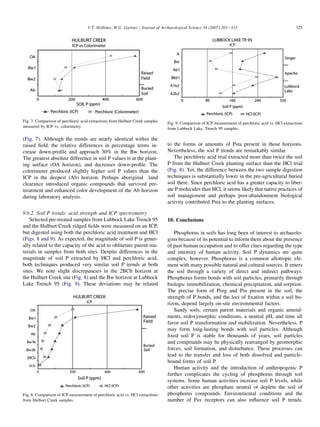
![Thus, the same activity in two different environments may
result in two very different soil P signatures.
Data on soil P have been widely used by archaeologists and
geoarchaeologists for a variety of purposes. Bethell and Máté
[18, pp. 14, 16, 17] present a rather negative assessment of
much of this work, noting that it has tended to support conclu-
sions already drawn, has been used for a kind of fishing expedi-
tion (application of soil P analysis just to see what would turn
up), and has rarely been used to find unseen and unknown sites.
These are not unreasonable statements, but soil P analyses are
useful. They help to direct excavations by locating activity
areas, for example, and for delimiting site areas. Levels of
Ptot and Pin seem to be the best indicators of human activity.
Quantitative field extractions are best for fieldwork, but rapid
lab analyses (e.g., various ICP techniques) are now commonly
available as well. Specific fractions of P may also be indicative
of specific kinds of human activity, but the complexities here are
just emerging. There is probably much more complexity in soil
systems and the P in them than we can explain at this point.
Much more empirical data need to be gathered before specific
relationships can be confidently offered. In particular, a variety
of factors must be taken into consideration, including the chem-
istry of the original soils and sediments, the duration of pedo-
genesis, and landscape position. The specific laboratory
procedures used to extract and measure soil P must also be con-
sidered when assessing soil P data. Interpretations of soil P gen-
erally seem strongest when supported by other information such
as elemental and SOM data, and soil magnetism.
Comparative studies are a useful way to understand the
utility, meaning, and complications of soil P measurements
in archaeological contexts and for making archaeological in-
terpretations. We measured duplicate samples of soil P from
three very different archaeological sites with four separate
acid extraction procedures. Selected duplicate samples were
also measured on an ICP and a colorimeter.
Some variability is to be expected when conducting multiple
trials on the same samples using the same methods. Neverthe-
less, our data (Figs. 2e9 and Tables 5e7) show that the results
of soil P analyses can vary significantly with the type of analyt-
ical method. Indeed, the same sample can produce soil P values
thatvaryoveranorderofmagnitudeor moresimplyasa function
of laboratory method. Such variability indicates that inter-site
comparisons of individual soil P values are inappropriate e if
researchers have used different methods to extract soil P. Fur-
ther, the amount of soil P in individual samples did not always
match expectations based on our fieldwork.
Strong and concentrated acids have a greater capacity to
obliterate soil particles and liberate soil P molecules than
weak or dilute ones. Not surprisingly, sample digestion in
perchloric acid produced the highest soil P values for 23 of
the 32 samples in our study. However, sulfuric and nitric
acid extracted more soil P than the other techniques, including
perchloric acid digestion, for nine soil horizons. It is tempting
to suggest that various acid extraction techniques discriminate
among the different sources of soil P. Yet, both the sources of
soil P and the deposits are very different and there are no com-
mon extenuating conditions for these nine horizons. Some
were subjected to redoxymorphic conditions (e.g., the pre-
agricultural soil at the Hulburt Creek site). Others were exposed
to human activity (e.g., the Bw2 and Ab horizon at the Hulburt
Creek site), and/or biologic activity (the A horizons for the
Singer and Apache Soils at the Lubbock Lake Tr 104 and
the Ab horizon at the Hulburt Creek site). The capacities of
the two methods to extract soil P likely overlap when levels of
Pav plus Pact plus some proportion of Psta approximate Ptot.
Sulfuricenitric acid generally extracted more soil P than HCl
with the possible exception of the Bw2b2 horizon at Lubbock
Lake where the difference is slight. HCl extraction produced
higher soil P values than sample digestion with citric acid, ex-
cept for stratum C at the British Camp site. The capacities of
HCl and citric acid converge when Ptot is dominated by soil P
forms from the Pav and Pact pools and if soil P is bound to Ca.
The association between human occupation and soil P is
particularly dramatic at the British Camp site (Table 6;
Fig. 6). The soil P values there are often a full order of mag-
nitude greater than those from the other sites. These very high
levels of soil P are not surprising given the nature of the site,
a midden with abundant shell and bone.
Some human activities can, in certain environments, leave
large quantities of Psta in the soil that are best extracted
with a strong or concentrated reagent. Perchloric acid appears
to be far more effective at extracting anthropogenic sources of
soil P than the other techniques, at least for the sites in our
study. Perchloric acid extracted significantly more soil P
from the planting surfaces of the Hulburt Creek site, and an
order of magnitude more soil P from the British Camp shell
midden, than did the sulfuricenitric acid. At the British
Camp site, the differences in soil P levels between the
perchloric acid and the citric acid trials are two orders of mag-
nitude. This large difference is significant as one characteristic
of an anthropic epipedon, according to the Soil Survey Staff
[209, p. 13], is a minimum soil P level of 1500 ppm extract-
able by 1% citric acid. P levels from all midden strata easily
exceeded this threshold during the perchloric acid trials. Yet,
not a single stratum crossed the 1500 ppm soil P threshold dur-
ing the citric acid trials, even though the deposits are demon-
strably anthropogenic in origin.
Citric acid does extract many forms of soil P. In some cases,
it extracted the same soil P forms as the more vigorous HCl
and the sulfuricenitric acid extraction techniques. However,
human activity may produce soil P forms that are not easily
extracted by citric acid and this may complicate efforts to
identify and map anthropic epipedons.
This and other comparative laboratory studies show
that correlations between P levels and human activity are par-
tially a function of laboratory method. At the British Camp
site, each acid extraction technique documented a different P
peak; stratum C for citric acid, stratum D for HCl, stratum J
for sulfuricenitric acid, and stratum K for perchloric acid.
This variability should be expected in a simple P test given
the complexities of human behavior, site formation, soil P dy-
namics, and soil chemistry. More sophisticated analyses of
multiple soil elements and compounds have the potential to
explain the specific chemical reactions noted above.
326 V.T. Holliday, W.G. Gartner / Journal of Archaeological Science 34 (2007) 301e333](https://image.slidesharecdn.com/methodsofsoilpanalysisinarchaeology-230826052815-4b666c15/85/Methods_of_soil_P_analysis_in_archaeology-pdf-27-320.jpg)
![Duplicate samples were extracted by the same acid and
measured on an ICP and a colorimeter. The ICP generally
yielded slightly higher numbers than the colorimeter, due to
the presence of interfering compounds that affected either light
transmittance or absorbance. For the most part, however, the
two types of measurement produced similar soil P values.
Although the magnitudes of soil P values in our study are
largely dependent on acid strength and concentration, the dif-
ferent acid extraction methods often, but not always, yielded
similar trends. This is critically important for it underscores
the rigor and analytical value of conducting soil P analyses
during archaeological investigations. All techniques identified
elevated levels of soil P at the British Camp shell midden and
the Hulburt Creek planting surfaces. A horizons, the primary
surface for human and biological activity, often had higher
soil P values than the other horizons. There is some trend var-
iability between the techniques to be sure. And, the results did
not always match our expectations based on fieldwork. Yet,
the discrepancies noted in previous sections also have signifi-
cant archaeological value as they force attention to the dy-
namic nature of site formation and the complex qualities of
archaeological site chemistry.
The importance of understanding site geoarchaeology and
soil P dynamics is crucial in interpreting the results of soil P
studies. The Lubbock Lake site well illustrates the importance
of understanding all sources of soil P as well as soil formation
at an archaeological site. Parent material variability influenced
soil P values for certain analytical methods. Inputs of aerosolic
clays and translocation influenced soil P trends at Trench 104
and Trench 95. Soil formation can rearrange soil particles and
distort soil P trends as shown by the influence of shrinkeswell
and translocation on soil P values from the Trench 95 Bkb1
horizon. At the Hulburt Creek site, redoxymorphic conditions
and coarsely textured deposits affected soil P trends in the pre-
agricultural soil, while specific organic amendments influ-
enced soil P trends in the ridged-field planting surfaces. Soil
moisture conditions also affected soil P values for stratum M
at the British Camp site.
A wide variety of methods for P analyses are available to
archaeologists and geoarchaeologists. Only a few were exam-
ined here, yet our study clearly shows the importance of the
acid extraction method on soil P results. Which method or
methods are best for a particular project will depend on the re-
search questions and the availability of equipment, time, and
funds. This raises three points in closing. The interpretation
of soil P trends is dependent on an understanding of site geo-
archaeology and soil P dynamics. The comparison of soil P
values, even Ptot values, are suspect if the analytical methods
are different. Further, all soil P methods (or any lab methods,
for that matter) should be thoroughly described or referenced
to facilitate interpretations.
Acknowledgments
Julie Stein (University of Washington) kindly provided the
British Camp samples. We also thank B.L. Allen (Texas Tech
University), Jemuel Ripley, and James Mayer for their
assistance during this project. Additional laboratory work
was provided by James Burton (University of Wisconsin-
Madison Laboratory of Archaeological Chemistry), who also
read an earlier version of the manuscript, Glen Fredlund and
Mary Jo Schabel (University of Wisconsin-Milwaukee Soils
Physical Geography Laboratory), Donald Meyer (Rock
River Laboratory, Inc.), and the University of Wisconsin-
Madison Soil Plant Analysis Laboratory. Diane Holliday
helped organize and edit the reference list. The manuscript
benefitted significantly from the comments of E. Christian
Wells and an anonymous reviewer. Another anonymous re-
viewer provided mostly negative and unhelpful commentary.
References
[1] S.A. Ahler, A chemical analysis of deposits at Rogers Rock Shelter,
Missouri, Plains Anthropologist 18 (1973) 116e131.
[2] O. Arrhenius, Die Bodenanalyse im Dienst der Archäologie, Zeitschrift
für Pflanzenernährung, Düngung, and Bodenkunde Tiel B 10 (1931)
427e439.
[3] O. Arrhenius, Fosfathalten I Skanska Jordar, Sveriges Geologiska
Undersokning 28 (1934) 1e30.
[4] O. Arrhenius, Investigation of soil from old Indian sites, Ethnos 28
(1963) 122e136.
[5] S. Bakkevig, Phosphate analysis in archaeology e problems and recent
progress, Norwegian Archaeological Review 13 (1980) 73e100.
[6] J.W. Ball, R.G. Kelsay, Prehistoric phosphate levels in the upper
Belize Valley, Central America, in: T.W. Killion (Ed.), Gardens of
Prehistory: The Archaeology of Settlement Agriculture in Greater
Mesoamerica, The University of Alabama Press, Tuscaloosa, 1992,
pp. 234e262.
[7] L. Barba, P. Denise, Actividades humanas y análisis quimco de los su-
elos: El caso de Osumacinta Viejo, Chiapas, Memorias de la XVII
Mesa Redonda de la Sociedad Mexicana de Antropologia 2 (1984)
263e277.
[8] L. Barba, A. Ortiz, Análisis quimco de pisos de ocupacion: Un caso
etnografico en Tlaxcala, Mexico, Latin American Antiquity 3 (1992)
63e82.
[9] L. Barba, B. Ludlow, L. Manzanilla, R. Valdez, La vida doméstica en
Teotihuacan: Un estudio de interdiciplinario, Ciencia y Desarrollo 77
(1987) 21e32.
[10] L. Barba, A. Ortiz, K. Link, L. López Lujan, L. Lazos, The chemical
analysis of residues in floors and the reconstruction of ritual activities
at the Templo Mayor, Mexico, in: M.V. Orna (Ed.), Archaeological
Chemistry: Organic, Inorganic and Biochemical Analysis, American
Chemical Society, Washington, DC, 1996, pp. 139e156.
[11] L. Barba, F. Pierrebough, C. Trejo, A. Ortiz, K. Link, Activites
humaines refletees dans les sols d’unites d’habitation contemporaine
et prehispanique du Yucatan (Mexique): Etudes chimiques ethnoarchéo-
logiches et archéologiches, Revue d’Archéométrie 19 (1995) 79e95.
[12] S.A. Barber, Soil Nutrient Bioavailability: A Mechanistic Approach,
second ed., John Wiley and Sons, New York, 1995.
[13] T. Beach, Soil constraints on northwest Yucatán, Mexico: pedoarchaeol-
ogy and Maya subsistence at Chunchucmil, Geoarchaeology 13 (1998)
759e791.
[14] M. Bell, P.J. Fowler, S.W. Hillson (Eds.), Experimental Earthwork
Project 1960e1992, Council for British Archaeology Research Report
100, 1996.
[15] M.R. Bender, C.W. Wood, Total phosphorus in soil, in: G.M. Pierzynski
(Ed.), Methods of Phosphorous Analysis for Soils, Sediments, Resid-
uals, and Waters, Southern Cooperative Series Bulletin No. 396, U.S.
Department of Agriculture and North Carolina State University,
Raleigh, 2000, pp. 45e49 (Southern Extension/Research Activity-
Information Exchange Group 17).
327
V.T. Holliday, W.G. Gartner / Journal of Archaeological Science 34 (2007) 301e333](https://image.slidesharecdn.com/methodsofsoilpanalysisinarchaeology-230826052815-4b666c15/85/Methods_of_soil_P_analysis_in_archaeology-pdf-28-320.jpg)
![[16] P. Benzing, C.J. Richardson, CaCO3 causes underestimation of NaOH
extractable phosphorus in sequential fractionations, Soil Science 170
(2005) 802e809.
[17] C.L. Berlin, J.R. Ambler, R.H. Hevly, G.G. Schaber, Identification of
a Sinagua agricultural field by aerial thermography, soil chemistry, pol-
len/plant analysis, and archaeology, American Antiquity 42 (1977)
588e600.
[18] P. Bethell, I. Máté, The use of soil phosphate analysis in archaeology:
a critique, in: J. Henderson (Ed.), Scientific Analysis in Archaeology
and its Interpretation, U.C.L.A. Institute of Archaeology, Los Angeles,
1989, pp. 1e29 (Archaeological Research Tools 5).
[19] P.W. Birkeland, Soil Geomorphology, Oxford University Press, New
York, 1984.
[20] V. Bjelajac, E.M. Luby, R. Ray, A validation test of a field-based phos-
phate analysis technique, Journal of Archaeological Science 23 (1996)
243e248.
[21] C.A. Black (Ed.), Methods of Soil Analysis, American Society of
Agronomy, Madison, WI, 1965 (Monograph 9).
[22] R.A. Bowman, A rapid method to determine total phosphorous in soils,
Soil Science Society of America Journal 52 (1988) 1301e1304.
[23] R.H. Bray, L.T. Kurtz, Determination of total, organic, and available
forms of phosphorus in soils, Soil Science 59 (1945) 39e45.
[24] R. Brinkmann, Pedological characteristics of anthrosols in the al-Jadi-
dah Basin of Wadi al-Jubah, and native sediments in Wadi al-Ajwirah,
Yemen Arab Republic, in: M.J. Grolier, R. Brinkmann, J.A. Blakely
(Eds.), Environmental Research in Support of Archaeological Investiga-
tions in the Yemen Arab Republic, 1982e1987, American Foundation
for the Study of Man, Washington, DC, 1996, pp. 45e211.
[25] S. Buehler, A. Oberson, I.M. Rao, D.K. Erieson, E. Frossard, Sequential
phosphorus extraction of a 33
P-labeled oxisol under contrasting agricul-
tural systems, Soil Science Society of America Journal 66 (2002) 868e
877.
[26] K.W. Butzer, Cave sediments, Upper Pleistocene stratigraphy and
Mousterian facies in Cantabrian Spain, Journal of Archaeological
Science 8 (1981) 133e183.
[27] B.J. Cade-Menun, S.M. Berch, C.M. Preston, L.M. Lavkulich, Phospho-
rus forms and related soil chemistry of podzolic soils on northern Van-
couver Island. II. The effects of clear-cutting and burning, Canadian
Journal of Forest Research 30 (2000) 1726e1741.
[28] C. Carr, Handbook on Soil Resistivity Surveying: Interpretation of Data
from Earthen Archaeological Sites, Center for American Archaeology
Press, Evanston, IL, 1982.
[29] W.G. Cavanagh, S. Hirst, C.D. Litton, Soil phosphate, site boundaries and
change point analysis, Journal of Field Archaeology 15 (1988) 67e83.
[30] S.C. Chang, M.L. Jackson, Fractionation of soil phosphorus, Soil
Science 84 (1957) 133e144.
[31] S.C. Chang, M.L. Jackson, Soil phosphorus fractions in some represen-
tative soils, Journal of Soil Science 9 (1957) 109e119.
[32] H.J. Chaya, Studies of soils from an Aleutian Island site, in: M.V. Orna
(Ed.), Archaeological Chemistry: Organic, Inorganic, and Biochemical
Analysis, American Chemical Society Symposium Series 625, 1996,
pp. 131e138 (Washington, DC).
[33] M.J. Conry, Plaggen soils: a review of man-made raised soils, Soil and
Fertilizers 37 (1974) 319e326.
[34] J.S. Conway, An investigation of soil phosphorous distribution within
occupation deposits from a Romano-British hut group, Journal of Ar-
chaeological Science 10 (1983) 117e128.
[35] S.F. Cook, R.F. Heizer, Studies on the Chemical Analysis of Archaeo-
logical Sites, in: University of California Publications in Anthropology
2, University of California Press, Berkeley, 1965.
[36] I.W. Cornwall, Soils for the Archaeologist, Phoenix House, London,
1958.
[37] C.L. Coultas, Soils of Caracol, Belize and their significance to agricul-
ture and land use, in: A.C. Goodyear, J.E. Foss, K.E. Sassaman (Eds.),
Proceedings of the Second International Conference on Pedo-Archaeol-
ogy, Occasional Papers of the South Carolina Institute of Archaeology
and Anthropology, Anthropology Studies 10, University of South Caro-
lina, Columbia, 1997, pp. 103e109.
[38] M.-A. Courty, P. Nørnberg, Comparison between buried uncultivated
and cultivated Iron Age soils of the west coast of Jutland, Denmark,
Iskos 5 (1985) 57e69.
[39] P.T. Craddock, D. Gurney, F. Pryor, M.J. Hughes, The application of
phosphate analysis to the location and interpretation of archaeological
sites, Archaeological Journal 142 (1985) 361e376.
[40] C.B. Craft, C. Chang, Forms and amounts of soil nitrogen and phospho-
rus across a longleaf pine depressional wetland landscape, Soil Science
Society of America Journal 66 (2002) 1713e1721.
[41] A.F. Cross, W.H. Schlesinger, A literature review and evaluation of
the Hedley fractionation: applications to the biogeochemical cycle
of soil phosphorus in natural ecosystems, Geoderma 64 (1995)
197e214.
[42] J. Crowther, Soil phosphate surveys: critical approaches to sampling,
analysis and interpretation, Archaeological Prospection 4 (1997)
93e102.
[43] J. Crowther, The experimental earthwork at Wareham, Dorset after 33
years: retention and leaching of phosphate released in the decomposi-
tion of buried bone, Journal of Archaeological Science 29 (2002)
405e411.
[44] K.D.M. Dauncy, Phosphate content of soils on archaeological sites,
Advancement of Science 9 (1952) 33e37.
[45] D.A. Davidson, Particle size and phosphate analysis-evidence for the
evolution of a tell, Archaeometry 15 (1973) 143e152.
[46] D.A. Davidson, G. Dercon, M. Stewart, F. Watson, The legacy of past
urban waste disposal on local soils, Journal of Archaeological Science
33 (2006) 778e783.
[47] A.M. Derry, P.G. Kevan, S.D.M. Rowley, Soil nutrients and vegetation:
characteristics of a Dorset/Thule site in the Canadian Arctic, Arctic 52
(1999) 204e213.
[48] W.A. Dick, M.A. Tabatabai, An alkaline oxidation method for determi-
nation of total phosphorus in soils, Soil Science Society of America
Journal 41 (1977) 511e514.
[49] E.F. Dietz, Phosphorus accumulation in soil of an Indian habitation site,
American Antiquity 22 (1957) 405e409.
[50] S.J. Dockrill, I.A. Simpson, The identification of prehistoric anthropo-
genic soils in the Northern Isles using an integrated sampling method-
ology, Archaeological Prospection 1 (1994) 75e92.
[51] S.J. Dockrill, J.M. Bond, A. Milles, I. Simpson, J. Ambers, Tofts Ness,
Sanday, Orkney: an integrated study of a buried Orcadian landscape, in:
R. Luff, P. Rowley-Conwy (Eds.), Whither Environmental Archaeology,
vol. 7, Oxbow Books, Oxford, UK, 1994, pp. 115e132.
[52] J.F. Dormaar, A.B. Beaudoin, Application of soil chemistry to interpret
cultural events at the Calderwood Buffalo Jump (DkPj-27), southern
Alberta, Canada, Geoarchaeology 6 (1991) 85e98.
[53] N. Dunning, Ancient Maya anthrosols: soil phosphate testing and land-
use, in: J.E. Foss, M.E. Timpson, M.W. Morris (Eds.), Proceedings of
the First International Conference on PedoArchaeology, University of
Tennessee Agricultural Experimentation Station, Knoxville (1994),
pp. 203e210.
[54] N. Dunning, T. Beach, D. Rue, The paleoecology and ancient settlement
of the Petexbatun region, Guatemala, Ancient Mesoamerica 8 (1997)
255e266.
[55] J.L. Dupouey, E. Dambrine, J.D. Laffite, C. Moares, Irreversible impact
of past land use on forest soils and biodiversity, Ecology 83 (2002)
2978e2984.
[56] F.W. Eddy, H.E. Dregne, Soil tests on alluvial and archaeological de-
posits, Navajo Reservoir District, El Palacio 71 (1964) 5e21.
[57] R.C. Eidt, A rapid chemical field test for archaeological site surveying,
American Antiquity 38 (1973) 206e210.
[58] R.C. Eidt, Detection and examination of anthrosols by phosphate anal-
ysis, Science 197 (1977) 1327e1333.
[59] R.C. Eidt, Advances in Abandoned Settlement Analysis: Application to
Prehistoric Anthrosols in Columbia, South America, University of
Wisconsin-Milwaukee, Center for Latin America, Milwaukee, 1984.
[60] R.C. Eidt, Theoretical and practical considerations in the analysis of
anthrosols, in: G. Rapp, J.A. Gifford (Eds.), Archaeological Geology,
Yale University Press, New Haven, CT, 1985, pp. 155e190.
328 V.T. Holliday, W.G. Gartner / Journal of Archaeological Science 34 (2007) 301e333](https://image.slidesharecdn.com/methodsofsoilpanalysisinarchaeology-230826052815-4b666c15/85/Methods_of_soil_P_analysis_in_archaeology-pdf-29-320.jpg)
![[61] R.C. Eidt, W.I. Woods, Abandoned Settlement Analysis: Theory and
Practice, Field Test Associates, Shorewood, WI, 1974.
[62] R. Engelmark, J. Linderholm, Prehistoric land management and cultiva-
tion: a soil chemical study, Proceedings from the Sixth Nordic Confer-
ence on the Application of Scientific Methods in Archaeology, Esbjerg,
Denmark, Arkaeologiske Rapporter 1 (1996) 315e322.
[63] J.A. Entwistle, P.W. Abrahams, Multi-element analysis of soils and sed-
iments from Scottish historical sites: the potential of inductively cou-
pled plasma-mass spectrometry for rapid site investigation, Journal of
Archaeological Science 24 (1997) 407e416.
[64] J.A. Entwistle, P.W. Abrahams, R.A. Dodgshon, Multi-element analysis
of soils from Scottish historical sites: interpreting land-use history
through physical and geochemical analysis of soil, Journal of Archaeo-
logical Science 25 (1998) 53e68.
[65] J.A. Entwistle, P.W. Abrahams, R.A. Dodgshon, The geoarchaeological
significance and spatial variability of a range of physical and chemical
soil properties from a former habitation site, Isle of Skye, Journal of
Archaeological Science 27 (2000) 287e303.
[66] F.G. Fernández, R.E. Terry, T. Inomata, M. Eberl, An ethnoarchaeolog-
ical study of chemical residues in the floors and soils of Q’eqchi’
Maya houses at Las Pozas, Guatemala, Geoarchaeology 17 (2002)
487e519.
[67] J.C. Forster, Soil phosphorus, in: K. Alef, P. Nannipieri (Eds.), Methods
in Applied Soil Microbiology and Biochemistry, Academic Press,
London, 1995, pp. 88e93.
[68] W.G. Gartner, Late Woodland landscapes of Wisconsin: ridged fields,
effigy mounds, and territoriality, Antiquity 73 (1999) 671e683.
[69] W.G. Gartner, Raised field landscapes of native North America, PhD
dissertation, Department of Geography, University of Wisconsin-Madi-
son, 2003.
[70] R. Geisler, T. Andersson, L. Lovgrën, P. Persson, Phosphate sorption in
aluminum- and iron-rich humus soils, Soil Science Society of America
Journal 69 (2005) 77e86.
[71] B. Glaser, W.I. Woods (Eds.), Amazonian Dark Earths: Explorations in
Space and Time, Springer, Heidelberg, 2004.
[72] B. Glaser, L. Haumaier, G. Guggenberger, W. Zech, The ‘‘Terra Preta’’
phenomenon: a model for sustainable agriculture in the humid tropics,
Naturwissenschaften 88 (2001) 37e41.
[73] B. Glaser, J. Lehmann, W. Zech, Ameliorating physical and chemical
properties of highly weathered soils in the tropics with charcoal:
a review, Biology and Fertility of Soils 35 (2002) 219e230.
[74] P. Goldberg, V.T. Holliday, Geology and stratigraphy, in: M.B. Collins
(Ed.), Introduction, Background, and Synthesis, Wilson-Leonard: An
11,000-year Archeological Record of HuntereGatherers in Central
Texas, vol. I, The University of Texas at Austin, Texas Archeological
Research Laboratory, Austin, 1998, pp. 77e121 (Studies in Archaeol-
ogy 31).
[75] A.E. Greenberg, L.S. Clesceri, A.D. Eaton (Eds.), Standard Methods
for the Examination of Water and Wastewater, 18th ed., American
Public Health Association, American Water Works Association, and
Water Environment Federation, Victor Graphics, Inc., Baltimore, MD,
1992.
[76] M.A. Griffith, A pedological investigation of an archaeological site in
Ontario, Canada, I: an examination of the soils in and adjacent to a for-
mer village, Geoderma 24 (1980) 327e336.
[77] M.A. Griffith, A pedological investigation of an archaeological site in
Ontario, Canada, II: use of chemical data to discriminate features of
the Benson site, Geoderma 25 (1981) 27e34.
[78] H. Gundlach, Tüpfelmethode auf Phosphat, angewandt in prähistor-
ischer Forschung (als Feldmethode), Mikrochimica Acta 5 (1961)
735e737.
[79] C.N. Guppy, N.W. Menzies, F.P.C. Blamey, P.W. Moody, Do decompos-
ing organic matter residues reduce phosphorus sorption in highly
weathered soils? Soil Science Society of America Journal 69 (2005)
1405e1411.
[80] D.A. Gurney, Phosphate Analysis of Soils: A Guide for the Field Ar-
chaeologist, The Institute of Field Archaeologists, Birmingham, UK,
1985 (Technical Paper 3).
[81] E.B. Guttmann, I.A. Simpson, D.A. Davidson, S.J. Dockrill, The man-
agement of arable land from prehistory to the present: case studies from
the northern Isles of Scotland, Geoarchaeology 21 (2006) 61e92.
[82] F.W. Hamond, Phosphate analysis of archaeology sediments, in:
T. Reeves-Smyth, F. Hamond (Eds.), Landscape Archaeology in Ireland,
BAR British Series 116, 1983, pp. 47e80 (Oxford, UK).
[83] A.F. Harrison, Soil Organic Phosphorus: A Review of World Literature,
C A B International, Wallingford, UK, 1987.
[84] F.A. Hassan, Rapid quantitative determination of phosphate in archaeo-
logical sediments, Journal of Field Archaeology 8 (1981) 384e387.
[85] P.M. Haygarth, S.C. Jarvis, Transfer of phosphorus from agricultural
soils, Advances in Agronomy 66 (1999) 195e249.
[86] M.J. Hedley, J.W.B. Stewart, B.S. Chauhan, Changes in inorganic and
organic phosphorus fractions induced by cultivation practices and by
laboratory incubations, Soil Science Society of America Journal 46
(1982) 970e976.
[87] C.E. Heidenreich, A relict Indian corn field near Creemore, Ontario,
Canadian Geographer 18 (1974) 379e394.
[88] C.E. Heidenreich, V.A. Konrad, Soil analysis at the Robitaille site, part
II: a method useful in determining the location of longhouse patterns,
Ontario Archaeology 20 (1973) 33e62.
[89] C.E. Heidenreich, S. Navratil, Soil analysis at the Robitaille site, part I:
determining the perimeter of the village, Ontario Archaeology 20
(1973) 25e32.
[90] C.E. Heidenreich, A.R. Hill, D.M. Lapp, S. Navratil, Soil and environ-
mental analysis at the Robitaille site, in: W.M. Hurley,
C.E. Heidenreich (Eds.), Palaeoecology and Ontario Prehistory e II,
University of Toronto, Department of Anthropology, Toronto, Canada,
1971, pp. 179e237 (Research Report 2).
[91] N. Herz, E.G. Garrison, Geological Methods for Archaeology, Oxford
University Press, New York, 1998.
[92] V.T. Holliday, Morphology of late Holocene soils at the Lubbock Lake
archaeological site, Texas, Soil Science Society of America Journal 49
(1985) 938e946.
[93] V.T. Holliday, Early Holocene soils at the Lubbock Lake archaeological
site, Texas, Catena 12 (1985) 61e78.
[94] V.T. Holliday, Archaeological geology of the Lubbock Lake site, South-
ern High Plains of Texas, Geological Society of America Bulletin 96
(1985) 1483e1492.
[95] V.T. Holliday, Genesis of a late Holocene soil chronosequence at the
Lubbock Lake archaeological site, Texas, Annals of the Association
of American Geographers 78 (1988) 594e610.
[96] V.T. Holliday, Soils in Archaeological Research, Oxford University
Press, New York, 2004.
[97] V.T. Holliday, E. Johnson, H. Haas, R. Stuckenrath, Radiocarbon ages
from the Lubbock Lake site, 1950e1980: framework for cultural and
ecological change on the southern High Plains, Plains Anthropologist
28 (1983) 165e182.
[98] V.T. Holliday, J.K. Stein, W.G. Gartner, Appendix 3: variability of soil
laboratory procedures and results, in: V.T. Holliday (Ed.), Soils in
Archaeological Research, Oxford University Press, New York, 2004,
pp. 363e374.
[99] J.A. Homburg, J.A. Sandor, An agronomic study of two Classic Period
agricultural fields in the Horseshoe Basin, in: J.A. Homburg, R. Ciolek-
Torrello (Eds.), Agricultural, Subsistence, and Environmental Studies
(CD-ROM), Vanishing River: Landscapes and Lives of the Lower Verde
Valley: The Lower Verde Archaeological Project, vol. 2, SRI Press,
Tucson, AZ, 1997, pp. 127e147.
[100] J.A. Homburg, J.A. Sandor, J.B. Norton, Anthropogenic influences on
Zuni agricultural soils, Geoarchaeology 20 (2005) 661e693.
[101] L.K. Homsey, R.C. Capo, Integrating geochemistry and micromorphol-
ogy to interpret feature use at Dust Cave, a Paleo-Indian through
middle-Archaic site in northwest Alabama, Geoarchaeology 21 (2006)
237e269.
[102] P.M. Huang, Soil mineraleorganic matteremicroorganism interactions:
fundamentals and impacts, Advances in Agronomy 82 (2004) 391e472.
[103] F. Iyamuremye, R.P. Dick, Organic amendments and phosphorus sorp-
tion by soils, Advances in Agronomy 56 (1996) 139e185.
329
V.T. Holliday, W.G. Gartner / Journal of Archaeological Science 34 (2007) 301e333](https://image.slidesharecdn.com/methodsofsoilpanalysisinarchaeology-230826052815-4b666c15/85/Methods_of_soil_P_analysis_in_archaeology-pdf-30-320.jpg)
![[104] M.L. Jackson, Soil Chemical Analysis e Advanced Course, second ed.,
Published by the Author, Department of Soils, University of Wisconsin,
Madison, 1969.
[105] E. Johnson(Ed.), LubbockLake: Late QuaternaryStudieson the Southern
High Plains, Texas AM University Press, College Station, TX, 1987.
[106] E. Johnson, V.T. Holliday, M.J. Kaczor, R. Stuckenrath, The Garza oc-
cupation at the Lubbock Lake site, Bulletin of the Texas Archeological
Society 48 (1977) 83e109.
[107] K. Kaiser, W. Zech, Nitrate, sulfate, and biophosphate retention in acid
forest soils affected by natural dissolved organic C, Journal of Environ-
mental Quality 25 (1996) 1325e1331.
[108] K. Kaiser, W. Zech, Competitive sorption of dissolved organic matter
fractions to soils and related mineral phases, Soil Science Society of
America Journal 61 (1997) 64e69.
[109] E.J. Kamprath, M.E. Watson, Conventional soil and tissue tests for as-
sessing the phosphorus status of soils, in: F.E. Khasawneh, E.C. Sample,
E.J. Kamprath (Eds.), The Role of Phosphorus in Agriculture, Soil
Science Society of America, Madison, WI, 1980, pp. 433e469.
[110] H.C.M. Keeley, Recent work using soil phosphorus analysis in archae-
ological prospection, Revue d’Archéométrie 5 (1981) 89e95.
[111] J.P. Kerr, Phosphate imprinting within Mound A at the Huntsville site,
in: M.E. Collins, B.J. Carter, B.G. Gladfelter, R.J. Southard (Eds.), Ped-
ological Perspectives in Archaeological Research, Soil Science Society
of America, Madison, WI, 1995, pp. 133e149 (Special Publication 44).
[112] G. Knapp, Review of ‘‘Advances in Abandoned Settlement Analysis’’
by R.C. Eidt, Geographical Review 75 (1985) 370e372.
[113] K.J. Knudson, L. Frink, B.W. Hoffman, T.D. Price, Chemical character-
ization of Arctic soils: activity area analysis in contemporary Yup’ik
fish camps using ICPeAES, Journal of Archaeological Science 31
(2004) 443e456.
[114] M.F. Kolb, J.A. Homburg, Soil and sediment analyses, in: J. Ellick,
S.M. Whittlesey (Eds.), The Lower Verde Archaeological Project: Labo-
ratory Manual, Statistical Research, Inc., Tucson, AZ, 1991, pp. 43e62.
[115] M.F. Kolb, N.P. Lasca, L.G. Goldstein, A soil-geomorphic analysis of
the midden deposits at the Aztalan site, Wisconsin, in: N.P. Lasca,
J. Donahue (Eds.), Archaeological Geology of North America, Geolog-
ical Society of America Centennial Volume 4 (1990), pp. 199e218
(Boulder, CO).
[116] V.A. Konrad, R. Bonnichsen, V. Clay, Soil chemical identification of ten
thousand years of prehistoric human activity areas at the Munsungun
lake thoroughfares, Maine, Journal of Archaeological Science 10
(1983) 13e28.
[117] S. Kuo, Phosphorus, in: D.L. Sparks, A.L. Page, P.A. Helmke,
R.H. Loeppert, P.N. Soltanpour, M.A. Tabatabai, C.T. Johnston,
M.E. Sumner (Eds.), Methods of Soil Analysis, Part 3 e Chemical
Methods, Soil Science Society of America Book Series 5, 1996, pp.
869e919 (Madison, WI).
[118] J. Lehmann, C.V. Campos, J.L. Vasconselos de Macêdo, L. German, Se-
quential P fractionation of relict anthropogenic Dark Earths of Amazo-
nia, in: B. Glaser, W.I. Woods (Eds.), Amazonian Dark Earths:
Explorations in Time and Space, Springer, Berlin, Germany, 2004,
pp. 113e123.
[119] J. Lehmann, D. Günther, M. Socorro da Mota, M. Pereira de Almeida,
W. Zech, K. Kaiser, Inorganic and organic soil phosphorus and sulfur
pools in an Amazonian multistrata agroforestry system, Agroforestry
Systems 53 (2001) 113e124.
[120] J. Lehmann, D.C. Kern, B. Glaser, W.I. Woods (Eds.), Amazonian Dark
Earths: Origin, Properties, Management, Kluwer Academic Publishers,
Boston, MA, 2003.
[121] J. Lehmann, J.P. da Silva Jr., C. Steiner, T. Nehls, W. Zech, B. Glaser,
Nutrient availability and leaching in an archaeological anthrosol and
a ferralsol of the Central Amazon basin: fertilizer, manure and charcoal
amendments, Plant and Soil 249 (2003) 343e357.
[122] G. Leonardi, M. Miglavacca, S. Nardi, Soil phosphorus analysis as an
integrative tool for recognizing ancient ploughsoils, Journal of Archae-
ological Science 26 (1999) 343e352.
[123] D.R. Lewis, Use of phosphate analysis for determining land use pat-
terns, Bulletin of the Texas Archeological Society 49 (1978) 309e317.
[124] R.J. Lewis, J.E. Foss, M.W. Morris, M.E. Timpson, C.A. Stiles, Trace-
element analysis in pedo-archaeology studies, in: J.E. Foss,
M.E. Timpson, M.W. Morris (Eds.), Proceedings of the First Interna-
tional Conference on Pedo-Archaeology, The University of Tennessee
Agricultural Experiment Station, Knoxville, 1994, pp. 81e88.
[125] K.T. Lillios, Phosphate fractionation of soils at Agroal, Portugal, Amer-
ican Antiquity 57 (1992) 495e506.
[126] H.N. Lima, C.E.R. Schaefer, J.W.V. Mello, R.J. Gilkes, J.C. Ker,
Pedogenesis and pre-Colombian land use of ‘‘Terra Preta Anthrosols’’
(‘‘Indian black earths’’) of western Amazonia, Geoderma 110 (2002)
1e17.
[127] J. Linderholm, E. Lundberg, Chemical characterization of various ar-
chaeological soil samples using main and trace elements determined
by inductively coupled plasma emission spectrometry, Journal of
Archaeological Science 21 (1994) 303e314.
[128] R.D. Lippi, Paleotopography and phosphate analysis of a buried jungle
site in Ecuador, Journal of Field Archaeology 15 (1988) 85e97.
[129] W. Lorch, Neue methoden der siedlungsgeshichte, Geographisches
Zeitschrift 45 (1930) 294e305.
[130] W. Lorch, Methodische Untersuchungen zur Wüstungsforschung, Ar-
beiten zur Landesund Volksforschung, Band 4, Anstalt für geschichtlich
Landeskunde an der Friedrish-Schiller Universittät, Jena, 1939.
[131] W. Lorch, Die siedlungsgeographische phosphatmethode, Die Natur-
wissenschaften 28 (1940) 633e640.
[132] W. Lorch, Die anthropogenen bodenphosphate des hohenstaufen-gip-
fels, Jahrbücher für Statistik and Landeskunde von Baden-Württemberg
1 (1954) 367e375.
[133] J.B. Lyons, J.H. Gorres, J.A. Amador, Spatial temporal variability of
phosphate retention in riparian forest soils, Journal of Environmental
Quality 27 (1998) 895e903.
[134] R.I. Macphail, A reply to Carter and Davidson’s ‘‘An evaluation of the
contribution of soil micromorphology to the study of ancient arable ag-
riculture’’, Geoarchaeology 13 (1998) 549e564.
[135] R.I. Macphail, G.M. Cruise, The soil micromorphologist as a team
player: a multianalytical approach to the study of European microstra-
tigraphy, in: P. Goldberg, V.T. Holliday, C.R. Ferring (Eds.), Earth Sci-
ences and Archaeology, Kluwer Academic/Plenum Publishers, New
York, 2001, pp. 241e267.
[136] R.I. Macphail, J. Crowther, T.G. Acott, M.G. Bell, J.M. Cruise, The ex-
perimental earthwork at Wareham, Dorset after 33 years: changes to the
buried LFH and Ah horizons, Journal of Archaeological Science 30
(2003) 77e93.
[137] R.I. Macphail, G.M. Cruise, M.J. Allen, J. Linderholm, P. Reynolds,
Archaeological soil and pollen analysis of experimental floor deposits;
with special reference to Butser Ancient Farm, Hampshire, UK, Journal
of Archaeological Science 31 (2004) 175e191.
[138] R.I. Macphail, G. Cruise, R. Engelmark, J. Linderholm, Integrating soil
micromorphology and rapid chemical survey methods: new develop-
ments in reconstructing past rural settlement and landscape organiza-
tion, in: S. Roskams (Ed.), Interpreting Stratigraphy: Site Evaluation,
Recording Procedures and Stratigraphic Analysis, BAR International
Series 910, 2000, pp. 71e80 (Oxford, UK).
[139] L. Manzanilla, Corporate groups and domestic activities at Teotihuacan,
Latin American Antiquity 7 (1996) 228e246.
[140] L. Manzanilla, Soil analyses to identify ancient human activities, Cana-
dian Journal of Soil Science 76 (1996) 107e108.
[141] B. Marwick, Element concentrations and magnetic susceptibility
of anthrosols: indicators of prehistoric human occupation in the inland
Pilbara, Western Australia, Journal of Archaeological Science 32 (2005)
1357e1368.
[142] G.E.G. Mattingly, R.J.B. Williams, A note on the chemical analysis of
a soil buried since Roman times, Journal of Soil Science 13 (1962)
253e258.
[143] J.M. McCann, W.I. Woods, D.W. Meyer, Organic matter and anthrosols
in Amazonia: interpreting the Amerindian legacy, in: M. Rees,
B.C. Ball, C.D. Campbell, C.A. Watson (Eds.), Sustainable Manage-
ment of Soil Organic Matter, CAB International, Wallingford, UK,
2001, pp. 180e189.
330 V.T. Holliday, W.G. Gartner / Journal of Archaeological Science 34 (2007) 301e333](https://image.slidesharecdn.com/methodsofsoilpanalysisinarchaeology-230826052815-4b666c15/85/Methods_of_soil_P_analysis_in_archaeology-pdf-31-320.jpg)
![[144] P.F. McDowell, Chemical enrichment of soils at archaeological sites:
some Oregon case studies, Physical Geography 9 (1988) 247e262.
[145] J.A. McKeague, Manual on Soil Sampling and Methods of Analysis,
second ed., Canadian Society of Soil Science, Ottawa, 1978.
[146] I.D. McKelvie, Separation, preconcentration, and speciation of organic
phosphorus in environmental samples, in: B.L. Turner, E. Frossard,
D. Baldwin (Eds.), Organic Phosphorus in the Environment, CABI Pub-
lishing, Wallingford, UK, 2005, pp. 1e20.
[147] A. Mehlich, New extractant for soil test evaluation of phosphorus, po-
tassium, magnesium, calcium, sodium, manganese, and zinc, Communi-
cations in Soil Science and Plant Analysis 9 (1978) 477e492.
[148] A. Mehlich, Mehlich 3 soil test extractant: a modification of Mehlich 2
extractant, Communications in Soil Science and Plant Analysis 15
(1984) 1409e1416.
[149] R. Meixner, Total phosphorus (extraction), in: M.J. Singer, P. Janitzky
(Eds.), Field and Laboratory Procedures Used in a Soil Chronosequence
Study, U.S. Geological Survey Bulletin 164, 1986, pp. 43e44 (Wash-
ington, DC).
[150] W.D. Middleton, T.D. Price, Identification of activity areas by multi-
element characterization of sediments from modern and archaeolog-
ical house floors using inductively coupled plasma-atomic emission
spectroscopy, Journal of Archaeological Science 23 (1996) 673e
687.
[151] J.H. Mikkelsen, Laboratory method for determining organic, inorganic
and total phosphate, Bulletin 1 of the Archaeological Soil Micromor-
phology Working Group, University College, London, 1997. (Available
from: http://www.gre.ac.uk/wat05/micro/soilmain/intro1.htm).
[152] N.F. Miller, K.L. Gleason, Fertilizer in the identification and analysis of
cultivated soil, in: N.F. Miller, K.L. Gleason (Eds.), The Archaeology of
Garden and Field, University of Pennsylvania Press, Philadelphia, 1994,
pp. 25e43.
[153] T.R. Moore, D. Denton, The role of soils in the interpretation of archae-
ological sites in northern Quebec, in: J.L. Bintliff, D.A. Davidson,
E.G. Grant (Eds.), Conceptual Issues in Environmental Archaeology,
University Press, Edinburgh, 1988, pp. 25e37.
[154] S. Mora, L.F. Herrera, I. Cavelier, C. Rodrı́guez, Cultivars, Anthropic
Soils and Stability: A Preliminary Report of Archaeological Research
in Araracuara, Colombia Amazonia, University of Pittsburgh Latin
American Archaeology, Pittsburgh, PA, 1991 (Reports 2).
[155] M.F. Morgan, Chemical soil diagnosis by the universal testing system,
Connecticut Agricultural Experiment Station Bulletin 450 (1941)
579e628.
[156] T. Mubyana, M. Krah, O. Totolo, C.M. Bonyongo, Influence of seasonal
flooding on soil total nitrogen, organic phosphorus and microbial pop-
ulations in the Okavango Delta, Botswana, Journal of Arid Environ-
ments 54 (2003) 359e369.
[157] D.R. Muhs, R.R. Kautz, J.J. MacKinnon, Soils and the location of cacao
orchards at a Maya site in western Belize, Journal of Archaeological
Science 12 (1985) 121e137.
[158] J. Murphy, J.P. Riley, A modified single solution method for determina-
tion of phosphate in natural waters, Analytica Chimica Acta 27 (1962)
31e36.
[159] J.B. Norton, J.A. Sandor, C.S. White, Hillslope soils and organic mat-
ter dynamics within a native American agroecosystem on the Colo-
rado Plateau, Soil Science Society of America Journal 67 (2003)
225e234.
[160] M. Nunez, Phosphate survey, Norwegian Archaeological Review 23
(1990) 120e127.
[161] M. Nunez, A. Vinberg, Determination of anthropic soil phosphate on
Aland, Norwegian Archaeological Review 23 (1990) 93e104.
[162] S.R. Olsen, L.A. Dean, Phosphorus, in: A. Black (Ed.), Methods of Soil
Analysis, Part 2 e Chemical and Microbiological Properties, American
Society of Agronomy, Madison, WI, 1965, pp. 1035e1049 (Mono-
graph 9).
[163] S.R. Olsen, L.E. Sommers, Phosphorus, in: A.L. Page, R.H. Miller,
D.R. Keeney (Eds.), Methods of Soil Analysis, Part 2 e Chemical
and Microbiological Properties, second ed., American Society of
Agronomy, Madison, WI, 1982, pp. 403e430 (Monograph 9).
[164] J.H. Ottaway, Persistence of organic phosphate in buried soils, Nature
307 (1984) 257e259.
[165] D.F. Overstreet, A rapid chemical field test for archaeological survey-
ing: an application and evaluation, The Wisconsin Archeologist 55
(1974) 262e270.
[166] W.C. Overstreet, R.C. Eidt, R. Brinkmann, D.E. Detra, T.T. Chao, Ori-
entation survey using phosphate fractionation to distinguish anthrosols
from native sediments in the Wadi al-Jubah archaeological area, Yemen
Arab Republic, in: W.C. Overstreet, M.J. Grolier, M.R. Toplyn (Eds.),
Geological and Archaeological Reconnaissance in the Yemen Arab Re-
public, 1985, American Foundation for the Study of Man, Washington,
DC, 1988, pp. 121e154.
[167] A.L. Page, R.H. Miller, D.R. Keeney (Eds.), Methods of Soil Analysis,
Part 2 e Chemical and Microbiological Properties, second ed., Ameri-
can Society of Agronomy, Madison, WI, 1982 (Monograph 9).
[168] J.C. Pape, Plaggen soils in the Netherlands, Geoderma 4 (1970) 229e
255.
[169] J.J. Parnell, R.E. Terry, C. Golden, Using in-field phosphate testing to
rapidly identify middens at Piedras Negras, Guatemala, Geoarchaeol-
ogy 16 (2001) 855e873.
[170] J.J. Parnell, R.E. Terry, Z. Nelson, Soil chemical analysis applied as an
interpretive tool for ancient human activities in Piedras Negras, Guate-
mala, Journal of Archaeological Science 29 (2002) 379e404.
[171] C.J. Penn, G.L. Mullins, L.W. Zelzany, Mineralogy in relation to phos-
phorus sorption and dissolved phosphorus losses in runoff, Soil Science
Society of America Journal 69 (2005) 1532e1540.
[172] G.M. Pierzynski (Ed.), Methods of Phosphorous Analysis for Soils,
Sediments, Residuals, and Waters, Southern Cooperative Series Bulletin
# 396, U.S. Department of Agriculture and North Carolina State Univer-
sity, Raleigh, 2000, Available from: http://www.soil.ncsu.edu/sera17/
publications/sera17-2/pm_cover.htm (Southern Extension/Research
Activity-Information Exchange Group 17).
[173] D.H. Pote, T.C. Daniel, Analyzing for total phosphorus and total dis-
solved phosphorus in water samples, in: G.M. Pierzynski (Ed.),
Methods of Phosphorous Analysis for Soils, Sediments, Residuals,
and Waters, Southern Cooperative Series Bulletin # 396, U.S. Depart-
ment of Agriculture and North Carolina State University, Raleigh,
2000, pp. 94e97 (Southern Extension/Research Activity-Information
Exchange Group 17).
[174] L. Prosch-Danielsen, A. Simonsen, Principle component analysis of
pollen, charcoal and soil phosphate data as a tool in prehistoric land-
use investigation at Forsandmoen, southwest Norway, Norwegian Ar-
chaeological Review 21 (1988) 85e102.
[175] B. Proudfoot, The analysis and interpretation of soil phosphorus in
archaeological contexts, in: D.A. Davidson, M.L. Shackley (Eds.),
Geoarchaeology, Westview Press, Boulder, CO, 1976, pp. 93e113.
[176] D.M. Provan, Soil phosphate analysis as a tool in archaeology, Norwe-
gian Archaeological Review 4 (1971) 37e50.
[177] T. Quine, Soil analysis and archaeological site formation studies, in:
A.J. Barham, R.I. Macphail (Eds.), Archaeological Sediments and Soils:
Analysis, Interpretation and Management, Institute of Archaeology,
University College, London, 1995, pp. 77e98.
[178] A.M. Salas, E. Elliott, D.G. Westfall, C.N. Cole, J. Six, The role of par-
ticulate organic matter in phosphorus cycling, Soil Science Society of
America Journal 67 (2003) 181e189.
[179] A. Sanchez, M.L. Canabate, R. Lizcano, Phosphorus analysis at archae-
ological sites: an optimization of the method and interpretation of the
results, Archaeometry 38 (1996) 151e164.
[180] J.A. Sandor, Initial investigation of soils in agricultural terraces in the
Colca Valley, Peru, in: W.M. Denevan, K. Mathewson, G. Knapp
(Eds.), Pre-Hispanic Agricultural Terraces in the Andean Region,
BAR International Series 359, 1987, pp. 163e192 (Oxford, UK).
[181] J.A. Sandor, N.S. Eash, Ancient agricultural soils in the Andes of
Southern Peru, Soil Science Society of America Journal 59 (1995)
170e179.
[182] J.A. Sandor, P.L. Gersper, J.W. Hawley, Soils at prehistoric agricultural
terracing sites in New Mexico (3 parts), Soil Science Society of Amer-
ica Journal 50 (1986) 166e180.
331
V.T. Holliday, W.G. Gartner / Journal of Archaeological Science 34 (2007) 301e333](https://image.slidesharecdn.com/methodsofsoilpanalysisinarchaeology-230826052815-4b666c15/85/Methods_of_soil_P_analysis_in_archaeology-pdf-32-320.jpg)
![[183] A. Sarris, M.L. Galaty, R.W. Yerkes, W.A. Parkinson, A. Gyucha,
D.M. Billingsley, R. Tate, Geophysical prospection and soil chemistry
at the Early Copper Age settlement of VésztT-Bikeri, southeastern Hun-
gary, Journal of Archaeological Science 31 (2004) 927e939.
[184] C.E.G.R. Schaefer, H.N. Lima, R.J. Gilkes, J.W.V. Mello, Micromor-
phology and electron microprobe analysis of phosphorus and potassium
forms of an Indian Black Earth (IBE) anthrosol from Western Amazo-
nia, Australian Journal of Soil Research 42 (2004) 401e409.
[185] D.R. Schlezinger, B.L. Howes, Organic phosphorus and elemental ratios
as indicators of prehistoric human occupation, Journal of Archaeologi-
cal Science 27 (2000) 479e492.
[186] J. Schuldenrein, Geochemistry, phosphate fractionation, and the detec-
tion of activity areas at prehistoric North American sites, in:
M.E. Collins, B.J. Carter, B.G. Gladfelter, R.J. Southard (Eds.),
Pedological Perspectives in Archaeological Research, Soil Science
Society of America, Madison, WI, 1995, pp. 107e132 (Special
Publication 44).
[187] G.T. Schwarz, A simplified chemical test for archaeological field work,
Archaeometry 10 (1967) 57e63.
[188] K.M. Scow, C.R. Johnson, Effect of sorption on biodegradation of soil
pollutants, Advances in Agronomy 58 (1997) 1e56.
[189] S.J. Scudder, Human influence on pedogenesis: midden soils on a south-
west Florida Pleistocene island, in: E.J. Reitz, L.A. Newsom,
S.J. Scudder (Eds.), Case Studies in Environmental Archaeology, Ple-
num Press, New York, 1996, pp. 55e69.
[190] M.L. Self-Davis, P.A. Moore Jr., B.C. Joern, Determination of water-
and/or dilute salt-extractable phosphorus, in: G.M. Pierzynski (Ed.),
Methods of Phosphorous Analysis for Soils, Sediments, Residuals,
and Waters, Southern Cooperative Series Bulletin # 396, U.S. Depart-
ment of Agriculture and North Carolina State University, Raleigh,
2000, pp. 24e26 (Southern Extension/Research Activity-Information
Exchange Group 17).
[191] M.L. Shackley, Archaeological Sediments: A Survey of Analytical
Methods, Butterworths, London, 1975.
[192] A.N. Sharpley, H. Tiessen, C.V. Cole, Soil phosphorus forms extracted
by soil tests as a function of pedogenesis, Soil Science Society of
America Journal 51 (1987) 362e365.
[193] G. De G. Sieveking, I.H. Longworth, M.J. Hughes, A.J. Clark,
A. Millett, A new survey of Grime’s Graves e first report, Proceedings
of the Prehistoric Society 39 (1973) 182e218.
[194] I.A. Simpson, Relict soil properties of anthropogenic deep top soils as
indicators of infield management in Marwick, West Mainland, Orkney,
Journal of Archaeological Science 24 (1997) 365e380.
[195] I.A. Simpson, S.J. Dockrill, I.D. Bull, R.P. Evershed, Early anthropo-
genic soil formation at Tofts Ness, Sanday, Orkney, Journal of Archae-
ological Science 25 (1998) 729e746.
[196] I.A. Simpson, E.B. Guttmann, J. Cluett, A. Shepard, Characterizing an-
thropic sediments in north European Neolithic settlements: an assess-
ment from Skara Brae, Orkney, Geoarchaeology 21 (2006) 221e235.
[197] J.T. Sims, Soil test phosphorus: Mehlich 1, in: G.M. Pierzynski (Ed.),
Methods of Phosphorous Analysis for Soils, Sediments, Residuals,
and Waters, Southern Cooperative Series Bulletin # 396, U.S. Depart-
ment of Agriculture and North Carolina State University, Raleigh,
2000, pp. 15e16 (Southern Extension/Research Activity-Information
Exchange Group 17).
[198] J.T. Sims, Soil test phosphorus: Mehlich 3, in: G.M. Pierzynski (Ed.),
Methods of Phosphorous Analysis for Soils, Sediments, Residuals,
and Waters, Southern Cooperative Series Bulletin # 396, U.S. Depart-
ment of Agriculture and North Carolina State University, Raleigh,
2000, pp. 17e19 (Southern Extension/Research Activity-Information
Exchange Group 17).
[199] J.T. Sims, Soil test phosphorus: Olsen P, in: G.M. Pierzynski (Ed.),
Methods of Phosphorous Analysis for Soils, Sediments, Residuals,
and Waters, Southern Cooperative Series Bulletin # 396, U.S. Depart-
ment of Agriculture and North Carolina State University, Raleigh,
2000, pp. 20e21 (Southern Extension/Research Activity-Information
Exchange Group 17).
[200] J.T. Sims, Soil test phosphorus: Bray and Kurtz P-1, in: G.M. Pierzynski
(Ed.), Methods of Phosphorous Analysis for Soils, Sediments, Resid-
uals, and Waters, Southern Cooperative Series Bulletin # 396, U.S. De-
partment of Agriculture and North Carolina State University, Raleigh,
2000, pp. 13e14 (Southern Extension/Research Activity-Information
Exchange Group 17).
[201] J.T. Sims, A.N. Sharpley, G.M. Pierzynski, D.T. Westermann,
M.L. Cabrera, J.M. Powell, T.C. Daniel, P.J.A. Withers (Eds.), Phospho-
rus: Agriculture and the Environment, Agronomy Monograph 46, Soil
Science Society of America, Madison, WI, 2005.
[202] A. Sjöberg, Phosphate analysis of anthropic soils, Journal of Field
Archaeology 3 (1976) 447e454.
[203] S.M. Skinner, Phosphorous as an anthrosol indicator, Midcontinental
Journal of Archaeology 11 (1986) 51e78.
[204] N.E. Smeck, Phosphorus: an indicator of pedogenetic weathering pro-
cesses, Soil Science 115 (1973) 199e206.
[205] N.E. Smeck, Phosphorus dynamics in soils and landscapes, Geoderma
36 (1985) 185e199.
[206] B.F.L. Smith, D.C. Bain, A sodium fusion method for the determination
of total phosphate in soils, Communications in Soil Science and Plant
Analysis 13 (1982) 185e190.
[207] M.P. Smyth, C.D. Dore, N.P. Dunning, Interpreting prehistoric settle-
ment patterns: lessons from the Maya center of Sayil, Yucatan, Journal
of Field Archaeology 22 (1995) 321e347.
[208] Soil Survey Laboratory Staff, Soil Survey Laboratory Methods Man-
ual Version 4.0, U.S. Department of Agriculture, National Soil
Survey Center, Lincoln, NE, 2004 (Soil Survey Investigations Report
42).
[209] Soil Survey Staff, Soil Taxonomy, second ed., In: Agriculture Handbook
436, U.S. Department of Agriculture, Washington, D.C, 1999.
[210] R.S. Solecki, Notes on soil analysis and archaeology, American Antiq-
uity 16 (1951) 254e256.
[211] D. Solomon, J. Lehmann, Loss of phosphorus from soil in semi-arid
northern Tanzania as a result of cropping: evidence from sequential ex-
traction and 31
P-NMR spectroscopy, European Journal of Soil Science
51 (2000) 699e708.
[212] D. Solomon, J. Lehmann, T. Mamo, F. Fritzsche, W. Zech, Phosphorus
forms and dynamics as influenced by land use changes in the sub-humid
Ethiopian highlands, Geoderma 105 (2002) 21e48.
[213] P.N. Soltanpour, G.W. Johnson, S.M. Workman, J.B. Jones Jr.,
R.O. Miller, Inductively coupled plasma emission spectrometry and in-
ductively coupled plasma mass-spectroscopy, in: D.L. Sparks,
A.L. Page, P.A. Helmke, R.H. Loeppert, P.N. Soltanpour,
M.A. Tabatabai, C.T. Johnston, M.E. Sumner (Eds.), Methods of Soil
Analysis, Part 3 e Chemical Methods, Soil Science Society of America
Book Series 5, 1996, pp. 91e139 (Madison, WI).
[214] D.L. Sparks, A.L. Page, P.A. Helmke, R.H. Loeppert, P.N. Soltanpour,
M.A. Tabatabai, C.T. Johnson, M.E. Sumner (Eds.), Methods of Soil
Analysis: Part 3 e Chemical Methods, Soil Science Society of America
Book Series 5, 1996 (Madison, WI).
[215] J.K. Stein (Ed.), Deciphering a Shell Midden, Academic Press, New
York, 1992.
[216] J.K. Stein, Exploring Coast Salish Prehistory: The archaeology of San
Juan Island, Burke Memorial Museum, University of Washington Press,
Seattle, 2000.
[217] F.J. Stevenson, M.A. Cole, Cycles of Soil: Carbon, Nitrogen, Phospho-
rus, Sulfur, Micronutrients, second ed., John Wiley and Sons, New
York, 1999.
[218] J.W.B. Stewart, H. Tiessen, Dynamics of soil organic phosphorus,
Biogeochemistry 4 (1987) 41e60.
[219] C.A. Stimmel, R.G.V. Hancock, A.M. Davis, Chemical analysis of ar-
chaeological soils from Yagi site, Japan, in: J.B. Lambert (Ed.), Archae-
ological Chemistry e III, Advances in Chemistry Series 205, American
Chemical Society, Washington, DC, 1984, pp. 79e96.
[220] A.P. Sullivan III, Effects of small-scale prehistoric runoff agriculture on
soil fertility: the developing picture from upland terraces in the Amer-
ican Southwest, Geoarchaeology 15 (2000) 291e313.
332 V.T. Holliday, W.G. Gartner / Journal of Archaeological Science 34 (2007) 301e333](https://image.slidesharecdn.com/methodsofsoilpanalysisinarchaeology-230826052815-4b666c15/85/Methods_of_soil_P_analysis_in_archaeology-pdf-33-320.jpg)
![[221] K.A. Sullivan, L. Kealhofer, Identifying activity areas in archaeological
soils from a colonial Virginia house lot using phytolith analysis and soil
chemistry, Journal of Archaeological Science 31 (2004) 1659e1673.
[222] J.K. Syers, T.W. Walker, Phosphorous transformations in a chronose-
quence of soils developed on wind-blown sand in New Zealand I:
total and organic phosphorous, Journal of Soil Science 20 (1969)
57e64.
[223] J.K. Syers, T.W. Walker, Phosphorous transformations in a chronose-
quence of soils developed on wind-blown sand in New Zealand II:
inorganic phosphorous, Journal of Soil Science 20 (1969) 318e324.
[224] R.E. Terry, P.J. Hardin, S.D. Houston, S.D. Nelson, M.W. Jackson,
J. Carr, J. Parnell, Quantitative phosphorus measurement: a field test
procedure for archaeological site analysis at Piedras Negras, Guatemala,
Geoarchaeology 15 (2000) 151e166.
[225] T.L. Thurston, Landscapes of Power, Landscapes of Conflict: Site For-
mation in the South Scandinavian Iron Age, Kluwer Academic/Plenum
Publishers, New York, 2001.
[226] H. Tiessen, J.O. Moir, Characterization of available P by sequential ex-
traction, in: M.R. Carter (Ed.), Soil Sampling and Methods of Analysis,
Canadian Society of Soil Science, Lewis Publishers, Boca Raton, FL,
1993, pp. 75e86.
[227] E. Truog, Determination of the readily available phosphorus in soils,
Journal of the American Society of Agronomy 22 (1930) 874e882.
[228] B.L. Turner, Storage-induced changes in phosphorus solubility of air-
dried soils, Soil Science Society of America Journal 69 (2005) 630e
633.
[229] N.J. Van der Merwe, P.H. Stein, Soil chemistry of post molds and rodent
burrows: identification without excavation, American Antiquity 37
(1972) 245e254.
[230] K. Verheyen, B. Bossuyt, M. Hermy, G. Tack, The land use history
(1278e1990) of a mixed hardwood forest in western Belgium and its
relationship with chemical soil characteristics, Journal of Biogeography
26 (1999) 1115e1128.
[231] A.S. Vizcaı́no, M.L. Cañabate, Identification of activity areas by soil
phosphorus and organic matter analysis in two rooms of the Iberian
sanctuary ‘‘Cerro El Pajarillo’’, Geoarchaeology 14 (1999) 47e62.
[232] T.W. Walker, The significance of phosphorous in pedogenesis, in:
E.G. Hallsworth, D.V. Crawford (Eds.), Experimental Pedology, Butter-
worths, London, 1964, pp. 295e316.
[233] T.W. Walker, J.K. Syers, The fate of phosphorus during pedogenesis,
Geoderma 15 (1976) 1e19.
[234] C. Weisbach, H. Tiessen, J.J. Jimenez-Osornio, Soil fertility during
shifting cultivation in the tropical karst soils of Yucatan, Agronomie
22 (2002) 253e263.
[235] E.C. Wells, Investigating activity patterns in prehispanic plazas: weak
acid-extraction ICPeAES analysis of anthrosols at Classic Period El
Coyote, Northwestern Honduras, Archaeometry 46 (2004) 67e84.
[236] E.C. Wells, P.A. Urban, An ethnoarchaeological perspective on the ma-
terial and chemical residues of communal feasting at El Coyote, north-
west Honduras, in: P. Vandiver, M. Goodway, J. Mass (Eds.), Materials
Issues in Art and Archaeology VI, MRS Proceedings, vol. 712, Mate-
rials Research Society, Warrendale, PA, 2002, pp. 193e198.
[237] E.C. Wells, R.E. Terry, J.J. Parnell, P.J. Hardin, M.W. Jackson,
S.D. Houston, Chemical analyses of ancient anthrosols in residential
areas at Piedras Negras, Guatemala, Journal of Archaeological Science
27 (2000) 449e462.
[238] E.M. White, Cautionary note on soil phosphate data interpretation for
archaeology, American Antiquity 43 (1978) 507e508.
[239] T.J. Wilkinson, The archaeological component of agricultural soils in
the Middle East: the effects of manuring in antiquity, in:
W. Groennmann-van Waateringe, M. Robinson (Eds.), Man-made Soils,
BAR International Series 410, 1988, pp. 93e114 (Oxford, UK).
[240] T.J. Wilkinson, Soil development and early land use in the Jazira region,
Upper Mesopotamia, World Archaeology 22 (1990) 87e103.
[241] J.D.H. Williams, J.K. Syers, R.F. Harris, D.E. Armstrong, Fractionation
of inorganic phosphate in calcareous lake sediments, Soil Science Soci-
ety of America Proceedings 35 (1971) 250e255.
[242] J.D.H. Williams, J.K. Syers, T.W. Walker, Fractionation of soil inor-
ganic phosphate by a modification of Chang and Jackson’s procedure,
Soil Science Society of America Proceedings 31 (1967) 736e739.
[243] W.I. Woods, The analysis of abandoned settlements by a new phosphate
field test method, The Chesopiean, A Journal of North American Ar-
chaeology 13 (1975) 1e45.
[244] W.I. Woods, The quantitative analysis of soil phosphate, American
Antiquity 42 (1977) 248e251.
[245] W.I. Woods, Analysis of soils, in: R.W. Jefferies, B.M. Butler (Eds.),
The Carrier Mills Archaeological Project: Human Adaptation in the Sa-
line Valley, Illinois, vol. II, Southern Illinois University at Carbondale,
Center for Archaeological Investigations, 1982, pp. 1383e1407 (Re-
search Paper No. 33).
[246] W.I. Woods, Soil chemical investigations in Illinois archaeology: two
example studies, in: J.B. Lambert (Ed.), Archaeological Chemistry e
III, Advances in Chemistry Series 205, American Chemical Society,
Washington, DC, 1984, pp. 67e77.
[247] J. Yaeger, M.C. Church, J. Dornan, R.M. Leventhal, The San Pedro Maya
project: Preliminary report of the 2001 Field Season (2002) (Report sub-
mitted to the Belize Department of Archaeology, Belmopan, Belize).
[248] D.J. Zarin, A.L. Duchesne, M. Hiraoka, Shifting cultivation on the tidal
floodplains of Amazonia: impacts on soil nutrient status, Agroforestry
Systems 41 (1998) 307e311.
[249] Z. Zheng, R.R. Simard, J. Lafond, L.E. Parent, Pathways of soil phos-
phorus transformations after 8 years of cultivation under contrasting
cropping practice, Soil Science Society of America Journal 66 (2002)
999e1007.
333
V.T. Holliday, W.G. Gartner / Journal of Archaeological Science 34 (2007) 301e333
View publication stats](https://image.slidesharecdn.com/methodsofsoilpanalysisinarchaeology-230826052815-4b666c15/85/Methods_of_soil_P_analysis_in_archaeology-pdf-34-320.jpg)


