METHODS USED FOR
OFFICIAL ASSAY
General Methods
■ General Methods are the “classical methods”.
Types:
A. Titrimetry
B. Gravimetry
Instrumental Methods
■ Based on the utilization of an instrument to
measure physicochemical properties.
Types of Instrumental Methods:
A. Spectrometric
B. Chromatographic
C. Electrometric
SPECTROMETRIC
METHODS
SPECTROSCOPY
■ A branch of science that deals with the study of
interaction of electromagnetic radiation with
matter or sample substances.
■ Based on the absorption or emission of
electromagnetic (EM) radiation as a result of
interaction with matter.
■ Instrument: SPECTROPHOTOMETER
PLAYS AN IMPORTANT ROLE IN
SPECTROSCOPY
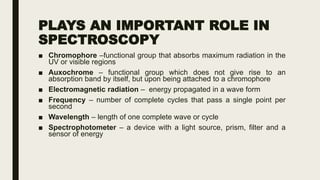
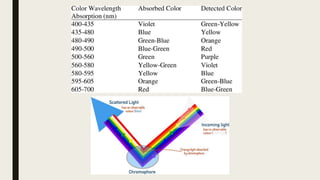
■ Chromophore –functional group that absorbs maximum radiation in the
UV or visible regions
■ Auxochrome – functional group which does not give rise to an
absorption band by itself, but upon being attached to a chromophore
■ Electromagnetic radiation – energy propagated in a wave form
■ Frequency – number of complete cycles that pass a single point per
second
■ Wavelength – length of one complete wave or cycle
■ Spectrophotometer – a device with a light source, prism, filter and a
sensor of energy
CHROMOPHORE
■ Functional group that shows a characteristic
absorption of EMR in the UV or visible region.
■ From the Greek word. Chroma = “color” & phoros =
“bearer
■ Responsible for the change in color of molecules
Examples: (EMO KA)
Ethylene, Methylene, Organic acids, Ketones,
Aldehydes
AUXOCHROME
■ A functional group that, when attached to
chromophore alters both wavelength and
intensity of absorption, leading to an enhanced or
modified color.
Example:
Hydroxyl group (-OH)
ABSORPTION AND INTENSITY
SHIFTS
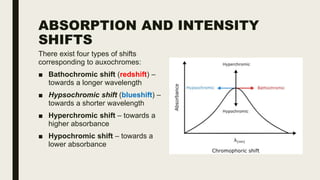
There exist four types of shifts
corresponding to auxochromes:
■ Bathochromic shift (redshift) –
towards a longer wavelength
■ Hypsochromic shift (blueshift) –
towards a shorter wavelength
■ Hyperchromic shift – towards a
higher absorbance
■ Hypochromic shift – towards a
lower absorbance
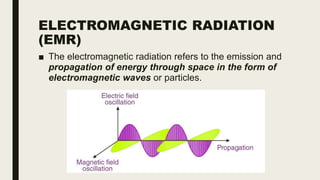
ELECTROMAGNETIC RADIATION
(EMR)
■ The electromagnetic radiation refers to the emission and
propagation of energy through space in the form of
electromagnetic waves or particles.
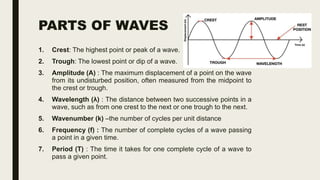
PARTS OF WAVES
1. Crest: The highest point or peak of a wave.
2. Trough: The lowest point or dip of a wave.
3. Amplitude (A) : The maximum displacement of a point on the wave
from its undisturbed position, often measured from the midpoint to
the crest or trough.
4. Wavelength (λ) : The distance between two successive points in a
wave, such as from one crest to the next or one trough to the next.
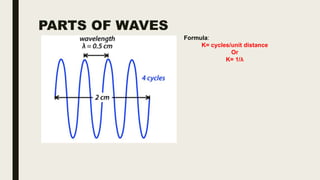
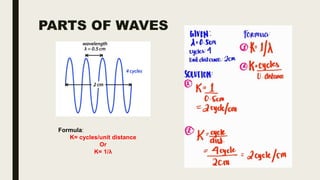
5. Wavenumber (k) –the number of cycles per unit distance
6. Frequency (f) : The number of complete cycles of a wave passing
a point in a given time.
7. Period (T) : The time it takes for one complete cycle of a wave to
pass a given point.
PARTS OF WAVES
Formula:
K= cycles/unit distance
Or
K= 1/λ
PARTS OF WAVES
Formula:
K= cycles/unit distance
Or
K= 1/λ
PARTS OF WAVES
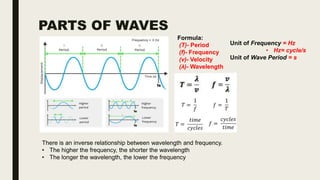
There is an inverse relationship between wavelength and frequency.
• The higher the frequency, the shorter the wavelength
• The longer the wavelength, the lower the frequency
Formula:
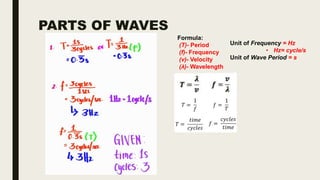
(T)- Period
(f)- Frequency
(v)- Velocity
(λ)- Wavelength
Unit of Frequency = Hz
• Hz= cycle/s
Unit of Wave Period = s
PARTS OF WAVES
Formula:
(T)- Period
(f)- Frequency
(v)- Velocity
(λ)- Wavelength
Unit of Frequency = Hz
• Hz= cycle/s
Unit of Wave Period = s
PLANCK’S EQUATION
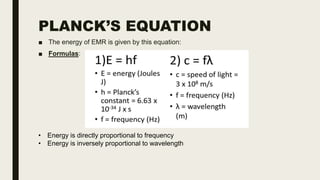
■ The energy of EMR is given by this equation:
■ Formulas:
• Energy is directly proportional to frequency
• Energy is inversely proportional to wavelength
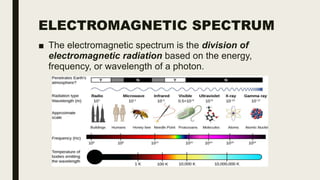
ELECTROMAGNETIC SPECTRUM
■ The electromagnetic spectrum is the division of
electromagnetic radiation based on the energy,
frequency, or wavelength of a photon.
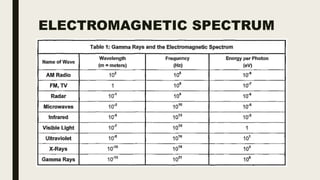
ELECTROMAGNETIC SPECTRUM
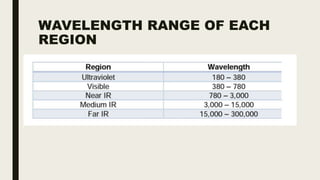
WAVELENGTH RANGE OF EACH
REGION
FUNDAMENTAL LAWS OF
SPECTROMETRY
1. Beer’s Law
■ Transmittance decreases exponentially as the concentration of the solution
increases arithmetically
2. Lambert’s Law/Bouger’s Law
■ Transmittance decreases exponentially as the thickness of the solution
increases arithmetically
3. Beer-Lambert Law
■ combination of Beer’s Law & Lambert’s/Bouger’s Law
■ Absorbance is directly proportional to the path length and concentration
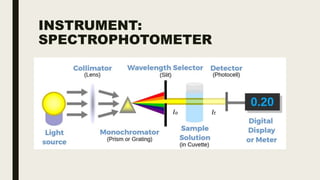
INSTRUMENT:
SPECTROPHOTOMETER
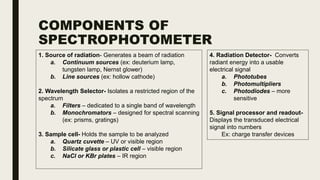
COMPONENTS OF
SPECTROPHOTOMETER
4. Radiation Detector- Converts
radiant energy into a usable
electrical signal
a. Phototubes
b. Photomultipliers
c. Photodiodes – more
sensitive
5. Signal processor and readout-
Displays the transduced electrical
signal into numbers
Ex: charge transfer devices
1. Source of radiation- Generates a beam of radiation
a. Continuum sources (ex: deuterium lamp,
tungsten lamp, Nernst glower)
b. Line sources (ex: hollow cathode)
2. Wavelength Selector- Isolates a restricted region of the
spectrum
a. Filters – dedicated to a single band of wavelength
b. Monochromators – designed for spectral scanning
(ex: prisms, gratings)
3. Sample cell- Holds the sample to be analyzed
a. Quartz cuvette – UV or visible region
b. Silicate glass or plastic cell – visible region
c. NaCl or KBr plates – IR region
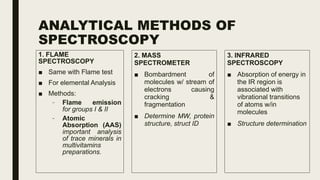
ANALYTICAL METHODS OF
SPECTROSCOPY
1. FLAME
SPECTROSCOPY
■ Same with Flame test
■ For elemental Analysis
■ Methods:
– Flame emission
for groups I & II
– Atomic
Absorption (AAS)
important analysis
of trace minerals in
multivitamins
preparations.
2. MASS
SPECTROMETER
■ Bombardment of
molecules w/ stream of
electrons causing
cracking &
fragmentation
■ Determine MW, protein
structure, struct ID
3. INFRARED
SPECTROSCOPY
■ Absorption of energy in
the IR region is
associated with
vibrational transitions
of atoms w/in
molecules
■ Structure determination
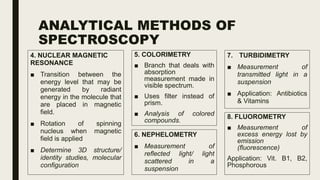
ANALYTICAL METHODS OF
SPECTROSCOPY
4. NUCLEAR MAGNETIC
RESONANCE
■ Transition between the
energy level that may be
generated by radiant
energy in the molecule that
are placed in magnetic
field.
■ Rotation of spinning
nucleus when magnetic
field is applied
■ Determine 3D structure/
identity studies, molecular
configuration
5. COLORIMETRY
■ Branch that deals with
absorption
measurement made in
visible spectrum.
■ Uses filter instead of
prism.
■ Analysis of colored
compounds.
6. NEPHELOMETRY
■ Measurement of
reflected light/ light
scattered in a
suspension
7. TURBIDIMETRY
■ Measurement of
transmitted light in a
suspension
■ Application: Antibiotics
& Vitamins
8. FLUOROMETRY
■ Measurement of
excess energy lost by
emission
(fluorescence)
Application: Vit. B1, B2,
Phosphorous

Methods used for Official Assay- SPECTROSCOPY

  • 1.
  • 2.
    General Methods ■ GeneralMethods are the “classical methods”. Types: A. Titrimetry B. Gravimetry
  • 3.
    Instrumental Methods ■ Basedon the utilization of an instrument to measure physicochemical properties. Types of Instrumental Methods: A. Spectrometric B. Chromatographic C. Electrometric
  • 4.
  • 5.
    SPECTROSCOPY ■ A branchof science that deals with the study of interaction of electromagnetic radiation with matter or sample substances. ■ Based on the absorption or emission of electromagnetic (EM) radiation as a result of interaction with matter. ■ Instrument: SPECTROPHOTOMETER
  • 6.
    PLAYS AN IMPORTANTROLE IN SPECTROSCOPY ■ Chromophore –functional group that absorbs maximum radiation in the UV or visible regions ■ Auxochrome – functional group which does not give rise to an absorption band by itself, but upon being attached to a chromophore ■ Electromagnetic radiation – energy propagated in a wave form ■ Frequency – number of complete cycles that pass a single point per second ■ Wavelength – length of one complete wave or cycle ■ Spectrophotometer – a device with a light source, prism, filter and a sensor of energy
  • 7.
    CHROMOPHORE ■ Functional groupthat shows a characteristic absorption of EMR in the UV or visible region. ■ From the Greek word. Chroma = “color” & phoros = “bearer ■ Responsible for the change in color of molecules Examples: (EMO KA) Ethylene, Methylene, Organic acids, Ketones, Aldehydes
  • 8.
    AUXOCHROME ■ A functionalgroup that, when attached to chromophore alters both wavelength and intensity of absorption, leading to an enhanced or modified color. Example: Hydroxyl group (-OH)
  • 9.
    ABSORPTION AND INTENSITY SHIFTS Thereexist four types of shifts corresponding to auxochromes: ■ Bathochromic shift (redshift) – towards a longer wavelength ■ Hypsochromic shift (blueshift) – towards a shorter wavelength ■ Hyperchromic shift – towards a higher absorbance ■ Hypochromic shift – towards a lower absorbance
  • 11.
    ELECTROMAGNETIC RADIATION (EMR) ■ Theelectromagnetic radiation refers to the emission and propagation of energy through space in the form of electromagnetic waves or particles.
  • 12.
    PARTS OF WAVES 1.Crest: The highest point or peak of a wave. 2. Trough: The lowest point or dip of a wave. 3. Amplitude (A) : The maximum displacement of a point on the wave from its undisturbed position, often measured from the midpoint to the crest or trough. 4. Wavelength (λ) : The distance between two successive points in a wave, such as from one crest to the next or one trough to the next. 5. Wavenumber (k) –the number of cycles per unit distance 6. Frequency (f) : The number of complete cycles of a wave passing a point in a given time. 7. Period (T) : The time it takes for one complete cycle of a wave to pass a given point.
  • 13.
    PARTS OF WAVES Formula: K=cycles/unit distance Or K= 1/λ
  • 14.
    PARTS OF WAVES Formula: K=cycles/unit distance Or K= 1/λ
  • 15.
    PARTS OF WAVES Thereis an inverse relationship between wavelength and frequency. • The higher the frequency, the shorter the wavelength • The longer the wavelength, the lower the frequency Formula: (T)- Period (f)- Frequency (v)- Velocity (λ)- Wavelength Unit of Frequency = Hz • Hz= cycle/s Unit of Wave Period = s
  • 16.
    PARTS OF WAVES Formula: (T)-Period (f)- Frequency (v)- Velocity (λ)- Wavelength Unit of Frequency = Hz • Hz= cycle/s Unit of Wave Period = s
  • 17.
    PLANCK’S EQUATION ■ Theenergy of EMR is given by this equation: ■ Formulas: • Energy is directly proportional to frequency • Energy is inversely proportional to wavelength
  • 18.
    ELECTROMAGNETIC SPECTRUM ■ Theelectromagnetic spectrum is the division of electromagnetic radiation based on the energy, frequency, or wavelength of a photon.
  • 19.
  • 20.
  • 21.
    FUNDAMENTAL LAWS OF SPECTROMETRY 1.Beer’s Law ■ Transmittance decreases exponentially as the concentration of the solution increases arithmetically 2. Lambert’s Law/Bouger’s Law ■ Transmittance decreases exponentially as the thickness of the solution increases arithmetically 3. Beer-Lambert Law ■ combination of Beer’s Law & Lambert’s/Bouger’s Law ■ Absorbance is directly proportional to the path length and concentration
  • 22.
  • 23.
    COMPONENTS OF SPECTROPHOTOMETER 4. RadiationDetector- Converts radiant energy into a usable electrical signal a. Phototubes b. Photomultipliers c. Photodiodes – more sensitive 5. Signal processor and readout- Displays the transduced electrical signal into numbers Ex: charge transfer devices 1. Source of radiation- Generates a beam of radiation a. Continuum sources (ex: deuterium lamp, tungsten lamp, Nernst glower) b. Line sources (ex: hollow cathode) 2. Wavelength Selector- Isolates a restricted region of the spectrum a. Filters – dedicated to a single band of wavelength b. Monochromators – designed for spectral scanning (ex: prisms, gratings) 3. Sample cell- Holds the sample to be analyzed a. Quartz cuvette – UV or visible region b. Silicate glass or plastic cell – visible region c. NaCl or KBr plates – IR region
  • 24.
    ANALYTICAL METHODS OF SPECTROSCOPY 1.FLAME SPECTROSCOPY ■ Same with Flame test ■ For elemental Analysis ■ Methods: – Flame emission for groups I & II – Atomic Absorption (AAS) important analysis of trace minerals in multivitamins preparations. 2. MASS SPECTROMETER ■ Bombardment of molecules w/ stream of electrons causing cracking & fragmentation ■ Determine MW, protein structure, struct ID 3. INFRARED SPECTROSCOPY ■ Absorption of energy in the IR region is associated with vibrational transitions of atoms w/in molecules ■ Structure determination
  • 25.
    ANALYTICAL METHODS OF SPECTROSCOPY 4.NUCLEAR MAGNETIC RESONANCE ■ Transition between the energy level that may be generated by radiant energy in the molecule that are placed in magnetic field. ■ Rotation of spinning nucleus when magnetic field is applied ■ Determine 3D structure/ identity studies, molecular configuration 5. COLORIMETRY ■ Branch that deals with absorption measurement made in visible spectrum. ■ Uses filter instead of prism. ■ Analysis of colored compounds. 6. NEPHELOMETRY ■ Measurement of reflected light/ light scattered in a suspension 7. TURBIDIMETRY ■ Measurement of transmitted light in a suspension ■ Application: Antibiotics & Vitamins 8. FLUOROMETRY ■ Measurement of excess energy lost by emission (fluorescence) Application: Vit. B1, B2, Phosphorous

Editor's Notes

  • #6 - Interaction of EMR and matter or sample - Measures the EMR emitted and absorbed by the sample
  • #8 Role: A chromophore is the part of a molecule responsible for its color. It is the specific group or structure that absorbs light at certain wavelengths, leading to the visible color of the compound.
  • #9 Role: An auxochrome is a functional group that, when attached to a chromophore, modifies and enhances its color. Auxochromes influence the intensity and position of the absorption bands of the chromophore. For instance, if you add a hydroxyl group to a ketone, you get a compound like a hydroxyketone, and the –OH group acts as an auxochrome in this context.
  • #10 Bathochromic shift or redshift The bathochromic shift is the change of position of the absorption band towards the longer wavelength. This change occurs: By an attachment of an auxochrome to the chromophore By conjugation of two or more chromophoric groups By using solvent of lower polarity. Hypsochromic shift or blue shift The hypsochromic shift is the change in the position of the spectral band towards a shorter wavelength. It occurs due to the removal of conjugation in a system or by change of solvent into higher polarity. Hyperchromic shift Hyperchromic shift is the increase in the intensity of the absorption. This shift is brought by introducing an auxochrome. Hypochromic shift A hypochromic shift is a decrease in the intensity of the absorption It is brought about by groups which distort the geometry of the molecule.
  • #12 The electromagnetic spectrum encompasses the entire range of electromagnetic waves, including radio waves, microwaves, infrared radiation, visible light, ultraviolet radiation, X-rays, and gamma rays. Radiation, on the other hand, refers to the emission and propagation of energy through space in the form of electromagnetic waves or particles. In essence, radiation is the process, while the electromagnetic spectrum is the broader range of waves involved in this process.
  • #13 Wavenumber (k) = cycles/unit distance Or K= 1/wavelength
  • #14 Wavenumber (k) = cycles/unit distance Or K= 1/wavelength Difference: Wavelength is the distance between two consecutive points in a wave that are in phase, such as two peaks or two troughs. Period, on the other hand, is the time it takes for one complete cycle of the wave to pass a given point. They are related by the speed of the wave, where speed equals wavelength divided by period. Frequency =
  • #15 Wavenumber (k) = cycles/unit distance Or K= 1/wavelength Difference: Wavelength is the distance between two consecutive points in a wave that are in phase, such as two peaks or two troughs. Period, on the other hand, is the time it takes for one complete cycle of the wave to pass a given point. They are related by the speed of the wave, where speed equals wavelength divided by period. Frequency =
  • #16 Wavenumber (k) = cycles/unit distance Or K= 1/wavelength Difference: Wavelength is the distance between two consecutive points in a wave that are in phase, such as two peaks or two troughs. Period, on the other hand, is the time it takes for one complete cycle of the wave to pass a given point. They are related by the speed of the wave, where speed equals wavelength divided by period. Frequency =
  • #17 Wavenumber (k) = cycles/unit distance Or K= 1/wavelength Difference: Wavelength is the distance between two consecutive points in a wave that are in phase, such as two peaks or two troughs. Period, on the other hand, is the time it takes for one complete cycle of the wave to pass a given point. They are related by the speed of the wave, where speed equals wavelength divided by period. Frequency =
  • #19 The electromagnetic spectrum encompasses the entire range of electromagnetic waves, including radio waves, microwaves, infrared radiation, visible light, ultraviolet radiation, X-rays, and gamma rays. Radiation, on the other hand, refers to the emission and propagation of energy through space in the form of electromagnetic waves or particles. In essence, radiation is the process, while the electromagnetic spectrum is the broader range of waves involved in this process.
  • #21 The electromagnetic spectrum encompasses the entire range of electromagnetic waves, including radio waves, microwaves, infrared radiation, visible light, ultraviolet radiation, X-rays, and gamma rays. Radiation, on the other hand, refers to the emission and propagation of energy through space in the form of electromagnetic waves or particles. In essence, radiation is the process, while the electromagnetic spectrum is the broader range of waves involved in this process.