Methods of Data
Collection
SUBMITTED BY:- JAYASANKAR JAYASOMAN
PROV/LLM/7-19/031
ROLL NO. 31
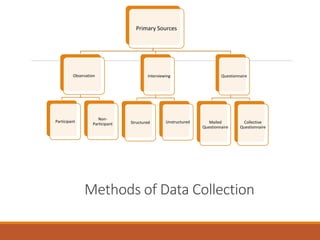
Methods of Data Collection
Primary Sources
Observation
Participant
Non-
Participant
Interviewing
Structured Unstructured
Questionnaire
Mailed
Questionnaire
Collective
Questionnaire
Observation
Observation is purposeful, systematic and selective way of
watching and listening to an interaction or phenomenon as it
takes place.
There are some researches where observation is the most
appropriate method of data collection.
Example: When you want to study the interaction in the group,
ascertain the functions performed by a worker, Study of
behaviour or personality traits of an individual.
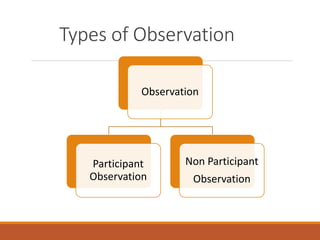
Types of Observation
Observation
Participant
Observation
Non Participant
Observation
Participant observation
When the researcher, participate in the activities of the group being
observed in the same manner as its members, with or without their
knowing that they are being observed.
Example: If you want to study the life of prisoners and pretend to be
a prisoner in order to do this.
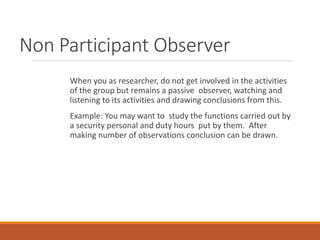
Non Participant Observer
When you as researcher, do not get involved in the activities
of the group but remains a passive observer, watching and
listening to its activities and drawing conclusions from this.
Example: You may want to study the functions carried out by
a security personal and duty hours put by them. After
making number of observations conclusion can be drawn.
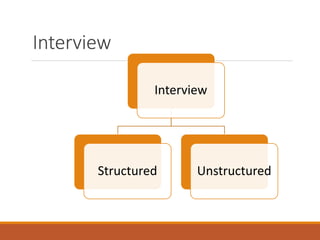
Interview
Interview
Structured Unstructured
Unstructured Interview
There is complete freedom they provide in terms of content
and structure.
Questions can be posed in any order.
There is complete freedom to use word and expressions.
Questions can be raised even on the spur of the moment.
Unstructured in depth interview can be conducted to know
the person better or his perspective. [Example research to
write biography]
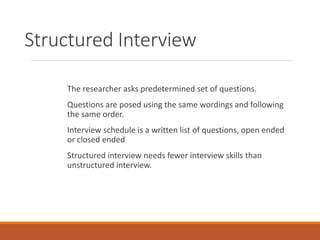
Structured Interview
The researcher asks predetermined set of questions.
Questions are posed using the same wordings and following
the same order.
Interview schedule is a written list of questions, open ended
or closed ended
Structured interview needs fewer interview skills than
unstructured interview.
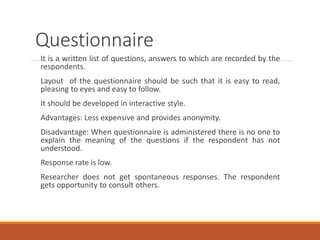
Questionnaire
It is a written list of questions, answers to which are recorded by the
respondents.
Layout of the questionnaire should be such that it is easy to read,
pleasing to eyes and easy to follow.
It should be developed in interactive style.
Advantages: Less expensive and provides anonymity.
Disadvantage: When questionnaire is administered there is no one to
explain the meaning of the questions if the respondent has not
understood.
Response rate is low.
Researcher does not get spontaneous responses. The respondent
gets opportunity to consult others.

Methods of Data Collection

  • 1.
    Methods of Data Collection SUBMITTEDBY:- JAYASANKAR JAYASOMAN PROV/LLM/7-19/031 ROLL NO. 31
  • 2.
    Methods of DataCollection Primary Sources Observation Participant Non- Participant Interviewing Structured Unstructured Questionnaire Mailed Questionnaire Collective Questionnaire
  • 3.
    Observation Observation is purposeful,systematic and selective way of watching and listening to an interaction or phenomenon as it takes place. There are some researches where observation is the most appropriate method of data collection. Example: When you want to study the interaction in the group, ascertain the functions performed by a worker, Study of behaviour or personality traits of an individual.
  • 4.
  • 5.
    Participant observation When theresearcher, participate in the activities of the group being observed in the same manner as its members, with or without their knowing that they are being observed. Example: If you want to study the life of prisoners and pretend to be a prisoner in order to do this.
  • 6.
    Non Participant Observer Whenyou as researcher, do not get involved in the activities of the group but remains a passive observer, watching and listening to its activities and drawing conclusions from this. Example: You may want to study the functions carried out by a security personal and duty hours put by them. After making number of observations conclusion can be drawn.
  • 7.
  • 8.
    Unstructured Interview There iscomplete freedom they provide in terms of content and structure. Questions can be posed in any order. There is complete freedom to use word and expressions. Questions can be raised even on the spur of the moment. Unstructured in depth interview can be conducted to know the person better or his perspective. [Example research to write biography]
  • 9.
    Structured Interview The researcherasks predetermined set of questions. Questions are posed using the same wordings and following the same order. Interview schedule is a written list of questions, open ended or closed ended Structured interview needs fewer interview skills than unstructured interview.
  • 10.
    Questionnaire It is awritten list of questions, answers to which are recorded by the respondents. Layout of the questionnaire should be such that it is easy to read, pleasing to eyes and easy to follow. It should be developed in interactive style. Advantages: Less expensive and provides anonymity. Disadvantage: When questionnaire is administered there is no one to explain the meaning of the questions if the respondent has not understood. Response rate is low. Researcher does not get spontaneous responses. The respondent gets opportunity to consult others.