Methods for
Teaching EFL:
Skills
CLASS 1 - Introduction
Methods for Teaching EFL: Skills
"Methods for Teaching EFL: Skills" refers to several instructional
approaches and strategies used in the field of English as a Foreign
Language (EFL) education to develop and improve students'
language skills.
EFL typically involves teaching English to non-native speakers who
are learning it as a second or foreign language. The term "skills" in
this context usually covers the four main language skills:
EFL/ESL:
UNIT 1
1. What´s EFL?
2. What is ESL?
3. What is the difference?
Skills:
Skills:
UNIT 2
A skill is the learned ability to act with determined results with good execution often within a
given amount of time, energy, or both. Skills can often be divided into domain-general and
domain-specific skills.
•Merriam-Webster Dictionary
•Cambridge Dictionary
•International Bureau of Education
Skills:
Domain-general skills are those that can be applied to a wide range of tasks and situations.
They include things like critical thinking, problem-solving, communication, and collaboration.
•Merriam-Webster Dictionary
•Cambridge Dictionary
•International Bureau of Education
Skills:
Domain-specific skills are those that are specific to a particular area of knowledge or expertise.
They include things like programming, accounting, and surgery.
•Merriam-Webster Dictionary
•Cambridge Dictionary
•International Bureau of Education
Skills:
Skills can be learned through a variety of means, such as formal education, training programs,
and on-the-job experience. They can also be developed through practice and self-study.
Some examples of skills include:
Writing and speaking effectively Playing a musical instrument
Cooking Programming
Designing websites Managing projects
Accounting Nursing
Teaching Carpentry
Plumbing Public speaking
Hard vs Soft Skills:
Hard skills are teachable and measurable abilities, such as writing,
reading, math, or ability to use computer programs. They are often listed
in job descriptions and required for specific roles.
Soft skills are personal attributes that enable someone to interact
effectively and with harmony with other people. They are also known as
interpersonal skills or people skills. Soft skills are important in all aspects
of life, including work, school, and personal relationships.
Hard vs Soft Skills:
Examples of hard skills include:
• Programming languages (Python, Java, C++)
• Software development tools (Git, Jira, Eclipse)
• Data analysis tools (SQL, Excel, Tableau)
• Financial modeling tools (Excel, Bloomberg)
• Graphic design tools (Photoshop, Illustrator, InDesign)
Hard vs Soft Skills:
Examples of soft skills include:
• Communication
• Teamwork
• Problem-solving
• Leadership
• Critical thinking
• Creativity
• Adaptability
• Work ethic
• Time management
Skills:
In the context of teaching English as a Foreign Language (EFL) or teaching English as a
Second Language (ESL), a "skill" refers to one of the four primary language abilities that
learners need to acquire in order to effectively communicate in English. These language skills
are:
Skills:
Listening: The ability to understand spoken English, including different accents, dialects, and
levels of spoken language, such as casual conversation, lectures, or news broadcasts.
Speaking: The ability to produce spoken English, express ideas, hold conversations, and
communicate fluently and accurately in various contexts.
Reading: The ability to comprehend written English texts, including books, articles,
newspapers, websites, and other written materials.
Writing: The ability to compose written English, including essays, reports, emails, and other
forms of written communication.
METHODS:
UNIT 3
1. What´s a method?
2. What´s a technique?
3. What´s a procedure?
4. What´s a strategy?
5. What is an approach?
6. What´s a model?
 Grammar-Translation Method:
 Direct Method:
 Audio-Lingual Method:
 Communicative Language Teaching (CLT):
 Total Physical Response (TPR):
 Suggestopedia:
 Task-Based Language Teaching (TBLT):
 The Natural Approach:
 The Silent Way:
TEACHING METHODS:
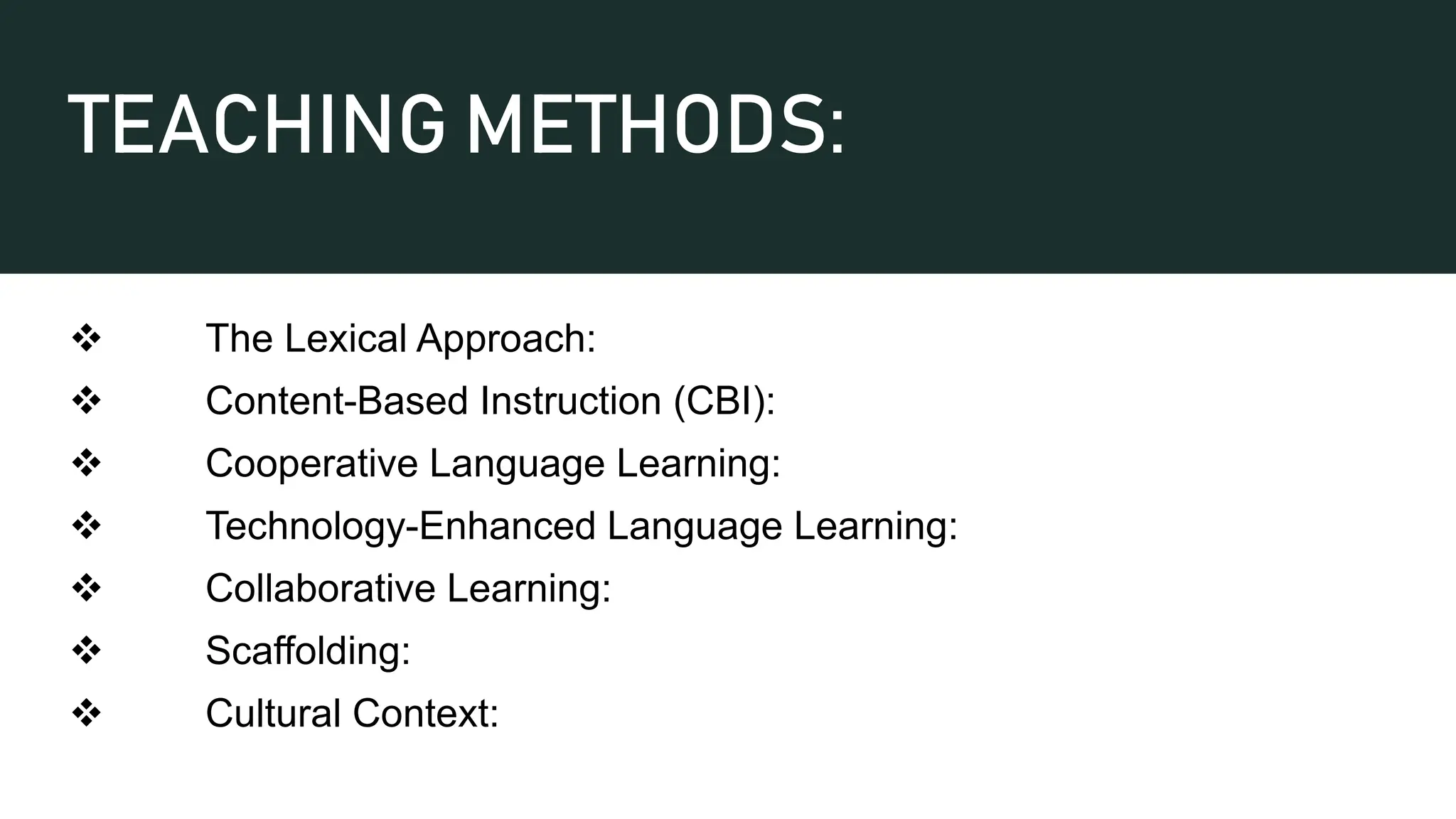
 The Lexical Approach:
 Content-Based Instruction (CBI):
 Cooperative Language Learning:
 Technology-Enhanced Language Learning:
 Collaborative Learning:
 Scaffolding:
 Cultural Context:
TEACHING METHODS:

METHODS FOR TEACHING ENGLISH

  • 1.
  • 2.
    Methods for TeachingEFL: Skills "Methods for Teaching EFL: Skills" refers to several instructional approaches and strategies used in the field of English as a Foreign Language (EFL) education to develop and improve students' language skills. EFL typically involves teaching English to non-native speakers who are learning it as a second or foreign language. The term "skills" in this context usually covers the four main language skills:
  • 3.
    EFL/ESL: UNIT 1 1. What´sEFL? 2. What is ESL? 3. What is the difference?
  • 4.
  • 5.
    Skills: UNIT 2 A skillis the learned ability to act with determined results with good execution often within a given amount of time, energy, or both. Skills can often be divided into domain-general and domain-specific skills. •Merriam-Webster Dictionary •Cambridge Dictionary •International Bureau of Education
  • 6.
    Skills: Domain-general skills arethose that can be applied to a wide range of tasks and situations. They include things like critical thinking, problem-solving, communication, and collaboration. •Merriam-Webster Dictionary •Cambridge Dictionary •International Bureau of Education
  • 7.
    Skills: Domain-specific skills arethose that are specific to a particular area of knowledge or expertise. They include things like programming, accounting, and surgery. •Merriam-Webster Dictionary •Cambridge Dictionary •International Bureau of Education
  • 8.
    Skills: Skills can belearned through a variety of means, such as formal education, training programs, and on-the-job experience. They can also be developed through practice and self-study. Some examples of skills include: Writing and speaking effectively Playing a musical instrument Cooking Programming Designing websites Managing projects Accounting Nursing Teaching Carpentry Plumbing Public speaking
  • 9.
    Hard vs SoftSkills:
  • 10.
    Hard vs SoftSkills: Hard skills are teachable and measurable abilities, such as writing, reading, math, or ability to use computer programs. They are often listed in job descriptions and required for specific roles. Soft skills are personal attributes that enable someone to interact effectively and with harmony with other people. They are also known as interpersonal skills or people skills. Soft skills are important in all aspects of life, including work, school, and personal relationships.
  • 11.
    Hard vs SoftSkills: Examples of hard skills include: • Programming languages (Python, Java, C++) • Software development tools (Git, Jira, Eclipse) • Data analysis tools (SQL, Excel, Tableau) • Financial modeling tools (Excel, Bloomberg) • Graphic design tools (Photoshop, Illustrator, InDesign)
  • 12.
    Hard vs SoftSkills: Examples of soft skills include: • Communication • Teamwork • Problem-solving • Leadership • Critical thinking • Creativity • Adaptability • Work ethic • Time management
  • 13.
    Skills: In the contextof teaching English as a Foreign Language (EFL) or teaching English as a Second Language (ESL), a "skill" refers to one of the four primary language abilities that learners need to acquire in order to effectively communicate in English. These language skills are:
  • 14.
    Skills: Listening: The abilityto understand spoken English, including different accents, dialects, and levels of spoken language, such as casual conversation, lectures, or news broadcasts. Speaking: The ability to produce spoken English, express ideas, hold conversations, and communicate fluently and accurately in various contexts. Reading: The ability to comprehend written English texts, including books, articles, newspapers, websites, and other written materials. Writing: The ability to compose written English, including essays, reports, emails, and other forms of written communication.
  • 15.
    METHODS: UNIT 3 1. What´sa method? 2. What´s a technique? 3. What´s a procedure? 4. What´s a strategy? 5. What is an approach? 6. What´s a model?
  • 16.
     Grammar-Translation Method: Direct Method:  Audio-Lingual Method:  Communicative Language Teaching (CLT):  Total Physical Response (TPR):  Suggestopedia:  Task-Based Language Teaching (TBLT):  The Natural Approach:  The Silent Way: TEACHING METHODS:
  • 17.
     The LexicalApproach:  Content-Based Instruction (CBI):  Cooperative Language Learning:  Technology-Enhanced Language Learning:  Collaborative Learning:  Scaffolding:  Cultural Context: TEACHING METHODS: