InterActive Learning Methods
(ILM)
At the end of this session the participants shall
be able to:
-state the meaning of active learning
-explain the need for active learning
-describe the different types of interactive
learning methods
-provide hands on experience on interactive
learning through group tasks
OBJECTIVES
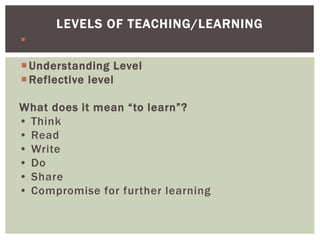
 Memory level
Understanding Level
Reflective level
What does it mean “to learn”?
• Think
• Read
• Write
• Do
• Share
• Compromise for further learning
LEVELS OF TEACHING/LEARNING
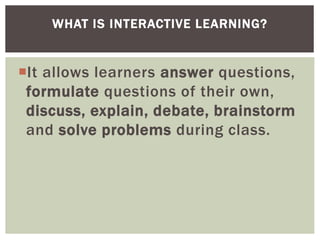
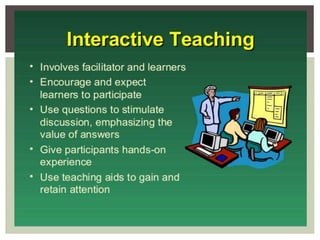
It allows learners answer questions,
formulate questions of their own,
discuss, explain, debate, brainstorm
and solve problems during class.
WHAT IS INTERACTIVE LEARNING?
A task oriented environment
A predictable environment
Is ready and waiting for students
12
A WELL-MANAGED CLASSROOM IS…
Discussion
Small and large group activities
Cooperative learning strategies (i.e., jigsaw,
think-pair-share)
Self-Reflection
Question and answer sessions
Active Learning Strategies (i.e., role play,
scenarios, simulations)
others
13
PRESENTATION TECHNIQUES
(UTILIZING THE PRINCIPLES OF ADULT LEARNING
THEORY)
…all of the things that a teacher does to
organize students, space, time and
materials so that instruction in content
and student learning can take place.
Two major goals…
1. To foster student involvement and
cooperation in all classroom activities
2. To establish a productive working
environment.
-First Days of School, Wong
14
CLASSROOM MANAGEMENT IS…
Dealing With Student Behavior in Today’s
Classrooms
15
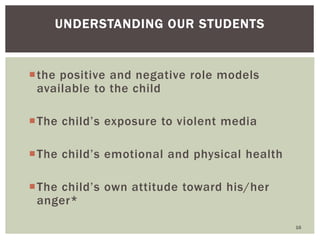
UNDERSTANDING OUR
STUDENTS
the positive and negative role models
available to the child
The child’s exposure to violent media
The child’s emotional and physical health
The child’s own attitude toward his/her
anger*
16
UNDERSTANDING OUR STUDENTS
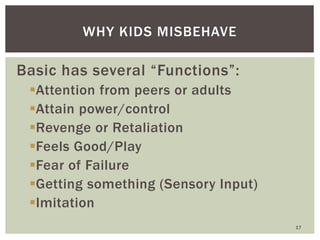
Basic has several “Functions”:
Attention from peers or adults
Attain power/control
Revenge or Retaliation
Feels Good/Play
Fear of Failure
Getting something (Sensory Input)
Imitation
17
WHY KIDS MISBEHAVE
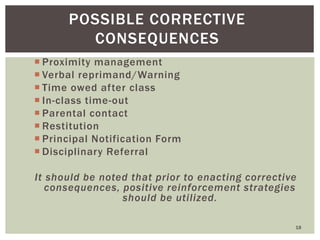
 Proximity management
 Verbal reprimand/Warning
 Time owed after class
 In-class time-out
 Parental contact
 Restitution
 Principal Notification Form
 Disciplinary Referral
It should be noted that prior to enacting corrective
consequences, positive reinforcement strategies
should be utilized.
18
POSSIBLE CORRECTIVE
CONSEQUENCES

Methodology.pptx

  • 1.
  • 2.
    At the endof this session the participants shall be able to: -state the meaning of active learning -explain the need for active learning -describe the different types of interactive learning methods -provide hands on experience on interactive learning through group tasks OBJECTIVES
  • 4.
     Memory level UnderstandingLevel Reflective level What does it mean “to learn”? • Think • Read • Write • Do • Share • Compromise for further learning LEVELS OF TEACHING/LEARNING
  • 5.
    It allows learnersanswer questions, formulate questions of their own, discuss, explain, debate, brainstorm and solve problems during class. WHAT IS INTERACTIVE LEARNING?
  • 12.
    A task orientedenvironment A predictable environment Is ready and waiting for students 12 A WELL-MANAGED CLASSROOM IS…
  • 13.
    Discussion Small and largegroup activities Cooperative learning strategies (i.e., jigsaw, think-pair-share) Self-Reflection Question and answer sessions Active Learning Strategies (i.e., role play, scenarios, simulations) others 13 PRESENTATION TECHNIQUES (UTILIZING THE PRINCIPLES OF ADULT LEARNING THEORY)
  • 14.
    …all of thethings that a teacher does to organize students, space, time and materials so that instruction in content and student learning can take place. Two major goals… 1. To foster student involvement and cooperation in all classroom activities 2. To establish a productive working environment. -First Days of School, Wong 14 CLASSROOM MANAGEMENT IS…
  • 15.
    Dealing With StudentBehavior in Today’s Classrooms 15 UNDERSTANDING OUR STUDENTS
  • 16.
    the positive andnegative role models available to the child The child’s exposure to violent media The child’s emotional and physical health The child’s own attitude toward his/her anger* 16 UNDERSTANDING OUR STUDENTS
  • 17.
    Basic has several“Functions”: Attention from peers or adults Attain power/control Revenge or Retaliation Feels Good/Play Fear of Failure Getting something (Sensory Input) Imitation 17 WHY KIDS MISBEHAVE
  • 18.
     Proximity management Verbal reprimand/Warning  Time owed after class  In-class time-out  Parental contact  Restitution  Principal Notification Form  Disciplinary Referral It should be noted that prior to enacting corrective consequences, positive reinforcement strategies should be utilized. 18 POSSIBLE CORRECTIVE CONSEQUENCES