LONGVOWELS
A try…
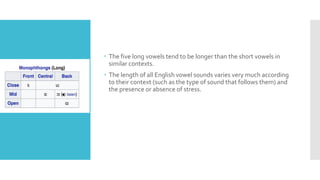
 The five long vowels tend to be longer than the short vowels in
similar contexts.
 The length of all English vowel sounds varies very much according
to their context (such as the type of sound that follows them) and
the presence or absence of stress.
i: (example words: ‘beat’, ‘mean’, ‘peace’)
This vowel is nearer to cardinal vowel no.
1 [i] (i.e. it is closer and more front) than is
the short vowel of‘bid’, ‘pin’, ‘fish’
described in Chapter 2. Although the
tongue shape is not much different from
cardinal vowel no. 1, the lips are only
slightly spread and this results in a rather
different vowel quality.
 з: (example words; ‘bird’, ‘fern’, ‘purse’)
This is a mid-central vowel which is used
in most Enghsh accents as a hesitation
sound (written ‘er’), but which many
learners find difficult to copy.The lip
position is neutral, a: (example words:
‘card’, ‘half’, ‘pass’)This is an open vowel
in the region of cardinal vowel no. 5 [a],
but not as back as this.The Up position
is neutral, o: (example words: ‘board’,
‘torn’, ‘horse’)The tongue height for this
vowel is between cardinal vowel no. 6 [o]
and no. 7 [o], and closer to the latter.
This vowel is almost fuUy back and has
quite strong lip-rounding, u: (example
words: ‘food’, ‘soon’, ‘loose’)The nearest
cardinal vowel to this is no. 8 [u], but
BBC u: is much less back and less close,
while the Ups are only moderately
rounded.
Diphthongs
 BBC pronunciation has a large number of diphthongs - sounds which
consist of a movement or glide from one vowel to another. A vowel which
remains constant and does not gUde is caUed a pure vowel.
 the most important thing to remember about the diphthongs is that the
first part is much longer and stronger than the second part; for example,
most of the diphthong ai (as in the words ‘eye’), consists of the a vowel,
and only in about the last quarter of the diphthong does the glide to i
become noticeable.As the glide to i happens, the loudness of the sound
decreases.
Centring
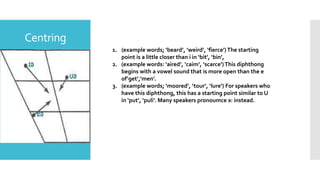
1. (example words; ‘beard’, ‘weird’, ‘fierce’)The starting
point is a little closer than i in ‘bit’, ‘bin’,
2. (example words: ‘aired’, ‘caim’, ‘scarce’)This diphthong
begins with a vowel sound that is more open than the e
of‘get’,‘men’.
3. (example words; ‘moored’, ‘tour’, ‘lure’) For speakers who
have this diphthong, this has a starting point similar to U
in ‘put’, ‘puli’. Many speakers pronoumce э: instead.
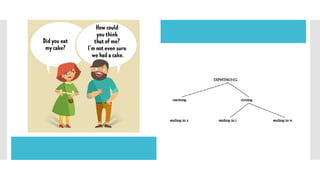
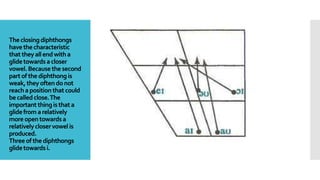
Theclosingdiphthongs
havethe characteristic
that theyallendwitha
glidetowards acloser
vowel.Becausethe second
partof the diphthong is
weak,theyoftendonot
reachaposition that could
becalledclose.The
importantthingisthat a
glidefrom arelatively
moreopentowardsa
relativelycloservowelis
produced.
Threeof the diphthongs
glidetowards i.
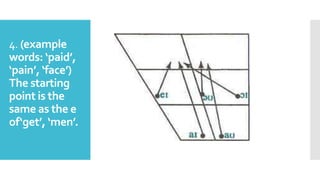
4. (example
words: ‘paid’,
‘pain’, ‘face’)
The starting
point is the
same as the e
of‘get’, ‘men’.
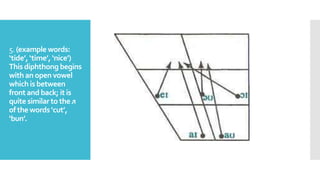
5. (example words:
‘tide’, ‘time’, ‘nice’)
This diphthong begins
with an open vowel
which is between
front and back; it is
quite similar to the л
of the words ‘cut’,
‘bun’.
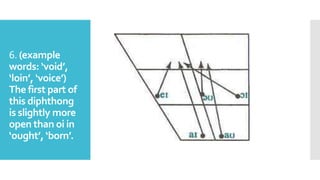
6. (example
words: ‘void’,
‘loin’, ‘voice’)
The first part of
this diphthong
is slightly more
open than oi in
‘ought’, ‘born’.
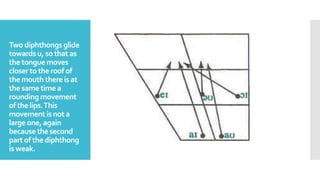
Two diphthongs glide
towards u, so that as
the tongue moves
closer to the roof of
the mouth thereis at
the same time a
rounding movement
of the lips.This
movement is not a
large one, again
because the second
part of the diphthong
is weak.
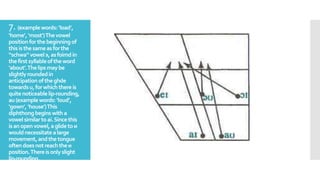
7. (examplewords:‘load’,
‘home’, ‘most’)Thevowel
position forthebeginning of
thisisthesameasforthe
“schwa” vowelэ, asfoimdin
thefirstsyllableoftheword
‘about’.Thelipsmaybe
slightlyroundedin
anticipation oftheghde
towardsu,forwhich thereis
quitenoticeablelip-rounding,
au(examplewords:‘loud’,
‘gown’, ‘house’)This
diphthong beginswith a
vowelsimilartoai.Sincethis
isanopenvowel, aglidetoи
wouldnecessitatealarge
movement,andthe tongue
oftendoesnotreachtheи
position.Thereisonlyslight
liр-rounding.
Triphthongs
 The most complex English sounds of the vowel type are the
triphthongs. They can be rather difficult to pronounce, and very
difficult to recognise. A triphthong is a glide from one vowel to
another and then to a third, all produced rapidly and without
interruption.
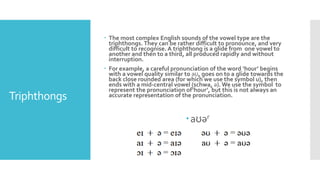
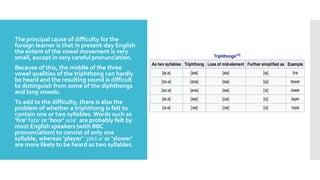
 For example, a careful pronunciation of the word ‘hour’ begins
with a vowel quality similar to aʊ, goes on to a glide towards the
back close rounded area (for which we use the symbol u), then
ends with a mid-central vowel (schwa, ə).We use the symbol to
represent the pronunciation of‘hour’, but this is not always an
accurate representation of the pronunciation.
aʊər

 The principal cause of difficulty for the
foreign learner is that in present-day English
the extent of the vowel movement is very
small, except in very careful pronunciation.
 Because of this, the middle of the three
vowel qualities of the triphthong can hardly
be heard and the resulting sound is difficult
to distinguish from some of the diphthongs
and long vowels.
 To add to the difficulty, there is also the
problem of whether a triphthong is felt to
contain one or two syllables.Words such as
‘fire’ faɪər or ‘hour’ aʊər are probably felt by
most English speakers (with BBC
pronunciation) to consist of only one
syllable, whereas ‘player’ ˈpleɪ·ər or ‘slower’
are more likely to be heard as two syllables.
Voicing and
Consonants
 The larynx
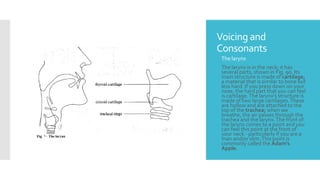
 The larynx is in the neck; it has
several parts, shown in Fig. 90. Its
main structure is made of cartilage,
a material that is similar to bone but
less hard. If you press down on your
nose, the hard part that you can feel
is cartilage.The larynx's structure is
made of two large cartilages.These
are hollow and are attached to the
top of the trachea; when we
breathe, the air passes through the
trachea and the larynx.The front of
the larynx comes to a point and you
can feel this point at the front of
your neck - particularly if you are a
man and/or slim.This point is
commonly called the Adam's
Apple.
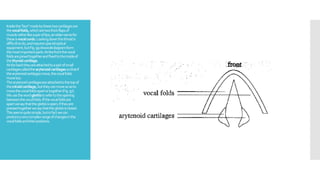
Insidethe"box"madebythesetwocartilagesare
thevocalfolds,whicharetwothickflapsof
muscleratherlikeapairoflips;anoldernamefor
theseisvocalcords.Lookingdownthethroatis
difficulttodo,andrequiresspecialoptical
equipment,butFig.99showsindiagramform
themostimportantparts.Atthefrontthevocal
foldsarejoinedtogetherandfixedtotheinsideof
thethyroidcartilage.
Atthebacktheyareattachedtoapairofsmall
cartilagescalledthearytenoidcartilagessothatif
thearytenoidcartilagesmove,thevocalfolds
movetoo.
Thearytenoidcartilagesareattachedtothetopof
thecricoidcartilage,buttheycanmovesoasto
movethevocalfoldsapartortogether(Fig.97).
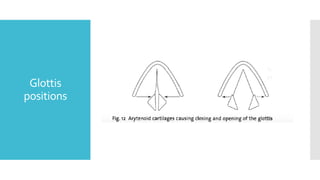
Weusethewordglottistorefertotheopening
betweenthevocalfolds.Ifthevocalfoldsare
apartwesaythattheglottisisopen;iftheyare
pressedtogetherwesaythattheglottisisclosed.
Thisseemsquitesimple,butinfactwecan
produceaverycomplexrangeofchangesinthe
vocalfoldsandtheirpositions.
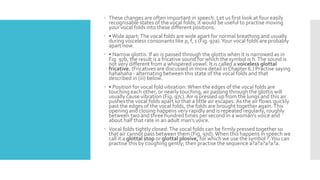
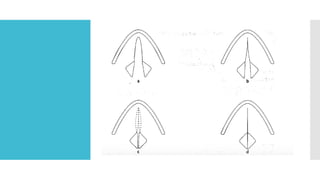
 These changes are often important in speech. Let us first look at four easily
recognisable states of the vocal folds; it would be useful to practise moving
your vocal folds into these different positions.
 •Wide apart:The vocal folds are wide apart for normal breathing and usually
during voiceless consonants like p, f, s (Fig. 97a).Your vocal folds are probably
apart now.
 • Narrow glottis: If air is passed through the glottis when it is narrowed as in
Fig. 97b, the result is a fricative sound for which the symbol is h.The sound is
not very different from a whispered vowel. It is called a voiceless glottal
fricative. (Fricatives are discussed in more detail in Chapter 6.) Practise saying
hahahaha - alternating between this state of the vocal folds and that
described in (iii) below.
 • Position for vocal fold vibration:When the edges of the vocal folds are
touching each other, or nearly touching, air passing through the glottis will
usually cause vibration (Fig. 97c). Air is pressed up from the lungs and this air
pushes the vocal folds apart so that a little air escapes. As the air flows quickly
past the edges of the vocal folds, the folds are brought together again.This
opening and closing happens very rapidly and is repeated regularly, roughly
between two and three hundred times per second in a woman's voice and
about half that rate in an adult man's voice.
 Vocal folds tightly closed:The vocal folds can be firmly pressed together so
that air cannot pass between them (Fig. 97d).When this happens in speech we
call it a glottal stop or glottal plosive, for which we use the symbol ?.You can
practise this by coughing gently; then practise the sequence a?a?a?a?a?a.
Glottis
positions
Respiration
and voicing
 Section 7.9 referred several times to air passing between the vocal
folds.The normal way for this airflow to be produced is for some of
the air in the lungs to be pushed out; when air is made to move out of
the lungs we say that there is an egressive pulmonic airstream. All
speech sounds are made with some movement of air, and the
egressive pulmonic is by far the most commonly found air
movement in the languages of the world.There are other ways of
making air move in the vocal tract, but they are not usually relevant
in the study of English pronunciation, so we will not discuss them
here.
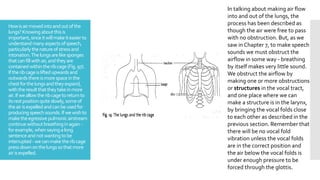
Howisairmovedintoandoutofthe
lungs?Knowingaboutthisis
important,sinceitwillmakeiteasierto
understand manyaspectsofspeech,
particularlythenatureofstressand
intonation.Thelungsarelikesponges
thatcanfillwithair,andtheyare
contained withintheribcage(Fig.97).
Iftheribcageisliftedupwardsand
outwardsthereismorespaceinthe
chestforthelungsandtheyexpand,
withtheresultthattheytakeinmore
air.Ifweallowtheribcagetoreturnto
itsrestpositionquiteslowly,someof
theairisexpelledandcanbeusedfor
producingspeechsounds.Ifwewishto
maketheegressive pulmonicairstream
continuewithoutbreathinginagain -
forexample,whensayingalong
sentence andnotwantingtobe
interrupted-wecanmaketheribcage
pressdownonthelungssothatmore
airisexpelled.
In talking about making air flow
into and out of the lungs, the
process has been described as
though the air were free to pass
with no obstruction. But, as we
saw in Chapter 7, to make speech
sounds we must obstruct the
airflow in some way - breathing
by itself makes very little sound.
We obstruct the airflow by
making one or more obstructions
or structures in the vocal tract,
and one place where we can
make a structure is in the larynx,
by bringing the vocal folds close
to each other as described in the
previous section. Remember that
there will be no vocal fold
vibration unless the vocal folds
are in the correct position and
the air below the vocal folds is
under enough pressure to be
forced through the glottis.
…cntnd
 If the vocal folds vibrate we will hear the sound that we call voicing or
phonation. There are many different sorts of voicing that we can
produce - think of the differences in the quality of your voice between
singing, shouting and speaking quietly, or think of the different voices
you might use reading a story to young children in which you have to
read out what is said by characters such as giants, fairies, mice or
ducks; many of the differences are made with the larynx.We can
make changes in the vocal folds themselves - they can, for example,
be made longer or shorter, more tense or more relaxed or be more or
less strongly pressed together.The pressure of the air below the vocal
folds (the subglottal pressure) can also be varied.Three main
differences are found:
 •Variations in intensity: We produce voicing with high intensity for
shouting, for example, and with low intensity for speaking quietly.
 •Variations in frequency: If the vocal folds vibrate rapidly, the voicing
is at high frequency; if there are fewer vibrations per second, the
frequency is lower.
 •Variations in quality: We can produce different-sounding voice
qualities, such as those we might call harsh, breathy, murmured or
creaky.
Plosives
Username:
SOS2019
Password:
SoS2109
 A plosive is a consonant articulation with the following characteristics:
 • One articulator is moved against another, or two articulators are moved against each other,
so as to form a stricture that allows no air to escape from the vocal tract.The stricture is, then,
total.
 • After this stricture has been formed and air has been compressed behind it, it is released -
that is, air is allowed to escape.
 • If the air behind the stricture is still under pressure when the plosive is released, it is probable
that the escape of air will produce noise loud enough to be heard.This noise is called plosion.
d)There may be voicing during part or all of the plosive articulation.

 To give a complete description of a plosive consonant we must describe what happens at each
of the following four phases in its production:
 •The first phase is when the articulator or articulators move to form the stricture for the
plosive.We call this the closing phase.
 •The second phase is when the compressed air is stopped from escaping.We call this the
compression phase.
 •The third phase is when the articulators used to form the stricture are moved so as to allow air
to escape.This is the release phase.
 •The fourth phase is what happens immediately after (iii), so we will call it the post-release
phase.
English
plosives
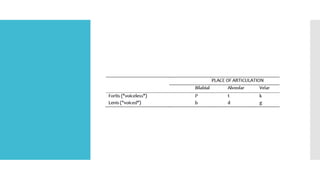
 English has six plosive consonants: p, t, k, b, d, g.The glottal
plosive ? occurs frequently but it is of less importance, since it is
usually just an alternative pronunciation of p, t, k in certain
contexts.The plosives have different places of articulation.The
plosives p, b are bilabial since the lips are pressed together (Fig.
98); t, d are alveolar since the tongue blade is pressed against the
alveolar ridge (Fig. 96). Normally the tongue does not touch the
front teeth as it does in the dental plosives found in many
languages.The plosives k, g are velar; the back of the tongue is
pressed against the area where the hard palate ends and the soft
palate begins (Fig. 92).
 All six plosives can occur at the beginning of a word (initial
position), between other sounds (medial position) and at the end
of a word (final position). To begin with we will look at plosives
preceding vowels (which can be abbreviated as CV, where C stands
for a consonant andV stands for a vowel), between vowels (VCV)
and following vowels (VC).
INITIAL
POSTION
 (CV):The closing phase for p, t, k and b, d, g takes place silently. During the
compression phase there is no voicing in p, t, k; in b, d, g there is normally very
little voicing - it begins only just before the release. If the speaker pronounces an
initial b, d, g very slowly and carefully there may be voicing during the entire
compression phase (the plosive is then fully voiced), while in rapid speech there
may be no voicing at all.
 The release of p, t, k is followed by audible plosion - that is, a burst of noise.There
is then, in the post-release phase, a period during which air escapes through the
vocal folds, making a sound like h.This is called aspiration. Then the vocal folds
come together and voicing begins. The release of b, d, g is followed by weak
plosion, and this happens at about the same time as, or shortly after, the beginning
of voicing.The most noticeable and important difference, then, between initial p,
t, k and b, d, g is the aspiration of the voiceless plosives p, t, k.The different phases
of the plosive all happen very rapidly, but the ear distinguishes clearly between p, t,
k and b, d, g. If English speakers hear a fully voiced initial plosive, they will hear it
as one of b, d, g but will notice that it does not sound quite natural. If they hear a
voiceless unaspi- rated plosive they will also hear that as one of b, d, g, because it is
aspiration, not voicing which distinguishes initial p, t, k from b, d, g. Only when
they hear a voiceless aspirated plosive will they hear it as one of p, t, k;
experiments have shown that we perceive aspiration when there is a delay
between the sound of plosion and the beginning (or onset) of voicing.
 In initial position, b, d, g cannot be preceded by any consonant, but p, t, k may be
preceded by s. When one of p, t, k is preceded by s it is unaspirated. From what was
said above it should be clear that the unaspirated p, t, k of the initial combinations
sp, st, sk have the sound quality that makes English speakers perceive a plosive as
one of b, d, g; if a recording of a word beginning with one of sp, st, sk is heard with
the s removed, an initial b, d or g is perceived by English speakers.
MEDIAL
POSITION

 (VCV):The pronunciation of p, t, k and b, d, g in medial position
depends to some extent on whether the syllables preceding and
following the plosive are stressed. In general we can say that a
medial plosive may have the characteristics either of final or of
initial plosives.
FINAL
POSITION

 Final position (VC): Final b, d, g normally have little voicing; if
there is voicing, it is at the beginning of the compression phase; p,
t, k are always voiceless.The plosion following the release of p, t, k
and b, d, g is very weak and often not audible.The difference
between p, t, k and b, d, g is primarily the fact that vowels
preceding p, t, k are much shorter.The shortening effect of p, t, k
is most noticeable when the vowel is one of the long vowels or
diphthongs.This effect is sometimes known as pre-fortis
clipping.
Fortis and
lenis
 Are b, d, g voiced plosives?The description of them makes it clear
that it is not very accurate to call them "voiced"; in initial and final
position they are scarcely voiced at all, and any voicing they may
have seems to have no perceptual importance. Some phoneticians
say that p, t, k are produced with more force than b, d, g, and that
it would therefore be better to give the two sets of plosives (and
some other consonants) names that indicate that fact; so the
voiceless plosives p, t, k are sometimes called fortis (meaning
'strong') and b, d, g are then called lenis (meaning 'weak'). It may
well be true that p, t, k are produced with more force, though
nobody has really proved it - force of articulation is very difficult to
define and measure. On the other hand, the terms fortis and lenis
are difficult to remember. Despite this, we shall follow the practice
of many books and use these terms.
long vowels presentation to introduce  the idea

long vowels presentation to introduce the idea

  • 1.
  • 2.
  • 3.
     The fivelong vowels tend to be longer than the short vowels in similar contexts.  The length of all English vowel sounds varies very much according to their context (such as the type of sound that follows them) and the presence or absence of stress.
  • 4.
    i: (example words:‘beat’, ‘mean’, ‘peace’) This vowel is nearer to cardinal vowel no. 1 [i] (i.e. it is closer and more front) than is the short vowel of‘bid’, ‘pin’, ‘fish’ described in Chapter 2. Although the tongue shape is not much different from cardinal vowel no. 1, the lips are only slightly spread and this results in a rather different vowel quality.
  • 5.
     з: (examplewords; ‘bird’, ‘fern’, ‘purse’) This is a mid-central vowel which is used in most Enghsh accents as a hesitation sound (written ‘er’), but which many learners find difficult to copy.The lip position is neutral, a: (example words: ‘card’, ‘half’, ‘pass’)This is an open vowel in the region of cardinal vowel no. 5 [a], but not as back as this.The Up position is neutral, o: (example words: ‘board’, ‘torn’, ‘horse’)The tongue height for this vowel is between cardinal vowel no. 6 [o] and no. 7 [o], and closer to the latter. This vowel is almost fuUy back and has quite strong lip-rounding, u: (example words: ‘food’, ‘soon’, ‘loose’)The nearest cardinal vowel to this is no. 8 [u], but BBC u: is much less back and less close, while the Ups are only moderately rounded.
  • 6.
    Diphthongs  BBC pronunciationhas a large number of diphthongs - sounds which consist of a movement or glide from one vowel to another. A vowel which remains constant and does not gUde is caUed a pure vowel.  the most important thing to remember about the diphthongs is that the first part is much longer and stronger than the second part; for example, most of the diphthong ai (as in the words ‘eye’), consists of the a vowel, and only in about the last quarter of the diphthong does the glide to i become noticeable.As the glide to i happens, the loudness of the sound decreases.
  • 8.
    Centring 1. (example words;‘beard’, ‘weird’, ‘fierce’)The starting point is a little closer than i in ‘bit’, ‘bin’, 2. (example words: ‘aired’, ‘caim’, ‘scarce’)This diphthong begins with a vowel sound that is more open than the e of‘get’,‘men’. 3. (example words; ‘moored’, ‘tour’, ‘lure’) For speakers who have this diphthong, this has a starting point similar to U in ‘put’, ‘puli’. Many speakers pronoumce э: instead.
  • 9.
    Theclosingdiphthongs havethe characteristic that theyallendwitha glidetowardsacloser vowel.Becausethe second partof the diphthong is weak,theyoftendonot reachaposition that could becalledclose.The importantthingisthat a glidefrom arelatively moreopentowardsa relativelycloservowelis produced. Threeof the diphthongs glidetowards i.
  • 10.
    4. (example words: ‘paid’, ‘pain’,‘face’) The starting point is the same as the e of‘get’, ‘men’.
  • 11.
    5. (example words: ‘tide’,‘time’, ‘nice’) This diphthong begins with an open vowel which is between front and back; it is quite similar to the л of the words ‘cut’, ‘bun’.
  • 12.
    6. (example words: ‘void’, ‘loin’,‘voice’) The first part of this diphthong is slightly more open than oi in ‘ought’, ‘born’.
  • 13.
    Two diphthongs glide towardsu, so that as the tongue moves closer to the roof of the mouth thereis at the same time a rounding movement of the lips.This movement is not a large one, again because the second part of the diphthong is weak.
  • 14.
    7. (examplewords:‘load’, ‘home’, ‘most’)Thevowel positionforthebeginning of thisisthesameasforthe “schwa” vowelэ, asfoimdin thefirstsyllableoftheword ‘about’.Thelipsmaybe slightlyroundedin anticipation oftheghde towardsu,forwhich thereis quitenoticeablelip-rounding, au(examplewords:‘loud’, ‘gown’, ‘house’)This diphthong beginswith a vowelsimilartoai.Sincethis isanopenvowel, aglidetoи wouldnecessitatealarge movement,andthe tongue oftendoesnotreachtheи position.Thereisonlyslight liр-rounding.
  • 15.
    Triphthongs  The mostcomplex English sounds of the vowel type are the triphthongs. They can be rather difficult to pronounce, and very difficult to recognise. A triphthong is a glide from one vowel to another and then to a third, all produced rapidly and without interruption.  For example, a careful pronunciation of the word ‘hour’ begins with a vowel quality similar to aʊ, goes on to a glide towards the back close rounded area (for which we use the symbol u), then ends with a mid-central vowel (schwa, ə).We use the symbol to represent the pronunciation of‘hour’, but this is not always an accurate representation of the pronunciation. aʊər
  • 16.
      The principalcause of difficulty for the foreign learner is that in present-day English the extent of the vowel movement is very small, except in very careful pronunciation.  Because of this, the middle of the three vowel qualities of the triphthong can hardly be heard and the resulting sound is difficult to distinguish from some of the diphthongs and long vowels.  To add to the difficulty, there is also the problem of whether a triphthong is felt to contain one or two syllables.Words such as ‘fire’ faɪər or ‘hour’ aʊər are probably felt by most English speakers (with BBC pronunciation) to consist of only one syllable, whereas ‘player’ ˈpleɪ·ər or ‘slower’ are more likely to be heard as two syllables.
  • 17.
    Voicing and Consonants  Thelarynx  The larynx is in the neck; it has several parts, shown in Fig. 90. Its main structure is made of cartilage, a material that is similar to bone but less hard. If you press down on your nose, the hard part that you can feel is cartilage.The larynx's structure is made of two large cartilages.These are hollow and are attached to the top of the trachea; when we breathe, the air passes through the trachea and the larynx.The front of the larynx comes to a point and you can feel this point at the front of your neck - particularly if you are a man and/or slim.This point is commonly called the Adam's Apple.
  • 18.
    Insidethe"box"madebythesetwocartilagesare thevocalfolds,whicharetwothickflapsof muscleratherlikeapairoflips;anoldernamefor theseisvocalcords.Lookingdownthethroatis difficulttodo,andrequiresspecialoptical equipment,butFig.99showsindiagramform themostimportantparts.Atthefrontthevocal foldsarejoinedtogetherandfixedtotheinsideof thethyroidcartilage. Atthebacktheyareattachedtoapairofsmall cartilagescalledthearytenoidcartilagessothatif thearytenoidcartilagesmove,thevocalfolds movetoo. Thearytenoidcartilagesareattachedtothetopof thecricoidcartilage,buttheycanmovesoasto movethevocalfoldsapartortogether(Fig.97). Weusethewordglottistorefertotheopening betweenthevocalfolds.Ifthevocalfoldsare apartwesaythattheglottisisopen;iftheyare pressedtogetherwesaythattheglottisisclosed. Thisseemsquitesimple,butinfactwecan produceaverycomplexrangeofchangesinthe vocalfoldsandtheirpositions.
  • 19.
     These changesare often important in speech. Let us first look at four easily recognisable states of the vocal folds; it would be useful to practise moving your vocal folds into these different positions.  •Wide apart:The vocal folds are wide apart for normal breathing and usually during voiceless consonants like p, f, s (Fig. 97a).Your vocal folds are probably apart now.  • Narrow glottis: If air is passed through the glottis when it is narrowed as in Fig. 97b, the result is a fricative sound for which the symbol is h.The sound is not very different from a whispered vowel. It is called a voiceless glottal fricative. (Fricatives are discussed in more detail in Chapter 6.) Practise saying hahahaha - alternating between this state of the vocal folds and that described in (iii) below.  • Position for vocal fold vibration:When the edges of the vocal folds are touching each other, or nearly touching, air passing through the glottis will usually cause vibration (Fig. 97c). Air is pressed up from the lungs and this air pushes the vocal folds apart so that a little air escapes. As the air flows quickly past the edges of the vocal folds, the folds are brought together again.This opening and closing happens very rapidly and is repeated regularly, roughly between two and three hundred times per second in a woman's voice and about half that rate in an adult man's voice.  Vocal folds tightly closed:The vocal folds can be firmly pressed together so that air cannot pass between them (Fig. 97d).When this happens in speech we call it a glottal stop or glottal plosive, for which we use the symbol ?.You can practise this by coughing gently; then practise the sequence a?a?a?a?a?a.
  • 20.
  • 22.
    Respiration and voicing  Section7.9 referred several times to air passing between the vocal folds.The normal way for this airflow to be produced is for some of the air in the lungs to be pushed out; when air is made to move out of the lungs we say that there is an egressive pulmonic airstream. All speech sounds are made with some movement of air, and the egressive pulmonic is by far the most commonly found air movement in the languages of the world.There are other ways of making air move in the vocal tract, but they are not usually relevant in the study of English pronunciation, so we will not discuss them here.
  • 23.
    Howisairmovedintoandoutofthe lungs?Knowingaboutthisis important,sinceitwillmakeiteasierto understand manyaspectsofspeech, particularlythenatureofstressand intonation.Thelungsarelikesponges thatcanfillwithair,andtheyare contained withintheribcage(Fig.97). Iftheribcageisliftedupwardsand outwardsthereismorespaceinthe chestforthelungsandtheyexpand, withtheresultthattheytakeinmore air.Ifweallowtheribcagetoreturnto itsrestpositionquiteslowly,someof theairisexpelledandcanbeusedfor producingspeechsounds.Ifwewishto maketheegressivepulmonicairstream continuewithoutbreathinginagain - forexample,whensayingalong sentence andnotwantingtobe interrupted-wecanmaketheribcage pressdownonthelungssothatmore airisexpelled. In talking about making air flow into and out of the lungs, the process has been described as though the air were free to pass with no obstruction. But, as we saw in Chapter 7, to make speech sounds we must obstruct the airflow in some way - breathing by itself makes very little sound. We obstruct the airflow by making one or more obstructions or structures in the vocal tract, and one place where we can make a structure is in the larynx, by bringing the vocal folds close to each other as described in the previous section. Remember that there will be no vocal fold vibration unless the vocal folds are in the correct position and the air below the vocal folds is under enough pressure to be forced through the glottis.
  • 24.
    …cntnd  If thevocal folds vibrate we will hear the sound that we call voicing or phonation. There are many different sorts of voicing that we can produce - think of the differences in the quality of your voice between singing, shouting and speaking quietly, or think of the different voices you might use reading a story to young children in which you have to read out what is said by characters such as giants, fairies, mice or ducks; many of the differences are made with the larynx.We can make changes in the vocal folds themselves - they can, for example, be made longer or shorter, more tense or more relaxed or be more or less strongly pressed together.The pressure of the air below the vocal folds (the subglottal pressure) can also be varied.Three main differences are found:  •Variations in intensity: We produce voicing with high intensity for shouting, for example, and with low intensity for speaking quietly.  •Variations in frequency: If the vocal folds vibrate rapidly, the voicing is at high frequency; if there are fewer vibrations per second, the frequency is lower.  •Variations in quality: We can produce different-sounding voice qualities, such as those we might call harsh, breathy, murmured or creaky.
  • 25.
    Plosives Username: SOS2019 Password: SoS2109  A plosiveis a consonant articulation with the following characteristics:  • One articulator is moved against another, or two articulators are moved against each other, so as to form a stricture that allows no air to escape from the vocal tract.The stricture is, then, total.  • After this stricture has been formed and air has been compressed behind it, it is released - that is, air is allowed to escape.  • If the air behind the stricture is still under pressure when the plosive is released, it is probable that the escape of air will produce noise loud enough to be heard.This noise is called plosion. d)There may be voicing during part or all of the plosive articulation.   To give a complete description of a plosive consonant we must describe what happens at each of the following four phases in its production:  •The first phase is when the articulator or articulators move to form the stricture for the plosive.We call this the closing phase.  •The second phase is when the compressed air is stopped from escaping.We call this the compression phase.  •The third phase is when the articulators used to form the stricture are moved so as to allow air to escape.This is the release phase.  •The fourth phase is what happens immediately after (iii), so we will call it the post-release phase.
  • 26.
    English plosives  English hassix plosive consonants: p, t, k, b, d, g.The glottal plosive ? occurs frequently but it is of less importance, since it is usually just an alternative pronunciation of p, t, k in certain contexts.The plosives have different places of articulation.The plosives p, b are bilabial since the lips are pressed together (Fig. 98); t, d are alveolar since the tongue blade is pressed against the alveolar ridge (Fig. 96). Normally the tongue does not touch the front teeth as it does in the dental plosives found in many languages.The plosives k, g are velar; the back of the tongue is pressed against the area where the hard palate ends and the soft palate begins (Fig. 92).  All six plosives can occur at the beginning of a word (initial position), between other sounds (medial position) and at the end of a word (final position). To begin with we will look at plosives preceding vowels (which can be abbreviated as CV, where C stands for a consonant andV stands for a vowel), between vowels (VCV) and following vowels (VC).
  • 27.
    INITIAL POSTION  (CV):The closingphase for p, t, k and b, d, g takes place silently. During the compression phase there is no voicing in p, t, k; in b, d, g there is normally very little voicing - it begins only just before the release. If the speaker pronounces an initial b, d, g very slowly and carefully there may be voicing during the entire compression phase (the plosive is then fully voiced), while in rapid speech there may be no voicing at all.  The release of p, t, k is followed by audible plosion - that is, a burst of noise.There is then, in the post-release phase, a period during which air escapes through the vocal folds, making a sound like h.This is called aspiration. Then the vocal folds come together and voicing begins. The release of b, d, g is followed by weak plosion, and this happens at about the same time as, or shortly after, the beginning of voicing.The most noticeable and important difference, then, between initial p, t, k and b, d, g is the aspiration of the voiceless plosives p, t, k.The different phases of the plosive all happen very rapidly, but the ear distinguishes clearly between p, t, k and b, d, g. If English speakers hear a fully voiced initial plosive, they will hear it as one of b, d, g but will notice that it does not sound quite natural. If they hear a voiceless unaspi- rated plosive they will also hear that as one of b, d, g, because it is aspiration, not voicing which distinguishes initial p, t, k from b, d, g. Only when they hear a voiceless aspirated plosive will they hear it as one of p, t, k; experiments have shown that we perceive aspiration when there is a delay between the sound of plosion and the beginning (or onset) of voicing.  In initial position, b, d, g cannot be preceded by any consonant, but p, t, k may be preceded by s. When one of p, t, k is preceded by s it is unaspirated. From what was said above it should be clear that the unaspirated p, t, k of the initial combinations sp, st, sk have the sound quality that makes English speakers perceive a plosive as one of b, d, g; if a recording of a word beginning with one of sp, st, sk is heard with the s removed, an initial b, d or g is perceived by English speakers.
  • 28.
    MEDIAL POSITION   (VCV):The pronunciationof p, t, k and b, d, g in medial position depends to some extent on whether the syllables preceding and following the plosive are stressed. In general we can say that a medial plosive may have the characteristics either of final or of initial plosives.
  • 29.
    FINAL POSITION   Final position(VC): Final b, d, g normally have little voicing; if there is voicing, it is at the beginning of the compression phase; p, t, k are always voiceless.The plosion following the release of p, t, k and b, d, g is very weak and often not audible.The difference between p, t, k and b, d, g is primarily the fact that vowels preceding p, t, k are much shorter.The shortening effect of p, t, k is most noticeable when the vowel is one of the long vowels or diphthongs.This effect is sometimes known as pre-fortis clipping.
  • 30.
    Fortis and lenis  Areb, d, g voiced plosives?The description of them makes it clear that it is not very accurate to call them "voiced"; in initial and final position they are scarcely voiced at all, and any voicing they may have seems to have no perceptual importance. Some phoneticians say that p, t, k are produced with more force than b, d, g, and that it would therefore be better to give the two sets of plosives (and some other consonants) names that indicate that fact; so the voiceless plosives p, t, k are sometimes called fortis (meaning 'strong') and b, d, g are then called lenis (meaning 'weak'). It may well be true that p, t, k are produced with more force, though nobody has really proved it - force of articulation is very difficult to define and measure. On the other hand, the terms fortis and lenis are difficult to remember. Despite this, we shall follow the practice of many books and use these terms.