React + Meteor
Declarative JS with Sensible State
Taggart
Bowen-Gaddy
Campus Bubble (Previous)
• Built MVP with Meteor 0.6 

•	Moved to Backbone/React client, Meteor server

Insightpool (Current)
• Adopted a monolithic Rails app

•	Built a React / Flux client from the ground up
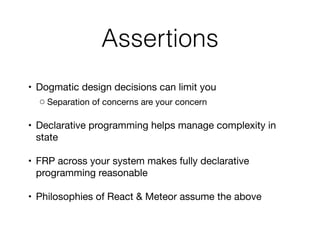
Assertions
	•	 Dogmatic design decisions can limit you

	 ◦	Separation of concerns are your concern

	•	 Declarative programming helps manage complexity in
state

	•	 FRP across your system makes fully declarative
programming reasonable 

	•	 Philosophies of React & Meteor assume the above
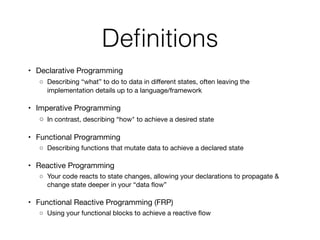
Definitions
	 •	 Declarative Programming

	 ◦	 Describing “what” to do to data in different states, often leaving the
implementation details up to a language/framework

	 •	 Imperative Programming

	 ◦	 In contrast, describing “how" to achieve a desired state

	 •	 Functional Programming

	 ◦	 Describing functions that mutate data to achieve a declared state

	 •	 Reactive Programming

	 ◦	 Your code reacts to state changes, allowing your declarations to propagate &
change state deeper in your “data flow”

	 •	 Functional Reactive Programming (FRP)

	 ◦	 Using your functional blocks to achieve a reactive flow
React
	•	 Just the UI

	 ◦	Lots of people use React as the V in MVC. Since React makes no
assumptions about the rest of your technology stack, it's easy to
try it out on a small feature in an existing project.

	•	 Virtual DOM

	 ◦	React uses a virtual DOM diff implementation for ultra-high
performance. It can also render on the server using Node.js — no
heavy browser DOM required.

	•	 Data Flow

	 ◦	React implements one-way reactive data flow which reduces
boilerplate and is easier to reason about than traditional data
binding.
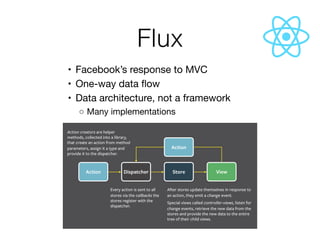
Flux
	•	 Facebook’s response to MVC

	•	 One-way data flow

	•	 Data architecture, not a framework

	 ◦	Many implementations
React Native
	•	 “Learn once, write anywhere"

	•	 Released today!

	•	 Compiles to native code

	 ◦	No webviews
Meteor
	•	 One language everywhere

	 ◦	Isomorphic APIs mean that the same code, written in the same
language, can run on both client and server.

	•	 Live Updates

	 ◦	Data updates live on the screen as it changes. Users can
collaborate seamlessly.

	•	 Ultra Responsive

	 ◦	Changes made by a user are instantly visible, without the
unprofessional laggy feeling that would result from waiting for a
round trip to the server.
How?
	•	 Blaze

	 ◦	Reactive templating library, similar to React

	•	 Tracker

	 ◦	FRP implementation

	•	 DDP

	 ◦	Fast, out-of-the-box reactive communication between the
client and the server

	•	 Livequery / minidatabases

	 ◦	The ability to query and update seamlessly between client and
server means isomorphic FRP is possible
React Compliments Meteor
	•	 React is Fast

	 ◦	 Virtual DOM diffing out-performs all other client-side re-rendering libraries

	•	 React is full-featured and built to manage your view state

	 ◦	 Blaze is only a templating system

	 ◦	 Blaze is tightly coupled with your Collections

	•	 Predictable, re-usable components

	 ◦	 Sharable, discrete, (FUNCTIONAL / REACTIVE!), components only
possible by re-thinking your separation of concerns

	•	 Serverside rendering

	 ◦	 Print to a string, serve up first for SEO or performance

	•	 Take advantage of the ecosystem surrounding it
Meteor compliments React
	•	 React is ONLY the “view layer”

	 ◦	Needs a “store” or a “model” to manage the data’s state

	•	 Flux is not an out-of-the-box solution

	 ◦	The ecosystem is still very much “in flux” and trying to figure out
best practices

	•	 Meteor’s Latency Compensation + React’s reactive nature
and fast diffing are a perfect pairing

	•	 Having livequery / minidatabases available to React means
less boilerplate and easy access to the data that view needs
Does this actually work?
YEAH!

	github.com/reactjs/react-meteor
How?
	•	 Hooks into React’s first-class + exposed lifecycle
functions to manage reactively setting state

	•	 Allows React components to be dropped into Blaze
templates

	•	 Meteor manages pubsub of model state + logic

	•	 React manages DOM manipulation and view state + logic
Lets look at some code
	•	 Leaderboard

	•	 Session.set() vs this.setState()
Other options?
Arunoda’s Flow Components

	•	 Not react, but VERY heavily inspired by it

	•	 Doesn’t “re-draw” as many lines RE: separations of
concerns

	•	 Lives in the meteor ecosystem

	 ◦	These are still Blaze templates

github.com/meteorhacks/flow-components
Other options?
Tmeasday’s Leaderboard example

	•	 Takes advantage of ES6 + newer React paradigms

	 ◦	Destructuring + Rest parameters

	 ◦	PropTypes

	 ◦	RenderToString()

http://blog.percolatestudio.com/engineering/reactive-user-interfaces/
Other options?
Roll your own!!
Also
React’s creator, Pete Hunt:

https://www.meteor.com/blog/2014/02/14/
pete-hunt-talks-facebook-react
React + Meteor
Questions & Answers!

Meteor + React

  • 1.
    React + Meteor DeclarativeJS with Sensible State
  • 2.
    Taggart Bowen-Gaddy Campus Bubble (Previous) •Built MVP with Meteor 0.6 • Moved to Backbone/React client, Meteor server Insightpool (Current) • Adopted a monolithic Rails app • Built a React / Flux client from the ground up
  • 3.
    Assertions • Dogmatic designdecisions can limit you ◦ Separation of concerns are your concern • Declarative programming helps manage complexity in state • FRP across your system makes fully declarative programming reasonable  • Philosophies of React & Meteor assume the above
  • 4.
    Definitions • DeclarativeProgramming ◦ Describing “what” to do to data in different states, often leaving the implementation details up to a language/framework • Imperative Programming ◦ In contrast, describing “how" to achieve a desired state • Functional Programming ◦ Describing functions that mutate data to achieve a declared state • Reactive Programming ◦ Your code reacts to state changes, allowing your declarations to propagate & change state deeper in your “data flow” • Functional Reactive Programming (FRP) ◦ Using your functional blocks to achieve a reactive flow
  • 5.
    React • Just theUI ◦ Lots of people use React as the V in MVC. Since React makes no assumptions about the rest of your technology stack, it's easy to try it out on a small feature in an existing project. • Virtual DOM ◦ React uses a virtual DOM diff implementation for ultra-high performance. It can also render on the server using Node.js — no heavy browser DOM required. • Data Flow ◦ React implements one-way reactive data flow which reduces boilerplate and is easier to reason about than traditional data binding.
  • 6.
    Flux • Facebook’s responseto MVC • One-way data flow • Data architecture, not a framework ◦ Many implementations
  • 7.
    React Native • “Learnonce, write anywhere" • Released today! • Compiles to native code ◦ No webviews
  • 8.
    Meteor • One languageeverywhere ◦ Isomorphic APIs mean that the same code, written in the same language, can run on both client and server. • Live Updates ◦ Data updates live on the screen as it changes. Users can collaborate seamlessly. • Ultra Responsive ◦ Changes made by a user are instantly visible, without the unprofessional laggy feeling that would result from waiting for a round trip to the server.
  • 9.
    How? • Blaze ◦ Reactivetemplating library, similar to React • Tracker ◦ FRP implementation • DDP ◦ Fast, out-of-the-box reactive communication between the client and the server • Livequery / minidatabases ◦ The ability to query and update seamlessly between client and server means isomorphic FRP is possible
  • 10.
    React Compliments Meteor • React is Fast ◦ Virtual DOM diffing out-performs all other client-side re-rendering libraries • React is full-featured and built to manage your view state ◦ Blaze is only a templating system ◦ Blaze is tightly coupled with your Collections • Predictable, re-usable components ◦ Sharable, discrete, (FUNCTIONAL / REACTIVE!), components only possible by re-thinking your separation of concerns • Serverside rendering ◦ Print to a string, serve up first for SEO or performance • Take advantage of the ecosystem surrounding it
  • 11.
    Meteor compliments React • React is ONLY the “view layer” ◦ Needs a “store” or a “model” to manage the data’s state • Flux is not an out-of-the-box solution ◦ The ecosystem is still very much “in flux” and trying to figure out best practices • Meteor’s Latency Compensation + React’s reactive nature and fast diffing are a perfect pairing • Having livequery / minidatabases available to React means less boilerplate and easy access to the data that view needs
  • 12.
    Does this actuallywork? YEAH! github.com/reactjs/react-meteor
  • 13.
    How? • Hooks intoReact’s first-class + exposed lifecycle functions to manage reactively setting state • Allows React components to be dropped into Blaze templates • Meteor manages pubsub of model state + logic • React manages DOM manipulation and view state + logic
  • 14.
    Lets look atsome code • Leaderboard • Session.set() vs this.setState()
  • 15.
    Other options? Arunoda’s FlowComponents • Not react, but VERY heavily inspired by it • Doesn’t “re-draw” as many lines RE: separations of concerns • Lives in the meteor ecosystem ◦ These are still Blaze templates github.com/meteorhacks/flow-components
  • 16.
    Other options? Tmeasday’s Leaderboardexample • Takes advantage of ES6 + newer React paradigms ◦ Destructuring + Rest parameters ◦ PropTypes ◦ RenderToString() http://blog.percolatestudio.com/engineering/reactive-user-interfaces/
  • 17.
  • 18.
    Also React’s creator, PeteHunt: https://www.meteor.com/blog/2014/02/14/ pete-hunt-talks-facebook-react
  • 19.