
N U R T U R E V E N T U R E
METEORThe Meteor Revolution
Massimo Sgrelli @ NURTURE VENTURE
meteorlog.com
Towards Connected Clients
•Model View Controller (MVC)
• Changed in the last 5 years
•How?
• Most modern applications moved the Model on the client and access
the server through API
• Many Javascript frameworks pop up to address this need
• Some frameworks like Rails still keep most of the login on the server
•Why move things on the client?
• To reduce latency and provide responsive applications
meteorlog.com
What’s Meteor
Meteor is a platform to build web and mobile
applications using just Javascript.
It’s been built on top of Nodejs.
•What’s a platform?
•Why is it different from a framework?
meteorlog.com
A Platform
•A framework
• Simplifies app creation
• Solves part of the problem
•A platform
• Provides you the building block to build a complete application
• It’s all-in-one solution for a broad range of problems
Meteor is a modular platform. It provides its own solutions, but it’s
open to integration with other frameworks like Angular and React.
meteorlog.com
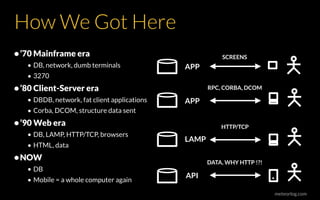
How We Got Here
•’70 Mainframe era
• DB, network, dumb terminals
• 3270
•’80 Client-Server era
• DBDB, network, fat client applications
• Corba, DCOM, structure data sent
•’90 Web era
• DB, LAMP, HTTP/TCP, browsers
• HTML, data
•NOW
• DB
• Mobile = a whole computer again
APP
SCREENS
APP
RPC, CORBA, DCOM
LAMP
HTTP/TCP
DATA, WHY HTTP !?!
API
meteorlog.com
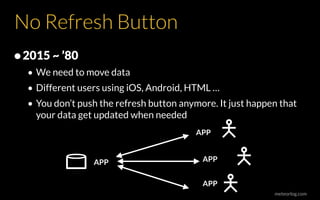
No Refresh Button
•2015 ~ ’80
• We need to move data
• Different users using iOS, Android, HTML …
• You don’t push the refresh button anymore. It just happen that
your data get updated when needed
APP
APP
APP
APP
meteorlog.com
Applications: What Changed
•They use (massively)
• Live updating
• Collaborative techniques
• Mobile
•They move data in real time, back and forth,
between server and client(s)
meteorlog.com
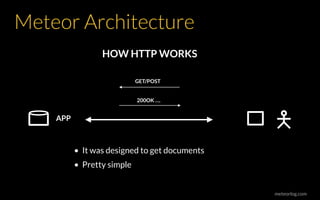
Meteor Architecture
APP
HOW HTTP WORKS
GET/POST
200OK ….
• It was designed to get documents
• Pretty simple
meteorlog.com
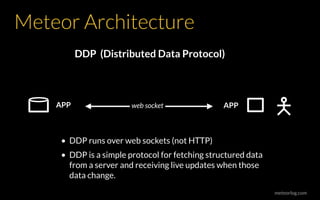
Meteor Architecture
APP
DDP (Distributed Data Protocol)
• DDP runs over web sockets (not HTTP)
• DDP is a simple protocol for fetching structured data
from a server and receiving live updates when those
data change.
web socket APP
meteorlog.com
Just in Case You Don’t Know…
•Socket
• 2 end points can talk to each other over a wire/pipe
• Data are sent in order, reliably and with no changes
•Web Socket
• You can do the same between a web browser and a point in the
cloud
meteorlog.com
How DDP Works
•Publication
• Client subscribe a Publication from the server
• Server starts exchanging data and messages (added, changed, remove)
• Ex. Subscribe Leaderboard publications: scores —> clients
•RPCs
• Client and server can call remote “methods”
• Ex. addToScore() <—
• Ex. result() —>
•JSON data are exchanged
feedthefounders
N U R T U R E V E N T U R E
DDP is like "REST for websockets"
It standardizes how real time
applications should talk to each other.
… or let’s say it’s just a few JSON
messages over a websocket.
meteorlog.com
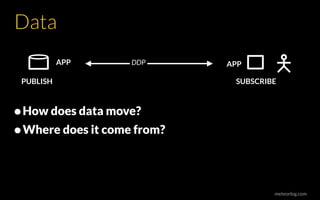
Data
•How does data move?
•Where does it come from?
APP DDP APP
PUBLISH SUBSCRIBE
meteorlog.com
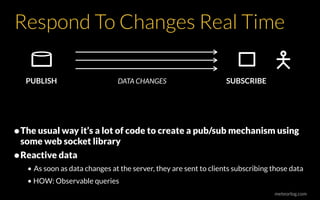
Respond To Changes Real Time
•The usual way it’s a lot of code to create a pub/sub mechanism using
some web socket library
•Reactive data
• As soon as data changes at the server, they are sent to clients subscribing those data
• HOW: Observable queries
DATA CHANGESPUBLISH SUBSCRIBE
meteorlog.com
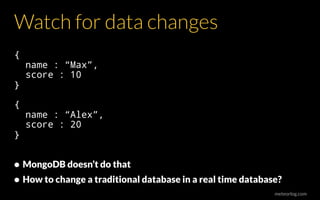
Watch for data changes
{
name : “Max”,
score : 10
}
{
name : “Alex”,
score : 20
}
• MongoDB doesn’t do that
• How to change a traditional database in a real time database?
meteorlog.com
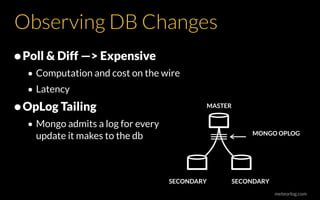
Observing DB Changes
•Poll & Diff —> Expensive
• Computation and cost on the wire
• Latency
•OpLog Tailing
• Mongo admits a log for every
update it makes to the db
MASTER
SECONDARY SECONDARY
MONGO OPLOG
meteorlog.com
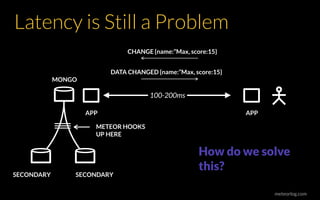
Latency is Still a Problem
MONGO
SECONDARY SECONDARY
METEOR HOOKS
UP HERE
100-200ms
APPAPP
CHANGE {name:”Max, score:15}
DATA CHANGED {name:”Max, score:15}
How do we solve
this?
meteorlog.com
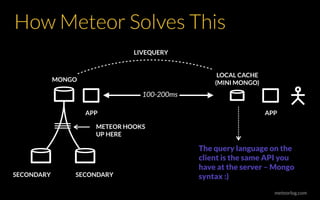
How Meteor Solves This
MONGO
SECONDARY SECONDARY
METEOR HOOKS
UP HERE
100-200ms
APPAPP
LOCAL CACHE
(MINI MONGO)
The query language on the
client is the same API you
have at the server – Mongo
syntax :)
LIVEQUERY
meteorlog.com
Some Advantages of This Approach
•Code sharing
• This mechanism allows to share code between client and server
• Javascript both on client and server
• Mongo syntax between client and server
•Livequery
• Turns your database into a reactive database, with streaming
queries
• Mongo, Redis (experimental) + more on the way
meteorlog.com
Some Advantages of This Approach
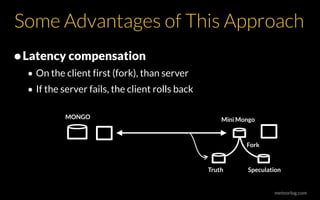
•Latency compensation
• On the client first (fork), than server
• If the server fails, the client rolls back
Mini Mongo
SpeculationTruth
MONGO
Fork
meteorlog.com
Reactive Templating
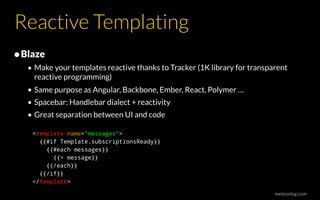
•Blaze
• Make your templates reactive thanks to Tracker (1K library for transparent
reactive programming)
• Same purpose as Angular, Backbone, Ember, React, Polymer …
• Spacebar: Handlebar dialect + reactivity
• Great separation between UI and code
<template name="messages">
{{#if Template.subscriptionsReady}}
{{#each messages}}
{{> message}}
{{/each}}
{{/if}}
</template>
meteorlog.com
Transparent Reactive Programming?
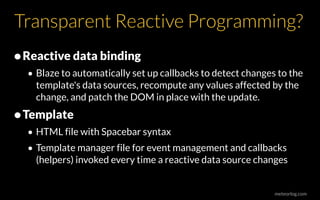
•Reactive data binding
• Blaze to automatically set up callbacks to detect changes to the
template's data sources, recompute any values affected by the
change, and patch the DOM in place with the update.
•Template
• HTML file with Spacebar syntax
• Template manager file for event management and callbacks
(helpers) invoked every time a reactive data source changes
meteorlog.com
Application Directory Structure
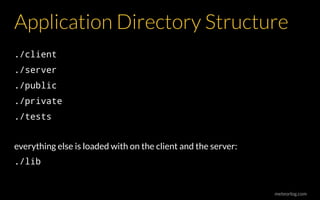
./client
./server
./public
./private
./tests
everything else is loaded with on the client and the server:
./lib
meteorlog.com
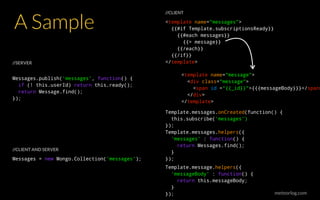
A Sample <template name="messages">
{{#if Template.subscriptionsReady}}
{{#each messages}}
{{> message}}
{{/each}}
{{/if}}
</template>
<template name="message">
<div class="message">
<span id =“{{_id}}">{{{messageBody}}}</span>
</div>
</template>
Template.messages.onCreated(function() {
this.subscribe(‘messages’)
});
Template.messages.helpers({
‘messages’ : function() {
return Messages.find();
}
});
Template.message.helpers({
‘messageBody’ : function() {
return this.messageBody;
}
});
Messages = new Mongo.Collection(‘messages’);
Messages.publish(‘messages’, function() {
if (! this.userId) return this.ready();
return Message.find();
});
//SERVER
//CLIENT
//CLIENT AND SERVER
N U R T U R E V E N T U R E
INSTALL METEOR & START
HAVING FUN
Send me your questions to massimo.sgrelli@gmail.com
www.meteorlog.com
www.nurtureventure.com

Meteor Revolution: From DDP to Blaze Reactive Rendering

  • 1.
    N U RT U R E V E N T U R E METEORThe Meteor Revolution Massimo Sgrelli @ NURTURE VENTURE
  • 2.
    meteorlog.com Towards Connected Clients •ModelView Controller (MVC) • Changed in the last 5 years •How? • Most modern applications moved the Model on the client and access the server through API • Many Javascript frameworks pop up to address this need • Some frameworks like Rails still keep most of the login on the server •Why move things on the client? • To reduce latency and provide responsive applications
  • 3.
    meteorlog.com What’s Meteor Meteor isa platform to build web and mobile applications using just Javascript. It’s been built on top of Nodejs. •What’s a platform? •Why is it different from a framework?
  • 4.
    meteorlog.com A Platform •A framework •Simplifies app creation • Solves part of the problem •A platform • Provides you the building block to build a complete application • It’s all-in-one solution for a broad range of problems Meteor is a modular platform. It provides its own solutions, but it’s open to integration with other frameworks like Angular and React.
  • 5.
    meteorlog.com How We GotHere •’70 Mainframe era • DB, network, dumb terminals • 3270 •’80 Client-Server era • DBDB, network, fat client applications • Corba, DCOM, structure data sent •’90 Web era • DB, LAMP, HTTP/TCP, browsers • HTML, data •NOW • DB • Mobile = a whole computer again APP SCREENS APP RPC, CORBA, DCOM LAMP HTTP/TCP DATA, WHY HTTP !?! API
  • 6.
    meteorlog.com No Refresh Button •2015~ ’80 • We need to move data • Different users using iOS, Android, HTML … • You don’t push the refresh button anymore. It just happen that your data get updated when needed APP APP APP APP
  • 7.
    meteorlog.com Applications: What Changed •Theyuse (massively) • Live updating • Collaborative techniques • Mobile •They move data in real time, back and forth, between server and client(s)
  • 8.
    meteorlog.com Meteor Architecture APP HOW HTTPWORKS GET/POST 200OK …. • It was designed to get documents • Pretty simple
  • 9.
    meteorlog.com Meteor Architecture APP DDP (DistributedData Protocol) • DDP runs over web sockets (not HTTP) • DDP is a simple protocol for fetching structured data from a server and receiving live updates when those data change. web socket APP
  • 10.
    meteorlog.com Just in CaseYou Don’t Know… •Socket • 2 end points can talk to each other over a wire/pipe • Data are sent in order, reliably and with no changes •Web Socket • You can do the same between a web browser and a point in the cloud
  • 11.
    meteorlog.com How DDP Works •Publication •Client subscribe a Publication from the server • Server starts exchanging data and messages (added, changed, remove) • Ex. Subscribe Leaderboard publications: scores —> clients •RPCs • Client and server can call remote “methods” • Ex. addToScore() <— • Ex. result() —> •JSON data are exchanged
  • 12.
    feedthefounders N U RT U R E V E N T U R E DDP is like "REST for websockets" It standardizes how real time applications should talk to each other. … or let’s say it’s just a few JSON messages over a websocket.
  • 13.
    meteorlog.com Data •How does datamove? •Where does it come from? APP DDP APP PUBLISH SUBSCRIBE
  • 14.
    meteorlog.com Respond To ChangesReal Time •The usual way it’s a lot of code to create a pub/sub mechanism using some web socket library •Reactive data • As soon as data changes at the server, they are sent to clients subscribing those data • HOW: Observable queries DATA CHANGESPUBLISH SUBSCRIBE
  • 15.
    meteorlog.com Watch for datachanges { name : “Max”, score : 10 } { name : “Alex”, score : 20 } • MongoDB doesn’t do that • How to change a traditional database in a real time database?
  • 16.
    meteorlog.com Observing DB Changes •Poll& Diff —> Expensive • Computation and cost on the wire • Latency •OpLog Tailing • Mongo admits a log for every update it makes to the db MASTER SECONDARY SECONDARY MONGO OPLOG
  • 17.
    meteorlog.com Latency is Stilla Problem MONGO SECONDARY SECONDARY METEOR HOOKS UP HERE 100-200ms APPAPP CHANGE {name:”Max, score:15} DATA CHANGED {name:”Max, score:15} How do we solve this?
  • 18.
    meteorlog.com How Meteor SolvesThis MONGO SECONDARY SECONDARY METEOR HOOKS UP HERE 100-200ms APPAPP LOCAL CACHE (MINI MONGO) The query language on the client is the same API you have at the server – Mongo syntax :) LIVEQUERY
  • 19.
    meteorlog.com Some Advantages ofThis Approach •Code sharing • This mechanism allows to share code between client and server • Javascript both on client and server • Mongo syntax between client and server •Livequery • Turns your database into a reactive database, with streaming queries • Mongo, Redis (experimental) + more on the way
  • 20.
    meteorlog.com Some Advantages ofThis Approach •Latency compensation • On the client first (fork), than server • If the server fails, the client rolls back Mini Mongo SpeculationTruth MONGO Fork
  • 21.
    meteorlog.com Reactive Templating •Blaze • Makeyour templates reactive thanks to Tracker (1K library for transparent reactive programming) • Same purpose as Angular, Backbone, Ember, React, Polymer … • Spacebar: Handlebar dialect + reactivity • Great separation between UI and code <template name="messages"> {{#if Template.subscriptionsReady}} {{#each messages}} {{> message}} {{/each}} {{/if}} </template>
  • 22.
    meteorlog.com Transparent Reactive Programming? •Reactivedata binding • Blaze to automatically set up callbacks to detect changes to the template's data sources, recompute any values affected by the change, and patch the DOM in place with the update. •Template • HTML file with Spacebar syntax • Template manager file for event management and callbacks (helpers) invoked every time a reactive data source changes
  • 23.
  • 24.
    meteorlog.com A Sample <templatename="messages"> {{#if Template.subscriptionsReady}} {{#each messages}} {{> message}} {{/each}} {{/if}} </template> <template name="message"> <div class="message"> <span id =“{{_id}}">{{{messageBody}}}</span> </div> </template> Template.messages.onCreated(function() { this.subscribe(‘messages’) }); Template.messages.helpers({ ‘messages’ : function() { return Messages.find(); } }); Template.message.helpers({ ‘messageBody’ : function() { return this.messageBody; } }); Messages = new Mongo.Collection(‘messages’); Messages.publish(‘messages’, function() { if (! this.userId) return this.ready(); return Message.find(); }); //SERVER //CLIENT //CLIENT AND SERVER
  • 25.
    N U RT U R E V E N T U R E INSTALL METEOR & START HAVING FUN Send me your questions to massimo.sgrelli@gmail.com www.meteorlog.com www.nurtureventure.com