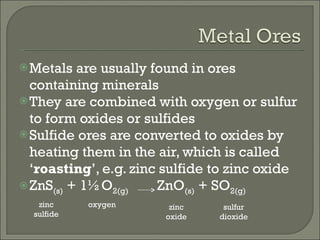
Metals are usually found in ores containing minerals They are combined with oxygen or sulfur to form oxides or sulfides Sulfide ores are converted to oxides by heating them in the air, which is called ‘ roasting ’, e.g. zinc sulfide to zinc oxide ZnS (s)  + 1½O 2(g)   ZnO (s)  + SO 2(g) zinc sulfide oxygen zinc oxide sulfur dioxide
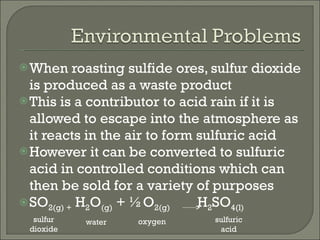
When roasting sulfide ores, sulfur dioxide is produced as a waste product This is a contributor to acid rain if it is allowed to escape into the atmosphere as it reacts in the air to form sulfuric acid However it can be converted to sulfuric acid in controlled conditions which can then be sold for a variety of purposes SO 2(g) +  H 2 O (g)  + ½O 2(g)   H 2 SO 4(l) sulfur dioxide oxygen water sulfuric acid
To obtain the metal its ore, a reducing agent is used to remove the oxygen, in a reduction reaction. Examples of some reducing agents;  Coke (an impure form of carbon) Hydrogen (made from methane and water) A more reactive metal may be used. Electrolysis can also be used for more reactive metals.
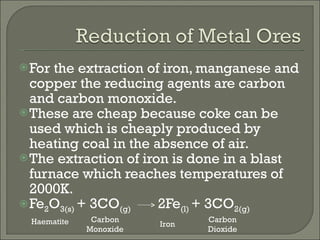
For the extraction of iron, manganese and copper the reducing agents are carbon and carbon monoxide. These are cheap because coke can be used which is cheaply produced by heating coal in the absence of air. The extraction of iron is done in a blast furnace which reaches temperatures of 2000K. Fe 2 O 3(s)  + 3CO (g)    2Fe (l)  + 3CO 2(g) Haematite Carbon Monoxide Iron Carbon Dioxide
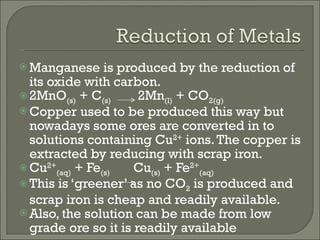
Manganese is produced by the reduction of its oxide with carbon.  2MnO (s)  + C (s)   2Mn (l)  + CO 2(g) Copper used to be produced this way but nowadays some ores are converted in to solutions containing Cu 2+  ions. The copper is extracted by reducing with scrap iron. Cu 2+ (aq)  + Fe (s)   Cu (s)  + Fe 2+ (aq) This is ‘greener’ as no CO 2  is produced and  scrap iron is cheap and readily available.  Also, the solution can be made from low grade ore so it is readily available
Some metals can’t be extracted using carbon reduction, such as aluminium, titanium and tungsten. Aluminium can’t because it is more reactive than carbon. Titanium and tungsten can’t because it would form a metal carbide which would make the metal brittle.
Aluminium is extracted from purified bauxite ore (mainly Al 2 O 3 ) The oxide is dissolved in molten cryolite, which forms a solution which melts at around 1240K (Al 2 O 3  melts at 2435K therefore less energy is required The solution is electrolysed so the main cost of the process is electricity which makes economic sense where cheap electricity is available
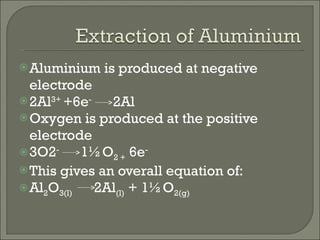
Aluminium is produced at negative electrode 2Al 3+  +6e -   2Al Oxygen is produced at the positive electrode 3O2 -   1½O 2 +  6e - This gives an overall equation of: Al 2 O 3(l)  2Al (l)  + 1½O 2(g)
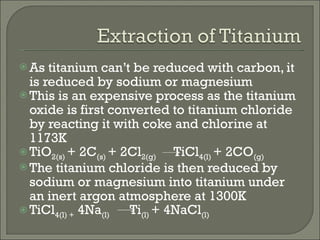
As titanium can’t be reduced with carbon, it is reduced by sodium or magnesium This is an expensive process as the titanium oxide is first converted to titanium chloride by reacting it with coke and chlorine at 1173K TiO 2(s)  + 2C (s)  + 2Cl 2(g)  TiCl 4(l)  + 2CO (g) The titanium chloride is then reduced by sodium or magnesium into titanium under an inert argon atmosphere at 1300K TiCl 4(l) +  4Na (l)  Ti (l)  + 4NaCl (l)
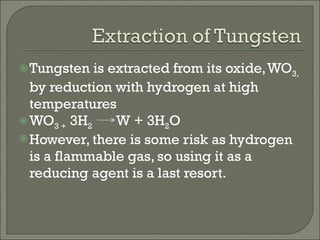
Tungsten is extracted from its oxide, WO 3,  by reduction with hydrogen at high temperatures WO 3 +  3H 2   W + 3H 2 O However, there is some risk as hydrogen is a flammable gas, so using it as a reducing agent is a last resort.
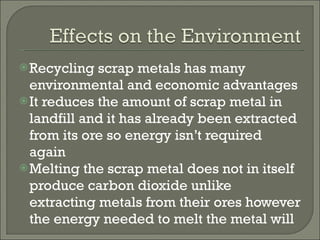
Recycling scrap metals has many environmental and economic advantages It reduces the amount of scrap metal in landfill and it has already been extracted from its ore so energy isn’t required again Melting the scrap metal does not in itself produce carbon dioxide unlike extracting metals from their ores however the energy needed to melt the metal will

Metal extraction

  • 1.
  • 2.
    Metals are usuallyfound in ores containing minerals They are combined with oxygen or sulfur to form oxides or sulfides Sulfide ores are converted to oxides by heating them in the air, which is called ‘ roasting ’, e.g. zinc sulfide to zinc oxide ZnS (s) + 1½O 2(g) ZnO (s) + SO 2(g) zinc sulfide oxygen zinc oxide sulfur dioxide
  • 3.
    When roasting sulfideores, sulfur dioxide is produced as a waste product This is a contributor to acid rain if it is allowed to escape into the atmosphere as it reacts in the air to form sulfuric acid However it can be converted to sulfuric acid in controlled conditions which can then be sold for a variety of purposes SO 2(g) + H 2 O (g) + ½O 2(g) H 2 SO 4(l) sulfur dioxide oxygen water sulfuric acid
  • 4.
    To obtain themetal its ore, a reducing agent is used to remove the oxygen, in a reduction reaction. Examples of some reducing agents; Coke (an impure form of carbon) Hydrogen (made from methane and water) A more reactive metal may be used. Electrolysis can also be used for more reactive metals.
  • 5.
    For the extractionof iron, manganese and copper the reducing agents are carbon and carbon monoxide. These are cheap because coke can be used which is cheaply produced by heating coal in the absence of air. The extraction of iron is done in a blast furnace which reaches temperatures of 2000K. Fe 2 O 3(s) + 3CO (g) 2Fe (l) + 3CO 2(g) Haematite Carbon Monoxide Iron Carbon Dioxide
  • 6.
    Manganese is producedby the reduction of its oxide with carbon. 2MnO (s) + C (s) 2Mn (l) + CO 2(g) Copper used to be produced this way but nowadays some ores are converted in to solutions containing Cu 2+ ions. The copper is extracted by reducing with scrap iron. Cu 2+ (aq) + Fe (s) Cu (s) + Fe 2+ (aq) This is ‘greener’ as no CO 2 is produced and scrap iron is cheap and readily available. Also, the solution can be made from low grade ore so it is readily available
  • 7.
    Some metals can’tbe extracted using carbon reduction, such as aluminium, titanium and tungsten. Aluminium can’t because it is more reactive than carbon. Titanium and tungsten can’t because it would form a metal carbide which would make the metal brittle.
  • 8.
    Aluminium is extractedfrom purified bauxite ore (mainly Al 2 O 3 ) The oxide is dissolved in molten cryolite, which forms a solution which melts at around 1240K (Al 2 O 3 melts at 2435K therefore less energy is required The solution is electrolysed so the main cost of the process is electricity which makes economic sense where cheap electricity is available
  • 9.
    Aluminium is producedat negative electrode 2Al 3+ +6e - 2Al Oxygen is produced at the positive electrode 3O2 - 1½O 2 + 6e - This gives an overall equation of: Al 2 O 3(l) 2Al (l) + 1½O 2(g)
  • 10.
    As titanium can’tbe reduced with carbon, it is reduced by sodium or magnesium This is an expensive process as the titanium oxide is first converted to titanium chloride by reacting it with coke and chlorine at 1173K TiO 2(s) + 2C (s) + 2Cl 2(g) TiCl 4(l) + 2CO (g) The titanium chloride is then reduced by sodium or magnesium into titanium under an inert argon atmosphere at 1300K TiCl 4(l) + 4Na (l) Ti (l) + 4NaCl (l)
  • 11.
    Tungsten is extractedfrom its oxide, WO 3, by reduction with hydrogen at high temperatures WO 3 + 3H 2 W + 3H 2 O However, there is some risk as hydrogen is a flammable gas, so using it as a reducing agent is a last resort.
  • 12.
    Recycling scrap metalshas many environmental and economic advantages It reduces the amount of scrap metal in landfill and it has already been extracted from its ore so energy isn’t required again Melting the scrap metal does not in itself produce carbon dioxide unlike extracting metals from their ores however the energy needed to melt the metal will