MET 212
            Fluid Mechanics


                Lecture # 2


1/15/2013
Objective
 Measures of Fluid Mass and Weight
      Density
      Specific Wight
      Specific Gravity
 Ideal Gas Law
 Viscosity
      Dynamic Viscosity
      Kinematic Viscosity
 Surface Tension

1/15/2013
Measures of Fluid Mass and Weight
 Density
          The density of the fluid designated by Greek symbol (ρ)
          Defined as a mass per unit volume
          Used to characterize the mass of fluid
          BG= slugs/ ft3 and SI= kg/m3
 Specific Weight
          The specific weight of the fluid designated by Greek symbol (γ)
          Defined as weight per unit volume
          Used to characterize the weight of the system
          BG= lb/ ft3 and SI= N/m3
 Specific Gravity
          The specific gravity of the fluid designated by SG
          Defined as a ratio of the density of the fluid to the density of the water
          The density of the water @ 4oC is BG=1.94 slugs/ft3 and SI=1000 kg/m3

   1/15/2013
Measures of Fluid Mass and Weight

Specific Gravity (Example)
      Calculate the density of the mercury in two system
       BG and SI by knowing the SGmercury @ 20oC is 13.55


1/15/2013
Ideal Gas Law
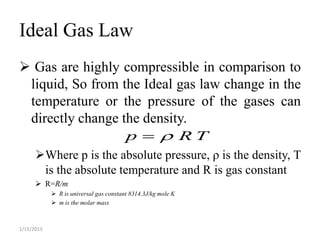
 Gas are highly compressible in comparison to
 liquid, So from the Ideal gas law change in the
 temperature or the pressure of the gases can
 directly change the density.
                                        p   RT
      Where p is the absolute pressure, ρ is the density, T
       is the absolute temperature and R is gas constant
       R=R/m
             R is universal gas constant 8314.3J/kg mole K
             m is the molar mass


1/15/2013
Ideal Gas Law
Example
    The absolute pressure and temperature of a gas in large
    chamber are found to be 500 kPa and 60oC respectively. Find
    the density if the air has m =28.97


1/15/2013s
Viscosity
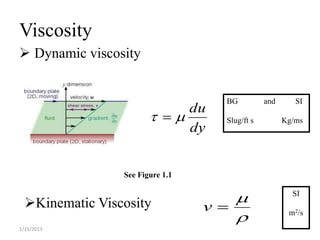
 Dynamic viscosity


                                    BG          and      SI
                             du
                                 Slug/ft s         Kg/ms
                             dy


                 See Figure 1.1


  Kinematic Viscosity                                 SI
                                  v
                                                      m2/s
1/15/2013
Viscosity
 Example
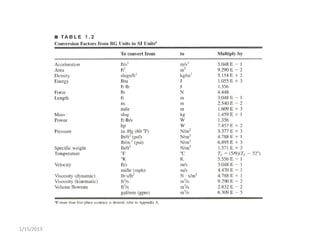
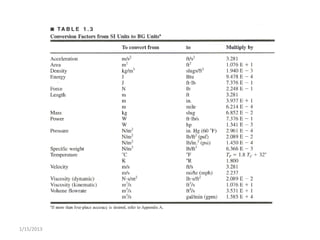
    Determine the value of the Reynolds number using SI system
    for fluid with viscosity of 0.38 N.s/m2 and specific gravity of
    0.91 flow into pipe with diameter of 25 mm with velocity of
    2.6 m/s.


1/15/2013
1/15/2013
1/15/2013
Surface Tension
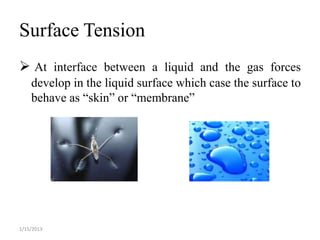
 At interface between a liquid and the gas forces
    develop in the liquid surface which case the surface to
    behave as “skin” or “membrane”


1/15/2013
Surface Tension(σ)


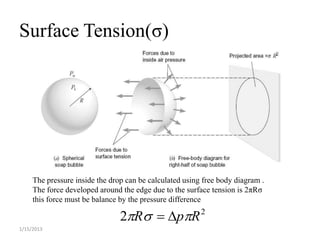
     The pressure inside the drop can be calculated using free body diagram .
     The force developed around the edge due to the surface tension is 2πRσ
     this force must be balance by the pressure difference

                                2R  pR              2

1/15/2013
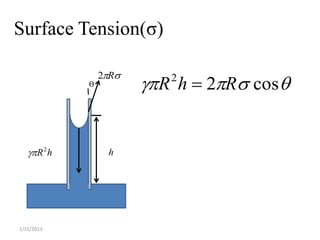
Surface Tension(σ)

                 2R
             ϴ          R h  2R cos
                           2


   R 2 h        h


1/15/2013
Surface Tension(σ)
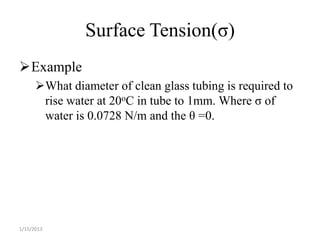
Example
      What diameter of clean glass tubing is required to
       rise water at 20oC in tube to 1mm. Where σ of
       water is 0.0728 N/m and the θ =0.


1/15/2013

Met 212 _2

  • 1.
    MET 212 Fluid Mechanics Lecture # 2 1/15/2013
  • 2.
    Objective  Measures ofFluid Mass and Weight Density Specific Wight Specific Gravity  Ideal Gas Law  Viscosity Dynamic Viscosity Kinematic Viscosity  Surface Tension 1/15/2013
  • 3.
    Measures of FluidMass and Weight  Density  The density of the fluid designated by Greek symbol (ρ)  Defined as a mass per unit volume  Used to characterize the mass of fluid  BG= slugs/ ft3 and SI= kg/m3  Specific Weight  The specific weight of the fluid designated by Greek symbol (γ)  Defined as weight per unit volume  Used to characterize the weight of the system  BG= lb/ ft3 and SI= N/m3  Specific Gravity  The specific gravity of the fluid designated by SG  Defined as a ratio of the density of the fluid to the density of the water  The density of the water @ 4oC is BG=1.94 slugs/ft3 and SI=1000 kg/m3 1/15/2013
  • 4.
    Measures of FluidMass and Weight Specific Gravity (Example) Calculate the density of the mercury in two system BG and SI by knowing the SGmercury @ 20oC is 13.55 1/15/2013
  • 5.
    Ideal Gas Law Gas are highly compressible in comparison to liquid, So from the Ideal gas law change in the temperature or the pressure of the gases can directly change the density. p   RT Where p is the absolute pressure, ρ is the density, T is the absolute temperature and R is gas constant  R=R/m  R is universal gas constant 8314.3J/kg mole K  m is the molar mass 1/15/2013
  • 6.
    Ideal Gas Law Example The absolute pressure and temperature of a gas in large chamber are found to be 500 kPa and 60oC respectively. Find the density if the air has m =28.97 1/15/2013s
  • 7.
    Viscosity  Dynamic viscosity BG and SI du   Slug/ft s Kg/ms dy See Figure 1.1 Kinematic Viscosity  SI v  m2/s 1/15/2013
  • 8.
    Viscosity  Example Determine the value of the Reynolds number using SI system for fluid with viscosity of 0.38 N.s/m2 and specific gravity of 0.91 flow into pipe with diameter of 25 mm with velocity of 2.6 m/s. 1/15/2013
  • 9.
  • 10.
  • 11.
    Surface Tension  Atinterface between a liquid and the gas forces develop in the liquid surface which case the surface to behave as “skin” or “membrane” 1/15/2013
  • 12.
    Surface Tension(σ) The pressure inside the drop can be calculated using free body diagram . The force developed around the edge due to the surface tension is 2πRσ this force must be balance by the pressure difference 2R  pR 2 1/15/2013
  • 13.
    Surface Tension(σ) 2R ϴ R h  2R cos 2 R 2 h h 1/15/2013
  • 14.
    Surface Tension(σ) Example What diameter of clean glass tubing is required to rise water at 20oC in tube to 1mm. Where σ of water is 0.0728 N/m and the θ =0. 1/15/2013