1. Introduction
2. Cities
3. Temples
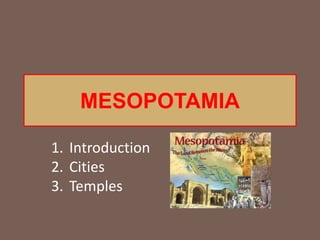
MESOPOTAMIA
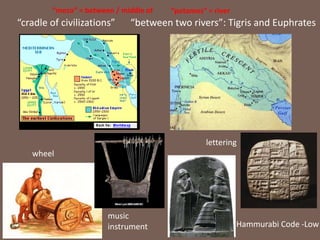
“between two rivers”: Tigris and Euphrates
“cradle of civilizations”
wheel
music
instrument Hammurabi Code -Low
lettering
“meso” = between / middle of “potamos” = river
Civilizations:
• Sumerians
• Assyrians
• Babylonians
Materials & Construction
• No stone available
• Sun-dried brick (light & flexible)
rounded arches
vaults
• Facades with pilasters reinforced
with palm trunks
• Surface with colored tiles
Contribution to the Architecture
• Founding number of cities (heavily protected)
Ur
Assur, Khorsabad, Nimrud, Nineveh
Babylon
• Differtnt types of buildings:
temples
public buildings
palaces, houses
CITIES & TEMPLES
Summerian City of Ur & modern parallel
“High” or Platform Temples – it will lead to the
“staged towers” or Ziggurats
“High” or Platform Temples
mud-brick temples repeatedly
built
buildings built on the ruins so
that the temple would stand
on the raised platform over-
looking the surrounding houses
“Oval” Temple
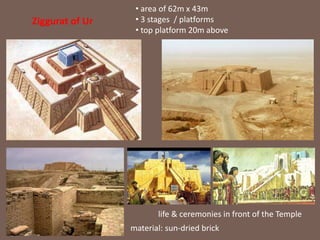
Ziggurat of Ur
• area of 62m x 43m
• 3 stages / platforms
• top platform 20m above
material: sun-dried brick
life & ceremonies in front of the Temple
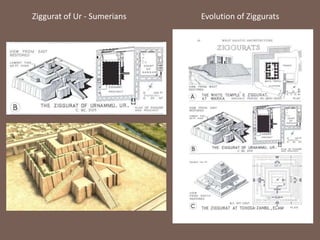
Ziggurat of Ur - Sumerians Evolution of Ziggurats
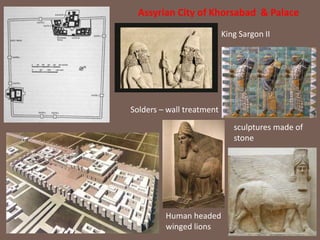
Assyrian City of Khorsabad & Palace
King Sargon II
Solders – wall treatment
sculptures made of
stone
Human headed
winged lions
Babylonian City of Babylon
Ishtar Gate & Processional Street
Wall treatment
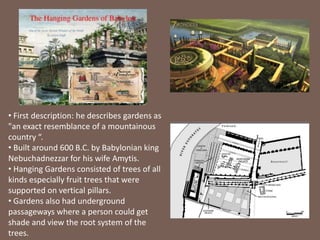
• First description: he describes gardens as
"an exact resemblance of a mountainous
country “.
• Built around 600 B.C. by Babylonian king
Nebuchadnezzar for his wife Amytis.
• Hanging Gardens consisted of trees of all
kinds especially fruit trees that were
supported on vertical pillars.
• Gardens also had underground
passageways where a person could get
shade and view the root system of the
trees.
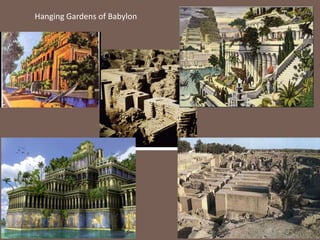
Hanging Gardens of Babylon
What have we learned….
• Civilizations 
• Materials & Construction 
• Contribution to the world of architecture 
• Cities 
• Temples 
• Hanging Gardens 

MESOPOTAMIA

  • 1.
    1. Introduction 2. Cities 3.Temples MESOPOTAMIA
  • 2.
    “between two rivers”:Tigris and Euphrates “cradle of civilizations” wheel music instrument Hammurabi Code -Low lettering “meso” = between / middle of “potamos” = river
  • 3.
    Civilizations: • Sumerians • Assyrians •Babylonians Materials & Construction • No stone available • Sun-dried brick (light & flexible) rounded arches vaults • Facades with pilasters reinforced with palm trunks • Surface with colored tiles Contribution to the Architecture • Founding number of cities (heavily protected) Ur Assur, Khorsabad, Nimrud, Nineveh Babylon • Differtnt types of buildings: temples public buildings palaces, houses
  • 4.
  • 5.
    Summerian City ofUr & modern parallel “High” or Platform Temples – it will lead to the “staged towers” or Ziggurats “High” or Platform Temples mud-brick temples repeatedly built buildings built on the ruins so that the temple would stand on the raised platform over- looking the surrounding houses “Oval” Temple
  • 6.
    Ziggurat of Ur •area of 62m x 43m • 3 stages / platforms • top platform 20m above material: sun-dried brick life & ceremonies in front of the Temple
  • 7.
    Ziggurat of Ur- Sumerians Evolution of Ziggurats
  • 8.
    Assyrian City ofKhorsabad & Palace King Sargon II Solders – wall treatment sculptures made of stone Human headed winged lions
  • 9.
    Babylonian City ofBabylon Ishtar Gate & Processional Street Wall treatment
  • 10.
    • First description:he describes gardens as "an exact resemblance of a mountainous country “. • Built around 600 B.C. by Babylonian king Nebuchadnezzar for his wife Amytis. • Hanging Gardens consisted of trees of all kinds especially fruit trees that were supported on vertical pillars. • Gardens also had underground passageways where a person could get shade and view the root system of the trees.
  • 11.
  • 12.
    What have welearned…. • Civilizations  • Materials & Construction  • Contribution to the world of architecture  • Cities  • Temples  • Hanging Gardens 