Dana C. Anselmi
                    EDUC 6232
The George Washington University
Agenda
     1) Introduction
     2) What is it?
     3) History
     4) Modern Research
     5) Pros
     6) Cons
     7) Examples
     8) Conclusion
What is merit pay?

“An additional sum paid
to an employee, as a
schoolteacher, whose
work is superior and
whose services are
valued”.
The History of Merit Pay
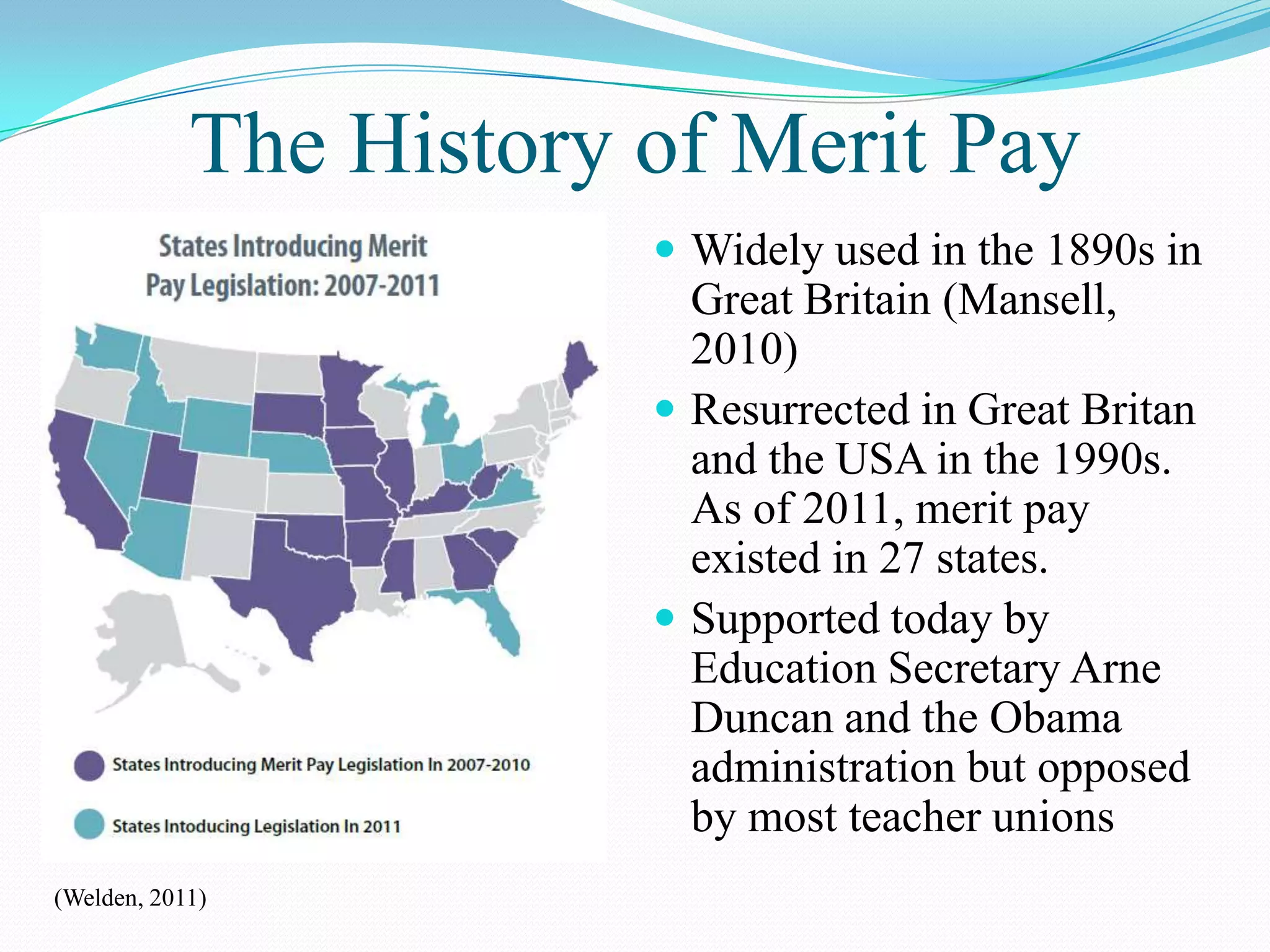
                         Widely used in the 1890s in
                          Great Britain (Mansell,
                          2010)
                         Resurrected in Great Britan
                          and the USA in the 1990s.
                          As of 2011, merit pay
                          existed in 27 states.
                         Supported today by
                          Education Secretary Arne
                          Duncan and the Obama
                          administration but opposed
                          by most teacher unions
(Welden, 2011)
Educational Research
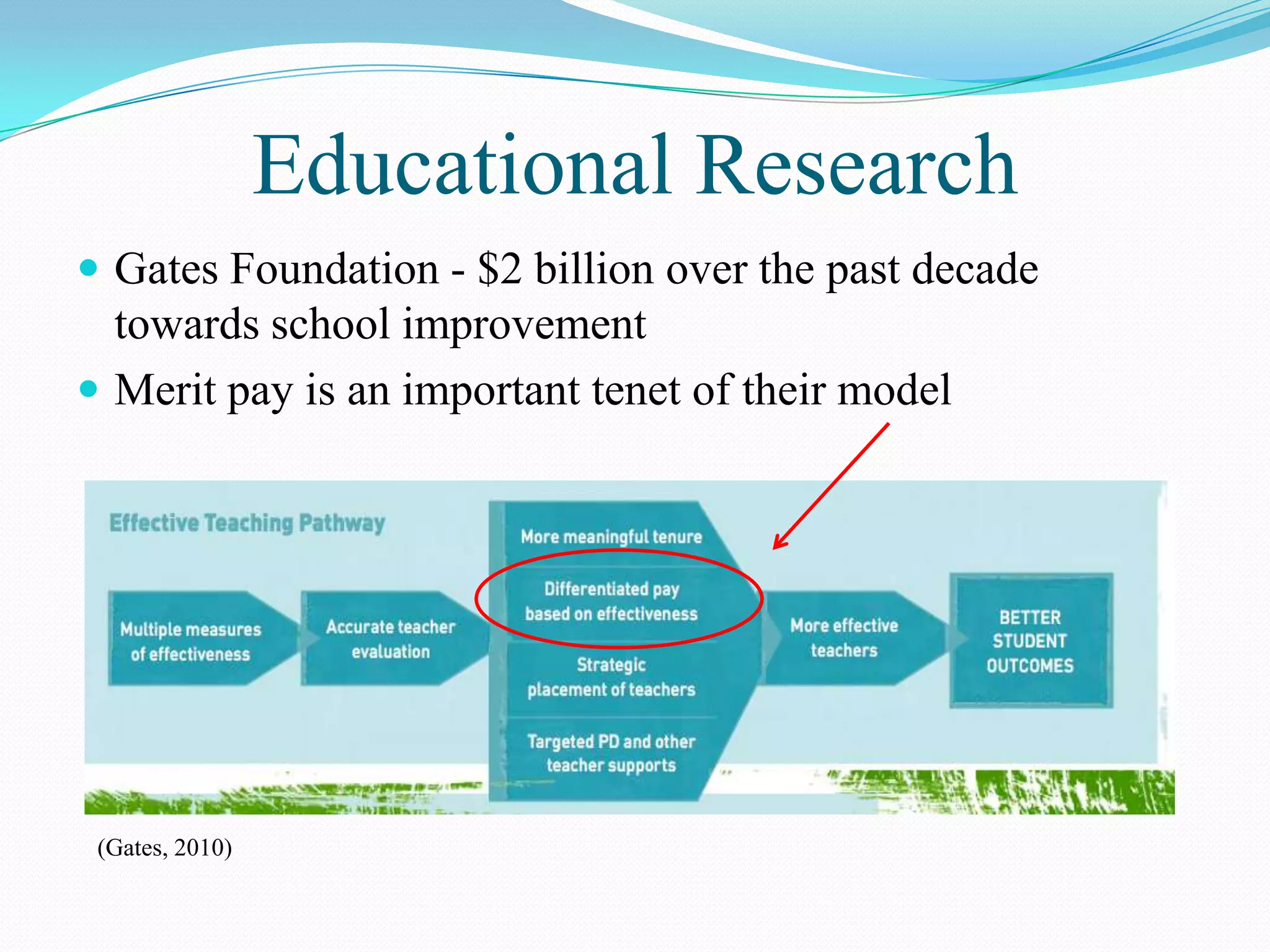
 Gates Foundation - $2 billion over the past decade
  towards school improvement
 Merit pay is an important tenet of their model


 (Gates, 2010)
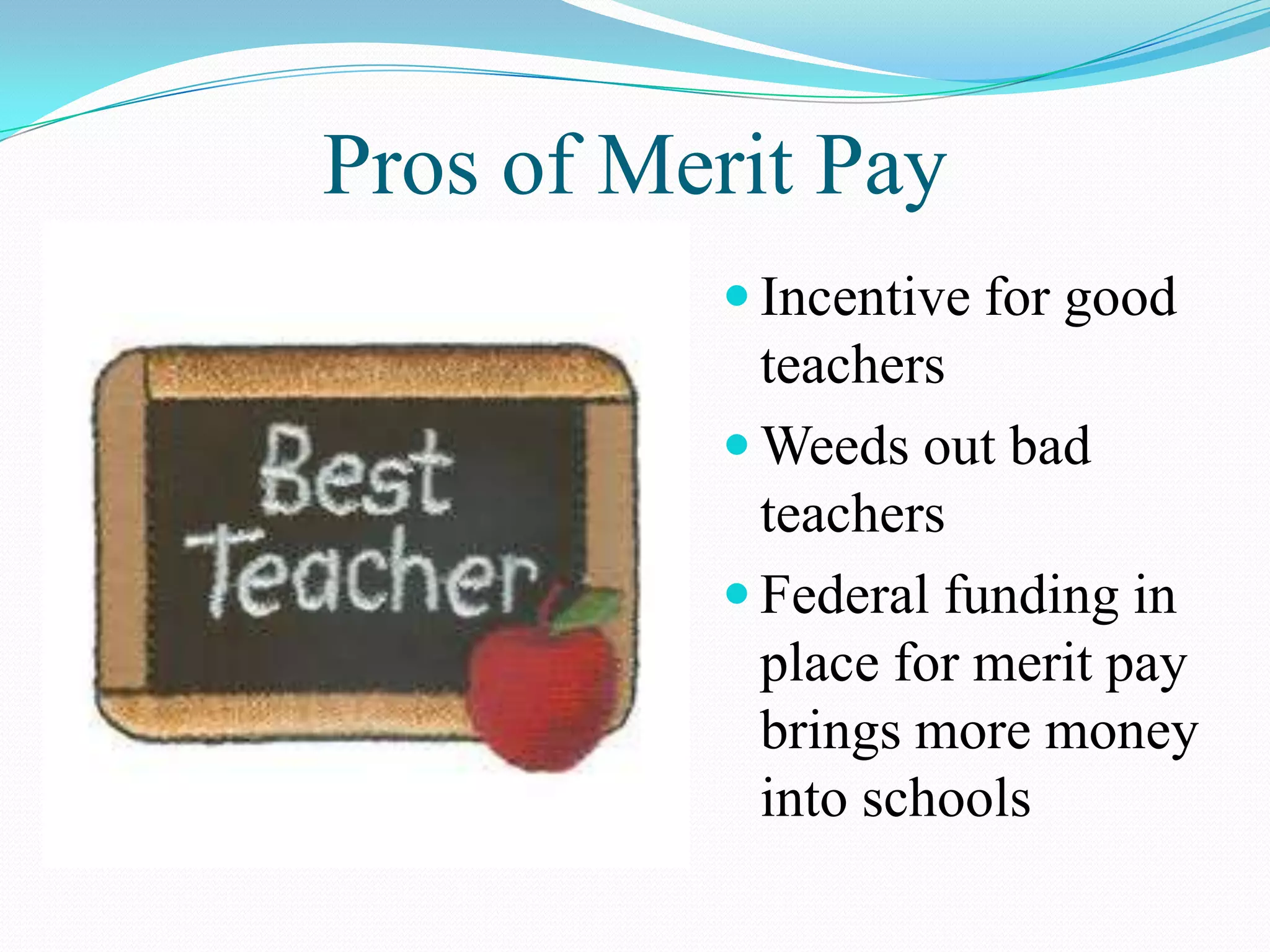
Pros of Merit Pay
           Incentive for good
            teachers
           Weeds out bad
            teachers
           Federal funding in
            place for merit pay
            brings more money
            into schools
Cons of Merit Pay
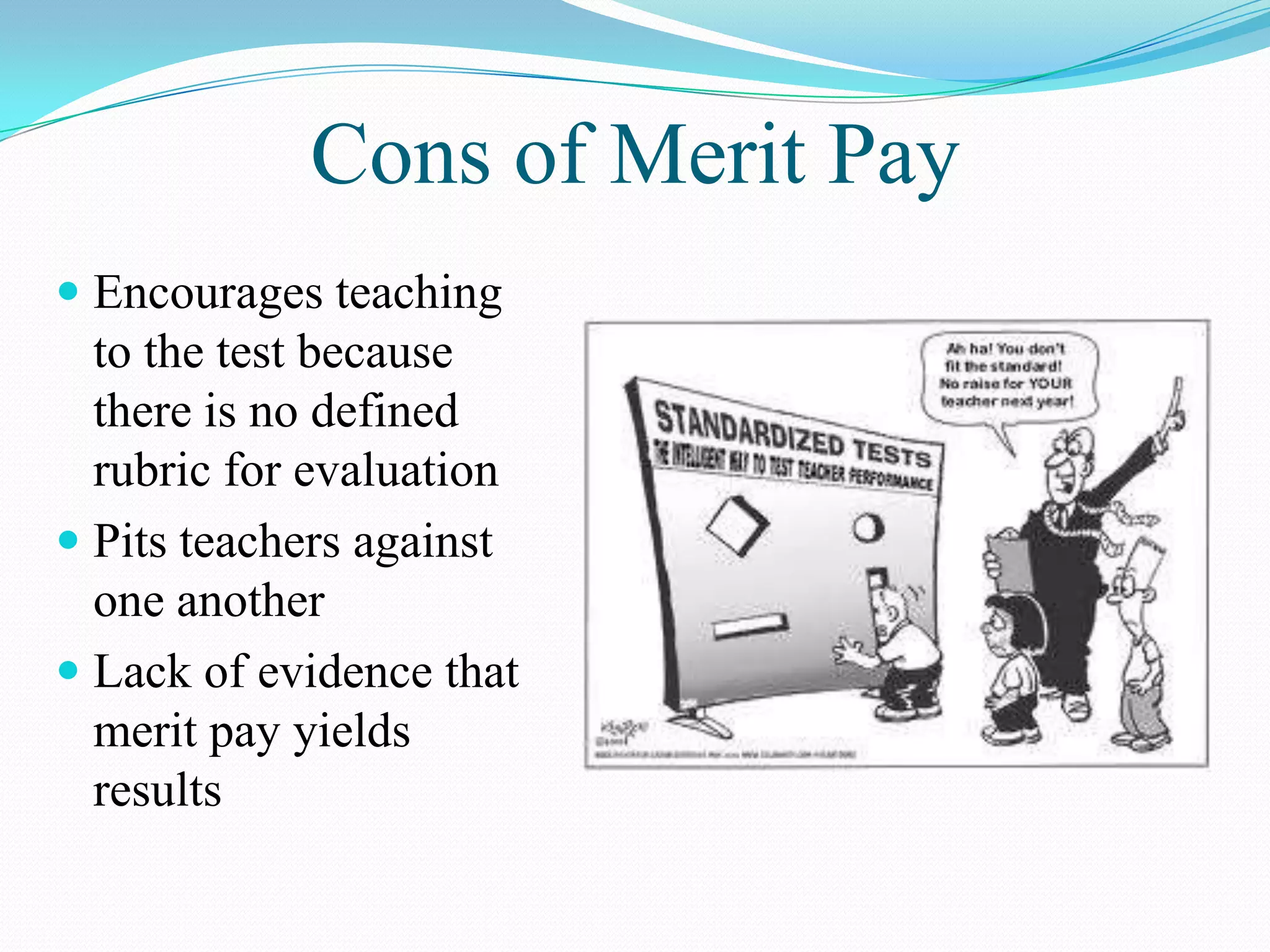
 Encourages teaching
  to the test because
  there is no defined
  rubric for evaluation
 Pits teachers against
  one another
 Lack of evidence that
  merit pay yields
  results
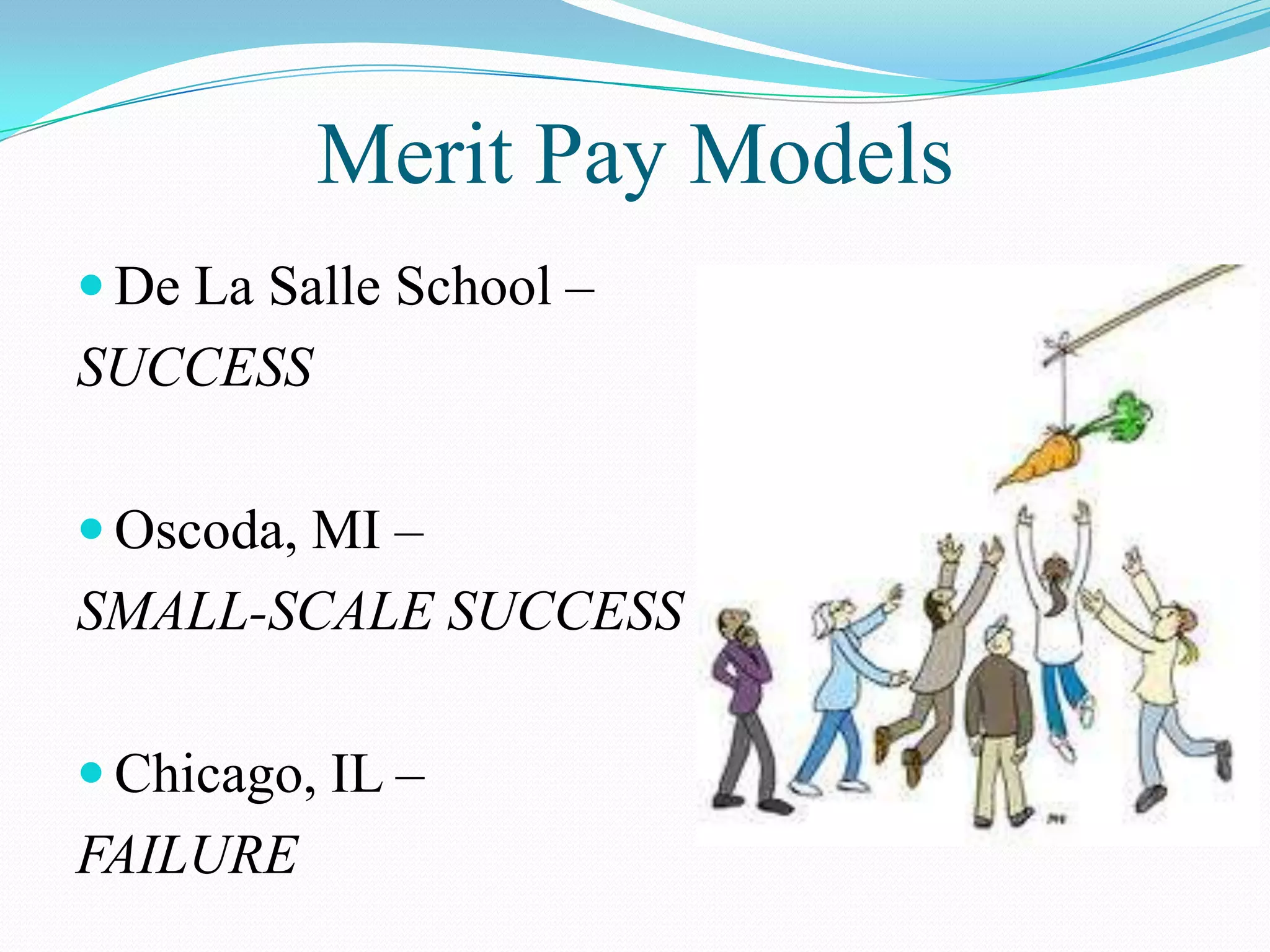
Merit Pay Models
 De La Salle School –
SUCCESS

 Oscoda, MI –
SMALL-SCALE SUCCESS

 Chicago, IL –
FAILURE
Conclusions
 Are we ready for merit pay?


 Discussion
References
Abowd, P. (2008). D.C. teachers divided on merit pay plan. Labor Notes, 1(1),14. Retrieved
            from http://search.proquest.com/docview/203697406?accountid=11243
Bill and Melinda Gates Foundation (2010). Learning about teaching: initial findings from the
            measures of effective teaching project. Retrieved from
            http://www.gatesfoundation.org/college-ready-education/Documents/preliminary-
            finding-policy-brief.pdf
Burk, I. (2010). More bang for your buck: The effect of Minnesota's alternative pay for teachers
            on the math achievement of high school students. Ph.D. diss., Capella University.
            Retrieved from http://search.proquest.com/docview/193266720?accountid=11243
By what measure? mapping and expanding the teacher effectiveness debate. (2012). Harvard
            Educational Review, 82(1), 78-82. Retrieved from
            http://search.proquest.com/docview/963359548?accountid=11243
Derringer, P. (2009). Race to the top's big question: Is merit pay ready for its close-up?
            Scholastic Administrator, 9, 47-47. Retrieved from
            http://search.proquest.com/docview/199514236?accountid=11243
Lampkin, M., & Weaver, R. (2008). Is merit pay for teachers a good idea? Ripon Forum, 42(3),
            16-18. Retrieved from
            http://search.proquest.com/docview/229653767?accountid=11243
References
Lavy, V. (2009). Performance pay and teachers' effort, productivity, and grading ethics. The
           American Economic Review 99(5), 1979-2011. Retrieved from
           http://search.proquest.com/docview/233010612?accountid=11243
Mansell, W. (2010). Merit pay across the pond. Phi Delta Kappan, 91(7), 83-84. Retrieved
           from http://search.proquest.com/docview/218485171?accountid=11243
Merit Pay. (n.d.). In Dictionary.com online. Retrieved from
           http://dictionary.reference.com/browse/merit+pay?s=t
Sawchuck, S. (2010). Merit pay model pushed by Duncan shows no achievement edge.
           Education Week, 29(33), 21-23. Retrieved from
           http://search.proquest.com.proxygw.wrlc.org/docview/375353589/139557B56D0
           229603C7/43?accountid=11243
Schmitz, G. (2008). A powerful merit pay system for teachers based on skill. Momentum, 39,
           34-38. Retrieved from
           http://search.proquest.com/docview/194670251?accountid=11243
Toch, T. (2009). The perils of merit pay. Phi Delta Kappan, 91(2), 99-100. Retrieved from
           http://search.proquest.com/docview/218542454?accountid=11243
Welden, T. (2011). Does merit pay for teachers have merit? Pros and cons of new models for
           teacher compensation. Knowledge Center: The Council of State Governments. Retrieved
           from www.knowledgecenter.csg.org/kc/content/capitol-research-does-merit-pay-teachers-
           have-merit-pros-and-cons-new-models-teacher-compensation

Merit pay presentation

  • 1.
    Dana C. Anselmi EDUC 6232 The George Washington University
  • 2.
    Agenda 1) Introduction 2) What is it? 3) History 4) Modern Research 5) Pros 6) Cons 7) Examples 8) Conclusion
  • 3.
    What is meritpay? “An additional sum paid to an employee, as a schoolteacher, whose work is superior and whose services are valued”.
  • 4.
    The History ofMerit Pay  Widely used in the 1890s in Great Britain (Mansell, 2010)  Resurrected in Great Britan and the USA in the 1990s. As of 2011, merit pay existed in 27 states.  Supported today by Education Secretary Arne Duncan and the Obama administration but opposed by most teacher unions (Welden, 2011)
  • 5.
    Educational Research  GatesFoundation - $2 billion over the past decade towards school improvement  Merit pay is an important tenet of their model (Gates, 2010)
  • 6.
    Pros of MeritPay  Incentive for good teachers  Weeds out bad teachers  Federal funding in place for merit pay brings more money into schools
  • 7.
    Cons of MeritPay  Encourages teaching to the test because there is no defined rubric for evaluation  Pits teachers against one another  Lack of evidence that merit pay yields results
  • 8.
    Merit Pay Models De La Salle School – SUCCESS  Oscoda, MI – SMALL-SCALE SUCCESS  Chicago, IL – FAILURE
  • 9.
    Conclusions  Are weready for merit pay?  Discussion
  • 10.
    References Abowd, P. (2008).D.C. teachers divided on merit pay plan. Labor Notes, 1(1),14. Retrieved from http://search.proquest.com/docview/203697406?accountid=11243 Bill and Melinda Gates Foundation (2010). Learning about teaching: initial findings from the measures of effective teaching project. Retrieved from http://www.gatesfoundation.org/college-ready-education/Documents/preliminary- finding-policy-brief.pdf Burk, I. (2010). More bang for your buck: The effect of Minnesota's alternative pay for teachers on the math achievement of high school students. Ph.D. diss., Capella University. Retrieved from http://search.proquest.com/docview/193266720?accountid=11243 By what measure? mapping and expanding the teacher effectiveness debate. (2012). Harvard Educational Review, 82(1), 78-82. Retrieved from http://search.proquest.com/docview/963359548?accountid=11243 Derringer, P. (2009). Race to the top's big question: Is merit pay ready for its close-up? Scholastic Administrator, 9, 47-47. Retrieved from http://search.proquest.com/docview/199514236?accountid=11243 Lampkin, M., & Weaver, R. (2008). Is merit pay for teachers a good idea? Ripon Forum, 42(3), 16-18. Retrieved from http://search.proquest.com/docview/229653767?accountid=11243
  • 11.
    References Lavy, V. (2009).Performance pay and teachers' effort, productivity, and grading ethics. The American Economic Review 99(5), 1979-2011. Retrieved from http://search.proquest.com/docview/233010612?accountid=11243 Mansell, W. (2010). Merit pay across the pond. Phi Delta Kappan, 91(7), 83-84. Retrieved from http://search.proquest.com/docview/218485171?accountid=11243 Merit Pay. (n.d.). In Dictionary.com online. Retrieved from http://dictionary.reference.com/browse/merit+pay?s=t Sawchuck, S. (2010). Merit pay model pushed by Duncan shows no achievement edge. Education Week, 29(33), 21-23. Retrieved from http://search.proquest.com.proxygw.wrlc.org/docview/375353589/139557B56D0 229603C7/43?accountid=11243 Schmitz, G. (2008). A powerful merit pay system for teachers based on skill. Momentum, 39, 34-38. Retrieved from http://search.proquest.com/docview/194670251?accountid=11243 Toch, T. (2009). The perils of merit pay. Phi Delta Kappan, 91(2), 99-100. Retrieved from http://search.proquest.com/docview/218542454?accountid=11243 Welden, T. (2011). Does merit pay for teachers have merit? Pros and cons of new models for teacher compensation. Knowledge Center: The Council of State Governments. Retrieved from www.knowledgecenter.csg.org/kc/content/capitol-research-does-merit-pay-teachers- have-merit-pros-and-cons-new-models-teacher-compensation

Editor's Notes

  • #2 Good afternoon good colleagues. We are gathered today to begin an important discussion about teaching and learning at our school. Everyone in this room cares about our school and our students yet we are getting crushed on state assessments and have failed to meet AYP for a second year in a row and this puts our school in jeopardy. I know that many good things are happening in our classrooms but we need to find ways to dig deeper and take our school to the next level. No Child Left Behind has given us some lofty goals and I know that we can reach them, but we may have to change the way we do things to get there.
  • #3 Today, I would like us to engage in a discussion about merit pay. I know that this is a widely debated topic and so I plan to present some information gleaned from research I have done over the past month. We all have our own opinion about performance compensation but I ask you to keep an open mind today as I am sharing the facts. I will define merit pay, explain its history and context in our schools today, present the pros and cons, outline specific models employed in other districts, and then open the floor to a thoughtful discussion about what is best for our school and if a merit pay model might be a realistic option.