MERCHANDISE TRADE –
CANADA – SEPTEMBER 2016
BY: PAUL YOUNG, CPA, CGA
NOVEMBER 4, 2016
AGENDA
• Summary
• Exports by Sector
• Exports by Country
• Exports by province and industry
• Key comments
SUMMARY
• Canada's imports rose 4.7% to a record $47.6 billion in September, as an exceptionally large transaction
accounted for the increase. Import prices increased 2.4% and volumes were up 2.3%.
• Exports edged up 0.1% to $43.5 billion, as a 0.9% increase in prices was mostly offset by a 0.8% decrease in
volumes. Consequently, Canada's merchandise trade deficit with the world widened from $2.0 billion in
August to a record $4.1 billion in September. Following a 4.7% decline in the second quarter, exports rose
5.0% to $130.3 billion in the third quarter, the strongest increase since the first quarter of 2014.
• Imports increased 2.4% to $138.5 billion. Consequently, Canada's quarterly trade deficit with the world
narrowed from a record $11.1 billion in the second quarter to $8.2 billion in the third quarter.
Source - http://www.statcan.gc.ca/daily-quotidien/161104/dq161104b-eng.htm
SUMMARY
• Canada's imports rose 4.7% to a record $47.6 billion in September, as an exceptionally large transaction accounted for the increase.
Import prices increased 2.4% and volumes were up 2.3%. Exports edged up 0.1% to $43.5 billion, as a 0.9% increase in prices was mostly
offset by a 0.8% decrease in volumes. Consequently, Canada's merchandise trade deficit with the world widened from $2.0 billion in
August to a record $4.1 billion in September. Following a 4.7% decline in the second quarter, exports rose 5.0% to $130.3 billion in the
third quarter, the strongest increase since the first quarter of 2014. Imports increased 2.4% to $138.5 billion. Consequently, Canada's
quarterly trade deficit with the world narrowed from a record $11.1 billion in the second quarter to $8.2 billion in the third quarter.
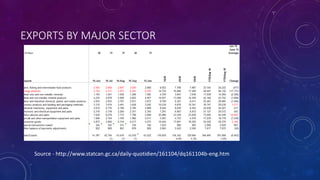
• Total exports edged up 0.1% to $43.5 billion in September, with 6 of 11 sections recording gains. This was the fourth consecutive
monthly increase. Higher exports of aircraft and other transportation equipment and parts, and energy products were partially offset by
lower exports of metal and non-metallic mineral products. In September, exports excluding energy products were down 0.2%. Year over
year, total exports decreased 1.2%. Following a large decline in August, exports of aircraft and other transportation equipment and parts
contributed the most to the overall increase in September, up 10.7% to $2.0 billion. Exports of aircraft increased 13.9% to $709 million
while aircraft engines and aircraft parts reached a record $1.0 billion on a 7.5% increase. In September, exports of energy products
increased 1.8% to $6.3 billion, the seventh consecutive increase. Exports of crude oil and crude bitumen rose 2.5% to $4.1 billion on
higher volumes. For the section as a whole, prices were up 1.7% while volumes were unchanged. Moderating these gains were lower
exports of metal and non-metallic mineral products, down 3.7% to $4.8 billion.
• After recording a 22.9% increase in July and a 12.4% increase in August, unwrought precious metals and precious metal alloys fell 5.4%
to $1.7 billion in September. Also contributing to the decrease were lower exports of unwrought nickel and nickel alloys, down 22.9% to
$259 million, mostly on fewer shipments of nickel to Norway. Overall, volumes decreased 4.2% and prices rose 0.6%.
Source - http://www.statcan.gc.ca/daily-quotidien/161104/dq161104b-eng.htm
EXPORTS BY MAJOR SECTOR
Source - http://www.statcan.gc.ca/daily-quotidien/161104/dq161104b-eng.htm
EXPORTS/TRADE BALANCE BY TOP 10 COUNTRIES
Source - http://www.statcan.gc.ca/daily-quotidien/161104/dq161104b-eng.htm and Scotiabank
Economics
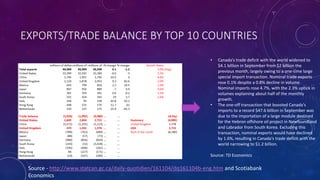
• Canada’s trade deficit with the world widened to
$4.1 billion in September from $2 billion the
previous month, largely owing to a one-time large
special import transaction. Nominal trade exports
rose 0.1% despite a 0.8% decline in volume.
Nominal imports rose 4.7%, with the 2.3% uptick in
volumes explaining about half of the monthly
growth.
• The one-off transaction that boosted Canada's
imports to a record $47.6 billion in September was
due to the importation of a large module destined
for the Hebron offshore oil project in Newfoundland
and Labrador from South Korea. Excluding this
transaction, nominal exports would have declined
by 1.6%, resulting in Canada's trade deficit with the
world narrowing to $1.2 billion.
Source: TD Economics
EXPORTS ANALYSIS – SECTOR / PROVINCE/COUNTRY
http://www.edc.ca/EN/Knowledge-Centre/Economic-Analysis-and-Research/Documents/export-
performance-monitor.pdf
EXPORTS ANALYSIS – SECTOR / PROVINCE/COUNTRY
http://www.edc.ca/EN/Knowledge-Centre/Economic-Analysis-and-Research/Documents/export-
performance-monitor.pdf
KEY QUOTES
• Canada's merchandise trade deficit ballooned to a record $4.1 billion in September, thanks to one large shipment of
equipment destined for an oil field off the coast of Newfoundland. While the country's exports edged up 0.1 per cent
from August to hit $43.5 billion in September, overall imports rose 4.7 per cent to a record $47.6 billion during the
month. "The one-off transaction that boosted Canada's imports to a record $47.6 billion in September was due to the
importation of a large module destined for the Hebron offshore oil project in Newfoundland and Labrador from South
Korea," TD Bank economist Fotios Raptis said. Excluding this transaction, Canada's total imports would have declined by
1.6 per cent, resulting in Canada's trade deficit narrowing to $1.2 billion. Source: - CBC -
http://www.cbc.ca/news/business/trade-gap-import-exports-1.3836545
• Why is this happening? While economic theory says a rising tide of international trade eventually lifts all boats, it also
brings disruptive change that can leave some feeling as if they’re been left to drown. In the U.S., for example, an
estimated five million U.S. factory jobs disappeared over the past 15 years, with many of them moving to China and
Mexico. In exchange, U.S. consumers enjoyed heaping shelves of cheap, foreign-made goods at their local Wal-Mart
store—a gain, to be sure, but one that likely comes as small consolation if you’ve been handed a pink slip. If all that
weren’t enough, today’s trade deals are more complicated—and controversial—than ever, reaching far behind borders to
deal with issues of regulatory and legal harmonization. There’s also growing disagreement about how much more benefit
they will actually yield. Yet, despite the challenges, turning our back on global trade seems a recipe for ruin. Consumers
are rarely willing to pay more than necessary, and isolationism, even if it were economically desirable, is unrealistic in an
era when a growing number of firms like Netflix and Amazon offer products and services via the borderless Internet.
“There’s a whole frontier of 21st-century trade issues that are going to have to be discussed, debated and negotiated,”
says Lee Branstetter, an economics professor at Pittsburgh’s Carnegie Mellon University. “Otherwise we could face first-
order losses relative to a world where we continue to move forward.”Source – Mcleans -
http://www.macleans.ca/economy/why-looming-trade-troubles-are-bad-news-for-canada/
Q&A
• Paul_Young_CGA@Hotmail.com

Merchandise Trade – Canada – September 2016

  • 1.
    MERCHANDISE TRADE – CANADA– SEPTEMBER 2016 BY: PAUL YOUNG, CPA, CGA NOVEMBER 4, 2016
  • 2.
    AGENDA • Summary • Exportsby Sector • Exports by Country • Exports by province and industry • Key comments
  • 3.
    SUMMARY • Canada's importsrose 4.7% to a record $47.6 billion in September, as an exceptionally large transaction accounted for the increase. Import prices increased 2.4% and volumes were up 2.3%. • Exports edged up 0.1% to $43.5 billion, as a 0.9% increase in prices was mostly offset by a 0.8% decrease in volumes. Consequently, Canada's merchandise trade deficit with the world widened from $2.0 billion in August to a record $4.1 billion in September. Following a 4.7% decline in the second quarter, exports rose 5.0% to $130.3 billion in the third quarter, the strongest increase since the first quarter of 2014. • Imports increased 2.4% to $138.5 billion. Consequently, Canada's quarterly trade deficit with the world narrowed from a record $11.1 billion in the second quarter to $8.2 billion in the third quarter. Source - http://www.statcan.gc.ca/daily-quotidien/161104/dq161104b-eng.htm
  • 4.
    SUMMARY • Canada's importsrose 4.7% to a record $47.6 billion in September, as an exceptionally large transaction accounted for the increase. Import prices increased 2.4% and volumes were up 2.3%. Exports edged up 0.1% to $43.5 billion, as a 0.9% increase in prices was mostly offset by a 0.8% decrease in volumes. Consequently, Canada's merchandise trade deficit with the world widened from $2.0 billion in August to a record $4.1 billion in September. Following a 4.7% decline in the second quarter, exports rose 5.0% to $130.3 billion in the third quarter, the strongest increase since the first quarter of 2014. Imports increased 2.4% to $138.5 billion. Consequently, Canada's quarterly trade deficit with the world narrowed from a record $11.1 billion in the second quarter to $8.2 billion in the third quarter. • Total exports edged up 0.1% to $43.5 billion in September, with 6 of 11 sections recording gains. This was the fourth consecutive monthly increase. Higher exports of aircraft and other transportation equipment and parts, and energy products were partially offset by lower exports of metal and non-metallic mineral products. In September, exports excluding energy products were down 0.2%. Year over year, total exports decreased 1.2%. Following a large decline in August, exports of aircraft and other transportation equipment and parts contributed the most to the overall increase in September, up 10.7% to $2.0 billion. Exports of aircraft increased 13.9% to $709 million while aircraft engines and aircraft parts reached a record $1.0 billion on a 7.5% increase. In September, exports of energy products increased 1.8% to $6.3 billion, the seventh consecutive increase. Exports of crude oil and crude bitumen rose 2.5% to $4.1 billion on higher volumes. For the section as a whole, prices were up 1.7% while volumes were unchanged. Moderating these gains were lower exports of metal and non-metallic mineral products, down 3.7% to $4.8 billion. • After recording a 22.9% increase in July and a 12.4% increase in August, unwrought precious metals and precious metal alloys fell 5.4% to $1.7 billion in September. Also contributing to the decrease were lower exports of unwrought nickel and nickel alloys, down 22.9% to $259 million, mostly on fewer shipments of nickel to Norway. Overall, volumes decreased 4.2% and prices rose 0.6%. Source - http://www.statcan.gc.ca/daily-quotidien/161104/dq161104b-eng.htm
  • 5.
    EXPORTS BY MAJORSECTOR Source - http://www.statcan.gc.ca/daily-quotidien/161104/dq161104b-eng.htm
  • 6.
    EXPORTS/TRADE BALANCE BYTOP 10 COUNTRIES Source - http://www.statcan.gc.ca/daily-quotidien/161104/dq161104b-eng.htm and Scotiabank Economics • Canada’s trade deficit with the world widened to $4.1 billion in September from $2 billion the previous month, largely owing to a one-time large special import transaction. Nominal trade exports rose 0.1% despite a 0.8% decline in volume. Nominal imports rose 4.7%, with the 2.3% uptick in volumes explaining about half of the monthly growth. • The one-off transaction that boosted Canada's imports to a record $47.6 billion in September was due to the importation of a large module destined for the Hebron offshore oil project in Newfoundland and Labrador from South Korea. Excluding this transaction, nominal exports would have declined by 1.6%, resulting in Canada's trade deficit with the world narrowing to $1.2 billion. Source: TD Economics
  • 7.
    EXPORTS ANALYSIS –SECTOR / PROVINCE/COUNTRY http://www.edc.ca/EN/Knowledge-Centre/Economic-Analysis-and-Research/Documents/export- performance-monitor.pdf
  • 8.
    EXPORTS ANALYSIS –SECTOR / PROVINCE/COUNTRY http://www.edc.ca/EN/Knowledge-Centre/Economic-Analysis-and-Research/Documents/export- performance-monitor.pdf
  • 9.
    KEY QUOTES • Canada'smerchandise trade deficit ballooned to a record $4.1 billion in September, thanks to one large shipment of equipment destined for an oil field off the coast of Newfoundland. While the country's exports edged up 0.1 per cent from August to hit $43.5 billion in September, overall imports rose 4.7 per cent to a record $47.6 billion during the month. "The one-off transaction that boosted Canada's imports to a record $47.6 billion in September was due to the importation of a large module destined for the Hebron offshore oil project in Newfoundland and Labrador from South Korea," TD Bank economist Fotios Raptis said. Excluding this transaction, Canada's total imports would have declined by 1.6 per cent, resulting in Canada's trade deficit narrowing to $1.2 billion. Source: - CBC - http://www.cbc.ca/news/business/trade-gap-import-exports-1.3836545 • Why is this happening? While economic theory says a rising tide of international trade eventually lifts all boats, it also brings disruptive change that can leave some feeling as if they’re been left to drown. In the U.S., for example, an estimated five million U.S. factory jobs disappeared over the past 15 years, with many of them moving to China and Mexico. In exchange, U.S. consumers enjoyed heaping shelves of cheap, foreign-made goods at their local Wal-Mart store—a gain, to be sure, but one that likely comes as small consolation if you’ve been handed a pink slip. If all that weren’t enough, today’s trade deals are more complicated—and controversial—than ever, reaching far behind borders to deal with issues of regulatory and legal harmonization. There’s also growing disagreement about how much more benefit they will actually yield. Yet, despite the challenges, turning our back on global trade seems a recipe for ruin. Consumers are rarely willing to pay more than necessary, and isolationism, even if it were economically desirable, is unrealistic in an era when a growing number of firms like Netflix and Amazon offer products and services via the borderless Internet. “There’s a whole frontier of 21st-century trade issues that are going to have to be discussed, debated and negotiated,” says Lee Branstetter, an economics professor at Pittsburgh’s Carnegie Mellon University. “Otherwise we could face first- order losses relative to a world where we continue to move forward.”Source – Mcleans - http://www.macleans.ca/economy/why-looming-trade-troubles-are-bad-news-for-canada/
  • 10.