Mental Workload Alerts
Reliable Brain Measurements
of HCI using fNIRS
Max L. Wilson
@gingdottwit
Dr Max L. Wilson http://cs.nott.ac.uk/~pszmw
2
Dr Max L. Wilson http://cs.nott.ac.uk/~pszmw
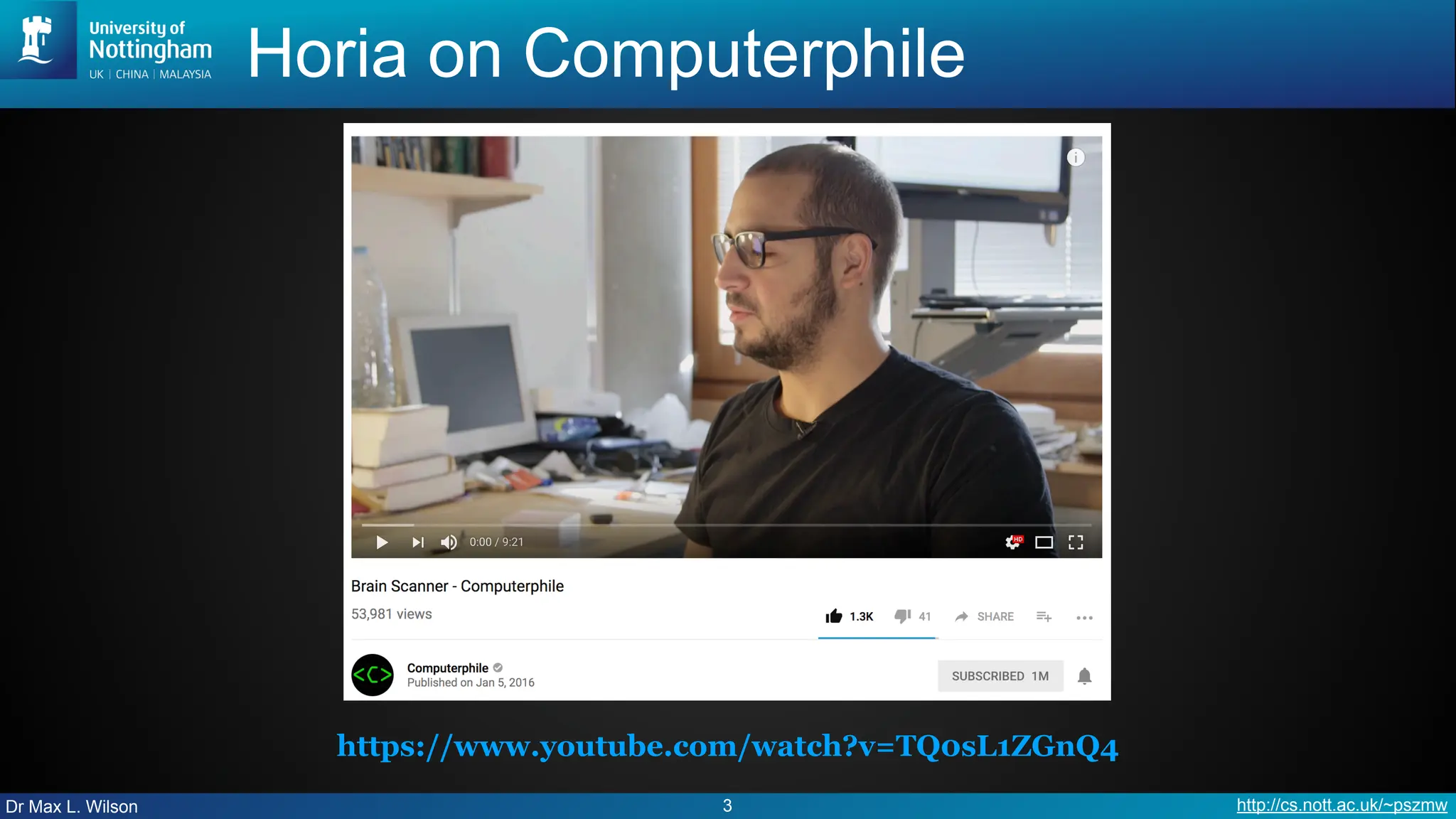
Horia on Computerphile
3
https://www.youtube.com/watch?v=TQ0sL1ZGnQ4
Dr Max L. Wilson http://cs.nott.ac.uk/~pszmw
To-Say List
• Context
• Workload Alerts
• Future Directions
4
Context
Dr Max L. Wilson http://cs.nott.ac.uk/~pszmw
6
Dr Max L. Wilson http://cs.nott.ac.uk/~pszmw
7
Dr Max L. Wilson http://cs.nott.ac.uk/~pszmw
User Interfaces
8
Great Complexity
and Confusion
With Great Power
Comes
Dr Max L. Wilson http://cs.nott.ac.uk/~pszmw
9
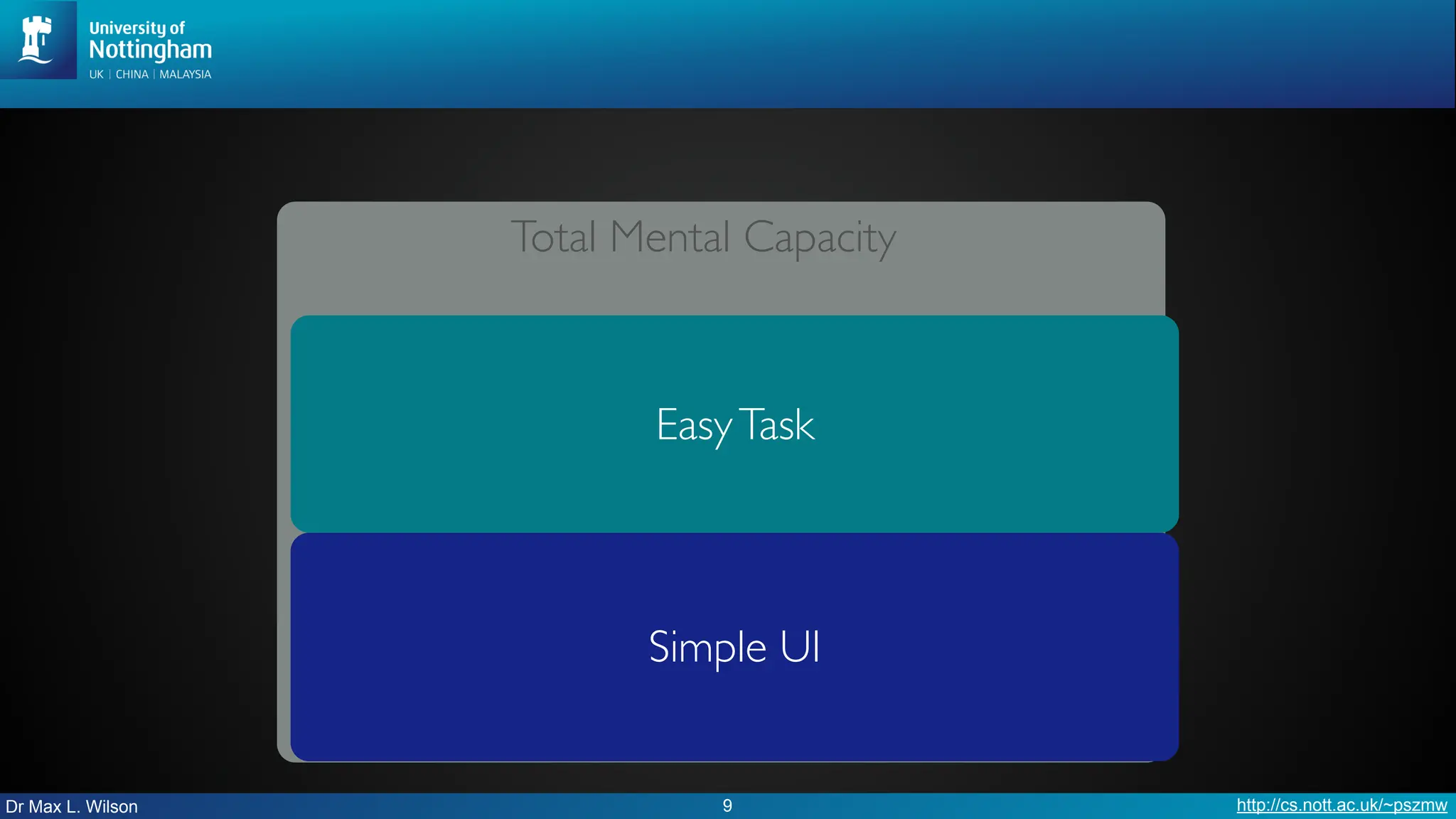
Total Mental Capacity
Simple UI
EasyTask
Dr Max L. Wilson http://cs.nott.ac.uk/~pszmw
10
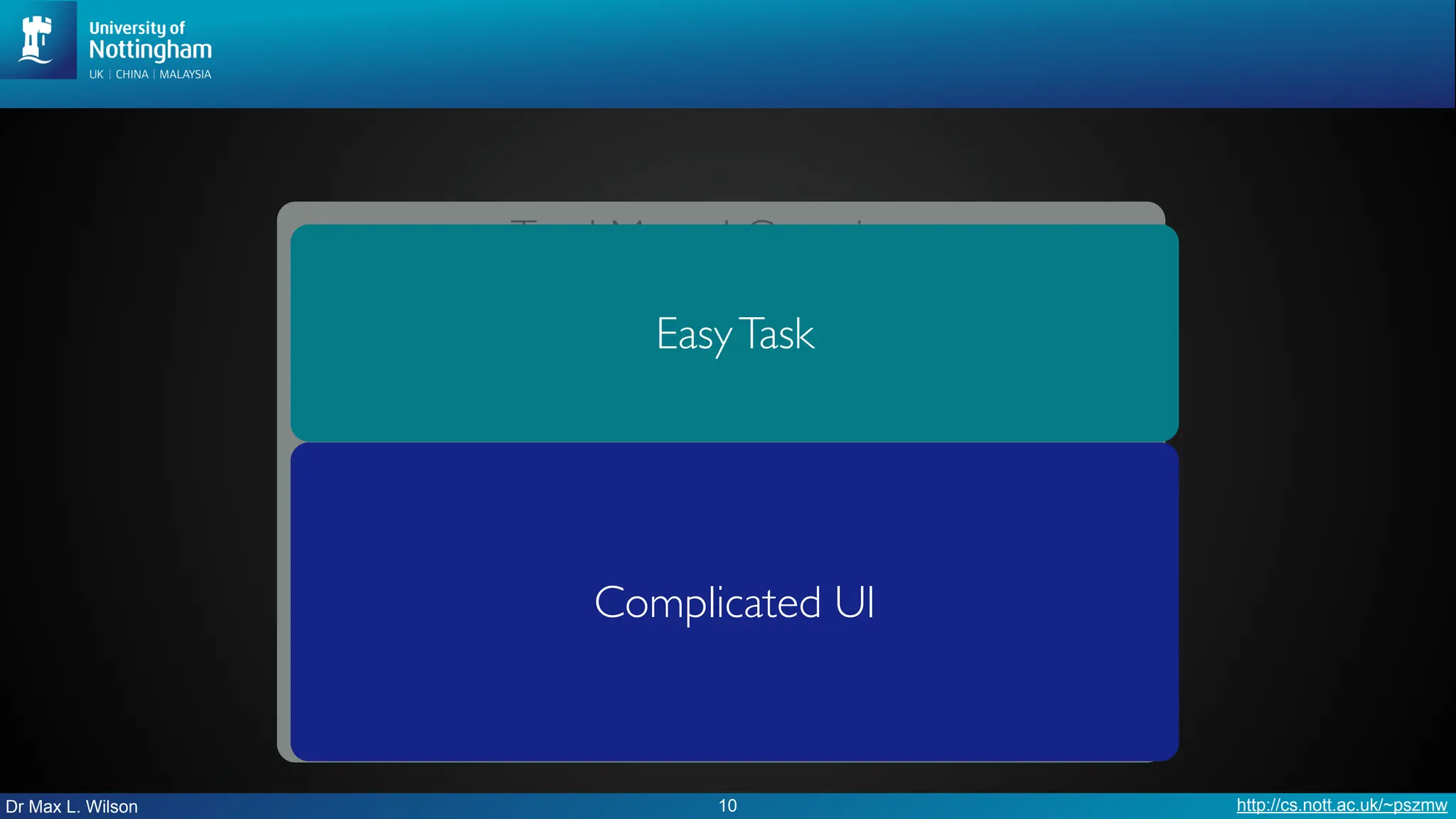
Total Mental Capacity
Complicated UI
EasyTask
Dr Max L. Wilson http://cs.nott.ac.uk/~pszmw
11
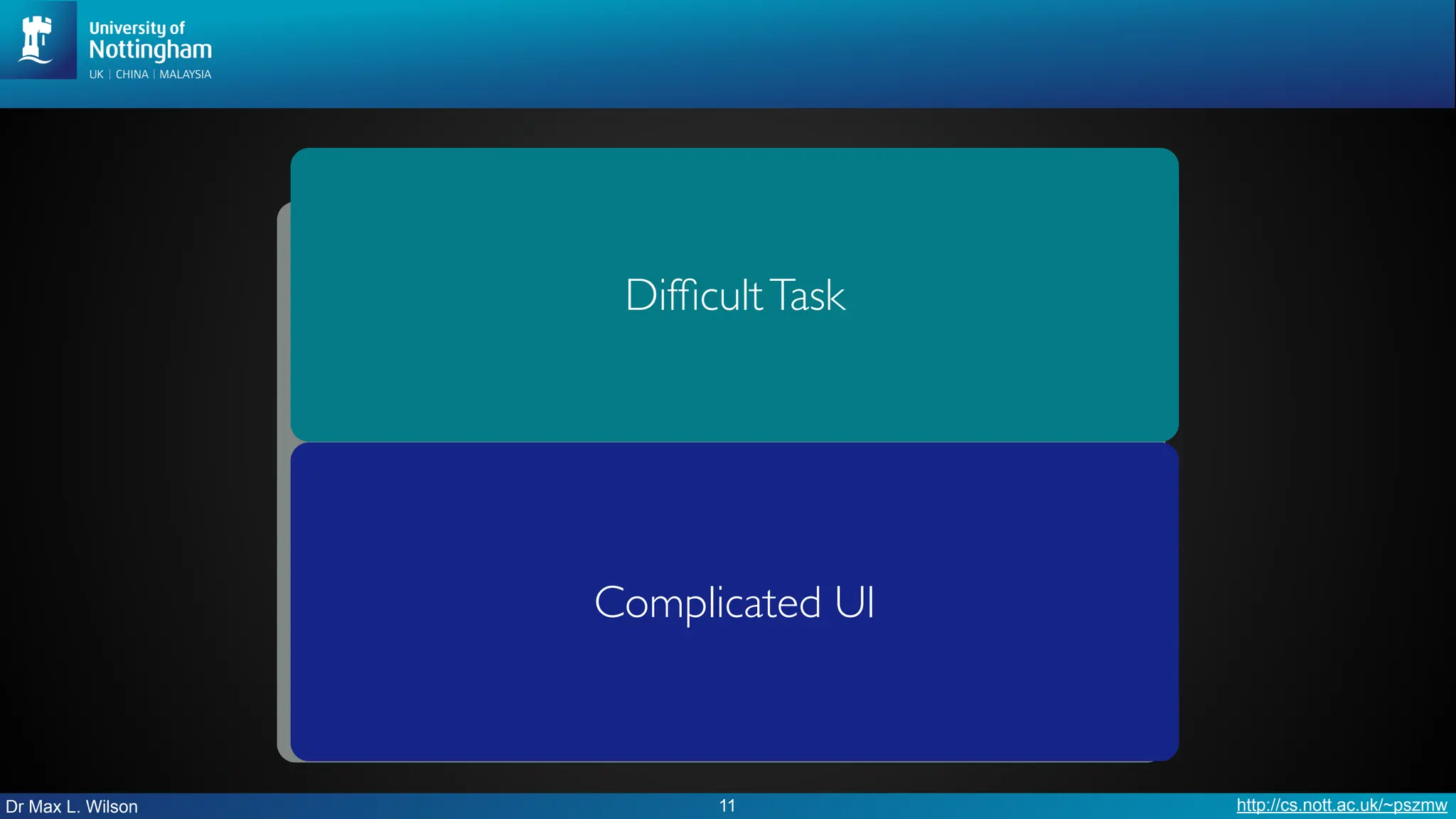
Total Mental Capacity
Complicated UI
DifficultTask
Dr Max L. Wilson http://cs.nott.ac.uk/~pszmw
12
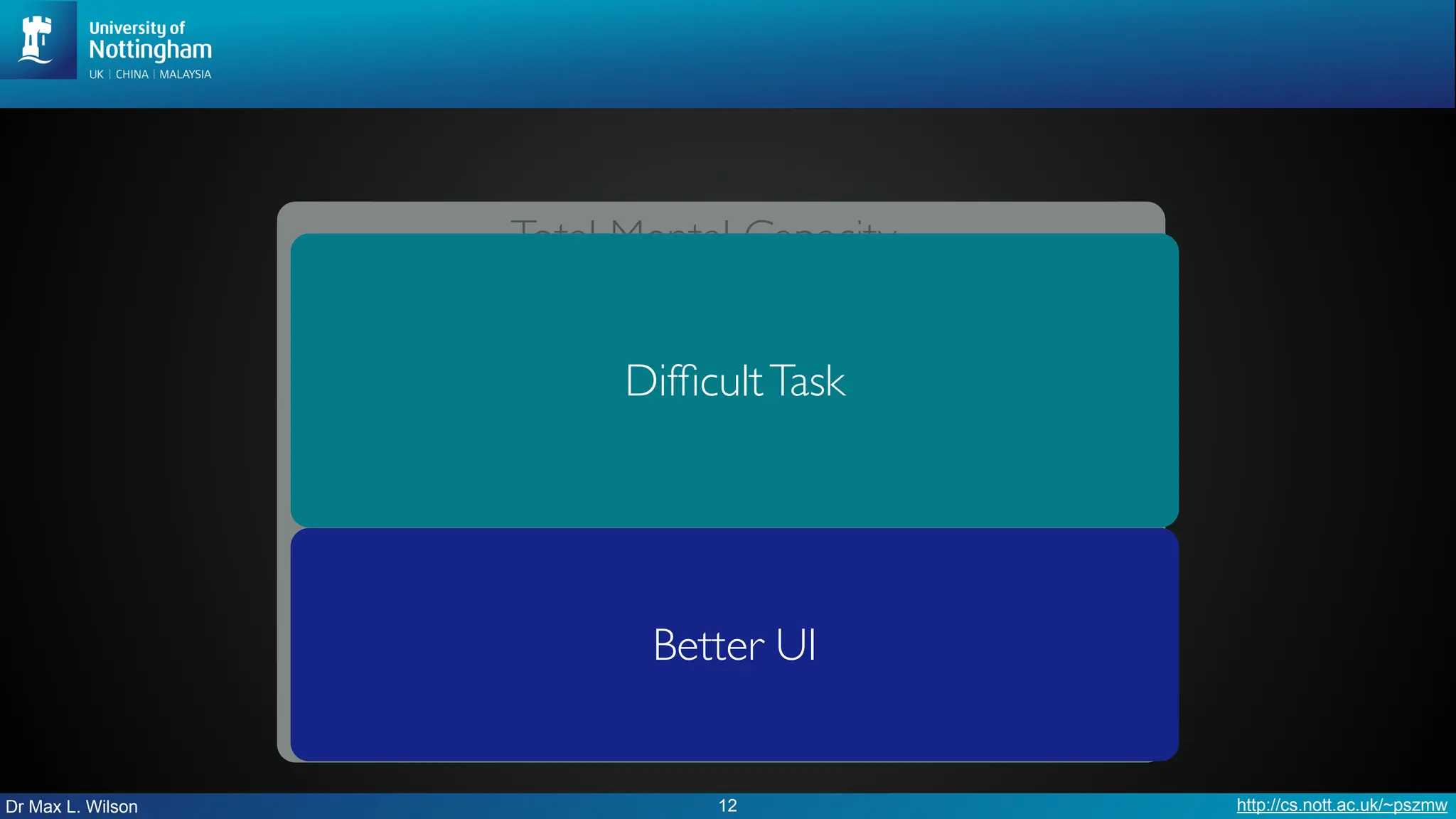
Total Mental Capacity
Better UI
DifficultTask
Dr Max L. Wilson http://cs.nott.ac.uk/~pszmw
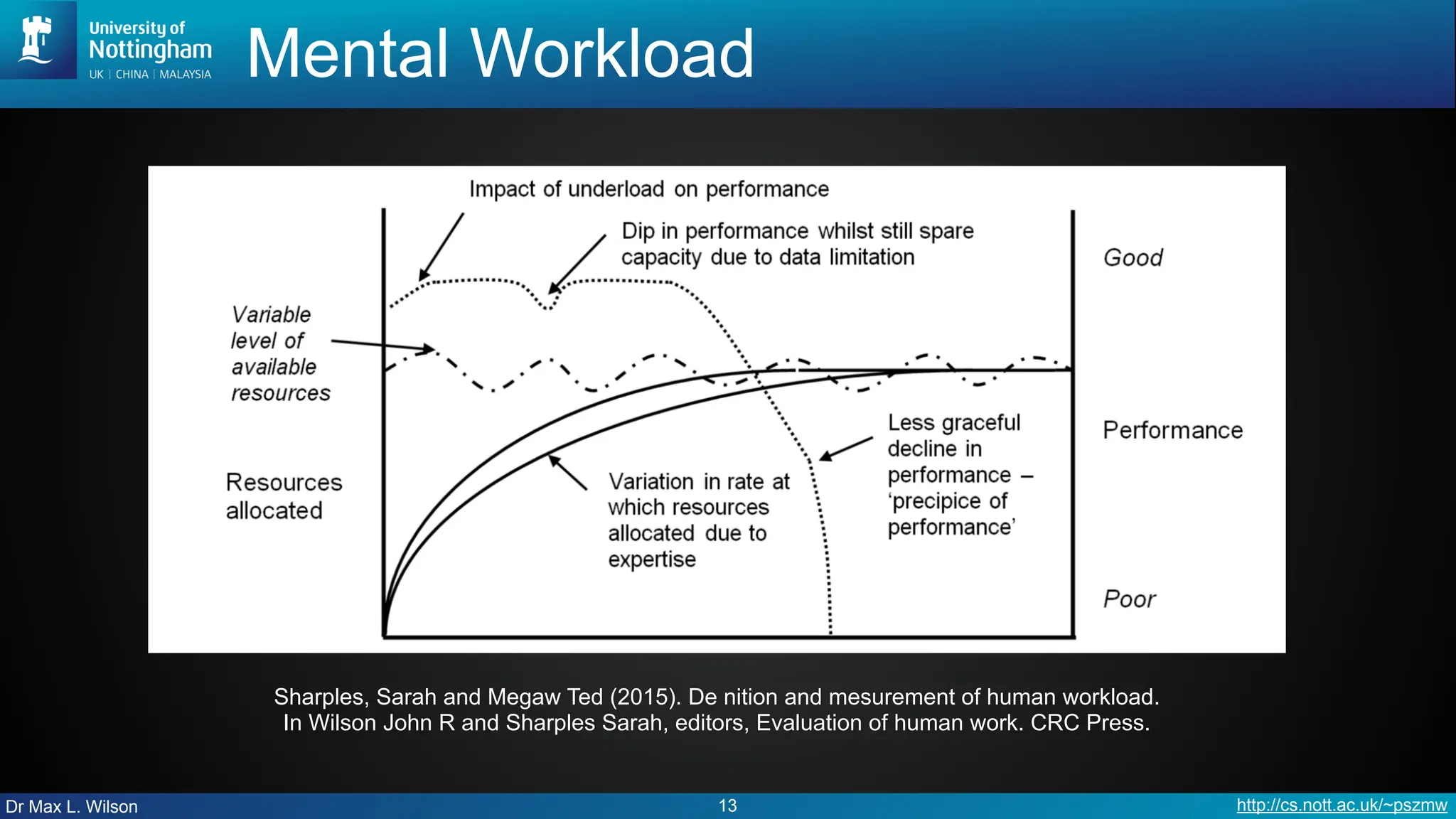
Mental Workload
13
Sharples, Sarah and Megaw Ted (2015). De nition and mesurement of human workload.
In Wilson John R and Sharples Sarah, editors, Evaluation of human work. CRC Press.
Dr Max L. Wilson http://cs.nott.ac.uk/~pszmw
Most important criteria for us
• We can run a ‘normal’ user study.
• As much ecological validity in
- the environment they do the study
- natural user behaviour in the study
- as normal/natural a task as possible
• And tell if theres a cognitive difference between UIs or Tasks
14
Dr Max L. Wilson http://cs.nott.ac.uk/~pszmw
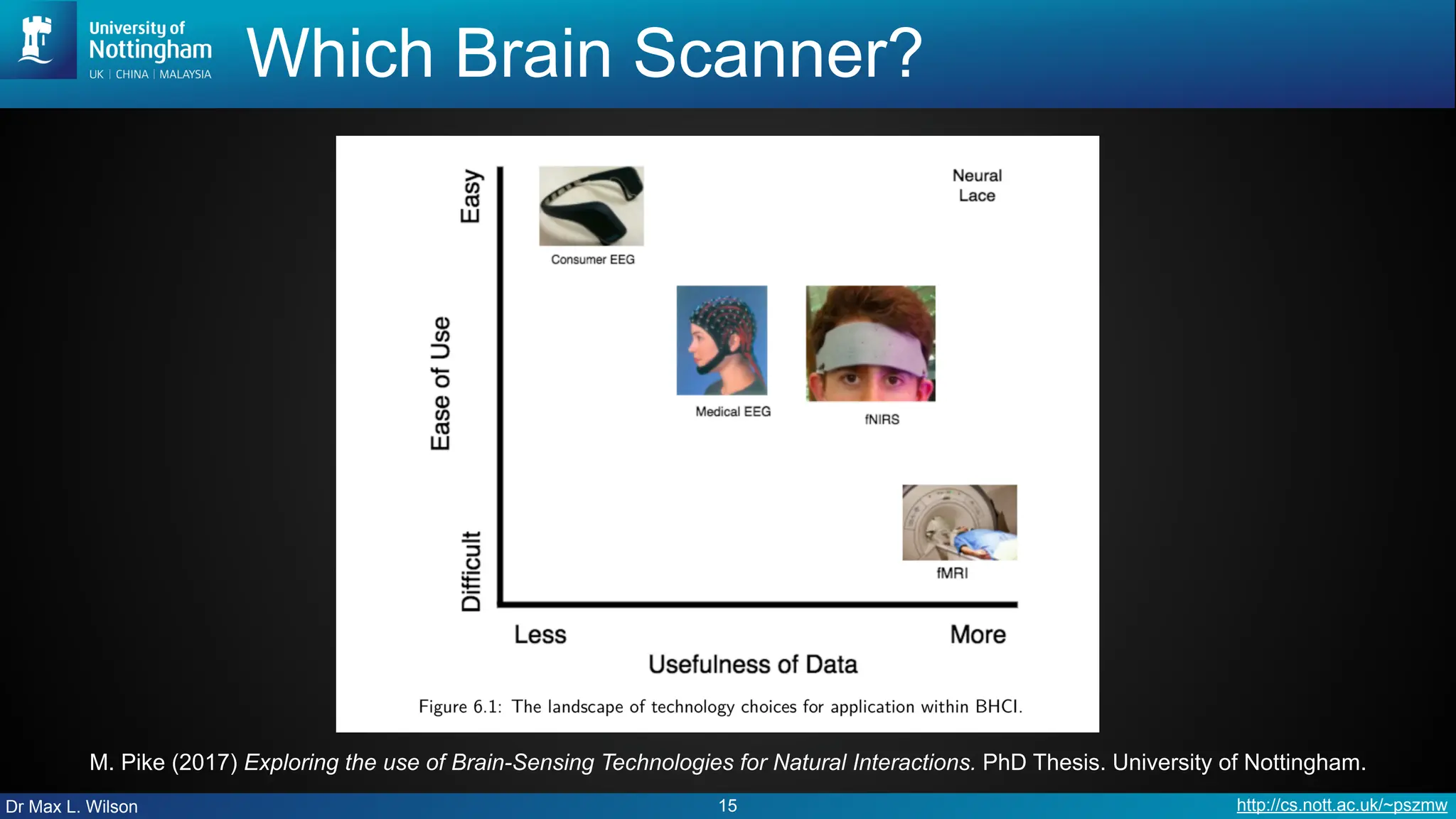
Which Brain Scanner?
15
M. Pike (2017) Exploring the use of Brain-Sensing Technologies for Natural Interactions. PhD Thesis. University of Nottingham.
Dr Max L. Wilson http://cs.nott.ac.uk/~pszmw
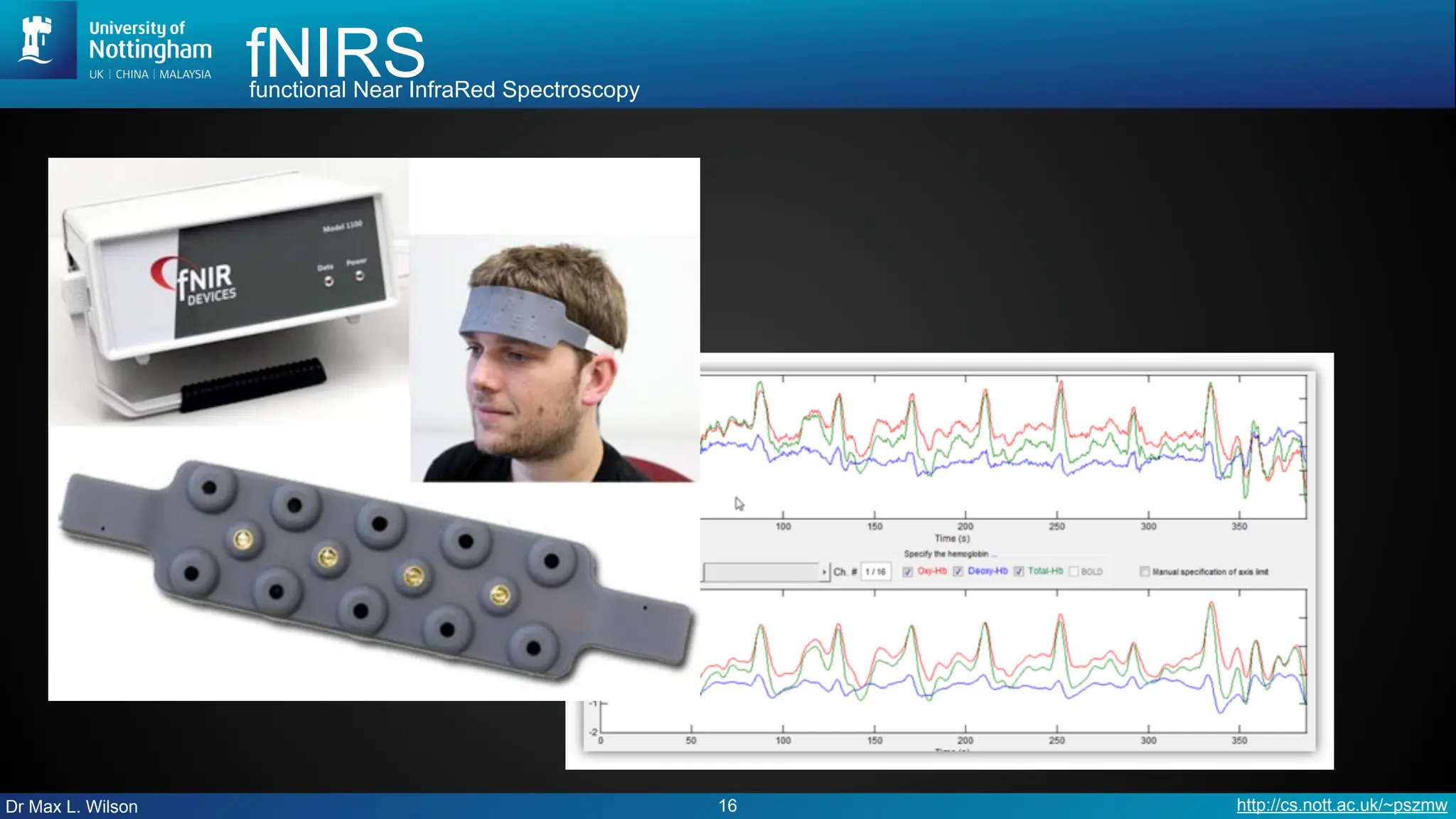
fNIRS
16
functional Near InfraRed Spectroscopy
Dr Max L. Wilson http://cs.nott.ac.uk/~pszmw
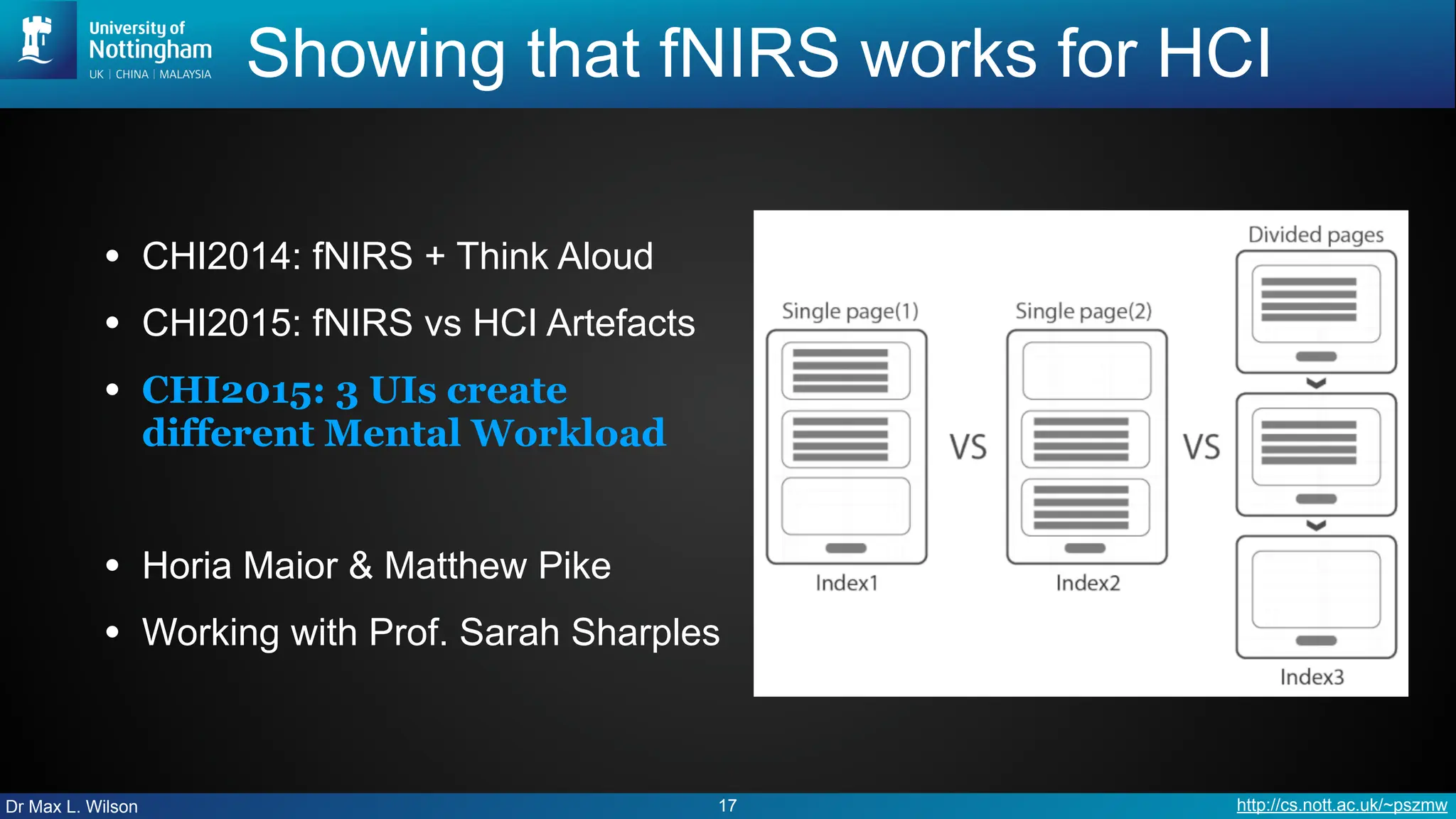
Showing that fNIRS works for HCI
• CHI2014: fNIRS + Think Aloud
• CHI2015: fNIRS vs HCI Artefacts
• CHI2015: 3 UIs create
different Mental Workload
• Horia Maior & Matthew Pike
• Working with Prof. Sarah Sharples
17
Workload Alerts
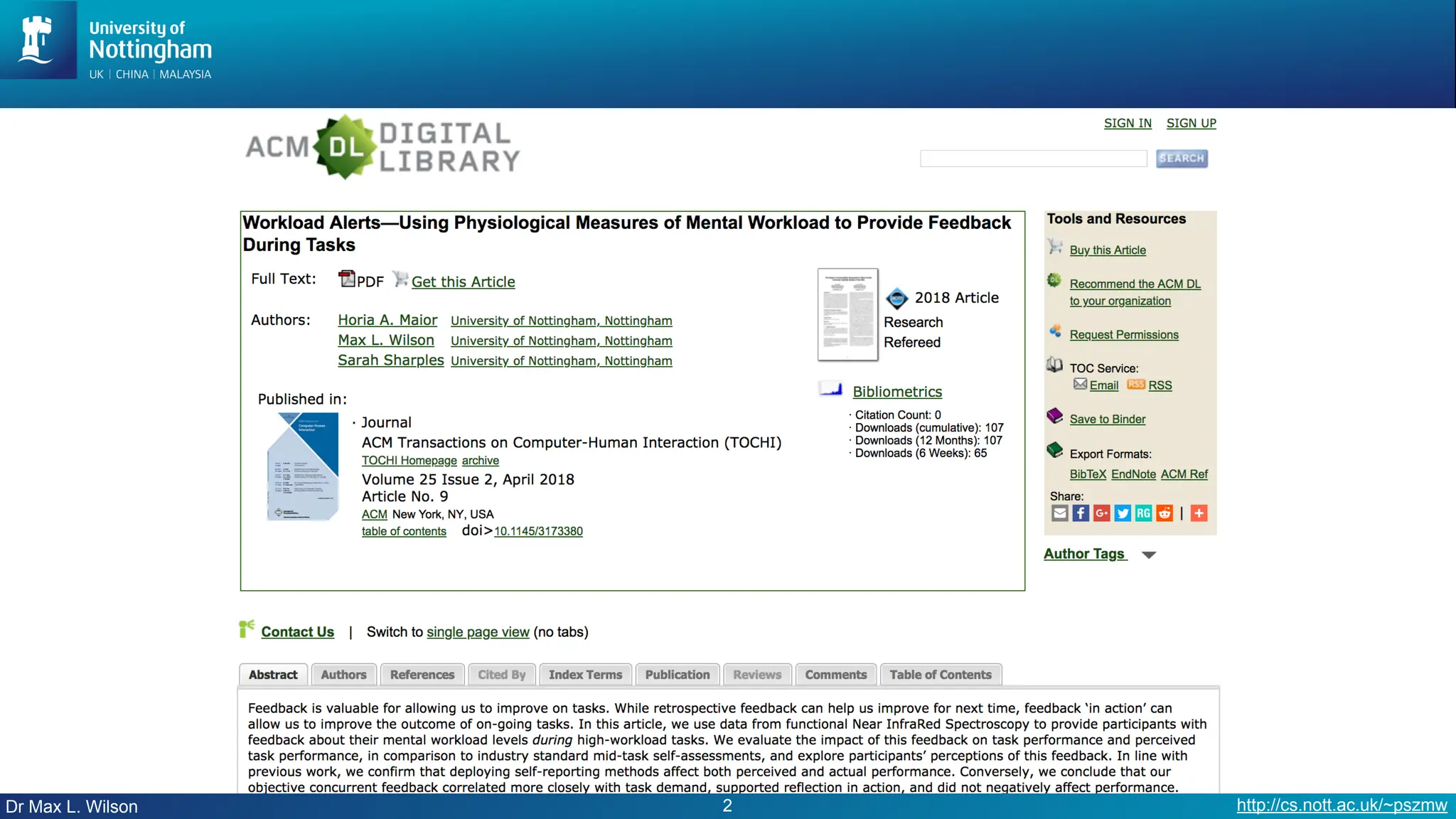
ToCHI Article
Presented at CHI2018
Dr Max L. Wilson http://cs.nott.ac.uk/~pszmw
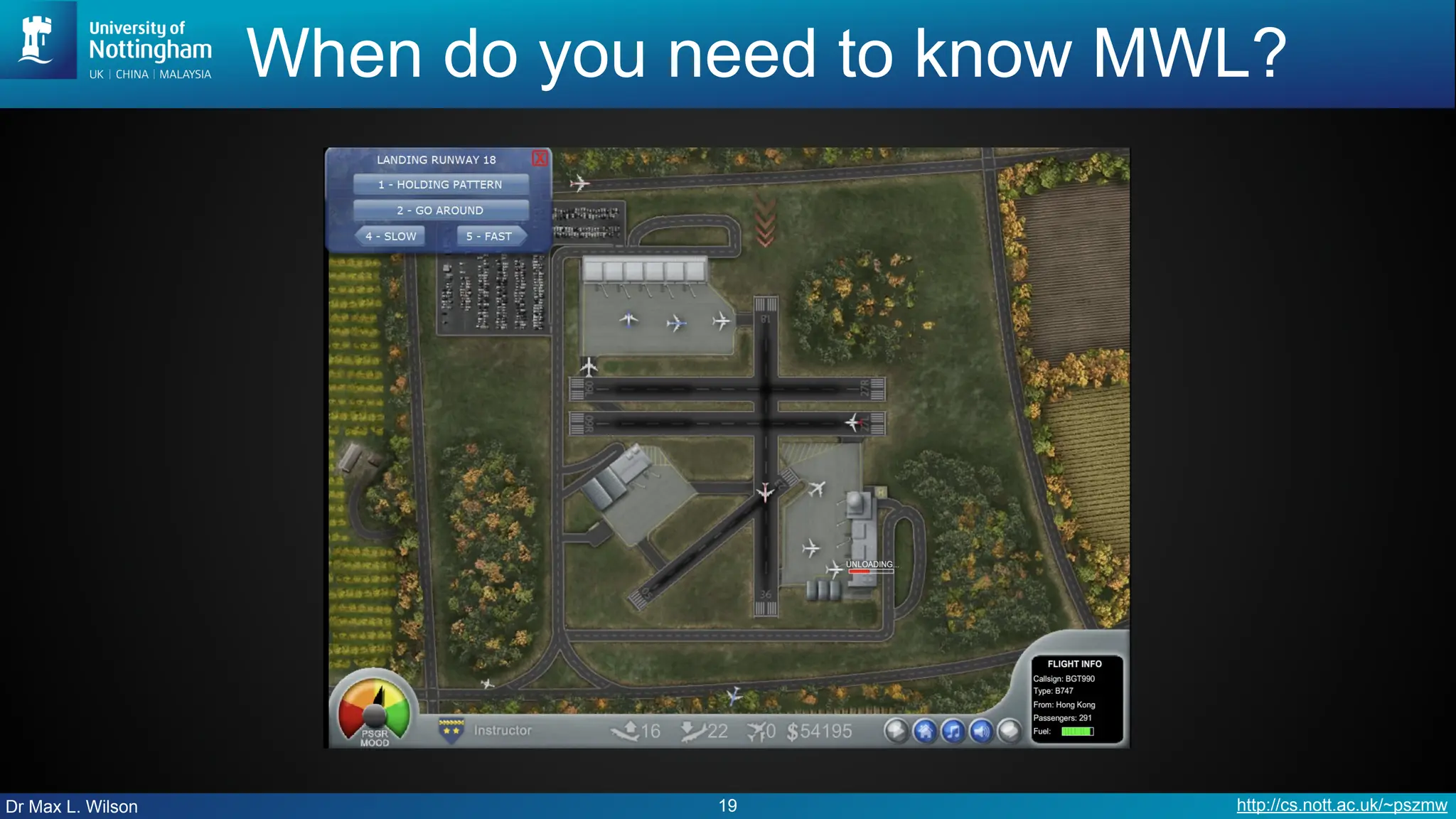
When do you need to know MWL?
19
Dr Max L. Wilson http://cs.nott.ac.uk/~pszmw
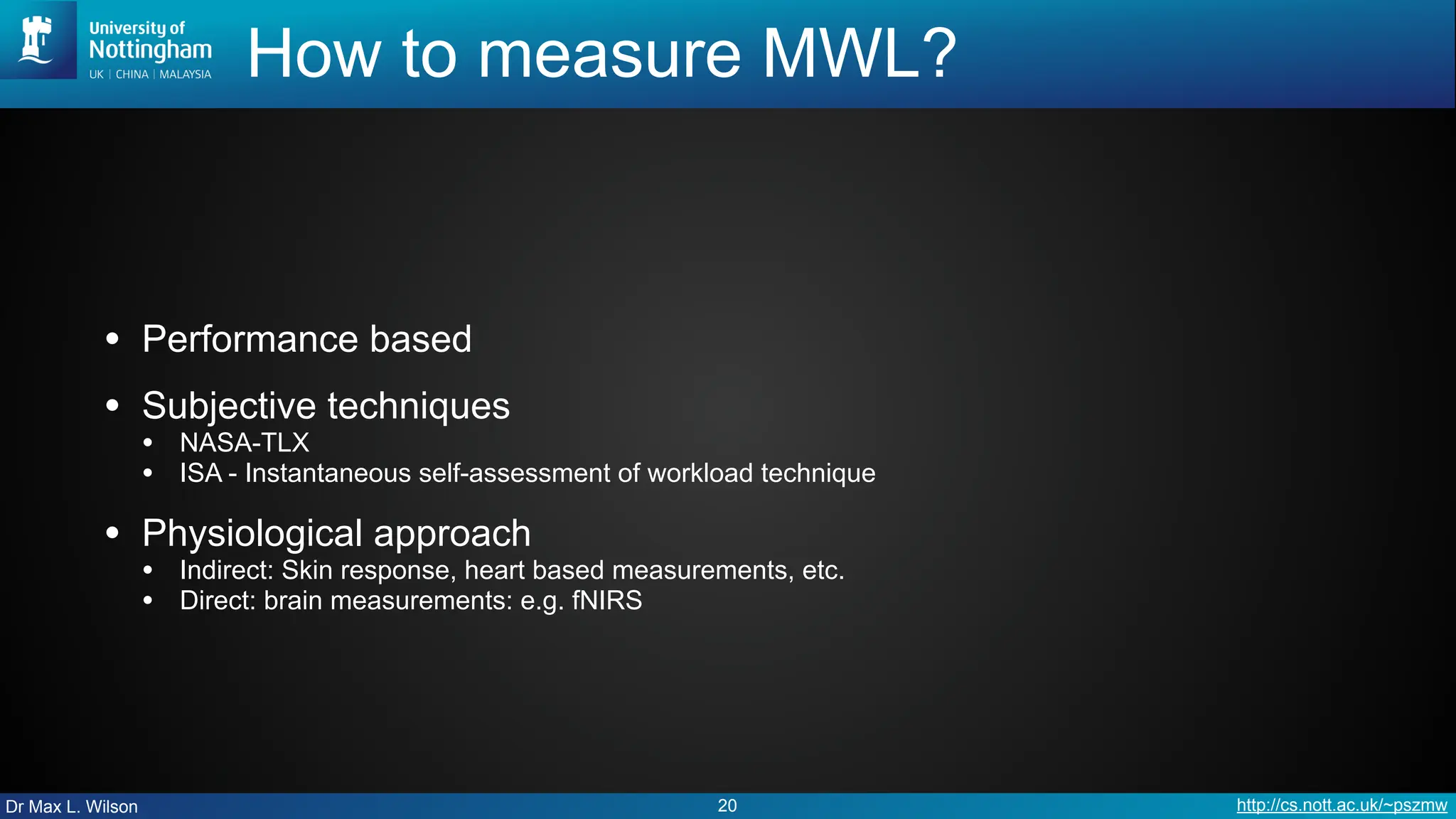
How to measure MWL?
• Performance based
• Subjective techniques
• NASA-TLX
• ISA - Instantaneous self-assessment of workload technique
• Physiological approach
• Indirect: Skin response, heart based measurements, etc.
• Direct: brain measurements: e.g. fNIRS
20
Dr Max L. Wilson http://cs.nott.ac.uk/~pszmw
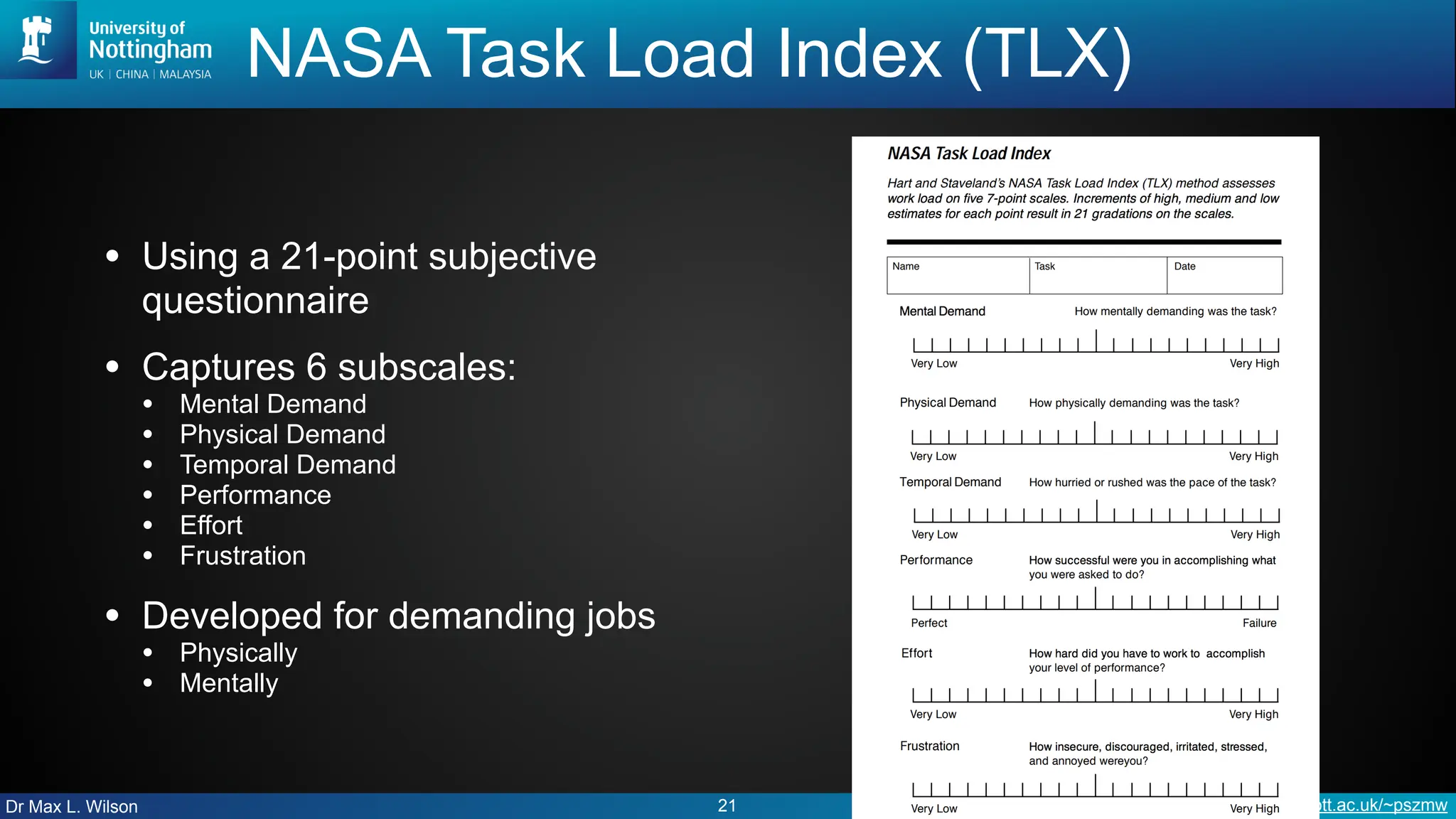
NASA Task Load Index (TLX)
• Using a 21-point subjective
questionnaire
• Captures 6 subscales:
• Mental Demand
• Physical Demand
• Temporal Demand
• Performance
• Effort
• Frustration
• Developed for demanding jobs
• Physically
• Mentally
21
Dr Max L. Wilson http://cs.nott.ac.uk/~pszmw
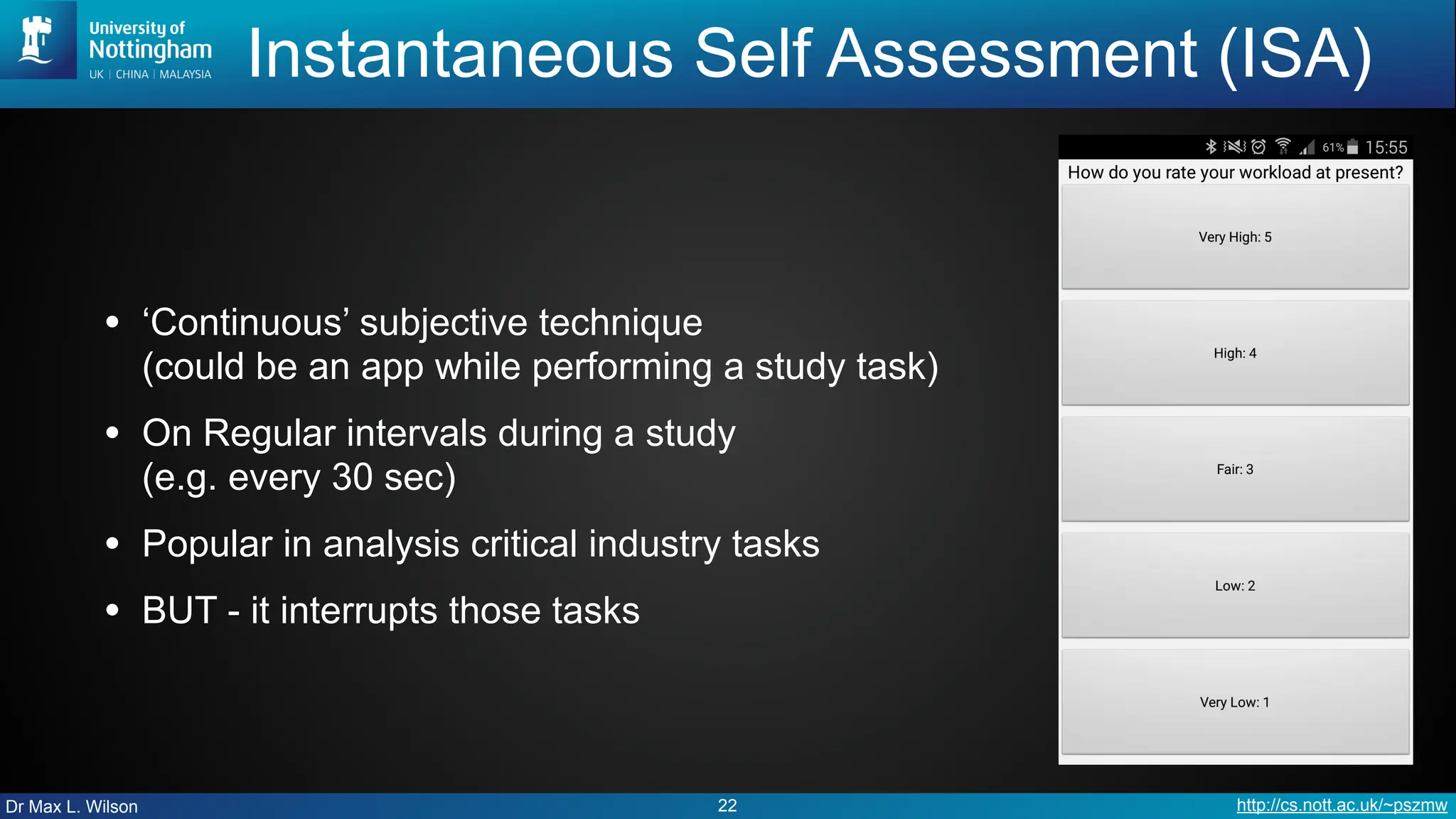
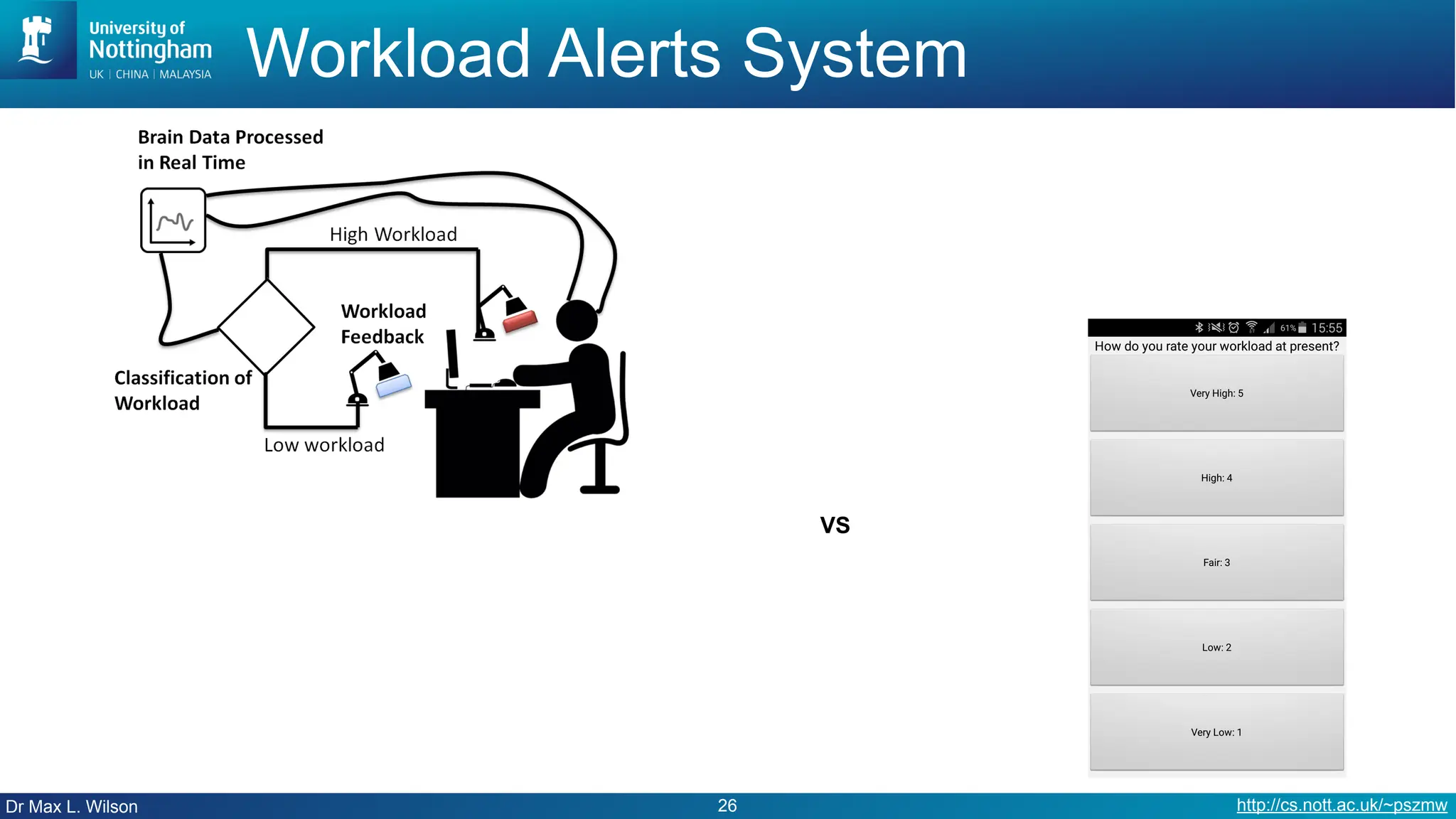
Instantaneous Self Assessment (ISA)
• ‘Continuous’ subjective technique
(could be an app while performing a study task)
• On Regular intervals during a study
(e.g. every 30 sec)
• Popular in analysis critical industry tasks
• BUT - it interrupts those tasks
22
Dr Max L. Wilson http://cs.nott.ac.uk/~pszmw
Workload Alerts: Aim
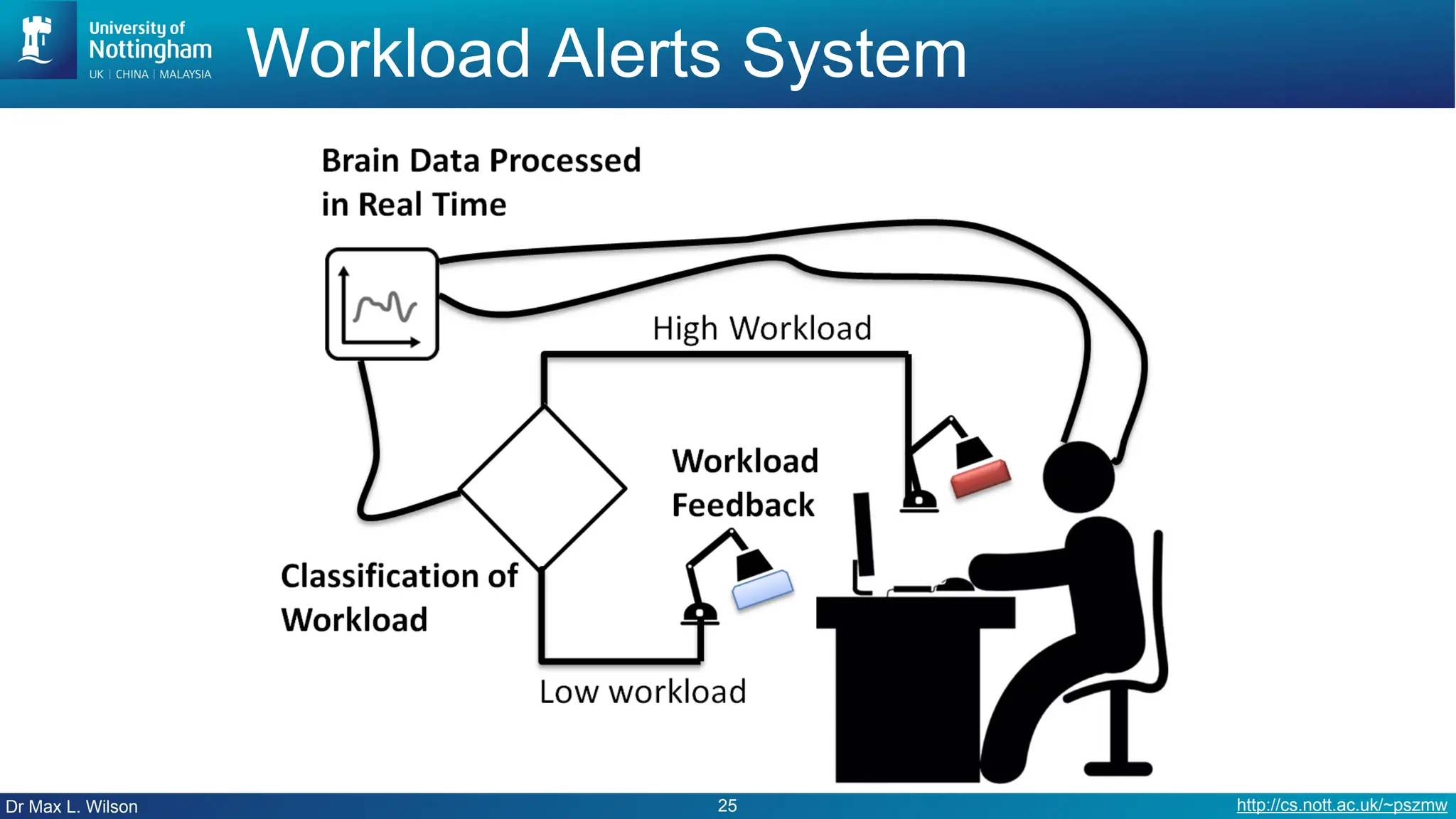
• What if we provide feedback of workload to people during tasks?
• Assess workload objectively using fNIRS
• Help people manage their workload during tasks
• Facilitate a form of Reflection-in-Action during tasks
(similar effect as ISA?)
23
Dr Max L. Wilson http://cs.nott.ac.uk/~pszmw
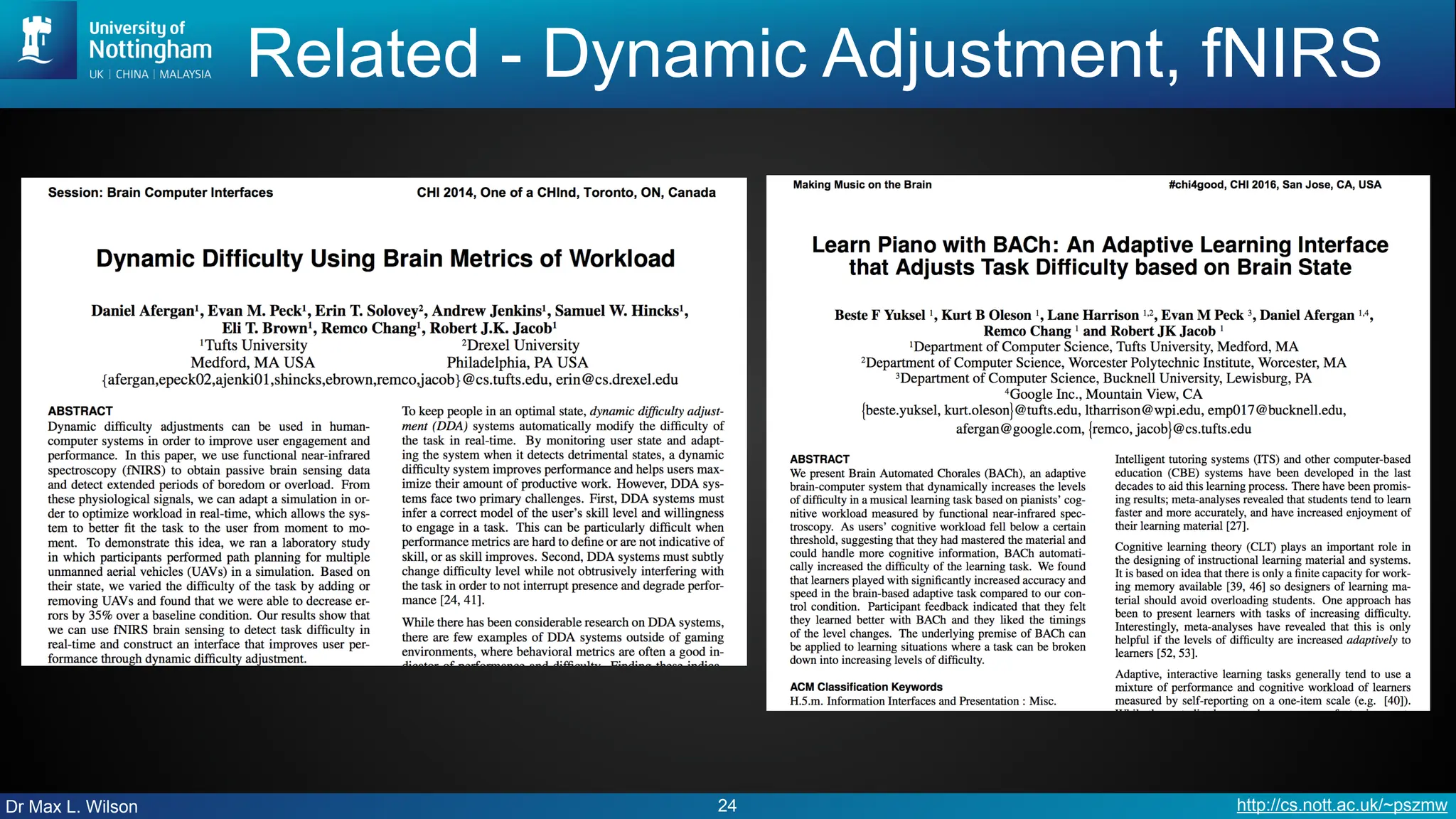
Related - Dynamic Adjustment, fNIRS
24
Dr Max L. Wilson http://cs.nott.ac.uk/~pszmw
Workload Alerts System
25
Dr Max L. Wilson http://cs.nott.ac.uk/~pszmw
Workload Alerts System
26
VS
Dr Max L. Wilson http://cs.nott.ac.uk/~pszmw
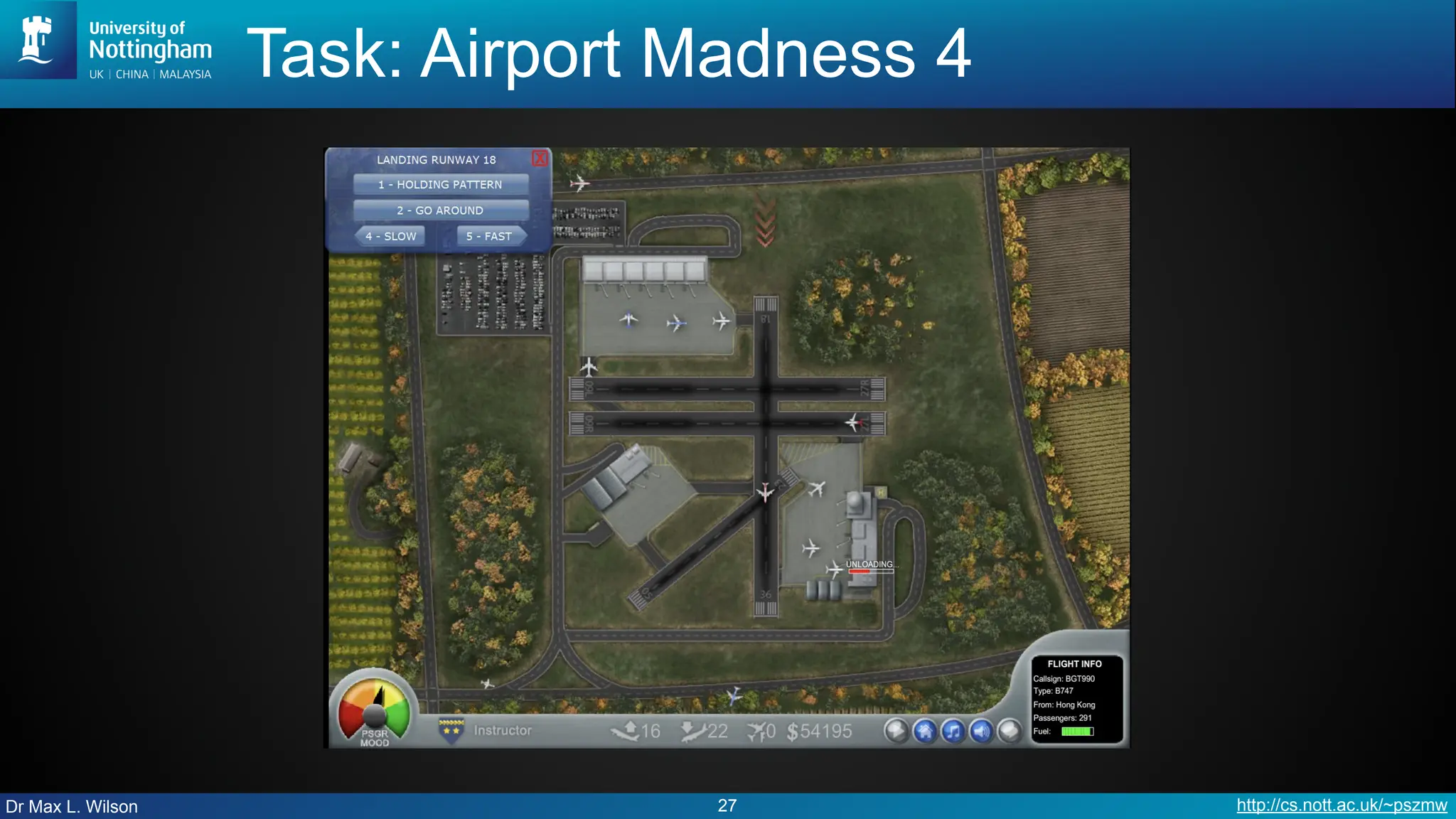
Task: Airport Madness 4
27
Dr Max L. Wilson http://cs.nott.ac.uk/~pszmw
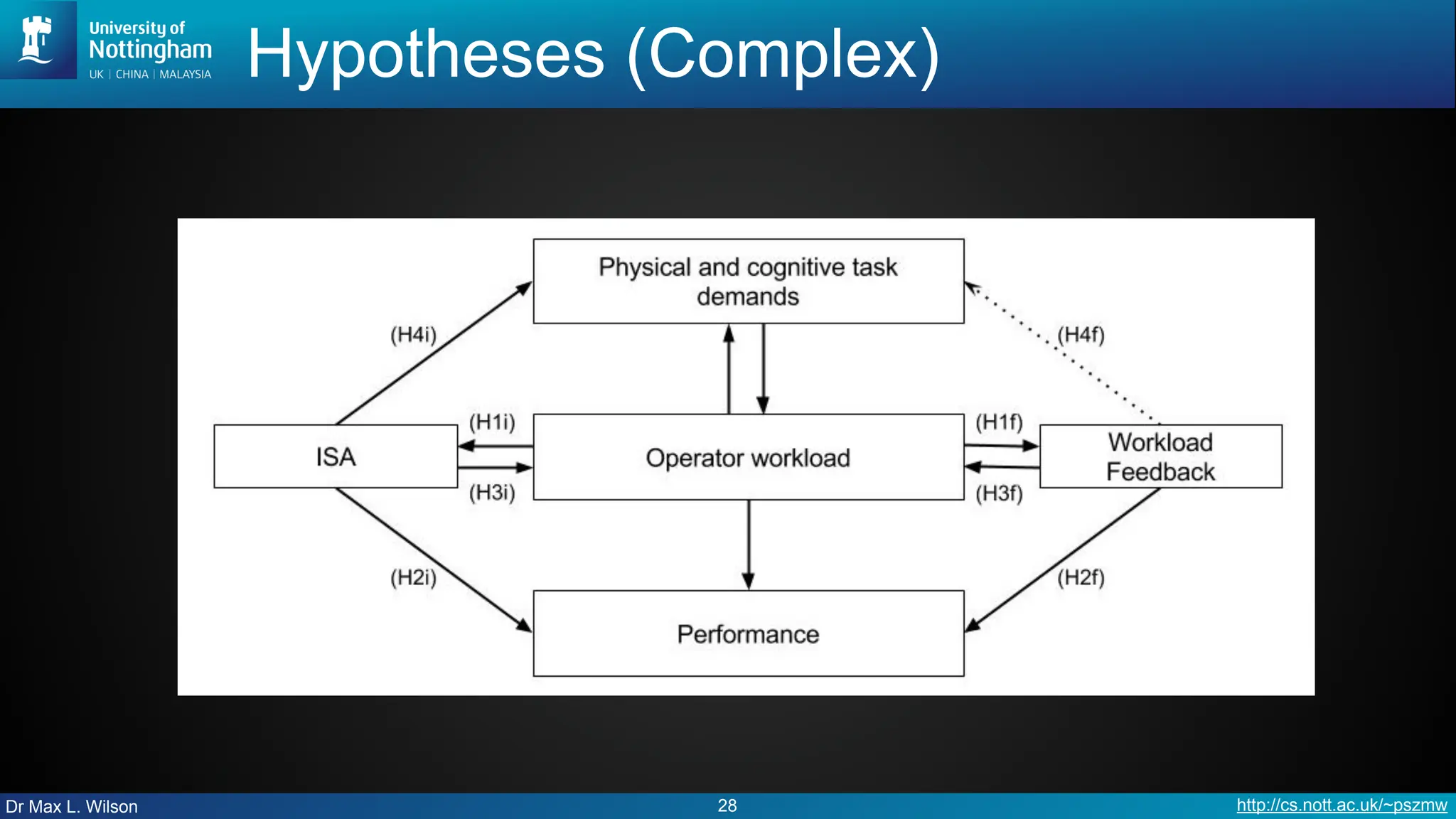
Hypotheses (Complex)
28
Dr Max L. Wilson http://cs.nott.ac.uk/~pszmw
Hypotheses Simplified
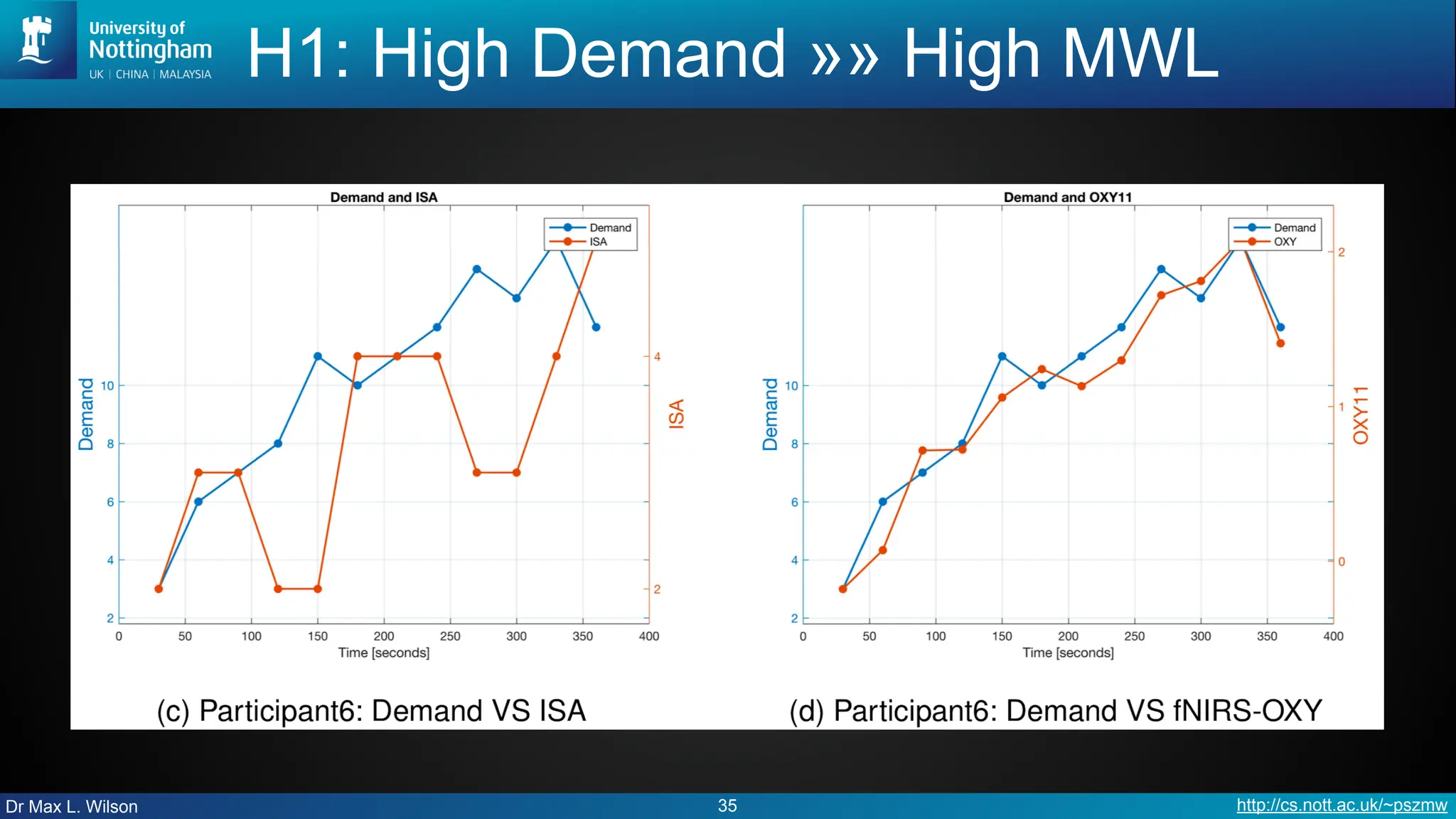
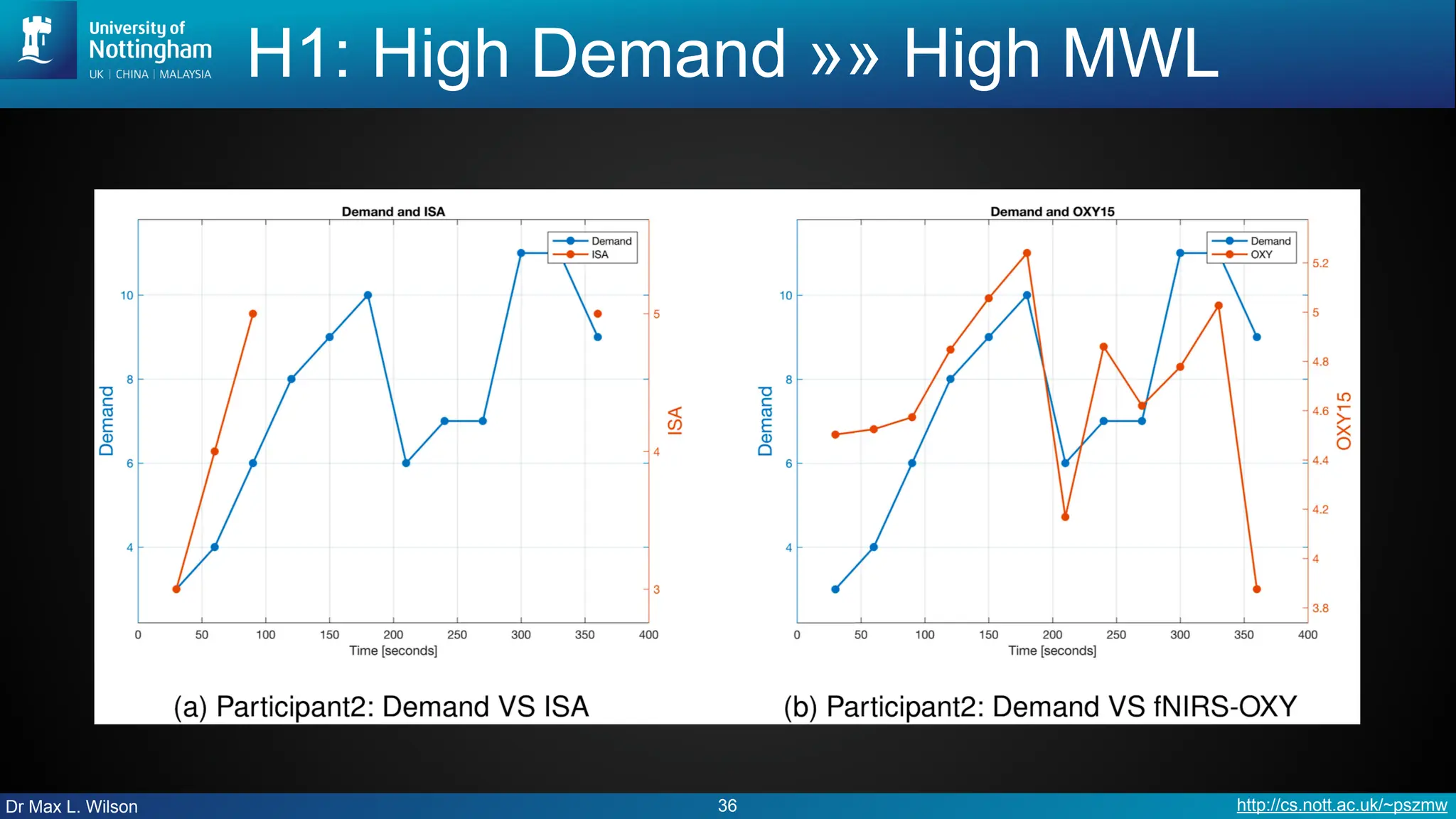
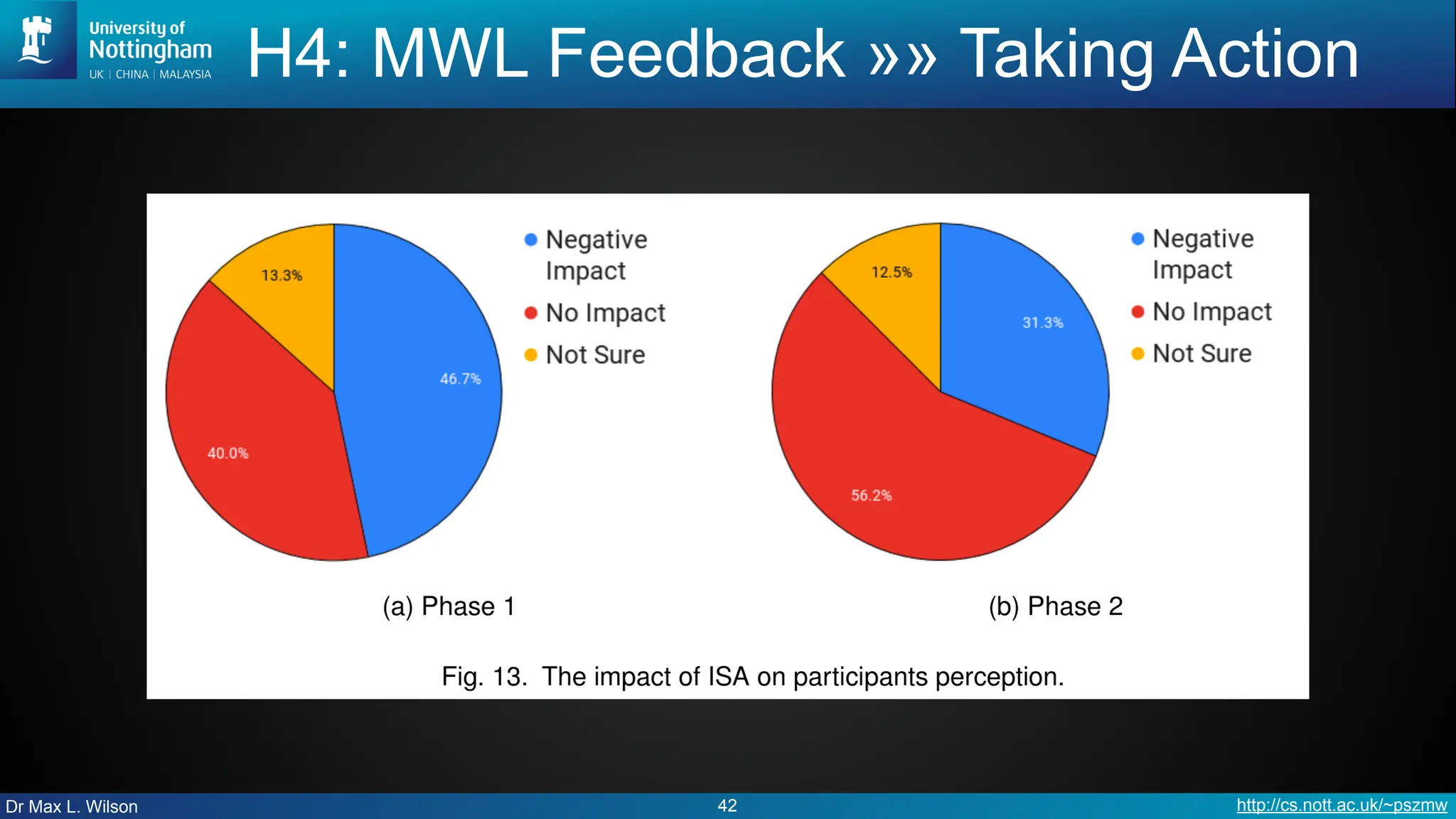
• H1: High Demand »» High MWL
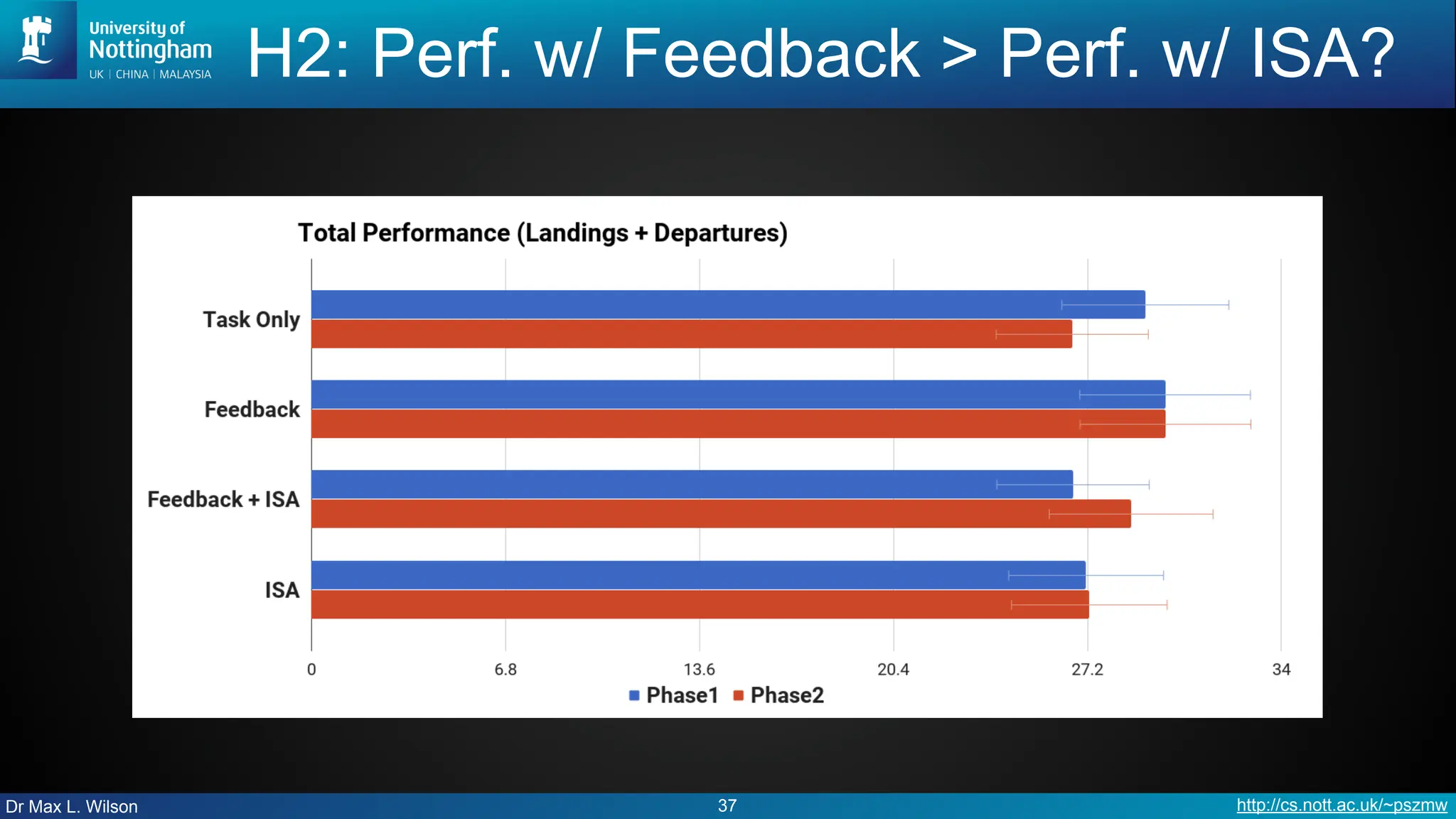
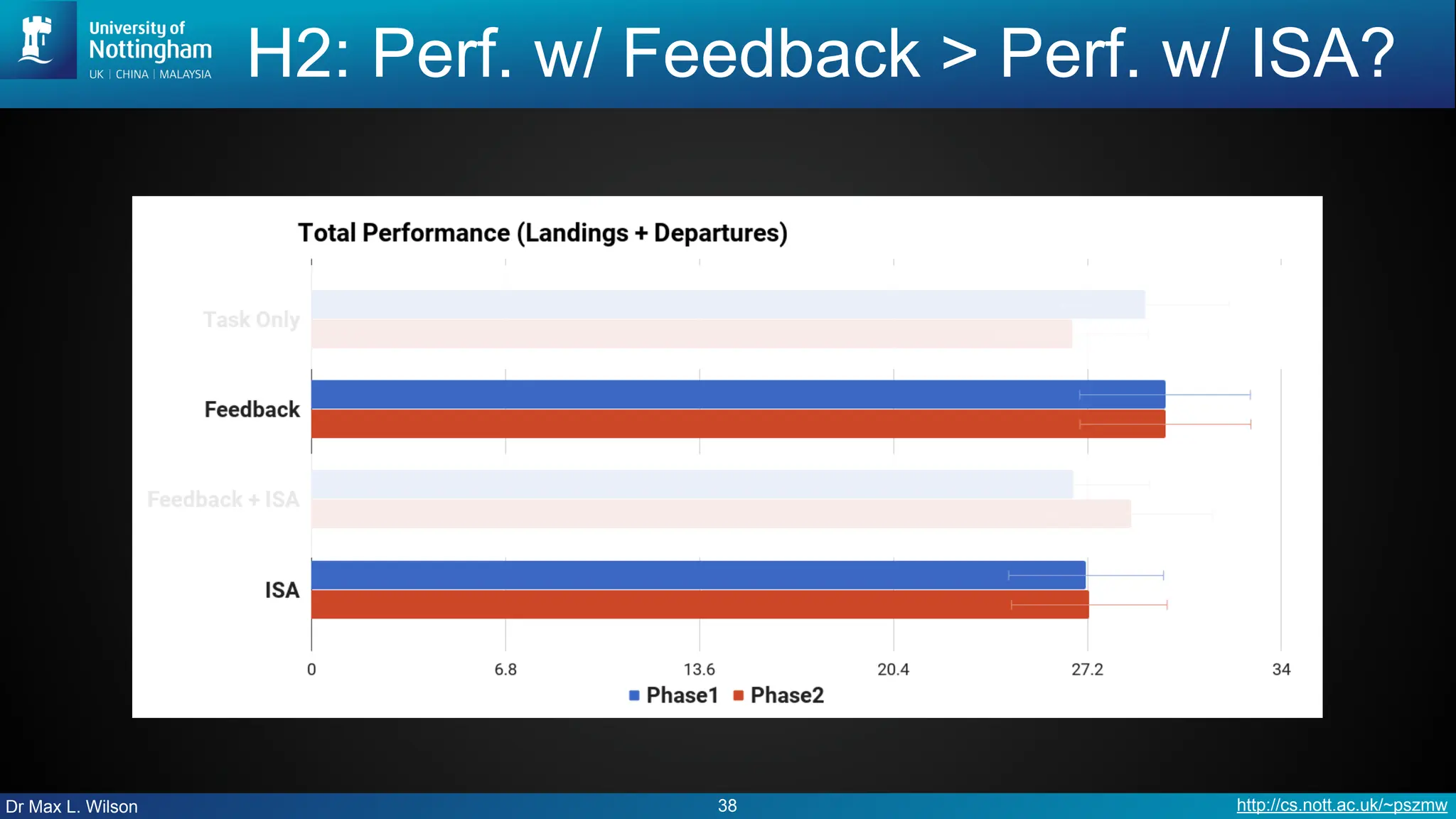
• H2: Performance w/ Feedback > Performance w/ ISA?
• H3: Perception of [H2]
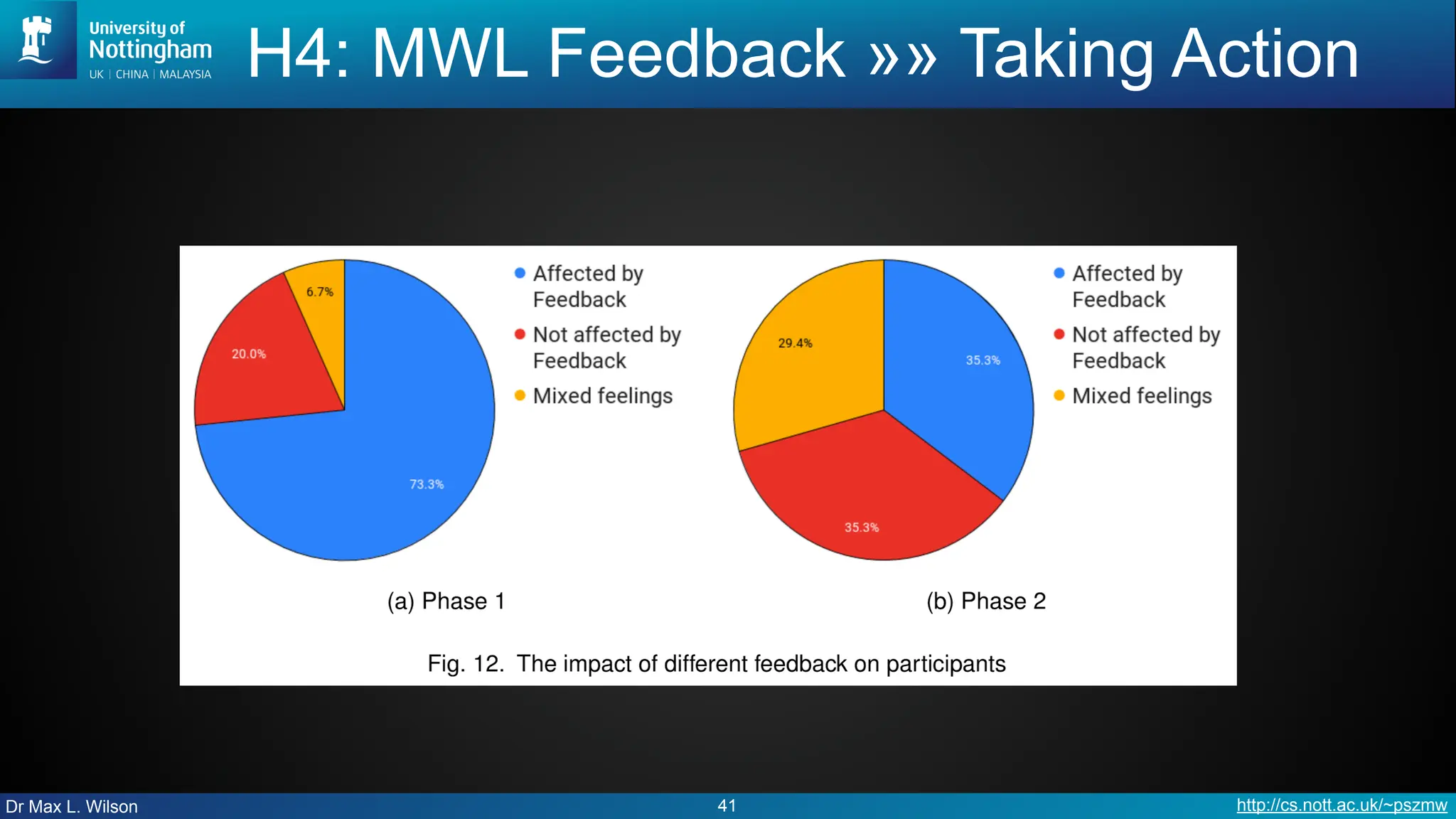
• H4: MWL Feedback »» Taking Action
29
Dr Max L. Wilson http://cs.nott.ac.uk/~pszmw
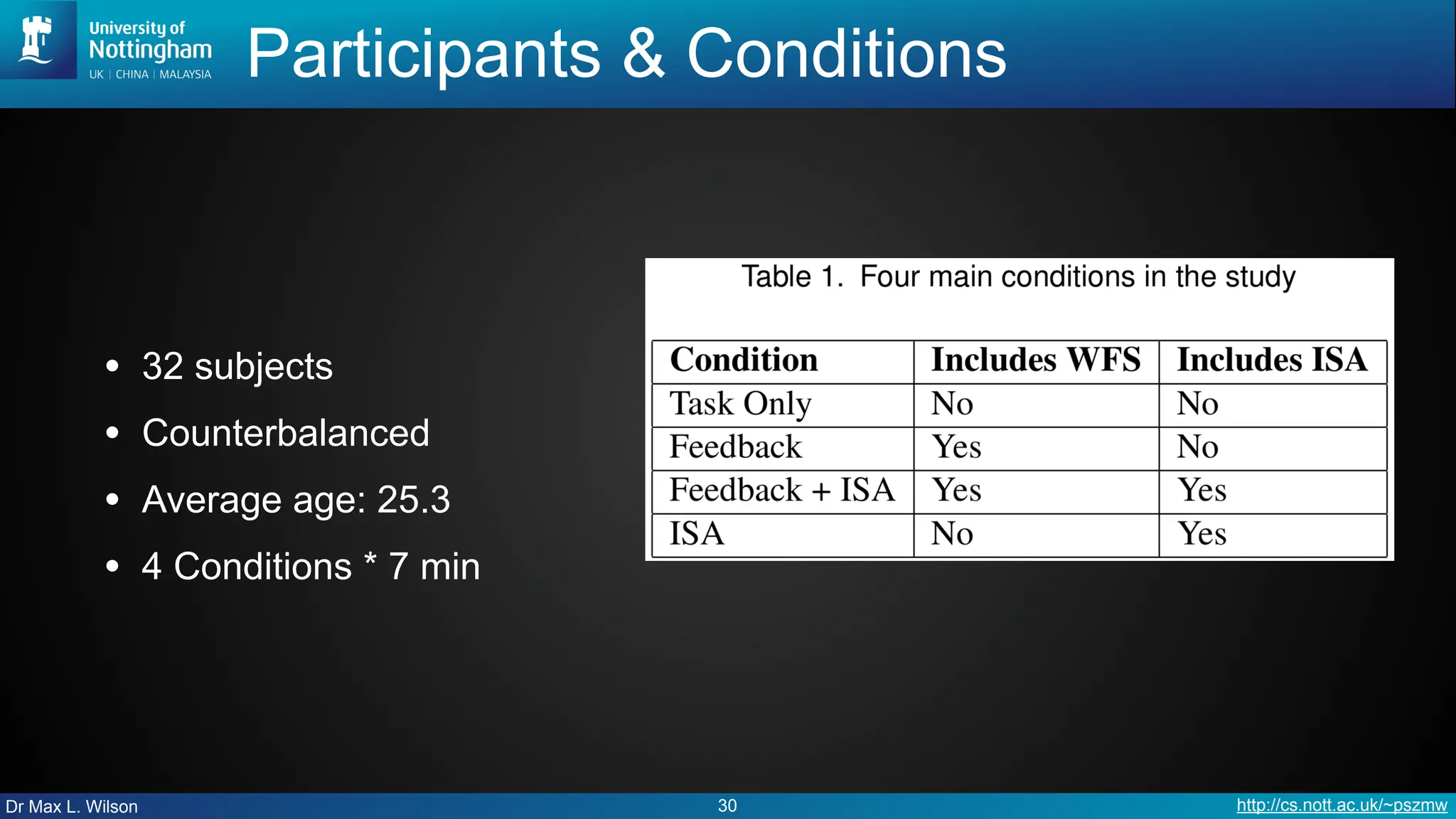
Participants & Conditions
• 32 subjects
• Counterbalanced
• Average age: 25.3
• 4 Conditions * 7 min
30
Dr Max L. Wilson http://cs.nott.ac.uk/~pszmw
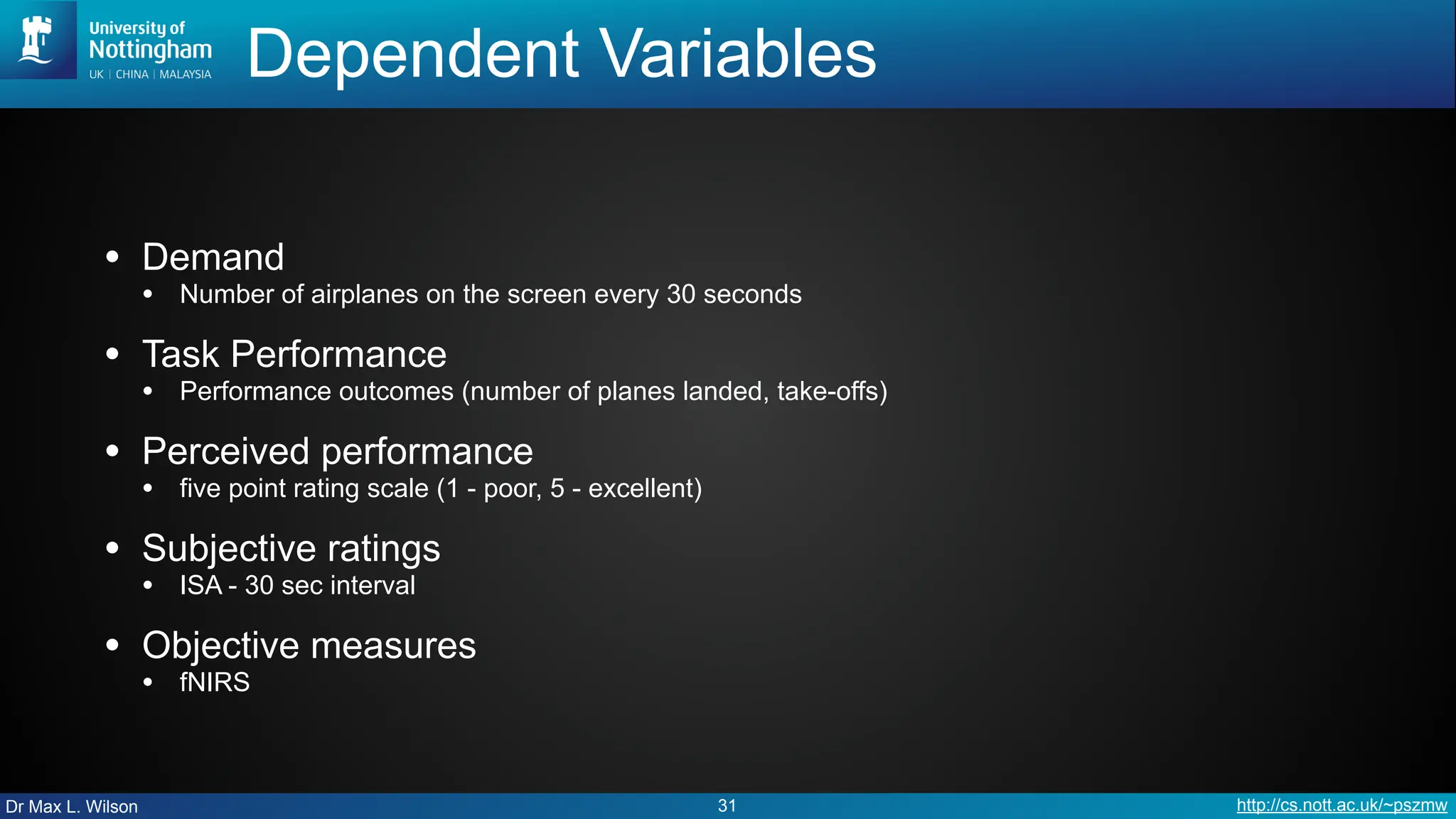
Dependent Variables
• Demand
• Number of airplanes on the screen every 30 seconds
• Task Performance
• Performance outcomes (number of planes landed, take-offs)
• Perceived performance
• five point rating scale (1 - poor, 5 - excellent)
• Subjective ratings
• ISA - 30 sec interval
• Objective measures
• fNIRS
31
Dr Max L. Wilson http://cs.nott.ac.uk/~pszmw
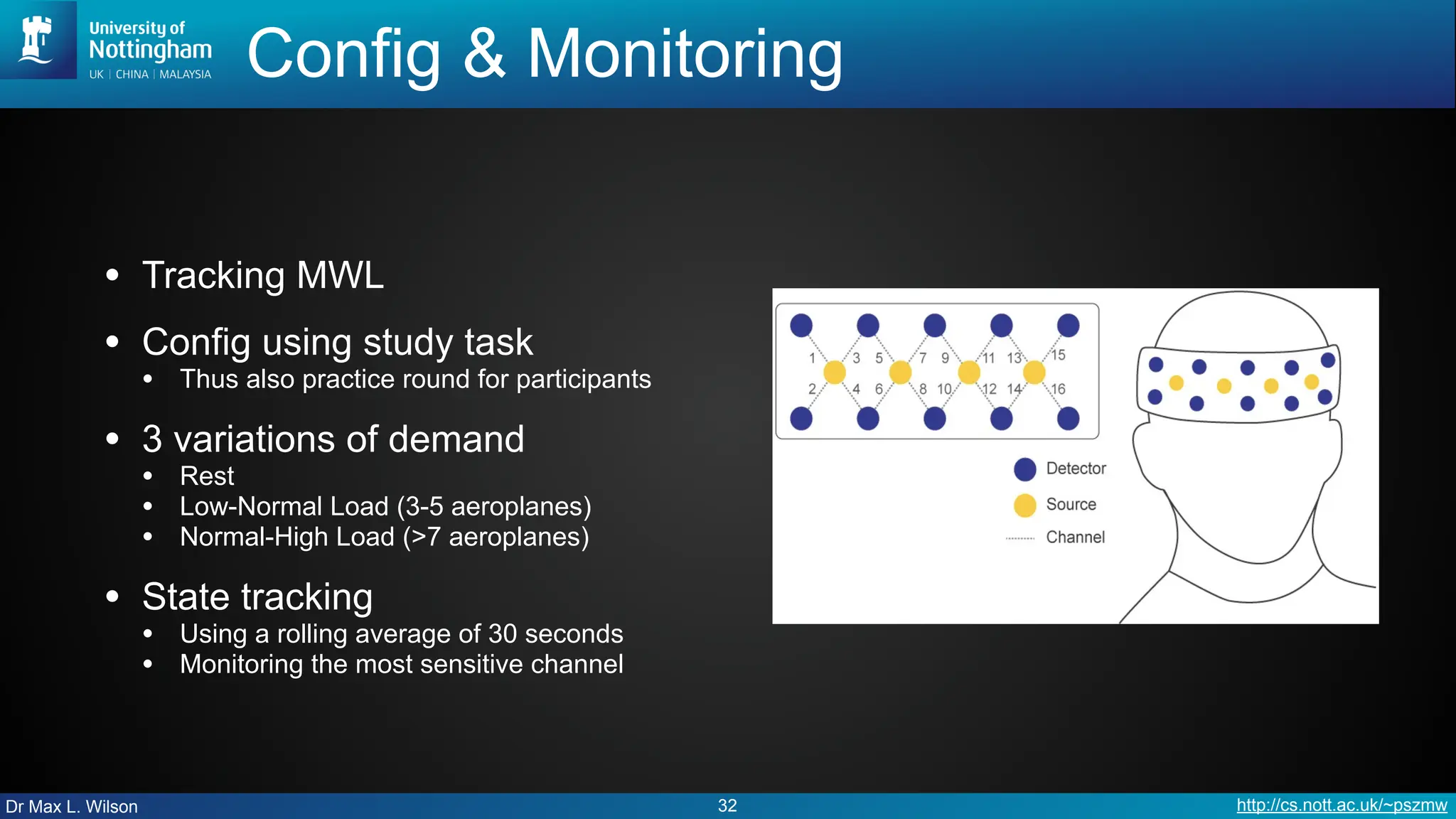
Config & Monitoring
• Tracking MWL
• Config using study task
• Thus also practice round for participants
• 3 variations of demand
• Rest
• Low-Normal Load (3-5 aeroplanes)
• Normal-High Load (>7 aeroplanes)
• State tracking
• Using a rolling average of 30 seconds
• Monitoring the most sensitive channel
32
Dr Max L. Wilson http://cs.nott.ac.uk/~pszmw
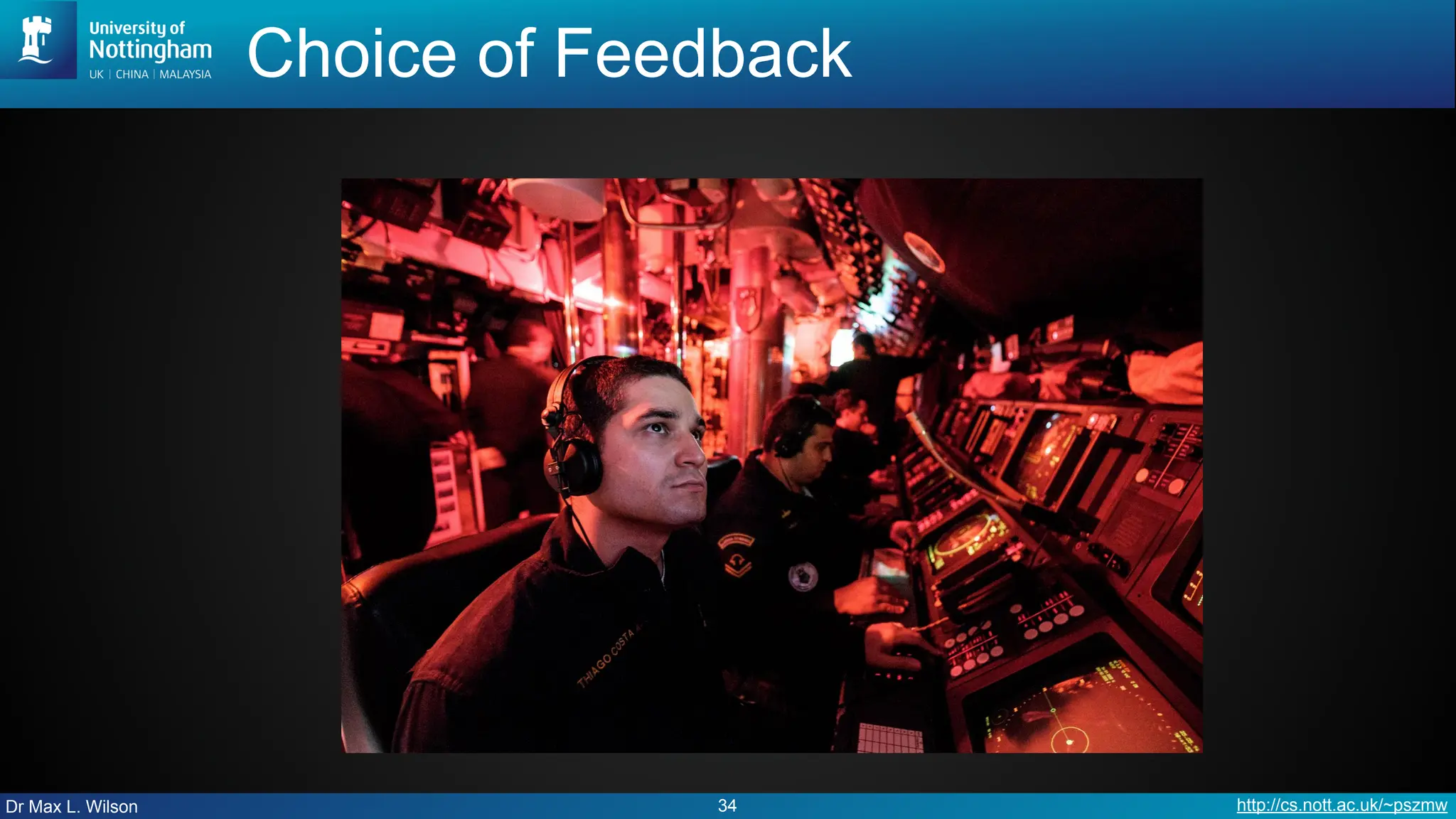
Choice of Feedback
• Noticeable
• Two states of interest:
• Low workload
• High Workload
• Hue Bulbs (Red and White Colours were used for feedback)
• Two Pronged approach:
• Phase1: Red for High Workload and White for Low workload
• Phase2: Reversed Phase1
33
Dr Max L. Wilson http://cs.nott.ac.uk/~pszmw
Choice of Feedback
34
Dr Max L. Wilson http://cs.nott.ac.uk/~pszmw
H1: High Demand »» High MWL
35
Dr Max L. Wilson http://cs.nott.ac.uk/~pszmw
H1: High Demand »» High MWL
36
Dr Max L. Wilson http://cs.nott.ac.uk/~pszmw
H2: Perf. w/ Feedback > Perf. w/ ISA?
37
Dr Max L. Wilson http://cs.nott.ac.uk/~pszmw
H2: Perf. w/ Feedback > Perf. w/ ISA?
38
Dr Max L. Wilson http://cs.nott.ac.uk/~pszmw
H3: Perception of [H2]
39
Dr Max L. Wilson http://cs.nott.ac.uk/~pszmw
H3: Perception of [H2]
40
Dr Max L. Wilson http://cs.nott.ac.uk/~pszmw
H4: MWL Feedback »» Taking Action
41
Dr Max L. Wilson http://cs.nott.ac.uk/~pszmw
H4: MWL Feedback »» Taking Action
42
Dr Max L. Wilson http://cs.nott.ac.uk/~pszmw
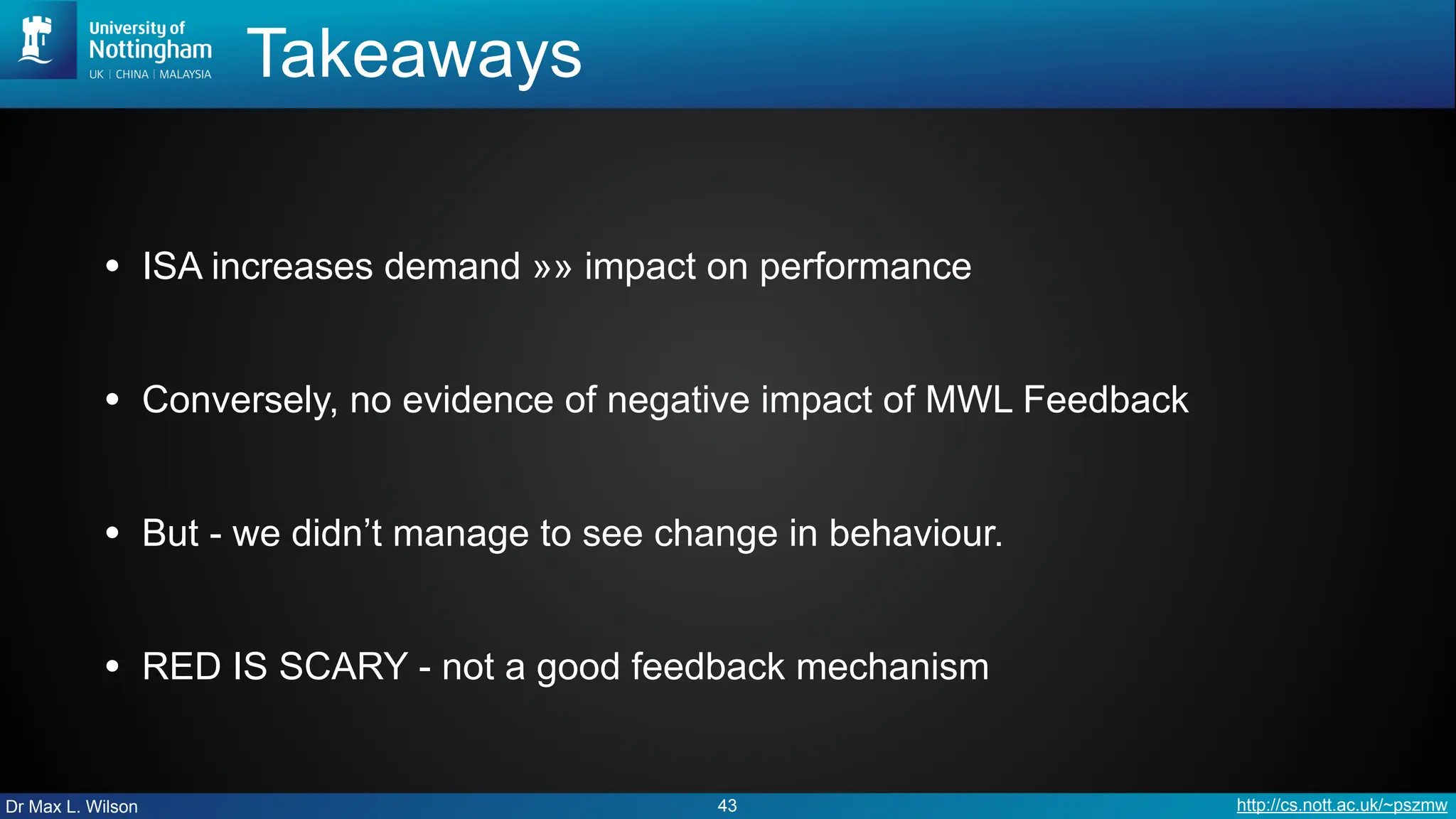
Takeaways
• ISA increases demand »» impact on performance
• Conversely, no evidence of negative impact of MWL Feedback
• But - we didn’t manage to see change in behaviour.
• RED IS SCARY - not a good feedback mechanism
43
Dr Max L. Wilson http://cs.nott.ac.uk/~pszmw
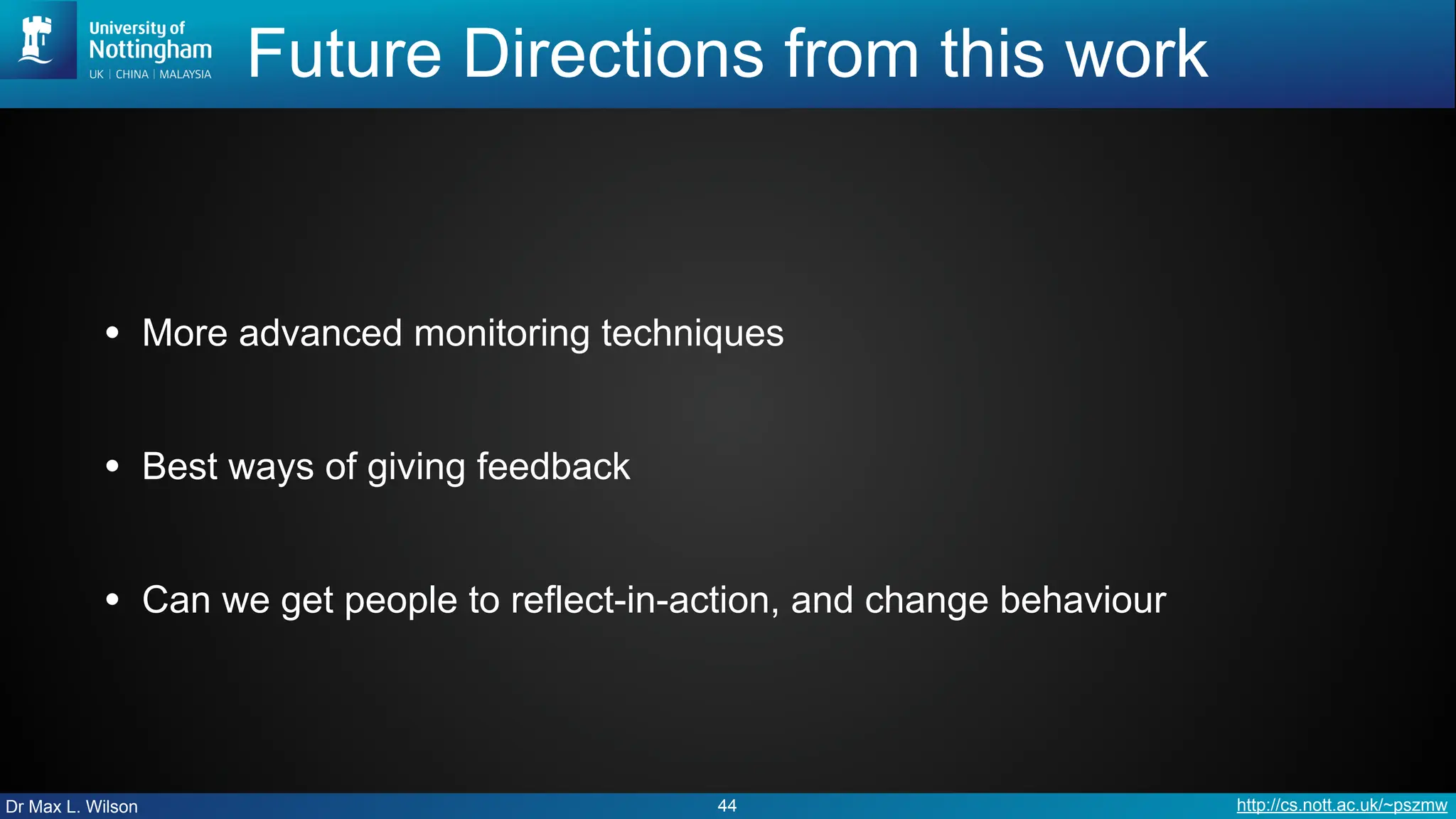
Future Directions from this work
• More advanced monitoring techniques
• Best ways of giving feedback
• Can we get people to reflect-in-action, and change behaviour
44
Future Directions
Dr Max L. Wilson http://cs.nott.ac.uk/~pszmw
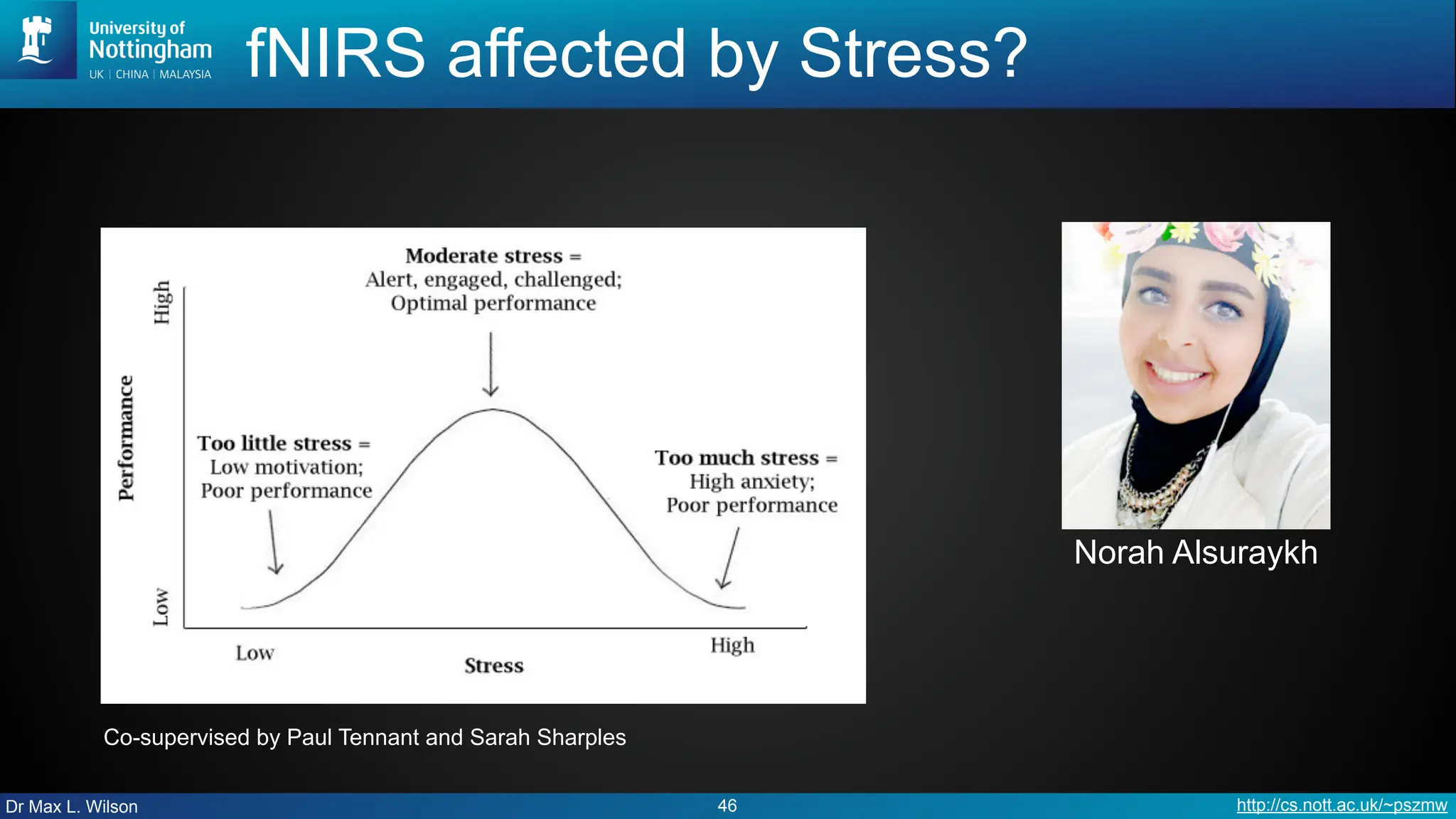
fNIRS affected by Stress?
46
Norah Alsuraykh
Co-supervised by Paul Tennant and Sarah Sharples
Dr Max L. Wilson http://cs.nott.ac.uk/~pszmw
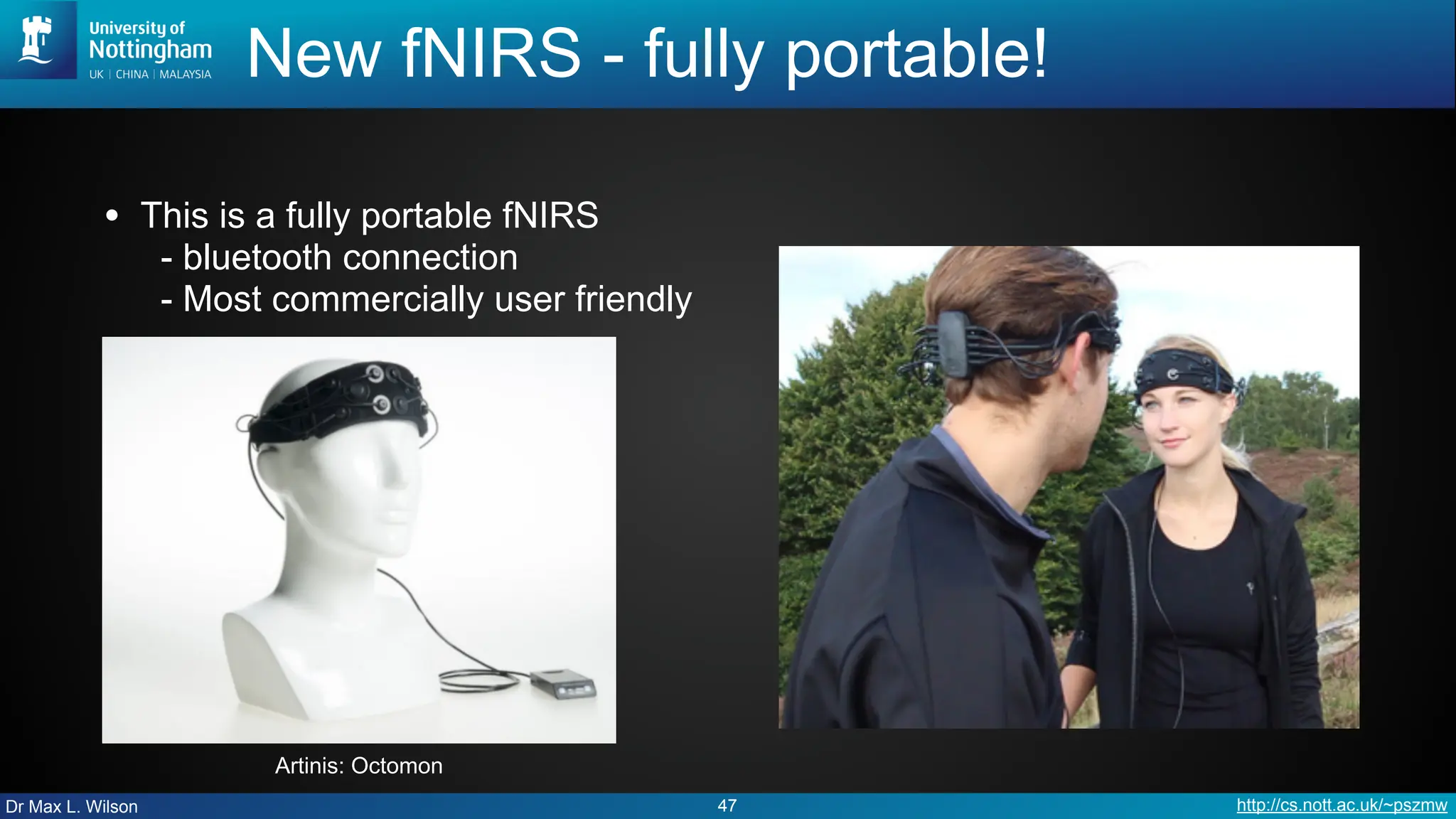
New fNIRS - fully portable!
• This is a fully portable fNIRS
- bluetooth connection
- Most commercially user friendly
47
Artinis: Octomon
Dr Max L. Wilson http://cs.nott.ac.uk/~pszmw
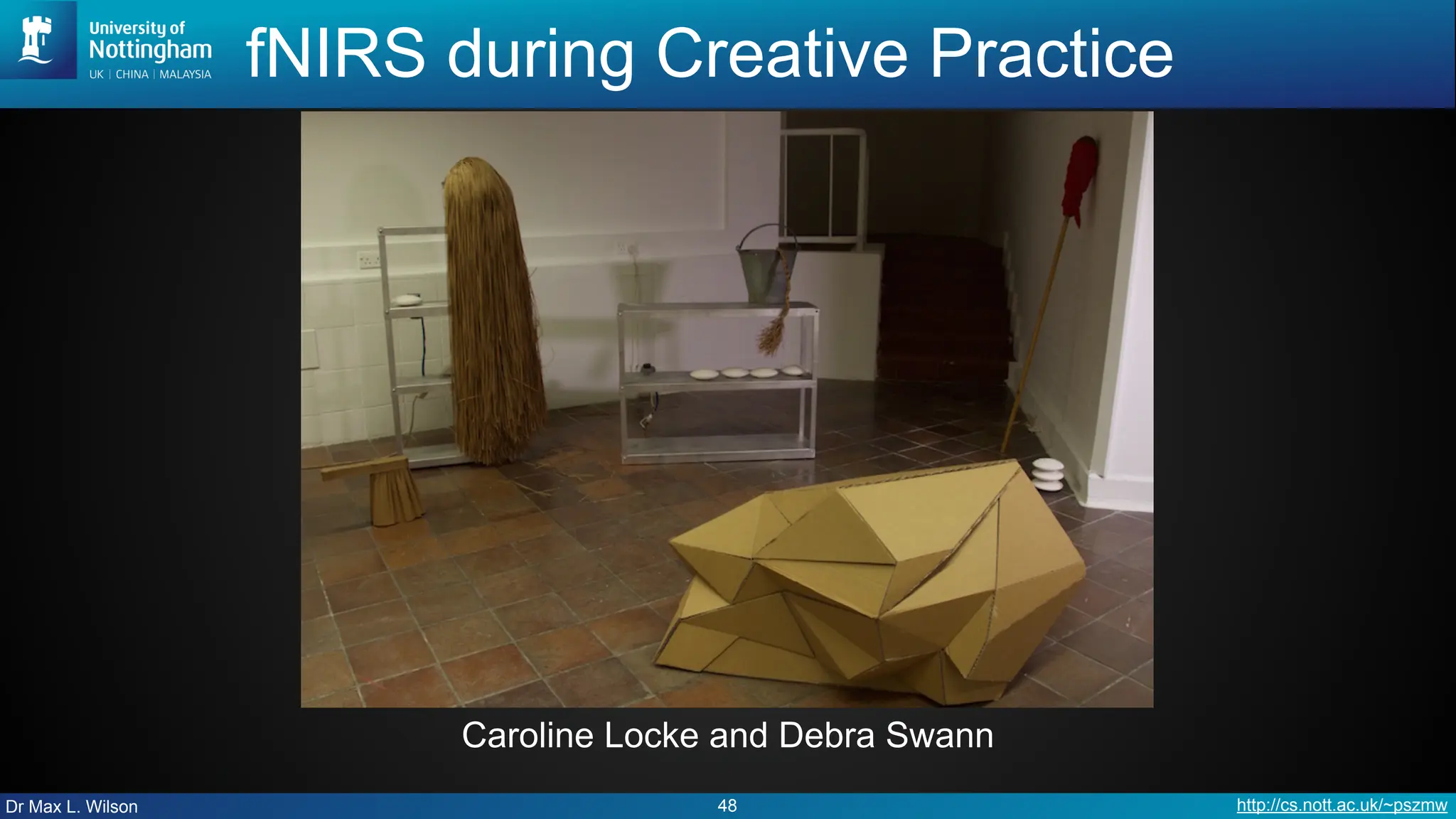
fNIRS during Creative Practice
48
Caroline Locke and Debra Swann
Dr Max L. Wilson http://cs.nott.ac.uk/~pszmw
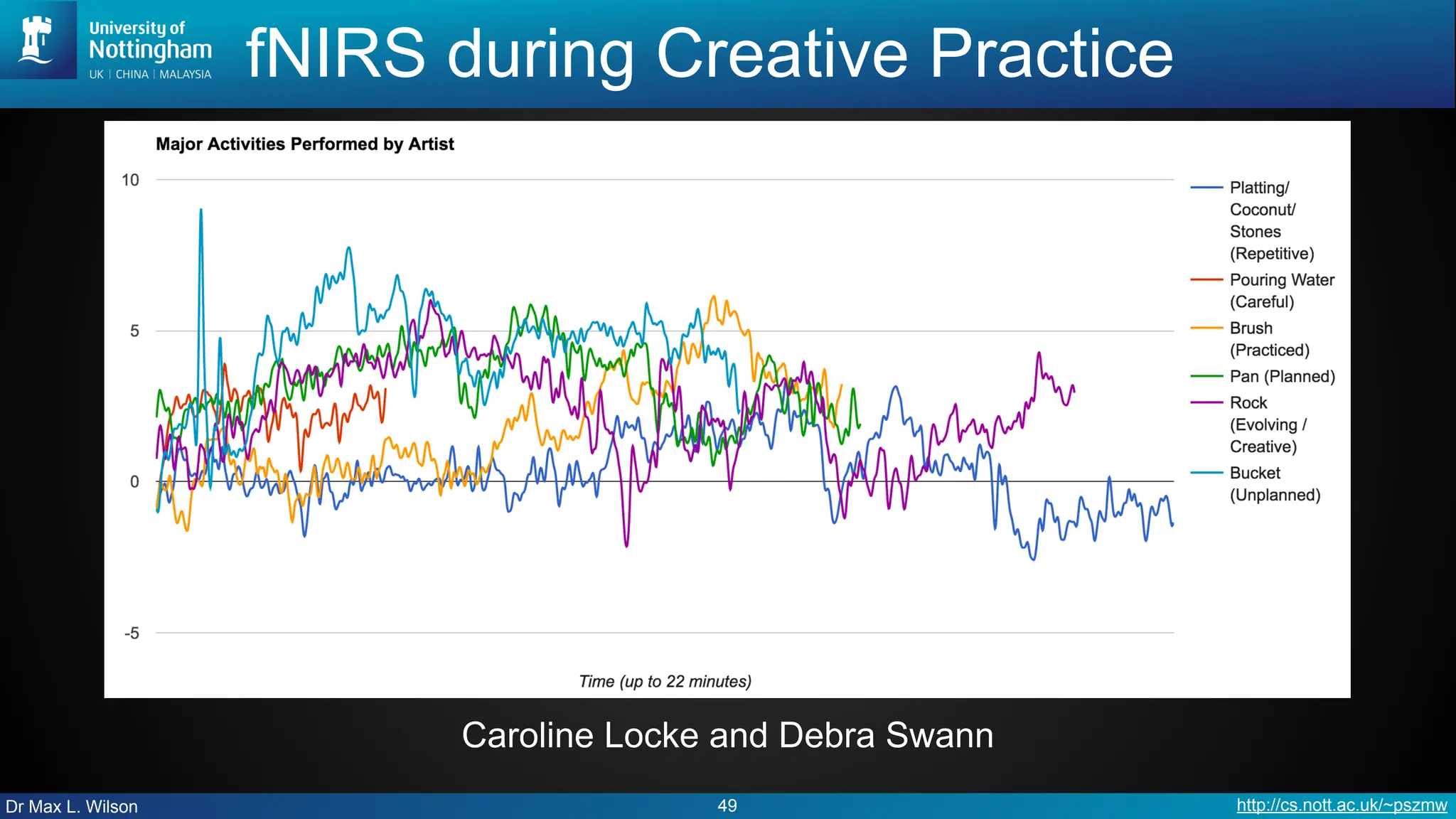
fNIRS during Creative Practice
49
Caroline Locke and Debra Swann
Dr Max L. Wilson http://cs.nott.ac.uk/~pszmw
Brain Controlled Film - The MOMENT
50
http://www.imdb.com/title/tt7853742/
Written & Directed by Richard Ramchurn
Brain Data as Personal Data
A Fitbit for the brain?
Dr Max L. Wilson http://cs.nott.ac.uk/~pszmw
Brain Data as Personal Data
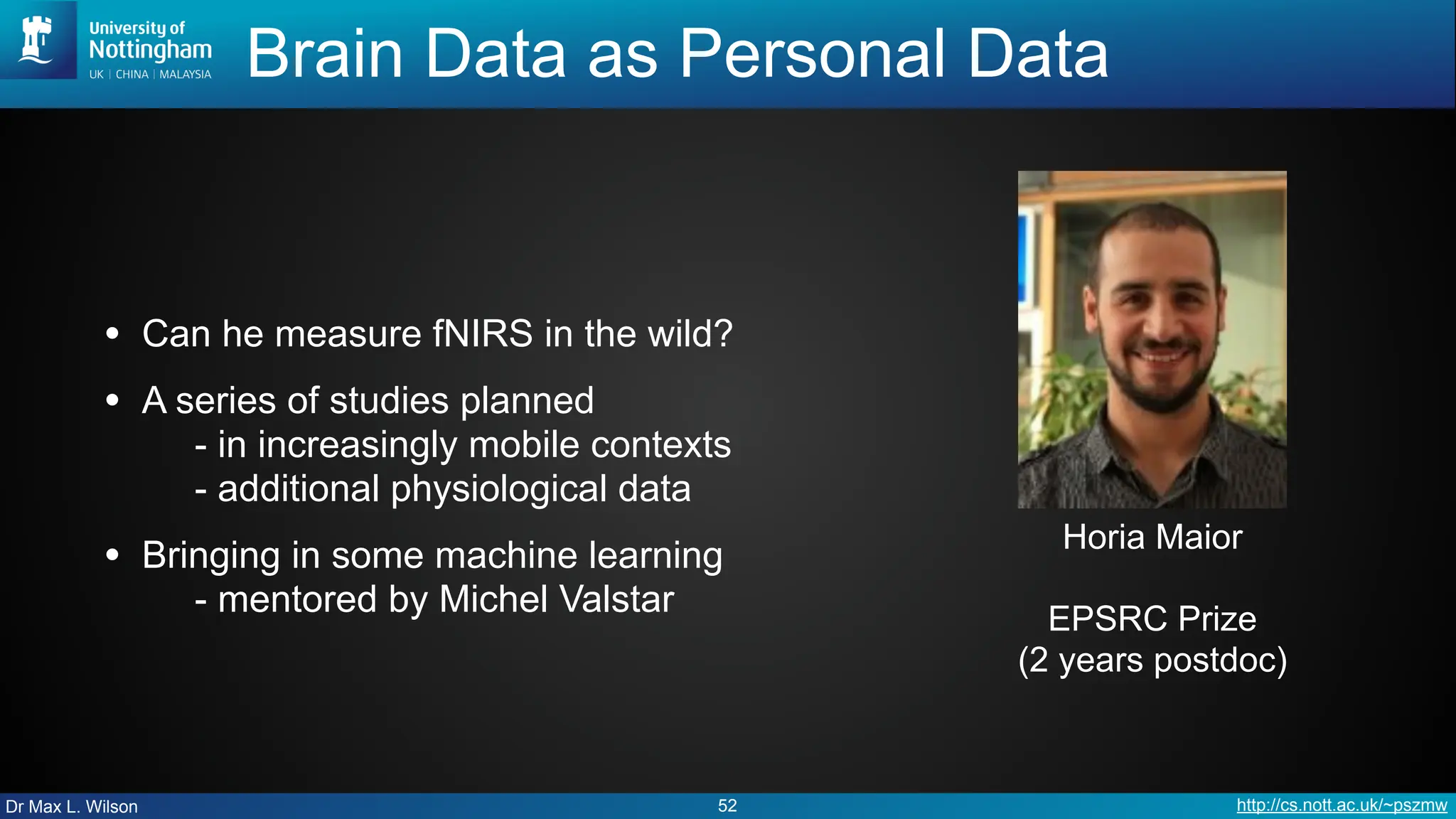
• Can he measure fNIRS in the wild?
• A series of studies planned
- in increasingly mobile contexts
- additional physiological data
• Bringing in some machine learning
- mentored by Michel Valstar
52
Horia Maior
EPSRC Prize
(2 years postdoc)
Dr Max L. Wilson http://cs.nott.ac.uk/~pszmw
Brain Data as Personal Data
53
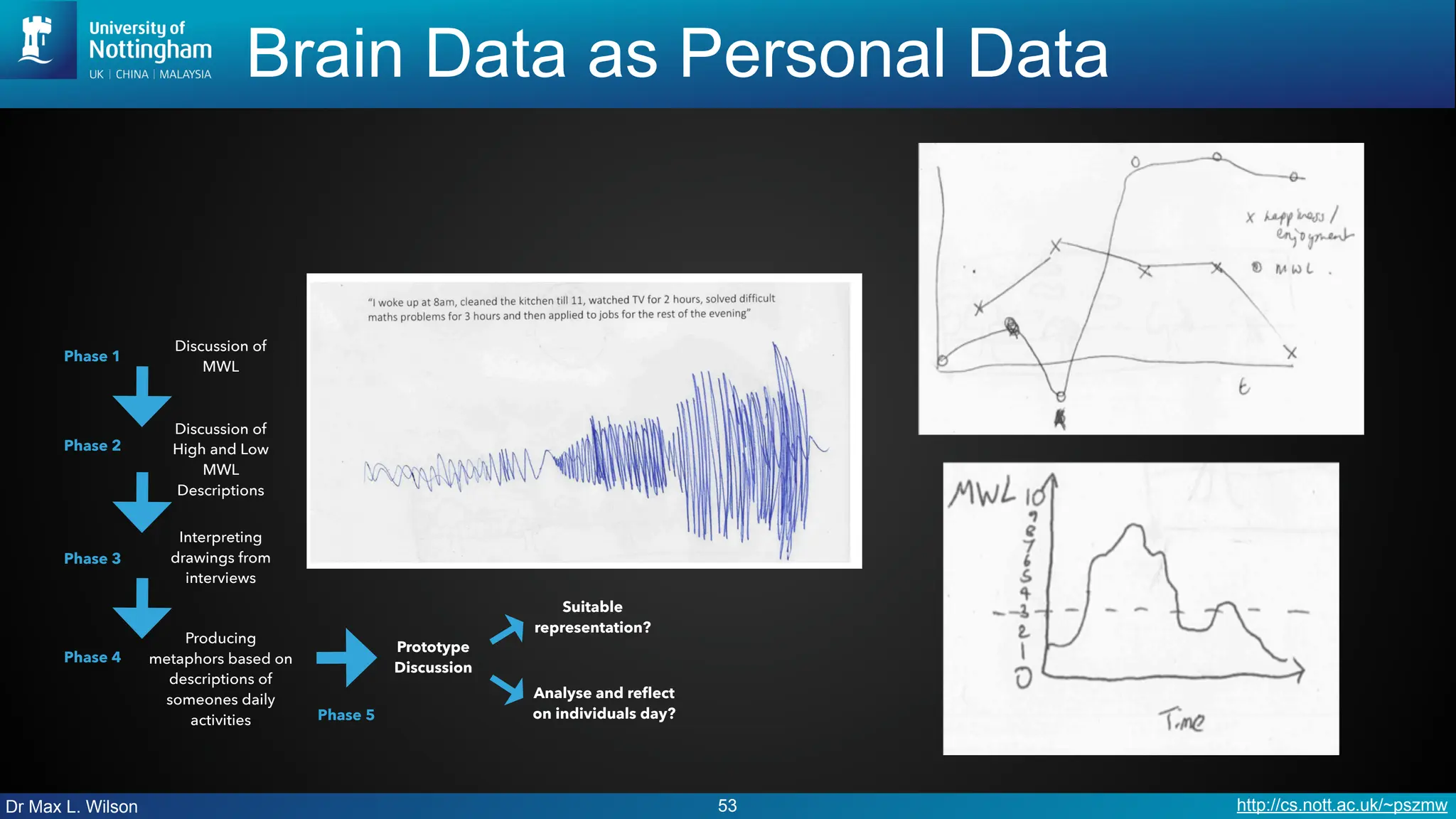
Discussion of
MWL
Phase 1
Discussion of
High and Low
MWL
Descriptions
Phase 2
Interpreting
drawings from
interviews
Phase 3
Producing
metaphors based on
descriptions of
someones daily
activities
Phase 4
Phase 5
Prototype
Discussion
Suitable
representation?
Analyse and reflect
on individuals day?
Dr Max L. Wilson http://cs.nott.ac.uk/~pszmw
Brain Data as Personal Data
54
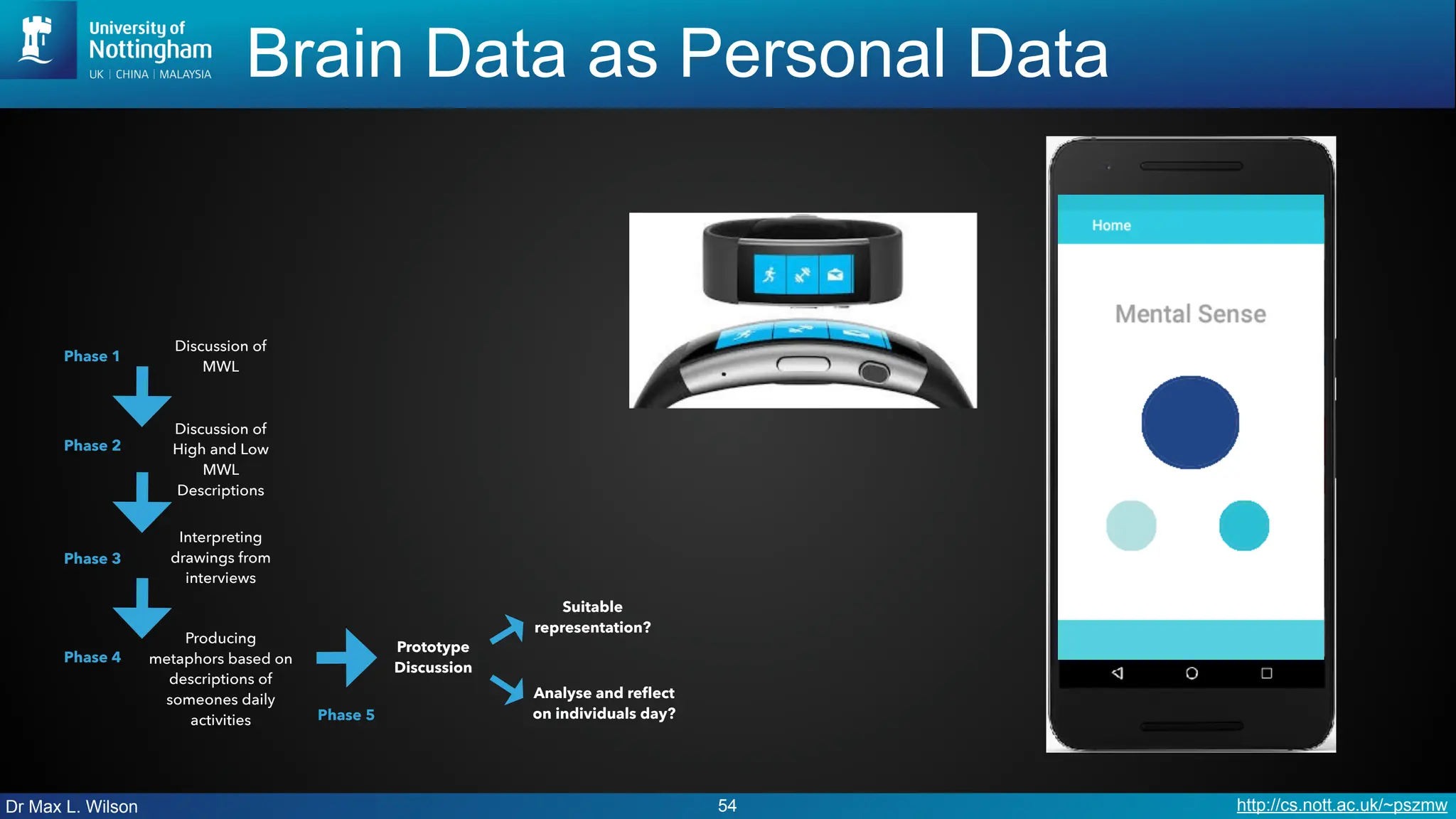
Discussion of
MWL
Phase 1
Discussion of
High and Low
MWL
Descriptions
Phase 2
Interpreting
drawings from
interviews
Phase 3
Producing
metaphors based on
descriptions of
someones daily
activities
Phase 4
Phase 5
Prototype
Discussion
Suitable
representation?
Analyse and reflect
on individuals day?
Dr Max L. Wilson http://cs.nott.ac.uk/~pszmw
Brain Data as Personal Data
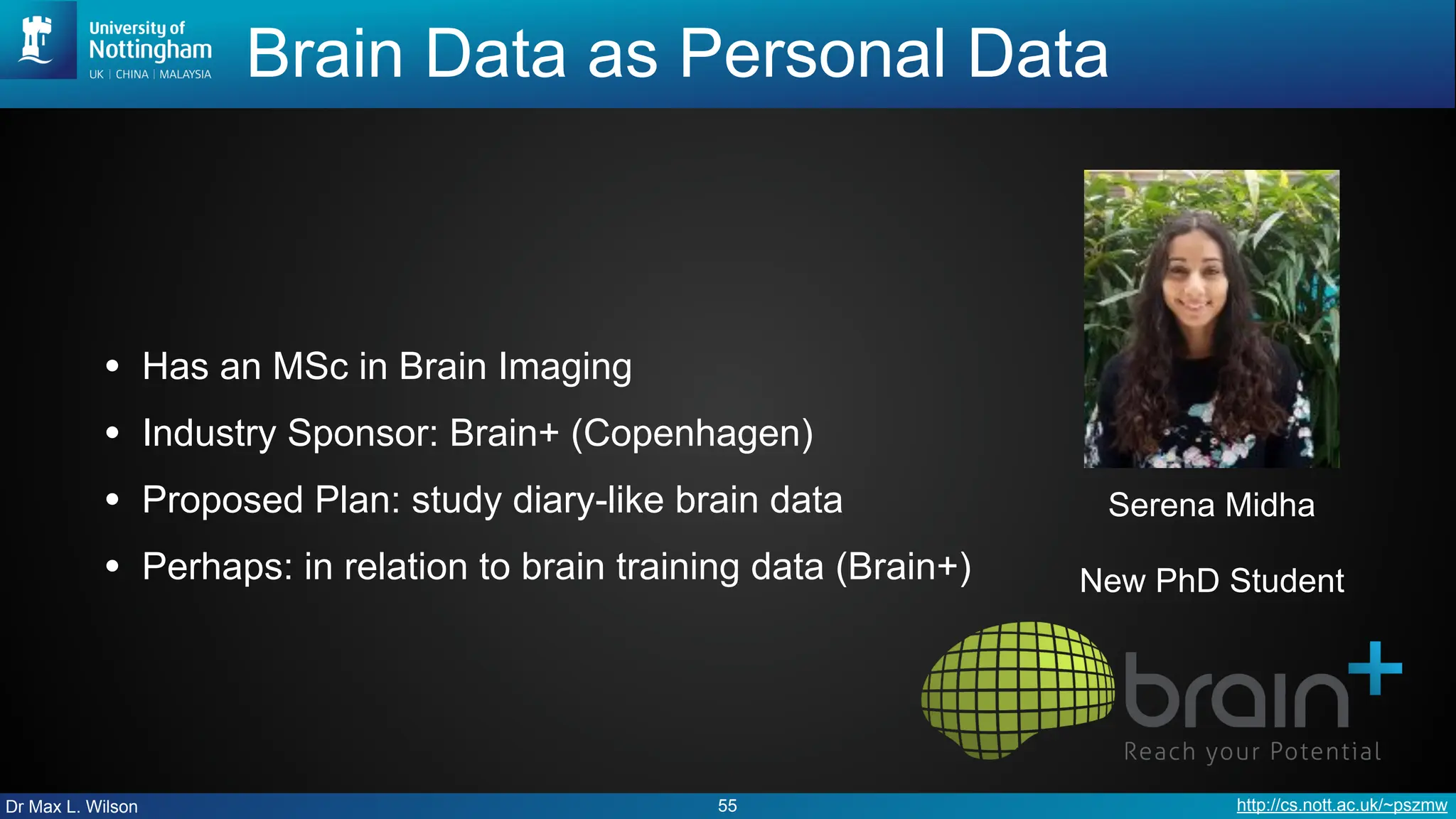
• Has an MSc in Brain Imaging
• Industry Sponsor: Brain+ (Copenhagen)
• Proposed Plan: study diary-like brain data
• Perhaps: in relation to brain training data (Brain+)
55
Serena Midha
New PhD Student
New EPSRC Grant
EP/R032718/1
Dr Max L. Wilson http://cs.nott.ac.uk/~pszmw
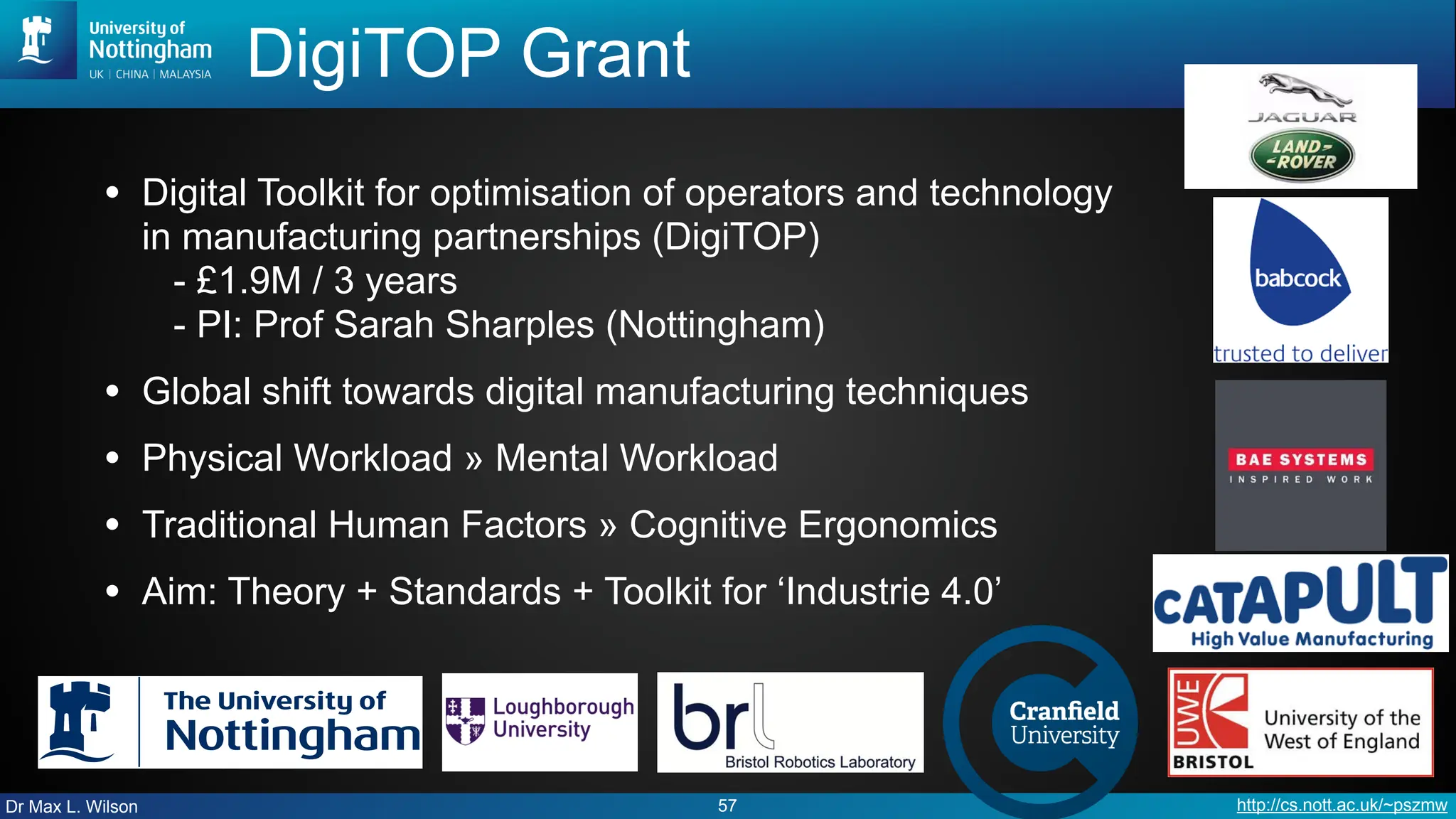
DigiTOP Grant
• Digital Toolkit for optimisation of operators and technology
in manufacturing partnerships (DigiTOP)
- £1.9M / 3 years
- PI: Prof Sarah Sharples (Nottingham)
• Global shift towards digital manufacturing techniques
• Physical Workload » Mental Workload
• Traditional Human Factors » Cognitive Ergonomics
• Aim: Theory + Standards + Toolkit for ‘Industrie 4.0’
57
Dr Max L. Wilson http://cs.nott.ac.uk/~pszmw
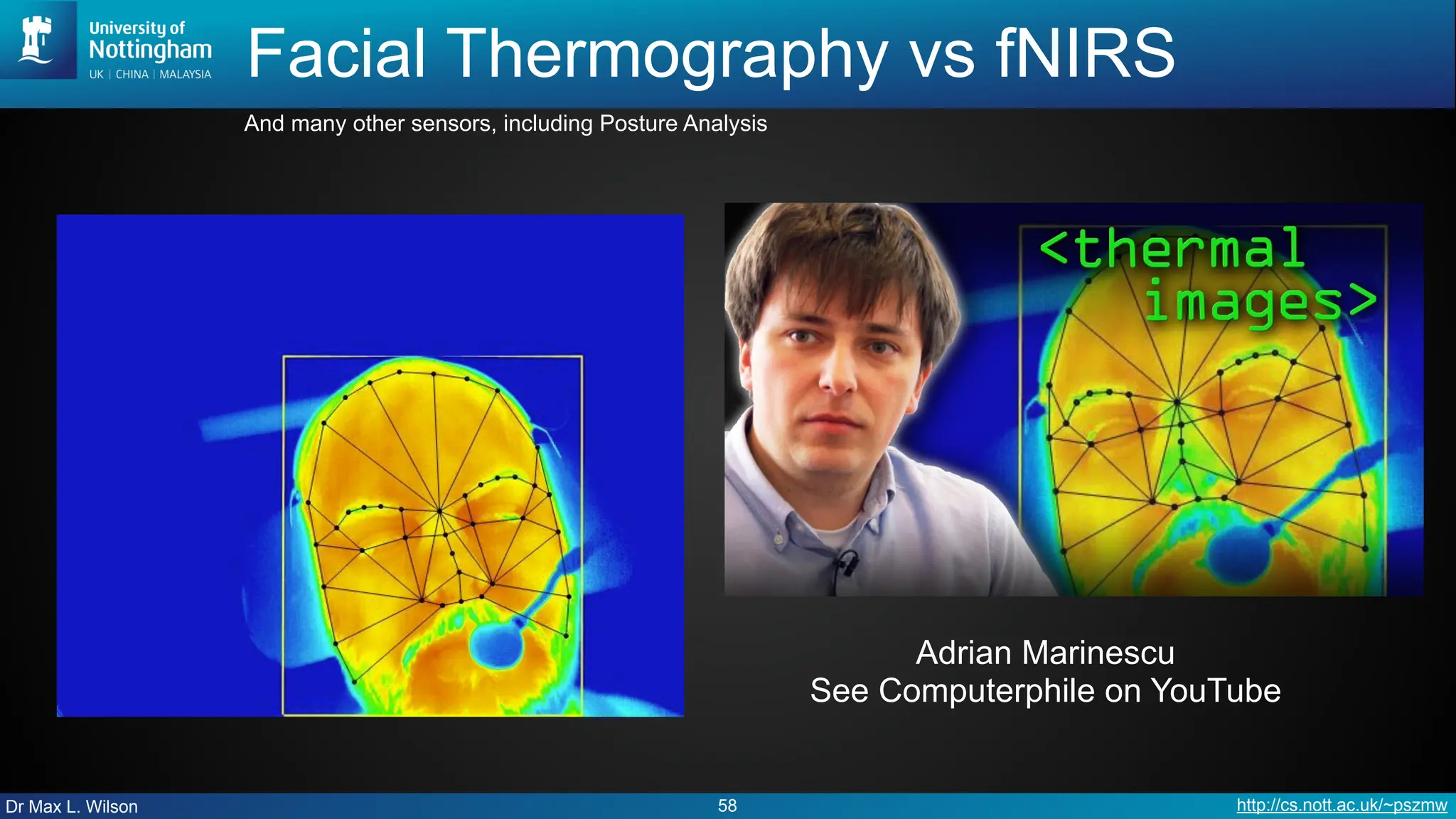
Facial Thermography vs fNIRS
58
Adrian Marinescu
See Computerphile on YouTube
And many other sensors, including Posture Analysis
New Horizon 2020 Grant
Fast Track to Innovation Fund
Dr Max L. Wilson http://cs.nott.ac.uk/~pszmw
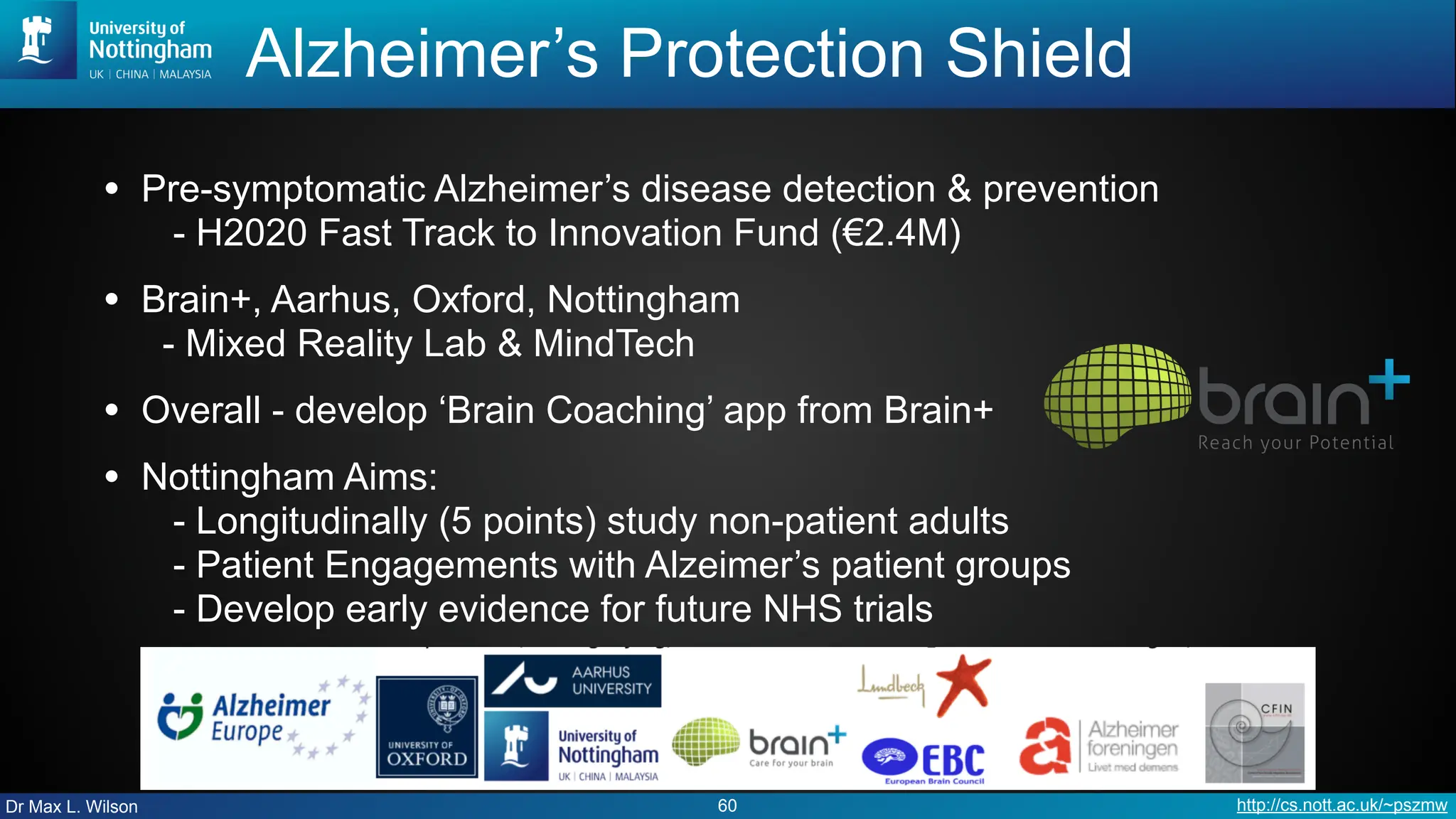
Alzheimer’s Protection Shield
• Pre-symptomatic Alzheimer’s disease detection & prevention
- H2020 Fast Track to Innovation Fund (€2.4M)
• Brain+, Aarhus, Oxford, Nottingham
- Mixed Reality Lab & MindTech
• Overall - develop ‘Brain Coaching’ app from Brain+
• Nottingham Aims:
- Longitudinally (5 points) study non-patient adults
- Patient Engagements with Alzeimer’s patient groups
- Develop early evidence for future NHS trials
60
Dr Max L. Wilson http://cs.nott.ac.uk/~pszmw
Questions?
61

Mental Workload Alerts - Reliable Brain Measurements of HCI using fNIRS - Uni Strathclyde, 2018

  • 1.
    Mental Workload Alerts ReliableBrain Measurements of HCI using fNIRS Max L. Wilson @gingdottwit
  • 2.
    Dr Max L.Wilson http://cs.nott.ac.uk/~pszmw 2
  • 3.
    Dr Max L.Wilson http://cs.nott.ac.uk/~pszmw Horia on Computerphile 3 https://www.youtube.com/watch?v=TQ0sL1ZGnQ4
  • 4.
    Dr Max L.Wilson http://cs.nott.ac.uk/~pszmw To-Say List • Context • Workload Alerts • Future Directions 4
  • 5.
  • 6.
    Dr Max L.Wilson http://cs.nott.ac.uk/~pszmw 6
  • 7.
    Dr Max L.Wilson http://cs.nott.ac.uk/~pszmw 7
  • 8.
    Dr Max L.Wilson http://cs.nott.ac.uk/~pszmw User Interfaces 8 Great Complexity and Confusion With Great Power Comes
  • 9.
    Dr Max L.Wilson http://cs.nott.ac.uk/~pszmw 9 Total Mental Capacity Simple UI EasyTask
  • 10.
    Dr Max L.Wilson http://cs.nott.ac.uk/~pszmw 10 Total Mental Capacity Complicated UI EasyTask
  • 11.
    Dr Max L.Wilson http://cs.nott.ac.uk/~pszmw 11 Total Mental Capacity Complicated UI DifficultTask
  • 12.
    Dr Max L.Wilson http://cs.nott.ac.uk/~pszmw 12 Total Mental Capacity Better UI DifficultTask
  • 13.
    Dr Max L.Wilson http://cs.nott.ac.uk/~pszmw Mental Workload 13 Sharples, Sarah and Megaw Ted (2015). De nition and mesurement of human workload. In Wilson John R and Sharples Sarah, editors, Evaluation of human work. CRC Press.
  • 14.
    Dr Max L.Wilson http://cs.nott.ac.uk/~pszmw Most important criteria for us • We can run a ‘normal’ user study. • As much ecological validity in - the environment they do the study - natural user behaviour in the study - as normal/natural a task as possible • And tell if theres a cognitive difference between UIs or Tasks 14
  • 15.
    Dr Max L.Wilson http://cs.nott.ac.uk/~pszmw Which Brain Scanner? 15 M. Pike (2017) Exploring the use of Brain-Sensing Technologies for Natural Interactions. PhD Thesis. University of Nottingham.
  • 16.
    Dr Max L.Wilson http://cs.nott.ac.uk/~pszmw fNIRS 16 functional Near InfraRed Spectroscopy
  • 17.
    Dr Max L.Wilson http://cs.nott.ac.uk/~pszmw Showing that fNIRS works for HCI • CHI2014: fNIRS + Think Aloud • CHI2015: fNIRS vs HCI Artefacts • CHI2015: 3 UIs create different Mental Workload • Horia Maior & Matthew Pike • Working with Prof. Sarah Sharples 17
  • 18.
  • 19.
    Dr Max L.Wilson http://cs.nott.ac.uk/~pszmw When do you need to know MWL? 19
  • 20.
    Dr Max L.Wilson http://cs.nott.ac.uk/~pszmw How to measure MWL? • Performance based • Subjective techniques • NASA-TLX • ISA - Instantaneous self-assessment of workload technique • Physiological approach • Indirect: Skin response, heart based measurements, etc. • Direct: brain measurements: e.g. fNIRS 20
  • 21.
    Dr Max L.Wilson http://cs.nott.ac.uk/~pszmw NASA Task Load Index (TLX) • Using a 21-point subjective questionnaire • Captures 6 subscales: • Mental Demand • Physical Demand • Temporal Demand • Performance • Effort • Frustration • Developed for demanding jobs • Physically • Mentally 21
  • 22.
    Dr Max L.Wilson http://cs.nott.ac.uk/~pszmw Instantaneous Self Assessment (ISA) • ‘Continuous’ subjective technique (could be an app while performing a study task) • On Regular intervals during a study (e.g. every 30 sec) • Popular in analysis critical industry tasks • BUT - it interrupts those tasks 22
  • 23.
    Dr Max L.Wilson http://cs.nott.ac.uk/~pszmw Workload Alerts: Aim • What if we provide feedback of workload to people during tasks? • Assess workload objectively using fNIRS • Help people manage their workload during tasks • Facilitate a form of Reflection-in-Action during tasks (similar effect as ISA?) 23
  • 24.
    Dr Max L.Wilson http://cs.nott.ac.uk/~pszmw Related - Dynamic Adjustment, fNIRS 24
  • 25.
    Dr Max L.Wilson http://cs.nott.ac.uk/~pszmw Workload Alerts System 25
  • 26.
    Dr Max L.Wilson http://cs.nott.ac.uk/~pszmw Workload Alerts System 26 VS
  • 27.
    Dr Max L.Wilson http://cs.nott.ac.uk/~pszmw Task: Airport Madness 4 27
  • 28.
    Dr Max L.Wilson http://cs.nott.ac.uk/~pszmw Hypotheses (Complex) 28
  • 29.
    Dr Max L.Wilson http://cs.nott.ac.uk/~pszmw Hypotheses Simplified • H1: High Demand »» High MWL • H2: Performance w/ Feedback > Performance w/ ISA? • H3: Perception of [H2] • H4: MWL Feedback »» Taking Action 29
  • 30.
    Dr Max L.Wilson http://cs.nott.ac.uk/~pszmw Participants & Conditions • 32 subjects • Counterbalanced • Average age: 25.3 • 4 Conditions * 7 min 30
  • 31.
    Dr Max L.Wilson http://cs.nott.ac.uk/~pszmw Dependent Variables • Demand • Number of airplanes on the screen every 30 seconds • Task Performance • Performance outcomes (number of planes landed, take-offs) • Perceived performance • five point rating scale (1 - poor, 5 - excellent) • Subjective ratings • ISA - 30 sec interval • Objective measures • fNIRS 31
  • 32.
    Dr Max L.Wilson http://cs.nott.ac.uk/~pszmw Config & Monitoring • Tracking MWL • Config using study task • Thus also practice round for participants • 3 variations of demand • Rest • Low-Normal Load (3-5 aeroplanes) • Normal-High Load (>7 aeroplanes) • State tracking • Using a rolling average of 30 seconds • Monitoring the most sensitive channel 32
  • 33.
    Dr Max L.Wilson http://cs.nott.ac.uk/~pszmw Choice of Feedback • Noticeable • Two states of interest: • Low workload • High Workload • Hue Bulbs (Red and White Colours were used for feedback) • Two Pronged approach: • Phase1: Red for High Workload and White for Low workload • Phase2: Reversed Phase1 33
  • 34.
    Dr Max L.Wilson http://cs.nott.ac.uk/~pszmw Choice of Feedback 34
  • 35.
    Dr Max L.Wilson http://cs.nott.ac.uk/~pszmw H1: High Demand »» High MWL 35
  • 36.
    Dr Max L.Wilson http://cs.nott.ac.uk/~pszmw H1: High Demand »» High MWL 36
  • 37.
    Dr Max L.Wilson http://cs.nott.ac.uk/~pszmw H2: Perf. w/ Feedback > Perf. w/ ISA? 37
  • 38.
    Dr Max L.Wilson http://cs.nott.ac.uk/~pszmw H2: Perf. w/ Feedback > Perf. w/ ISA? 38
  • 39.
    Dr Max L.Wilson http://cs.nott.ac.uk/~pszmw H3: Perception of [H2] 39
  • 40.
    Dr Max L.Wilson http://cs.nott.ac.uk/~pszmw H3: Perception of [H2] 40
  • 41.
    Dr Max L.Wilson http://cs.nott.ac.uk/~pszmw H4: MWL Feedback »» Taking Action 41
  • 42.
    Dr Max L.Wilson http://cs.nott.ac.uk/~pszmw H4: MWL Feedback »» Taking Action 42
  • 43.
    Dr Max L.Wilson http://cs.nott.ac.uk/~pszmw Takeaways • ISA increases demand »» impact on performance • Conversely, no evidence of negative impact of MWL Feedback • But - we didn’t manage to see change in behaviour. • RED IS SCARY - not a good feedback mechanism 43
  • 44.
    Dr Max L.Wilson http://cs.nott.ac.uk/~pszmw Future Directions from this work • More advanced monitoring techniques • Best ways of giving feedback • Can we get people to reflect-in-action, and change behaviour 44
  • 45.
  • 46.
    Dr Max L.Wilson http://cs.nott.ac.uk/~pszmw fNIRS affected by Stress? 46 Norah Alsuraykh Co-supervised by Paul Tennant and Sarah Sharples
  • 47.
    Dr Max L.Wilson http://cs.nott.ac.uk/~pszmw New fNIRS - fully portable! • This is a fully portable fNIRS - bluetooth connection - Most commercially user friendly 47 Artinis: Octomon
  • 48.
    Dr Max L.Wilson http://cs.nott.ac.uk/~pszmw fNIRS during Creative Practice 48 Caroline Locke and Debra Swann
  • 49.
    Dr Max L.Wilson http://cs.nott.ac.uk/~pszmw fNIRS during Creative Practice 49 Caroline Locke and Debra Swann
  • 50.
    Dr Max L.Wilson http://cs.nott.ac.uk/~pszmw Brain Controlled Film - The MOMENT 50 http://www.imdb.com/title/tt7853742/ Written & Directed by Richard Ramchurn
  • 51.
    Brain Data asPersonal Data A Fitbit for the brain?
  • 52.
    Dr Max L.Wilson http://cs.nott.ac.uk/~pszmw Brain Data as Personal Data • Can he measure fNIRS in the wild? • A series of studies planned - in increasingly mobile contexts - additional physiological data • Bringing in some machine learning - mentored by Michel Valstar 52 Horia Maior EPSRC Prize (2 years postdoc)
  • 53.
    Dr Max L.Wilson http://cs.nott.ac.uk/~pszmw Brain Data as Personal Data 53 Discussion of MWL Phase 1 Discussion of High and Low MWL Descriptions Phase 2 Interpreting drawings from interviews Phase 3 Producing metaphors based on descriptions of someones daily activities Phase 4 Phase 5 Prototype Discussion Suitable representation? Analyse and reflect on individuals day?
  • 54.
    Dr Max L.Wilson http://cs.nott.ac.uk/~pszmw Brain Data as Personal Data 54 Discussion of MWL Phase 1 Discussion of High and Low MWL Descriptions Phase 2 Interpreting drawings from interviews Phase 3 Producing metaphors based on descriptions of someones daily activities Phase 4 Phase 5 Prototype Discussion Suitable representation? Analyse and reflect on individuals day?
  • 55.
    Dr Max L.Wilson http://cs.nott.ac.uk/~pszmw Brain Data as Personal Data • Has an MSc in Brain Imaging • Industry Sponsor: Brain+ (Copenhagen) • Proposed Plan: study diary-like brain data • Perhaps: in relation to brain training data (Brain+) 55 Serena Midha New PhD Student
  • 56.
  • 57.
    Dr Max L.Wilson http://cs.nott.ac.uk/~pszmw DigiTOP Grant • Digital Toolkit for optimisation of operators and technology in manufacturing partnerships (DigiTOP) - £1.9M / 3 years - PI: Prof Sarah Sharples (Nottingham) • Global shift towards digital manufacturing techniques • Physical Workload » Mental Workload • Traditional Human Factors » Cognitive Ergonomics • Aim: Theory + Standards + Toolkit for ‘Industrie 4.0’ 57
  • 58.
    Dr Max L.Wilson http://cs.nott.ac.uk/~pszmw Facial Thermography vs fNIRS 58 Adrian Marinescu See Computerphile on YouTube And many other sensors, including Posture Analysis
  • 59.
    New Horizon 2020Grant Fast Track to Innovation Fund
  • 60.
    Dr Max L.Wilson http://cs.nott.ac.uk/~pszmw Alzheimer’s Protection Shield • Pre-symptomatic Alzheimer’s disease detection & prevention - H2020 Fast Track to Innovation Fund (€2.4M) • Brain+, Aarhus, Oxford, Nottingham - Mixed Reality Lab & MindTech • Overall - develop ‘Brain Coaching’ app from Brain+ • Nottingham Aims: - Longitudinally (5 points) study non-patient adults - Patient Engagements with Alzeimer’s patient groups - Develop early evidence for future NHS trials 60
  • 61.
    Dr Max L.Wilson http://cs.nott.ac.uk/~pszmw Questions? 61