MENTAL HEALTH
BY
MUHAMMAD SULIMAN
LECTURER
ROYAL COLLEGE OF NURSING
WHO HEALTH DEFINITION
Health is a state of complete state
Physical
Mental
social well-being
 and not merely the absence of disease
or infirmity.
2
muhammad suliman/lecturer
What Is Mental Health?
Mental health includes emotional,
psychological, and social well-being.
It affects how we think, feel, and act.
It also helps determine how we handle stress,
relate to others, and make choices.
Mental health is important at every stage of
life, from childhood and adolescence through
adulthood.
3
muhammad suliman/lecturer
Historical Overview of Psychiatric Care
Primitive beliefs regarding mental disturbances took several views.
Some thought that an individual with mental illness had been
dispossessed of his or her soul and that the only way wellness could be
achieved was if the soul returned.
Others believed that evil spirits or supernatural or magical powers had
entered the body.
The “cure” for these individuals involved a ritualistic exorcism to
purge the body of these unwanted forces.
This often consisted of brutal beatings, starvation, or other torturous
means.
4
muhammad suliman/lecturer
Definition
• The American Psychiatric Association (APA 1980) defines mental
health as
 “ Simultaneous success at working, loving and creating with the capacity of
mature & flexible resolution of conflicts between instincts, conscience,
important other people & reality.”
5
muhammad suliman/lecturer
Mental Health and Wellness
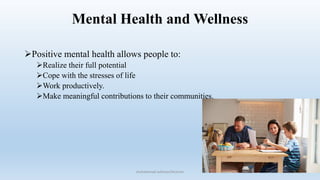
Positive mental health allows people to:
Realize their full potential
Cope with the stresses of life
Work productively.
Make meaningful contributions to their communities.
6
muhammad suliman/lecturer
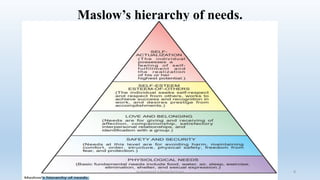
Maslow’s hierarchy of needs.
Maslow (1970) emphasized an individual’s motivation in the
continuous quest for self-actualization.
He identified a “hierarchy of needs,” the lower ones requiring
fulfillment before those at higher levels can be achieved, with self-
actualization being fulfillment of one’s highest potential.
7
muhammad suliman/lecturer
Maslow’s hierarchy of needs.
8
muhammad suliman/lecturer
MENTAL ILNESS
• The American Psychiatric Association (APA, 2013), in its Diagnostic
and Statistical Manual of Mental Disorders, Fifth Edition (DSM-5),
defines mental disorder as:
A syndrome characterized by clinically significant disturbance in an
individual’s cognitions, emotion regulation, or behavior that reflects a
dysfunction in the psychological, biological, or developmental processes
underlying mental functioning.
9
muhammad suliman/lecturer
Factors contribute to mental health
problems
Many factors contribute to mental health problems,
including:
Biological factors, such as genes or brain chemistry
Life experiences, such as trauma or abuse
Family history of mental health problems
Mental health problems are common but help is
available
People with mental health problems can get better and
many recover completely.
10
muhammad suliman/lecturer
Early Warning Signs
Eating or sleeping too much or too little
Pulling away from people and usual activities
Having low or no energy
Feeling numb or like nothing matters
Having unexplained aches and pains
Feeling helpless or hopeless
Smoking, drinking, or using drugs more than usual
Feeling unusually confused, forgetful, angry, upset, worried, or scared.
Yelling or fighting with family and friends
11
muhammad suliman/lecturer
Early Warning Signs
Experiencing severe mood swings that cause problems in relationships
Having persistent thoughts and memories you can't get out of your head
Hearing voices or believing things that are not true
Thinking of harming yourself or others
Inability to perform daily tasks like taking care of your kids or getting to
work or school
12
muhammad suliman/lecturer
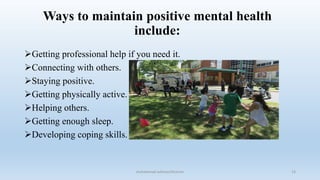
Ways to maintain positive mental health
include:
Getting professional help if you need it.
Connecting with others.
Staying positive.
Getting physically active.
Helping others.
Getting enough sleep.
Developing coping skills.
13
muhammad suliman/lecturer
References
https://www.who.int/
Psychiatric mental health nursing 8th edition/concept of care in
evidence base practice/by Mary C Townsend
14
muhammad suliman/lecturer
15
muhammad suliman/lecturer

Mental health

  • 1.
  • 2.
    WHO HEALTH DEFINITION Healthis a state of complete state Physical Mental social well-being  and not merely the absence of disease or infirmity. 2 muhammad suliman/lecturer
  • 3.
    What Is MentalHealth? Mental health includes emotional, psychological, and social well-being. It affects how we think, feel, and act. It also helps determine how we handle stress, relate to others, and make choices. Mental health is important at every stage of life, from childhood and adolescence through adulthood. 3 muhammad suliman/lecturer
  • 4.
    Historical Overview ofPsychiatric Care Primitive beliefs regarding mental disturbances took several views. Some thought that an individual with mental illness had been dispossessed of his or her soul and that the only way wellness could be achieved was if the soul returned. Others believed that evil spirits or supernatural or magical powers had entered the body. The “cure” for these individuals involved a ritualistic exorcism to purge the body of these unwanted forces. This often consisted of brutal beatings, starvation, or other torturous means. 4 muhammad suliman/lecturer
  • 5.
    Definition • The AmericanPsychiatric Association (APA 1980) defines mental health as  “ Simultaneous success at working, loving and creating with the capacity of mature & flexible resolution of conflicts between instincts, conscience, important other people & reality.” 5 muhammad suliman/lecturer
  • 6.
    Mental Health andWellness Positive mental health allows people to: Realize their full potential Cope with the stresses of life Work productively. Make meaningful contributions to their communities. 6 muhammad suliman/lecturer
  • 7.
    Maslow’s hierarchy ofneeds. Maslow (1970) emphasized an individual’s motivation in the continuous quest for self-actualization. He identified a “hierarchy of needs,” the lower ones requiring fulfillment before those at higher levels can be achieved, with self- actualization being fulfillment of one’s highest potential. 7 muhammad suliman/lecturer
  • 8.
    Maslow’s hierarchy ofneeds. 8 muhammad suliman/lecturer
  • 9.
    MENTAL ILNESS • TheAmerican Psychiatric Association (APA, 2013), in its Diagnostic and Statistical Manual of Mental Disorders, Fifth Edition (DSM-5), defines mental disorder as: A syndrome characterized by clinically significant disturbance in an individual’s cognitions, emotion regulation, or behavior that reflects a dysfunction in the psychological, biological, or developmental processes underlying mental functioning. 9 muhammad suliman/lecturer
  • 10.
    Factors contribute tomental health problems Many factors contribute to mental health problems, including: Biological factors, such as genes or brain chemistry Life experiences, such as trauma or abuse Family history of mental health problems Mental health problems are common but help is available People with mental health problems can get better and many recover completely. 10 muhammad suliman/lecturer
  • 11.
    Early Warning Signs Eatingor sleeping too much or too little Pulling away from people and usual activities Having low or no energy Feeling numb or like nothing matters Having unexplained aches and pains Feeling helpless or hopeless Smoking, drinking, or using drugs more than usual Feeling unusually confused, forgetful, angry, upset, worried, or scared. Yelling or fighting with family and friends 11 muhammad suliman/lecturer
  • 12.
    Early Warning Signs Experiencingsevere mood swings that cause problems in relationships Having persistent thoughts and memories you can't get out of your head Hearing voices or believing things that are not true Thinking of harming yourself or others Inability to perform daily tasks like taking care of your kids or getting to work or school 12 muhammad suliman/lecturer
  • 13.
    Ways to maintainpositive mental health include: Getting professional help if you need it. Connecting with others. Staying positive. Getting physically active. Helping others. Getting enough sleep. Developing coping skills. 13 muhammad suliman/lecturer
  • 14.
    References https://www.who.int/ Psychiatric mental healthnursing 8th edition/concept of care in evidence base practice/by Mary C Townsend 14 muhammad suliman/lecturer
  • 15.