

Menstrual Cycle
DR . SNEHAL
Biology and the Menstrual Cycle
• Menstrual cycle is regulated by fluctuating
levels of sex hormones and pituatary
Hormones.
• These hormones produce certain changes in
the ovaries and uterus.
The Phases of the Menstrual Cycle
1. Follicular phase - proliferative
phase or preovulatory phase
2. Ovulation
3. Luteal phase - secretory phase or
postovulatory phase
4. Menstruation
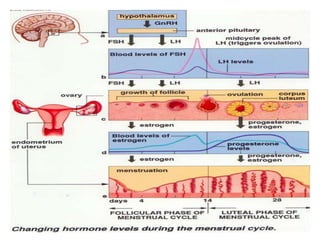
What Happens in the Ovaries
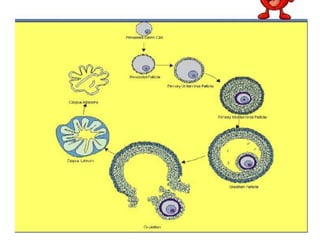
• Follicular phase - high levels of FSH secreted
– Function is to stimulate follicles in the ovaries
– One follicle begins to ripen and brings an egg to maturity
– Follicle secretes estrogen
• Ovulation - follicle ruptures open and releases the
ripened egg
• Luteal phase - after releasing an egg, the follicle turns
into the corpus luteum manufactures progesterone
• Menstruation - shedding of the inner lining of the
uterus
What Happens in the Uterus
• Follicular phase - endometrium proliferates
• Luteal phase - progesterone secreted by the
corpus luteum stimulates the glands of the
endometrium to start secreting the
nourishing substances.
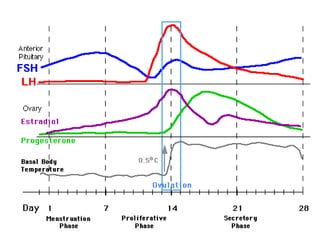
• Corpus luteum continues to produce estrogen
and progesterone for about 10 to 12 days
• If pregnancy has not occurred, its hormone
output declines
Length and Timing of the Cycle
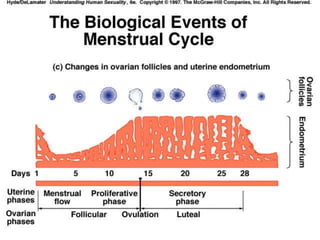
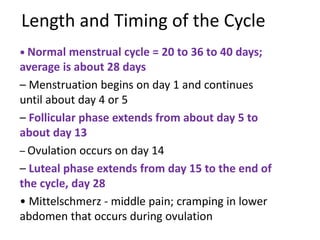
• Normal menstrual cycle = 20 to 36 to 40 days;
average is about 28 days
– Menstruation begins on day 1 and continues
until about day 4 or 5
– Follicular phase extends from about day 5 to
about day 13
– Ovulation occurs on day 14
– Luteal phase extends from day 15 to the end of
the cycle, day 28
• Mittelschmerz - middle pain; cramping in lower
abdomen that occurs during ovulation
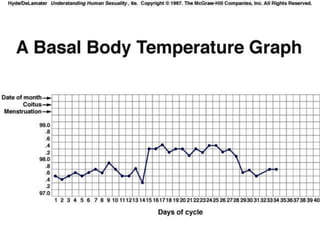
Other Cyclic Changes
• Two other physiological processes
fluctuate with the menstrual cycle:
– The cervical mucus cycle
– The basal body temperature cycle
Menstrual cycle ppt nitin

Menstrual cycle ppt nitin

  • 1.
  • 2.
    Biology and theMenstrual Cycle • Menstrual cycle is regulated by fluctuating levels of sex hormones and pituatary Hormones. • These hormones produce certain changes in the ovaries and uterus.
  • 3.
    The Phases ofthe Menstrual Cycle 1. Follicular phase - proliferative phase or preovulatory phase 2. Ovulation 3. Luteal phase - secretory phase or postovulatory phase 4. Menstruation
  • 4.
    What Happens inthe Ovaries • Follicular phase - high levels of FSH secreted – Function is to stimulate follicles in the ovaries – One follicle begins to ripen and brings an egg to maturity – Follicle secretes estrogen • Ovulation - follicle ruptures open and releases the ripened egg • Luteal phase - after releasing an egg, the follicle turns into the corpus luteum manufactures progesterone • Menstruation - shedding of the inner lining of the uterus
  • 6.
    What Happens inthe Uterus • Follicular phase - endometrium proliferates • Luteal phase - progesterone secreted by the corpus luteum stimulates the glands of the endometrium to start secreting the nourishing substances. • Corpus luteum continues to produce estrogen and progesterone for about 10 to 12 days • If pregnancy has not occurred, its hormone output declines
  • 10.
    Length and Timingof the Cycle • Normal menstrual cycle = 20 to 36 to 40 days; average is about 28 days – Menstruation begins on day 1 and continues until about day 4 or 5 – Follicular phase extends from about day 5 to about day 13 – Ovulation occurs on day 14 – Luteal phase extends from day 15 to the end of the cycle, day 28 • Mittelschmerz - middle pain; cramping in lower abdomen that occurs during ovulation
  • 11.
    Other Cyclic Changes •Two other physiological processes fluctuate with the menstrual cycle: – The cervical mucus cycle – The basal body temperature cycle