DONE BY : SHEENA JOSE
ST. JACOBS TRAINING COLLEGE
MENAMKULAM
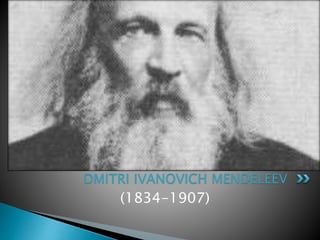
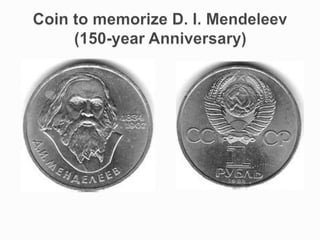
(1834-1907)
DMITRI IVANOVICH MENDELEEV
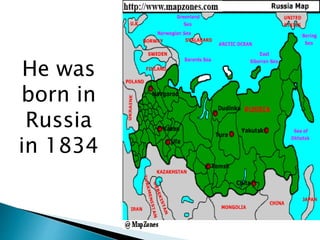
He was
born in
Russia
in 1834
He always
tried to be
the best
that he
could be,
And chose
to make
his mark in
chemistry.
Dmitri Ivanovich Mendeleev was his full
name
Born in Tobolsk, Siberia, Russia
He was a Russian chemist
Born on February 8, 1834
Parents were Ivan Pavlovich Mendeleev and
Maria Dmitrievna Kornilieva
Mendeleev died on February 2, 1907
Studied at St. Petersburg and graduated in 1856
After graduating from St. Petersburg he was
appointed to a professorship
Three years after being appointed to a
professorship he succeeded to the chair in the
University
He was considered one of the greatest teachers of
his time
Davy Medal from Royal Society of England in
1882
Domindov Proze for his book "Organic
Chemistry"
Copley Medal from the Royal Society of
England (its highest award) in 1905
In 1893, he was appointed the Director of the
Bureau of Weights and Measures.
In 1905 Dmitri Mendeleev was elected a
member of the Royal Swedish Academy of
Sciences.
The crater Mendeleev on the Moon, as well as
an element number 101, the radioactive
Mendelevium, are named after him.
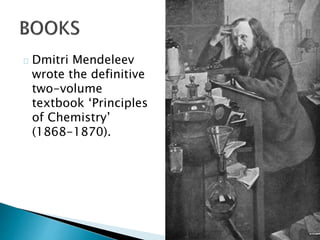
Dmitri Mendeleev
wrote the definitive
two-volume
textbook ‘Principles
of Chemistry’
(1868-1870).
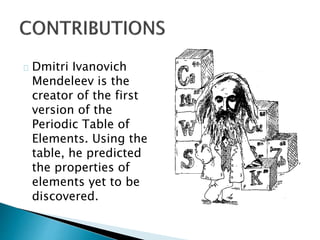
Dmitri Ivanovich
Mendeleev is the
creator of the first
version of the
Periodic Table of
Elements. Using the
table, he predicted
the properties of
elements yet to be
discovered.
He investigated the heat expansion of liquids,
and devised a formula similar to Gay-Lussac's
law of the uniformity of the expansion of
gases
He investigated the composition of oil fields,
and helped to found the first oil refinery in
Russia.
He formulated new state standards for the
production of vodka
He invented pyrocollodion, a kind of
smokeless powder based on nitrocellulose.
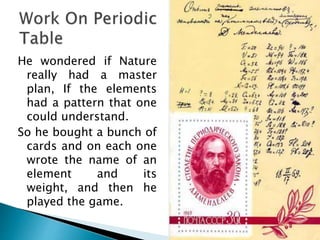
He wondered if Nature
really had a master
plan, If the elements
had a pattern that one
could understand.
So he bought a bunch of
cards and on each one
wrote the name of an
element and its
weight, and then he
played the game.
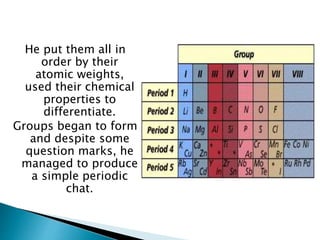
He put them all in
order by their
atomic weights,
used their chemical
properties to
differentiate.
Groups began to form
and despite some
question marks, he
managed to produce
a simple periodic
chat.
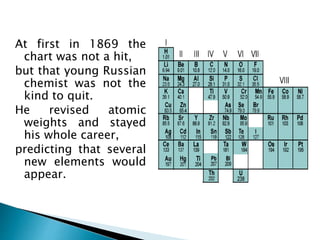
At first in 1869 the
chart was not a hit,
but that young Russian
chemist was not the
kind to quit.
He revised atomic
weights and stayed
his whole career,
predicting that several
new elements would
appear.
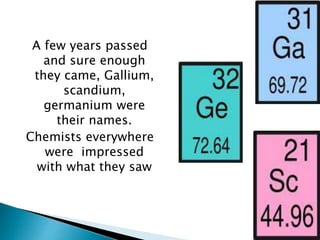
A few years passed
and sure enough
they came, Gallium,
scandium,
germanium were
their names.
Chemists everywhere
were impressed
with what they saw
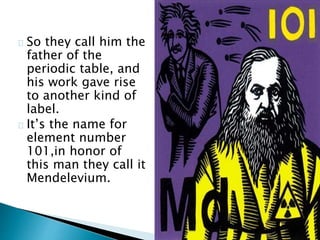
So they call him the
father of the
periodic table, and
his work gave rise
to another kind of
label.
It’s the name for
element number
101,in honor of
this man they call it
Mendelevium.
Classification: is an actinide metal
Atomic weight: 258
State: solid
Melting point: 827 oC, 1100 K
Electrons: 101
Protons: 101
isotope: 157
Electron shells: 2,8,18,32,31,8,2
Electron configuration: [Rn] 5f12 7s2
MENDELEEV
MENDELEEV

MENDELEEV

  • 1.
    DONE BY :SHEENA JOSE ST. JACOBS TRAINING COLLEGE MENAMKULAM
  • 2.
  • 3.
  • 4.
    He always tried tobe the best that he could be, And chose to make his mark in chemistry.
  • 5.
    Dmitri Ivanovich Mendeleevwas his full name Born in Tobolsk, Siberia, Russia He was a Russian chemist Born on February 8, 1834 Parents were Ivan Pavlovich Mendeleev and Maria Dmitrievna Kornilieva Mendeleev died on February 2, 1907
  • 6.
    Studied at St.Petersburg and graduated in 1856 After graduating from St. Petersburg he was appointed to a professorship Three years after being appointed to a professorship he succeeded to the chair in the University He was considered one of the greatest teachers of his time
  • 8.
    Davy Medal fromRoyal Society of England in 1882 Domindov Proze for his book "Organic Chemistry" Copley Medal from the Royal Society of England (its highest award) in 1905
  • 9.
    In 1893, hewas appointed the Director of the Bureau of Weights and Measures. In 1905 Dmitri Mendeleev was elected a member of the Royal Swedish Academy of Sciences. The crater Mendeleev on the Moon, as well as an element number 101, the radioactive Mendelevium, are named after him.
  • 10.
    Dmitri Mendeleev wrote thedefinitive two-volume textbook ‘Principles of Chemistry’ (1868-1870).
  • 11.
    Dmitri Ivanovich Mendeleev isthe creator of the first version of the Periodic Table of Elements. Using the table, he predicted the properties of elements yet to be discovered.
  • 12.
    He investigated theheat expansion of liquids, and devised a formula similar to Gay-Lussac's law of the uniformity of the expansion of gases He investigated the composition of oil fields, and helped to found the first oil refinery in Russia. He formulated new state standards for the production of vodka He invented pyrocollodion, a kind of smokeless powder based on nitrocellulose.
  • 13.
    He wondered ifNature really had a master plan, If the elements had a pattern that one could understand. So he bought a bunch of cards and on each one wrote the name of an element and its weight, and then he played the game.
  • 14.
    He put themall in order by their atomic weights, used their chemical properties to differentiate. Groups began to form and despite some question marks, he managed to produce a simple periodic chat.
  • 15.
    At first in1869 the chart was not a hit, but that young Russian chemist was not the kind to quit. He revised atomic weights and stayed his whole career, predicting that several new elements would appear.
  • 16.
    A few yearspassed and sure enough they came, Gallium, scandium, germanium were their names. Chemists everywhere were impressed with what they saw
  • 17.
    So they callhim the father of the periodic table, and his work gave rise to another kind of label. It’s the name for element number 101,in honor of this man they call it Mendelevium.
  • 18.
    Classification: is anactinide metal Atomic weight: 258 State: solid Melting point: 827 oC, 1100 K Electrons: 101 Protons: 101 isotope: 157 Electron shells: 2,8,18,32,31,8,2 Electron configuration: [Rn] 5f12 7s2