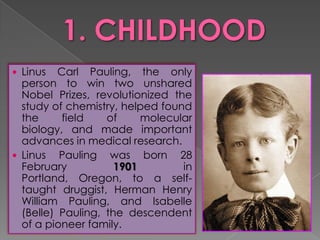
 Linus   Carl Pauling, the only
  person to win two unshared
  Nobel Prizes, revolutionized the
  study of chemistry, helped found
  the      field   of     molecular
  biology, and made important
  advances in medical research.
 Linus Pauling was born 28
  February           1901        in
  Portland, Oregon, to a self-
  taught druggist, Herman Henry
  William Pauling, and Isabelle
  (Belle) Pauling, the descendent
  of a pioneer family.
 At age 16 Pauling dropped
  out to enroll at Oregon
  Agricultural College (now
  Oregon                     State
  University), intending to pursue
  a    degree       in   chemical
  engineering.

Pauling quickly demonstrated that he knew more
about chemistry than many of his professors!!!
   By the time he graduated as a chemical
    engineer in 1922 he had set his sights on
    answering one of the most important questions
    of chemistry: how did atoms bond together to
    form molecules?. He enrolled in the first
    graduate program that offered adequate
    support, choosing a fledgling Pasadena
    research school, the California Institute of
    Technology, or Caltech
   Pauling earned his Ph.D. in 1925, and
    then spent 15 months in Europe on a
    Guggenheim Fellowship, intending to
    study the basics of atomic structure.
    Pauling returned to Caltech in 1927 as
    a faculty member, and began to
    apply     quantum     mechanics     to
    problems of chemical structure and
    function. His 1939 work, The Nature of
    the Chemical Bond, encapsulated his
    ideas and quickly became a standard
    work in the field.

At the age of 38, Pauling was a full professor and head of
the chemistry division at Caltech, and the father of four
children .
 During the 1930s he shifted his structural studies to large
  biomolecules, especially proteins.
 In World War II, he patented an armor-piercing
  shell, invented an oxygen meter for submarines, and was
  offered the chance to head the chemistry program at the
  top-secret Manhattan Project because it would mean
  uprooting his family.

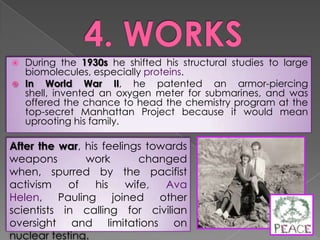
After the war, his feelings towards
weapons        work        changed
when, spurred by the pacifist
activism    of   his    wife,  Ava
Helen, Pauling joined other
scientists in calling for civilian
oversight and limitations on
nuclear testing.
 In    1949,      Pauling's   team
  discovered the molecular basis
  of sickle-cell anemia.
 In 1950s, determined the large-
  scale      structures   of   many
  proteins, the so-called "alpha-
  helix“.
 He      also    worked,    though
  unsuccessfully, on the structure
  of DNA.
   His many achievements were
     crowned with the awarding of
     the Nobel Prize in Chemistry in
     1954, "for his research into the
     nature of the chemical bond
     and its application to the
     elucidation of the structure of
     complex substances“.
His many achievements were crowned with
the awarding of the Nobel Prize in Chemistry
in 1954, "for his research into the nature of
the chemical bond and its application to the
elucidation of the structure of complex
substances“.
For over twenty years, between 1973
and 1994, Pauling's research focused
on a field he termed "orthomolecular
medicine".
He viewed vitamin C as one of the
most important of these molecules. In
1973 he co-founded a California
research institute devoted to the study
of the health effects of vitamin C and
other nutrients.
 He conducted research there until his
death from cancer in 1994, at age 93.
The Alpha Helix Proteins sits
in front of the home where
Linus Pauling lived from
age 9 to 16 on SE
Hawthorne Blvd., Portland.


                   HIS OWN
                   STAMP
Trabajo sobre Linus Pauling

Trabajo sobre Linus Pauling

  • 3.
     Linus Carl Pauling, the only person to win two unshared Nobel Prizes, revolutionized the study of chemistry, helped found the field of molecular biology, and made important advances in medical research.  Linus Pauling was born 28 February 1901 in Portland, Oregon, to a self- taught druggist, Herman Henry William Pauling, and Isabelle (Belle) Pauling, the descendent of a pioneer family.
  • 4.
     At age16 Pauling dropped out to enroll at Oregon Agricultural College (now Oregon State University), intending to pursue a degree in chemical engineering. Pauling quickly demonstrated that he knew more about chemistry than many of his professors!!!
  • 5.
    By the time he graduated as a chemical engineer in 1922 he had set his sights on answering one of the most important questions of chemistry: how did atoms bond together to form molecules?. He enrolled in the first graduate program that offered adequate support, choosing a fledgling Pasadena research school, the California Institute of Technology, or Caltech
  • 6.
    Pauling earned his Ph.D. in 1925, and then spent 15 months in Europe on a Guggenheim Fellowship, intending to study the basics of atomic structure. Pauling returned to Caltech in 1927 as a faculty member, and began to apply quantum mechanics to problems of chemical structure and function. His 1939 work, The Nature of the Chemical Bond, encapsulated his ideas and quickly became a standard work in the field. At the age of 38, Pauling was a full professor and head of the chemistry division at Caltech, and the father of four children .
  • 7.
     During the1930s he shifted his structural studies to large biomolecules, especially proteins.  In World War II, he patented an armor-piercing shell, invented an oxygen meter for submarines, and was offered the chance to head the chemistry program at the top-secret Manhattan Project because it would mean uprooting his family. After the war, his feelings towards weapons work changed when, spurred by the pacifist activism of his wife, Ava Helen, Pauling joined other scientists in calling for civilian oversight and limitations on nuclear testing.
  • 8.
     In 1949, Pauling's team discovered the molecular basis of sickle-cell anemia.  In 1950s, determined the large- scale structures of many proteins, the so-called "alpha- helix“.  He also worked, though unsuccessfully, on the structure of DNA.
  • 9.
    His many achievements were crowned with the awarding of the Nobel Prize in Chemistry in 1954, "for his research into the nature of the chemical bond and its application to the elucidation of the structure of complex substances“. His many achievements were crowned with the awarding of the Nobel Prize in Chemistry in 1954, "for his research into the nature of the chemical bond and its application to the elucidation of the structure of complex substances“.
  • 10.
    For over twentyyears, between 1973 and 1994, Pauling's research focused on a field he termed "orthomolecular medicine". He viewed vitamin C as one of the most important of these molecules. In 1973 he co-founded a California research institute devoted to the study of the health effects of vitamin C and other nutrients. He conducted research there until his death from cancer in 1994, at age 93.
  • 12.
    The Alpha HelixProteins sits in front of the home where Linus Pauling lived from age 9 to 16 on SE Hawthorne Blvd., Portland. HIS OWN STAMP