Unit 3: Memory
Think about it:If someone asked you what memory is (to define) memory, what would you say?Are there different types / kinds of memory? If so, brainstorm some.How important is the ability to remember? Why? Explain your thoughts?Without our memory we would not survive. Agree or disagree, and explain your choice.Without memories we would not know who we are. Agree or disagree, and explain your choice.
Memory:The concept of memory is difficult to define.Memory is one of those abilities that we take forgranted. Certainly memory is related to learning.Memory:Is the system or process by which the productsor results of learning are stored for future use.
There are many ways we memorize learned material:Serial Learning: - Material that has been learned must berepeated in the order which it was presented.Examples: 	- Phone numbers	- Simple procedure like how to make coffee  - Math equations
Paired-Associate Learning:Items to be recalled are learned in pairs. During recall,one member of the pair is presented and the other is tobe recalled.Example: Learning a foreign language, basic definitionstudy, etc.Free Recall: - When material that has been learned may be repeated in any order. Here the task is to remember as many items as possible, regardless of their orderExample: Essay Answers.
Read Handout: Initial Studies in Memory:Who was Herman Ebbinghaus?What are nonsense syllables and why are they important?Explain the curve of forgetting.What is a recognition test (provide an example).What is a relearning test? What does it show?
Music and Memory:Advertisers have found a strategy that emphasizes free recall. . . Use music.
How many commercials have you seen or heard that did not include music or a jingle?
Advertisers assume that we are more likely to remember brands and products if they are associated with catchy phrases or jingles.Surprisingly little research has been conducted to verify this assumptionResults of research that has been done are mixed:Some studies have yielded a positive correlation between memory and music, some have found no relationship, and still others have found that music can actually interfere with recall.Most psychologist conclude that items associated with musical jingles or catchy phrases are easier to retrieve from memory, but that pairing an item with music it does not necessarily enhance recognition of those items
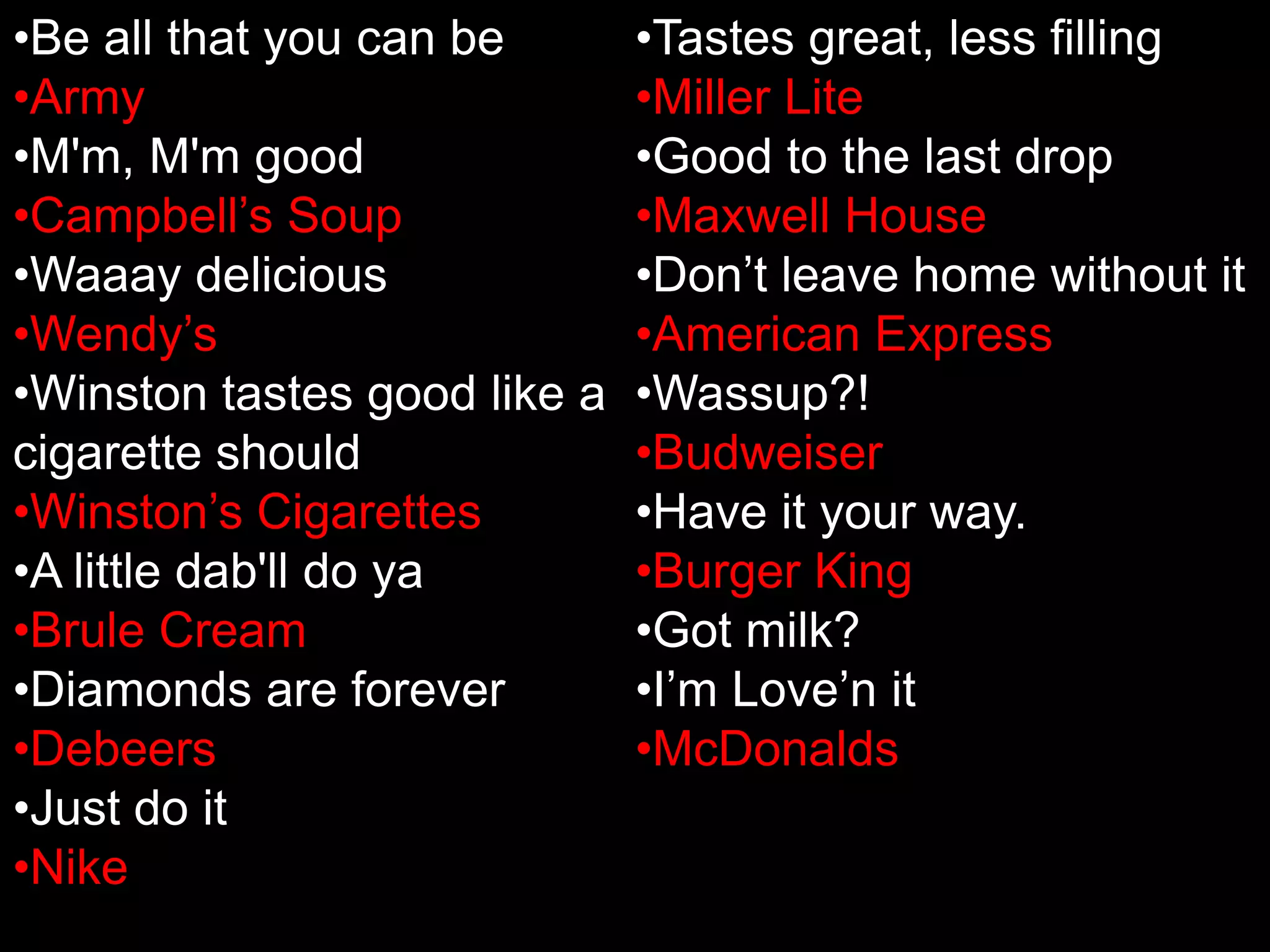
Let’s Test Your Memory for Advertisements:
Be all that you can be
Army
M'm, M'm good
Campbell’s Soup
Waaay delicious
Wendy’s
Winston tastes good like a cigarette should
Winston’s Cigarettes
A little dab'll do ya
Brule Cream
Diamonds are forever
Debeers
Just do it
Nike
Tastes great, less filling
Miller Lite
Good to the last drop
Maxwell House
Don’t leave home without it
American Express
Wassup?!
Budweiser
Have it your way.
Burger King
Got milk?
I’m Love’n it
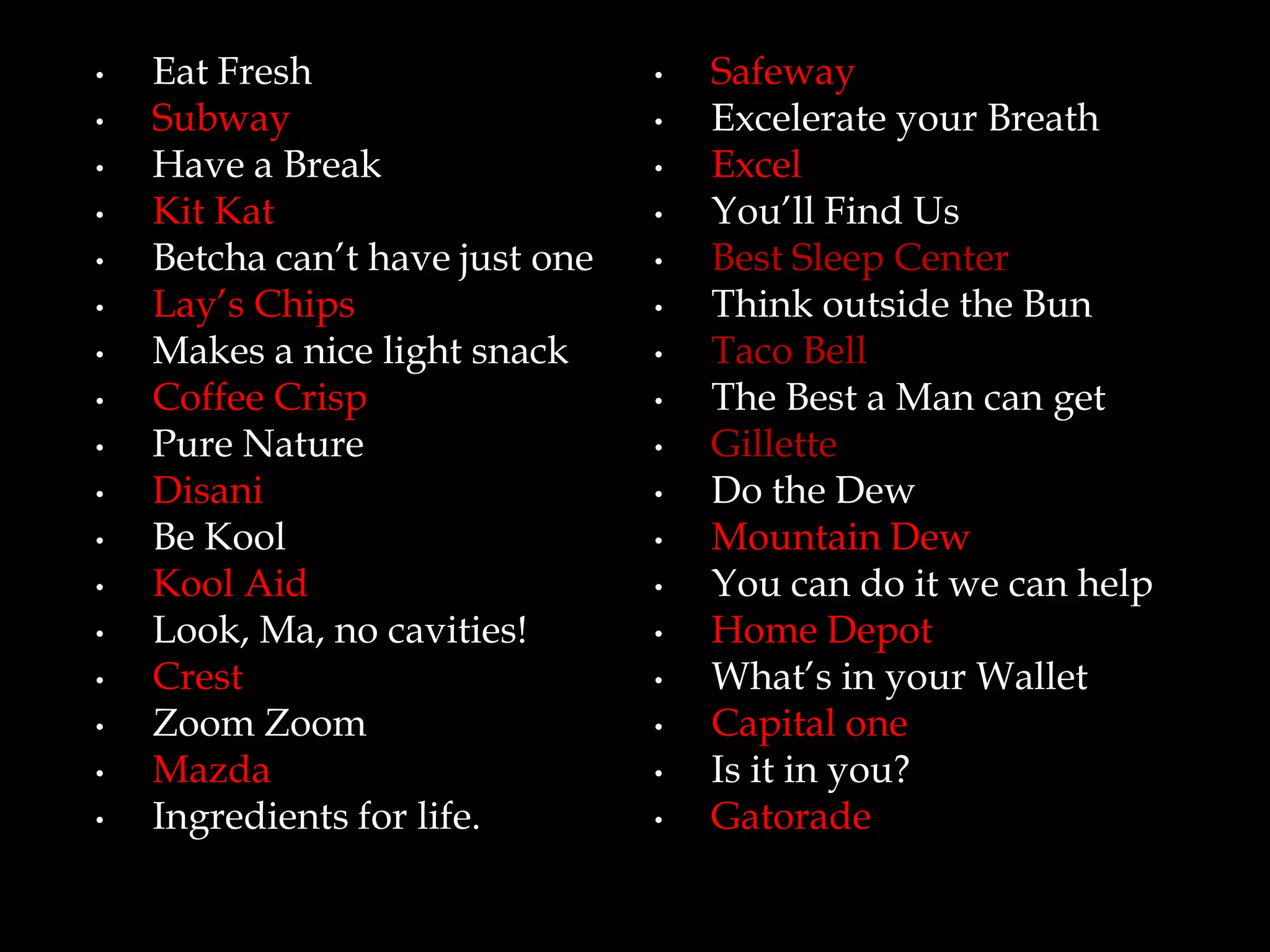
McDonaldsEat Fresh
Subway
Have a Break
Kit Kat
Betcha can’t have just one
Lay’s Chips
Makes a nice light snack
Coffee Crisp
Pure Nature
Disani
Be Kool
Kool Aid
Look, Ma, no cavities!
Crest
Zoom Zoom
Mazda
Ingredients for life.
Memory

  • 1.
  • 2.
    Think about it:Ifsomeone asked you what memory is (to define) memory, what would you say?Are there different types / kinds of memory? If so, brainstorm some.How important is the ability to remember? Why? Explain your thoughts?Without our memory we would not survive. Agree or disagree, and explain your choice.Without memories we would not know who we are. Agree or disagree, and explain your choice.
  • 3.
    Memory:The concept ofmemory is difficult to define.Memory is one of those abilities that we take forgranted. Certainly memory is related to learning.Memory:Is the system or process by which the productsor results of learning are stored for future use.
  • 4.
    There are manyways we memorize learned material:Serial Learning: - Material that has been learned must berepeated in the order which it was presented.Examples: - Phone numbers - Simple procedure like how to make coffee - Math equations
  • 5.
    Paired-Associate Learning:Items tobe recalled are learned in pairs. During recall,one member of the pair is presented and the other is tobe recalled.Example: Learning a foreign language, basic definitionstudy, etc.Free Recall: - When material that has been learned may be repeated in any order. Here the task is to remember as many items as possible, regardless of their orderExample: Essay Answers.
  • 6.
    Read Handout: InitialStudies in Memory:Who was Herman Ebbinghaus?What are nonsense syllables and why are they important?Explain the curve of forgetting.What is a recognition test (provide an example).What is a relearning test? What does it show?
  • 7.
    Music and Memory:Advertisershave found a strategy that emphasizes free recall. . . Use music.
  • 8.
    How many commercialshave you seen or heard that did not include music or a jingle?
  • 9.
    Advertisers assume thatwe are more likely to remember brands and products if they are associated with catchy phrases or jingles.Surprisingly little research has been conducted to verify this assumptionResults of research that has been done are mixed:Some studies have yielded a positive correlation between memory and music, some have found no relationship, and still others have found that music can actually interfere with recall.Most psychologist conclude that items associated with musical jingles or catchy phrases are easier to retrieve from memory, but that pairing an item with music it does not necessarily enhance recognition of those items
  • 10.
    Let’s Test YourMemory for Advertisements:
  • 11.
    Be all thatyou can be
  • 12.
  • 13.
  • 14.
  • 15.
  • 16.
  • 17.
    Winston tastes goodlike a cigarette should
  • 18.
  • 19.
  • 20.
  • 21.
  • 22.
  • 23.
  • 24.
  • 25.
  • 26.
  • 27.
    Good to thelast drop
  • 28.
  • 29.
  • 30.
  • 31.
  • 32.
  • 33.
  • 34.
  • 35.
  • 36.
  • 37.
  • 38.
  • 39.
  • 40.
  • 41.
  • 42.
  • 43.
    Makes a nicelight snack
  • 44.
  • 45.
  • 46.
  • 47.
  • 48.
  • 49.
    Look, Ma, nocavities!
  • 50.
  • 51.
  • 52.
  • 53.
  • 54.
  • 55.
  • 56.
  • 57.
  • 58.
  • 59.
  • 60.
  • 61.
    The Best aMan can get
  • 62.
  • 63.
  • 64.
  • 65.
    You can doit we can help
  • 66.
  • 67.
  • 68.
  • 69.
  • 70.
    GatoradeAtkinson-Shiffrin Model ofMemory:The encoding-storage-retrieval model of memory would serve our purpose well if we only had one type of memory to storeHowever, we have at least three well-defined types of memory:Sensory MemoryShort Term MemoryLong Term Memory
  • 71.
  • 72.
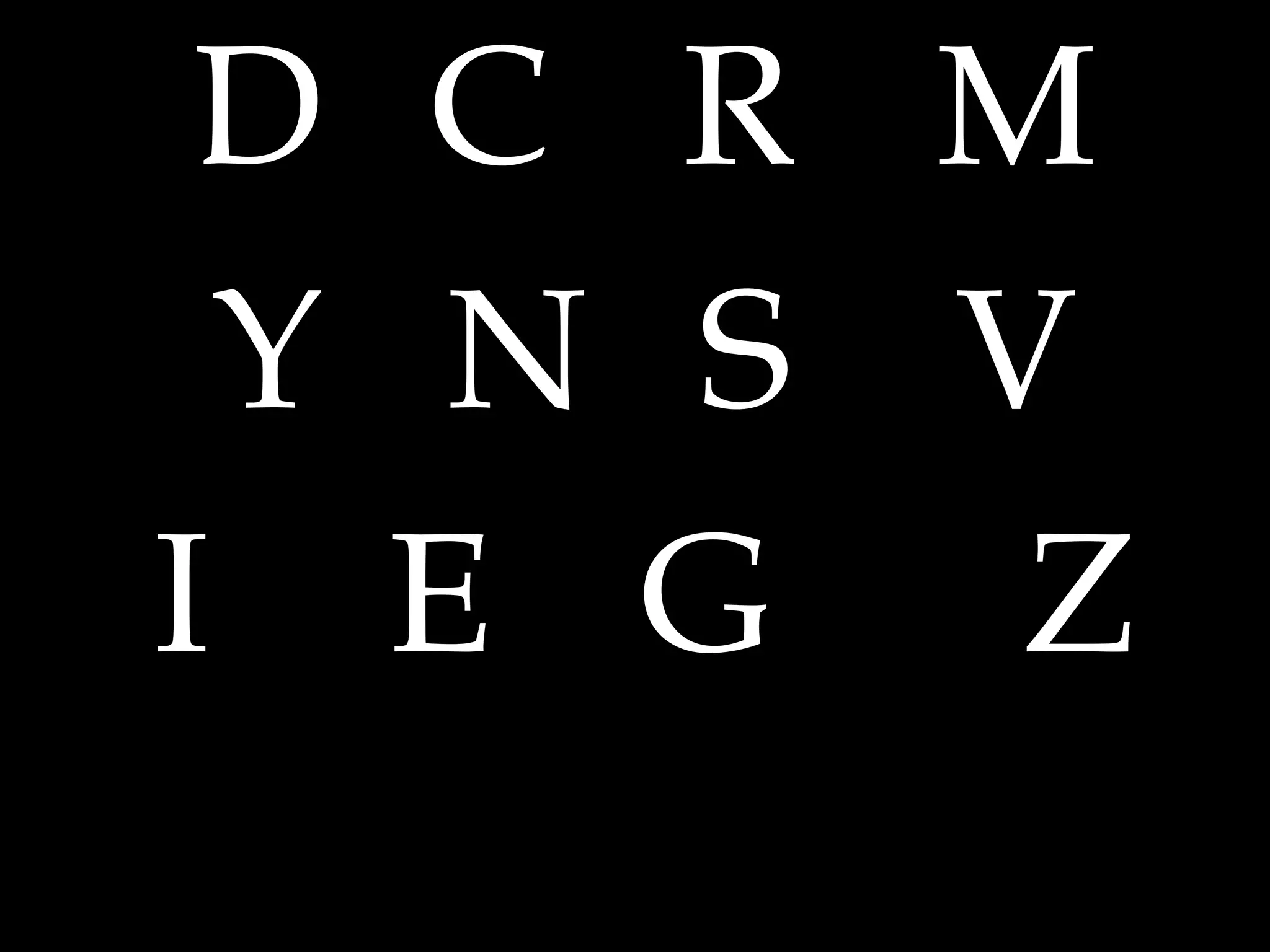
    Therefore the informationprocessing model of memory must be modified: Encoding – “type” of storage – RetrievalSensory Memory:Storage of sensory events such as sights, sounds, and tastes, with no further processing or interpretation
  • 73.
    Provides us witha very brief image of all the stimuli that are present at a particular moment
  • 74.
    it is quitelargeLasts only briefly about one half to one second, depending on which sensory systems are involvedSensory information that is not selected for further processing by higher brain centers is displaced by incoming stimuli and may be lost completely
  • 75.
    2. Short TermMemory:Once info has be selected from sensory memory, it is transferred to our conscious awareness
  • 76.
    Info must beprocessed in STM before it can be transferred to more permanent storage in LTM
  • 77.
    STM lasts onlyfor a short period of time
  • 78.
    It appears thatitems are lost from STM in 10 -20 secondsFor example: one study found that participants’ recall of a three-letter stimulus fell from 90% correct immediately following the presentation of the stimulus, to 5% correct after 18 secondsThere are two reasons for this: 1. Unless memories are practiced or rehearsed they become weaker and fade away 2. To make room for new incoming information some of the memories in STM are pushed out or displaced
  • 79.
    For example: Inthe same experiment as above participants counted backwards by threes (an interfering task) after learning the three-letter stimulus. The result was that most Short Term information was simply lost.
  • 80.
    George Miller andthe 7 Plus or Minus 2 ModelTheory states that we can hold approximately 7 (+-) 2 items in our STM
  • 81.
    What about phonenumbers that are 10 digits with the area code?
  • 82.
    Grouping or chunkingthings is the solution
  • 83.
    STM is limitedto five to nine items 7(+-)2, each of those items may consist of a chunk or group of itemsPhase Two: Working MemoryInitial 15-20 second STM leads to a second phase called working memory
  • 84.
    Working memory –the intermediate processing stage between STM and LTM, where attention and conscious effort are brought to bear on the materialFor example: you are in class listening to a lecture in which a definition is mentioned. While you hold what the teacher is saying in your STM, you retrieve word meaning from LTM. Then you use Working memory to make sense of the new sentence you just heard.
  • 85.
    Long Term Memory:Memorystage that has a very large capacity and the capability to store information relatively permanentlyRehearsal or practice is important in the transfer of information from STM into LTMTwo types of memory rehearsal: 1. Maintenance Rehearsal 2. Elaborative Rehearsal
  • 86.
    Two Types ofMemory Rehearsal to Move Material into LTM:Maintenance Rehearsal: rehearsal used when we want to save or maintain a memory for a specific period of time.
  • 87.
    Elaborative Rehearsal: Meaningis added to the material to be remembered.- This leads to more permanent memory and promotes transfer of information into LTM.
  • 88.
    Why do weforget?Some memory loss is due to fading or decay of memories over time (Curve of Forgetting)Other memory loss is caused by interferenceThere are two main types of memory interference:Proactive InterferenceRetroactive Interference
  • 89.
    Proactive Interference:Situation inwhich previously learned (old) informationhinders the recall of information learned more recently(new information)For example: You move into a new house but findyourself still using your old address and phone numberExample 2: In January many people continue to writethe previous year’s date
  • 90.
    2. Retroactive Interference:-Situation when information learned more recently(new information) hinders the recall of informationlearned previously (old information)- Models of memory suggests that when a memory isrecalled from LTM and enters our consciousness, it maybe combined with new information that have beenreceived, creating a new memory. - If this new modified memory is properly rehearsed itmay be transferred back to LTM for permanent storage
  • 91.
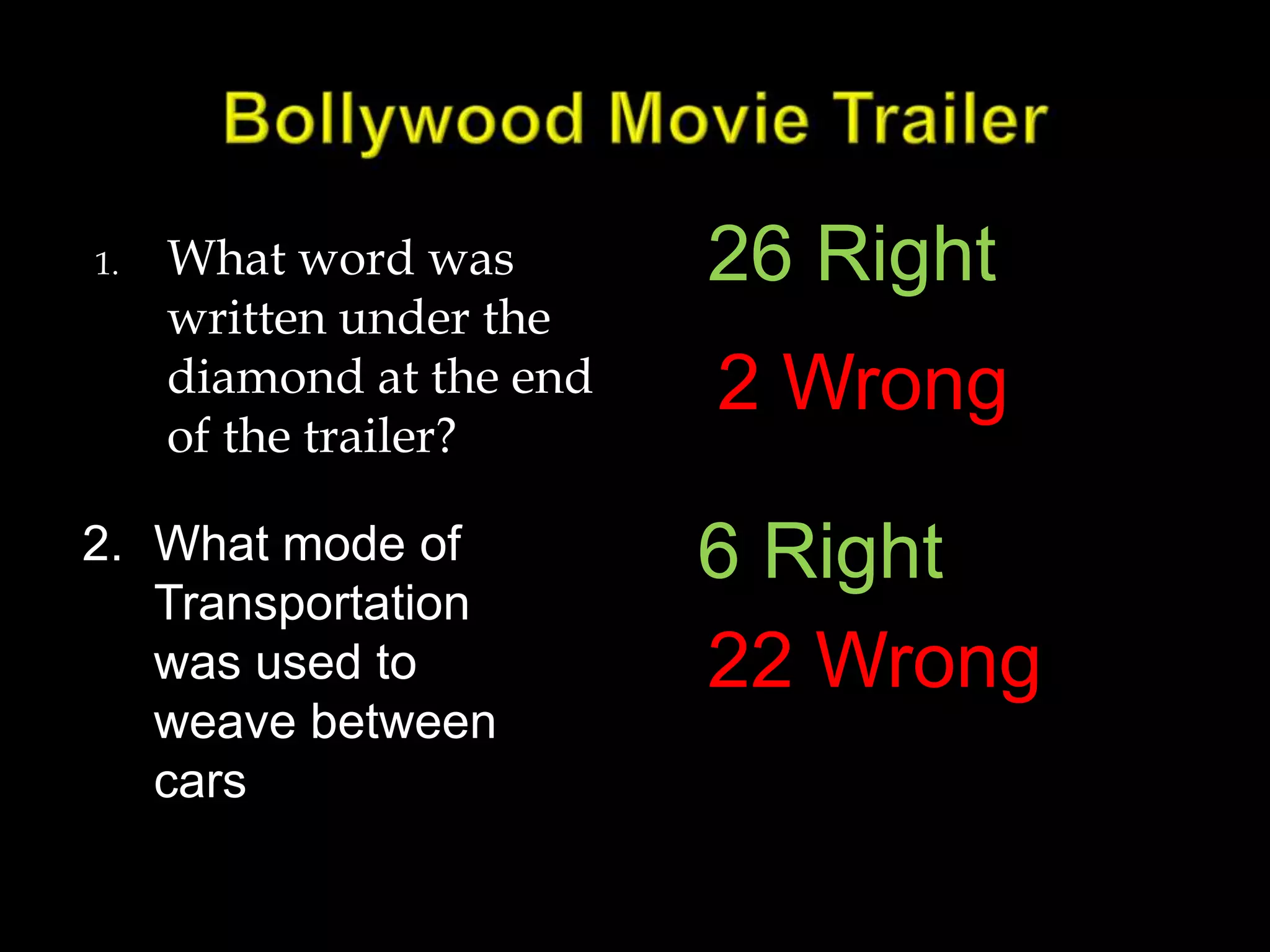
    Bollywood Movie Trailer26RightWhat word was written under the diamond at the end of the trailer?2 Wrong6 RightWhat mode of Transportation was used to weave between cars22 Wrong
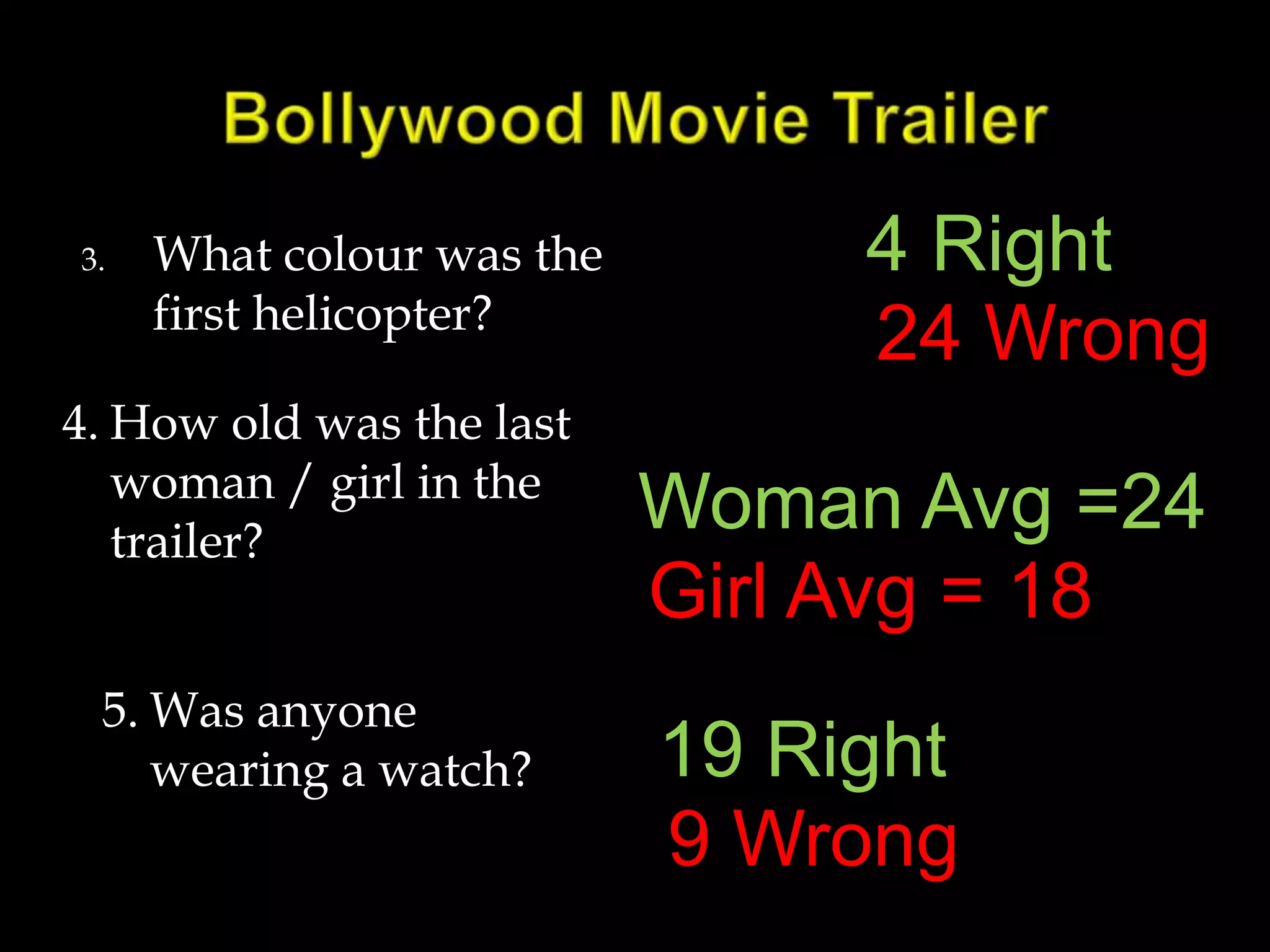
  • 92.
    Bollywood Movie Trailer4RightWhat colour was the first helicopter?24 WrongHow old was the last woman / girl in the trailer?Woman Avg =24Girl Avg = 18Was anyone wearing a watch?19 Right9 Wrong
  • 93.
    10 Techniques forImproving Memory:Influential Factors:1.Number of study sessions: - Generally the greater the number of sessions the better the learning and memory2. Distribution of Study Sessions: - Sessions should be spread out. Spaced practice is more effective than massed practice3. Meaningfulness of Material: - If you attach meaning you will learn better and remember longer
  • 94.
    4. Similarity ofitems: - a group of items of the same general type will be learned better than a group of dissimilar items5. Serial Positioning: - Items at the beginning and end of a study session or list will be learned better than items in the middle of the study session or list6. Mnemonic Devices: - When you are not able to attach authentic meaning to information, creating associations to help you remember the material will increase memory
  • 95.
    7. Imagery: - Creatingmental images or pictures in your mind enhances recognition and recall of information8. Grouping or Chunking: - grouping similar items together into categories helps to remember them better9. Coding: - Creating special codes to help learn material that lack relevance10. Exercise regularly – Both mind and body
  • 96.
    Memory Champ!What washis technique?Walk a path several timesThen hang a memory on each significant part of the path.We are going to do that.
  • 97.
    Here is theTaskWalk a path in the school.Classes are in session so you need to be silent.As you walk the path create 10 anchors.These could be rooms or teachers.It should be some place where you have a memory.Walk the path 4 times! Memorize the order of your anchors.Attach a memory technique on an anchor.Try to have meaning to the associationEx. Maybe Serial Positioning could be associated with the Foods’ Lab (Cereal -> food, get it?)
  • 98.
    Memory Reconstruction Article:Question#5 Will be discussed / presented and Handedin by group:Leader – Leads discussion / makes sure everyone has contributed ideasRecorder – Writes down group’s answers / thoughtsFocuser – Redirects the group back to the task at hand when they get off taskTime Keeper – reminds group of time remaining so that task gets completeReporter – Shares key points of the groups discussion with the whole class
  • 99.
    Different Types ofLTM3 Major types of LTM:ProceduralMemory for making responses and performing skilled actions.
  • 100.
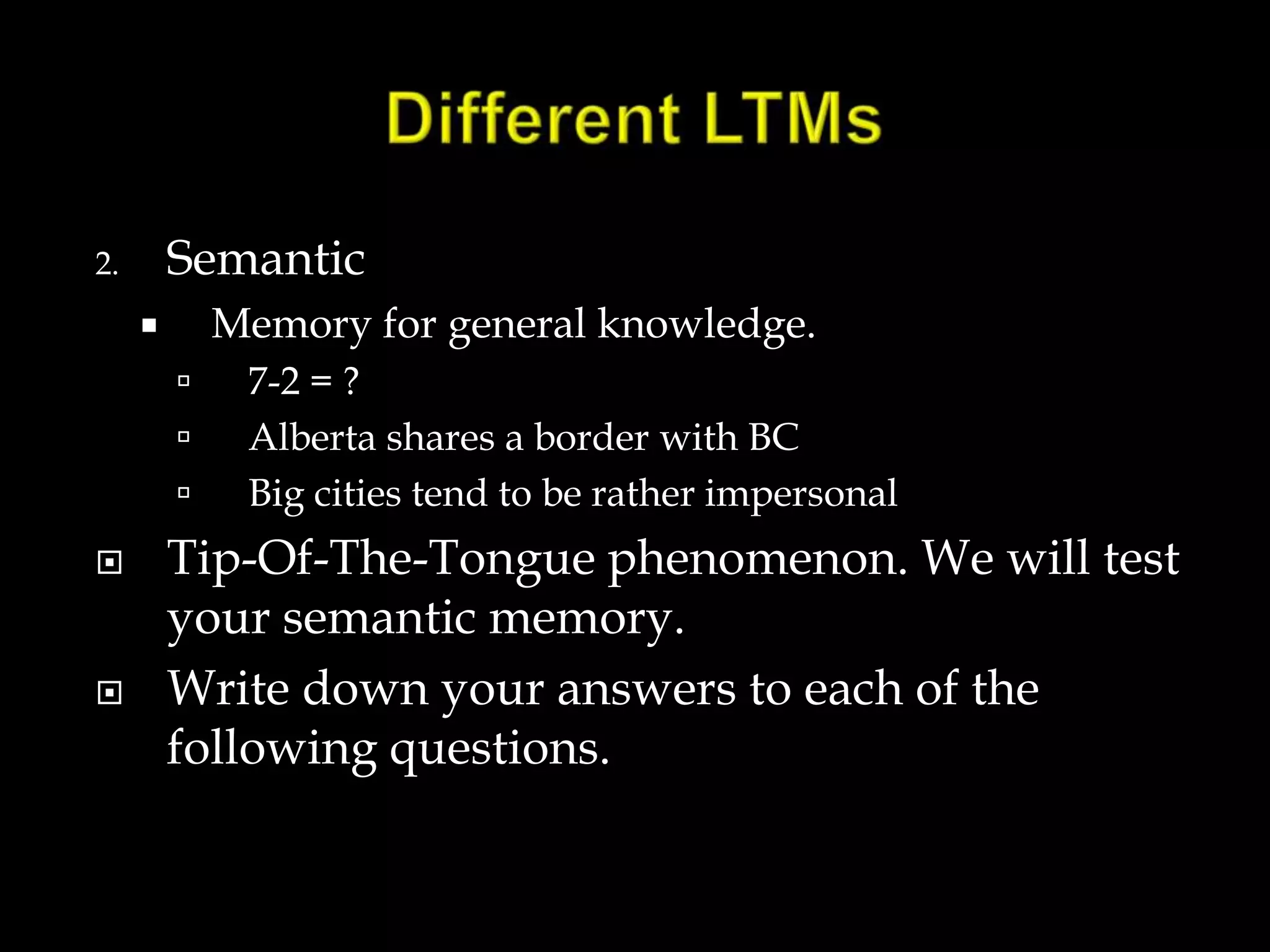
    Different LTMs SemanticMemory for general knowledge. 7-2 = ?Alberta shares a border with BCBig cities tend to be rather impersonalTip-Of-The-Tongue phenomenon. We will test your semantic memory.Write down your answers to each of the following questions.
  • 101.
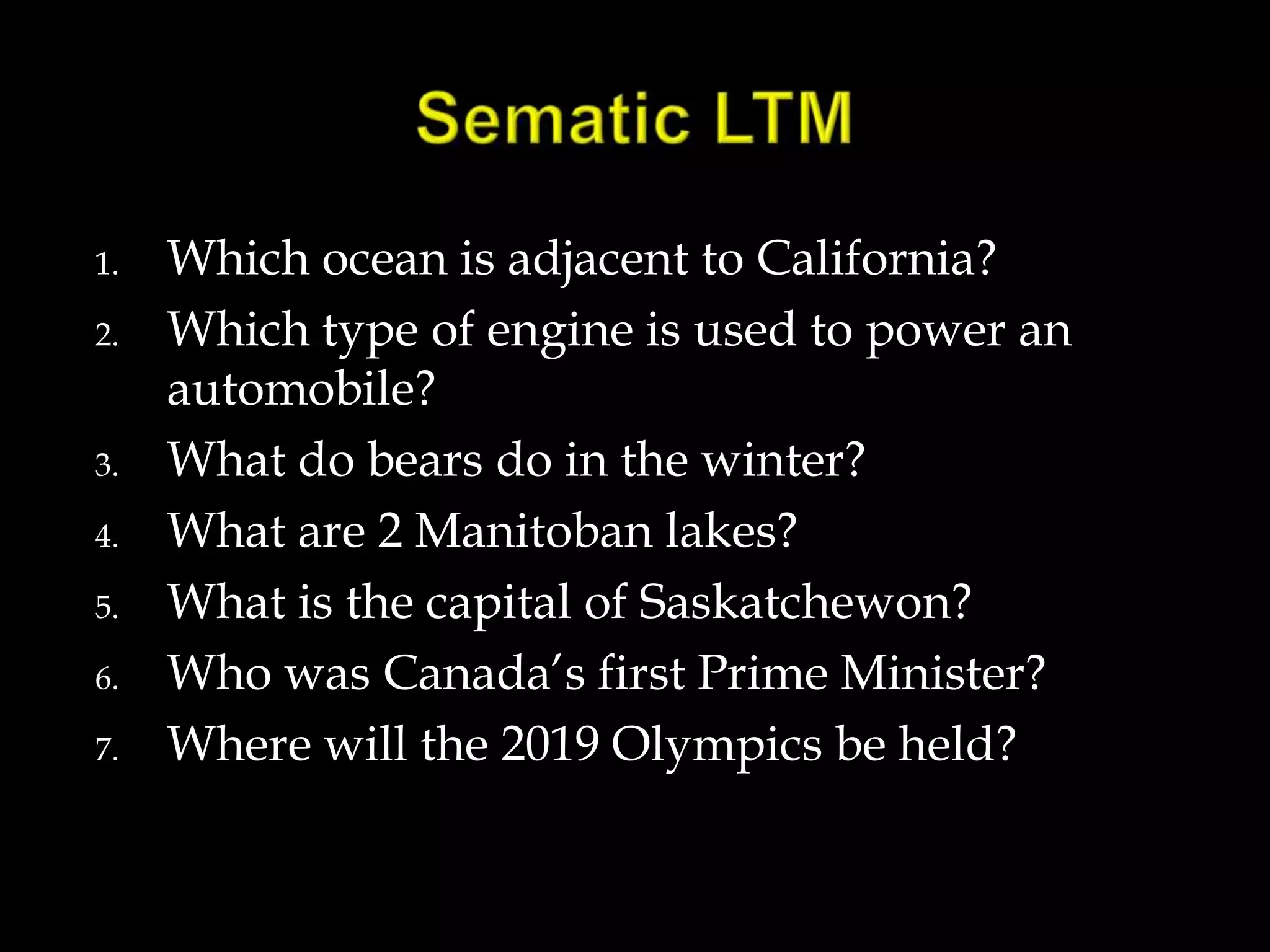
    Sematic LTMWhich oceanis adjacent to California?Which type of engine is used to power an automobile?What do bears do in the winter?What are 2 Manitoban lakes?What is the capital of Saskatchewon?Who was Canada’s first Prime Minister?Where will the 2019 Olympics be held?
  • 102.
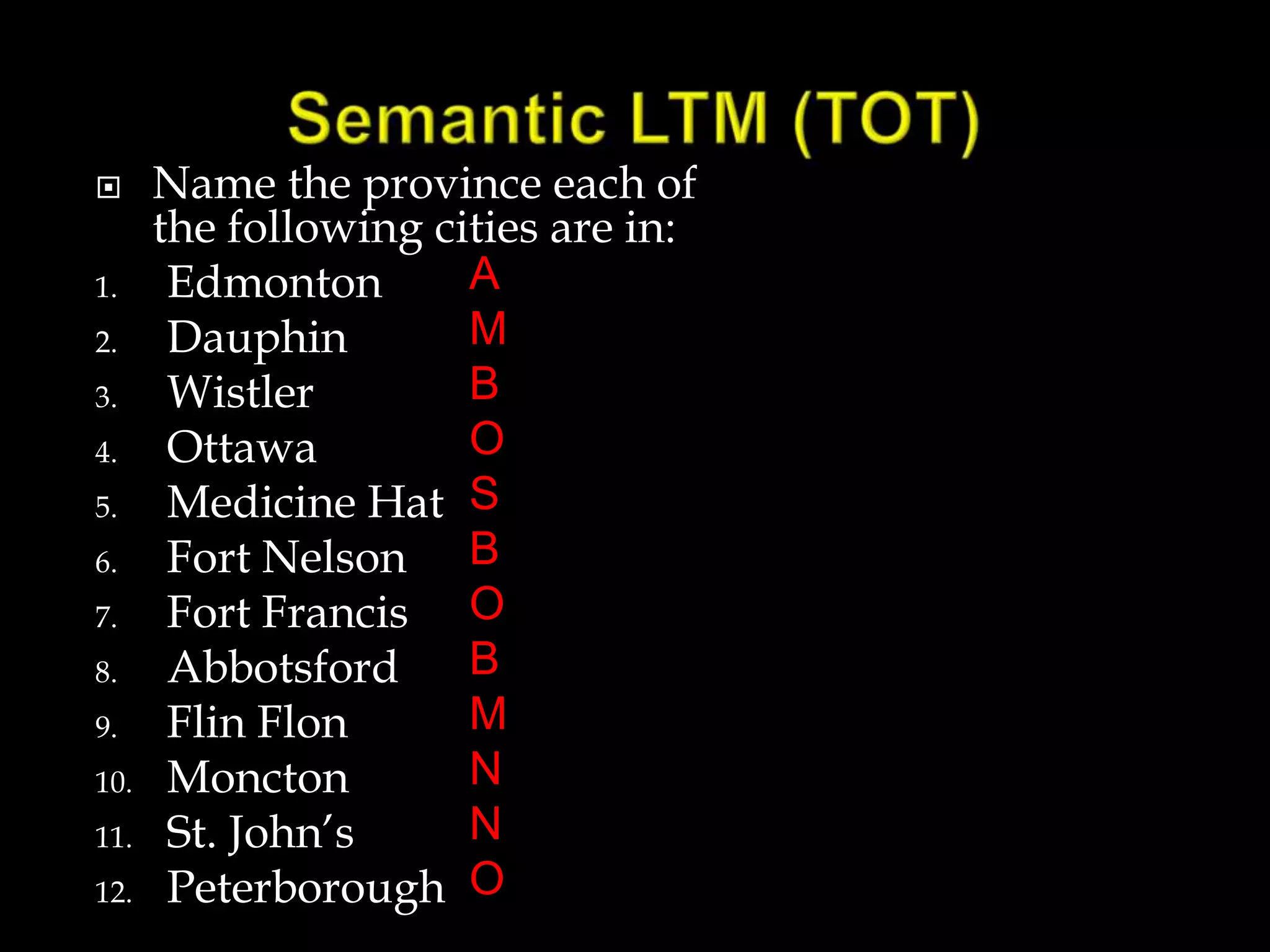
    Semantic LTM (TOT)Namethe province each of the following cities are in:EdmontonDauphinWistlerOttawaMedicine HatFort NelsonFort FrancisAbbotsfordFlinFlonMonctonSt. John’sPeterboroughAMBOSBOBMNNO
  • 103.
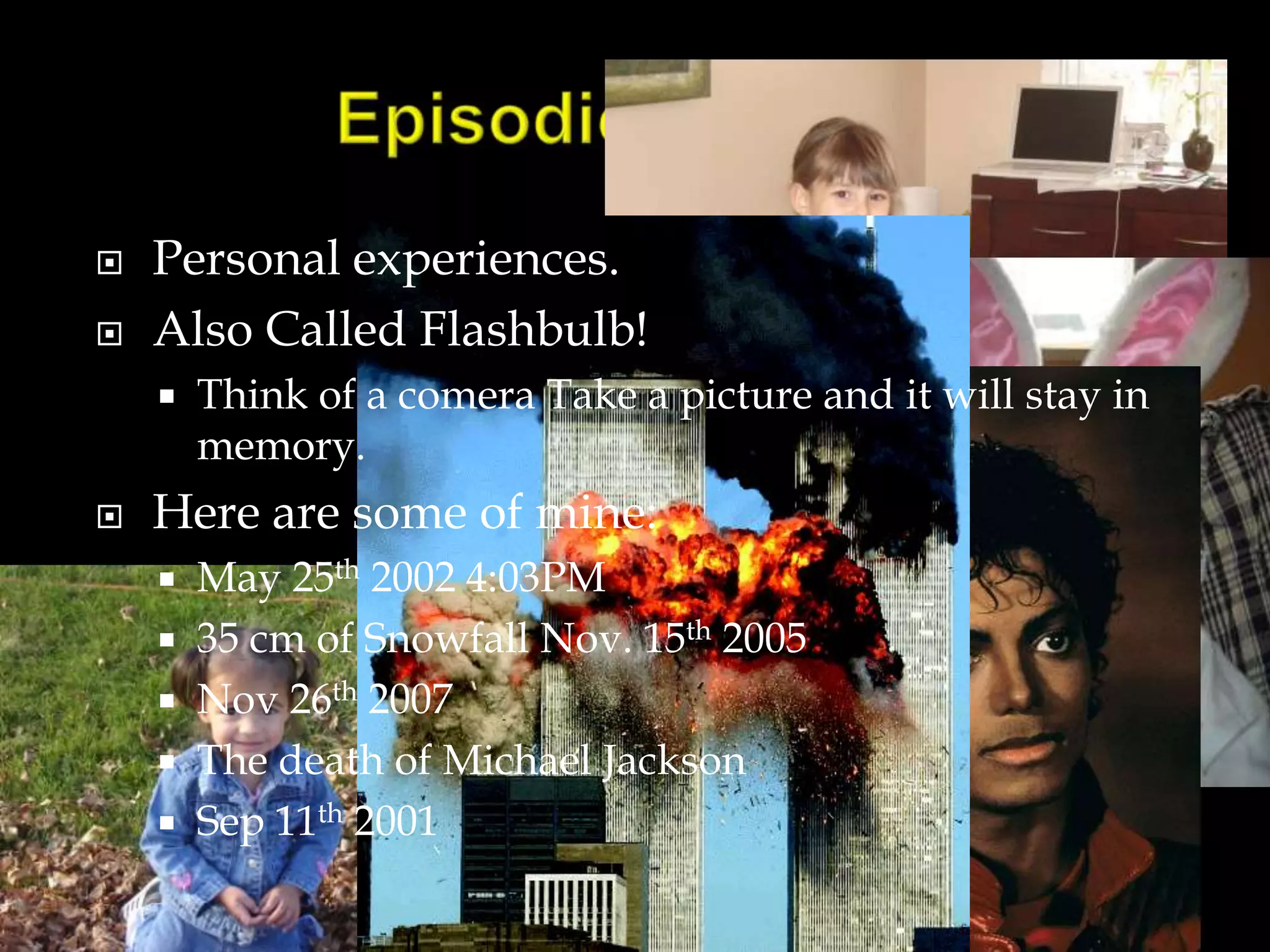
    Episodic MemoryPersonal experiences.AlsoCalled Flashbulb!Think of a comera Take a picture and it will stay in memory.Here are some of mine:May 25th 2002 4:03PM35 cm of Snowfall Nov. 15th 2005Nov 26th 2007The death of Michael JacksonSep 11th 2001
  • 104.
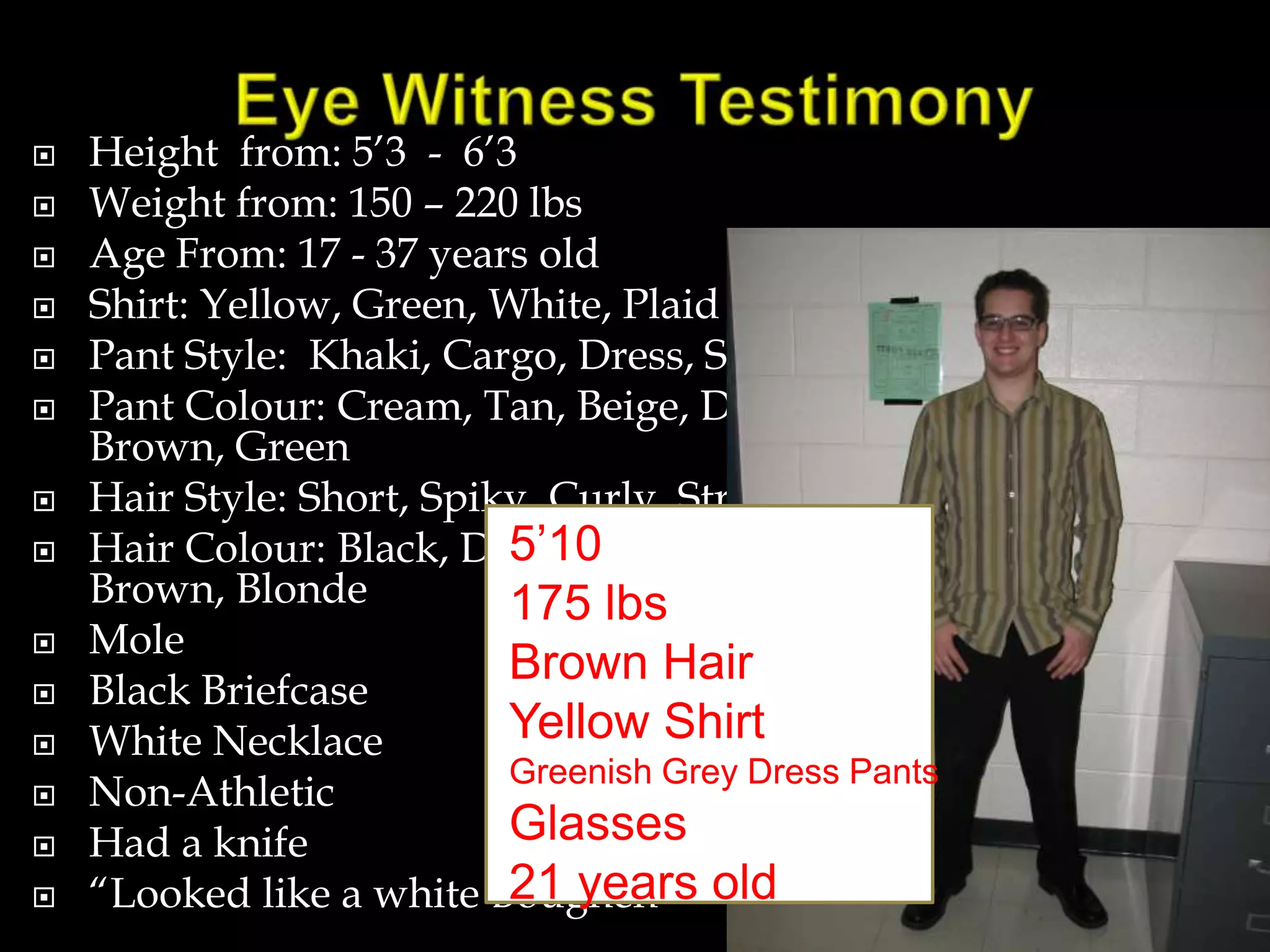
    Eye Witness TestimonyHeight from: 5’3 - 6’3Weight from: 150 – 220 lbsAge From: 17 - 37 years old Shirt: Yellow, Green, White, Plaid Pant Style: Khaki, Cargo, Dress, SlacksPant Colour: Cream, Tan, Beige, Dark, Black, Brown, GreenHair Style: Short, Spiky, Curly, StraightHair Colour: Black, Dark Brown, Light Brown, Brown, BlondeMoleBlack BriefcaseWhite NecklaceNon-AthleticHad a knife“Looked like a white Boughen”5’10175 lbsBrown HairYellow ShirtGreenish Grey Dress PantsGlasses21 years old
  • 105.
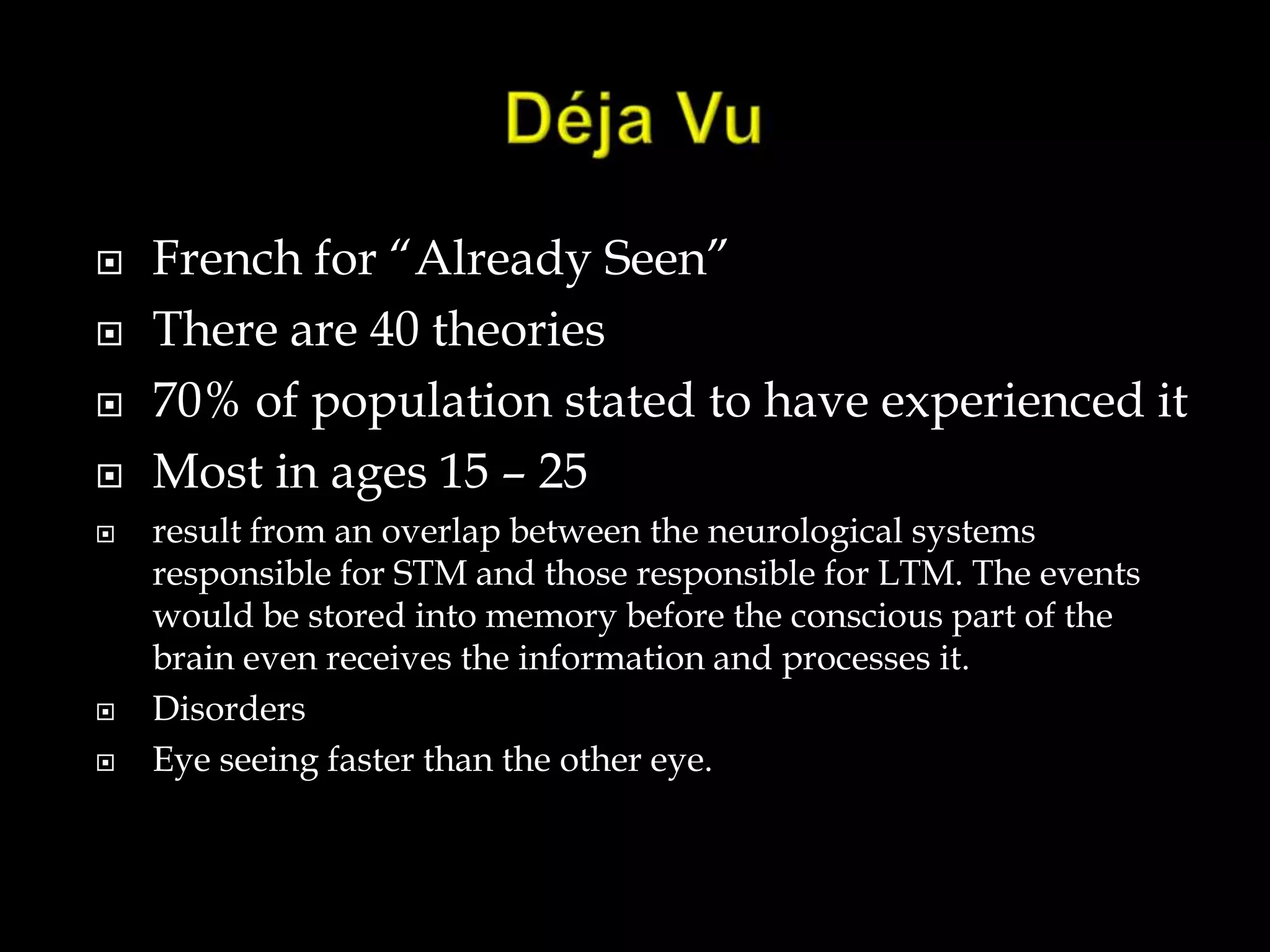
    Déja VuFrench for“Already Seen”There are 40 theories70% of population stated to have experienced itMost in ages 15 – 25result from an overlap between the neurological systems responsible for STM and those responsible for LTM. The events would be stored into memory before the conscious part of the brain even receives the information and processes it.DisordersEye seeing faster than the other eye.
  • 106.
    Eye- Witness TestimonyOneof the most intriguing applications of the “encoding specificity hypothesis” has been in the area of eye witness testimony
  • 107.
    Such testimony oftenplay an important part in jury trials
  • 108.
  • 109.
    What cues werepresent when the accident was present?
  • 110.
    What cues werepresent when the statement was made?
  • 111.
    Is it possiblefor the drivers of the 2 cars to modify the memories of the eye witness as they discussed the accident?When you retrieve a memory from LTM it is placed in STM. New information can then me added to the memory.
  • 112.
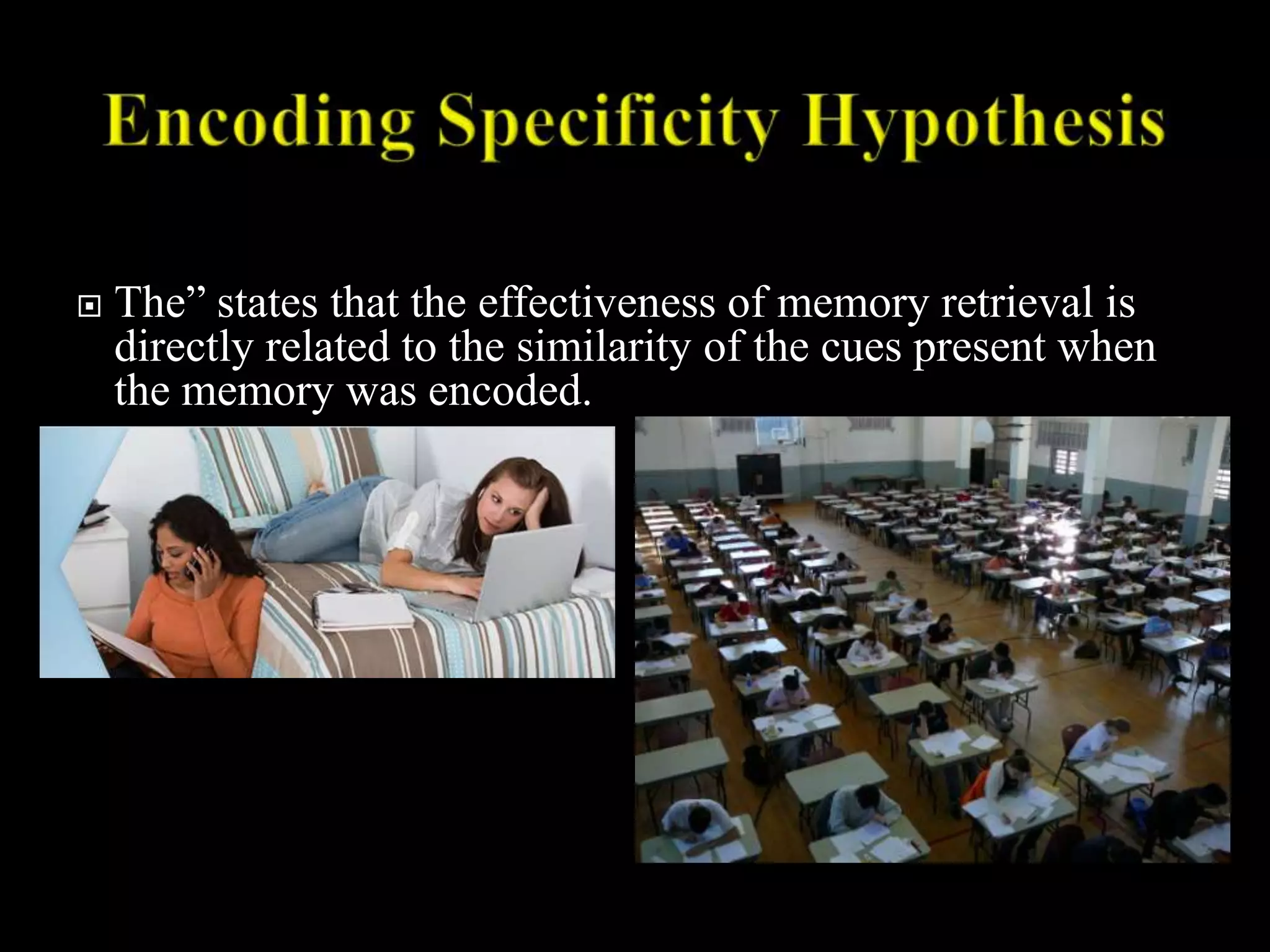
    Encoding Specificity HypothesisThe”states that the effectiveness of memory retrieval is directly related to the similarity of the cues present when the memory was encoded.
  • 113.
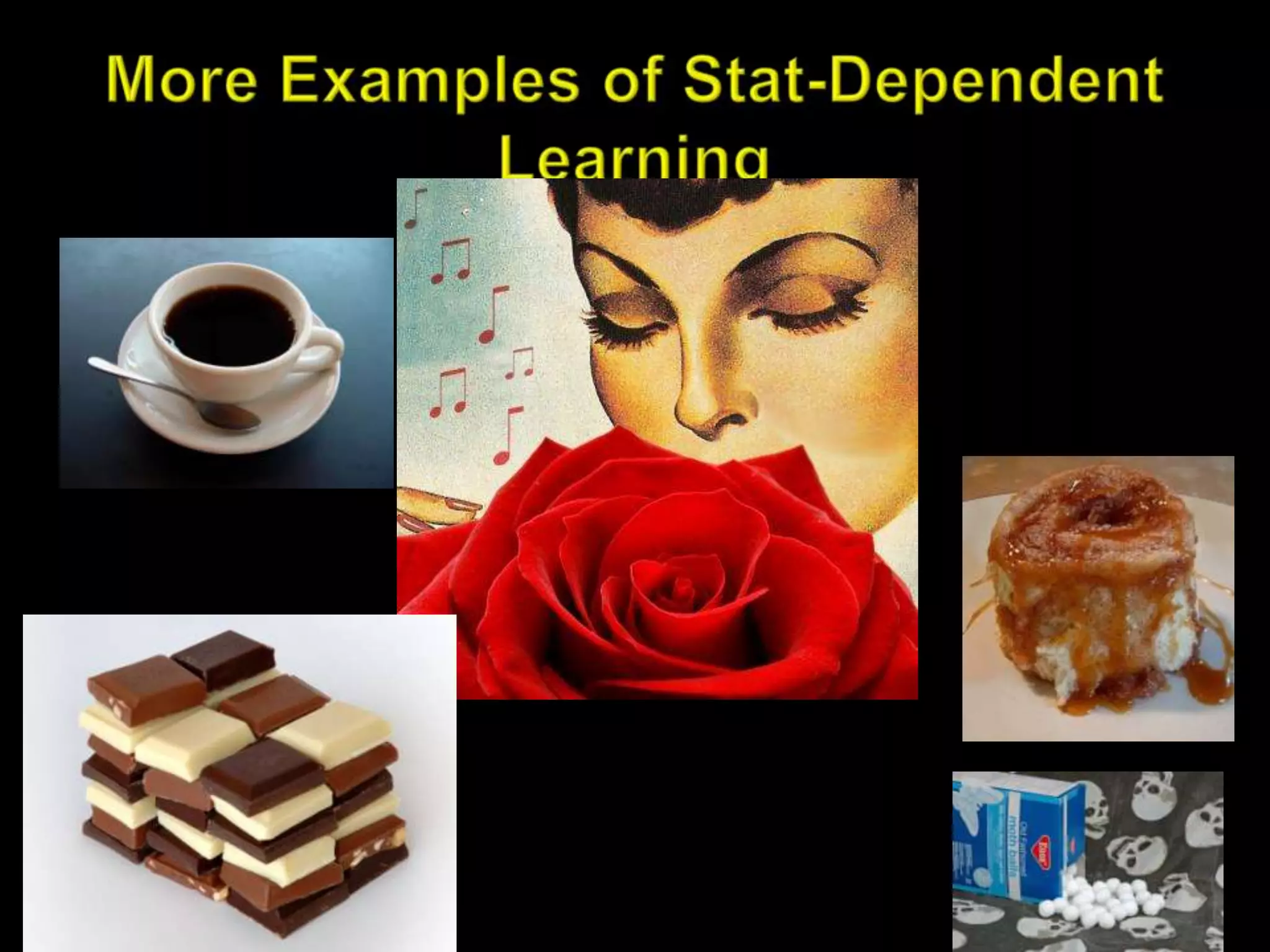
    More Examples ofStat-Dependent Learning
  • 114.
    Eyewitness Continued…The possibilitythat eyewitness reports may be inaccurate has stimulated a large amount of psychological research
  • 115.
    Psychologists have foundthat when a memory is retrieved from LTM, it appears to be placed in STM for processing
  • 116.
    While in STM it is possible to add new information to a memory and then re-encode the modified memory
  • 117.
    The next timeyou retrieve the new memory, your report may not correspond exactly to what actually happened because the new memory now contains the additional information
  • 118.
    This effect wastested in several experimentsconducted by Elizabeth LoftusElizabeth Loftus – Memory ResearchAmerican psychologist
  • 119.
    Focus of herwork was on human memory and how it can be changed by facts, ideas, suggestions and other forms of post-event information
  • 120.
    Her interest inmemory began with one of her first studies The Lost in the Mall experiment.
  • 121.
    Discovered what shetermed as “False Memory Syndrome”
  • 122.
  • 123.
    a memory biasthat occurs when misinformation affects people's reports of their own memory.Her Research:Famous Car Accident Reconstruction Experiment:Experiment:Two groups of people watched a series of slides that showed a collision between a red sports car and another automobile
  • 124.
    One groups sawthe red sports car approach a stop sign at the intersection, the second group saw the sports car approach a yield sign at the intersection
  • 125.
    After the slidepresentation was complete the participant were asked a series of questions about what they had seen.
  • 126.
    For half ofthe participants in each group the questions were consistent with what they had seen
  • 127.
    For the participantsin each group, the questions were inconsistent with what really happened – if they had seen a stop sign, the question referred to a yield sign, etc.
  • 128.
    Finally, all participantswere shown both pairs of slides and asked to pick the one they had actually seen.The results were startling:
  • 129.
    75% of individualswho were asked consistent questions after seeing the slides correctly picked the slide that they had seen
  • 130.
    Only 40% ofthe participants asked the inconsistent questions were able to select the slide they had actually seen.
  • 131.
    The experiment provedthat questioning had altered their memory of the incident
  • 132.
    Loftus repeated asimilar experiment, called the CrashExperiment and found similar results.
  • 133.
    Recently Loftus hadfound similar findings in what became known as the “Bugs Bunny” experimentIn addition to demonstrating the memory –alteringeffects of questioning. Loftus did many othercontroversial experiments involving the accuracy of eyewitness testimonies.Her findings all concluded three important things: 1. Participants have trouble distinguishing between individuals of other races 2. Violence interferes with memory retrieval 3. The degree of confidence of an eye witness is not related to the accuracy of the memory.
  • 134.
    Unit 5: Thinking,Language, Intelligence, and the Brain
  • 135.
    Think about it:Q1:What does it mean to have the ability to think? That is, what is thinking?
  • 136.
    Q2: What doesit mean to be intelligent?
  • 137.
    Q3: What arethe characteristics of an intelligent person?
  • 138.
    Q4:Is intelligence aresult of your genes (nature) or you environment (nurture)?
  • 139.
    Q5:Can a personlearn intelligence?