Dr Vandana Gaur
Associate Professor
Department of Psychology
SDM Govt PG College Doiwala Dehradun
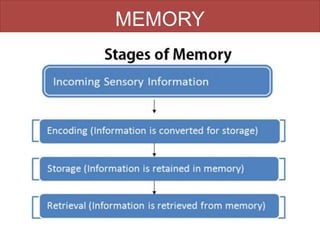
MEMORY
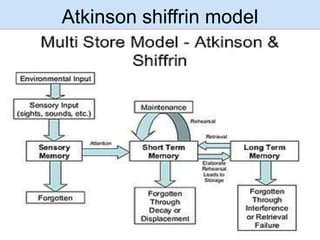
Atkinson shiffrin model
ATTKINSON AND SHIFFRIN MODEL
Sensory input - sensory register - STM- LTM
This model assumes-
That we humans have a three stage of memory that meets our
need to store information for different length of time. We seem to
have one memory store that holds information for exceedingly
brief intervals ,a second memory that holds information for no
more than 30 seconds unless it's renewed, and a third ,more
permanent memory .Each of these memory operates according to
different rules and serves somewhat different purposes. Because
information must pass through each memory to get to the next
more permanent one, these memory stores are best thought of as
three closely linked stages of memory.
Sensory Register
The first stage in memory-the sensory register -
designed to hold an exact image of each sensory
experience until it can be fully processed.
The information stored in the sensory register does not
last long. The sensory register holds an exact image of
each sensory experience for a very brief interval until it
can be fully processed.
Visual information in the sensory register is lost and
replaced so replaced so rapidly with new information
that we seldom are aware we even have such a memory
store.
SHORT-TERM MEMORY
When a bit of information is selected for further processing, it is
transferred into short-term memory or STM.
It's not necessary to intentionally transfer information to STM;
generally, just paying attention to the information is enough to
transfer it.
Rehearsal in STM : Overcoming STM'S limited life span
Information can be renewed in STM by mental repetition, or
rehearsal, of the information
Short-term memory holds information for about half minute.
1. information fades from short-term memory unless it is renewed
by rehearsal.
2. short-term memory has a limited capacity of 7+2 items(Miler-
1956).
3. The capacity of STM can be increased by organizing
information in to large chunks is called chunking.
LONG-TERM MEMORY
LTM, is the storehouse for information that must be kept for Long
period of time. But LTM is not just a more durable version of
STM; the stage model of memory suggests it's a different kind of
memory altogether.
LTM differs from STM in four major ways
1-how information is recalled
2-the form in which information is stored in memory
3- the reason that forgetting occurs, and
4- the physical location of these functions in the human brain(STM
is primarily a function of the frontal lobe of the cerebral cortex
,while information that is stored in LTM is first held in the
hippocampus and then transferred to the areas of the cerebral
cortex involved in language
and perception for permanent storage.
CATEGORIES OF LONG TERM MEMORY
according to Tulvin (1972,1985,1987) has proposed the
existence of three kinds of long term memory storage,
each with distinctly different properties and each
probably based on different brain activities.
1-Procedural memory refers to memory for skills and
other procedures.
2-Episodic memory refers to memory for specific
experience that can be defined in terms of time and
space.
3-Semantic memory refers to memory for meaning.
4-Declarative memory, which includes both episodic and
semantic memory, refers to memory that is described
easily in words.
RETRIEVAL OF LONG-TERM MEMORIES
Three ways of testing retrieval:
recall, recognition, and relearning
The relearning (or saving) method is the most
sensitive of all three of the methods of evaluating
memory. Even when you can neither recall nor
recognize information, it may be possible to
measure some memory of it using the relearning
method. In this method, you relearn previously
memorized information. If the learning takes less
time than the original learning, then some of the
information has been ā€œrememberedā€ in this sense.
THE ā€œTIP OF THE TONGUEā€ PHENOMENA
We all had the maddening experience of trying to recall
a fact that we can almost remember-it's on the ā€œtip of
tongue". It is important because it is consistent with the
notion that long-term memory is permanent.
The ā€œtip of tongueā€ phenomenon also tells us that
retrieval is not an ā€œall or noneā€ process. Instead, we
appear to recall bits of information related to target, such
as its starting letter or number of syllables, during our
search process. These cues might actually help us to
locate the target information, but we are not aware of
them unless the search is slow or unsuccessful.
Causes of Forgetting
There are four major causes of forgetting. each with different
relevance to the three stages of memory
A-Decay theory states that forgetting occurs simply because time
passes.
B-Interference theory states that forgetting occurs when other
memories interfere with retrieval. Interference can occur from
memories that were formed by prior learning(proactive
interference)or from memories that were formed by later
learning(retroactive interference).
C-Reconstruction theory states that memories retrieved from
LTM become partially distorted or totally unrecognizable during
the process.
D- Memory can be lost from long-term memory through
repression because they are unpleasant or
threatening(motivated forgetting).
BIOLOGICAL BASIS OF BEHAVIOR
A-Synaptic theories view the anagram as a change in
the pattern or strength of synaptic linkage between
neurons.
B-Amnesia is a major disorder of memory.
1-An inability to consciously retrieve new information
in LTM is anterograde amnesia. Damage causing
anterograde occurs in the hippocampus.
2-The inability to retrieve old, rather than new ,long-
term memories is known as retrograde amnesia.
C- Research on Alzheimer's disease has led to the
identification of chemicals that have been shown to
enhance memory in laboratory animals.
EYEWITNESS MEMORY
No evidence is more convincing to a jury than the
testimony of an eyewitness to the crime.
Eyewitness memory is a person's episodic memory for a
crime or other dramatic event that he or she has
witnessed. Eyewitness testimony is often relied upon in
the judicial system. It can also refer to an individual's
memory for a face, where they are required to remember
the face of their perpetrator, for example. However, the
accuracy of eyewitness memories is sometimes
questioned because there are many factors that can act
durind encoding and retrieval of the witnessed event
which may adversely affect
the creation and maintenance of the memory for the
event.
CAUSES OF EYEWITNESS MEMORY
• Inaccurate recall due to biased questioning.
• Inaccurate recall due to characteristics of the
eyewitness.
• Suggestive or misleading police procedures.
• The fact that witnesses tend to focus more on
weapons than a perpetrator's identity.
THANKS

MEMORY (1).pptx

  • 1.
    Dr Vandana Gaur AssociateProfessor Department of Psychology SDM Govt PG College Doiwala Dehradun
  • 2.
  • 3.
  • 4.
    ATTKINSON AND SHIFFRINMODEL Sensory input - sensory register - STM- LTM This model assumes- That we humans have a three stage of memory that meets our need to store information for different length of time. We seem to have one memory store that holds information for exceedingly brief intervals ,a second memory that holds information for no more than 30 seconds unless it's renewed, and a third ,more permanent memory .Each of these memory operates according to different rules and serves somewhat different purposes. Because information must pass through each memory to get to the next more permanent one, these memory stores are best thought of as three closely linked stages of memory.
  • 5.
    Sensory Register The firststage in memory-the sensory register - designed to hold an exact image of each sensory experience until it can be fully processed. The information stored in the sensory register does not last long. The sensory register holds an exact image of each sensory experience for a very brief interval until it can be fully processed. Visual information in the sensory register is lost and replaced so replaced so rapidly with new information that we seldom are aware we even have such a memory store.
  • 6.
    SHORT-TERM MEMORY When abit of information is selected for further processing, it is transferred into short-term memory or STM. It's not necessary to intentionally transfer information to STM; generally, just paying attention to the information is enough to transfer it. Rehearsal in STM : Overcoming STM'S limited life span Information can be renewed in STM by mental repetition, or rehearsal, of the information Short-term memory holds information for about half minute. 1. information fades from short-term memory unless it is renewed by rehearsal. 2. short-term memory has a limited capacity of 7+2 items(Miler- 1956). 3. The capacity of STM can be increased by organizing information in to large chunks is called chunking.
  • 7.
    LONG-TERM MEMORY LTM, isthe storehouse for information that must be kept for Long period of time. But LTM is not just a more durable version of STM; the stage model of memory suggests it's a different kind of memory altogether. LTM differs from STM in four major ways 1-how information is recalled 2-the form in which information is stored in memory 3- the reason that forgetting occurs, and 4- the physical location of these functions in the human brain(STM is primarily a function of the frontal lobe of the cerebral cortex ,while information that is stored in LTM is first held in the hippocampus and then transferred to the areas of the cerebral cortex involved in language and perception for permanent storage.
  • 8.
    CATEGORIES OF LONGTERM MEMORY according to Tulvin (1972,1985,1987) has proposed the existence of three kinds of long term memory storage, each with distinctly different properties and each probably based on different brain activities. 1-Procedural memory refers to memory for skills and other procedures. 2-Episodic memory refers to memory for specific experience that can be defined in terms of time and space. 3-Semantic memory refers to memory for meaning. 4-Declarative memory, which includes both episodic and semantic memory, refers to memory that is described easily in words.
  • 9.
    RETRIEVAL OF LONG-TERMMEMORIES Three ways of testing retrieval: recall, recognition, and relearning The relearning (or saving) method is the most sensitive of all three of the methods of evaluating memory. Even when you can neither recall nor recognize information, it may be possible to measure some memory of it using the relearning method. In this method, you relearn previously memorized information. If the learning takes less time than the original learning, then some of the information has been ā€œrememberedā€ in this sense.
  • 10.
    THE ā€œTIP OFTHE TONGUEā€ PHENOMENA We all had the maddening experience of trying to recall a fact that we can almost remember-it's on the ā€œtip of tongue". It is important because it is consistent with the notion that long-term memory is permanent. The ā€œtip of tongueā€ phenomenon also tells us that retrieval is not an ā€œall or noneā€ process. Instead, we appear to recall bits of information related to target, such as its starting letter or number of syllables, during our search process. These cues might actually help us to locate the target information, but we are not aware of them unless the search is slow or unsuccessful.
  • 11.
    Causes of Forgetting Thereare four major causes of forgetting. each with different relevance to the three stages of memory A-Decay theory states that forgetting occurs simply because time passes. B-Interference theory states that forgetting occurs when other memories interfere with retrieval. Interference can occur from memories that were formed by prior learning(proactive interference)or from memories that were formed by later learning(retroactive interference). C-Reconstruction theory states that memories retrieved from LTM become partially distorted or totally unrecognizable during the process. D- Memory can be lost from long-term memory through repression because they are unpleasant or threatening(motivated forgetting).
  • 12.
    BIOLOGICAL BASIS OFBEHAVIOR A-Synaptic theories view the anagram as a change in the pattern or strength of synaptic linkage between neurons. B-Amnesia is a major disorder of memory. 1-An inability to consciously retrieve new information in LTM is anterograde amnesia. Damage causing anterograde occurs in the hippocampus. 2-The inability to retrieve old, rather than new ,long- term memories is known as retrograde amnesia. C- Research on Alzheimer's disease has led to the identification of chemicals that have been shown to enhance memory in laboratory animals.
  • 13.
    EYEWITNESS MEMORY No evidenceis more convincing to a jury than the testimony of an eyewitness to the crime. Eyewitness memory is a person's episodic memory for a crime or other dramatic event that he or she has witnessed. Eyewitness testimony is often relied upon in the judicial system. It can also refer to an individual's memory for a face, where they are required to remember the face of their perpetrator, for example. However, the accuracy of eyewitness memories is sometimes questioned because there are many factors that can act durind encoding and retrieval of the witnessed event which may adversely affect the creation and maintenance of the memory for the event.
  • 14.
    CAUSES OF EYEWITNESSMEMORY • Inaccurate recall due to biased questioning. • Inaccurate recall due to characteristics of the eyewitness. • Suggestive or misleading police procedures. • The fact that witnesses tend to focus more on weapons than a perpetrator's identity.
  • 15.