DECOLONIZATION AND THE
DECOLONIZED
BY: ALBERT MEMMI
Jessica M. Rivera Sink| IS 760| Spring 2014
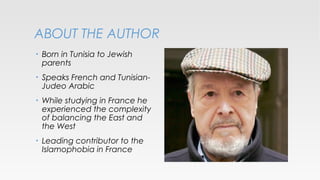
ABOUT THE AUTHOR
•

Born in Tunisia to Jewish
parents

•

Speaks French and TunisianJudeo Arabic

•

While studying in France he
experienced the complexity
of balancing the East and
the West

•

Leading contributor to the
Islamophobia in France
THE NEW CITIZEN
•

After decolonization comes poverty and corruption, violence,
and sometimes chaos

•

The prospect of being govern one of their own, leads to
disappointment

•

“There has been a change of masters, but, like new leeches, the
new ruling classes are often greedier than the old” (page 4)

•

Those who assume power are mainly upper class, educated
outside the country and former friends or allies of the colonizers
POVERTY AND CORRUPTION
•

Major problem in formerly colonized nations is poverty
•

•

Corruption is universal, affects everyone and everything- it creates
poverty
•

•

“…poverty leads to and helps prolong ignorance and superstition, stagnant forms of social
behavior, the absence of democracy, poor hygiene, sickness, and death” (5)

Money made by the government is not invested into the local economy, this
leads to a lack of domestic development

Lack of domestic development means little to no interest in foreign
or local investors
•

“Consequently there is a scarcity of directly available funding, which
perpetuates underdevelopment, and underdevelopment discourages
potential investment”
POVERTY AND CORRUPTION
•

Lack of a stable infrastructure leads to increase in violence
•

High unemployment levels, especially among the younger generation, are
linked to higher levels of violence and crime

•

Underdevelopment leads to a lack of development in the science
and technology fields (since all the money is either being invested
abroad or used by the corrupt leaders)

•

As a way to control the population the government promotes
folklore, arts and crafts, and tourism
•

A dependence on tourism, however, continues the dependence on the
developed world
EVERY CORRUPT NATION NEEDS A TYRANT LEADER
•

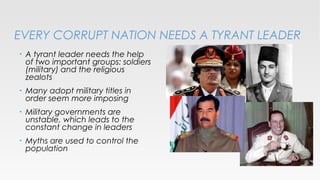
A tyrant leader needs the help
of two important groups: soldiers
(military) and the religious
zealots

•

Many adopt military titles in
order seem more imposing

•

Military governments are
unstable, which leads to the
constant change in leaders

•

Myths are used to control the
population
“IF YOU RAISE A BABY CROCODILE IN YOUR
APARTMENT ONE DAY HE WILL EAT YOU” (46)
•

Religion is used to distract and control the population

•

Religious fundamentalist are unstable, the leader will grant them
favors (the Islamic veil, the beard, the mosques)

•

“These texts should be placed on a shelf, along with the religious
books of other religions, as a contribution to the history of world
literature. This is not to attack Islam; all religions are intolerant,
exclusive, restrictive, and sometimes violence” (34)
RELIGION IS A SHARED IDENTITY
•

“Given the absence of other cohesive forces in still fragile nations,
religion continues to be one of the foundations of a shared identity. It
retains a tenacious hold on intellect and behavior; it is a relatively
coherent system; it contains beliefs, rituals, and morality, which
reinforce one another and combine to incorporate all aspects of life,
individual and collective” (47).

•

Reallocation of funds to build mosques, instead of schools

•

No formal legal system: relies heavily on religious law
CULTURE
•

The ruler introduces an ancient leader as a form of inspiration
for the society: it symbolizes their past and their bright future

•

Ancient traditions are reinstated, sometimes even created out
thin air

•

Rebirth of the traditional language (creates problems since it is
not spoken by the majority of the society)

•

This is all done to create a sense of nationalism, pride

•

The focus is placed on the past and the future, the present is
ignored, which leads to its destruction (lack of development,
investment, and interest)
ISLAMIC TERRORISM
•

Act of desperation

•

Different from other types of suicide attacks because these
attackers do not care for their lives and the lives of others

•

They are not afraid to die, in fact they welcome death

•

They are considered Martyrs, by not only their own countrymen
but also other Muslims around the world
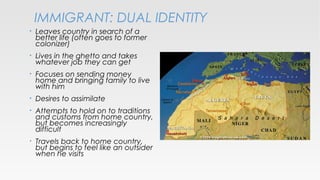
IMMIGRANT: DUAL IDENTITY
•

Leaves country in search of a
better life (often goes to former
colonizer)

•

Lives in the ghetto and takes
whatever job they can get

•

Focuses on sending money
home and bringing family to live
with him

•

Desires to assimilate

•

Attempts to hold on to traditions
and customs from home country,
but becomes increasingly
difficult

•

Travels back to home country,
but begins to feel like an outsider
when he visits
IMMIGRANT CHILDREN
•

The daughter:
•
•
•
•
•

•
•

rebels against tradition;
wears what she wants;
has no respect for father
Dates a non-Muslim
Begins to wear head scarves:
does not truly understand the
history behind the head scarf,
only does this for shock value
Begins to date non-Muslims
Lacks connection with parent’s
country

•

The son:
•

•
•
•
•

Rebels against tradition, yet
claims to be Muslim and uses
this to protest against the local
government
Embarrass by their father and his
desire to assimilate
Hostile and angry
Strong dislike of any national
institution (i.e. school, work)
Lacks connection with parent’s
country
HOW TO CREATE UTOPIA
•

A need to rediscover the
desire for self-government
and freedom

•

Stop the dependency on
foreign aid and investment:
invest profit made from the
natural resources into local
economy

•

Liberation of women

•

Better management of
wealth and equitable
distribution

•

Suppression of corruption
and despotism

•

Universal morality- which
leads to secularism

•

Freedom of thought

•

Create solidarity-without the
use of religion

•

Promote rationality
(sciences, technology, and
arts)

Memmi book review

  • 1.
    DECOLONIZATION AND THE DECOLONIZED BY:ALBERT MEMMI Jessica M. Rivera Sink| IS 760| Spring 2014
  • 2.
    ABOUT THE AUTHOR • Bornin Tunisia to Jewish parents • Speaks French and TunisianJudeo Arabic • While studying in France he experienced the complexity of balancing the East and the West • Leading contributor to the Islamophobia in France
  • 3.
    THE NEW CITIZEN • Afterdecolonization comes poverty and corruption, violence, and sometimes chaos • The prospect of being govern one of their own, leads to disappointment • “There has been a change of masters, but, like new leeches, the new ruling classes are often greedier than the old” (page 4) • Those who assume power are mainly upper class, educated outside the country and former friends or allies of the colonizers
  • 4.
    POVERTY AND CORRUPTION • Majorproblem in formerly colonized nations is poverty • • Corruption is universal, affects everyone and everything- it creates poverty • • “…poverty leads to and helps prolong ignorance and superstition, stagnant forms of social behavior, the absence of democracy, poor hygiene, sickness, and death” (5) Money made by the government is not invested into the local economy, this leads to a lack of domestic development Lack of domestic development means little to no interest in foreign or local investors • “Consequently there is a scarcity of directly available funding, which perpetuates underdevelopment, and underdevelopment discourages potential investment”
  • 5.
    POVERTY AND CORRUPTION • Lackof a stable infrastructure leads to increase in violence • High unemployment levels, especially among the younger generation, are linked to higher levels of violence and crime • Underdevelopment leads to a lack of development in the science and technology fields (since all the money is either being invested abroad or used by the corrupt leaders) • As a way to control the population the government promotes folklore, arts and crafts, and tourism • A dependence on tourism, however, continues the dependence on the developed world
  • 6.
    EVERY CORRUPT NATIONNEEDS A TYRANT LEADER • A tyrant leader needs the help of two important groups: soldiers (military) and the religious zealots • Many adopt military titles in order seem more imposing • Military governments are unstable, which leads to the constant change in leaders • Myths are used to control the population
  • 7.
    “IF YOU RAISEA BABY CROCODILE IN YOUR APARTMENT ONE DAY HE WILL EAT YOU” (46) • Religion is used to distract and control the population • Religious fundamentalist are unstable, the leader will grant them favors (the Islamic veil, the beard, the mosques) • “These texts should be placed on a shelf, along with the religious books of other religions, as a contribution to the history of world literature. This is not to attack Islam; all religions are intolerant, exclusive, restrictive, and sometimes violence” (34)
  • 8.
    RELIGION IS ASHARED IDENTITY • “Given the absence of other cohesive forces in still fragile nations, religion continues to be one of the foundations of a shared identity. It retains a tenacious hold on intellect and behavior; it is a relatively coherent system; it contains beliefs, rituals, and morality, which reinforce one another and combine to incorporate all aspects of life, individual and collective” (47). • Reallocation of funds to build mosques, instead of schools • No formal legal system: relies heavily on religious law
  • 9.
    CULTURE • The ruler introducesan ancient leader as a form of inspiration for the society: it symbolizes their past and their bright future • Ancient traditions are reinstated, sometimes even created out thin air • Rebirth of the traditional language (creates problems since it is not spoken by the majority of the society) • This is all done to create a sense of nationalism, pride • The focus is placed on the past and the future, the present is ignored, which leads to its destruction (lack of development, investment, and interest)
  • 10.
    ISLAMIC TERRORISM • Act ofdesperation • Different from other types of suicide attacks because these attackers do not care for their lives and the lives of others • They are not afraid to die, in fact they welcome death • They are considered Martyrs, by not only their own countrymen but also other Muslims around the world
  • 11.
    IMMIGRANT: DUAL IDENTITY • Leavescountry in search of a better life (often goes to former colonizer) • Lives in the ghetto and takes whatever job they can get • Focuses on sending money home and bringing family to live with him • Desires to assimilate • Attempts to hold on to traditions and customs from home country, but becomes increasingly difficult • Travels back to home country, but begins to feel like an outsider when he visits
  • 12.
    IMMIGRANT CHILDREN • The daughter: • • • • • • • rebelsagainst tradition; wears what she wants; has no respect for father Dates a non-Muslim Begins to wear head scarves: does not truly understand the history behind the head scarf, only does this for shock value Begins to date non-Muslims Lacks connection with parent’s country • The son: • • • • • Rebels against tradition, yet claims to be Muslim and uses this to protest against the local government Embarrass by their father and his desire to assimilate Hostile and angry Strong dislike of any national institution (i.e. school, work) Lacks connection with parent’s country
  • 13.
    HOW TO CREATEUTOPIA • A need to rediscover the desire for self-government and freedom • Stop the dependency on foreign aid and investment: invest profit made from the natural resources into local economy • Liberation of women • Better management of wealth and equitable distribution • Suppression of corruption and despotism • Universal morality- which leads to secularism • Freedom of thought • Create solidarity-without the use of religion • Promote rationality (sciences, technology, and arts)

Editor's Notes

  • #5 Examples of poverty: 50% of Zimbabwe inhabitants, where diamonds are mined, live in poverty North Korea: 1/3 of population survives on food support from around the world “Potentially it (third world) has the wherewithal to supply the needs of all its citizens, but lacks organization and suffers from an ineffective, absurd, and scandal-ridden system of distribution.” (7) Example of corruption: Nigeria: richest country in Africa but has very high levels of poverty and corruption Cameroon: highest levels of poverty and corruption in Africa (possibly the world)
  • #6 Examples: Iraq and Iran have 40% of population is unemployed “those who support the wall”-young men leaning on walls along the road Tourism: “As for tourism, it’s better to be a servant than to go hungry” (11)
  • #7 “The tyrant needs the army to survive, the army does not need the tyrant” (17) The leader must keep the soldiers happy by giving them money, positions, and political favors The zealots need to be kept in check, because they can completely ruin the leader. The zealots influence and control over the people is used by the leader Myths are used to control the population: blame outside forces (West) for their problems, directing their attention and anger towards something/someone else. Leaders claim that their country’s situation is caused by their colonizers/West and not because of the new leadership Another Myth: the possible unification of Arab nations into a EU like union; Also, blame Israel for their problems
  • #8 He calls for intellectuals and writers to speak out against the tyrants and the zealots. Development of education, medical care, a legal system- helps create an environment in which the citizens are ignorant and are in need of a guide “Modern education would risk disturbing the people’s intellect and might lead them to look elsewhere” (46)
  • #9 He calls for intellectuals and writers to speak out against the tyrants and the zealots. Development of education, medical care, a legal system- helps create an environment in which the citizens are ignorant and are in need of a guide “Modern education would risk disturbing the people’s intellect and might lead them to look elsewhere” (46) The focus of the government then is in building mosques and other religious centers rather than building the infrastructure. There is no formal legal system, so the leader (and his posse) can issue whatever punishment they see fit
  • #10 Nations were born too late: missed the industrial revolution and the implementation of free market economy