Mélange Space Folding for Multi-Focus Interaction Niklas Elmqvist Nathalie Henry Yann Riche Jean-Daniel Fekete CHI 2008 – Florence, Italy
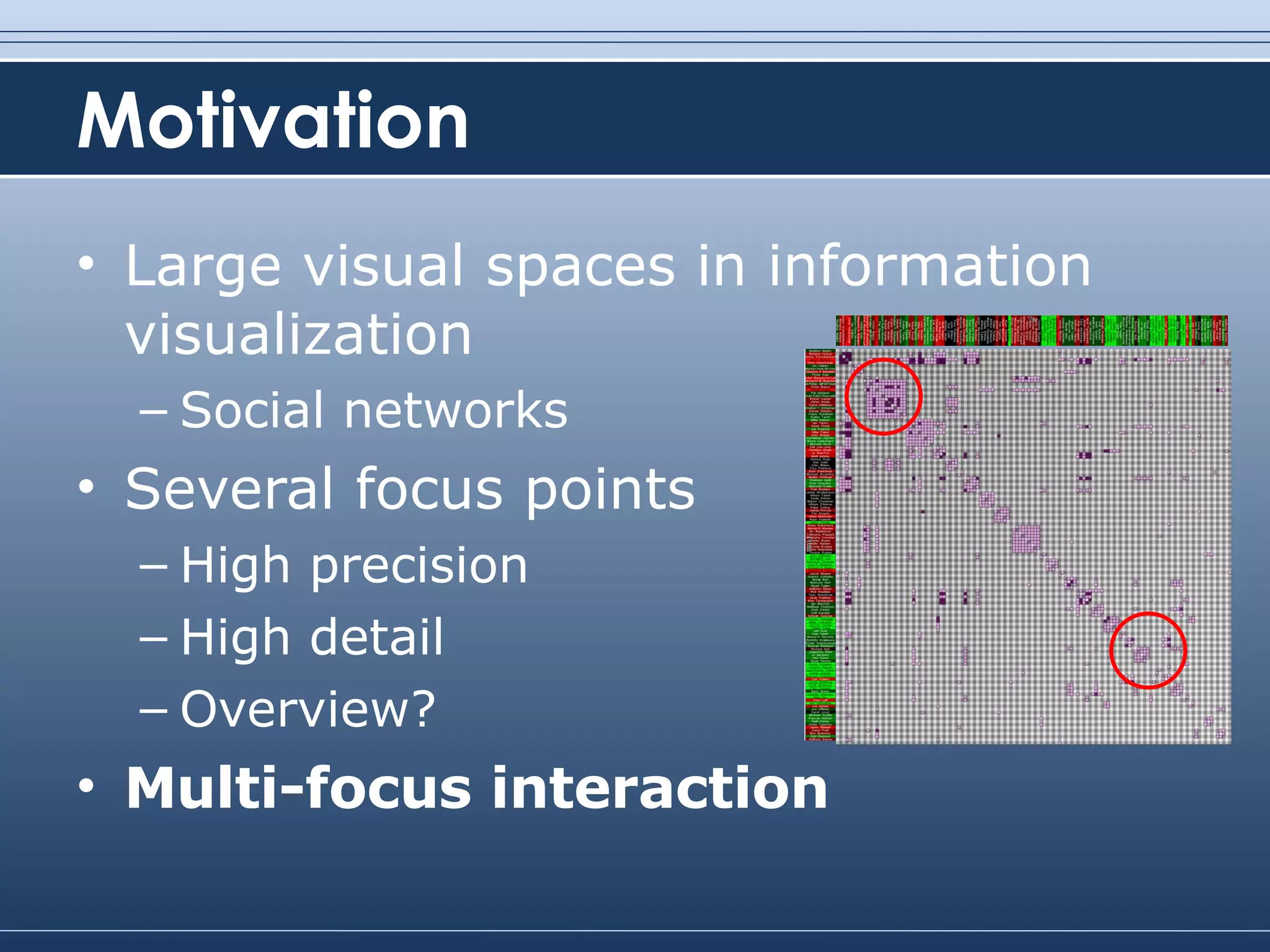
Motivation Large visual spaces in information visualization Social networks Several focus points High precision High detail Overview? Multi-focus interaction
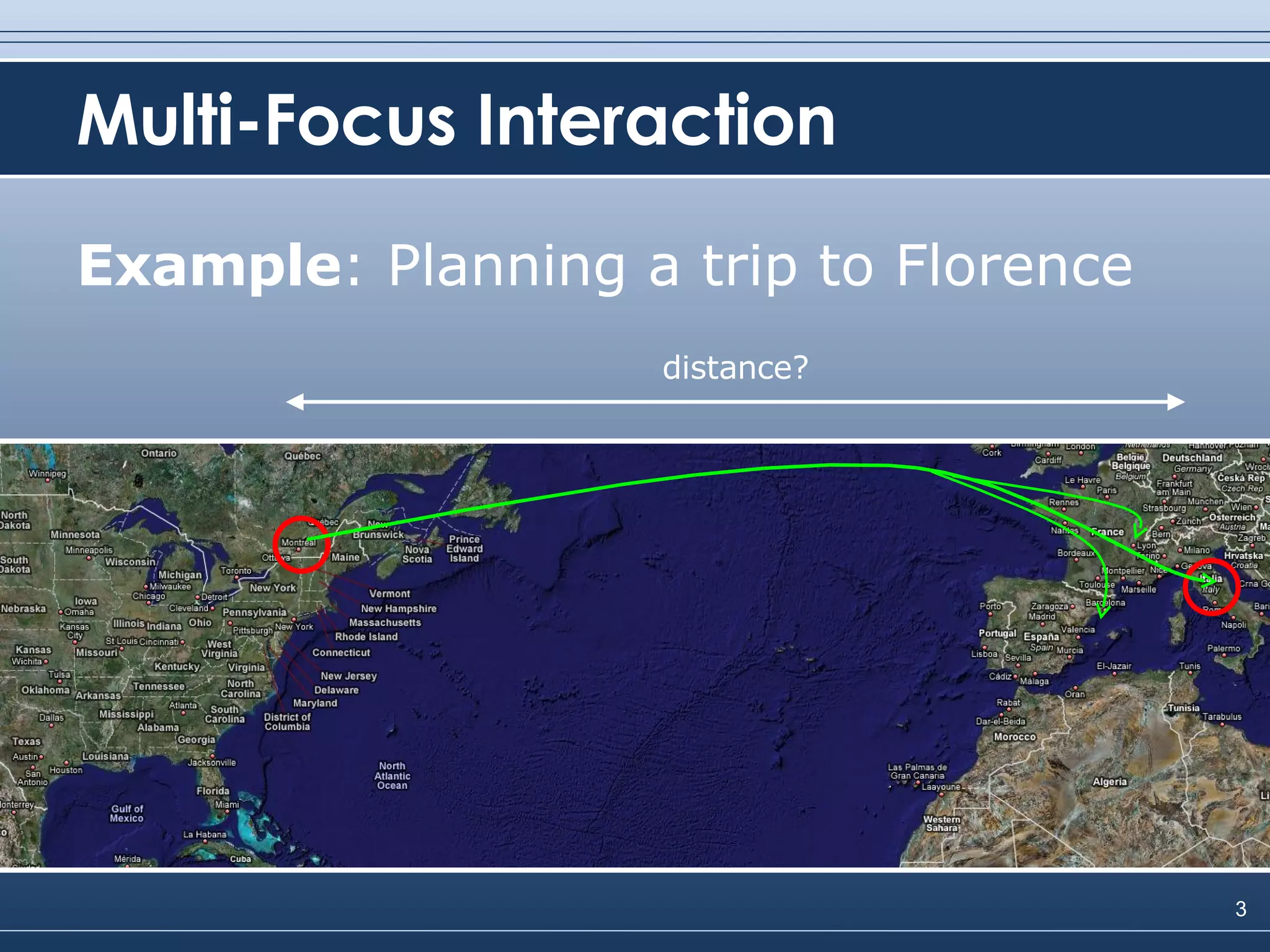
Multi-Focus Interaction Example : Planning a trip to Florence distance?
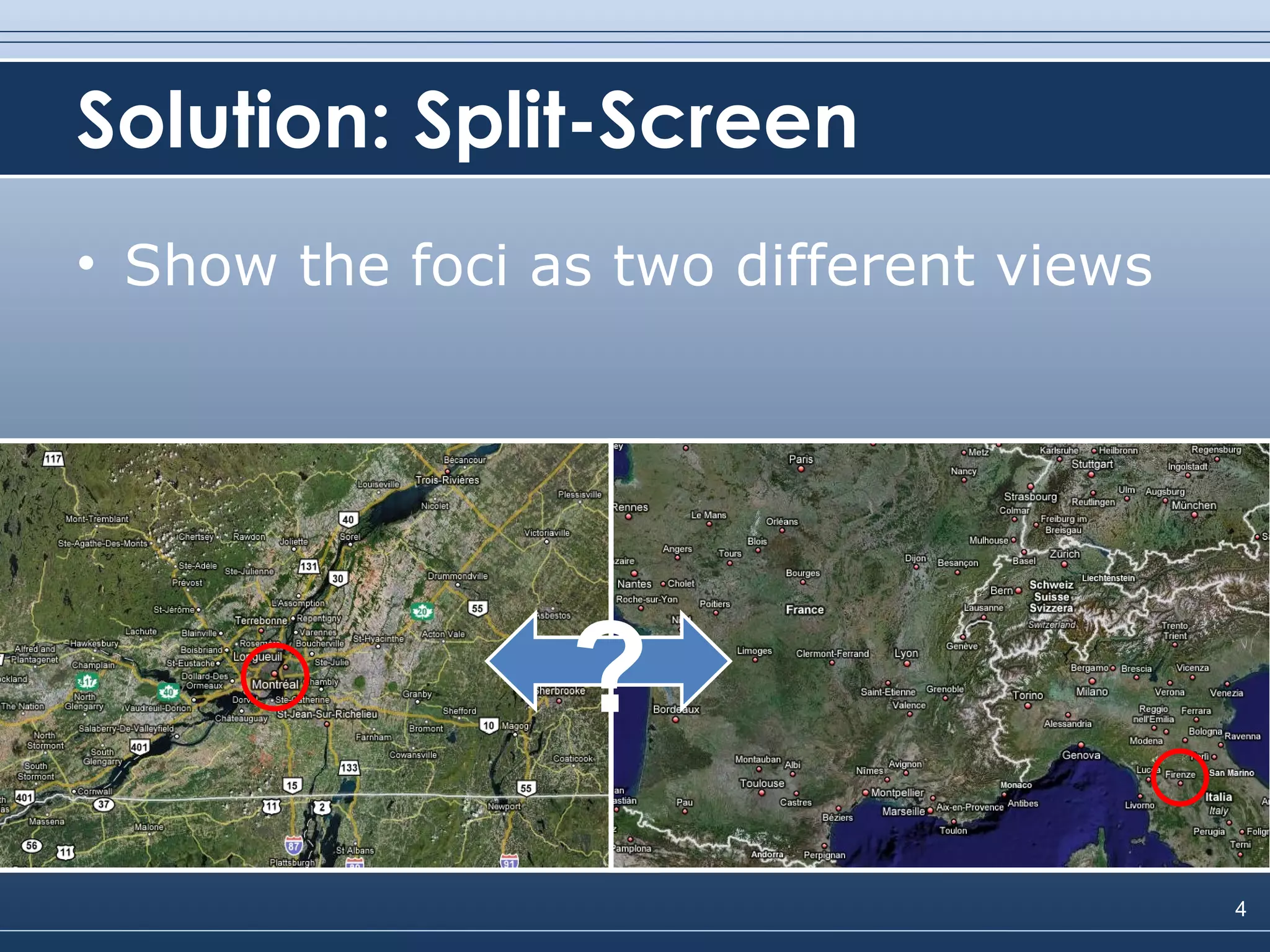
Solution: Split-Screen Show the foci as two different views ?
Mélange Demonstration!
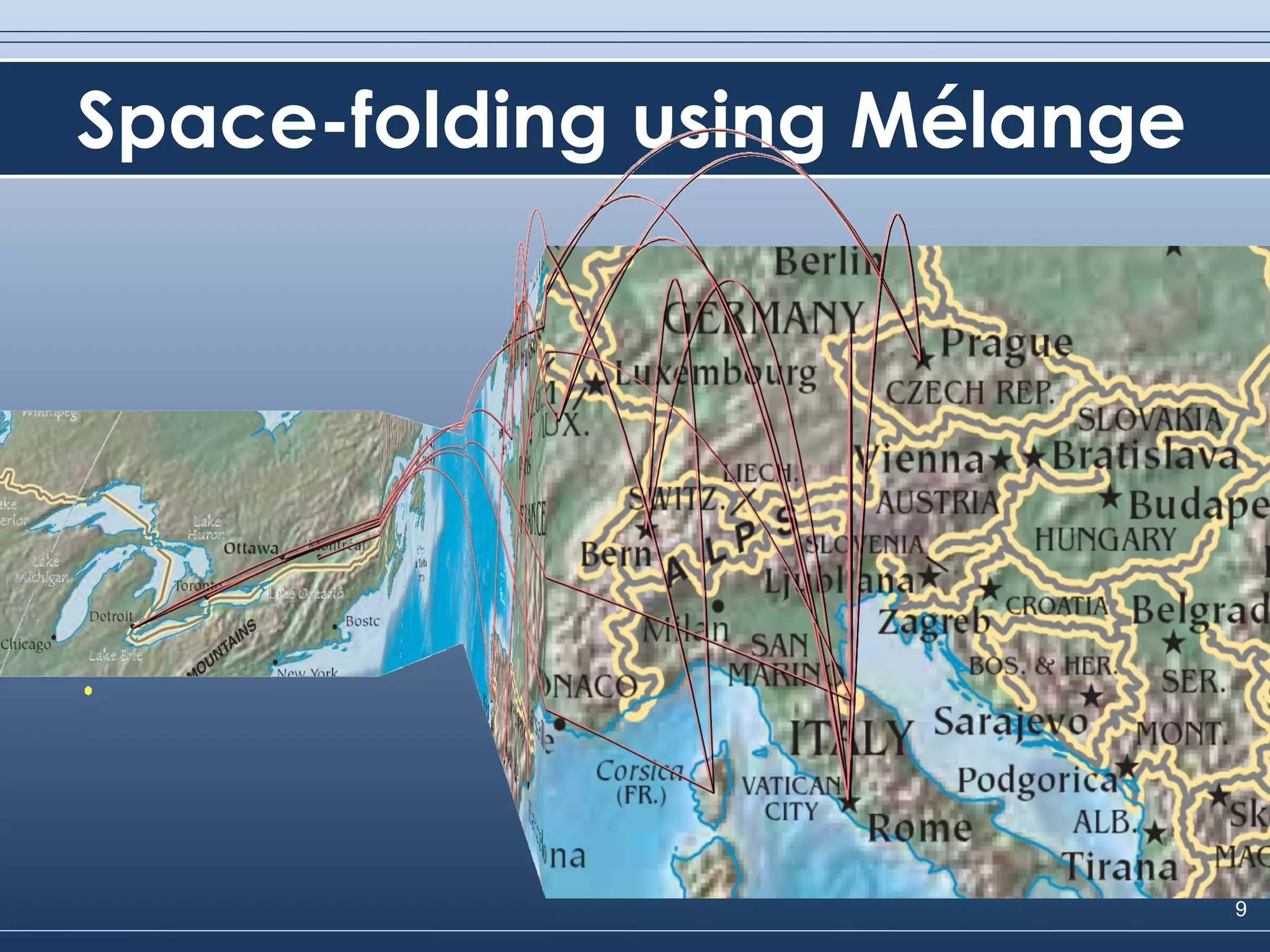
Generalizing Requirements G1:  Guaranteed focus visibility Montreal and Florence G2:  Surrounding context visibility Local area around Montreal and Florence G3 :  Intervening context awareness Relative positions, detours (interesting places?) G4 : Distance awareness Approximate trip distance
Related Work: Space Distortion Fisheye views [Furnas 1986, Shoemaker 2007] Rubber sheet [Sarkar 1993, Munzner 2003]
Related Work: Semantic Distortion DOITrees [Card 2002] SpaceTree [Plaisant 2002]
Space-folding using Mélange
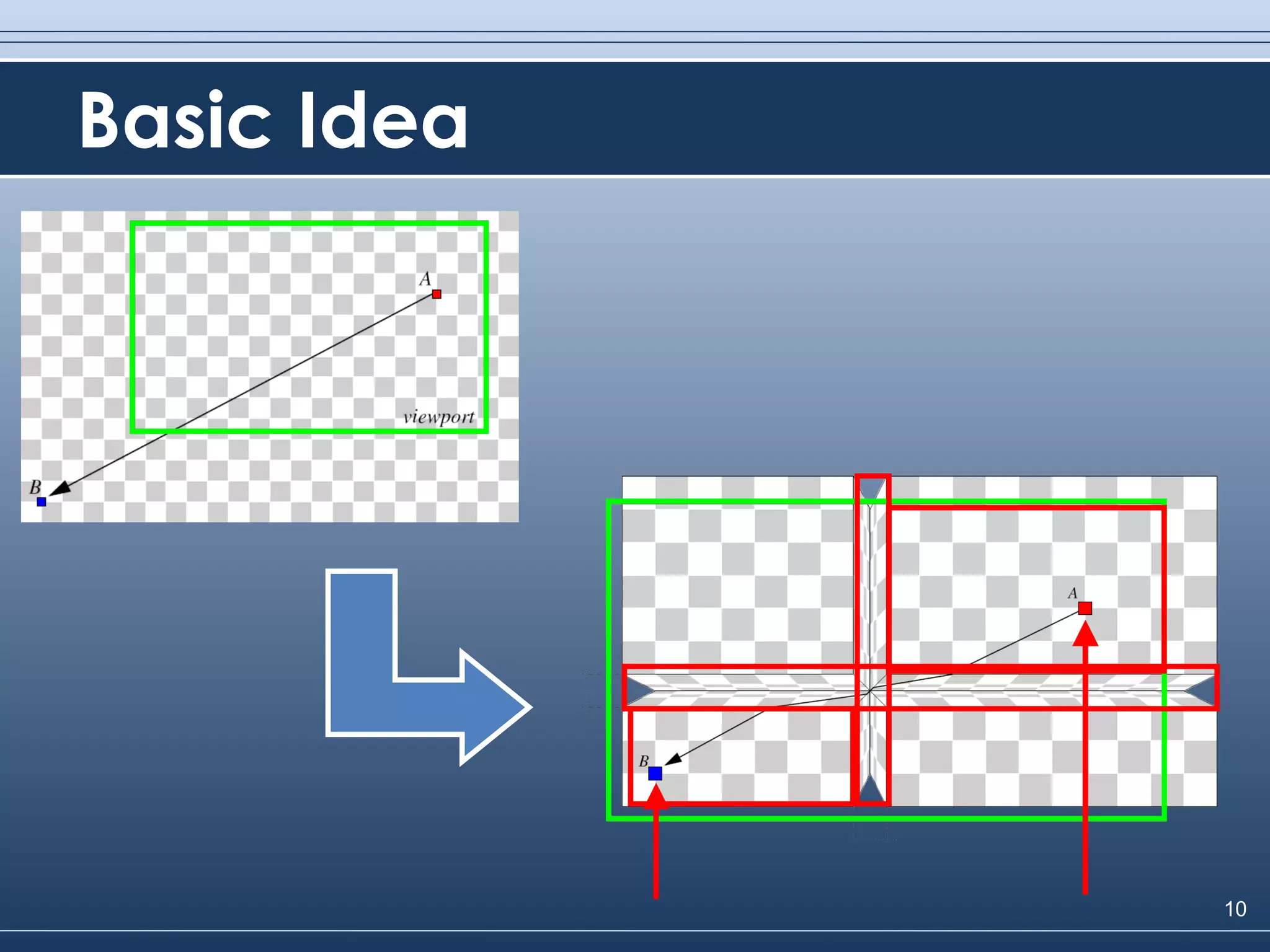
Basic Idea
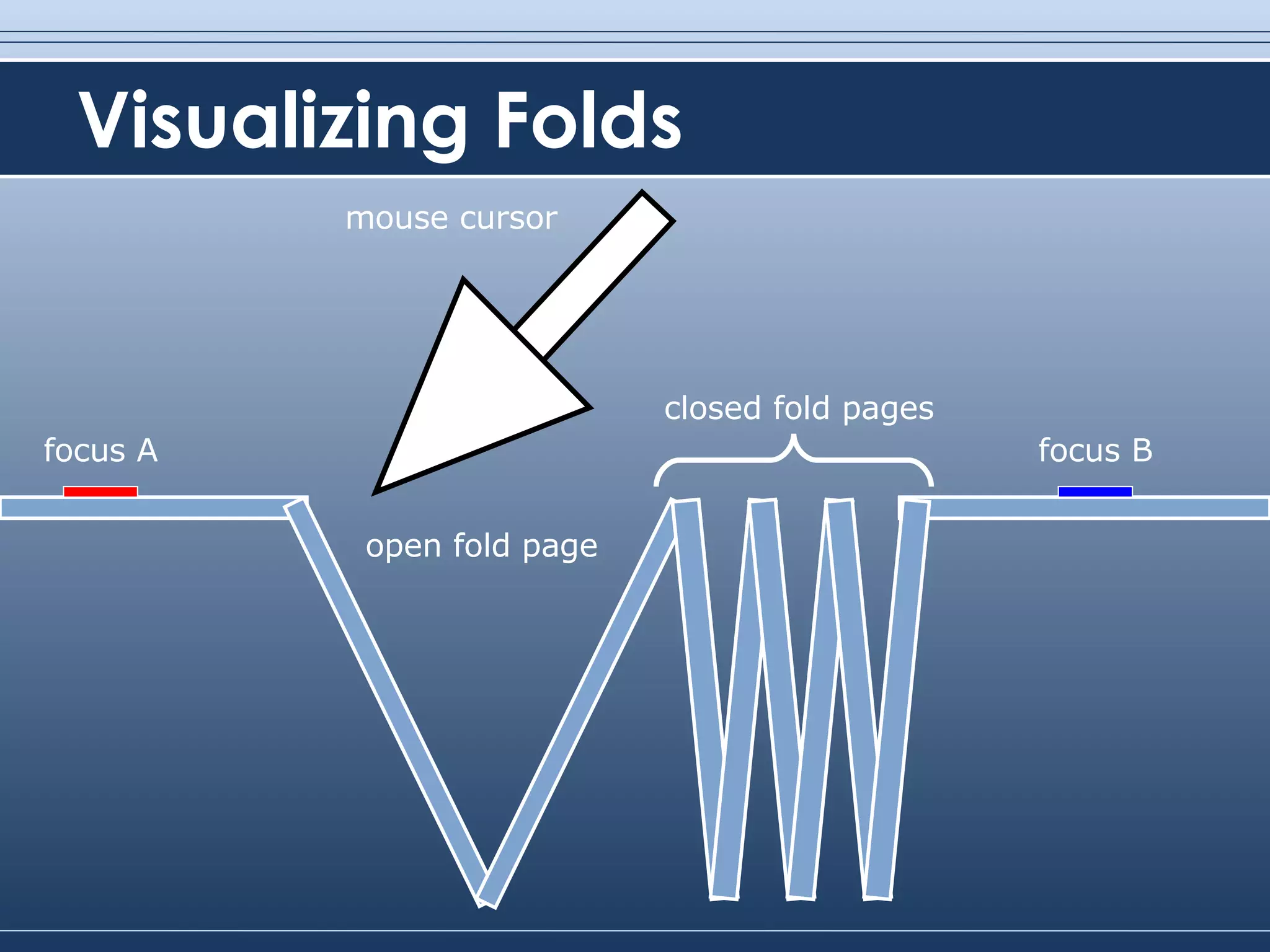
Visualizing Folds open fold page closed fold pages focus A focus B mouse cursor
Implementation Java  platform built using  OpenGL JOGL bindings Scene graph w/ geometrical  shapes Arcs, circles, rectangles (textured), etc Focus points  (one primary) controlled by user and/or application Mélange canvas guarantees visibility Seamlessly splits shapes into subshapes
Evaluation
Evaluation - Overview Controlled Experiment Based on social networks analysis: compare the immediate context of two distant connected nodes MatLink: social network analysis using matrices [Henry&Fekete @ Interact 2007]
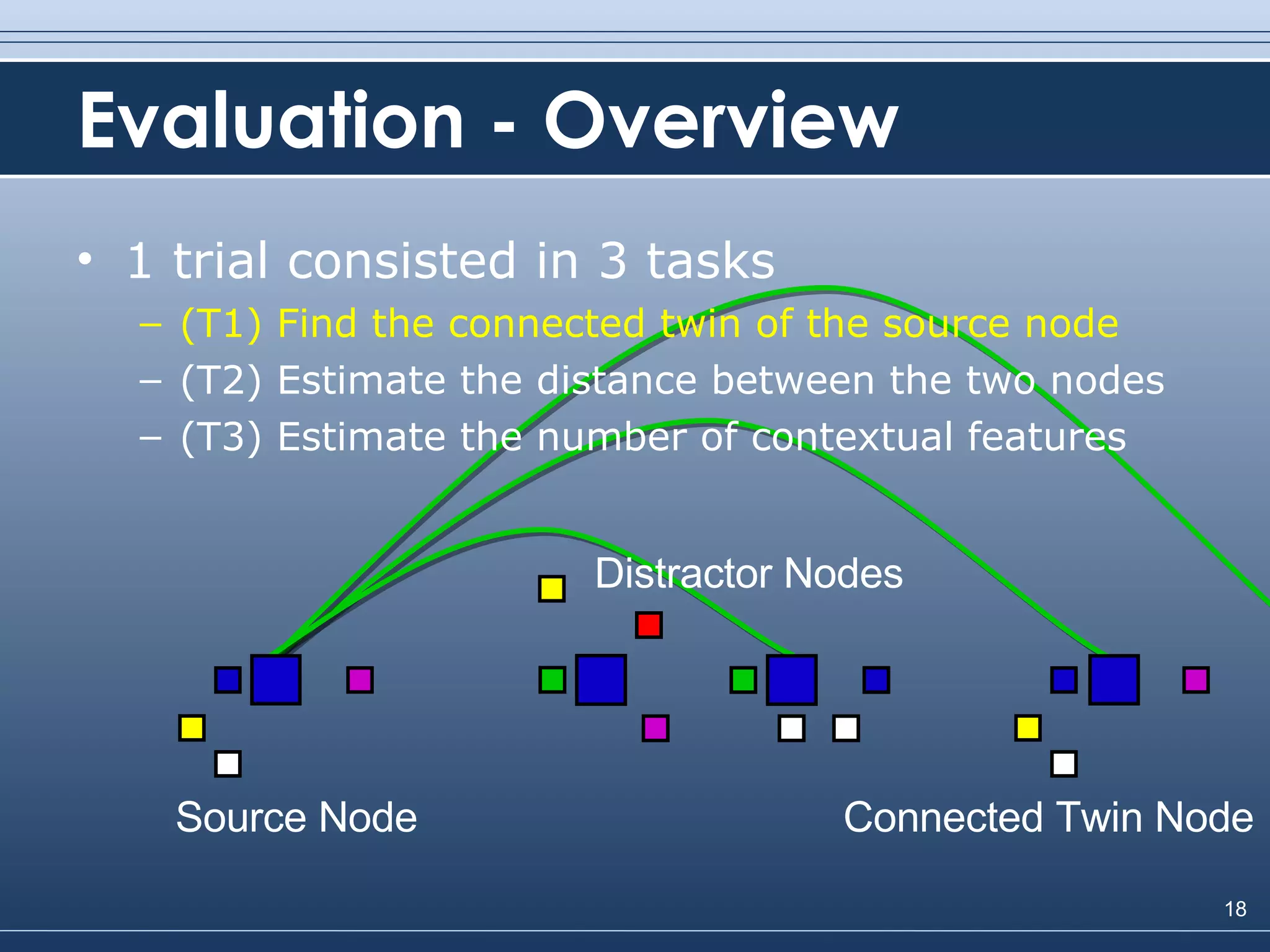
Evaluation - Overview 1 trial consisted in 3 tasks (T1) Find the connected twin of the source node (T2) Estimate the distance between the two nodes (T3) Estimate the number of contextual features Distractor Nodes Connected Twin Node Source Node
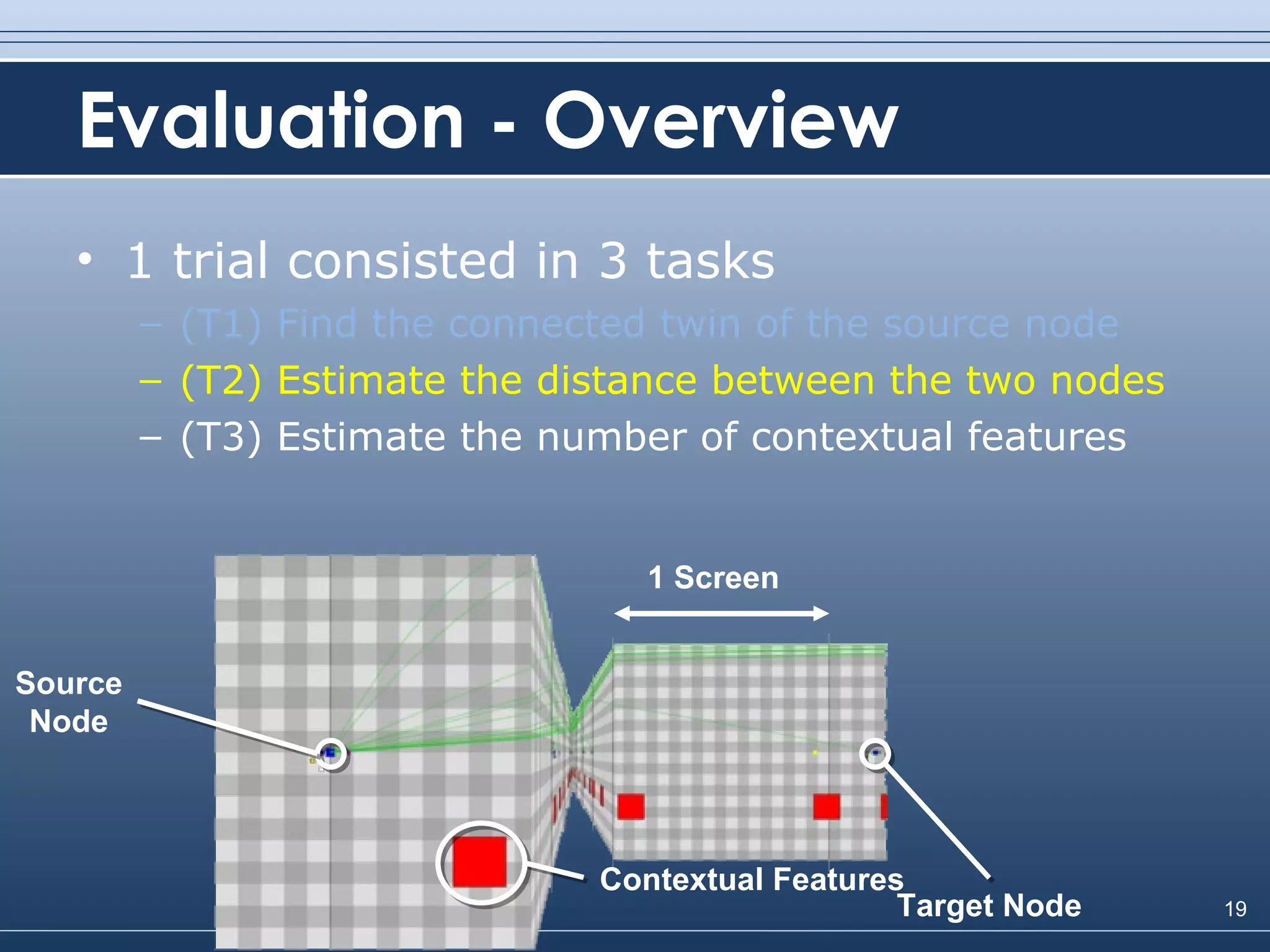
Evaluation - Overview 1 trial consisted in 3 tasks (T1) Find the connected twin of the source node (T2) Estimate the distance between the two nodes (T3) Estimate the number of contextual features 1 Screen Target Node Contextual Features Source Node
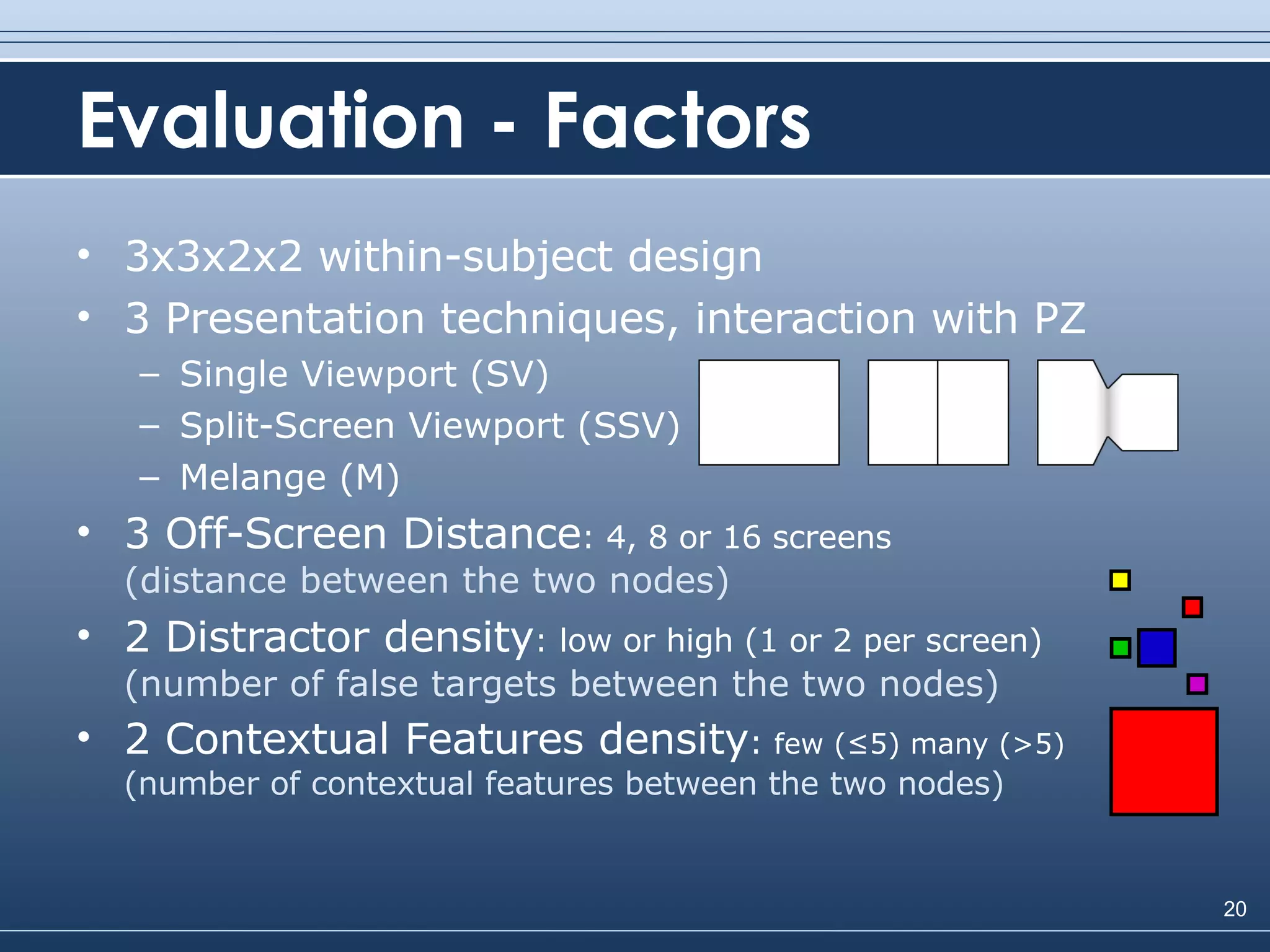
Evaluation - Factors 3x3x2x2 within-subject design 3 Presentation techniques, interaction with PZ Single Viewport (SV) Split-Screen Viewport (SSV) Melange (M) 3 Off-Screen Distance : 4, 8 or 16 screens (distance between the two nodes) 2 Distractor density : low or high (1 or 2 per screen) (number of false targets between the two nodes) 2 Contextual Features density :  few (≤5) many (>5) (number of contextual features between the two nodes)
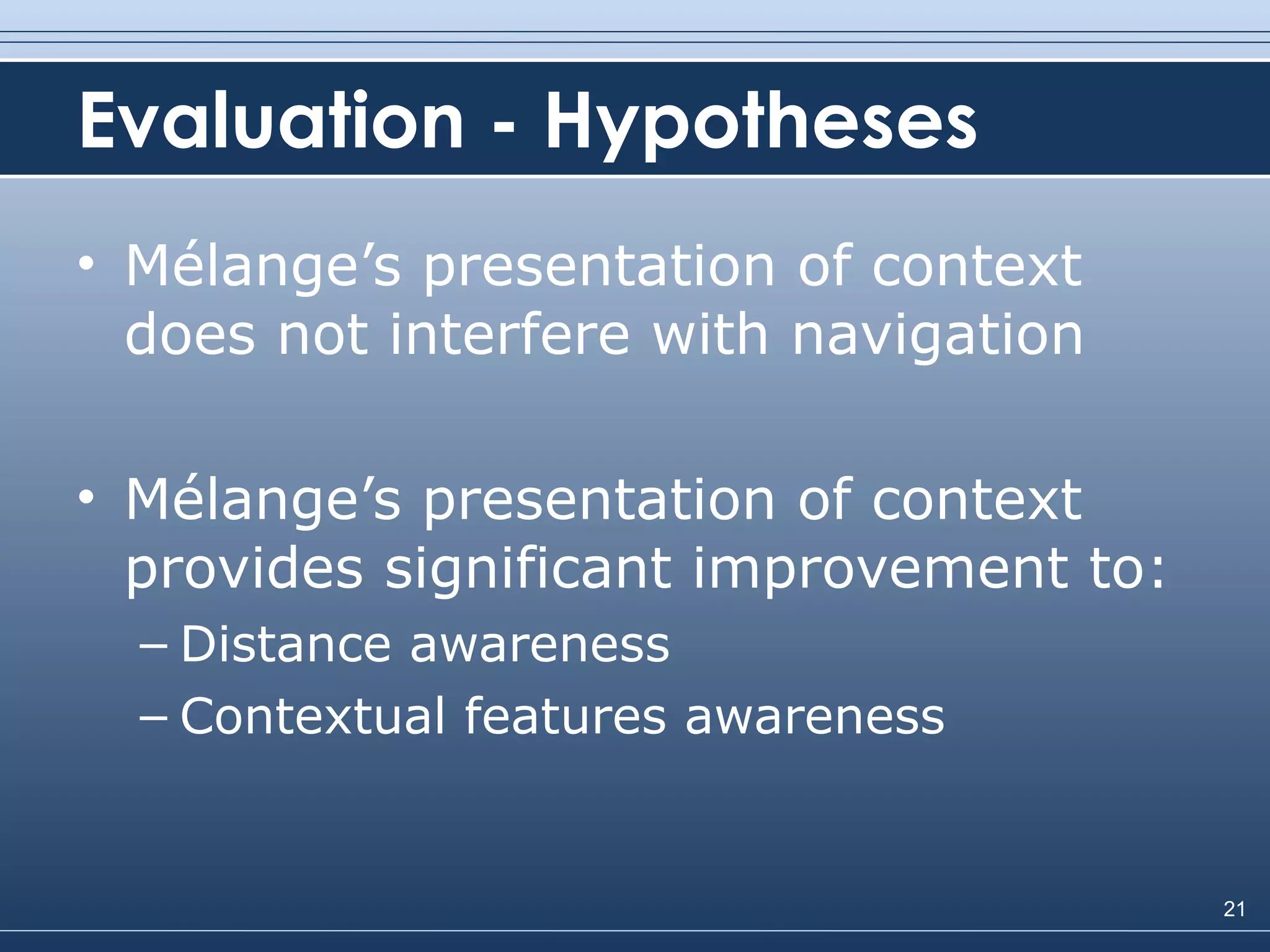
Evaluation - Hypotheses Mélange’s presentation of context does not interfere with navigation Mélange’s presentation of context provides significant improvement to: Distance awareness Contextual features awareness
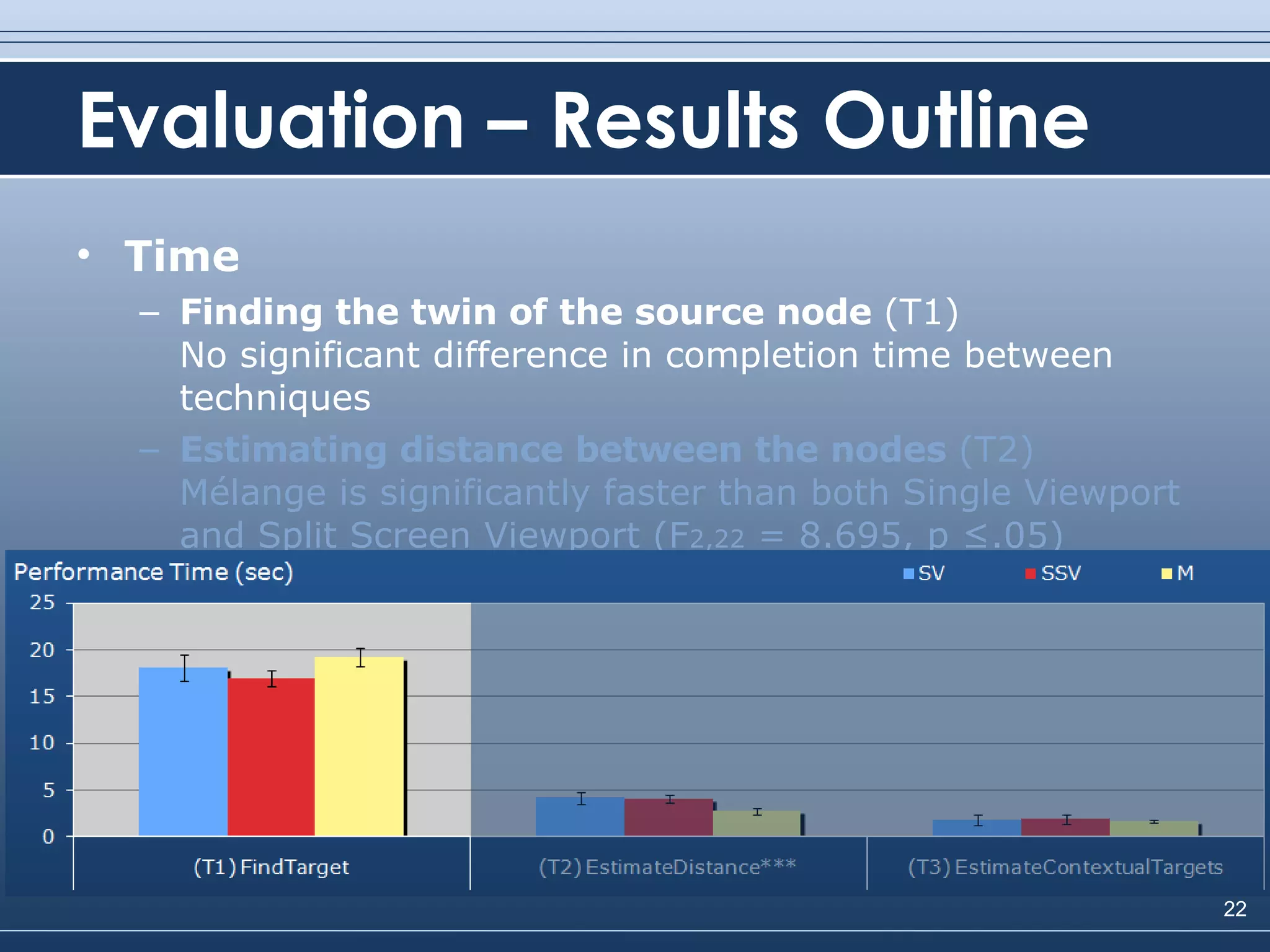
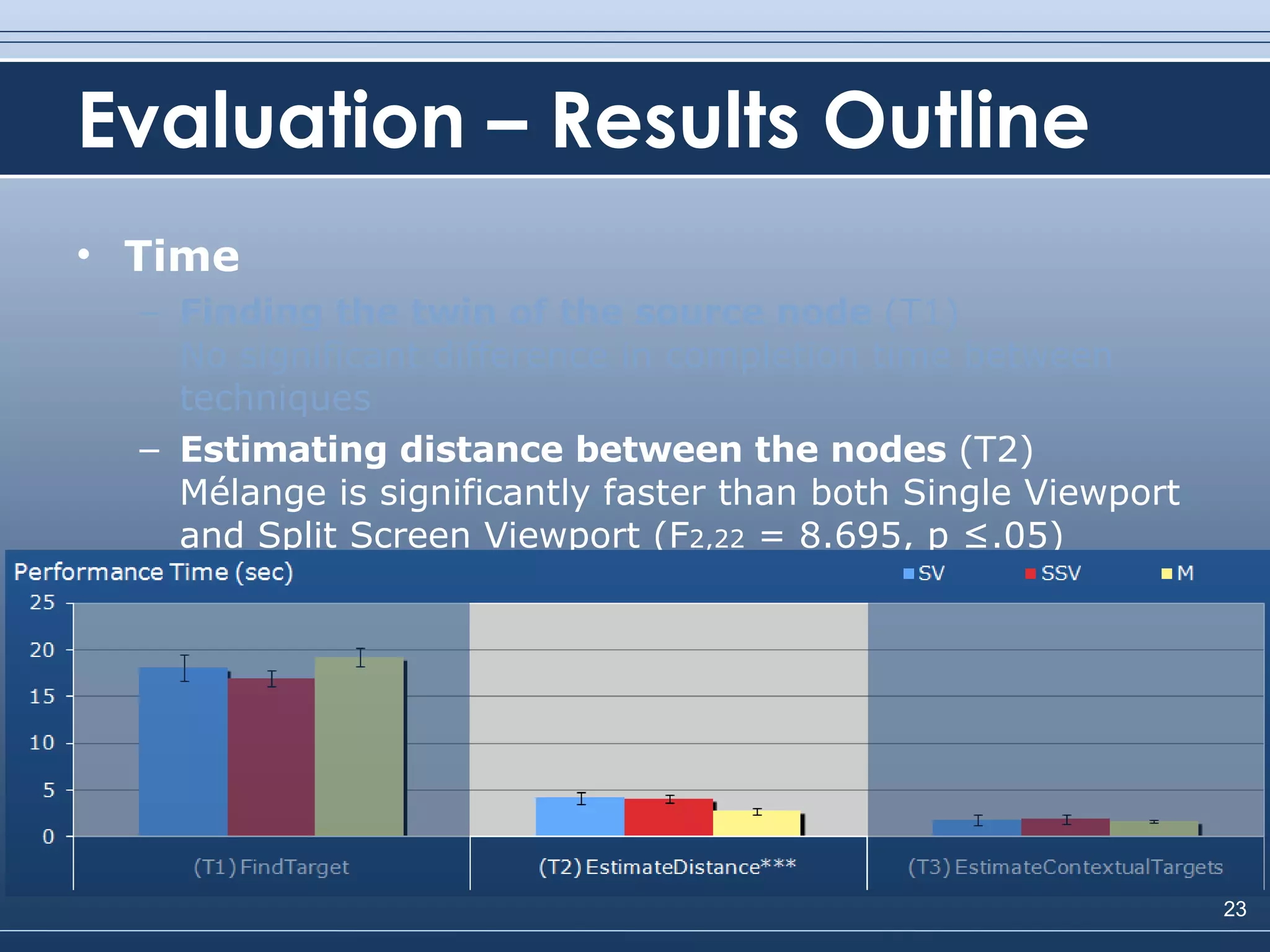
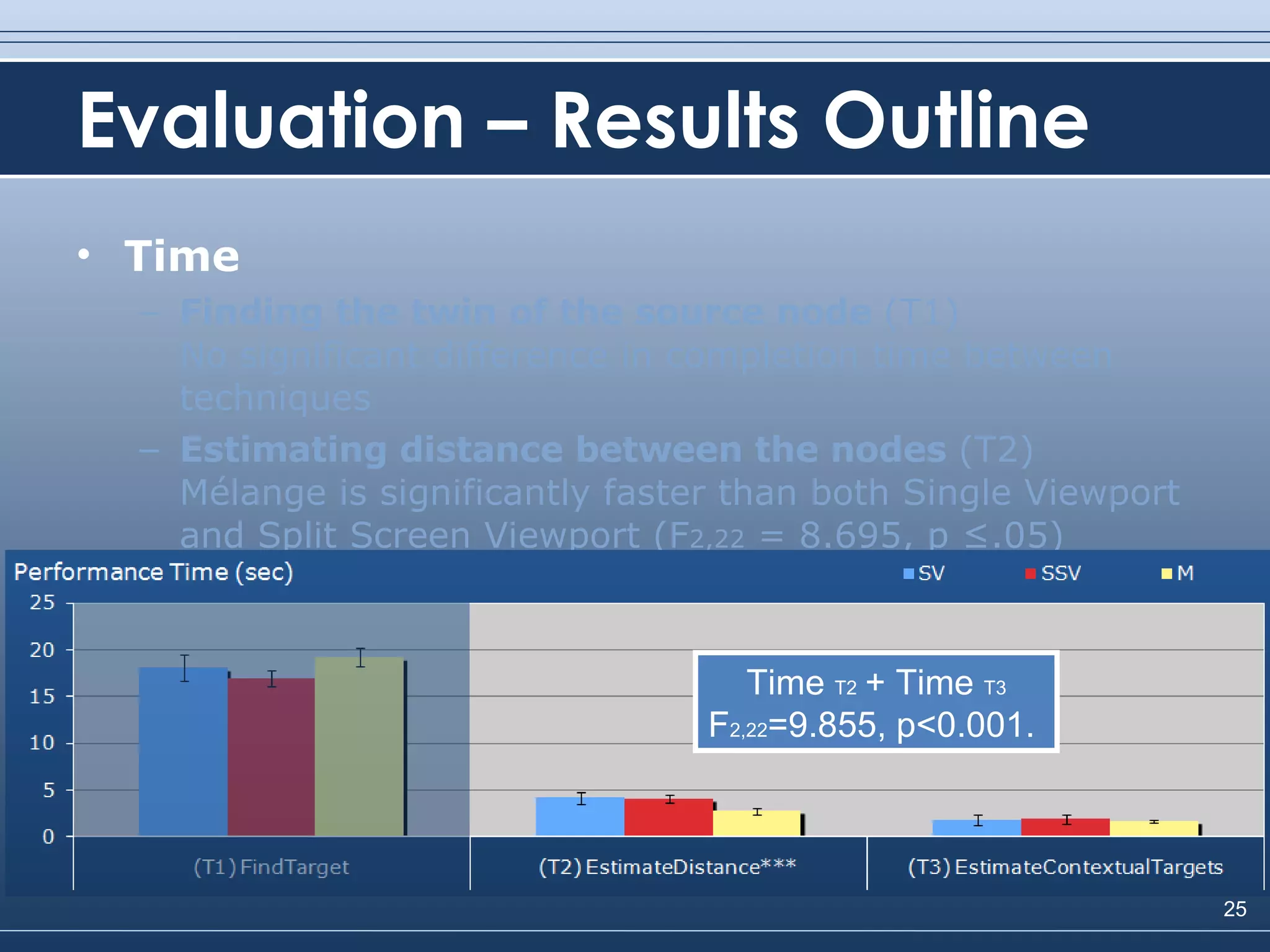
Evaluation – Results Outline Time Finding the twin of the source node  (T1) No significant difference in completion time between techniques Estimating distance between the nodes  (T2) Mélange is significantly faster than both Single Viewport and Split Screen Viewport ( F 2,22  = 8.695, p ≤.05)
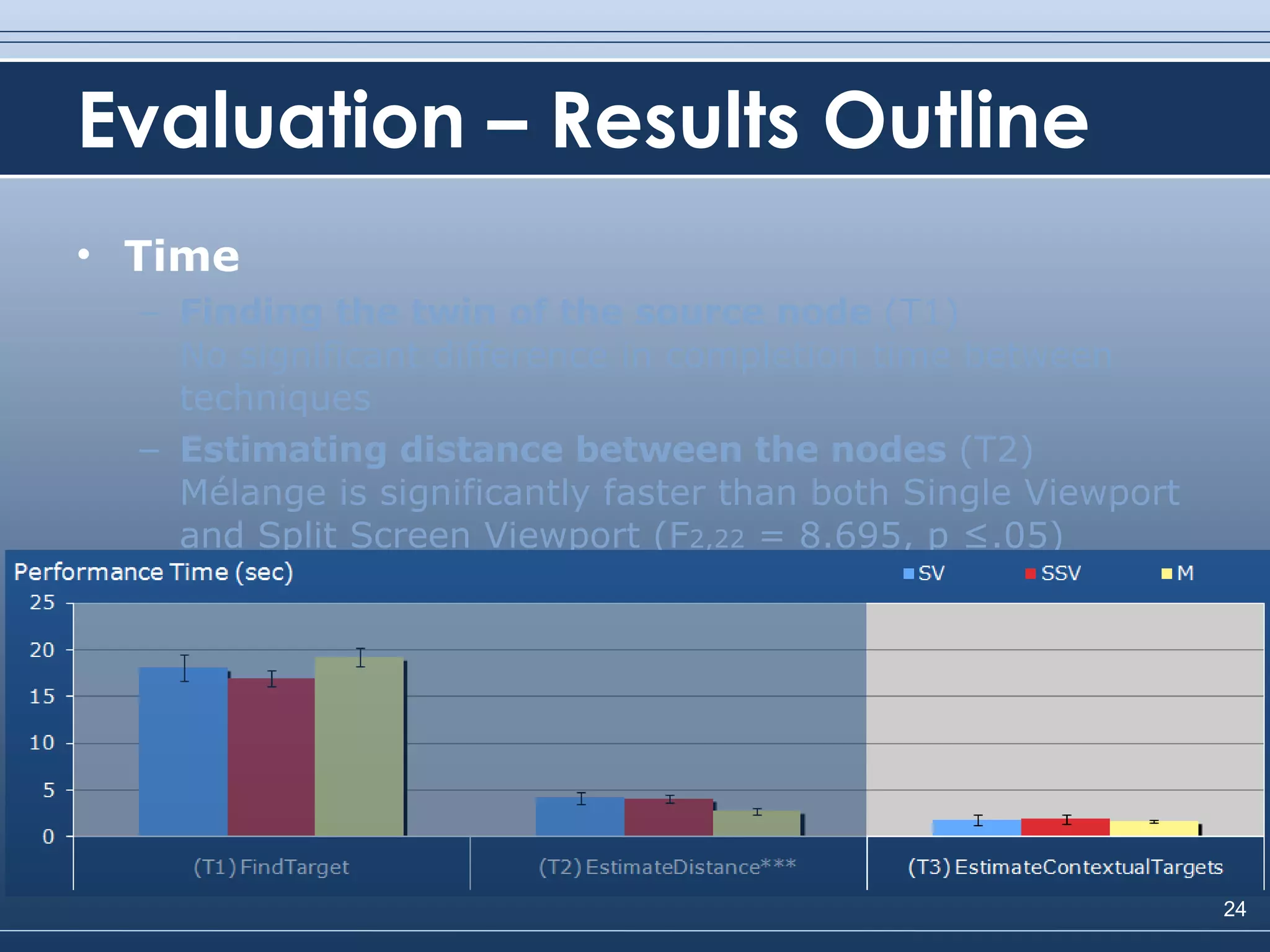
Evaluation – Results Outline Time Finding the twin of the source node  (T1) No significant difference in completion time between techniques Estimating distance between the nodes  (T2) Mélange is significantly faster than both Single Viewport and Split Screen Viewport ( F 2,22  = 8.695, p ≤.05) Time  T2   + Time  T3 F 2,22 =9.855, p<0.001.
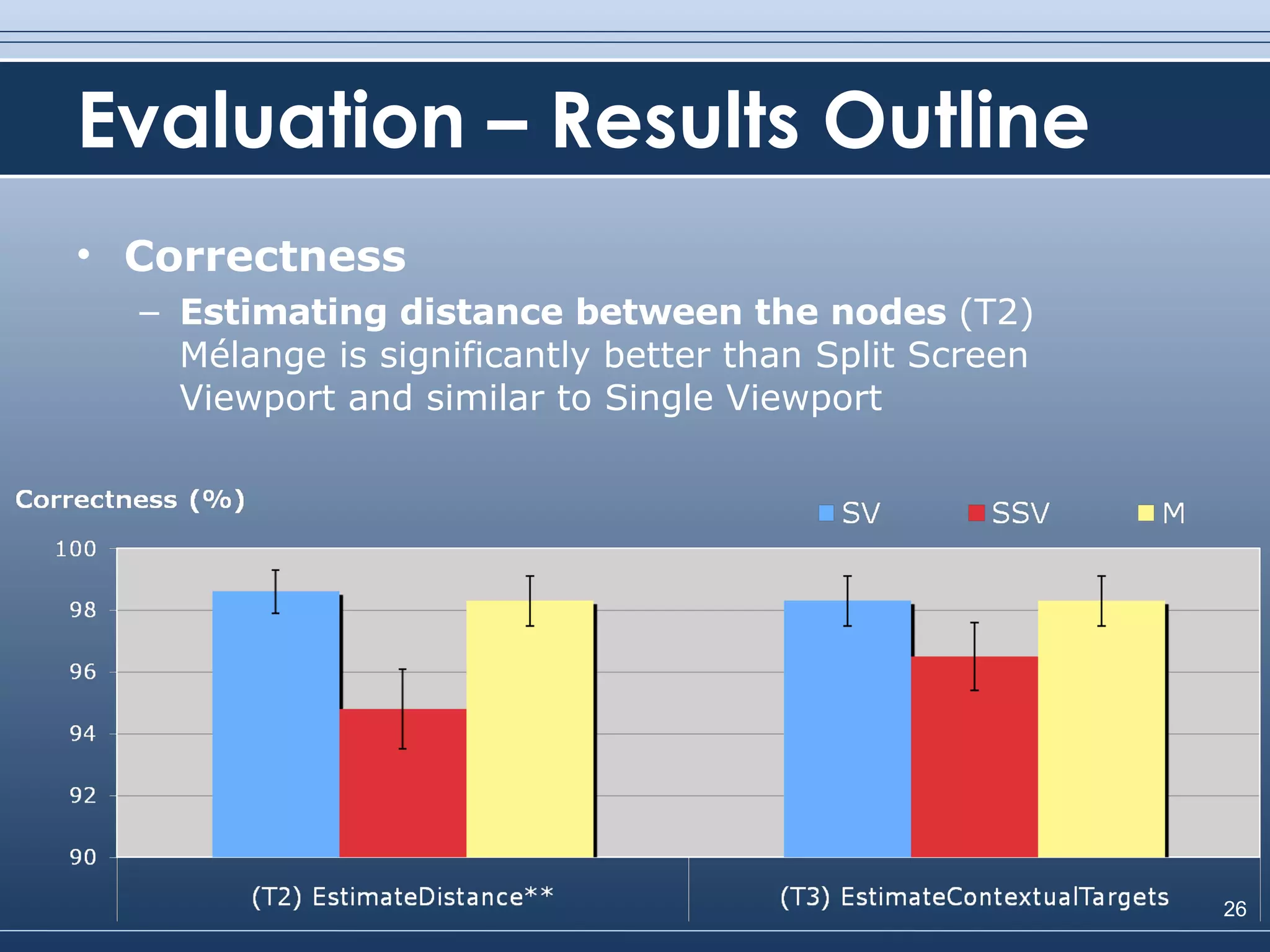
Evaluation – Results Outline Correctness Estimating distance between the nodes  (T2) Mélange is significantly better than Split Screen Viewport and similar to Single Viewport
Results Summary Mélange provides G1:  Guaranteed focus visibility G2:  Surrounding context visibility Mélange is significantly more efficient in supporting contextual tasks G3 :  Intervening context awareness G4 :  Distance awareness Mélange is not slower than the other techniques for navigation
Conclusions and Future Work Presentation technique for supporting  multi-focus interaction Folds 2D space into 3D to guarantee visibility of focus points Evaluation shows significant improvement over state of the art Future : Interaction for large spaces, real-world applications
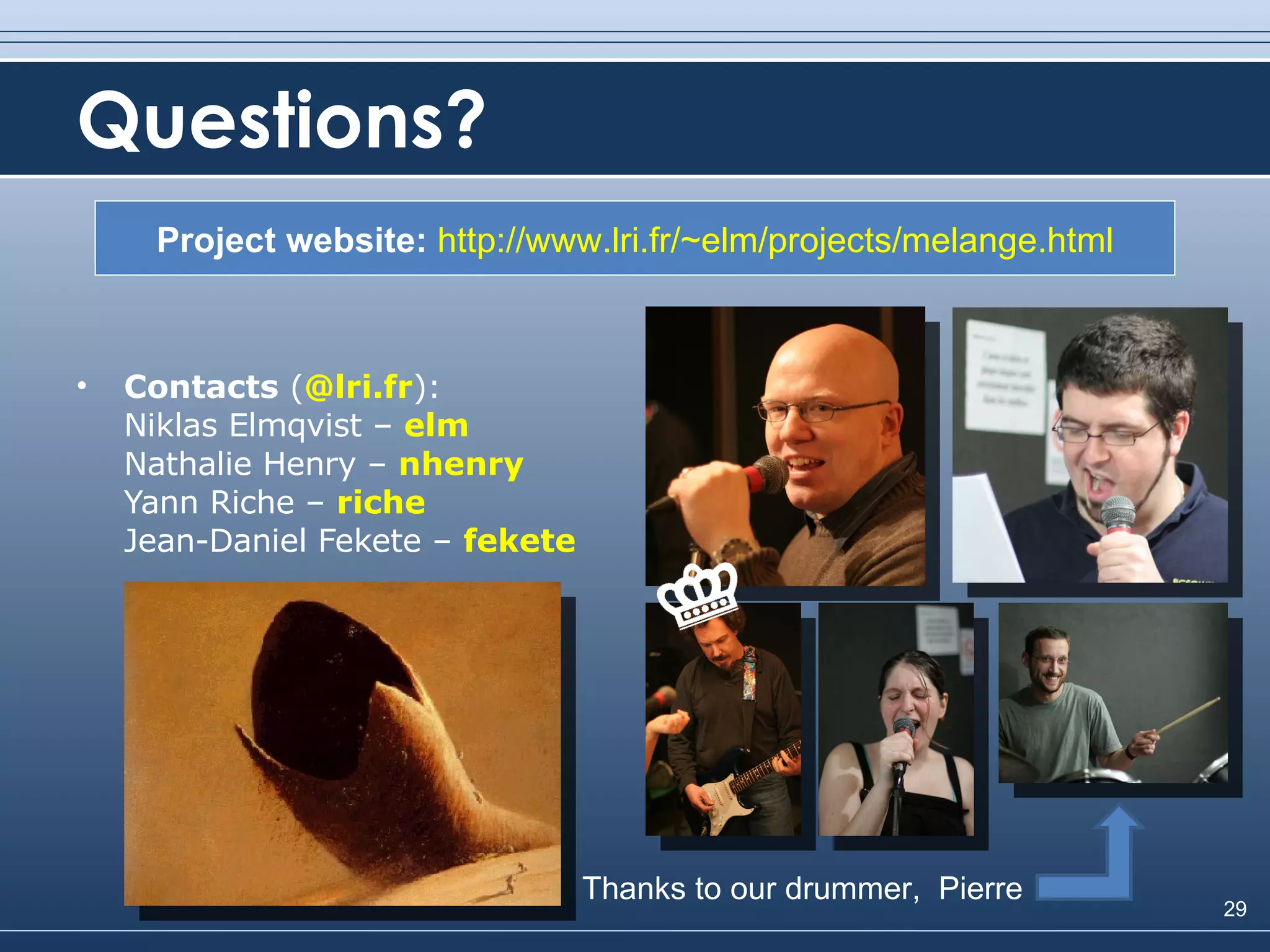
Questions? Contacts  ( @lri.fr ): Niklas Elmqvist –  elm Nathalie Henry –  nhenry Yann Riche –  riche Jean-Daniel Fekete –  fekete Project website:  http://www.lri.fr/~elm/projects/melange.html Thanks to our drummer,  Pierre
Related Work Technique G1 G2 G3 G4 Zoom and pan [Appert 2006, Igarashi 2000] - - - - Split-screen [Shoemaker 2007] Y Y - - Fisheye views [Furnas 1986, Shoemaker 2007] Y P Y - Rubber sheet [Sarkar 1993, Munzner 2007] P P Y P Semantic distortion [Card 2002, Plaisant 2002] Y Y Y -

Melange: Space Folding for Multi-Focus Interaction

  • 1.
    Mélange Space Foldingfor Multi-Focus Interaction Niklas Elmqvist Nathalie Henry Yann Riche Jean-Daniel Fekete CHI 2008 – Florence, Italy
  • 2.
    Motivation Large visualspaces in information visualization Social networks Several focus points High precision High detail Overview? Multi-focus interaction
  • 3.
    Multi-Focus Interaction Example: Planning a trip to Florence distance?
  • 4.
    Solution: Split-Screen Showthe foci as two different views ?
  • 5.
  • 6.
    Generalizing Requirements G1: Guaranteed focus visibility Montreal and Florence G2: Surrounding context visibility Local area around Montreal and Florence G3 : Intervening context awareness Relative positions, detours (interesting places?) G4 : Distance awareness Approximate trip distance
  • 7.
    Related Work: SpaceDistortion Fisheye views [Furnas 1986, Shoemaker 2007] Rubber sheet [Sarkar 1993, Munzner 2003]
  • 8.
    Related Work: SemanticDistortion DOITrees [Card 2002] SpaceTree [Plaisant 2002]
  • 9.
  • 10.
  • 11.
    Visualizing Folds openfold page closed fold pages focus A focus B mouse cursor
  • 12.
    Implementation Java platform built using OpenGL JOGL bindings Scene graph w/ geometrical shapes Arcs, circles, rectangles (textured), etc Focus points (one primary) controlled by user and/or application Mélange canvas guarantees visibility Seamlessly splits shapes into subshapes
  • 13.
  • 14.
    Evaluation - OverviewControlled Experiment Based on social networks analysis: compare the immediate context of two distant connected nodes MatLink: social network analysis using matrices [Henry&Fekete @ Interact 2007]
  • 15.
    Evaluation - OverviewControlled Experiment Based on social networks analysis: compare the immediate context of two distant connected nodes MatLink: social network analysis using matrices [Henry&Fekete @ Interact 2007]
  • 16.
    Evaluation - OverviewControlled Experiment Based on social networks analysis: compare the immediate context of two distant connected nodes MatLink: social network analysis using matrices [Henry&Fekete @ Interact 2007]
  • 17.
    Evaluation - OverviewControlled Experiment Based on social networks analysis: compare the immediate context of two distant connected nodes MatLink: social network analysis using matrices [Henry&Fekete @ Interact 2007]
  • 18.
    Evaluation - Overview1 trial consisted in 3 tasks (T1) Find the connected twin of the source node (T2) Estimate the distance between the two nodes (T3) Estimate the number of contextual features Distractor Nodes Connected Twin Node Source Node
  • 19.
    Evaluation - Overview1 trial consisted in 3 tasks (T1) Find the connected twin of the source node (T2) Estimate the distance between the two nodes (T3) Estimate the number of contextual features 1 Screen Target Node Contextual Features Source Node
  • 20.
    Evaluation - Factors3x3x2x2 within-subject design 3 Presentation techniques, interaction with PZ Single Viewport (SV) Split-Screen Viewport (SSV) Melange (M) 3 Off-Screen Distance : 4, 8 or 16 screens (distance between the two nodes) 2 Distractor density : low or high (1 or 2 per screen) (number of false targets between the two nodes) 2 Contextual Features density : few (≤5) many (>5) (number of contextual features between the two nodes)
  • 21.
    Evaluation - HypothesesMélange’s presentation of context does not interfere with navigation Mélange’s presentation of context provides significant improvement to: Distance awareness Contextual features awareness
  • 22.
    Evaluation – ResultsOutline Time Finding the twin of the source node (T1) No significant difference in completion time between techniques Estimating distance between the nodes (T2) Mélange is significantly faster than both Single Viewport and Split Screen Viewport ( F 2,22 = 8.695, p ≤.05)
  • 23.
    Evaluation – ResultsOutline Time Finding the twin of the source node (T1) No significant difference in completion time between techniques Estimating distance between the nodes (T2) Mélange is significantly faster than both Single Viewport and Split Screen Viewport ( F 2,22 = 8.695, p ≤.05)
  • 24.
    Evaluation – ResultsOutline Time Finding the twin of the source node (T1) No significant difference in completion time between techniques Estimating distance between the nodes (T2) Mélange is significantly faster than both Single Viewport and Split Screen Viewport ( F 2,22 = 8.695, p ≤.05)
  • 25.
    Evaluation – ResultsOutline Time Finding the twin of the source node (T1) No significant difference in completion time between techniques Estimating distance between the nodes (T2) Mélange is significantly faster than both Single Viewport and Split Screen Viewport ( F 2,22 = 8.695, p ≤.05) Time T2 + Time T3 F 2,22 =9.855, p<0.001.
  • 26.
    Evaluation – ResultsOutline Correctness Estimating distance between the nodes (T2) Mélange is significantly better than Split Screen Viewport and similar to Single Viewport
  • 27.
    Results Summary Mélangeprovides G1: Guaranteed focus visibility G2: Surrounding context visibility Mélange is significantly more efficient in supporting contextual tasks G3 : Intervening context awareness G4 : Distance awareness Mélange is not slower than the other techniques for navigation
  • 28.
    Conclusions and FutureWork Presentation technique for supporting multi-focus interaction Folds 2D space into 3D to guarantee visibility of focus points Evaluation shows significant improvement over state of the art Future : Interaction for large spaces, real-world applications
  • 29.
    Questions? Contacts ( @lri.fr ): Niklas Elmqvist – elm Nathalie Henry – nhenry Yann Riche – riche Jean-Daniel Fekete – fekete Project website: http://www.lri.fr/~elm/projects/melange.html Thanks to our drummer, Pierre
  • 30.
    Related Work TechniqueG1 G2 G3 G4 Zoom and pan [Appert 2006, Igarashi 2000] - - - - Split-screen [Shoemaker 2007] Y Y - - Fisheye views [Furnas 1986, Shoemaker 2007] Y P Y - Rubber sheet [Sarkar 1993, Munzner 2007] P P Y P Semantic distortion [Card 2002, Plaisant 2002] Y Y Y -