Tracing and Sketching Performance
using Blunt-tipped Styli on
Direct-Touch Tablets
Sriram Karthik Badam, Senthil Chandrasegaran
Niklas Elmqvist, Karthik Ramani
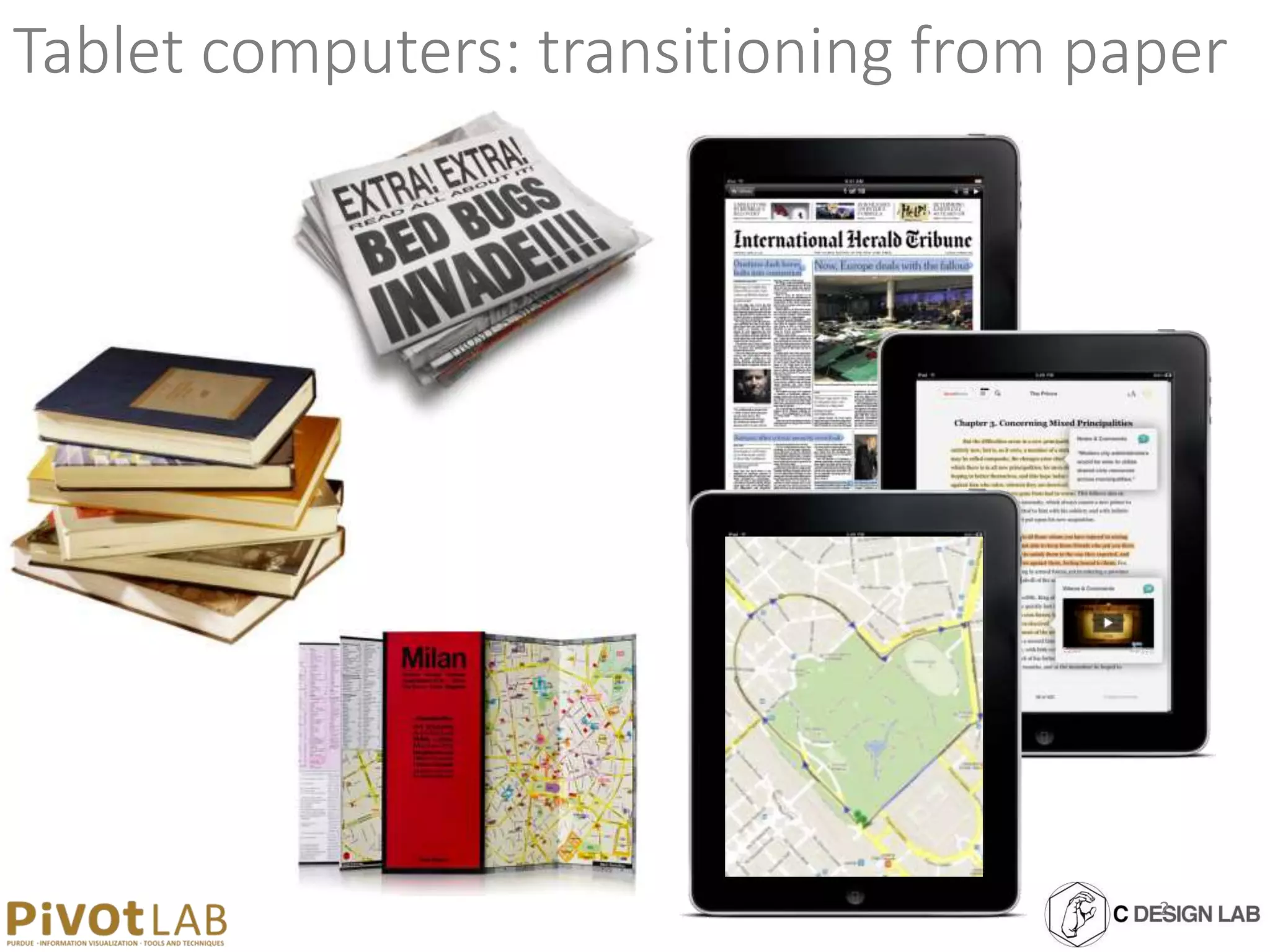
Tablet computers: transitioning from paper
2
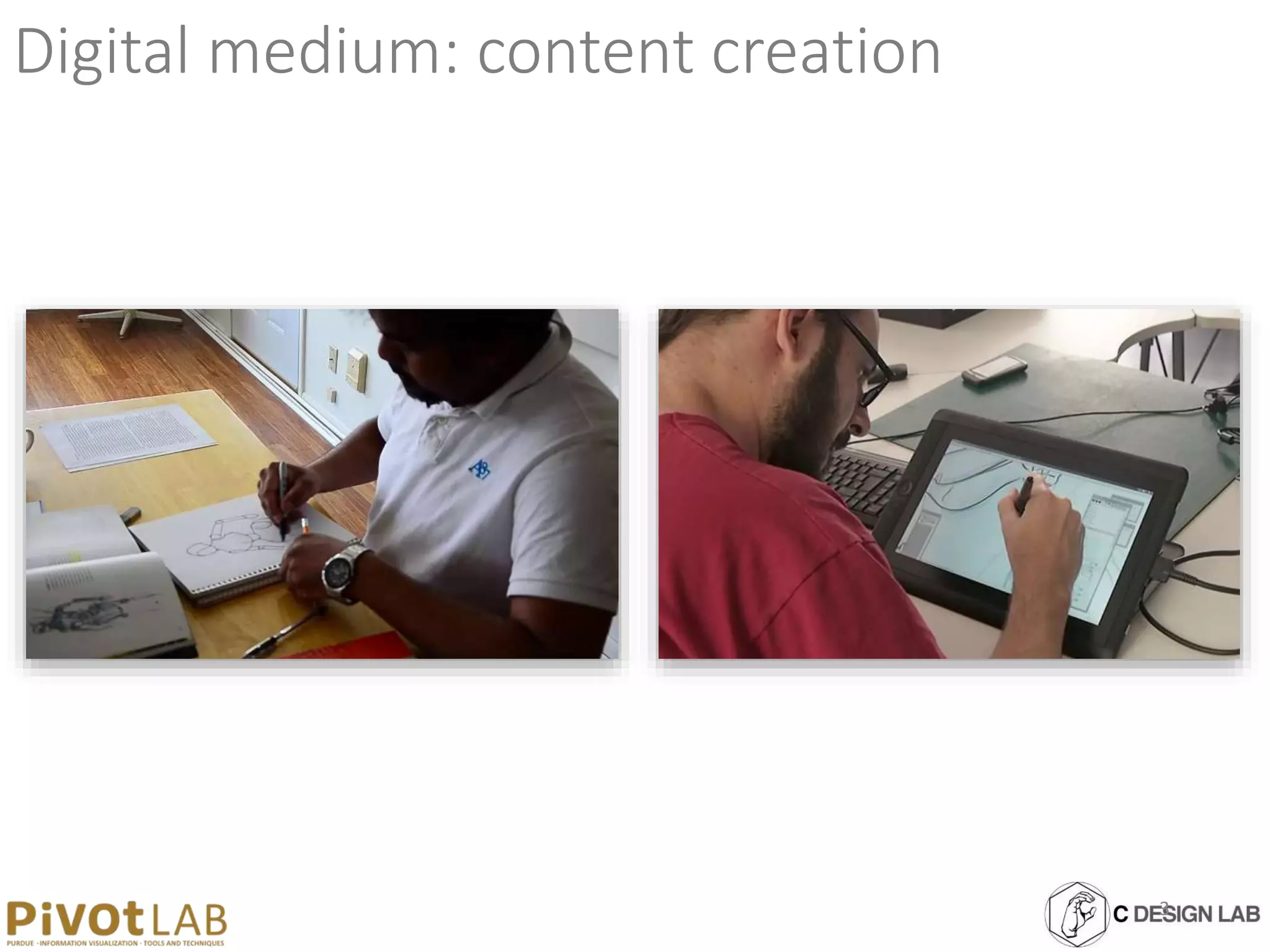
Digital medium: content creation
3
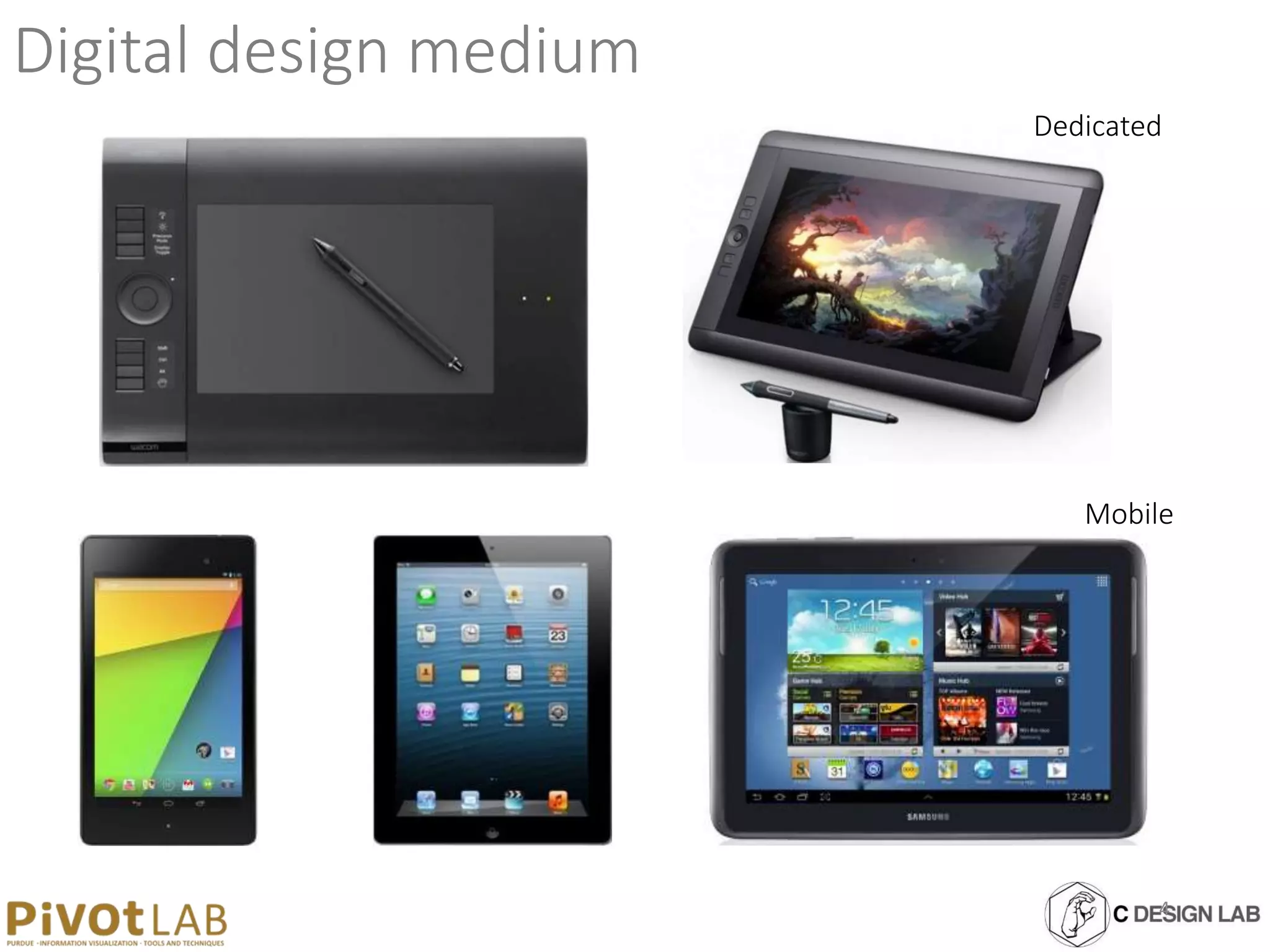
Digital design medium
Dedicated
Mobile
4
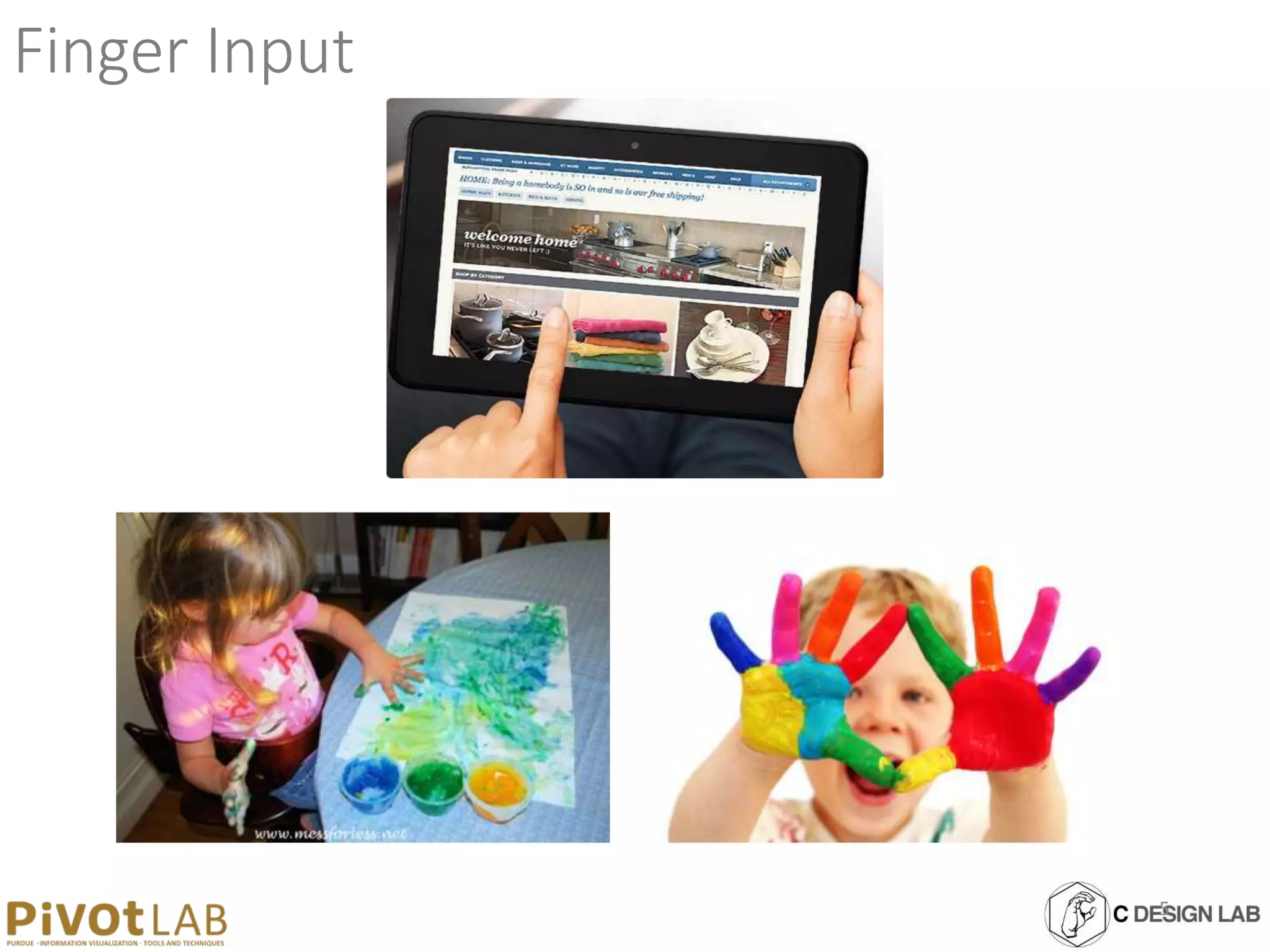
Finger Input
5
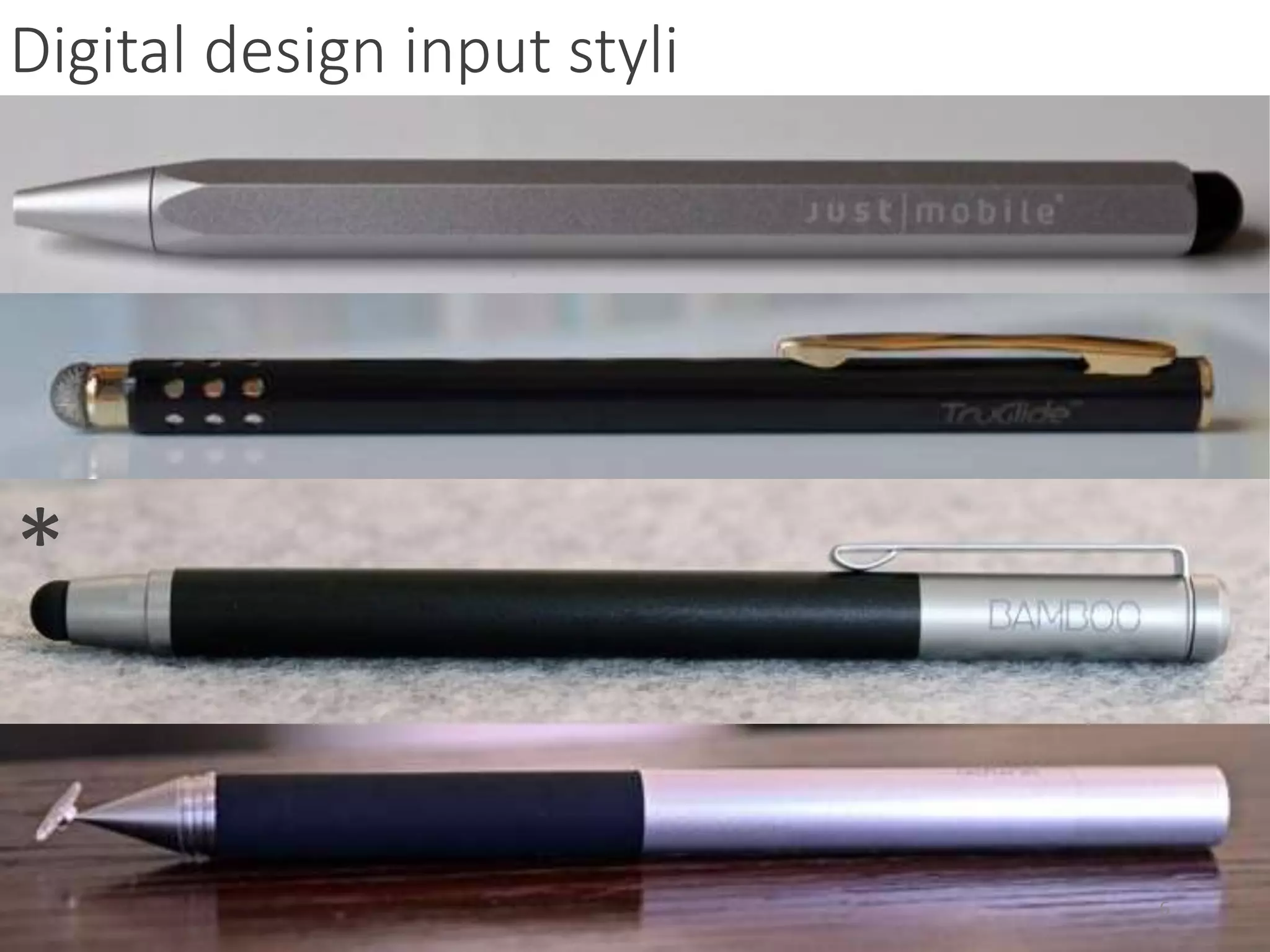
Digital design input styli
*
6
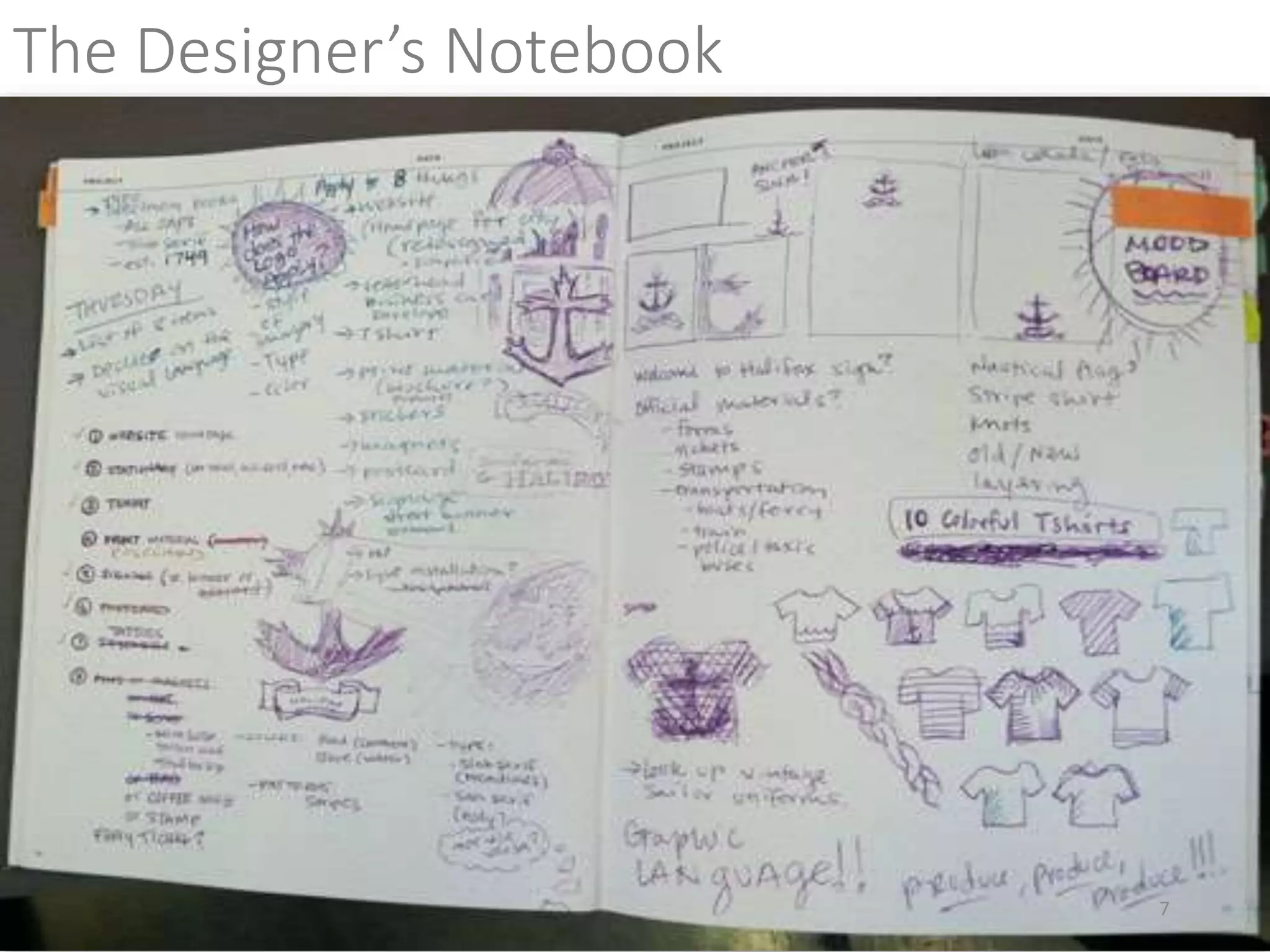
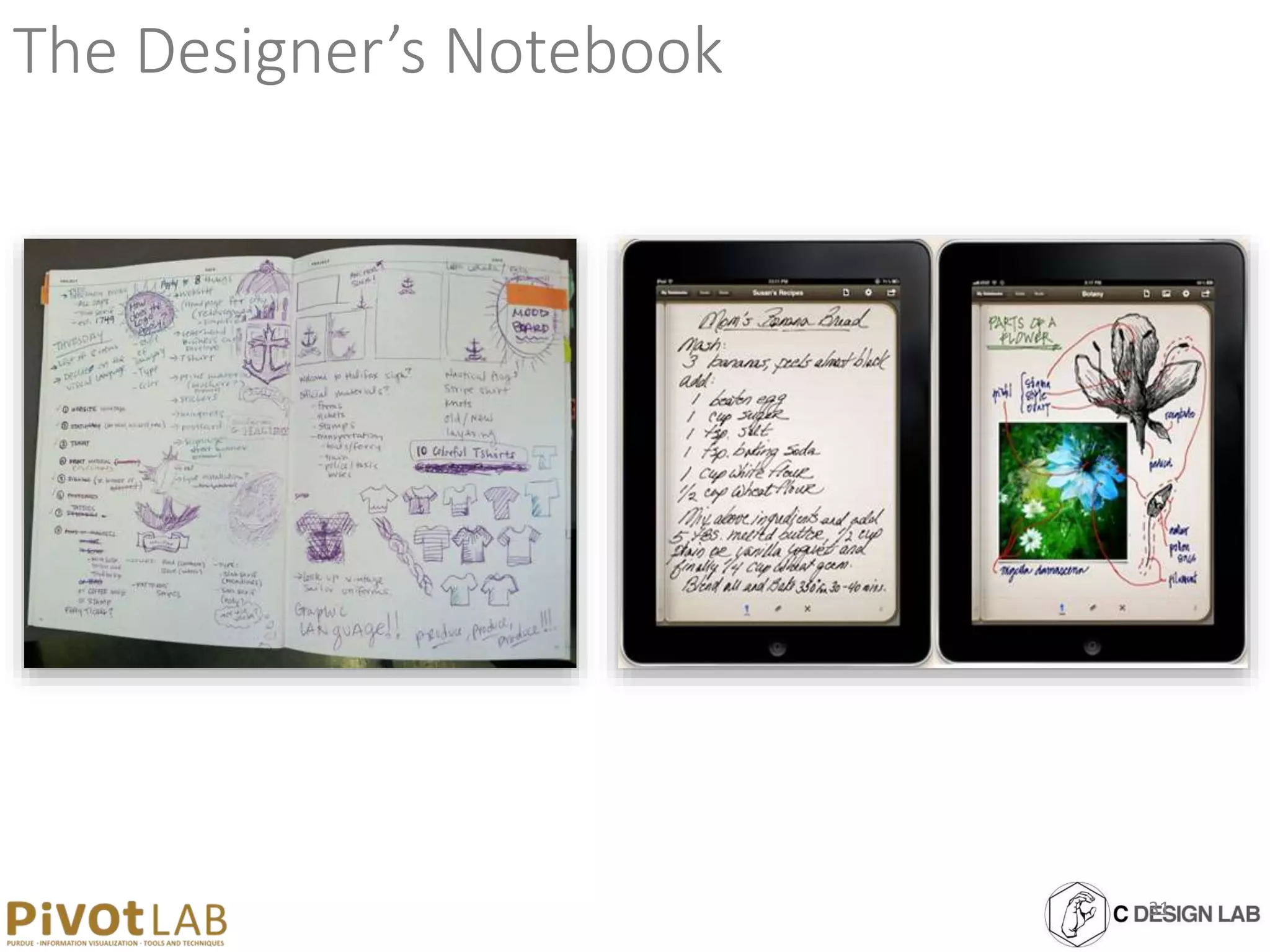
The Designer’s Notebook
7
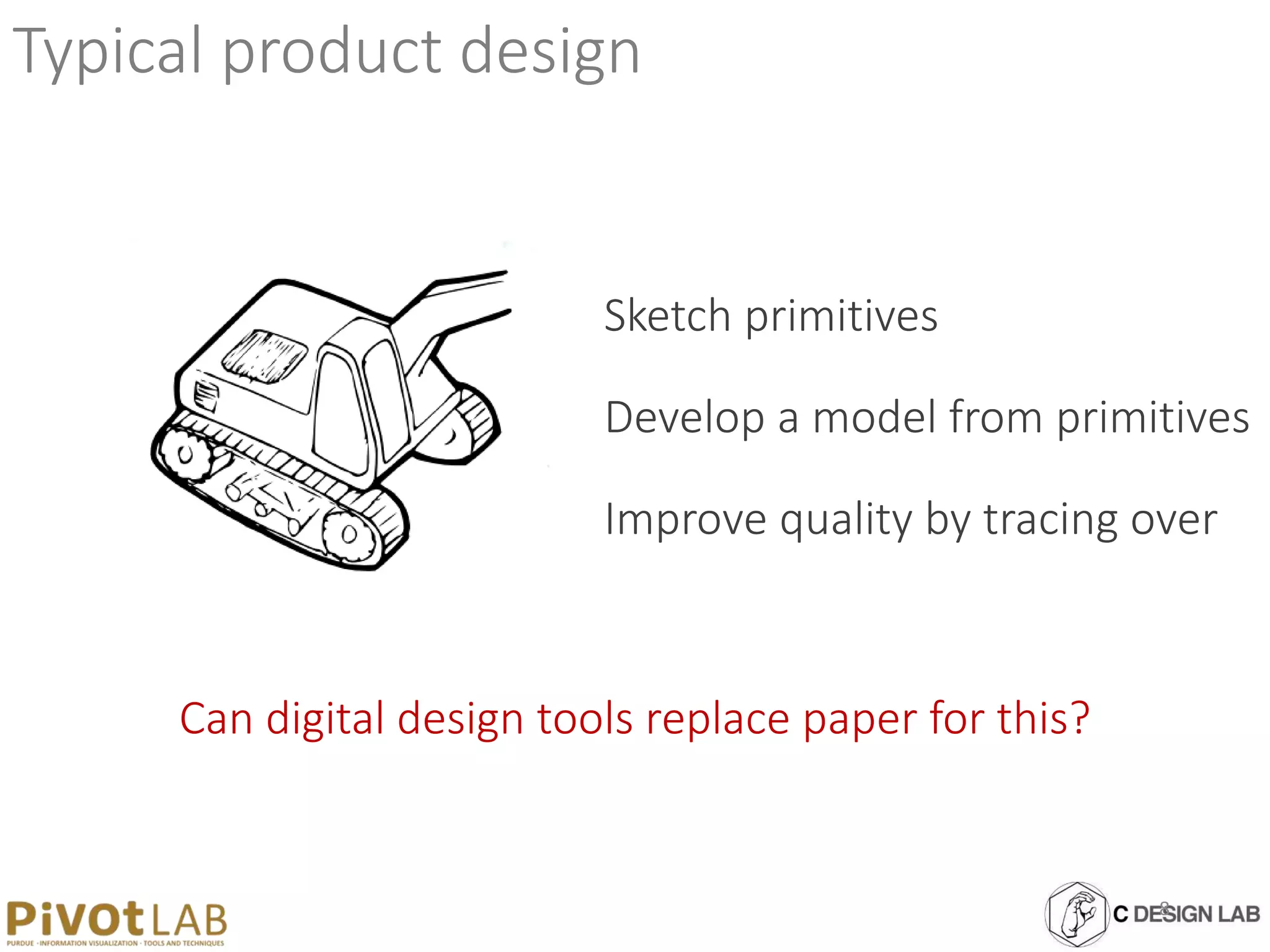
Typical product design
Sketch primitives
Develop a model from primitives
Improve quality by tracing over
Can digital design tools replace paper for this?
8
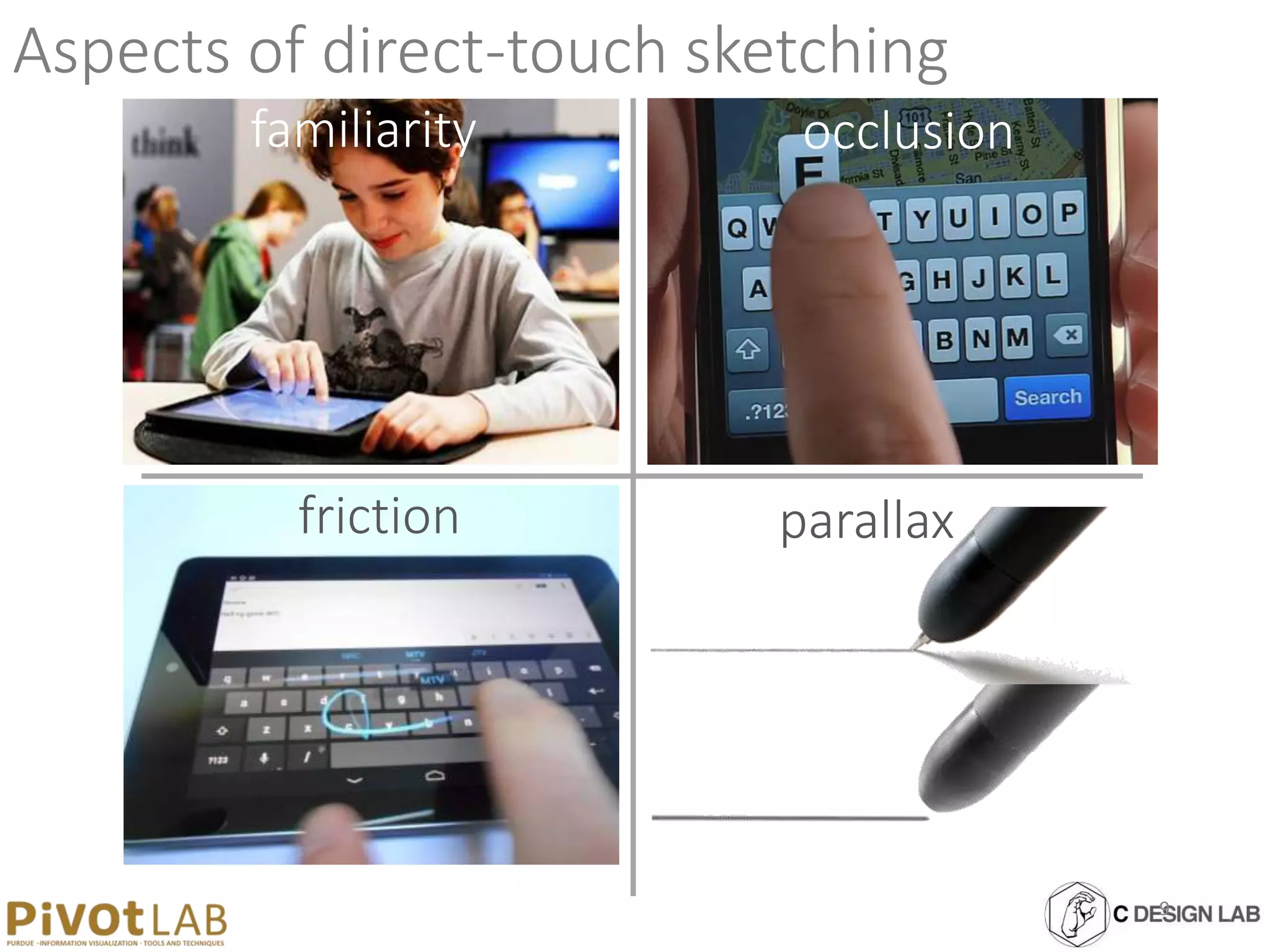
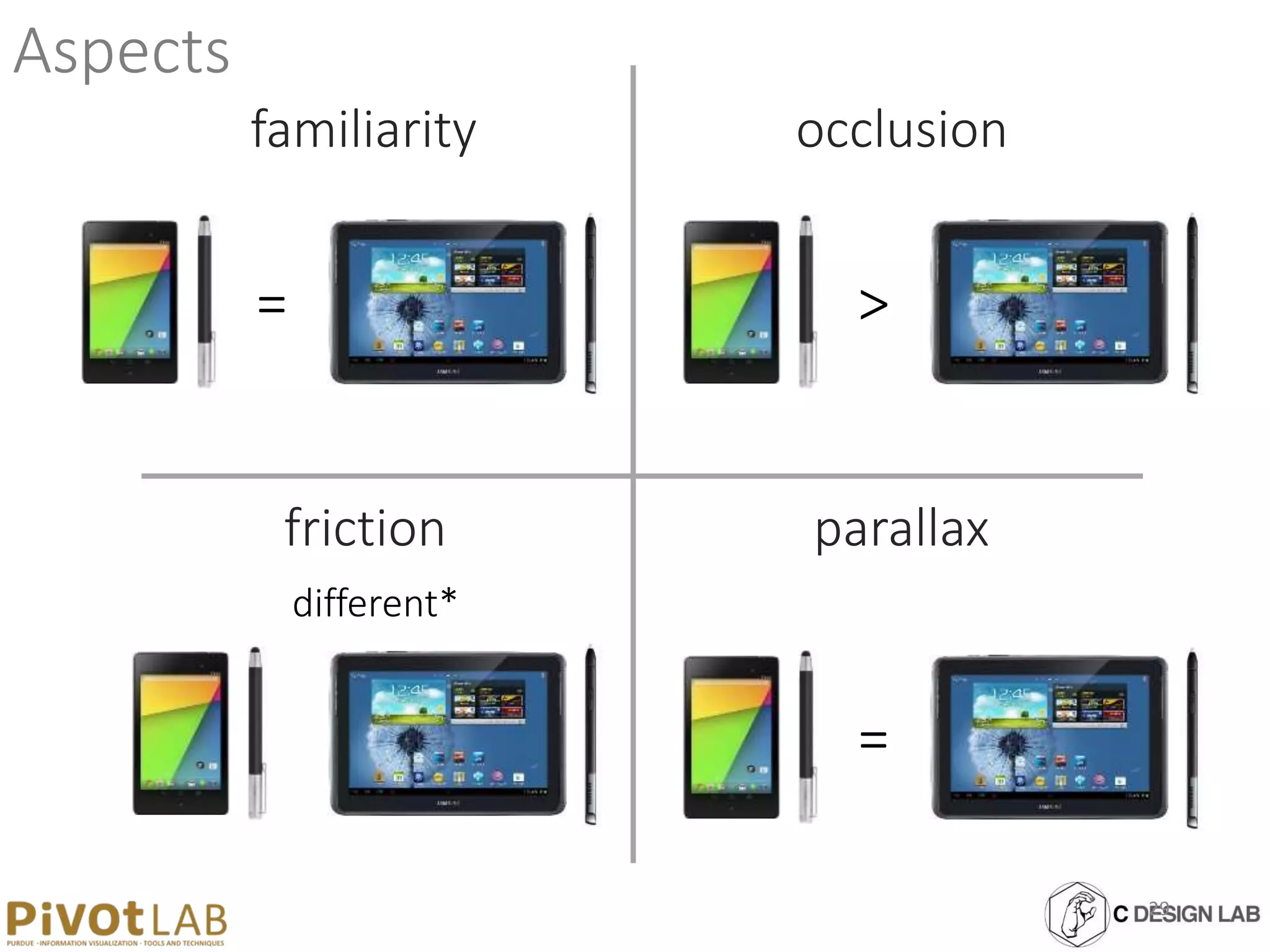
Aspects of direct-touch sketching
friction
occlusion
parallax
familiarity
9
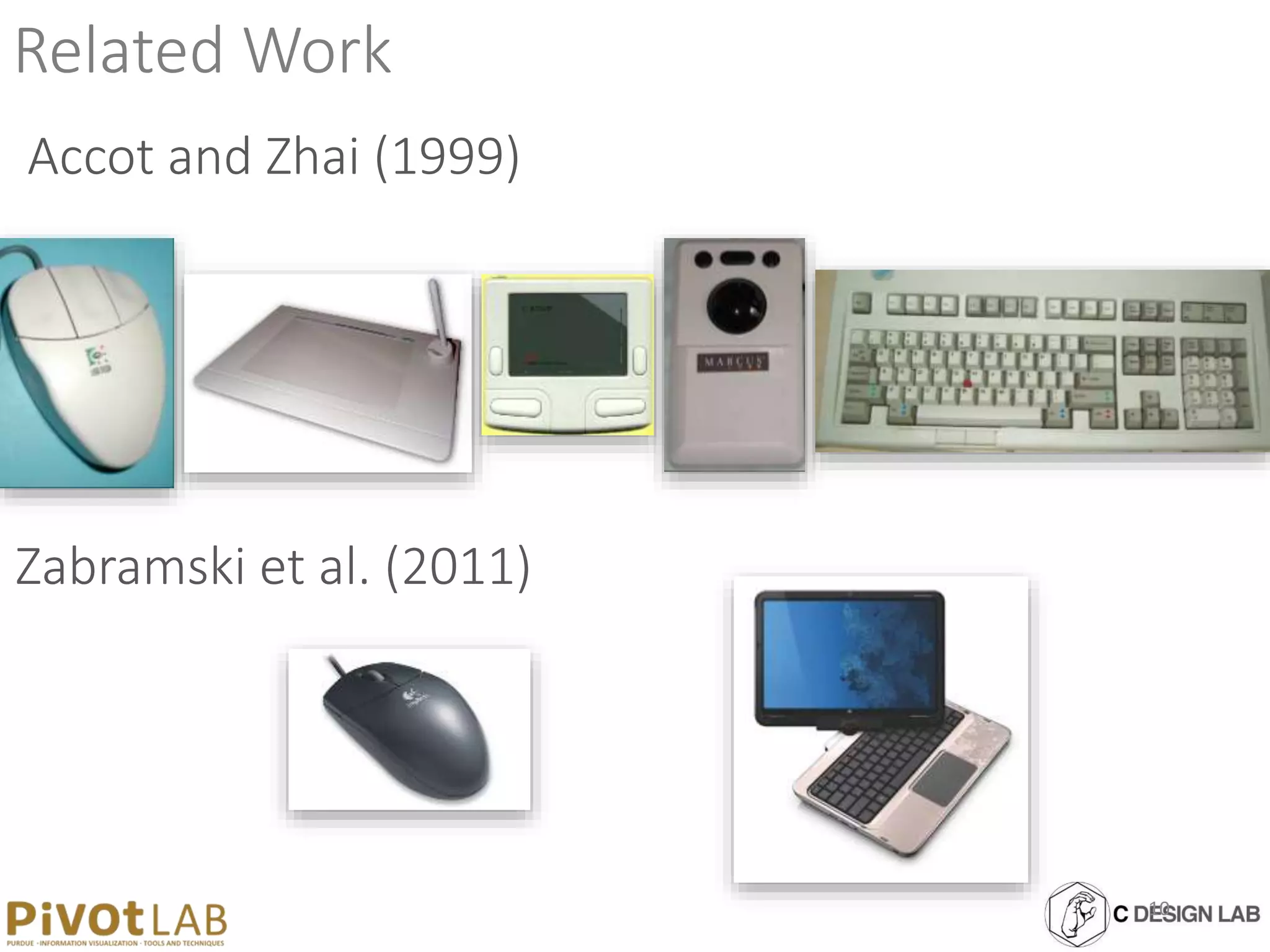
Related Work
Accot and Zhai (1999)
Zabramski et al. (2011)
10
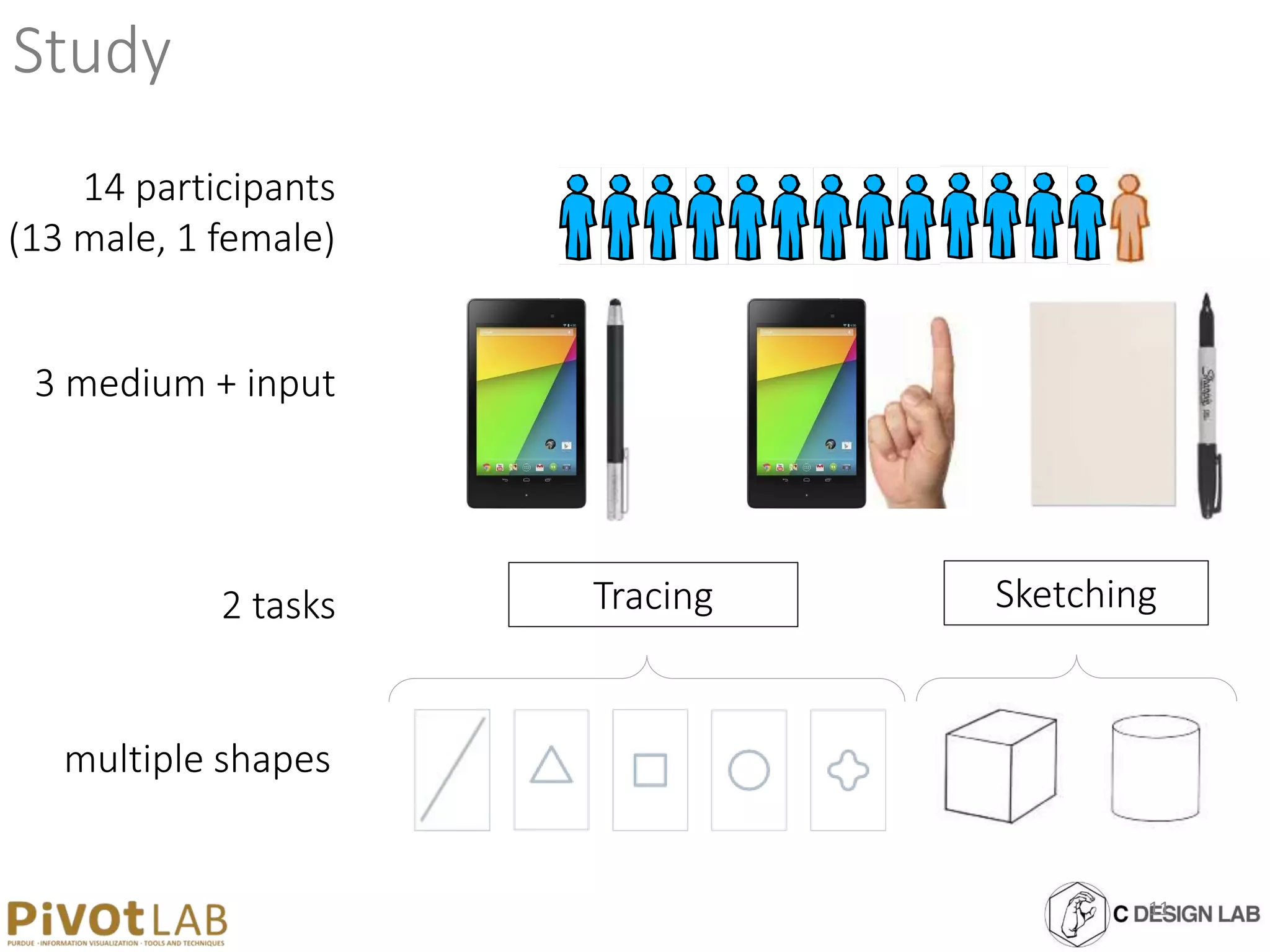
Study
14 participants
(13 male, 1 female)
3 medium + input
multiple shapes
2 tasks Tracing Sketching
11
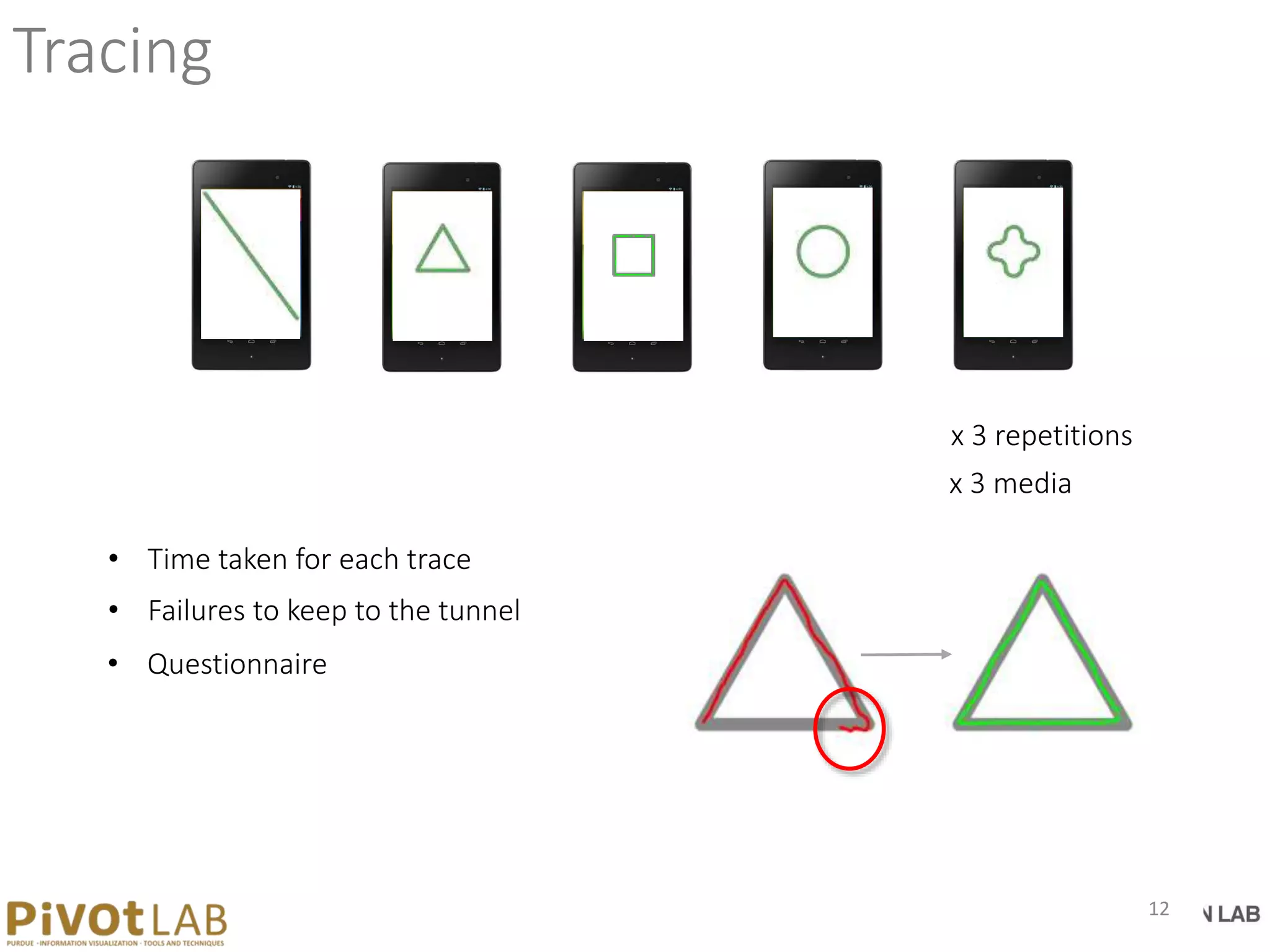
Tracing
x 3 repetitions
• Time taken for each trace
• Failures to keep to the tunnel
• Questionnaire
x 3 media
12
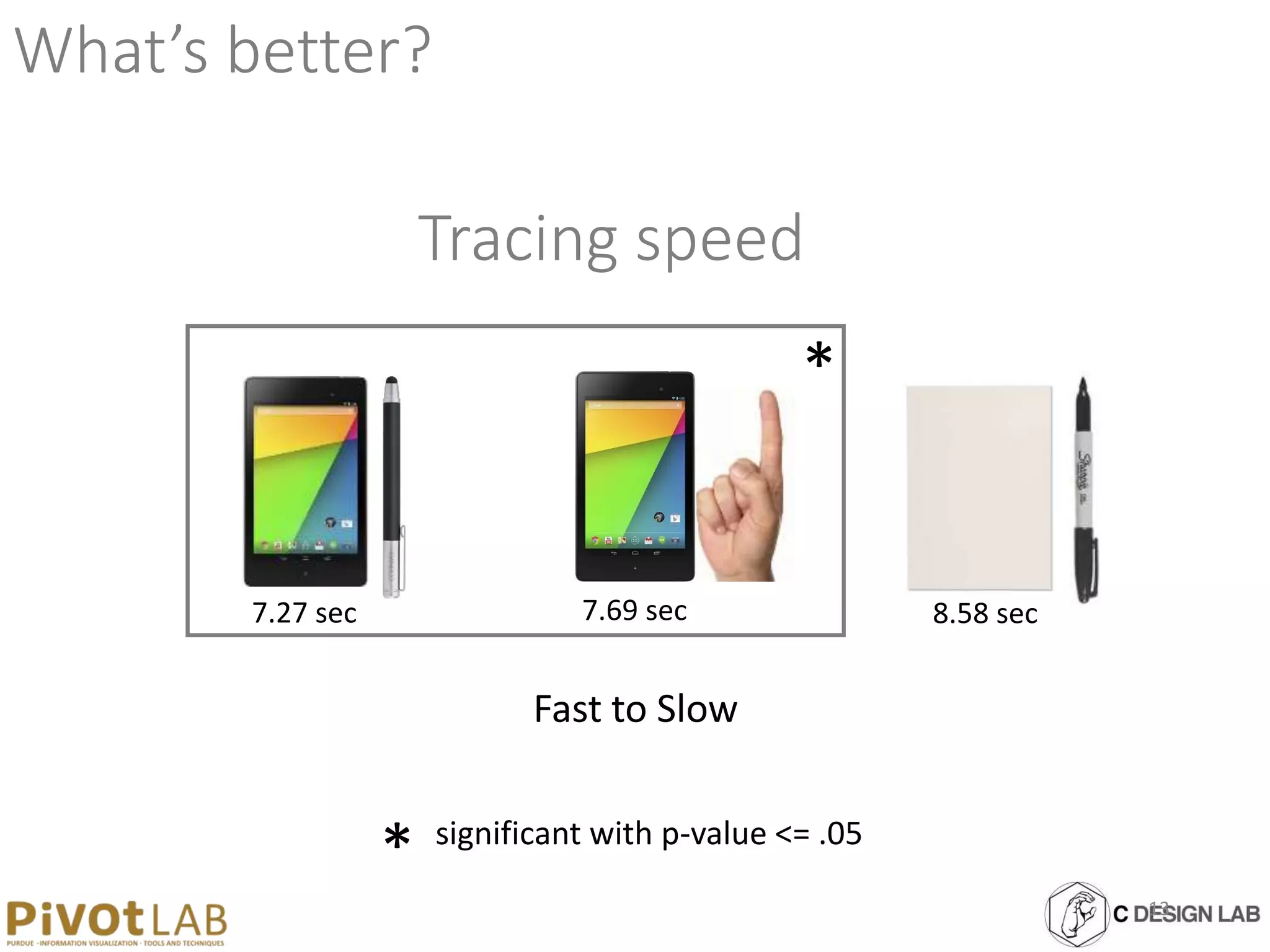
What’s better?
Tracing speed
Fast to Slow
*
7.27 sec 7.69 sec 8.58 sec
13
* significant with p-value <= .05
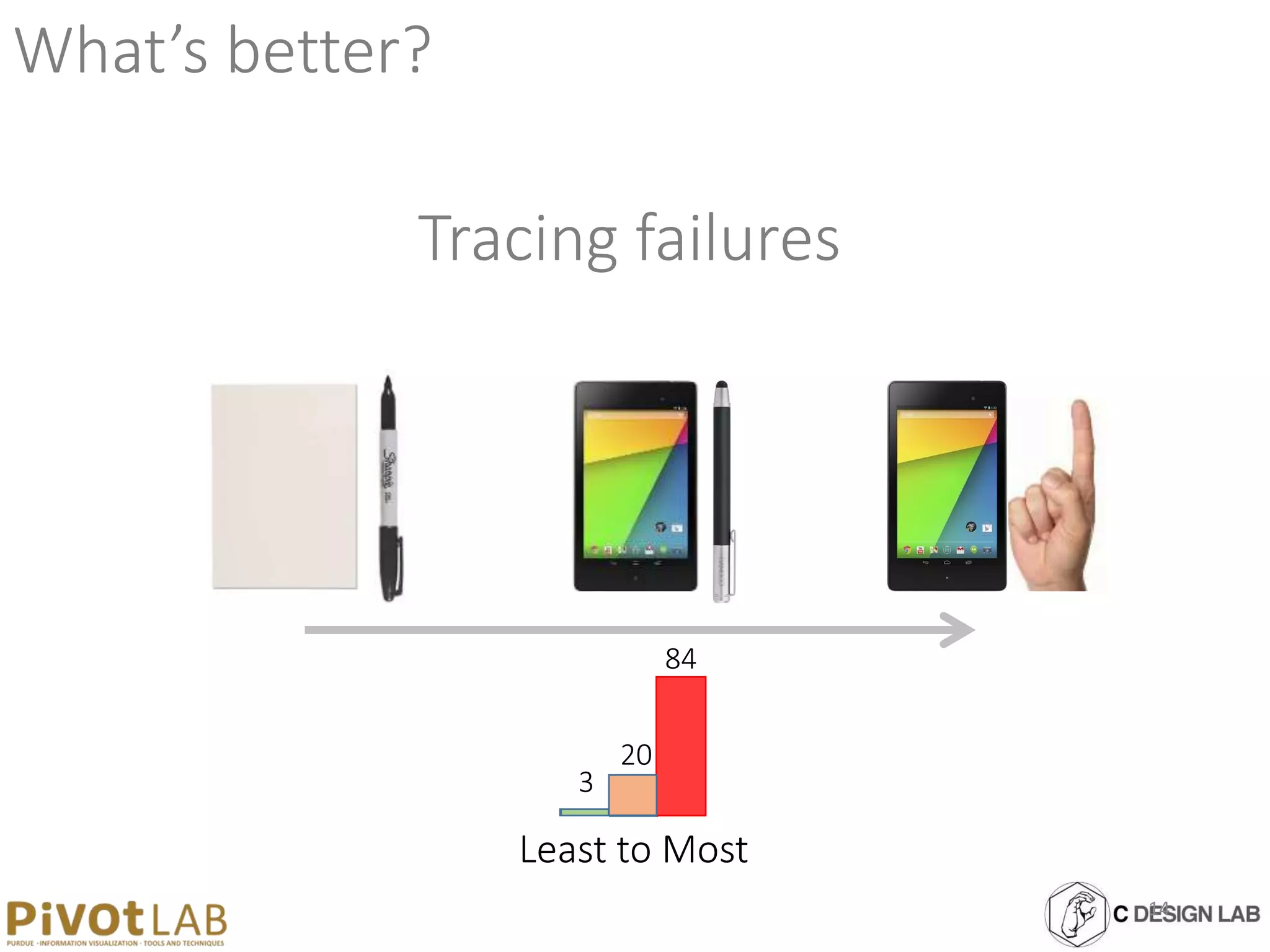
What’s better?
Tracing failures
Least to Most
3
20
84
14
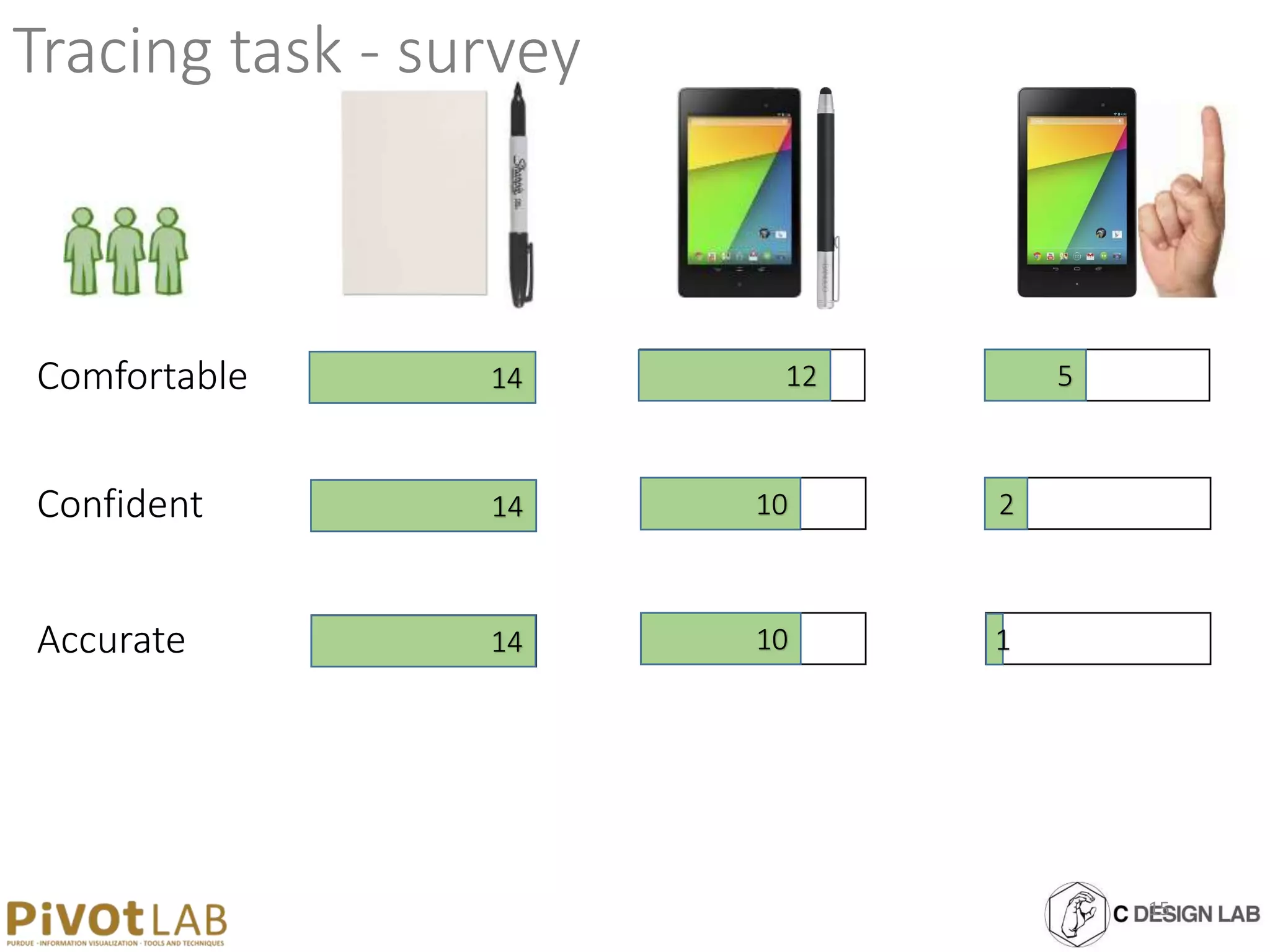
Tracing task - survey
Comfortable
Confident
Accurate
14
14
14
12
10
10
5
2
1
15
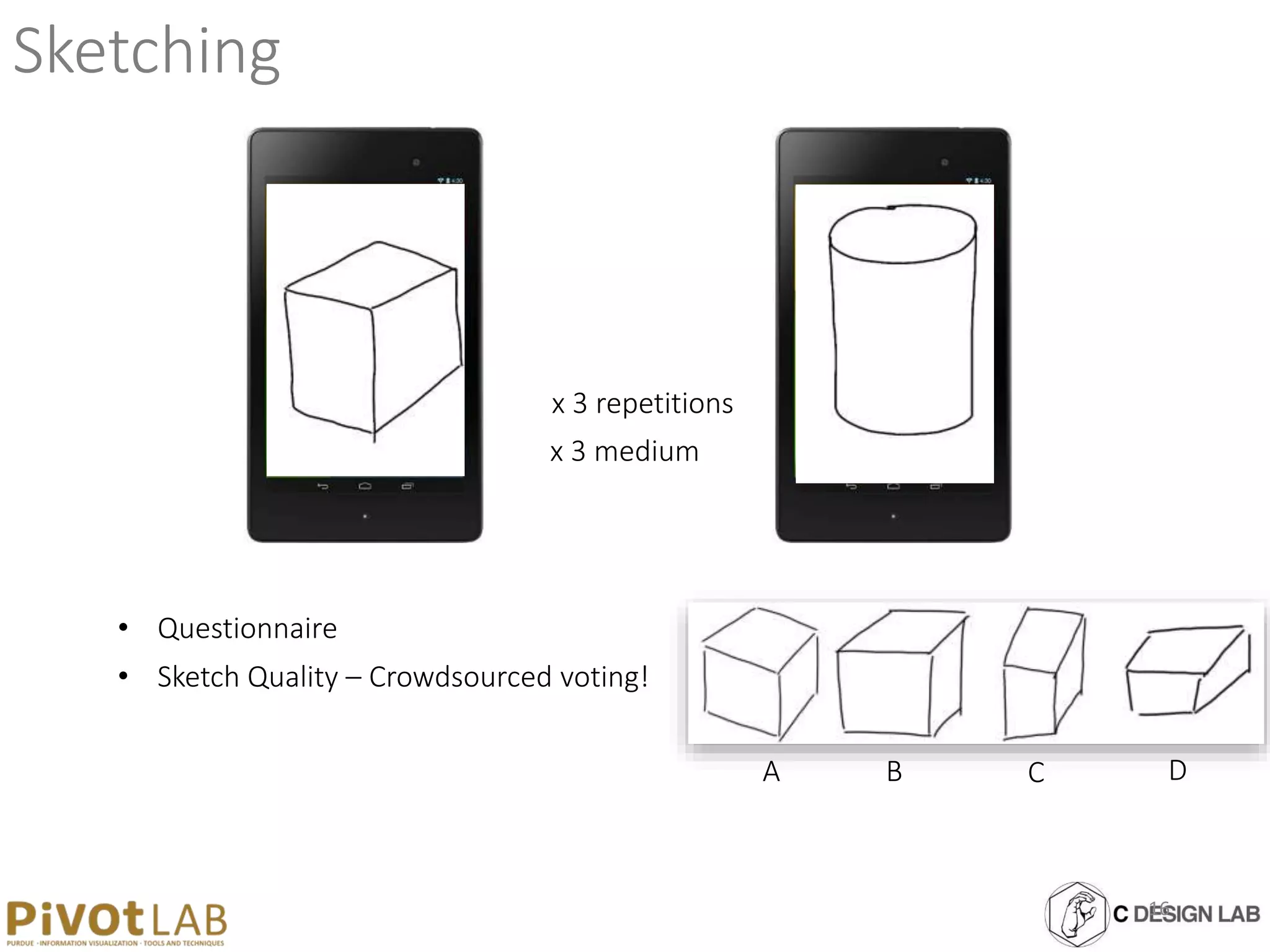
Sketching
x 3 repetitions
x 3 medium
• Sketch Quality – Crowdsourced voting!
• Questionnaire
A B C D
16
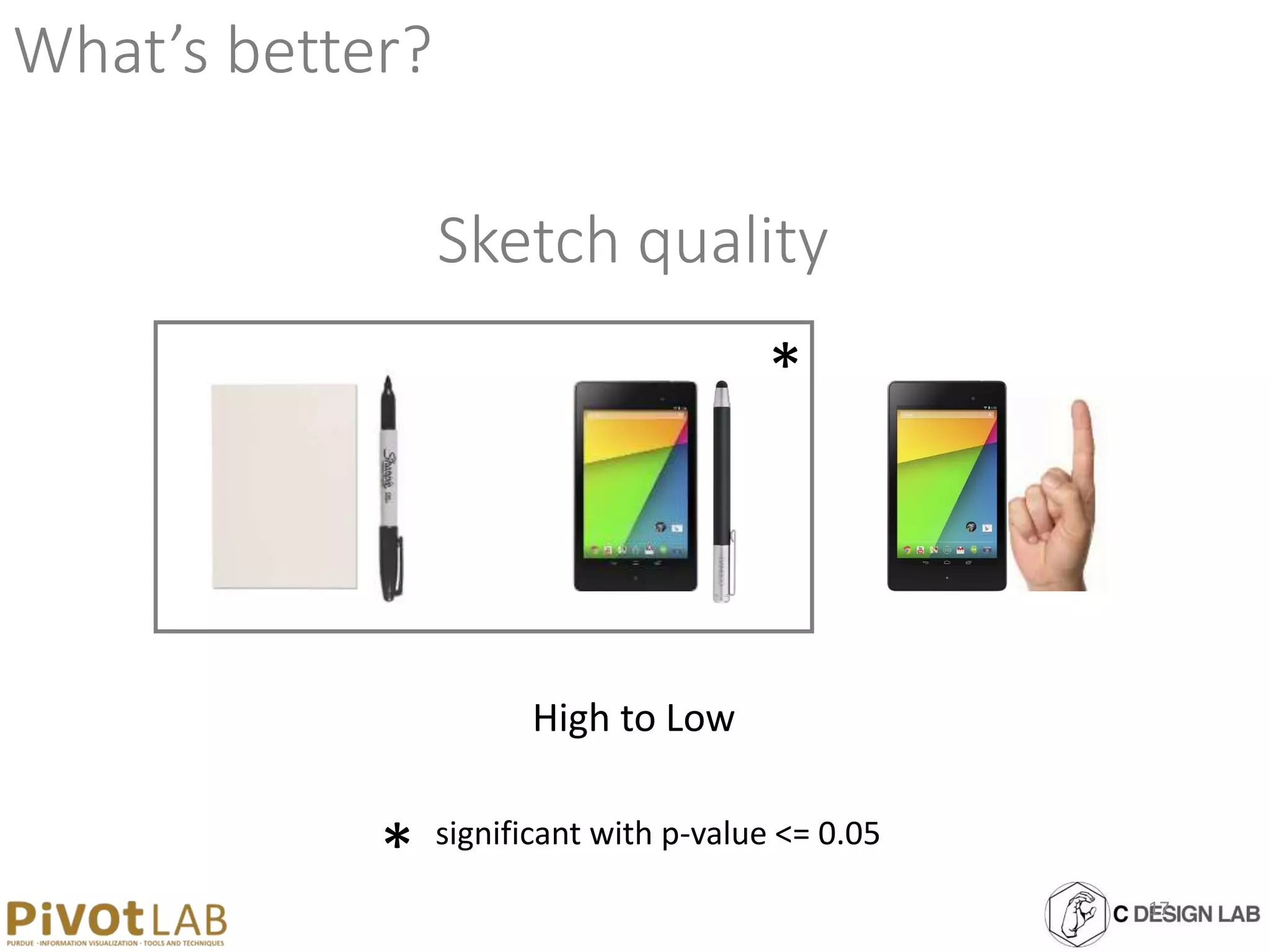
What’s better?
Sketch quality
High to Low
*
* significant with p-value <= 0.05
17
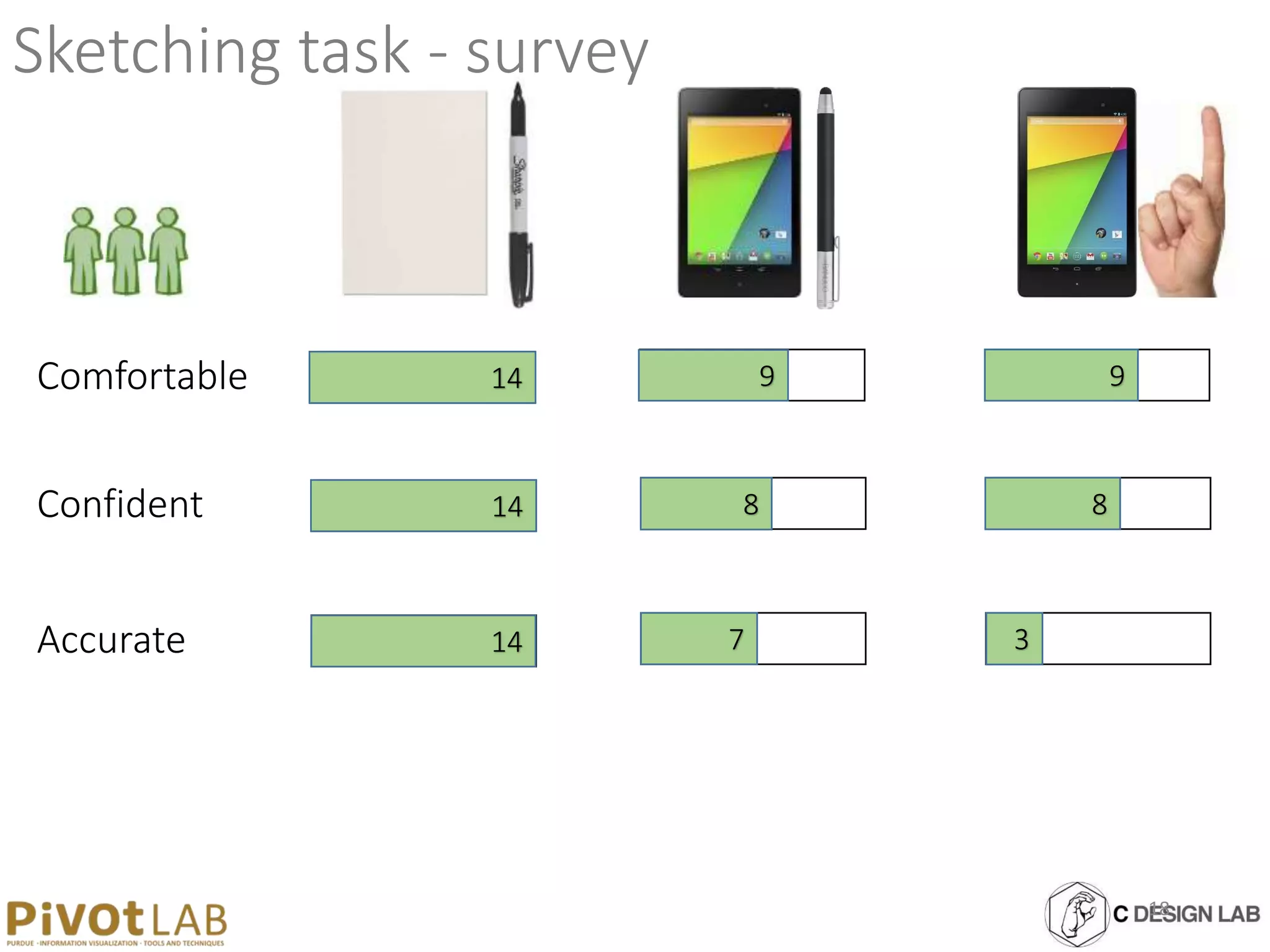
Comfortable
Confident
Accurate
14
14
14
9
8
7
9
8
3
Sketching task - survey
18
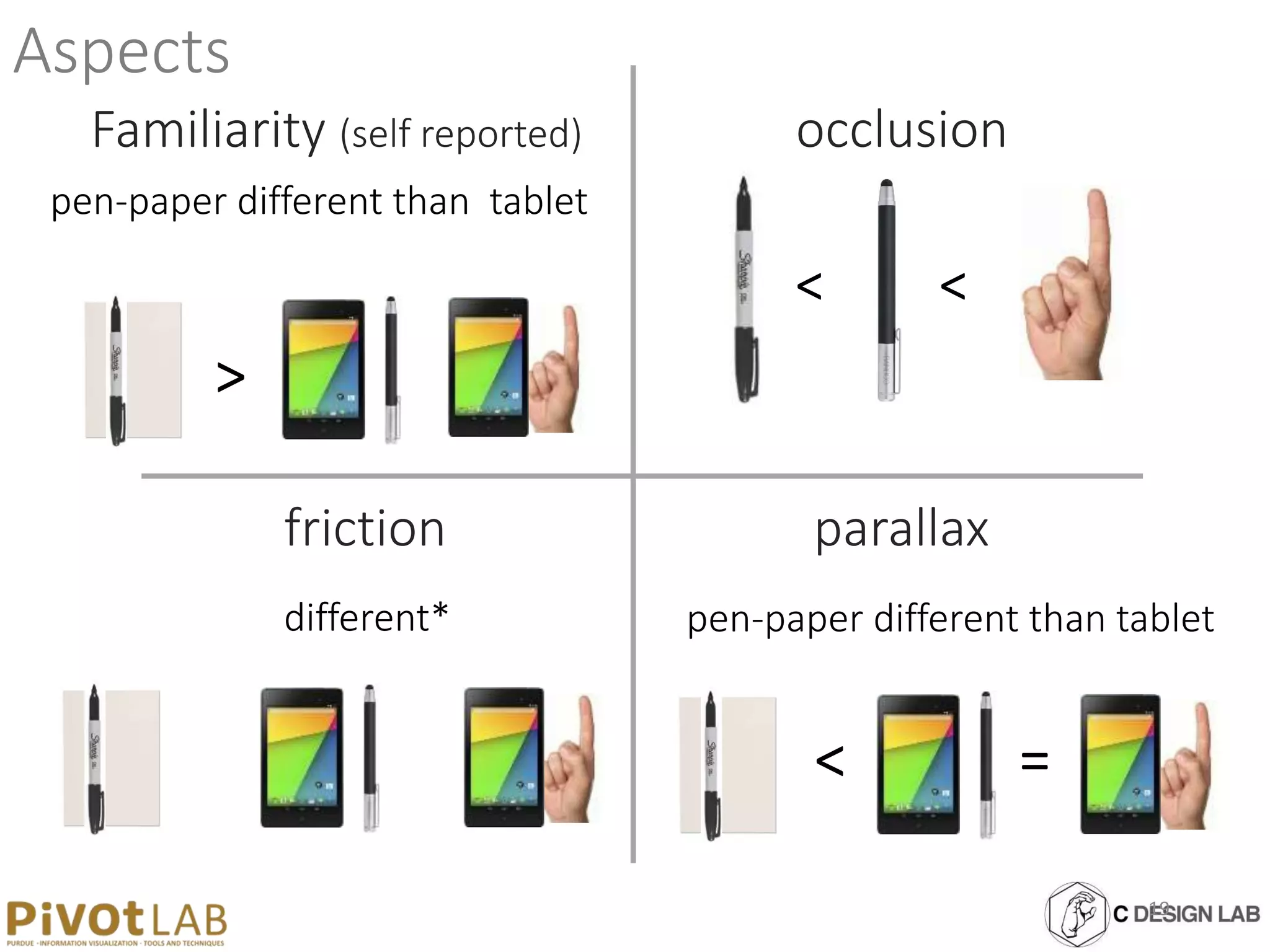
Aspects
Familiarity (self reported) occlusion
friction parallax
different* pen-paper different than tablet
pen-paper different than tablet
< <
>
< =
19
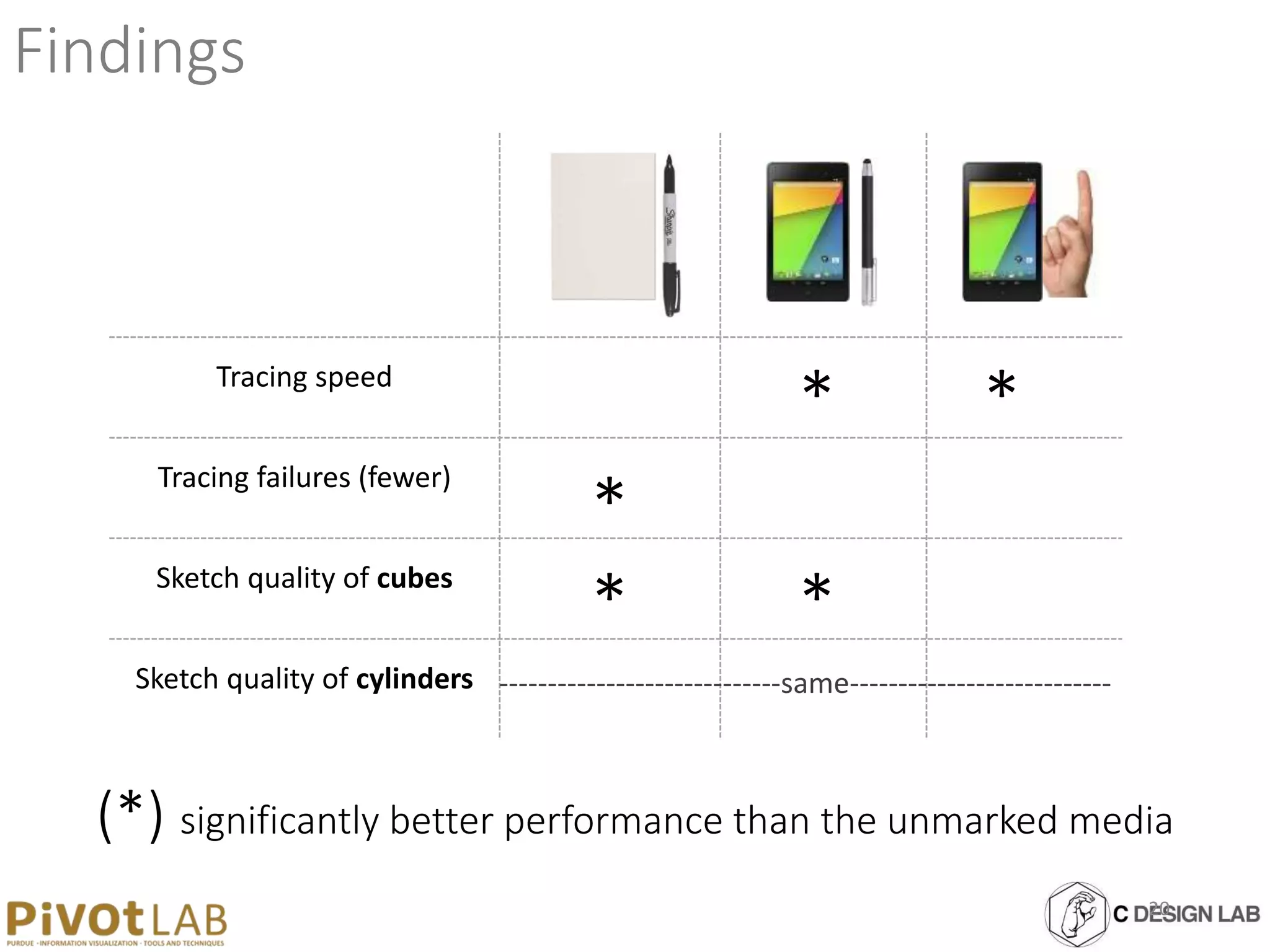
Findings
Tracing speed
Tracing failures (fewer)
Sketch quality of cubes
Sketch quality of cylinders
* *
*
* *
(*) significantly better performance than the unmarked media
-----------------------------same---------------------------
20
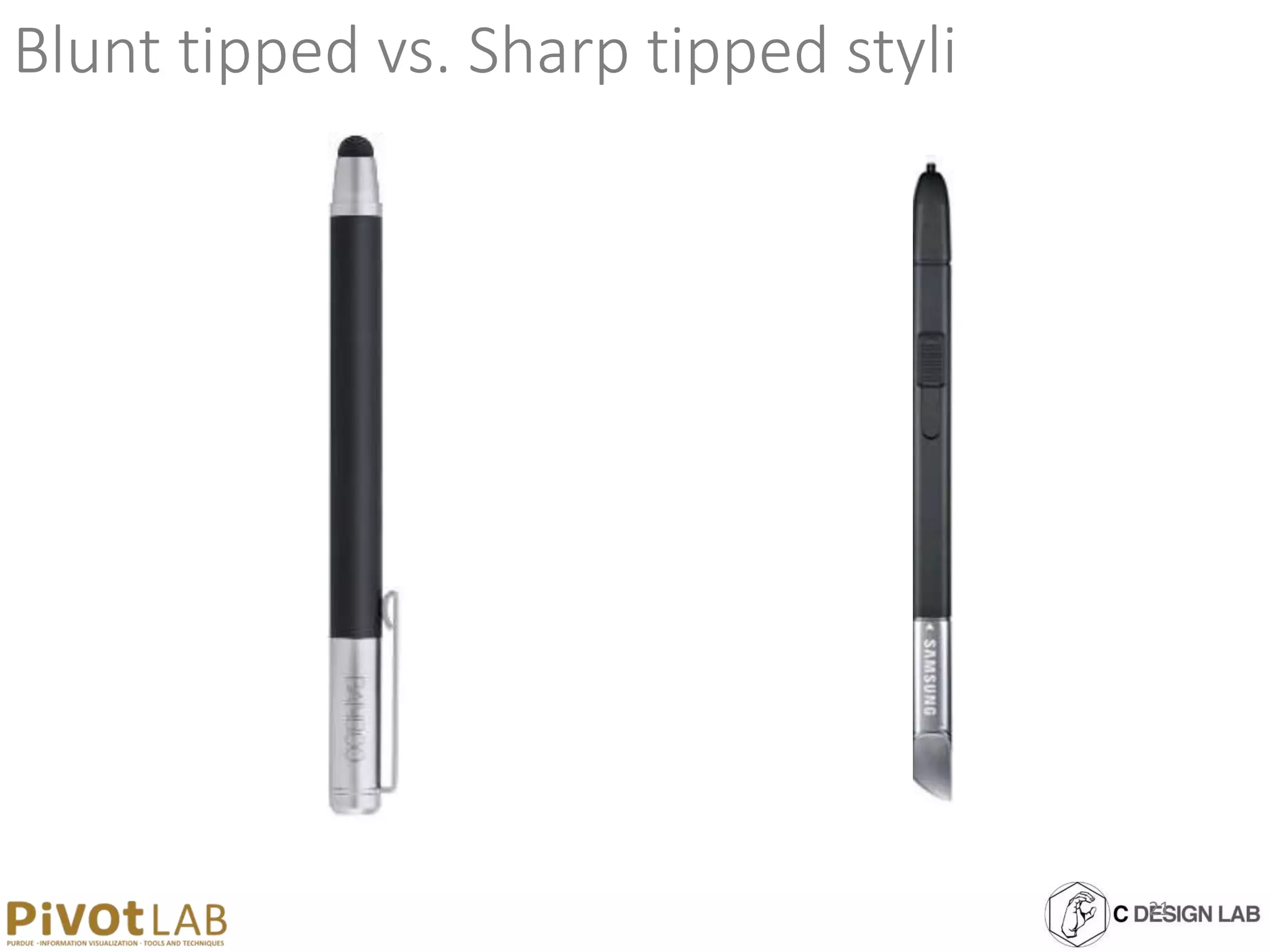
Blunt tipped vs. Sharp tipped styli
21
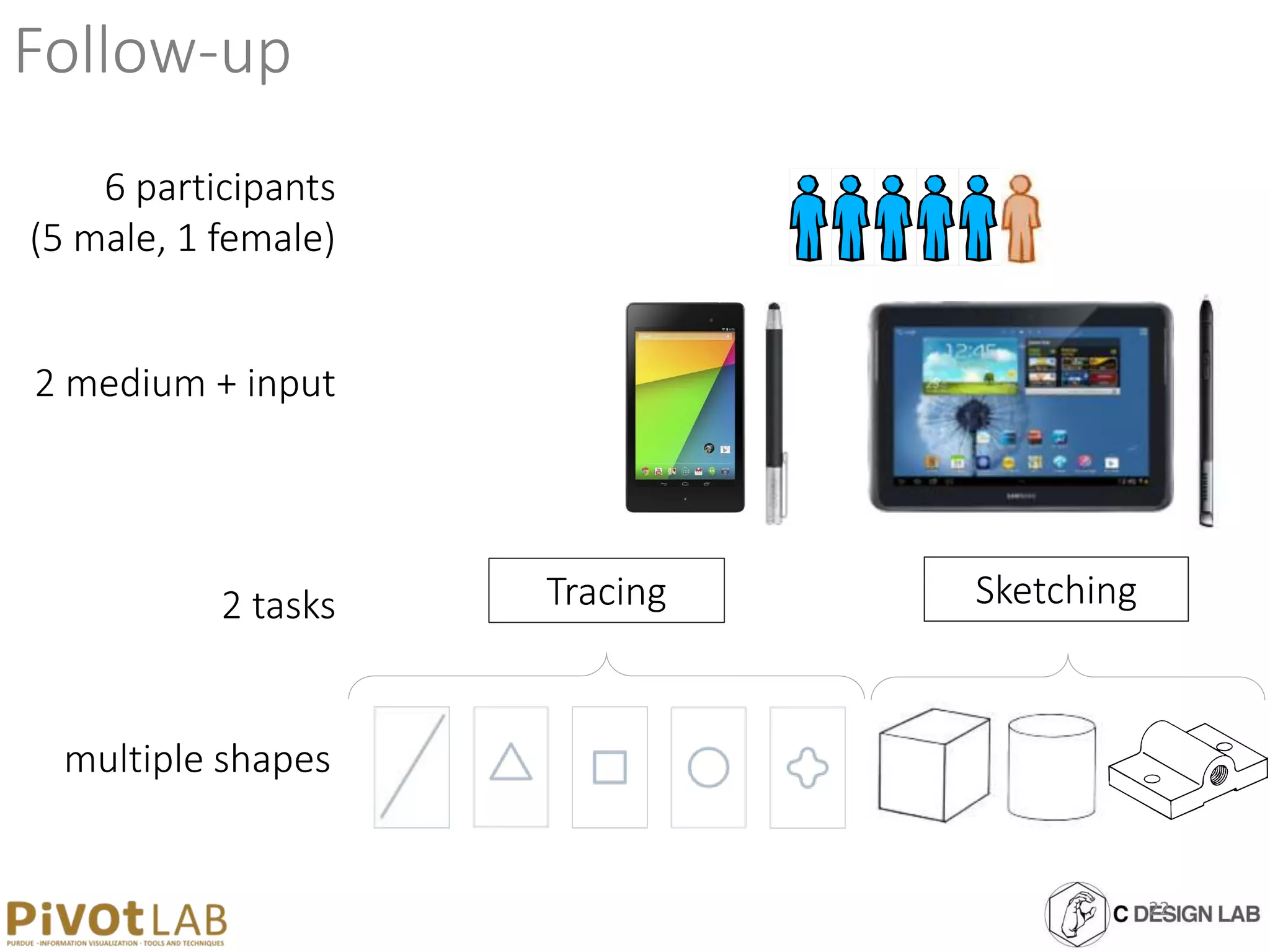
Follow-up
6 participants
(5 male, 1 female)
2 medium + input
multiple shapes
2 tasks Tracing Sketching
22
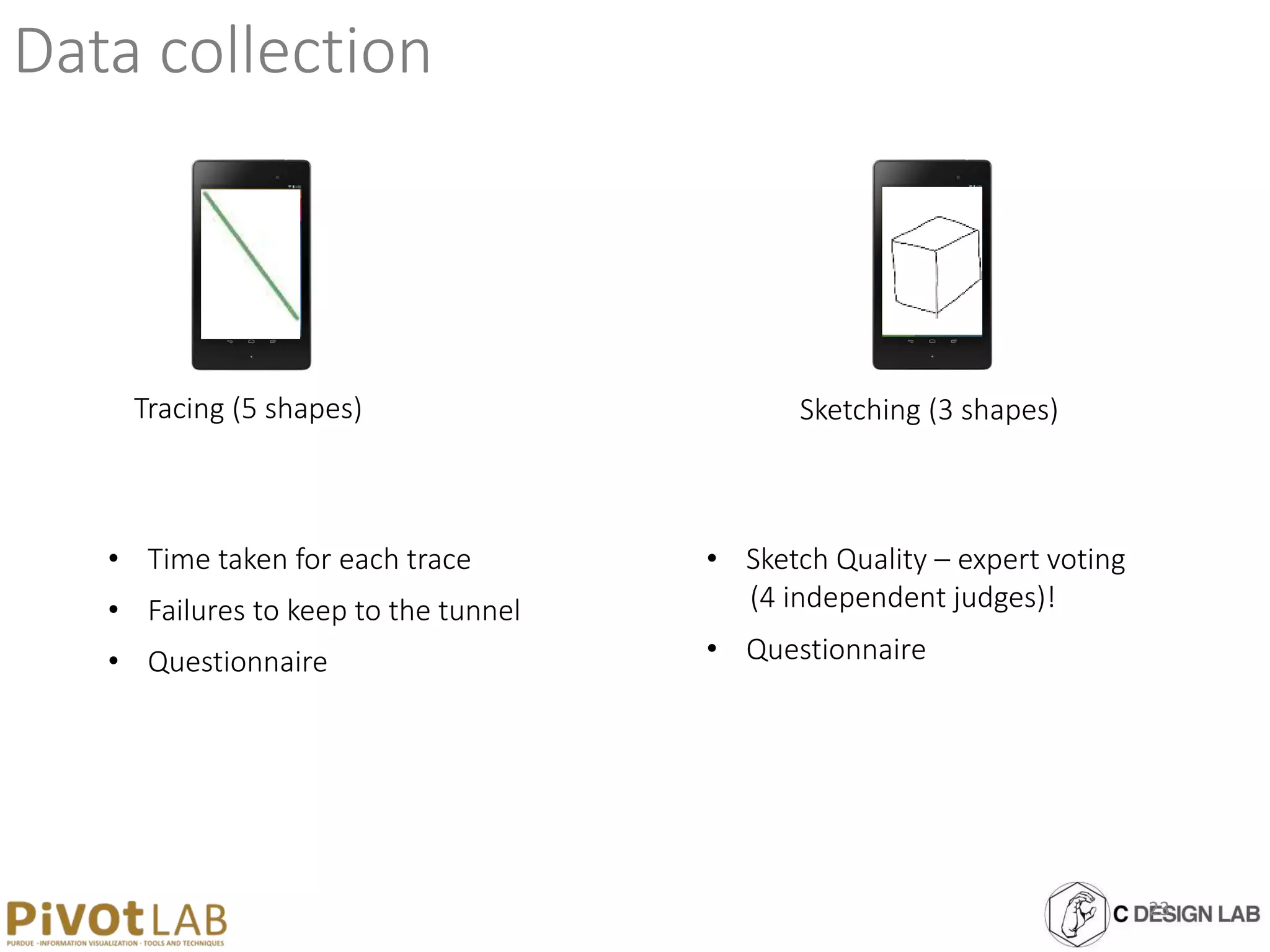
Data collection
• Time taken for each trace
• Failures to keep to the tunnel
• Sketch Quality – expert voting
(4 independent judges)!
Tracing (5 shapes) Sketching (3 shapes)
• Questionnaire • Questionnaire
23
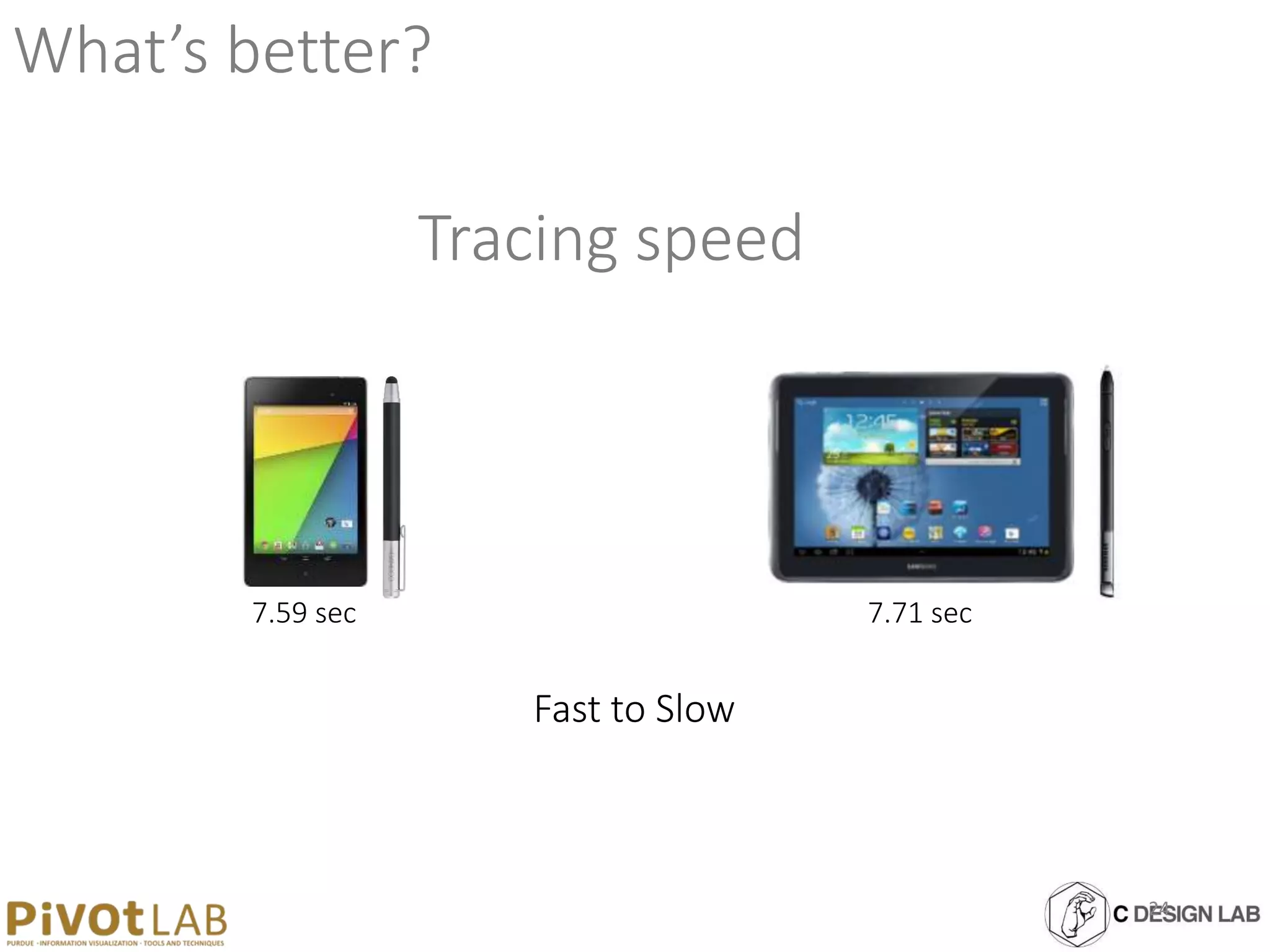
What’s better?
Tracing speed
Fast to Slow
7.59 sec 7.71 sec
24
What’s better?
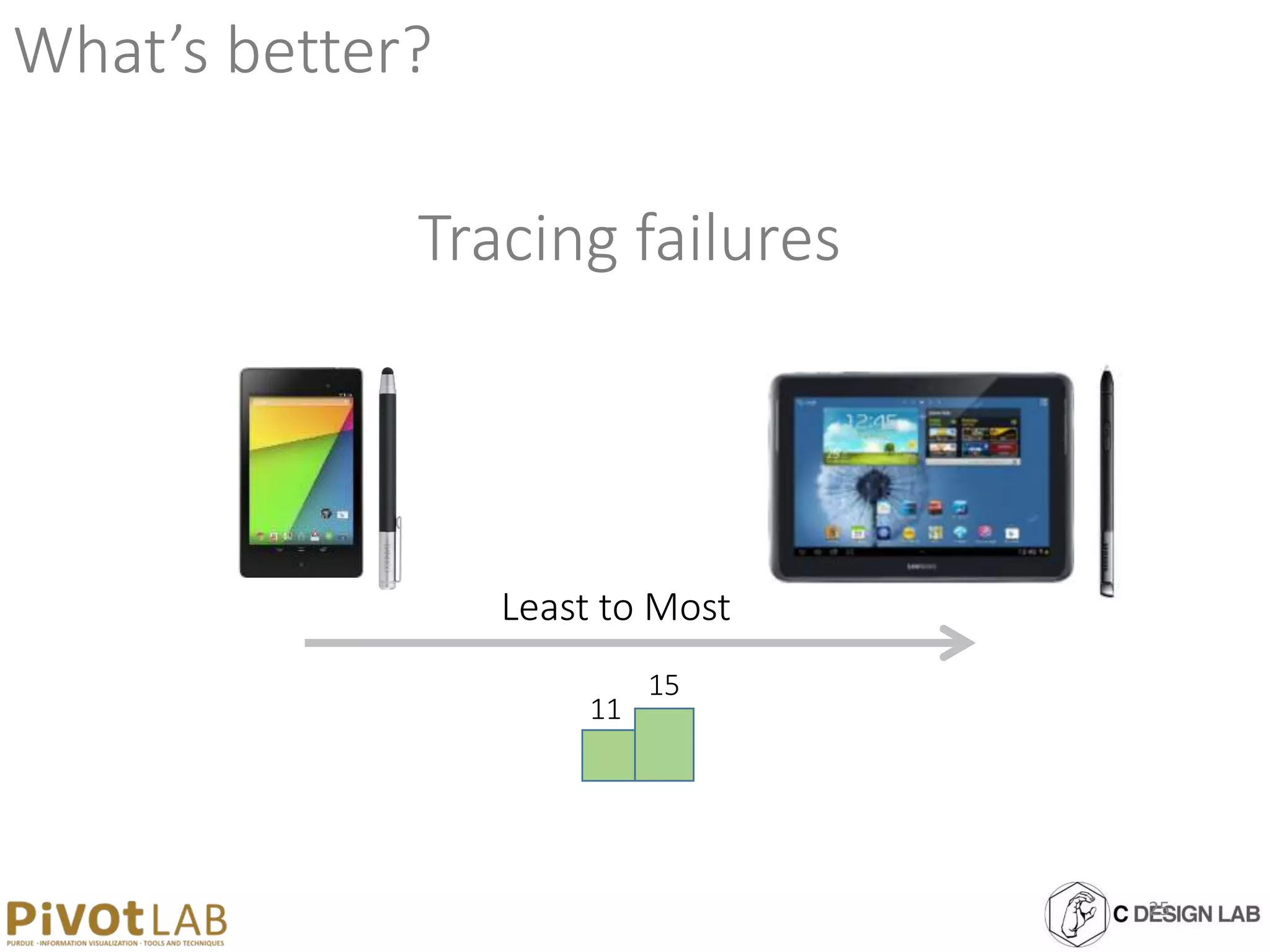
Tracing failures
Least to Most
11
15
25
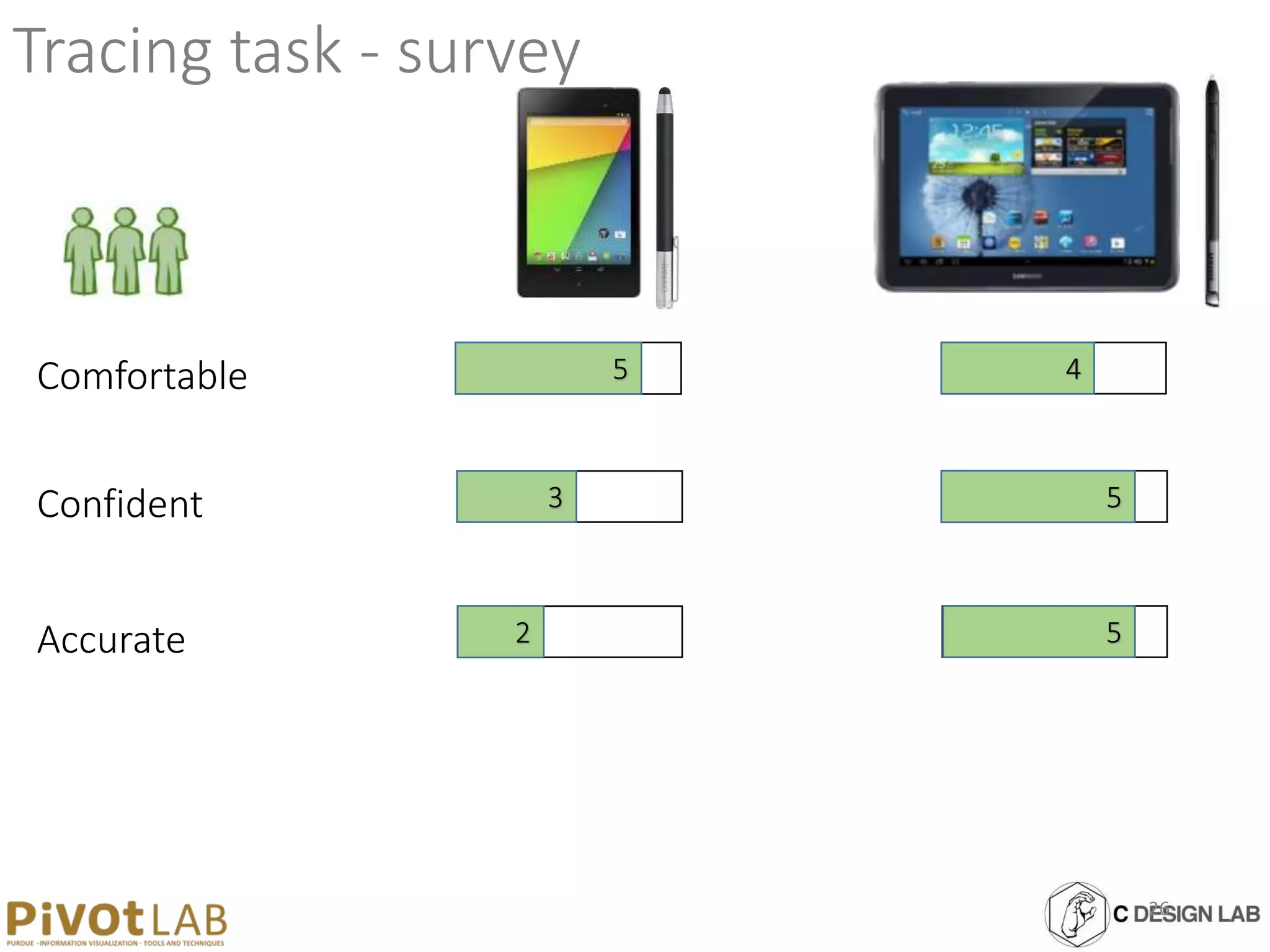
Tracing task - survey
Comfortable
Confident
Accurate
5
3
2
4
5
5
26
What’s better?
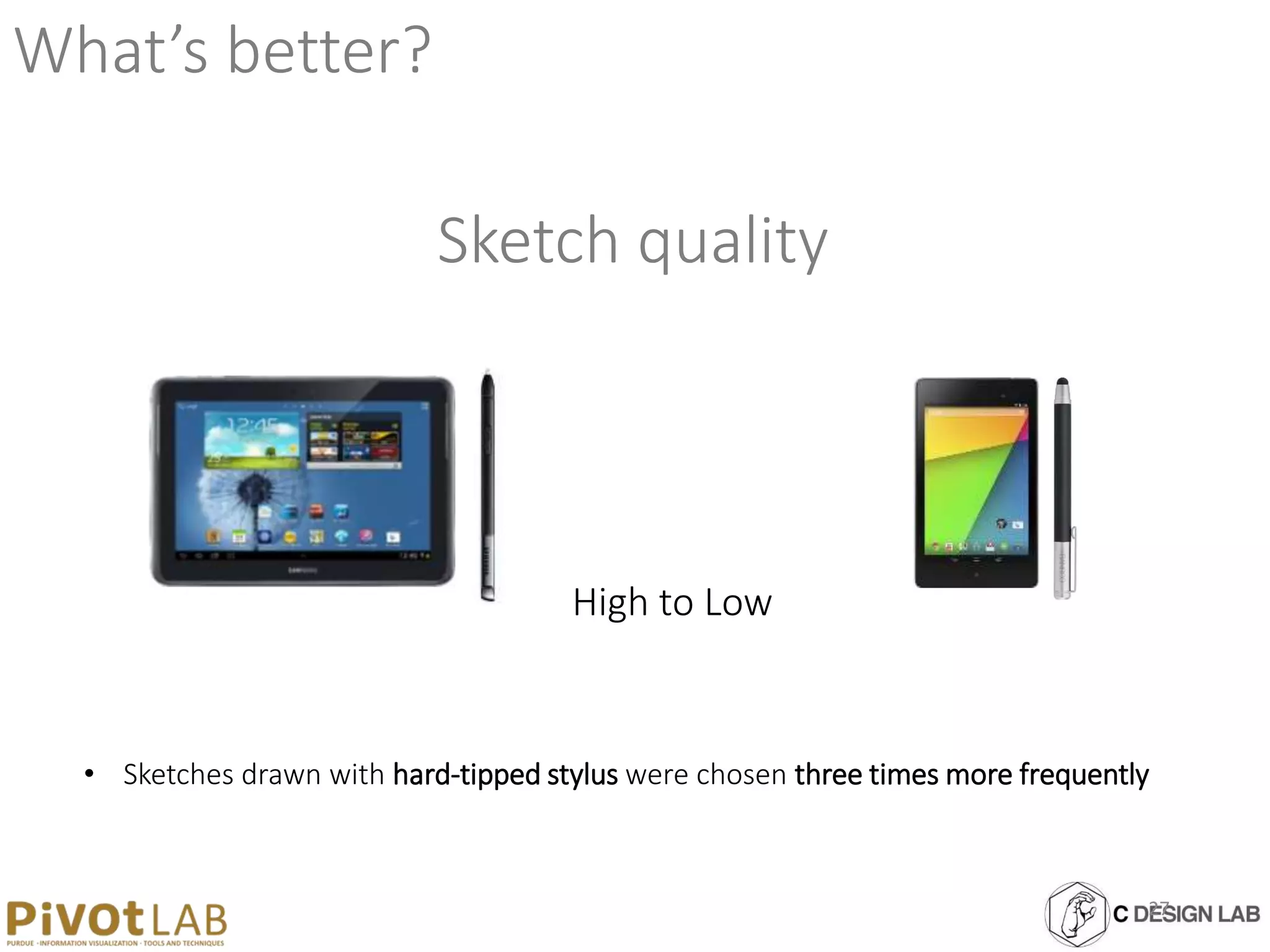
Sketch quality
High to Low
• Sketches drawn with hard-tipped stylus were chosen three times more frequently
27
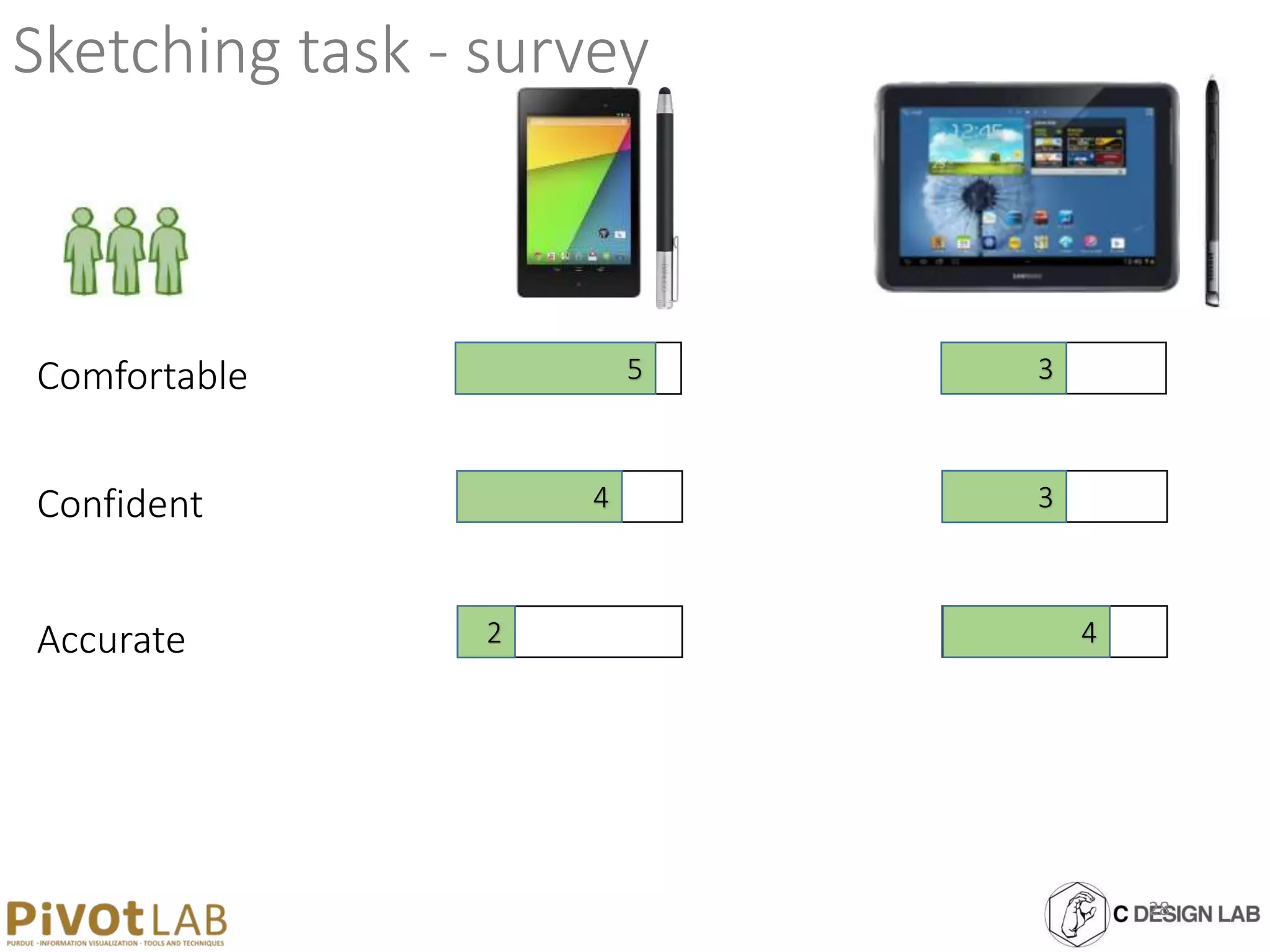
Sketching task - survey
Comfortable
Confident
Accurate
5
4
2
3
3
4
28
Aspects
familiarity occlusion
friction parallax
= >
different*
=
29
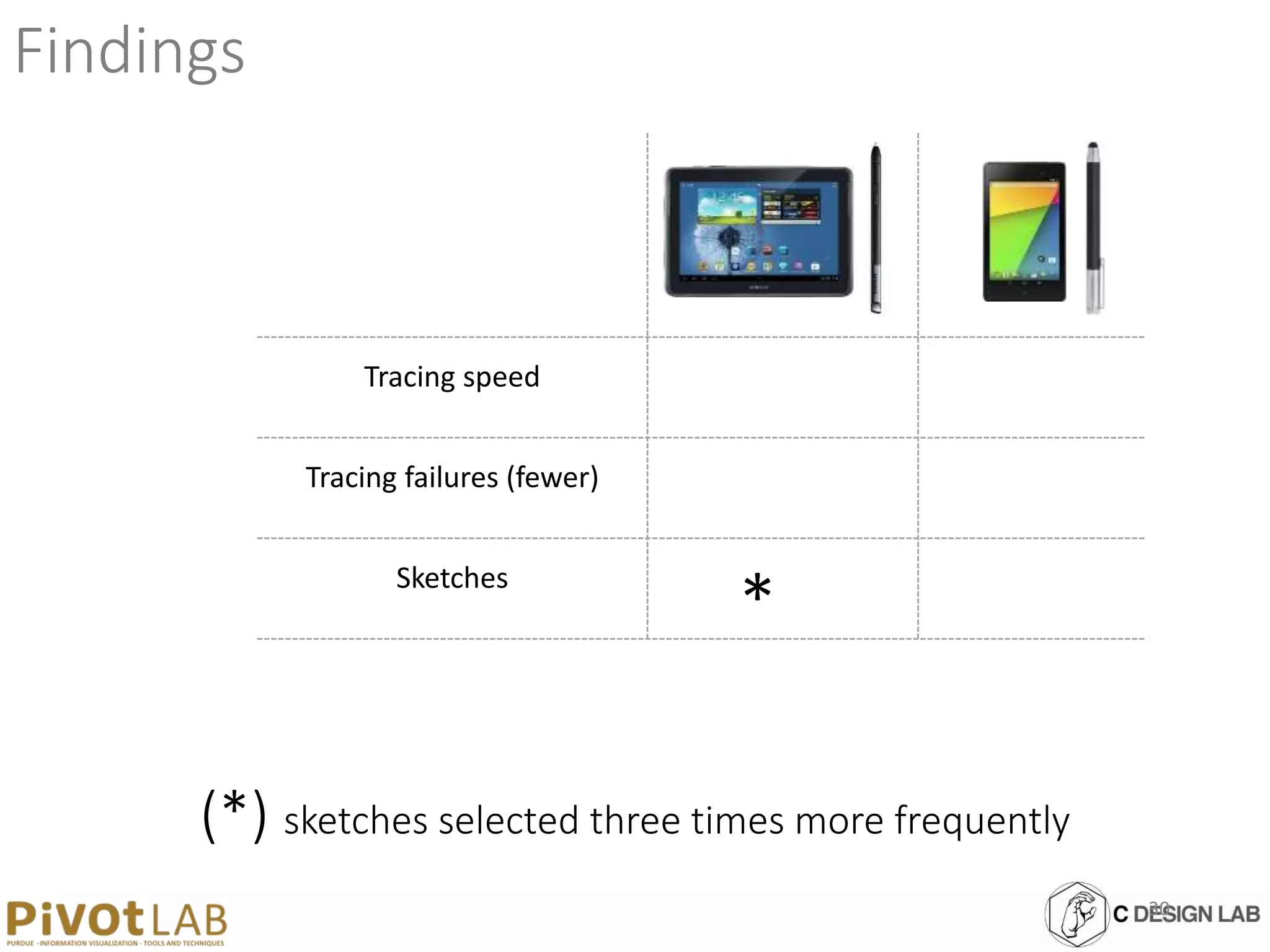
Findings
Tracing speed
Tracing failures (fewer)
Sketches
*
(*) sketches selected three times more frequently
30
The Designer’s Notebook
31
Implications
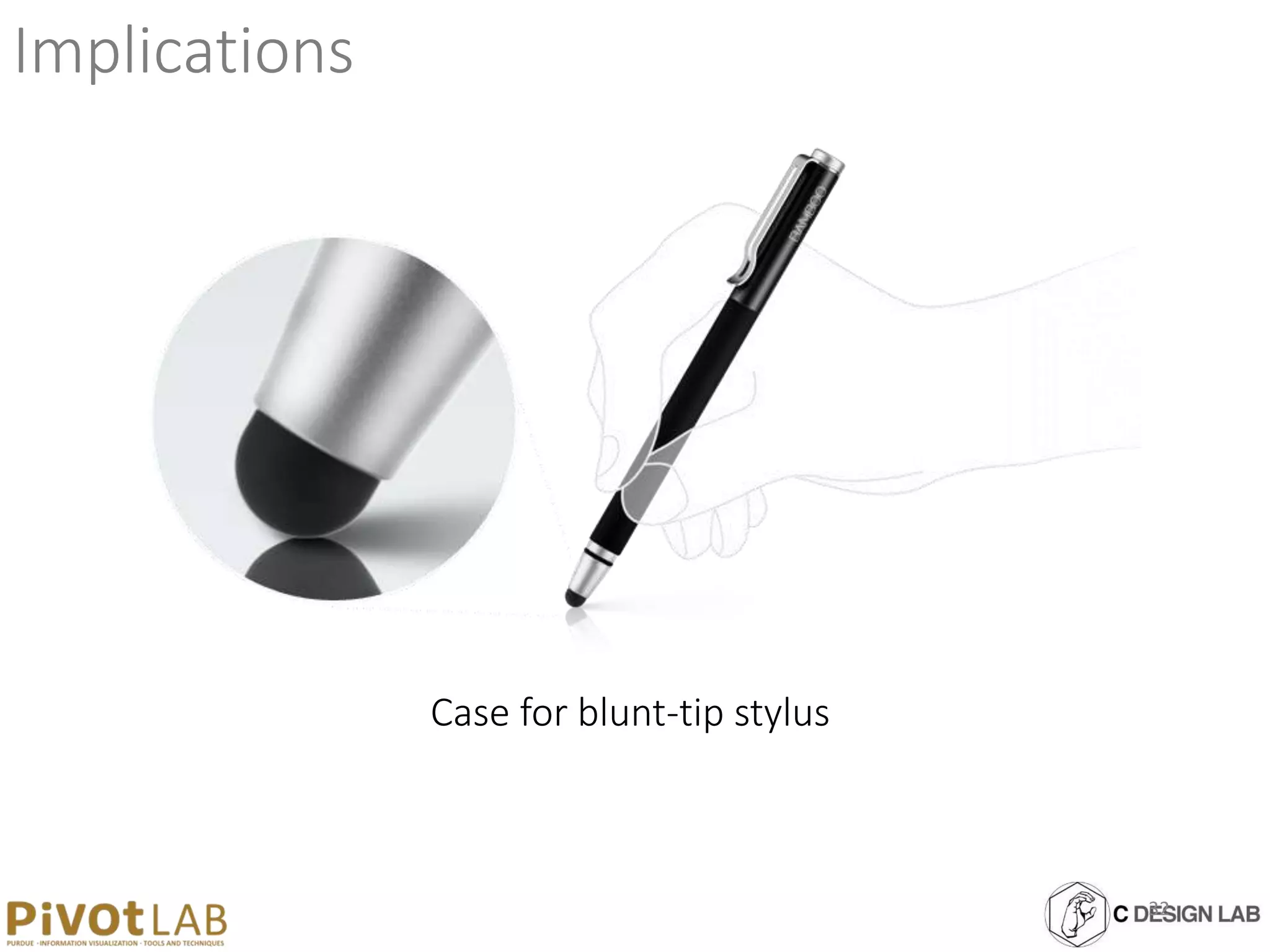
Case for blunt-tip stylus
32
IIS-1227639
IIS-1249229
IIS-1253863
Donald W. Feddersen Chaired Professorship
Purdue School of Mechanical Engineering.
Acknowledgment
Questions?
S. Karthik Badam
sbadam@purdue.edu
33

Tracing and Sketching Performance using Blunt-tipped Styli on Direct-Touch Tablets

Editor's Notes

  • #2 Introduce myself - co-authors – paper about evaluating the tracing and sketching performance on digital tablets
  • #3 Need for paper in day-to-day activities – newspapers, novels, and maps – replaced with well-designed tablet applications. [Segway] tablet replacing paper for content consumption. But what about content creation? For example, an industrial design
  • #4 Industrial design – requires paper for drafting – content creation – custom hardware for sketching and design [Segway] Provide natural interaction For example, with digital media you no longer need to use a copier to share your ideas, you can just transfer them with a button click. Although such tools exist they cannot promise better adaptability of designers to digital medium. The question we ask is whether you can sketch on a tablet as seamlessly or naturally as on a paper?
  • #5 Coming back – Wacom devices direct/in-direct interaction replace paper - but there are also numerous mobile devices – direct-touch – why not use them? [Segway] For one thing, the capacitive touch tablets have finger input
  • #6 [Segway] For one thing, the capacitive touch tablets have finger inpu As kids used to finger painting – its messy – but learn how to draw shapes with fingers – still we are more used to pen input
  • #7 Luckily, we now have digital styli, that can replace enable pen-like input to tablets – numerous models – differ in tip dimensions, material etc. – we have considered a common representative Wacom Bamboo (best consumer feedback).
  • #8 Considering the digital tech -- Designer’s notebook – repository of sketches of ideas – may not be fully mature – represents early-design process – these design notebooks are useful because – small, portable [Segway] considering all the digital technology we have right now, what is stopping us from replacing this?
  • #9 A typical early design has multiple steps. Play animation Can we replace pen and paper with digital tools (tablets, styli)? [Segway] aspects – that affect tablets
  • #10 We have identified 4 aspects – familiarity – occlusion – friction – parallax [segway] objective of our research – compare the performance of touch tablets with paper – ecological valid study with less constraints – similar attempts in past to compare input devices. Bridging pen-paper and digital
  • #11 Accot and Zhai 1999 Zabramski et al. 2011 both handled tracing tasks did a rigorous study with multiple shape tracing [Segway] since we target both sketching and tracing, as in early design, we did two user studies [Need to show roadmap at the end]
  • #12 14 participants – students from various departments in Purdue University – all had novice level exposure to design through a toy design course 3 media – 2 tasks – multiple shapes – 5 shapes – 2 shapes. We conducted a user study to understand the performance of three medium + input combinations i.e., stylus + tablet, finger + tablet, and pen + paper for sketching and tracing. Inspired by the previous research work in evaluating various input devices for tracing different shapes using Steering’s law, we have chosen 5 different shapes for tracing and two common 3D shapes for sketching. We recruited 14 participants (13 male + 1 female) from various departments in our University. They were all students and they only had beginner-level experience to early design. In essence, they were not expert designers.
  • #13 Tracing tasks – 5 shapes increasing complexity in curvature – participants asked to keep to an error tunnel – 3 times of each medium (so that we can compare pen-paper with tablet) [Mention how the task was done on paper] - video recorded and analyzed
  • #14 Tracing speed – faster on tablet with stylus input – followed by finger with tablet – pen-paper – just put in the average values for your reference – significant
  • #15 Tracing failures – least on pen-paper – followed by stylus tablet – finger tablet – pen-paper significantly better but finger-tablet had the worst failures
  • #16 In the post-survey questionnaire – we asked comfort, confidence, accuracy – pen-paper – stylus 12, 10, 10 – while only most of the participants were not with pen-paper [Segway] this covers the tracing tasks, following this the participants did sketching task
  • #17 Sketching tasks – 2 shapes – 3d shapes – 3 times of each medium (so that we can compare pen-paper with tablet) – participants selected the best representative sketch Analysis – instead of using image processing techniques, that are hard to define – used sketch quality measure from crowdsourcing – lineups of sketches – choose one -- ratios In each lineup, 5 sketches from the library of 42 submitted sketches for each shape was randomly displayed in a single row.
  • #18 277 respondents – for sketch quality - 5,440 individual responses – and from this *[enter slide]*
  • #19 In the post-survey questionnaire – again pen-paper (of course) – but this time stylus 9, 8, 7 and finger were similar except for accuracy – this can be due to the large occlusion [Segway] looking from the aspects perspective
  • #20 *Hard to quantify Familiarity to pen-paper > tablet - occlusion is more for finger (tip size) – friction couldnot be quantified but the perception is that more on pen-paper – parallax is more on tablet screen [Segway] clearly the media differ in these aspects but if we look at the results again
  • #21 Tablet with stylus and paper performed comparably* [Segway] so far we have looked at using existing generic input styli for direct-touch tablets. – followed with a different study - Blunt vs Sharp-tipped (Samsung note device). Coming to the second part of our paper,
  • #22 Now-a-days we have tablets with better styli such as Samsung note – they have a hard tip for handwriting – so we wanted to compare them with the blunt-tipped Wacom bamboo stylus in the follow-up study
  • #23 Additional bearing block (no motivation)– Sharp tipped can be used for intricate shapes..
  • #24 The tasks were similar to before but this due to the low participant pool we had to do a expert voting for sketch quality rather than crowdsourcing. Three repetitions – one selection - Not using lineups – but pair-wise selections by expert judges.
  • #25 Speed was higher!!!! Not much …The results were not significant
  • #27 Most of the participants were Comfortable with blunt tipped stylus – because the dimensions match a normal pen (quoted)
  • #29 Accuracy, of course, was better for hard-tipped stylus
  • #30 *Hard to quantify Looking from aspects the devices clearly were different – occlusion was more on the blunt tip but the questionnaire – doesn’t translate to this – because **tip size is one thing but form factor also matters** Samsung designed a small pen **
  • #31 Results not much but summarizing, we are planning to do a more rigorous study in future but
  • #32 We can take these results into account to replace the traditional design notebook with digital tools for tablets
  • #33 Blunt-tip stylus is not so bad – if we can add features to improve the accuracy – form factor is important – Thank you!! If you disagree with any of the findings here we can have a discussion now or even offline
  • #34 More details refer to the paper!