The Medieval Knights This is a slideshow of your average medieval knight.
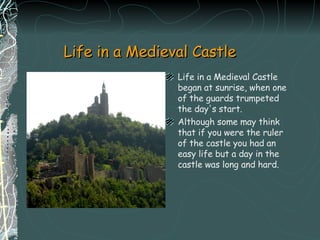
  Life in a Medieval Castle Life in a Medieval Castle began at sunrise, when one of the guards trumpeted the day's start. Although some may think that if you were the ruler of the castle you had an easy life but a day in the castle was long and hard.
What is a Knight? A knight was a mounted man-at-arms who served a lord or other superior  For his service he usually got in return a plot of land, or sometimes for pay
  Knight's Daily Routine
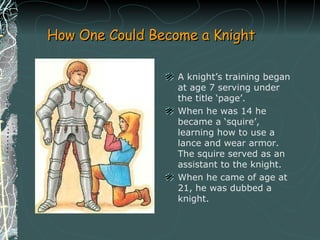
How One Could Become a Knight A knight’s training began at age 7 serving under the title ‘page’.  When he was 14 he became a ‘squire’, learning how to use a lance and wear armor. The squire served as an assistant to the knight.  When he came of age at 21, he was dubbed a knight.
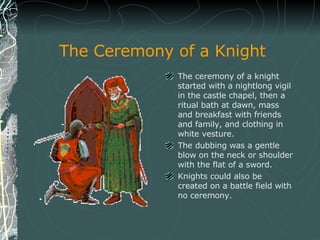
The Ceremony of a Knight The ceremony of a knight started with a nightlong vigil in the castle chapel, then a ritual bath at dawn, mass and breakfast with friends and family, and clothing in white vesture.  The dubbing was a gentle blow on the neck or shoulder with the flat of a sword.  Knights could also be created on a battle field with no ceremony.
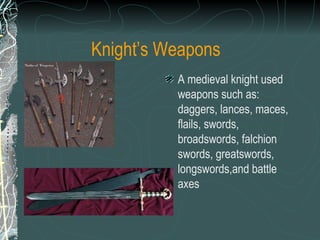
Knight’s Weapons A medieval knight used weapons such as: daggers, lances, maces, flails, swords, broadswords, falchion swords, greatswords, longswords,and battle axes
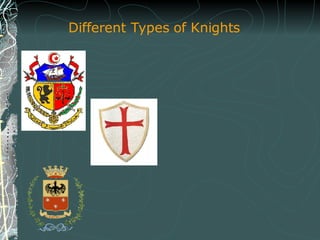
  Different Types of Knights
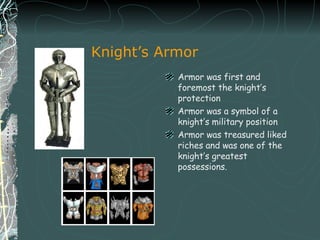
Knight’s Armor Armor was first and foremost the knight’s protection Armor  was a symbol of a knight’s military position Armor was treasured liked riches and was one of the knight’s greatest possessions.
The chivalric code The knight’s code of chivalry was an unwritten code to show: bravery, courtesy, honor, and gallantry toward women,  use their strength to perform good deeds, look after the poor, defend the weak, look after women and orphans, defend the church, stand for justice, morality, purity and honor
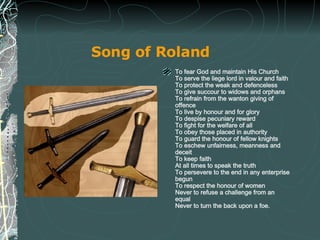
Song of Roland   To fear God and maintain His Church To serve the liege lord in valour and faith To protect the weak and defenceless To give succour to widows and orphans To refrain from the wanton giving of offence To live by honour and for glory To despise pecuniary reward To fight for the welfare of all To obey those placed in authority To guard the honour of fellow knights To eschew unfairness, meanness and deceit To keep faith At all times to speak the truth To persevere to the end in any enterprise begun To respect the honour of women Never to refuse a challenge from an equal Never to turn the back upon a foe.
Duties of a Knight.
Family of a knight
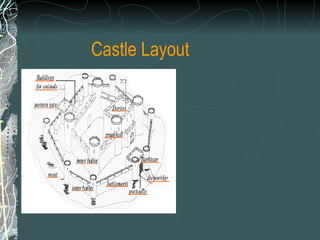
Castle Layout
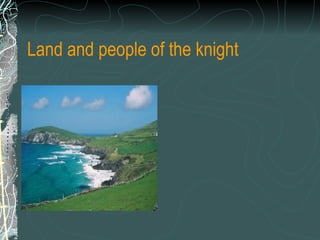
Land and people of the knight
Credits http://www. castlesofbritain .com/castle35. htm Encarta 1997
The End

Megan

  • 1.
    The Medieval KnightsThis is a slideshow of your average medieval knight.
  • 2.
    Lifein a Medieval Castle Life in a Medieval Castle began at sunrise, when one of the guards trumpeted the day's start. Although some may think that if you were the ruler of the castle you had an easy life but a day in the castle was long and hard.
  • 3.
    What is aKnight? A knight was a mounted man-at-arms who served a lord or other superior For his service he usually got in return a plot of land, or sometimes for pay
  • 4.
    Knight'sDaily Routine
  • 5.
    How One CouldBecome a Knight A knight’s training began at age 7 serving under the title ‘page’. When he was 14 he became a ‘squire’, learning how to use a lance and wear armor. The squire served as an assistant to the knight. When he came of age at 21, he was dubbed a knight.
  • 6.
    The Ceremony ofa Knight The ceremony of a knight started with a nightlong vigil in the castle chapel, then a ritual bath at dawn, mass and breakfast with friends and family, and clothing in white vesture. The dubbing was a gentle blow on the neck or shoulder with the flat of a sword. Knights could also be created on a battle field with no ceremony.
  • 7.
    Knight’s Weapons Amedieval knight used weapons such as: daggers, lances, maces, flails, swords, broadswords, falchion swords, greatswords, longswords,and battle axes
  • 8.
    DifferentTypes of Knights
  • 9.
    Knight’s Armor Armorwas first and foremost the knight’s protection Armor was a symbol of a knight’s military position Armor was treasured liked riches and was one of the knight’s greatest possessions.
  • 10.
    The chivalric codeThe knight’s code of chivalry was an unwritten code to show: bravery, courtesy, honor, and gallantry toward women, use their strength to perform good deeds, look after the poor, defend the weak, look after women and orphans, defend the church, stand for justice, morality, purity and honor
  • 11.
    Song of Roland To fear God and maintain His Church To serve the liege lord in valour and faith To protect the weak and defenceless To give succour to widows and orphans To refrain from the wanton giving of offence To live by honour and for glory To despise pecuniary reward To fight for the welfare of all To obey those placed in authority To guard the honour of fellow knights To eschew unfairness, meanness and deceit To keep faith At all times to speak the truth To persevere to the end in any enterprise begun To respect the honour of women Never to refuse a challenge from an equal Never to turn the back upon a foe.
  • 12.
    Duties of aKnight.
  • 13.
  • 14.
  • 15.
    Land and peopleof the knight
  • 16.
    Credits http://www. castlesofbritain.com/castle35. htm Encarta 1997
  • 17.