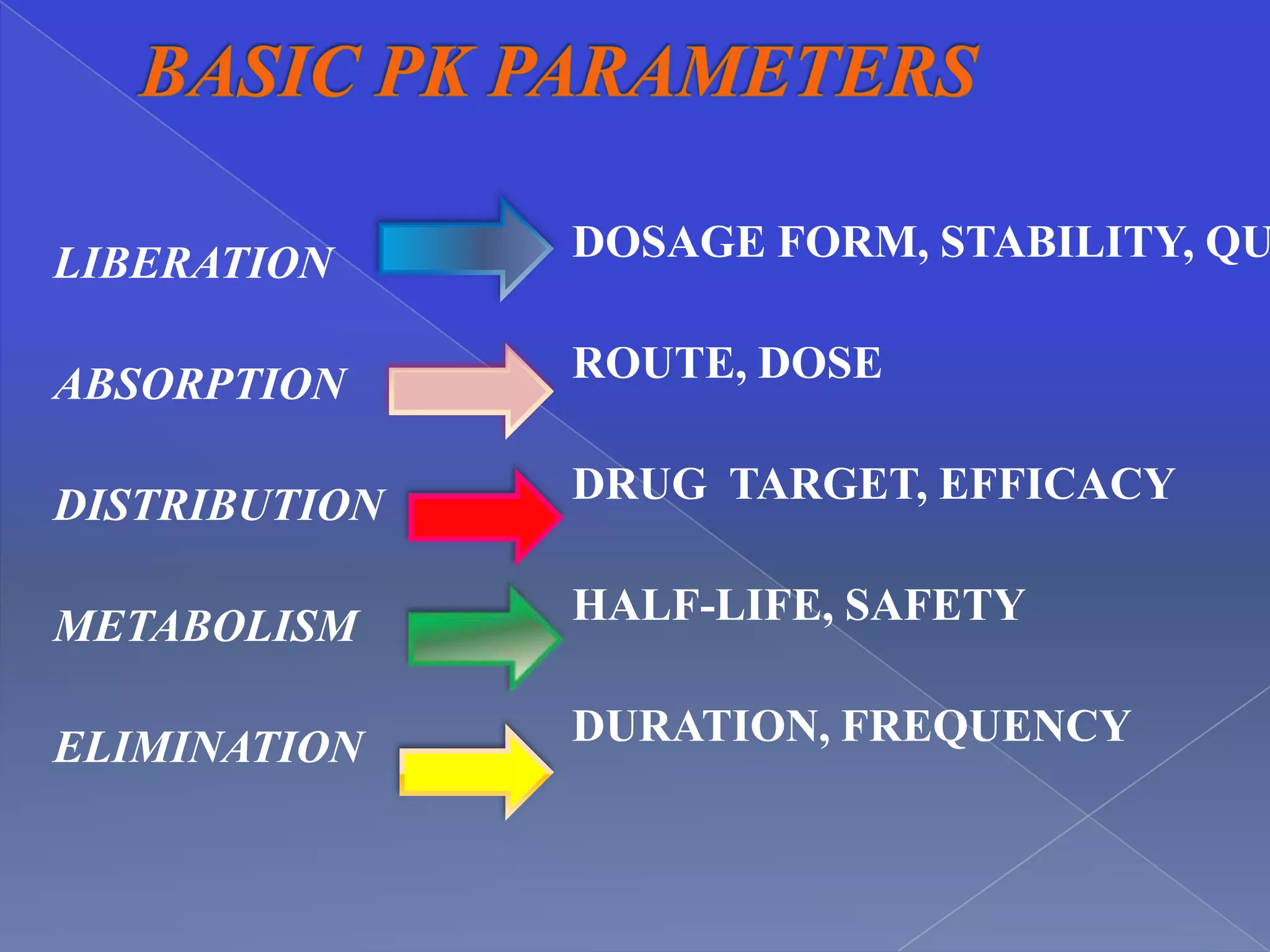
LIBERATION     DOSAGE FORM, STABILITY, QU


ABSORPTION     ROUTE, DOSE


DISTRIBUTION   DRUG TARGET, EFFICACY


METABOLISM     HALF-LIFE, SAFETY


ELIMINATION    DURATION, FREQUENCY
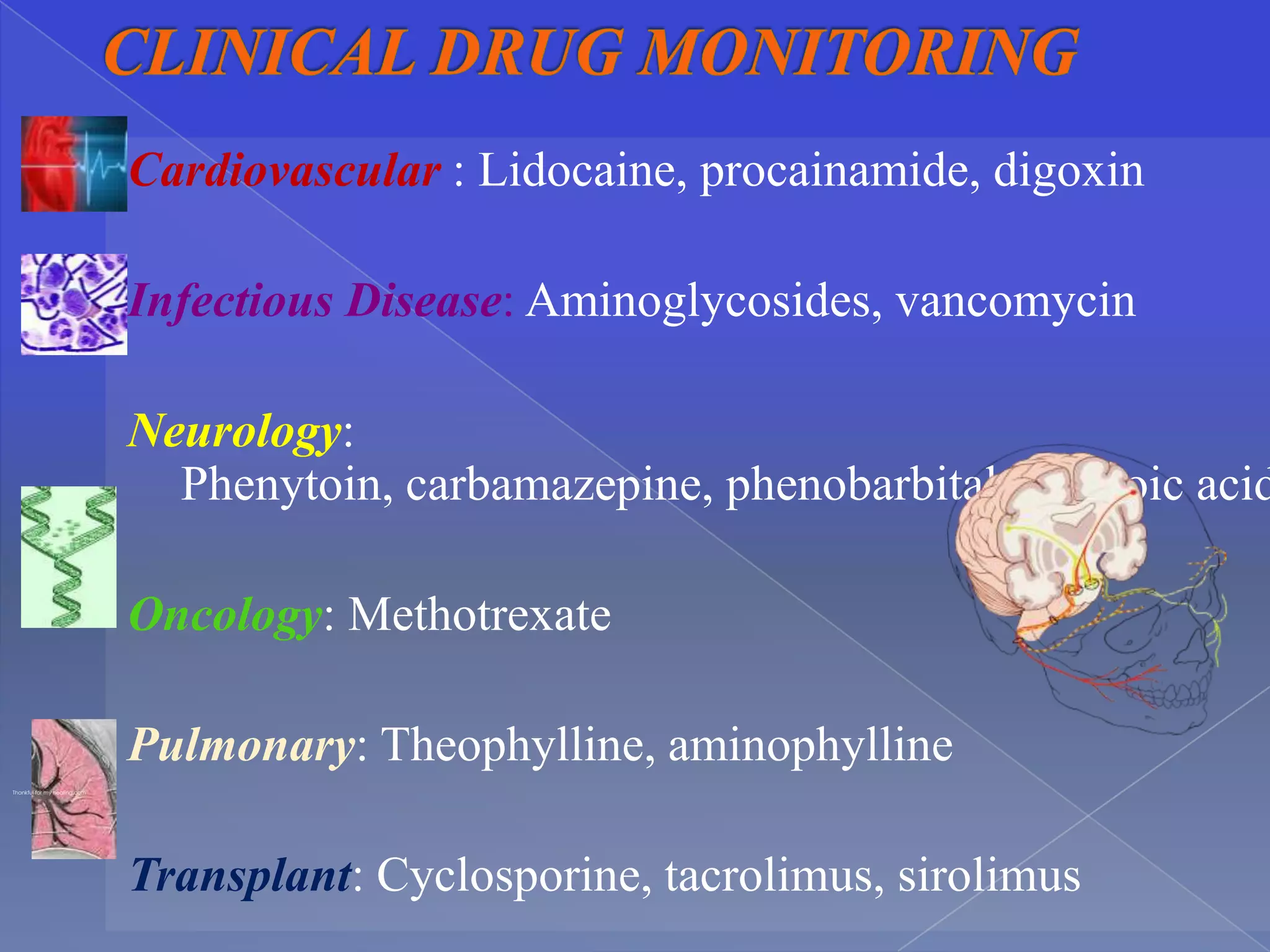
Cardiovascular : Lidocaine, procainamide, digoxin

                              Infectious Disease: Aminoglycosides, vancomycin

                              Neurology:
                                Phenytoin, carbamazepine, phenobarbital, valproic acid

                              Oncology: Methotrexate

                              Pulmonary: Theophylline, aminophylline
Thankful for my healing.com


                              Transplant: Cyclosporine, tacrolimus, sirolimus
   Intravenous:    X0 = C0/Vd
         Single IV: Ct future = C0* e-ket
                        Ct past = C0 / e-ket
         Multiple IV: Dose= (Cp *Vd)(1-e-nkeτ /1-e-keτ)e-ket
   Short-term Infusion (0.5 h), Multiple Dosing:
    › R0= CL*Cmax{1-e-keτ /1-e-keT} e-ket        1

    ›   Cmin= Cmax*e-ke(τ -T)
   Continuous Infusion (1 h):
     › R0= CL*Cpss*[1-e-keτ]/1-e-keT 1 ] e-ket   1

    ›   Cmin= Cpss*e-ke(τ -T)
    ›   2R0/(C1+C2) + 2Vd (C1-C2) )/(C1+C2) (t1-t2)
   Loading Dose:               LD = Vd*Css / SF
   Intermittent IV Bolus: Dose/τ = CL*Cp{1-e-keτ/1-e-keT}*e-ke(τ -T)
   Maintenance Dose: MD =CL*Css* τ / SF
   Oral:
     › Multidose: Cave steady state = [LD/Vd*(1-e-keτ)]            Ansel. Dosage Forms.


     › Dose = C*(ka-ke)*Vd/SF*ka* (e-ket-e-kat)
   Steady State: Multiple doses cause term 1-e-nket 1
                                                                      australianprescriber.com
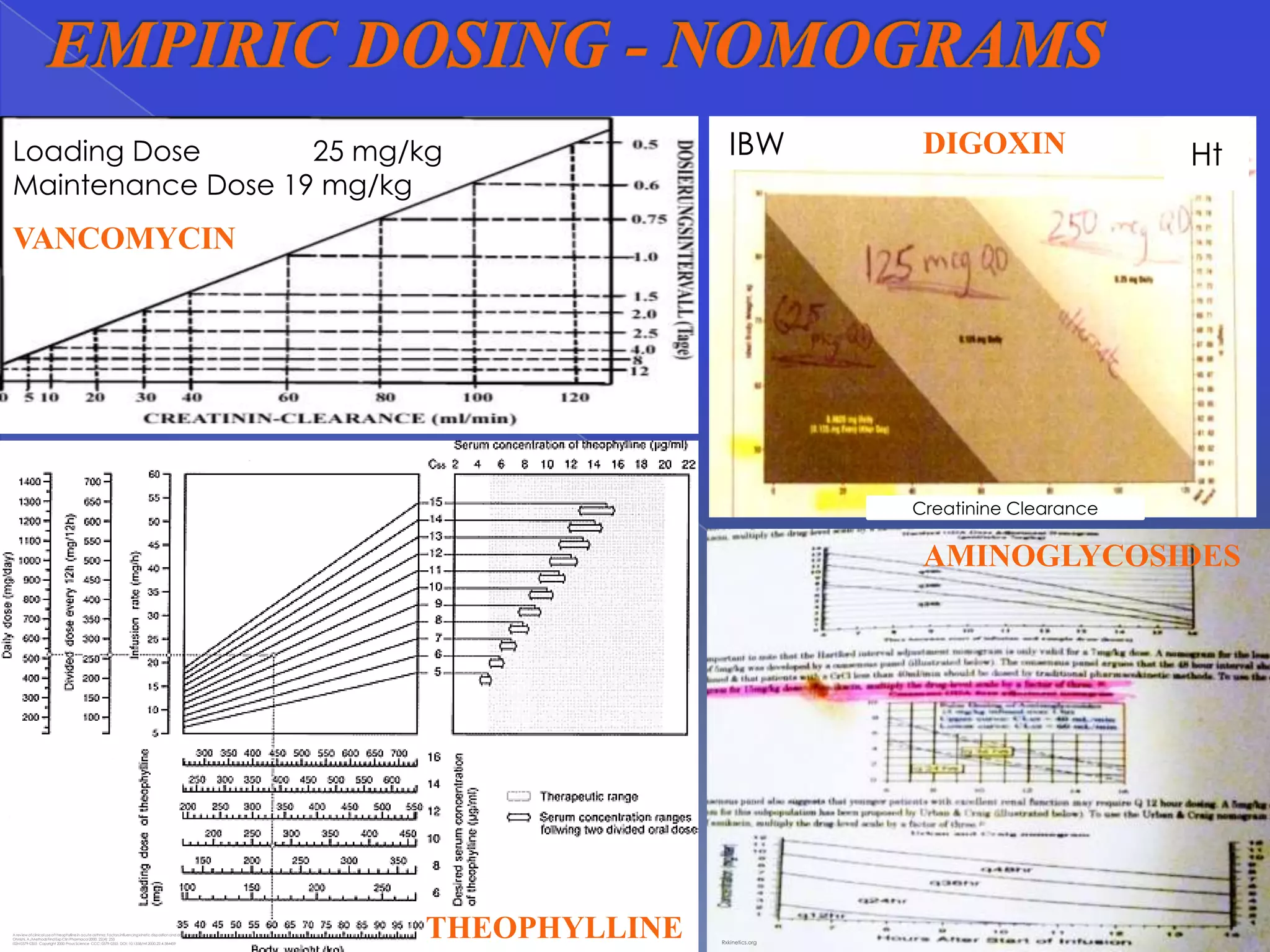
Loading Dose       25 mg/kg                                                                                                                IBW             DIGOXIN               Ht
Maintenance Dose 19 mg/kg
VANCOMYCIN


                                                                                                                                                          Creatinine Clearance

                                                                                                                                                           AMINOGLYCOSIDES


A review of clinical use of theophylline in acute asthma: Factors influencing kinetic disposition and drug interactions
Ohnishi, A./Methods Find Exp Clin Pharmacol 2000, 22(4): 253
ISSN 0379-0355 Copyright 2000 Prous Science CCC: 0379-0355 DOI: 10.1358/mf.2000.22.4.584459
                                                                                                                          THEOPHYLLINE   Rxkinetics.org
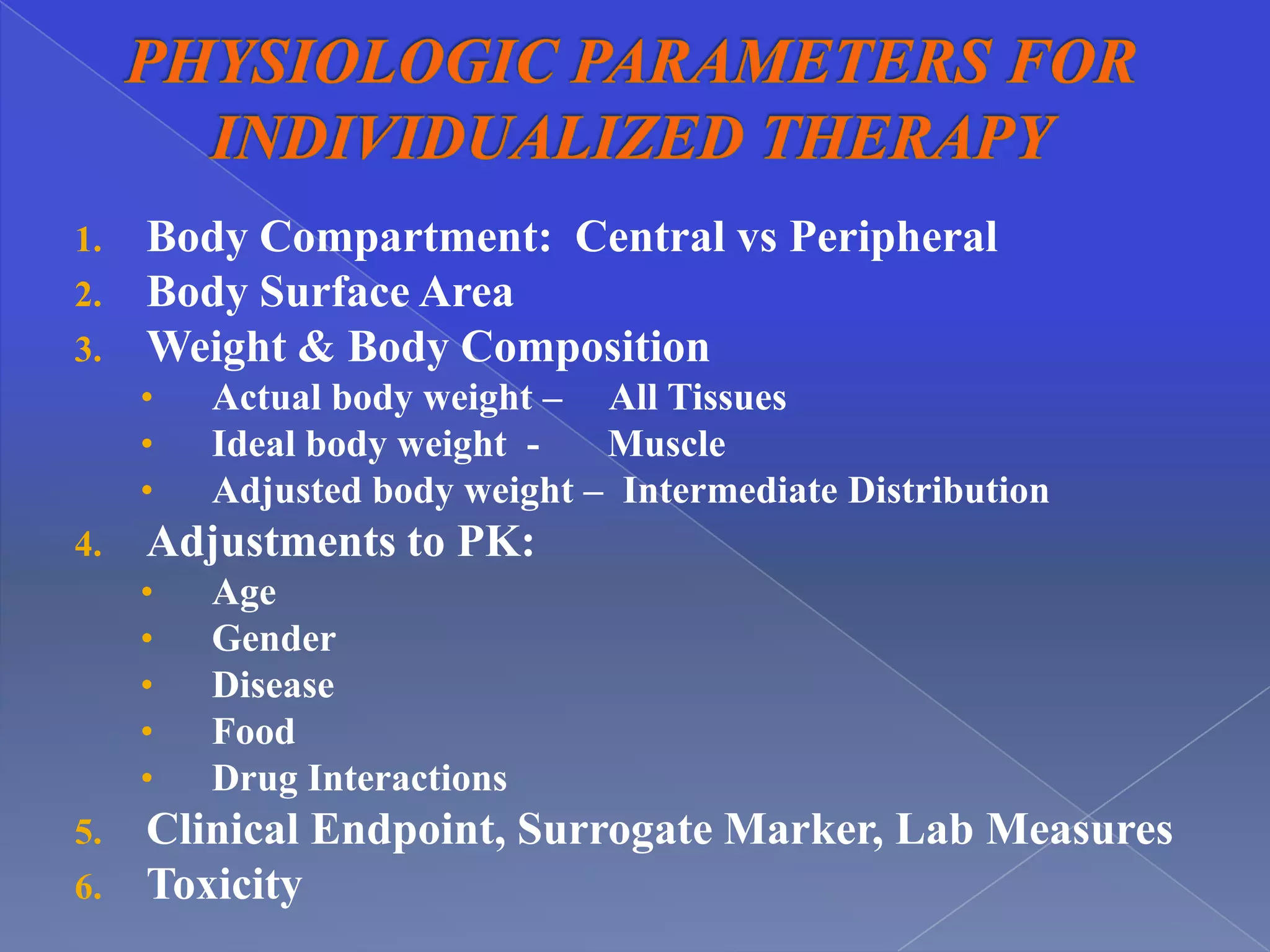
1.   Body Compartment: Central vs Peripheral
2.   Body Surface Area
3.   Weight & Body Composition
     •   Actual body weight – All Tissues
     •   Ideal body weight -   Muscle
     •   Adjusted body weight – Intermediate Distribution
4.   Adjustments to PK:
     •   Age
     •   Gender
     •   Disease
     •   Food
     •   Drug Interactions
5.   Clinical Endpoint, Surrogate Marker, Lab Measures
6.   Toxicity
Bike friendlyarlington.com


1.                      Allen L, Ansel H, Popovich N. Ansel’s Pharmaceutical Dosage Forms and Drug
                        Delivery Systems. Lippincott Williams & Wilkins. Baltimore, MD, USA. 2005.
2.                      Bauman JL, et al. “A Method of Determining the Dose of Digoxin for CHF in the
                        Modern Era.” Archives of Internal Medicine. Vol 166, Dec 11/25, 2006.
3.                      Derendorf H, Hochhaus G, Winkler J. “How the Lung Handles Drugs.
                        Pharmacokinetics and Pharmacodynamics of Inhaled Corticosteroids.” Proceedings of
                        the American Thoracic Society, Vol 1. pp 356-363, 2004.
4.                     Hendeles L, et al. “Food-induced "dose-dumping" from a once-a-day theophylline
                       product as a cause of theophylline toxicity.” Chest 87.6.758 Vol. 87no. 6 758-765. June
                       1985.
5.                     DiPiro JT. Concepts in Clinical Pharmacokinetics.
6.                      Hammerlein, et al. “Age-Related Changes in Drug Metabolism and Effect.” Clinical
                        Pharmacokinetics, Jul:35(1), 1998.
7.                      Tomlin ME. Pharmacology and Pharmacokinetics- A Basic Reader. Elsavier, 2010.
8.                      Images as noted and courtesy of Wikipedia Commons

Medicinal Kinetics & Dynamics

  • 2.
    LIBERATION DOSAGE FORM, STABILITY, QU ABSORPTION ROUTE, DOSE DISTRIBUTION DRUG TARGET, EFFICACY METABOLISM HALF-LIFE, SAFETY ELIMINATION DURATION, FREQUENCY
  • 3.
    Cardiovascular : Lidocaine,procainamide, digoxin Infectious Disease: Aminoglycosides, vancomycin Neurology: Phenytoin, carbamazepine, phenobarbital, valproic acid Oncology: Methotrexate Pulmonary: Theophylline, aminophylline Thankful for my healing.com Transplant: Cyclosporine, tacrolimus, sirolimus
  • 4.
    Intravenous: X0 = C0/Vd  Single IV: Ct future = C0* e-ket Ct past = C0 / e-ket  Multiple IV: Dose= (Cp *Vd)(1-e-nkeτ /1-e-keτ)e-ket  Short-term Infusion (0.5 h), Multiple Dosing: › R0= CL*Cmax{1-e-keτ /1-e-keT} e-ket 1 › Cmin= Cmax*e-ke(τ -T)  Continuous Infusion (1 h): › R0= CL*Cpss*[1-e-keτ]/1-e-keT 1 ] e-ket 1 › Cmin= Cpss*e-ke(τ -T) › 2R0/(C1+C2) + 2Vd (C1-C2) )/(C1+C2) (t1-t2)  Loading Dose: LD = Vd*Css / SF  Intermittent IV Bolus: Dose/τ = CL*Cp{1-e-keτ/1-e-keT}*e-ke(τ -T)  Maintenance Dose: MD =CL*Css* τ / SF  Oral: › Multidose: Cave steady state = [LD/Vd*(1-e-keτ)] Ansel. Dosage Forms. › Dose = C*(ka-ke)*Vd/SF*ka* (e-ket-e-kat)  Steady State: Multiple doses cause term 1-e-nket 1 australianprescriber.com
  • 5.
    Loading Dose 25 mg/kg IBW DIGOXIN Ht Maintenance Dose 19 mg/kg VANCOMYCIN Creatinine Clearance AMINOGLYCOSIDES A review of clinical use of theophylline in acute asthma: Factors influencing kinetic disposition and drug interactions Ohnishi, A./Methods Find Exp Clin Pharmacol 2000, 22(4): 253 ISSN 0379-0355 Copyright 2000 Prous Science CCC: 0379-0355 DOI: 10.1358/mf.2000.22.4.584459 THEOPHYLLINE Rxkinetics.org
  • 6.
    1. Body Compartment: Central vs Peripheral 2. Body Surface Area 3. Weight & Body Composition • Actual body weight – All Tissues • Ideal body weight - Muscle • Adjusted body weight – Intermediate Distribution 4. Adjustments to PK: • Age • Gender • Disease • Food • Drug Interactions 5. Clinical Endpoint, Surrogate Marker, Lab Measures 6. Toxicity
  • 7.
    Bike friendlyarlington.com 1. Allen L, Ansel H, Popovich N. Ansel’s Pharmaceutical Dosage Forms and Drug Delivery Systems. Lippincott Williams & Wilkins. Baltimore, MD, USA. 2005. 2. Bauman JL, et al. “A Method of Determining the Dose of Digoxin for CHF in the Modern Era.” Archives of Internal Medicine. Vol 166, Dec 11/25, 2006. 3. Derendorf H, Hochhaus G, Winkler J. “How the Lung Handles Drugs. Pharmacokinetics and Pharmacodynamics of Inhaled Corticosteroids.” Proceedings of the American Thoracic Society, Vol 1. pp 356-363, 2004. 4. Hendeles L, et al. “Food-induced "dose-dumping" from a once-a-day theophylline product as a cause of theophylline toxicity.” Chest 87.6.758 Vol. 87no. 6 758-765. June 1985. 5. DiPiro JT. Concepts in Clinical Pharmacokinetics. 6. Hammerlein, et al. “Age-Related Changes in Drug Metabolism and Effect.” Clinical Pharmacokinetics, Jul:35(1), 1998. 7. Tomlin ME. Pharmacology and Pharmacokinetics- A Basic Reader. Elsavier, 2010. 8. Images as noted and courtesy of Wikipedia Commons