Utilizing three important screens to improve health: the computer, cell phone and television James Kahn MD Professor of Medicine, UCSF AHRQ  HS017784; NIH grants  RR024369 and  MH088341  and DA032057
Overview Provide a framework for mHealth and internet based research Review active research projects Discuss new models that develop from the research projects Conclusions  A glimpse into the future
Conclusions New tools are necessary to improve health care Personal Health Records (PHRs) are intended to improve self management We deployed a PHR integrated into our EMR for patients  receiving care at the HIV/AIDS clinic at SFGH and were surprised by the ready acceptance of  the technology and its dissemination Text messaging is another important tool to deliver health care mHealth applications have local, national and international implications
Three themes for our work Improve health and reduce the digital divide through technology development, adoption and utilization Empower patients through innovative use of technology Provide a platform for research that emphasizes operational excellence and implementation science
IOM How to Improve Care “ Improvements in care cannot be achieved by further stressing current systems of care.  The current systems cannot do the job.  Trying harder will not work.” IOM 2001:  Crossing the Quality Chasm
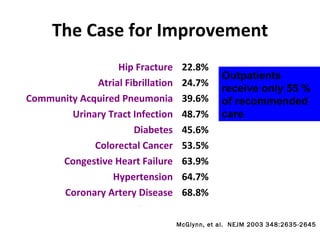
The Case for Improvement Hip Fracture Atrial Fibrillation Community Acquired Pneumonia Urinary Tract Infection Diabetes Colorectal Cancer Congestive Heart Failure Hypertension Coronary Artery Disease 22.8% 24.7% 39.6% 48.7% 45.6% 53.5% 63.9% 64.7% 68.8% McGlynn, et al.  NEJM 2003 348:2635-2645 Outpatients receive only 55 % of recommended care
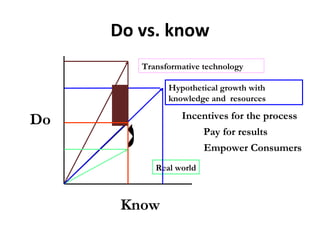
Do vs. know Transformative technology Real world Incentives for the process Hypothetical growth with knowledge and  resources Pay for results Empower Consumers Do Know
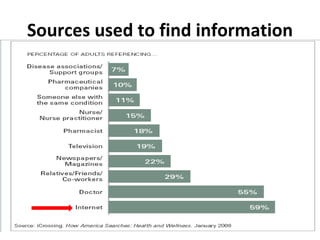
Sources used to find information
The future is already here, it's just not evenly distributed William Gibson The Economist   2003
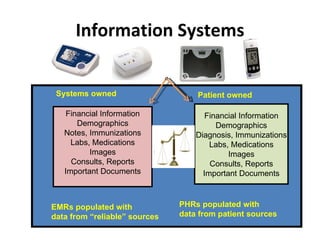
Information Systems Financial Information Demographics Notes, Immunizations Labs, Medications Images Consults, Reports Important Documents Financial Information Demographics Diagnosis, Immunizations Labs, Medications Images Consults, Reports Important Documents EMRs populated with data from “reliable” sources PHRs populated with data from patient sources Systems owned Patient owned
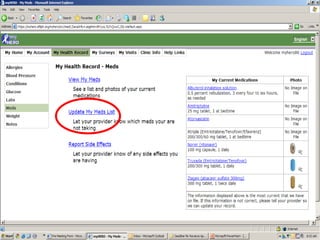
Definition--Personal Health Record A longitudinal record of individual health The PHR can be accessed and populated, from electronic sources,  patients or devices  Information in the PHR is owned or at the least shared by the patient The PHR is meant to move along with the patient no matter where they are located or their connection to a specific health plan or organization
Self management support vs. shared decision-making: a new dynamic Shared decision-making  is the process for  involving patients  in decision making and planning Self-management support  is the broader process of engaging and activating patients to more  fully participate  in care
Patient   Self-Management “ Patients with chronic conditions self-manage their illness.  This fact is inescapable.  Each day, patients decide what they are going to eat, whether they will exercise, and to what extent they will consume prescribed medications.” Tom Bodenheimer, et al 2002  JAMA  288(19); 2470
Why Develop a PHR? Promotes  self management by providing information that is up-to-date and understandable Reduce the Digital Divide  through more egalitarian access to information Improve the experience of care Improve the health of populations Reduce per capita costs of health care Health literacy is vital to understand the information to create an action plan based on the information Berwick, D. M et al. (2008).  Health Aff  2008:  27: 759-769
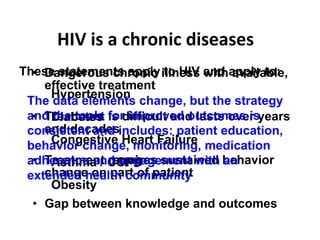
HIV is a chronic diseases  Dangerous chronic illness with available, effective treatment Treatment is difficult and lasts over years and decades Treatment requires sustained behavior change on part of patient Gap between knowledge and outcomes These statements apply to HIV and apply to: Hypertension Diabetes Congestive Heart Failure Asthma / COPD Obesity The data elements change, but the strategy and the tools for improved outcomes is consistent and includes: patient education, behavior change, monitoring, medication adherence and engagement with an extended health community
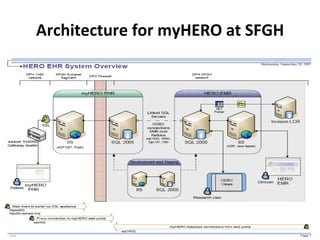
Architecture for myHERO at SFGH
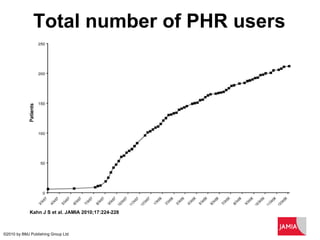
Total number of PHR users Kahn J S et al. JAMIA 2010;17:224-228 ©2010 by BMJ Publishing Group Ltd
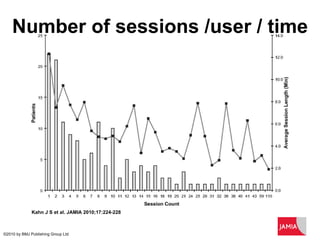
Number of sessions /user / time  Kahn J S et al. JAMIA 2010;17:224-228 ©2010 by BMJ Publishing Group Ltd
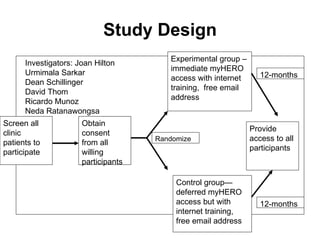
Goal of the project-AHRQ Our central hypothesis is that a secure PHR that combines meaningful information, web-based tools for support and reminders for patients will provide a substantial opportunity to promote self-management and will lead to improved health outcomes  To test our hypothesis we are performing a randomized controlled study to evaluate the biologic outcomes between persons randomly assigned to full use PHR compared with persons assigned to deferred access.
Study Design Investigators: Joan Hilton Urmimala Sarkar Dean Schillinger David Thom Ricardo Munoz Neda Ratanawongsa Screen all clinic patients to participate Obtain consent from all willing participants Control group—deferred myHERO access but with internet training, free email address Experimental group –immediate myHERO access with internet training,  free email address Provide access to all participants Randomize 12-months 12-months
 
 
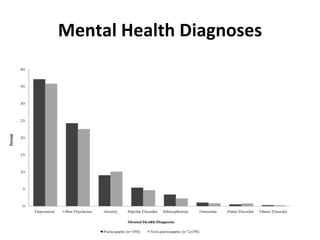
Mental Health Diagnoses
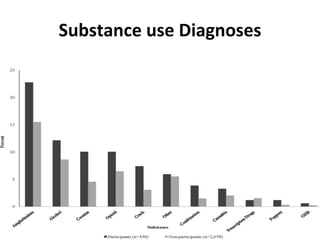
Substance use Diagnoses
Observations from Recruitment Patients who are “full” users are very excited about seeing their personal health information.  “ This is the coolest thing I have ever seen” “ This is truly amazing” Deferred users are not thrilled with their assignment but there is no differential drop-out rates
Accessibility Issues Font Size—we made the Font Bigger Radio Button Size—increased the size Mouse Use “ Next Page” vs. “Submit”—now “DONE” User names and passwords Patients now write these down New tool to reset passwords online
What worked and what did not Patients will use the PHR survey system. Patients want accurate data Patients are receiving appropriate care especially related to ART. Good anti-HIV responses are common with available medications
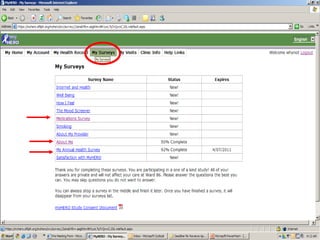
Technology Skill Acquisition We provided 50% with their first email account.  We taught 85% of patients how to use the internet.  Terms:  cursor,  field,  user name,  password,  address bar,  enter,  scroll and  link.  A series of  “How to” Make a capital letter;  Use numbers and letters; Locate a cursor;  Copy something;  Paste something;  Scroll down or around on the page; Make the @ sign;  Enter something;  Go to a website
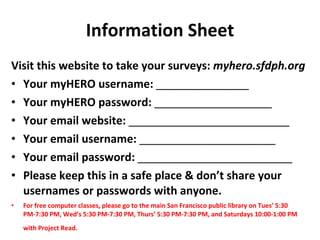
Information Sheet Visit this website to take your surveys:  myhero.sfdph.org Your myHERO username:  _______________ Your myHERO password:  ___________________ Your email website:  __________________________ Your email username:  ______________________ Your email password:  _________________________ Please keep this in a safe place & don’t share your usernames or passwords with anyone.   For free computer classes, please go to the main San Francisco public library on Tues’ 5:30 PM-7:30 PM, Wed’s 5:30 PM-7:30 PM, Thurs’ 5:30 PM-7:30 PM, and Saturdays 10:00-1:00 PM with Project Read.
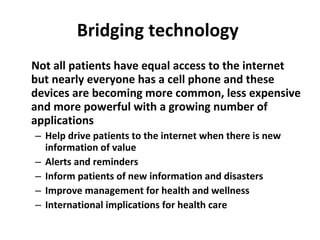
Bridging technology  Not all patients have equal access to the internet but nearly everyone has a cell phone and these devices are becoming more common, less expensive and more powerful with a growing number of applications Help drive patients to the internet when there is new information of value Alerts and reminders Inform patients of new information and disasters Improve management for health and wellness International implications for health care
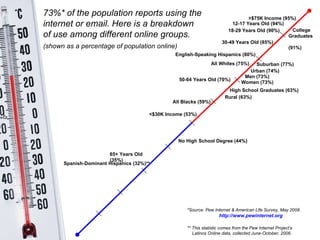
All Whites (75%)   All Blacks (59%)   English-Speaking Hispanics (80%)   73%* of the population reports using the internet or email. Here is a breakdown  of use among different online groups. (shown as a percentage of population online) 18-29 Years Old (90%) 30-49 Years Old (85%) 50-64 Years Old (70%) 65+ Years Old (35%) No High School Degree (44%) College  Graduates  (91%) <$30K Income (53%) >$75K Income (95%) Men (73%) Women (73%) *Source: Pew Internet & American Life Survey, May 2008.   http://www.pewinternet.org ** This statistic comes from the Pew Internet Project’s    Latinos Online data, collected June-October, 2006. High School Graduates (63%) Urban (74%) Rural (63%) Suburban (77%) Spanish-Dominant Hispanics (32%)**   12-17 Years Old (94%)
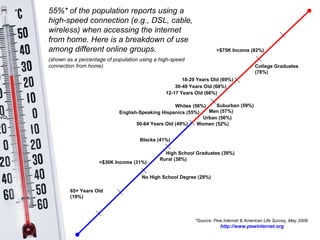
55%* of the population reports using a high-speed connection (e.g., DSL, cable, wireless) when accessing the internet from home. Here is a breakdown of use among different online groups. (shown as a percentage of population using a high-speed connection from home) Whites (56%)   Blacks (41%)   English-Speaking Hispanics (55%)   18-29 Years Old (69%) 30-49 Years Old (68%) 50-64 Years Old (49%) 65+ Years Old (19%) No High School Degree (29%) College Graduates (78%) <$30K Income (31%) >$75K Income (82%) Men (57%) Women (52%) High School Graduates (39%) Urban (56%) Suburban (59%) Rural (38%) *Source: Pew Internet & American Life Survey, May 2008. http://www.pewinternet.org 12-17 Years Old (66%)
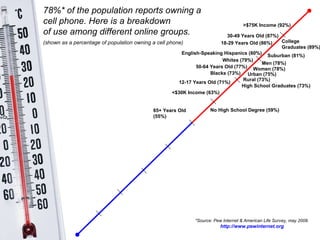
Whites (79%)   Blacks (73%)   English-Speaking Hispanics (80%)   78%* of the population reports owning a cell phone. Here is a breakdown  of use among different online groups. (shown as a percentage of population owning a cell phone) 18-29 Years Old (86%) 30-49 Years Old (87%) 50-64 Years Old (77%) 65+ Years Old (55%) No High School Degree (59%) College Graduates (89%) <$30K Income (63%) >$75K Income (92%) Men (78%) Women (78%) High School Graduates (73%) Urban (75%) Suburban (81%) Rural (73%) *Source: Pew Internet & American Life Survey, may 2008. http://www.pewinternet.org 12-17 Years Old (71%)
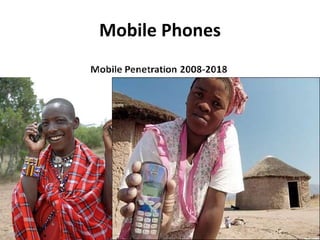
Mobile Phones In 2007, worldwide mobile telephone subscriptions reached 3.3 billion -- equivalent to half the global population 26 years after the first cellular network was launched  100% mobile phone penetration in the US by 2013
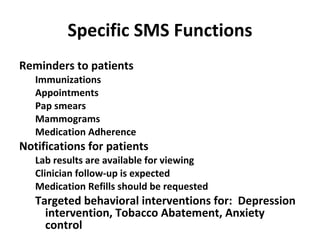
Specific SMS Functions Reminders to patients Immunizations Appointments Pap smears Mammograms Medication Adherence Notifications for patients Lab results are available for viewing Clinician follow-up is expected Medication Refills should be requested Targeted behavioral interventions for:  Depression intervention, Tobacco Abatement, Anxiety control
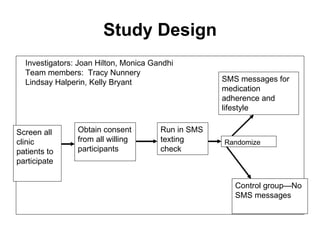
Study Design Investigators: Joan Hilton, Monica Gandhi Team members:  Tracy Nunnery Lindsay Halperin, Kelly Bryant Screen all clinic patients to participate Obtain consent from all willing participants Control group—No SMS messages SMS messages for medication adherence and lifestyle Randomize Run in SMS texting check
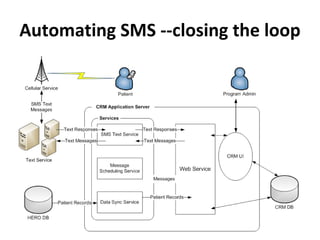
Automating SMS --closing the loop
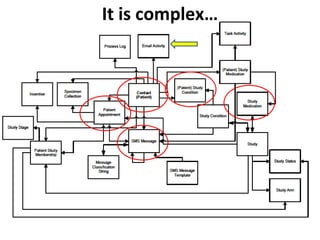
It is complex…
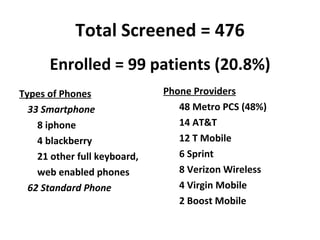
Total Screened = 476 Enrolled = 99 patients (20.8%) Types of Phones 33 Smartphone 8 iphone 4 blackberry 21 other full keyboard, web enabled phones 62 Standard Phone Phone Providers     48 Metro PCS (48%) 14 AT&T  12 T Mobile 6 Sprint  8 Verizon Wireless  4 Virgin Mobile 2 Boost Mobile
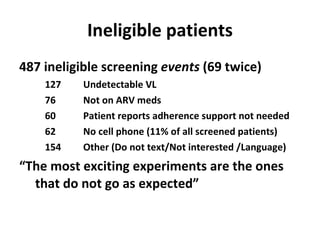
Ineligible patients 487 ineligible screening  events  (69 twice) 127 Undetectable VL  76 Not on ARV meds  60 Patient reports adherence support not needed  62 No cell phone (11% of all screened patients) 154 Other (Do not text/Not interested /Language) “ The most exciting experiments are the ones that do not go as expected”
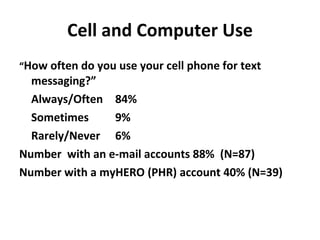
Cell and Computer Use “ How often do you use your cell phone for text messaging?” Always/Often  84% Sometimes  9% Rarely/Never  6% Number  with an e-mail accounts 88%  (N=87) Number with a myHERO (PHR) account 40% (N=39)
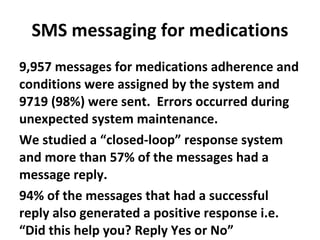
SMS messaging for medications 9,957 messages for medications adherence and conditions were assigned by the system and 9719 (98%) were sent.  Errors occurred during unexpected system maintenance. We studied a “closed-loop” response system and more than 57% of the messages had a message reply.  94% of the messages that had a successful reply also generated a positive response i.e. “Did this help you? Reply Yes or No”
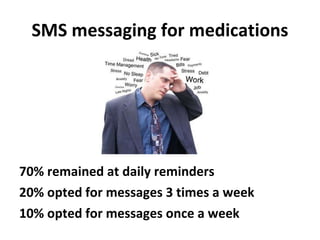
SMS messaging for medications 70% remained at daily reminders 20% opted for messages 3 times a week 10% opted for messages once a week
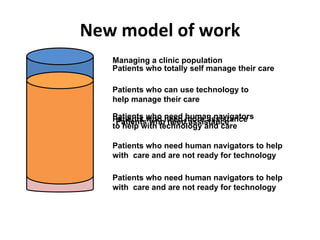
New model of work Managing a clinic population Patients who can use technology to help manage their care Patients who need human navigators to help with technology and care Patients who need human navigators to help with  care and are not ready for technology Patients who totally self manage their care Patients who need more assistance Patients who need assistance Patients who need human navigators to help with  care and are not ready for technology
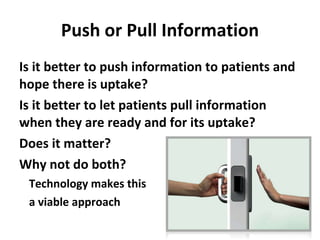
Push or Pull Information Is it better to push information to patients and hope there is uptake? Is it better to let patients pull information when they are ready and for its uptake? Does it matter? Why not do both? Technology makes this a viable approach
Utilizing three important screens to improve health: the computer, cell phone and television
Conceptual approach Systems pushing information to patients and clinicians (Ex:  PHRs and lab results) Patients pushing information to systems and others (Ex: Bluetooth devices, social networks) Systems pulling information from patients (Ex: GPS awareness; run on flu medications) Patients pulling information from systems (Ex: patients able to query databases)
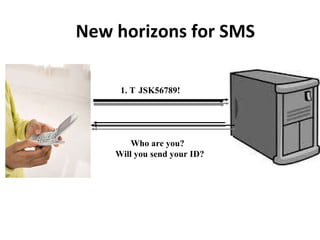
New horizons for SMS Help What would you like us to do? Make or change a visit? Refill meds or list my meds? Check labs? Receive advice now? Get a call back? 3. Check Labs What labs? T-cells HIV Viral load Liver studies Cholesterol studies Diabetes labs 1. T-cells Your last 3 T-cells were: 520 on September 24, 2010 310 on March 15, 2010 421 on November 1, 2009 Who are you?  Will you send your ID? JSK56789!
Telehealth Clinician perspective telehealth is already deployed for diagnostic and routine follow-up in Dermatology, Radiology, Psychiatry, Ophthalmology. Clinician extenders and save patient expenses Encourage connection to the health system Involve a group of caregivers or care providers efficiently---especially remote connections to areas of great expertise
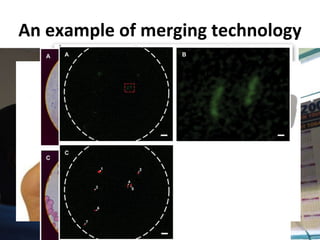
An example of merging technology
Good ideas are not adopted automatically. They must be driven into practice with courageous patience. Admiral Rickover
Conclusions New tools are necessary to improve health care Personal Health Records (PHRs) are intended to improve self management We deployed a PHR integrated into our EMR for patients  receiving care at the HIV/AIDS clinic at SFGH and were surprised by the ready acceptance of  technology its dissemination Text messaging is another important tool to deliver health care mHealth applications have local, national and international implications
Partners for our work Commonwealth Foundation Blue Shield Foundation NIMH, AHRQ, NCRR Microsoft Avanade Boomcomms California Health Care Foundation
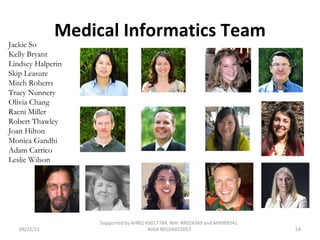
Medical Informatics Team 09/22/11 Supported by AHRQ  HS017784; NIH:  RR024369 and  MH088341  NIDA R01DA032057 Jackie So Kelly Bryant Lindsey Halperin Skip Leasure Mitch Roberts Tracy Nunnery Olivia Chang Raeni Miller Robert Thawley Joan Hilton Monica Gandhi Adam Carrico Leslie Wilson
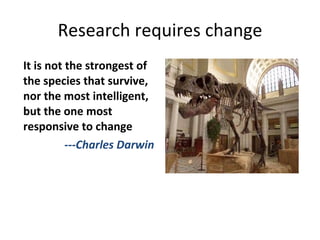
Research requires change It is not the strongest of the species that survive, nor the most intelligent, but the one most responsive to change ---Charles Darwin
Thank you and Questions Jim Kahn 415-699-1118 [email_address] http://profiles.ucsf.edu/ProfileDetails.aspx?Person=4999786
Jerry Garcia “ Somebody has to do something, and it's just incredibly pathetic that it has to be us.”

Medical grand rounds 9.22.2011

  • 1.
    Utilizing three importantscreens to improve health: the computer, cell phone and television James Kahn MD Professor of Medicine, UCSF AHRQ HS017784; NIH grants RR024369 and MH088341 and DA032057
  • 2.
    Overview Provide aframework for mHealth and internet based research Review active research projects Discuss new models that develop from the research projects Conclusions A glimpse into the future
  • 3.
    Conclusions New toolsare necessary to improve health care Personal Health Records (PHRs) are intended to improve self management We deployed a PHR integrated into our EMR for patients receiving care at the HIV/AIDS clinic at SFGH and were surprised by the ready acceptance of the technology and its dissemination Text messaging is another important tool to deliver health care mHealth applications have local, national and international implications
  • 4.
    Three themes forour work Improve health and reduce the digital divide through technology development, adoption and utilization Empower patients through innovative use of technology Provide a platform for research that emphasizes operational excellence and implementation science
  • 5.
    IOM How toImprove Care “ Improvements in care cannot be achieved by further stressing current systems of care. The current systems cannot do the job. Trying harder will not work.” IOM 2001: Crossing the Quality Chasm
  • 6.
    The Case forImprovement Hip Fracture Atrial Fibrillation Community Acquired Pneumonia Urinary Tract Infection Diabetes Colorectal Cancer Congestive Heart Failure Hypertension Coronary Artery Disease 22.8% 24.7% 39.6% 48.7% 45.6% 53.5% 63.9% 64.7% 68.8% McGlynn, et al. NEJM 2003 348:2635-2645 Outpatients receive only 55 % of recommended care
  • 7.
    Do vs. knowTransformative technology Real world Incentives for the process Hypothetical growth with knowledge and resources Pay for results Empower Consumers Do Know
  • 8.
    Sources used tofind information
  • 9.
    The future isalready here, it's just not evenly distributed William Gibson The Economist 2003
  • 10.
    Information Systems FinancialInformation Demographics Notes, Immunizations Labs, Medications Images Consults, Reports Important Documents Financial Information Demographics Diagnosis, Immunizations Labs, Medications Images Consults, Reports Important Documents EMRs populated with data from “reliable” sources PHRs populated with data from patient sources Systems owned Patient owned
  • 11.
    Definition--Personal Health RecordA longitudinal record of individual health The PHR can be accessed and populated, from electronic sources, patients or devices Information in the PHR is owned or at the least shared by the patient The PHR is meant to move along with the patient no matter where they are located or their connection to a specific health plan or organization
  • 12.
    Self management supportvs. shared decision-making: a new dynamic Shared decision-making is the process for involving patients in decision making and planning Self-management support is the broader process of engaging and activating patients to more fully participate in care
  • 13.
    Patient Self-Management “ Patients with chronic conditions self-manage their illness. This fact is inescapable. Each day, patients decide what they are going to eat, whether they will exercise, and to what extent they will consume prescribed medications.” Tom Bodenheimer, et al 2002 JAMA 288(19); 2470
  • 14.
    Why Develop aPHR? Promotes self management by providing information that is up-to-date and understandable Reduce the Digital Divide through more egalitarian access to information Improve the experience of care Improve the health of populations Reduce per capita costs of health care Health literacy is vital to understand the information to create an action plan based on the information Berwick, D. M et al. (2008). Health Aff 2008: 27: 759-769
  • 15.
    HIV is achronic diseases Dangerous chronic illness with available, effective treatment Treatment is difficult and lasts over years and decades Treatment requires sustained behavior change on part of patient Gap between knowledge and outcomes These statements apply to HIV and apply to: Hypertension Diabetes Congestive Heart Failure Asthma / COPD Obesity The data elements change, but the strategy and the tools for improved outcomes is consistent and includes: patient education, behavior change, monitoring, medication adherence and engagement with an extended health community
  • 16.
  • 17.
    Total number ofPHR users Kahn J S et al. JAMIA 2010;17:224-228 ©2010 by BMJ Publishing Group Ltd
  • 18.
    Number of sessions/user / time Kahn J S et al. JAMIA 2010;17:224-228 ©2010 by BMJ Publishing Group Ltd
  • 19.
    Goal of theproject-AHRQ Our central hypothesis is that a secure PHR that combines meaningful information, web-based tools for support and reminders for patients will provide a substantial opportunity to promote self-management and will lead to improved health outcomes To test our hypothesis we are performing a randomized controlled study to evaluate the biologic outcomes between persons randomly assigned to full use PHR compared with persons assigned to deferred access.
  • 20.
    Study Design Investigators:Joan Hilton Urmimala Sarkar Dean Schillinger David Thom Ricardo Munoz Neda Ratanawongsa Screen all clinic patients to participate Obtain consent from all willing participants Control group—deferred myHERO access but with internet training, free email address Experimental group –immediate myHERO access with internet training, free email address Provide access to all participants Randomize 12-months 12-months
  • 21.
  • 22.
  • 23.
  • 24.
  • 25.
    Observations from RecruitmentPatients who are “full” users are very excited about seeing their personal health information. “ This is the coolest thing I have ever seen” “ This is truly amazing” Deferred users are not thrilled with their assignment but there is no differential drop-out rates
  • 26.
    Accessibility Issues FontSize—we made the Font Bigger Radio Button Size—increased the size Mouse Use “ Next Page” vs. “Submit”—now “DONE” User names and passwords Patients now write these down New tool to reset passwords online
  • 27.
    What worked andwhat did not Patients will use the PHR survey system. Patients want accurate data Patients are receiving appropriate care especially related to ART. Good anti-HIV responses are common with available medications
  • 28.
    Technology Skill AcquisitionWe provided 50% with their first email account. We taught 85% of patients how to use the internet. Terms: cursor, field, user name, password, address bar, enter, scroll and link. A series of “How to” Make a capital letter; Use numbers and letters; Locate a cursor; Copy something; Paste something; Scroll down or around on the page; Make the @ sign; Enter something; Go to a website
  • 29.
    Information Sheet Visitthis website to take your surveys: myhero.sfdph.org Your myHERO username: _______________ Your myHERO password: ___________________ Your email website: __________________________ Your email username: ______________________ Your email password: _________________________ Please keep this in a safe place & don’t share your usernames or passwords with anyone. For free computer classes, please go to the main San Francisco public library on Tues’ 5:30 PM-7:30 PM, Wed’s 5:30 PM-7:30 PM, Thurs’ 5:30 PM-7:30 PM, and Saturdays 10:00-1:00 PM with Project Read.
  • 30.
    Bridging technology Not all patients have equal access to the internet but nearly everyone has a cell phone and these devices are becoming more common, less expensive and more powerful with a growing number of applications Help drive patients to the internet when there is new information of value Alerts and reminders Inform patients of new information and disasters Improve management for health and wellness International implications for health care
  • 31.
    All Whites (75%) All Blacks (59%) English-Speaking Hispanics (80%) 73%* of the population reports using the internet or email. Here is a breakdown of use among different online groups. (shown as a percentage of population online) 18-29 Years Old (90%) 30-49 Years Old (85%) 50-64 Years Old (70%) 65+ Years Old (35%) No High School Degree (44%) College Graduates (91%) <$30K Income (53%) >$75K Income (95%) Men (73%) Women (73%) *Source: Pew Internet & American Life Survey, May 2008. http://www.pewinternet.org ** This statistic comes from the Pew Internet Project’s Latinos Online data, collected June-October, 2006. High School Graduates (63%) Urban (74%) Rural (63%) Suburban (77%) Spanish-Dominant Hispanics (32%)** 12-17 Years Old (94%)
  • 32.
    55%* of thepopulation reports using a high-speed connection (e.g., DSL, cable, wireless) when accessing the internet from home. Here is a breakdown of use among different online groups. (shown as a percentage of population using a high-speed connection from home) Whites (56%) Blacks (41%) English-Speaking Hispanics (55%) 18-29 Years Old (69%) 30-49 Years Old (68%) 50-64 Years Old (49%) 65+ Years Old (19%) No High School Degree (29%) College Graduates (78%) <$30K Income (31%) >$75K Income (82%) Men (57%) Women (52%) High School Graduates (39%) Urban (56%) Suburban (59%) Rural (38%) *Source: Pew Internet & American Life Survey, May 2008. http://www.pewinternet.org 12-17 Years Old (66%)
  • 33.
    Whites (79%) Blacks (73%) English-Speaking Hispanics (80%) 78%* of the population reports owning a cell phone. Here is a breakdown of use among different online groups. (shown as a percentage of population owning a cell phone) 18-29 Years Old (86%) 30-49 Years Old (87%) 50-64 Years Old (77%) 65+ Years Old (55%) No High School Degree (59%) College Graduates (89%) <$30K Income (63%) >$75K Income (92%) Men (78%) Women (78%) High School Graduates (73%) Urban (75%) Suburban (81%) Rural (73%) *Source: Pew Internet & American Life Survey, may 2008. http://www.pewinternet.org 12-17 Years Old (71%)
  • 34.
    Mobile Phones In2007, worldwide mobile telephone subscriptions reached 3.3 billion -- equivalent to half the global population 26 years after the first cellular network was launched 100% mobile phone penetration in the US by 2013
  • 35.
    Specific SMS FunctionsReminders to patients Immunizations Appointments Pap smears Mammograms Medication Adherence Notifications for patients Lab results are available for viewing Clinician follow-up is expected Medication Refills should be requested Targeted behavioral interventions for: Depression intervention, Tobacco Abatement, Anxiety control
  • 36.
    Study Design Investigators:Joan Hilton, Monica Gandhi Team members: Tracy Nunnery Lindsay Halperin, Kelly Bryant Screen all clinic patients to participate Obtain consent from all willing participants Control group—No SMS messages SMS messages for medication adherence and lifestyle Randomize Run in SMS texting check
  • 37.
  • 38.
  • 39.
    Total Screened =476 Enrolled = 99 patients (20.8%) Types of Phones 33 Smartphone 8 iphone 4 blackberry 21 other full keyboard, web enabled phones 62 Standard Phone Phone Providers   48 Metro PCS (48%) 14 AT&T 12 T Mobile 6 Sprint 8 Verizon Wireless 4 Virgin Mobile 2 Boost Mobile
  • 40.
    Ineligible patients 487ineligible screening events (69 twice) 127 Undetectable VL 76 Not on ARV meds 60 Patient reports adherence support not needed 62 No cell phone (11% of all screened patients) 154 Other (Do not text/Not interested /Language) “ The most exciting experiments are the ones that do not go as expected”
  • 41.
    Cell and ComputerUse “ How often do you use your cell phone for text messaging?” Always/Often 84% Sometimes 9% Rarely/Never 6% Number with an e-mail accounts 88% (N=87) Number with a myHERO (PHR) account 40% (N=39)
  • 42.
    SMS messaging formedications 9,957 messages for medications adherence and conditions were assigned by the system and 9719 (98%) were sent. Errors occurred during unexpected system maintenance. We studied a “closed-loop” response system and more than 57% of the messages had a message reply. 94% of the messages that had a successful reply also generated a positive response i.e. “Did this help you? Reply Yes or No”
  • 43.
    SMS messaging formedications 70% remained at daily reminders 20% opted for messages 3 times a week 10% opted for messages once a week
  • 44.
    New model ofwork Managing a clinic population Patients who can use technology to help manage their care Patients who need human navigators to help with technology and care Patients who need human navigators to help with care and are not ready for technology Patients who totally self manage their care Patients who need more assistance Patients who need assistance Patients who need human navigators to help with care and are not ready for technology
  • 45.
    Push or PullInformation Is it better to push information to patients and hope there is uptake? Is it better to let patients pull information when they are ready and for its uptake? Does it matter? Why not do both? Technology makes this a viable approach
  • 46.
    Utilizing three importantscreens to improve health: the computer, cell phone and television
  • 47.
    Conceptual approach Systemspushing information to patients and clinicians (Ex: PHRs and lab results) Patients pushing information to systems and others (Ex: Bluetooth devices, social networks) Systems pulling information from patients (Ex: GPS awareness; run on flu medications) Patients pulling information from systems (Ex: patients able to query databases)
  • 48.
    New horizons forSMS Help What would you like us to do? Make or change a visit? Refill meds or list my meds? Check labs? Receive advice now? Get a call back? 3. Check Labs What labs? T-cells HIV Viral load Liver studies Cholesterol studies Diabetes labs 1. T-cells Your last 3 T-cells were: 520 on September 24, 2010 310 on March 15, 2010 421 on November 1, 2009 Who are you? Will you send your ID? JSK56789!
  • 49.
    Telehealth Clinician perspectivetelehealth is already deployed for diagnostic and routine follow-up in Dermatology, Radiology, Psychiatry, Ophthalmology. Clinician extenders and save patient expenses Encourage connection to the health system Involve a group of caregivers or care providers efficiently---especially remote connections to areas of great expertise
  • 50.
    An example ofmerging technology
  • 51.
    Good ideas arenot adopted automatically. They must be driven into practice with courageous patience. Admiral Rickover
  • 52.
    Conclusions New toolsare necessary to improve health care Personal Health Records (PHRs) are intended to improve self management We deployed a PHR integrated into our EMR for patients receiving care at the HIV/AIDS clinic at SFGH and were surprised by the ready acceptance of technology its dissemination Text messaging is another important tool to deliver health care mHealth applications have local, national and international implications
  • 53.
    Partners for ourwork Commonwealth Foundation Blue Shield Foundation NIMH, AHRQ, NCRR Microsoft Avanade Boomcomms California Health Care Foundation
  • 54.
    Medical Informatics Team09/22/11 Supported by AHRQ HS017784; NIH: RR024369 and MH088341 NIDA R01DA032057 Jackie So Kelly Bryant Lindsey Halperin Skip Leasure Mitch Roberts Tracy Nunnery Olivia Chang Raeni Miller Robert Thawley Joan Hilton Monica Gandhi Adam Carrico Leslie Wilson
  • 55.
    Research requires changeIt is not the strongest of the species that survive, nor the most intelligent, but the one most responsive to change ---Charles Darwin
  • 56.
    Thank you andQuestions Jim Kahn 415-699-1118 [email_address] http://profiles.ucsf.edu/ProfileDetails.aspx?Person=4999786
  • 57.
    Jerry Garcia “Somebody has to do something, and it's just incredibly pathetic that it has to be us.”

Editor's Notes

  • #18 Total number of activated personal health record users.
  • #19 Total number of sessions per user and time for each session.