MEDICAL ETHICS
MEDICAL ETHICS
Lecturer :Pro Dr. Mohamed Abdullah
Hussein Hared M.B.B.S, MD.
MEDICAL ETHICS
Faculty of Medicine and Surgery
Salaam University
Medical Ethics
CHAPTER ONE –
PRINCIPAL FEATURES OF
MEDICAL ETHICS
What's SPECIALABOUT
MEDICINE?
• Throughout almost all of recorded history and in
virtually every part of the world, being a physician
has meant something special. People come to
physicians for help with their most pressing needs –
relief from pain and suffering and restoration of
health and well-being. They allow physicians to see,
touch and manipulate every part of their bodies,
even the most intimate. They do this because they
trust their physicians to act in their best interests.
• “Many physicians feel that they are no
longer as respected as they once were.”
• The status of physicians differs from one country to
another and even within countries. In general,
though, it seems to be deteriorating. Many
physicians feel that they are no longer as respected
as they once were. In some countries, control of
healthcare has moved steadily away from physicians
to professional managers and bureaucrats,
• Patients who used to accept physicians’
• orders unquestioningly sometimes ask
physicians to defend their recommendations
if these are different from advice obtained
from other health practitioners or the Internet.
Some procedures that formerly only
physicians were capable of performing are
now done by medical technicians, nurses
or paramedics.
• Despite these changes impinging on
the status of physicians, medicine
continues to be a profession that is
highly valued by the sick people who
need its services. It also continues to
attract large numbers of the most
gifted, hard-working and dedicated
students.
THE WORLD MEDICALASSOCIATION
DECLARATION OF GENEVA
• At the time of being admitted as a member
of the medical profession: I solemnly pledge
myself to consecrate my life to the service
of humanity; I will give to my teachers the
respect and gratitude which is their due; I
will practice my profession with conscience
and dignity;
• The health of my patient will be my first
consideration; I will respect the secrets
which are confided in me, even after the
patient has died; I will maintain by all the
means in my power, the honor and the
noble traditions of the medical profession;
My colleagues will be my sisters and
brothers;
• I will not permit considerations of age, disease
or disability, creed, ethnic origin, gender,
nationality, political affiliation, race, sexual
orientation, or social standing to intervene
between my duty and my patient; I will
maintain the utmost respect for human life
from its beginning even under threat and I will
not use my medical knowledge contrary to the
laws of humanity; I make these promises
solemnly, freely and upon my honor
What's SPECIALABOUT MEDICAL
ETHICS?
• Compassion, competence and
autonomy are not exclusive to
medicine. However, physicians are
expected to exemplify them to a
higher degree than other people,
including members of many other
professions.
Compassion, defined as understanding and
concern for another
• person’s distress, is essential for the practice of
medicine. In order to deal with the patient’s
problems, the physician must identify the
• symptoms that the patient is experiencing and
their underlying causes and must want to help the
patient achieve relief. Patients respond better to
treatment if they perceive that the physician
appreciates their concerns and is treating them
rather than just their illness.
• A very high degree of competence is
both expected and required of
physicians. A lack of competence can
result in death or serious morbidity for
patients. Physicians undergo a long
training period to ensure competence, but
considering the rapid advance of medical
knowledge, it is a continual challenge for
them to maintain their competence.
• Moreover, it is not just their scientific knowledge
and technical skills that they have to maintain but
their ethical knowledge, skills and attitudes as
well, since new ethical issues arise with changes in
medical practice and its social and political
environment.
• Autonomy, or self-determination, is the core
value of medicine that has changed the most over
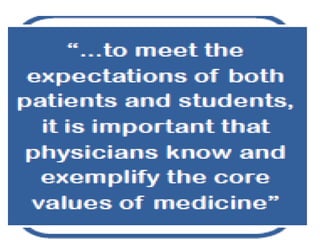
the years. Individual physicians have“...to meet the
expectations of both patients and students, it is
important that physicians know and exemplify
the core values of medicine”
• Manual, both of these ways of exercising physician
autonomy have been moderated in many countries by
governments and other authorities imposing controls
on physicians. Despite these challenges, physicians still
value their clinical and professional autonomy and try
to preserve it as much as possible.
• At the same time, there has been a widespread
acceptance by physicians worldwide of patient
autonomy, which means that patients should be
the ultimate decision-makers in matters that
affect themselves. This Manual will deal with
examples of potential conflicts between
physician autonomy and respect for patient
autonomy.
WHO DECIDES WHAT IS
ETHICAL?
• Ethics is pluralistic. Individuals disagree
among themselves about what is right and
what is wrong, and even when they agree,
it can be for different reasons. In some
societies, this disagreement is regarded as
normal and there is a great deal of
freedom to act however one wants, as
long as it does not violate the rights of
others.
THE WORLD MEDICALASSOCIATION
DECLARATION OF GENEVA
I solemnly pledge myself to consecrate my life to the
service of humanity; I will give to my teachers the
respect and gratitude which is their due; I will
practice my profession with conscience and dignity;
The health of my patient will be my first
consideration; I will respect the secrets which are
confided in me, even after the patient has died; I will
maintain by all the means in my power, the honour
and the noble traditions of the medical profession;
• My colleagues will be my sisters and
brothers; I will not permit considerations of
age, disease or disability, creed, ethnic
origin, gender, nationality, political
affiliation, race, sexual orientation,
or social standing to intervene between
my duty and my patient.
Cont”:
• The answer to the question, “who decides what is
ethical for people in general?” therefore varies from
one society to another and even within the same
society. In liberal societies, individuals have a great
deal of freedom to decide for themselves what is
ethical, although they will likely be influenced by
their families, friends, religion, the media and other
external sources. In more traditional societies,
family and clan elders, religious authorities and
political leaders usually have a greater role than
individuals in determining what is ethical.
• Despite these differences, it seems that most
human beings can agree on some fundamental
ethical principles, namely, the basic human rights
proclaimed in the United Nations Universal
Declaration of Human Rights and other
widely accepted and officially endorsed
documents. The human rights that are especially
important for medical ethics include the right to
life, to freedom from discrimination, torture and
cruel, inhuman or degrading treatment,
• to freedom of opinion and expression, to equal
access to public services in one’s country, and
to medical care. For physicians, the question,
“who decides what is ethical?” has
• until recently had a somewhat different answer
than for people in general. Over the centuries
the medical profession has developed its
• own standards of behavior for its members
• which are expressed in codes of ethics and
related policy documents. At the global level, the
WMA has set forth a broad range of ethical
statements that specify the behavior required of
physicians no matter where they live and practice
• example:
• Physicians have always been subject to the general laws of
the land and have sometimes been punished for acting
contrary to these laws.• Some medical organizations are
strongly influenced by religious teachings, which impose
additional obligations on their members besides those
applicable to all physicians.
• . The ethical directives of medical associations
are general in nature; they cannot deal with every
situation that physicians might face in their
medical practice. In most situations, physicians
have to decide for themselves what is the right
way to act, but in making decisions, it is helpful
to know what other physicians would do in
similar situations. Medical codes of ethics and
policy statements reflect a general consensus
about the way physicians should act and they
should be followed unless there are good reasons
for acting otherwise
DOES MEDICAL ETHICS
CHANGE?
• There can be little doubt that some aspects of
medical ethics have changed over the years. Until
recently physicians had the right and the duty to
decide how patients should be treated and there
was no obligation to obtain the patient’s informed
consent. In contrast, the 1995 version of the
WMA Declaration on the Rights of the Patient
“...in making decisions, it is helpful to know
what other physicians would do in similar
situations.”
• The relationship between physicians, their
patients and broader society has undergone
significant changes in recent times. While a
physician should always act according to
his/ her conscience, and always in the best
interests of the patient, equal effort must be
made to guarantee patient autonomy and
justice.”.
• Many individuals now consider that they are their
own primary health providers and that the role of
physicians is to act as their consultants or
instructors. Although this emphasis on self-care is
far from universal, it does seem to be spreading
and is symptomatic of a more general evolution
in the patient-physician relationship that gives
rise to different ethical obligations for physicians
than previously.
DOES MEDICAL ETHICS DIFFER FROM ONE
COUNTRY TO ANOTHER?
• “...different accountabilities can conflict with
one another”
• Just as medical ethics can and does change over
time, in response to developments in medical
science and technology as well as in societal
values, so does it vary from one country to
another depending on these same factors..
• On euthanasia, for example, there is a significant
difference of opinion among national medical
associations. Some associations condemn it but
others are neutral and at least one, the Royal Dutch
Medical Association, accepts it under certain
conditions. Likewise, regarding access to
healthcare, some national associations support the
equality of all citizens whereas others are willing
to tolerate great inequalities
• In some countries there is considerable interest
in the ethical issues posed by advanced medical
technology whereas in countries that do not
“...different accountabilities can conflict with
one another” have access to such technology,
these ethical issues do not arise.
• Physicians in some countries are confident that
they will not be forced by their government to
do anything unethical while in other countries it
may be difficult for them to meet their ethical
obligations, for example, to maintain the
confidentiality of patients in the face of police
or army requirements to report ‘suspicious’
injuries. Although these differences may seem
significant, the similarities
• Are far greater. Physicians throughout the
world have much in common, and when they
come together in organizations such as the
WMA,they usually achieve agreement on
controversial ethical issues, though this often
requires lengthy debate. The fundamental
values of medical ethics, such as compassion,
competence and autonomy, along with
physicians’ experience and skills in all aspects
of medicine
THE ROLE OF THE
WMA
• As the only international organization that
seeks to represent all
• physicians, regardless of nationality or
specialty, the WMA has
• undertaken the role of establishing general
standards in medical
• ethics that are applicable worldwide. From its
beginning in 1947
• it has worked to prevent any recurrence of
the unethical conduct exhibited by
physicians in Nazi Germany and
elsewhere. The WMA’s first task was to
update the Hippocratic Oath for 20th
century use; the result was the
Declaration of Geneva, adopted at the
WMA’s 2nd General Assembly in 1948. It
has been revised several times since, most
recently in 1994.
• The second task was the development of an
International Code of Medical Ethics, which
was adopted at the 3rd General Assembly in
1949 and revised in 1968 and 1983. This code
is currently undergoing further revision. The
next task was to develop ethical guidelines for
research on human subjects
HOW DOES THE WMA DECIDE
WHAT IS ETHICAL?
• Achieving international agreement on
controversial ethical issues is not an easy task,
even within a relatively cohesive group such as
physicians. The WMA ensures that its ethical
policy statements reflect a consensus by
requiring a 75% vote in favour of any new or
• revised policy at its annual Assembly.
• A precondition for achieving this degree of
agreement is widespread consultation on draft
statements, careful consideration of the
comments received by the WMA Medical Ethics
Committee and sometimes by a specially
appointed workgroup on the issue, redrafting of
the statement and often further consultation. The
process can be lengthy, depending on the
complexity and/or the novelty of the issue
• “Achieving international agreement on
• controversial ethical issues is not an
easy task”
• “Individuals are ultimately responsible
• for making their own ethical decisions
and
• for implementing them.”
HOW DO INDIVIDUALS DECIDE
WHAT IS ETHICAL?
• For individual physicians and medical
students, medical ethics does not consist
simply in following the recommendations
of the WMA or other medical
organizations. These recommendations
are usually general in nature and
individuals need to determine whether or
not they apply to the situation at hand.
• Moreover, many ethical issues arise in
medical practice for which there is no
guidance from medical associations.
Individuals are ultimately responsible
for making their own ethical decisions
and for implementing them
• When dealing with specific issues in medical
• ethics, it is good to keep in mind that
• physicians have faced many of the same
• issues throughout history and that their
• accumulated experience and wisdom can be
• very valuable today. The WMA and other
• medical organizations carry on this tradition
• and provide much helpful ethical guidance to
• physicians.
• However, despite a large measure
• of consensus among physicians on ethical
• issues, individuals can and do disagree on
• how to deal with specific cases. Moreover,
• the views of physicians can be quite different
• from those of patients and of other healthcare
• providers.
CHAPTER TWO –
PHYSICIANS AND PATIENTS
CHAPTER TWO –
PHYSICIANS AND PATIENTS
• OBJECTIVES
• After working through this chapter you should be
able to: explain why all patients are deserving of
respect and equal treatment; identify the essential
elements of informed consent; explain how
medical decisions should be made for patients
• who are incapable of making their own decisions;
• ·
• explain the justification for patient confidentiality
and recognize legitimate exceptions to
confidentiality; recognize the principal ethical
issues that occur at the beginning and end of life;
summarize the arguments for and against the
practice of euthanasia/assisted suicide and the
difference between these actions and palliative care
or forgoing treatment
CASE STUDY #1
• Dr. P, an experienced and skilled surgeon,
• is about to finish night duty at a medium sized
• community hospital. A young woman is
• brought to the hospital by her mother, who
• leaves immediately after telling the intake
• nurse that she has to look after her other
• children..
• The patient is bleeding vaginally and is in a great
deal of pain. Dr. P examines her and decides that
she has had either a miscarriage or a self-induced
abortion. He does a quick dilatation and curettage
and tells the nurse to ask the patient whether she
can afford to stay in the hospital until it is safe
• for her to be discharged. Dr. Q comes in to
• replace Dr. P, who goes home without having
spoken to the patient.
What's SPECIALABOUT THE PHYSICIAN
PATIENT
RELATIONSHIP?
• The physician-patient relationship is the
cornerstone of medical practice and therefore
of medical ethics. As noted above, the
Declaration of Geneva requires of the
physician that “The health of my patient will
be my first consideration,” and the
International Code of Medical Ethics states,
“A physician shall owe his patients complete
loyalty and all the resources of his science
RESPECT AND EQUAL TREATMENT
• The belief that all human beings deserve
respect and equal treatment is relatively
recent. In most societies disrespectful and
unequal treatment of individuals and
groups was accepted as normal and natural.
• Slavery was one such practice that was
not eradicated in the European colonies
and the USA until the 19th century and
still exists in some parts of the world. The
end of institutional discrimination against
non-whites in countries such as South
Africa is much more recent. Women still
experience lack of respect and unequal
treatment in most countries.
• Discrimination on the basis of age, disability or
sexual orientation is widespread. Clearly, there
remains considerable resistance to the claim that
all people should be treated as equals. The
gradual and still ongoing conversion of humanity
to a belief in human equality began in the 17th
and 18th centuries in Europe and North America.
• It was led by two opposed ideologies: a new
interpretation of Christian faith and an anti-
Christian rationalism. The former inspired the
American Revolution and Bill of Rights; the
latter, the French Revolution and related
political developments.
• The trust that is essential to the physician-
patient relationship has generally been
interpreted to mean that physicians should not
desert patients whose care they have
undertaken.
• The WMA’s International Code of
• Medical Ethics implies that the only
• reason for ending a physician-patient
relationship is if the patient requires another
physician with different skills: “A physician
shall owe his patients complete loyalty and all
the resources of his science.
• Whenever an examination or treatment is
beyond the physician’s capacity he
• should summon another physician who has the
necessary ability.”However, there are many
other reasons for a physician wanting to
• terminate a relationship with a patient,
• for example, the physician ’s moving or
stopping practice, the patient’s refusal or
inability to pay for the physician’s services,
dislike of the patient and the physician for each
other, the patient’s refusal to comply with the
physician’s recommendations, etc
• The reasons may be entirely legitimate, or
• they may be unethical. documents and
carefully examine their motives. They should
be prepared to justify their decision, to
themselves, to the patient and to a third party
if appropriate
• If the motive is legitimate, the physician should
help the patient find another suitable physician
or, if this is not possible, should give the patient
adequate notice of withdrawal of services so
that the patient can find alternative medical care.
If the motive is not legitimate, for example,
racial prejudice, the physician should take steps
to deal with this defect.
• Many physicians, especially those in the public sector, often have
no choice of the patients they treat. Some patients are violent and
pose a threat to the physician’s safety. Others can only be
described asobnoxious because of their antisocial attitudes and
behavior. Have such patients forsaken their right to respect and
equal treatment, or are physicians expected to make extra,
• perhaps even heroic, efforts to establish and
maintain therapeutic relationships with them?
With such patients, physicians must balance their
responsibility for their own safety and well-being
and that of their staff with their duty to promote
the well-being of the patients. They should attempt
to find ways to honour both of these obligations. If
this is not possible, they should try to make
alternative arrangements for the care of
• the patients.
• Another challenge to the principle of respect
and equal treatment for all patients arises in the
care of infectious patients. The focus here is
often on HIV/AIDS, not only because it is a
life-threatening disease but also because it is
often associated with social prejudices.
• However, there are many other serious infections
including some that are more easily
transmissible to healthcare workers than HIV/
AIDS. Some physicians hesitate to perform
invasive procedures on patients with such
conditions because of the possibility that they,
the physicians, might become infected.
However, medical codes of ethics make no
exception for infectious patients with regard to
the physician’s duty to treat all patients equally.
The WMA’s Statement
• on the Professional Responsibility of
Physicians in Treating AIDS Patients
puts it this way: AIDS patients are
entitled to competent medical care with
compassion and respect for human
dignity.
• A physician may not ethically refuse to treat a
patient whose condition is within the physician’s
current realm of competence, solely because the
• patient is sero positive.
• Medical ethics do not permit categorical
discrimination against a patient based
solely on his or her seropositivity. A
person who is afflicted with AIDS needs
competent, compassionate treatment. A
physician who is not able to provide the
care and services required by persons
with AIDS should make an appropriate
referral to those physicians or
COMMUNICATION AND
CONSENT
• Informed consent is one of the central concepts of
present-day medical ethics. The right of patients to
make decisions about their healthcare has been
enshrined in legal and ethical statements
• throughout the world.
• Patient states:
• The patient has the right to self-determination, to
make free decisions regarding himself/herself. The
physician will inform the patient of the
consequences of his/her decisions. A mentally
competent adult patient has the right to give or
withhold consent to any diagnostic procedure or
therapy. The patient has the right to the information
necessary to make his/her decisions. The patient
should understand clearly what is the purpose of any
test or treatment, what the results would imply, and
what would be the implications of withholding
consent.
• “Competent patients have the right to
refuse treatment, even when the refusal will
result in disability or death.”
• Futile and no beneficial can be understood as
follows. In some situations a physician can
determine that a treatment is ‘medically’ futile or
no beneficial because it offers no reasonable hope
of recovery or improvement or because the patient
is permanently unable to experience any benefit. In
other cases the utility and benefit of a treatment can
only be determined with reference to the patient’s
subjective judgment about his or her overall well-
being.
• As a general rule a patient should be
• involved in determining futility in his or
• her case. In exceptional circumstances
• such discussions may not be in the
• patient’s best interests. The physician
• has no obligation to offer a patient
• futile or nonbeneficial treatment.
NOTE
• “The physician has no obligation to offer
• a patient futile or no beneficial treatment.”
DECISION-MAKING FOR
INCOMPETENT PATIENTS
• Many patients are not competent to make
decisions for themselves. Examples include
young children, individuals affected by certain
psychiatric or neurological conditions, and those
who are temporarily unconscious or comatose.
These patients require substitute decision makers,
either the physician or another person. Ethical
issues arise in the determination of the
appropriate substitute decision-maker and in the
choice of criteria for decisions on behalf of
incompetent patients.
• When medical paternalism prevailed, the
physician was considered to be the appropriate
decision-maker for incompetent patients.
Physicians might consult with family members
about treatment options, but the final decisions
were theirs to make.
• Physicians have been gradually losing this
authority in many countries as patients are
given the opportunity to name their own
substitute decision makers to act for them
when they become incompetent. In addition,
some states specify the appropriate substitute
decision-makers in descending order (e.g.,
husband or wife, adult children, brothers and
sisters, etc.).
• In such cases physicians make decisions for
patients only when the designated substitute
cannot be found, as often happens in
emergency situations. The WMA Declaration
on the Rights of the Patient states the
physician’s duty in this matter as follows:
• If the patient is unconscious or otherwise
unable to express his/her will, informed
consent must be obtained, whenever possible,
from a legally entitled representative where
legally relevant. If a legally entitled
representative is not available, but a medical
intervention is urgently needed, consent of the
patient may be presumed,
• unless it is obvious and beyond any doubt
on the basis of the patient’s previous firm
expression or conviction that he/she would
refuse consent to the intervention in that
situation. “The physician has no
obligation to offer a patient futile or
Nonbeneficial treatment.” Do patients
have a right to services not
recommended by physicians?
CONFIDENTIALITY
• The physician’s duty to keep patient information
confidential has been a cornerstone of medical
ethics since the time of Hippocrates. The
Hippocratic Oath states: “What I may see or hear
in the course of the treatment or even outside of
the treatment in regard to the life of men,
• which on no account one must spread abroad,
• I will keep to myself holding such things shameful to
be spoken about.” The Oath, and some more recent
versions, allow no exception to this duty of
confidentiality. For example, the WMA’s
International Code of Medical Ethics requires that
“A physician shall preserve absolute confidentiality
on all he knows about his patient even after the
patient has died.” However, other codes reject this
absolutist approach to confidentiality. The possibility
that breaches of confidentiality are sometimes
justified calls for clarification of the very idea of
confidentiality.
• The high value that is placed on confidentiality has three
sources: autonomy, respect for others and trust. Autonomy
relates to confidentiality in that personal information about
an individual belongs to him or her and should not be
made known to others without his or her consent. When an
individual reveals personal information to another, a
physician or nurse for example, or when information
comes to light through a medical test, those in the know
are bound to keep it confidential unless authorized to
divulge it by the individual concerned.
• Confidentiality is also important because human beings
deserve respect. One important way of showing them respect
is by preserving their privacy. In the medical setting, privacy is
often greatly compromised, but this is all the more reason to
prevent further unnecessary intrusions into a person’s private
life. Since individuals differ regarding their desire for privacy,
we cannot assume that everyone wants to be treated as we
would want to be. Care must be taken to determine which
personal information a
• “A physician shall preserve absolute confidentiality on all
• he knows about his patient even after the patient has died.”
• Trust is an essential part of the physician-
patient relationship. In order to receive
medical care, patients have to reveal personal
• information to physicians and others who may
be total strangers to them---information that
they would not want anyone else to
• know. They must have good reason to trust
their caregivers not to divulge this information.
• The basis of this trust is the ethical and
• legal standards of confidentiality that
healthcare professionals are expected to
uphold. Without an understanding that their
disclosures will be kept secret, patients may
withhold personal information. This
• can hinder physicians in their efforts to
provide effective interventions or to attain
certain public health goals.
• The WMA Declaration on the Rights of the
Patient summarises
• the patient’s right to confidentiality as follows:
• • All identifiable information about a patient's
health status, medical condition, diagnosis,
prognosis and treatment
• and all other information of a personal kind,
must be kept confidential, even after death.
Exceptionally,
• the patient’s relatives may have a right of access
to information that would inform them of their
health risks. • Confidential information can only
be disclosed if the patient gives explicit consent
or if expressly provided for in the law.
• Information can be disclosed to other healthcare
providers only on a strictly "need to know" basis
unless the patient has given explicit consent.
• • All identifiable patient data must be protected. The
• protection of the data must be appropriate to the manner
of its storage. Human substances from which identifiable
data can be derived must be likewise protected. As this
WMA Declaration states, there are exceptions to the
requirement to maintain confidentiality. Some of these
are relatively non-problematic; others raise very difficult
ethical issues for physicians.
• Routine breaches of confidentiality occur
frequently in most healthcare institutions. Many
individuals – physicians, nurses, laboratory
technicians, students, etc. – require access to
patient’s health records in order to provide
adequate care to that person and, for students, to
learn how to practice medicine. Where patients
speak a different language than their caregivers,
there is a need for interpreters to facilitate
communication
• . In cases of patients who are not competent to
make their own medical decisions, other
• individuals have to be given information about
them in order to make decisions on their behalf
and to care for them.
• Physicians routinely inform the family
members of a deceased person about the cause
of death. These breaches of confidentiality are
usually justified, but they should be kept to a
minimum and those who gain access to
confidential information should be made aware
of the need not to spread it any further than is
necessary for the patient’s benefit. Where
possible, patients should be informed that such
breaches occur.
• “...physicians should view with a critical
• eye any legal requirement to breach
• confidentiality and assure themselves
• that it is justified before adhering to it.”
BACK TO THE CASE
STUDY
• According to the analysis of the physician patient
• relationship presented in this chapter,
• Dr. P’s conduct was deficient in several
• respects: (1) COMMUNICATION – he
• made no attempt to communicate with the
• patient regarding the cause of her condition,
• treatment options or her ability to afford to
• stay in the hospital while she recovered;
• .
• (2) CONSENT – he did not obtain her
• informed consent to treatment:
• (3) COMPASSION – his dealings with her
• displayed little compassion for her plight.
• His surgical treatment may have been highly
• competent and he may have been tired at the
• end of a long shift, but that does not excuse
• the breaches of ethics
• THANKS

2_Lecture_Medical_ethics_ALL_LECTURES (1).pptx

  • 1.
  • 2.
    MEDICAL ETHICS Lecturer :ProDr. Mohamed Abdullah Hussein Hared M.B.B.S, MD. MEDICAL ETHICS Faculty of Medicine and Surgery Salaam University
  • 3.
  • 4.
    CHAPTER ONE – PRINCIPALFEATURES OF MEDICAL ETHICS
  • 5.
    What's SPECIALABOUT MEDICINE? • Throughoutalmost all of recorded history and in virtually every part of the world, being a physician has meant something special. People come to physicians for help with their most pressing needs – relief from pain and suffering and restoration of health and well-being. They allow physicians to see, touch and manipulate every part of their bodies, even the most intimate. They do this because they trust their physicians to act in their best interests.
  • 6.
    • “Many physiciansfeel that they are no longer as respected as they once were.” • The status of physicians differs from one country to another and even within countries. In general, though, it seems to be deteriorating. Many physicians feel that they are no longer as respected as they once were. In some countries, control of healthcare has moved steadily away from physicians to professional managers and bureaucrats,
  • 7.
    • Patients whoused to accept physicians’ • orders unquestioningly sometimes ask physicians to defend their recommendations if these are different from advice obtained from other health practitioners or the Internet. Some procedures that formerly only physicians were capable of performing are now done by medical technicians, nurses or paramedics.
  • 8.
    • Despite thesechanges impinging on the status of physicians, medicine continues to be a profession that is highly valued by the sick people who need its services. It also continues to attract large numbers of the most gifted, hard-working and dedicated students.
  • 10.
    THE WORLD MEDICALASSOCIATION DECLARATIONOF GENEVA • At the time of being admitted as a member of the medical profession: I solemnly pledge myself to consecrate my life to the service of humanity; I will give to my teachers the respect and gratitude which is their due; I will practice my profession with conscience and dignity;
  • 11.
    • The healthof my patient will be my first consideration; I will respect the secrets which are confided in me, even after the patient has died; I will maintain by all the means in my power, the honor and the noble traditions of the medical profession; My colleagues will be my sisters and brothers;
  • 12.
    • I willnot permit considerations of age, disease or disability, creed, ethnic origin, gender, nationality, political affiliation, race, sexual orientation, or social standing to intervene between my duty and my patient; I will maintain the utmost respect for human life from its beginning even under threat and I will not use my medical knowledge contrary to the laws of humanity; I make these promises solemnly, freely and upon my honor
  • 13.
    What's SPECIALABOUT MEDICAL ETHICS? •Compassion, competence and autonomy are not exclusive to medicine. However, physicians are expected to exemplify them to a higher degree than other people, including members of many other professions.
  • 14.
    Compassion, defined asunderstanding and concern for another • person’s distress, is essential for the practice of medicine. In order to deal with the patient’s problems, the physician must identify the • symptoms that the patient is experiencing and their underlying causes and must want to help the patient achieve relief. Patients respond better to treatment if they perceive that the physician appreciates their concerns and is treating them rather than just their illness.
  • 15.
    • A veryhigh degree of competence is both expected and required of physicians. A lack of competence can result in death or serious morbidity for patients. Physicians undergo a long training period to ensure competence, but considering the rapid advance of medical knowledge, it is a continual challenge for them to maintain their competence.
  • 16.
    • Moreover, itis not just their scientific knowledge and technical skills that they have to maintain but their ethical knowledge, skills and attitudes as well, since new ethical issues arise with changes in medical practice and its social and political environment.
  • 17.
    • Autonomy, orself-determination, is the core value of medicine that has changed the most over the years. Individual physicians have“...to meet the expectations of both patients and students, it is important that physicians know and exemplify the core values of medicine”
  • 18.
    • Manual, bothof these ways of exercising physician autonomy have been moderated in many countries by governments and other authorities imposing controls on physicians. Despite these challenges, physicians still value their clinical and professional autonomy and try to preserve it as much as possible.
  • 19.
    • At thesame time, there has been a widespread acceptance by physicians worldwide of patient autonomy, which means that patients should be the ultimate decision-makers in matters that affect themselves. This Manual will deal with examples of potential conflicts between physician autonomy and respect for patient autonomy.
  • 20.
    WHO DECIDES WHATIS ETHICAL? • Ethics is pluralistic. Individuals disagree among themselves about what is right and what is wrong, and even when they agree, it can be for different reasons. In some societies, this disagreement is regarded as normal and there is a great deal of freedom to act however one wants, as long as it does not violate the rights of others.
  • 21.
    THE WORLD MEDICALASSOCIATION DECLARATIONOF GENEVA I solemnly pledge myself to consecrate my life to the service of humanity; I will give to my teachers the respect and gratitude which is their due; I will practice my profession with conscience and dignity; The health of my patient will be my first consideration; I will respect the secrets which are confided in me, even after the patient has died; I will maintain by all the means in my power, the honour and the noble traditions of the medical profession;
  • 22.
    • My colleagueswill be my sisters and brothers; I will not permit considerations of age, disease or disability, creed, ethnic origin, gender, nationality, political affiliation, race, sexual orientation, or social standing to intervene between my duty and my patient.
  • 23.
    Cont”: • The answerto the question, “who decides what is ethical for people in general?” therefore varies from one society to another and even within the same society. In liberal societies, individuals have a great deal of freedom to decide for themselves what is ethical, although they will likely be influenced by their families, friends, religion, the media and other external sources. In more traditional societies, family and clan elders, religious authorities and political leaders usually have a greater role than individuals in determining what is ethical.
  • 24.
    • Despite thesedifferences, it seems that most human beings can agree on some fundamental ethical principles, namely, the basic human rights proclaimed in the United Nations Universal Declaration of Human Rights and other widely accepted and officially endorsed documents. The human rights that are especially important for medical ethics include the right to life, to freedom from discrimination, torture and cruel, inhuman or degrading treatment,
  • 25.
    • to freedomof opinion and expression, to equal access to public services in one’s country, and to medical care. For physicians, the question, “who decides what is ethical?” has • until recently had a somewhat different answer than for people in general. Over the centuries the medical profession has developed its • own standards of behavior for its members
  • 26.
    • which areexpressed in codes of ethics and related policy documents. At the global level, the WMA has set forth a broad range of ethical statements that specify the behavior required of physicians no matter where they live and practice
  • 27.
    • example: • Physicianshave always been subject to the general laws of the land and have sometimes been punished for acting contrary to these laws.• Some medical organizations are strongly influenced by religious teachings, which impose additional obligations on their members besides those applicable to all physicians.
  • 28.
    • . Theethical directives of medical associations are general in nature; they cannot deal with every situation that physicians might face in their medical practice. In most situations, physicians have to decide for themselves what is the right way to act, but in making decisions, it is helpful to know what other physicians would do in similar situations. Medical codes of ethics and policy statements reflect a general consensus about the way physicians should act and they should be followed unless there are good reasons for acting otherwise
  • 29.
    DOES MEDICAL ETHICS CHANGE? •There can be little doubt that some aspects of medical ethics have changed over the years. Until recently physicians had the right and the duty to decide how patients should be treated and there was no obligation to obtain the patient’s informed consent. In contrast, the 1995 version of the WMA Declaration on the Rights of the Patient “...in making decisions, it is helpful to know what other physicians would do in similar situations.”
  • 30.
    • The relationshipbetween physicians, their patients and broader society has undergone significant changes in recent times. While a physician should always act according to his/ her conscience, and always in the best interests of the patient, equal effort must be made to guarantee patient autonomy and justice.”.
  • 31.
    • Many individualsnow consider that they are their own primary health providers and that the role of physicians is to act as their consultants or instructors. Although this emphasis on self-care is far from universal, it does seem to be spreading and is symptomatic of a more general evolution in the patient-physician relationship that gives rise to different ethical obligations for physicians than previously.
  • 33.
    DOES MEDICAL ETHICSDIFFER FROM ONE COUNTRY TO ANOTHER? • “...different accountabilities can conflict with one another” • Just as medical ethics can and does change over time, in response to developments in medical science and technology as well as in societal values, so does it vary from one country to another depending on these same factors..
  • 34.
    • On euthanasia,for example, there is a significant difference of opinion among national medical associations. Some associations condemn it but others are neutral and at least one, the Royal Dutch Medical Association, accepts it under certain conditions. Likewise, regarding access to healthcare, some national associations support the equality of all citizens whereas others are willing to tolerate great inequalities
  • 35.
    • In somecountries there is considerable interest in the ethical issues posed by advanced medical technology whereas in countries that do not “...different accountabilities can conflict with one another” have access to such technology, these ethical issues do not arise.
  • 36.
    • Physicians insome countries are confident that they will not be forced by their government to do anything unethical while in other countries it may be difficult for them to meet their ethical obligations, for example, to maintain the confidentiality of patients in the face of police or army requirements to report ‘suspicious’ injuries. Although these differences may seem significant, the similarities
  • 37.
    • Are fargreater. Physicians throughout the world have much in common, and when they come together in organizations such as the WMA,they usually achieve agreement on controversial ethical issues, though this often requires lengthy debate. The fundamental values of medical ethics, such as compassion, competence and autonomy, along with physicians’ experience and skills in all aspects of medicine
  • 38.
    THE ROLE OFTHE WMA • As the only international organization that seeks to represent all • physicians, regardless of nationality or specialty, the WMA has • undertaken the role of establishing general standards in medical • ethics that are applicable worldwide. From its beginning in 1947
  • 39.
    • it hasworked to prevent any recurrence of the unethical conduct exhibited by physicians in Nazi Germany and elsewhere. The WMA’s first task was to update the Hippocratic Oath for 20th century use; the result was the Declaration of Geneva, adopted at the WMA’s 2nd General Assembly in 1948. It has been revised several times since, most recently in 1994.
  • 40.
    • The secondtask was the development of an International Code of Medical Ethics, which was adopted at the 3rd General Assembly in 1949 and revised in 1968 and 1983. This code is currently undergoing further revision. The next task was to develop ethical guidelines for research on human subjects
  • 41.
    HOW DOES THEWMA DECIDE WHAT IS ETHICAL? • Achieving international agreement on controversial ethical issues is not an easy task, even within a relatively cohesive group such as physicians. The WMA ensures that its ethical policy statements reflect a consensus by requiring a 75% vote in favour of any new or • revised policy at its annual Assembly.
  • 42.
    • A preconditionfor achieving this degree of agreement is widespread consultation on draft statements, careful consideration of the comments received by the WMA Medical Ethics Committee and sometimes by a specially appointed workgroup on the issue, redrafting of the statement and often further consultation. The process can be lengthy, depending on the complexity and/or the novelty of the issue
  • 43.
    • “Achieving internationalagreement on • controversial ethical issues is not an easy task” • “Individuals are ultimately responsible • for making their own ethical decisions and • for implementing them.”
  • 44.
    HOW DO INDIVIDUALSDECIDE WHAT IS ETHICAL? • For individual physicians and medical students, medical ethics does not consist simply in following the recommendations of the WMA or other medical organizations. These recommendations are usually general in nature and individuals need to determine whether or not they apply to the situation at hand.
  • 45.
    • Moreover, manyethical issues arise in medical practice for which there is no guidance from medical associations. Individuals are ultimately responsible for making their own ethical decisions and for implementing them
  • 46.
    • When dealingwith specific issues in medical • ethics, it is good to keep in mind that • physicians have faced many of the same • issues throughout history and that their • accumulated experience and wisdom can be • very valuable today. The WMA and other • medical organizations carry on this tradition • and provide much helpful ethical guidance to • physicians.
  • 47.
    • However, despitea large measure • of consensus among physicians on ethical • issues, individuals can and do disagree on • how to deal with specific cases. Moreover, • the views of physicians can be quite different • from those of patients and of other healthcare • providers.
  • 49.
  • 50.
    CHAPTER TWO – PHYSICIANSAND PATIENTS • OBJECTIVES • After working through this chapter you should be able to: explain why all patients are deserving of respect and equal treatment; identify the essential elements of informed consent; explain how medical decisions should be made for patients • who are incapable of making their own decisions; • ·
  • 51.
    • explain thejustification for patient confidentiality and recognize legitimate exceptions to confidentiality; recognize the principal ethical issues that occur at the beginning and end of life; summarize the arguments for and against the practice of euthanasia/assisted suicide and the difference between these actions and palliative care or forgoing treatment
  • 52.
    CASE STUDY #1 •Dr. P, an experienced and skilled surgeon, • is about to finish night duty at a medium sized • community hospital. A young woman is • brought to the hospital by her mother, who • leaves immediately after telling the intake • nurse that she has to look after her other • children..
  • 53.
    • The patientis bleeding vaginally and is in a great deal of pain. Dr. P examines her and decides that she has had either a miscarriage or a self-induced abortion. He does a quick dilatation and curettage and tells the nurse to ask the patient whether she can afford to stay in the hospital until it is safe • for her to be discharged. Dr. Q comes in to • replace Dr. P, who goes home without having spoken to the patient.
  • 54.
    What's SPECIALABOUT THEPHYSICIAN PATIENT RELATIONSHIP? • The physician-patient relationship is the cornerstone of medical practice and therefore of medical ethics. As noted above, the Declaration of Geneva requires of the physician that “The health of my patient will be my first consideration,” and the International Code of Medical Ethics states, “A physician shall owe his patients complete loyalty and all the resources of his science
  • 55.
    RESPECT AND EQUALTREATMENT • The belief that all human beings deserve respect and equal treatment is relatively recent. In most societies disrespectful and unequal treatment of individuals and groups was accepted as normal and natural.
  • 56.
    • Slavery wasone such practice that was not eradicated in the European colonies and the USA until the 19th century and still exists in some parts of the world. The end of institutional discrimination against non-whites in countries such as South Africa is much more recent. Women still experience lack of respect and unequal treatment in most countries.
  • 57.
    • Discrimination onthe basis of age, disability or sexual orientation is widespread. Clearly, there remains considerable resistance to the claim that all people should be treated as equals. The gradual and still ongoing conversion of humanity to a belief in human equality began in the 17th and 18th centuries in Europe and North America.
  • 58.
    • It wasled by two opposed ideologies: a new interpretation of Christian faith and an anti- Christian rationalism. The former inspired the American Revolution and Bill of Rights; the latter, the French Revolution and related political developments.
  • 59.
    • The trustthat is essential to the physician- patient relationship has generally been interpreted to mean that physicians should not desert patients whose care they have undertaken.
  • 60.
    • The WMA’sInternational Code of • Medical Ethics implies that the only • reason for ending a physician-patient relationship is if the patient requires another physician with different skills: “A physician shall owe his patients complete loyalty and all the resources of his science.
  • 61.
    • Whenever anexamination or treatment is beyond the physician’s capacity he • should summon another physician who has the necessary ability.”However, there are many other reasons for a physician wanting to • terminate a relationship with a patient,
  • 62.
    • for example,the physician ’s moving or stopping practice, the patient’s refusal or inability to pay for the physician’s services, dislike of the patient and the physician for each other, the patient’s refusal to comply with the physician’s recommendations, etc
  • 63.
    • The reasonsmay be entirely legitimate, or • they may be unethical. documents and carefully examine their motives. They should be prepared to justify their decision, to themselves, to the patient and to a third party if appropriate
  • 64.
    • If themotive is legitimate, the physician should help the patient find another suitable physician or, if this is not possible, should give the patient adequate notice of withdrawal of services so that the patient can find alternative medical care. If the motive is not legitimate, for example, racial prejudice, the physician should take steps to deal with this defect.
  • 65.
    • Many physicians,especially those in the public sector, often have no choice of the patients they treat. Some patients are violent and pose a threat to the physician’s safety. Others can only be described asobnoxious because of their antisocial attitudes and behavior. Have such patients forsaken their right to respect and equal treatment, or are physicians expected to make extra,
  • 66.
    • perhaps evenheroic, efforts to establish and maintain therapeutic relationships with them? With such patients, physicians must balance their responsibility for their own safety and well-being and that of their staff with their duty to promote the well-being of the patients. They should attempt to find ways to honour both of these obligations. If this is not possible, they should try to make alternative arrangements for the care of • the patients.
  • 67.
    • Another challengeto the principle of respect and equal treatment for all patients arises in the care of infectious patients. The focus here is often on HIV/AIDS, not only because it is a life-threatening disease but also because it is often associated with social prejudices.
  • 68.
    • However, thereare many other serious infections including some that are more easily transmissible to healthcare workers than HIV/ AIDS. Some physicians hesitate to perform invasive procedures on patients with such conditions because of the possibility that they, the physicians, might become infected. However, medical codes of ethics make no exception for infectious patients with regard to the physician’s duty to treat all patients equally. The WMA’s Statement
  • 69.
    • on theProfessional Responsibility of Physicians in Treating AIDS Patients puts it this way: AIDS patients are entitled to competent medical care with compassion and respect for human dignity.
  • 70.
    • A physicianmay not ethically refuse to treat a patient whose condition is within the physician’s current realm of competence, solely because the • patient is sero positive.
  • 71.
    • Medical ethicsdo not permit categorical discrimination against a patient based solely on his or her seropositivity. A person who is afflicted with AIDS needs competent, compassionate treatment. A physician who is not able to provide the care and services required by persons with AIDS should make an appropriate referral to those physicians or
  • 72.
    COMMUNICATION AND CONSENT • Informedconsent is one of the central concepts of present-day medical ethics. The right of patients to make decisions about their healthcare has been enshrined in legal and ethical statements • throughout the world.
  • 73.
    • Patient states: •The patient has the right to self-determination, to make free decisions regarding himself/herself. The physician will inform the patient of the consequences of his/her decisions. A mentally competent adult patient has the right to give or withhold consent to any diagnostic procedure or therapy. The patient has the right to the information necessary to make his/her decisions. The patient should understand clearly what is the purpose of any test or treatment, what the results would imply, and what would be the implications of withholding consent.

  • 74.
    • “Competent patientshave the right to refuse treatment, even when the refusal will result in disability or death.”
  • 75.
    • Futile andno beneficial can be understood as follows. In some situations a physician can determine that a treatment is ‘medically’ futile or no beneficial because it offers no reasonable hope of recovery or improvement or because the patient is permanently unable to experience any benefit. In other cases the utility and benefit of a treatment can only be determined with reference to the patient’s subjective judgment about his or her overall well- being.
  • 76.
    • As ageneral rule a patient should be • involved in determining futility in his or • her case. In exceptional circumstances • such discussions may not be in the • patient’s best interests. The physician • has no obligation to offer a patient • futile or nonbeneficial treatment.
  • 77.
    NOTE • “The physicianhas no obligation to offer • a patient futile or no beneficial treatment.”
  • 78.
    DECISION-MAKING FOR INCOMPETENT PATIENTS •Many patients are not competent to make decisions for themselves. Examples include young children, individuals affected by certain psychiatric or neurological conditions, and those who are temporarily unconscious or comatose. These patients require substitute decision makers, either the physician or another person. Ethical issues arise in the determination of the appropriate substitute decision-maker and in the choice of criteria for decisions on behalf of incompetent patients.
  • 79.
    • When medicalpaternalism prevailed, the physician was considered to be the appropriate decision-maker for incompetent patients. Physicians might consult with family members about treatment options, but the final decisions were theirs to make.
  • 80.
    • Physicians havebeen gradually losing this authority in many countries as patients are given the opportunity to name their own substitute decision makers to act for them when they become incompetent. In addition, some states specify the appropriate substitute decision-makers in descending order (e.g., husband or wife, adult children, brothers and sisters, etc.).
  • 81.
    • In suchcases physicians make decisions for patients only when the designated substitute cannot be found, as often happens in emergency situations. The WMA Declaration on the Rights of the Patient states the physician’s duty in this matter as follows:
  • 82.
    • If thepatient is unconscious or otherwise unable to express his/her will, informed consent must be obtained, whenever possible, from a legally entitled representative where legally relevant. If a legally entitled representative is not available, but a medical intervention is urgently needed, consent of the patient may be presumed,
  • 83.
    • unless itis obvious and beyond any doubt on the basis of the patient’s previous firm expression or conviction that he/she would refuse consent to the intervention in that situation. “The physician has no obligation to offer a patient futile or Nonbeneficial treatment.” Do patients have a right to services not recommended by physicians?
  • 85.
    CONFIDENTIALITY • The physician’sduty to keep patient information confidential has been a cornerstone of medical ethics since the time of Hippocrates. The Hippocratic Oath states: “What I may see or hear in the course of the treatment or even outside of the treatment in regard to the life of men, • which on no account one must spread abroad,
  • 86.
    • I willkeep to myself holding such things shameful to be spoken about.” The Oath, and some more recent versions, allow no exception to this duty of confidentiality. For example, the WMA’s International Code of Medical Ethics requires that “A physician shall preserve absolute confidentiality on all he knows about his patient even after the patient has died.” However, other codes reject this absolutist approach to confidentiality. The possibility that breaches of confidentiality are sometimes justified calls for clarification of the very idea of confidentiality.
  • 87.
    • The highvalue that is placed on confidentiality has three sources: autonomy, respect for others and trust. Autonomy relates to confidentiality in that personal information about an individual belongs to him or her and should not be made known to others without his or her consent. When an individual reveals personal information to another, a physician or nurse for example, or when information comes to light through a medical test, those in the know are bound to keep it confidential unless authorized to divulge it by the individual concerned.
  • 88.
    • Confidentiality isalso important because human beings deserve respect. One important way of showing them respect is by preserving their privacy. In the medical setting, privacy is often greatly compromised, but this is all the more reason to prevent further unnecessary intrusions into a person’s private life. Since individuals differ regarding their desire for privacy, we cannot assume that everyone wants to be treated as we would want to be. Care must be taken to determine which personal information a • “A physician shall preserve absolute confidentiality on all • he knows about his patient even after the patient has died.”
  • 89.
    • Trust isan essential part of the physician- patient relationship. In order to receive medical care, patients have to reveal personal • information to physicians and others who may be total strangers to them---information that they would not want anyone else to • know. They must have good reason to trust their caregivers not to divulge this information.
  • 90.
    • The basisof this trust is the ethical and • legal standards of confidentiality that healthcare professionals are expected to uphold. Without an understanding that their disclosures will be kept secret, patients may withhold personal information. This • can hinder physicians in their efforts to provide effective interventions or to attain certain public health goals.
  • 91.
    • The WMADeclaration on the Rights of the Patient summarises • the patient’s right to confidentiality as follows: • • All identifiable information about a patient's health status, medical condition, diagnosis, prognosis and treatment • and all other information of a personal kind, must be kept confidential, even after death. Exceptionally,
  • 92.
    • the patient’srelatives may have a right of access to information that would inform them of their health risks. • Confidential information can only be disclosed if the patient gives explicit consent or if expressly provided for in the law. • Information can be disclosed to other healthcare providers only on a strictly "need to know" basis unless the patient has given explicit consent.
  • 93.
    • • Allidentifiable patient data must be protected. The • protection of the data must be appropriate to the manner of its storage. Human substances from which identifiable data can be derived must be likewise protected. As this WMA Declaration states, there are exceptions to the requirement to maintain confidentiality. Some of these are relatively non-problematic; others raise very difficult ethical issues for physicians.
  • 94.
    • Routine breachesof confidentiality occur frequently in most healthcare institutions. Many individuals – physicians, nurses, laboratory technicians, students, etc. – require access to patient’s health records in order to provide adequate care to that person and, for students, to learn how to practice medicine. Where patients speak a different language than their caregivers, there is a need for interpreters to facilitate communication
  • 95.
    • . Incases of patients who are not competent to make their own medical decisions, other • individuals have to be given information about them in order to make decisions on their behalf and to care for them.
  • 96.
    • Physicians routinelyinform the family members of a deceased person about the cause of death. These breaches of confidentiality are usually justified, but they should be kept to a minimum and those who gain access to confidential information should be made aware of the need not to spread it any further than is necessary for the patient’s benefit. Where possible, patients should be informed that such breaches occur.
  • 97.
    • “...physicians shouldview with a critical • eye any legal requirement to breach • confidentiality and assure themselves • that it is justified before adhering to it.”
  • 98.
    BACK TO THECASE STUDY • According to the analysis of the physician patient • relationship presented in this chapter, • Dr. P’s conduct was deficient in several • respects: (1) COMMUNICATION – he • made no attempt to communicate with the • patient regarding the cause of her condition, • treatment options or her ability to afford to • stay in the hospital while she recovered; • .
  • 99.
    • (2) CONSENT– he did not obtain her • informed consent to treatment: • (3) COMPASSION – his dealings with her • displayed little compassion for her plight. • His surgical treatment may have been highly • competent and he may have been tired at the • end of a long shift, but that does not excuse • the breaches of ethics
  • 100.